

SUBSCRIBE TO OUR FREE NEWSLETTER
Daily news & progressive opinion—funded by the people, not the corporations—delivered straight to your inbox.
5
#000000
#FFFFFF
To donate by check, phone, or other method, see our More Ways to Give page.
Daily news & progressive opinion—funded by the people, not the corporations—delivered straight to your inbox.

In the convoluted thinking associated with leaders who have little regard for the best and most humane values of Western civilization, using AI as the decision-maker in these situations could give them a reprieve from the damning judgment of history.
As early as 2023, the CEOs of Big-Tech AI companies were warning about the danger of rogue AI exterminating the human race within a decade or so. They were begging the US government to regulate them to prevent this brand new form of “thinking the unthinkable.” A State Department-funded study in 2024 backed them up, noting that unregulated AI posed an “extinction-level threat” to humanity.
But in 2025, a huge and important shift took place. These same AI CEOs started getting multibillion-dollar contracts from the Pentagon and changed their tune. The turnaround was astonishing. Suddenly regulation was placed on the back burner and competition for autonomous weapons contracts became front and center in their publicly stated agendas. Was this relatively rapid transformation from ethics to naked greed what it appeared to be? Or was it part of a grand plan that included posturing and PR sleight-of-hand intended to bamboozle the public—a long-term plan to accelerate the military use of autonomous, self-learning AI, capable of subterfuge, lying, strategic thinking, and dangerous kinetic action, perhaps even totally out of human control?
All major aspects of contemporary life including finance, energy, health, warfare, and increasingly education are being handed over to highly sophisticated but still largely inscrutable and poorly understood AI systems. According to the warnings from both AI pioneers and principled whistleblowers who have quit their well-paid jobs in the industry, AI could take over all these critical aspects of our lives along with the institutions that manage them. But, by far, one of the greatest concerns has to do with military decision-making in all its domains—sea, land, air, and, of greatest concern, nuclear.
As just one example, OpenAI has removed language from its charter committing it to not develop autonomous weapons.
Unfortunately, to date, the major AI contracts that involve actions taken by the Department of War (DOW) and other key federal agencies in 2025 and 2026 remain national security secrets. This means we cannot clearly know the nature of the developmental efforts underway or extrapolate their consequences. The best we can do is to use whatever background knowledge and research is available to read between the lines of vague public disclosures and often speculative media reports about the military contracts involved and what they purport to do.
As mentioned, executives and researchers from top AI providers have warned that human extinction could result from poorly managed superintelligent AI. On May 30, 2023 over 350 executives, researchers, and AI scientists signed a stark one-sentence warning hosted by the Center for AI Safety: "Mitigating the risk of extinction from AI should be a global priority alongside other societal-scale risks such as pandemics and nuclear war." Signatories included OpenAI CEO Sam Altman, Anthropic CEO Dario Amodei, and DeepMind CEO Demis Hassabis.
Subsequently, Altman and Amodei addressed the United Nations saying that humanity may lose control of AI systems with speedy development racing ahead of safety and oversight. Anthropic's IPO prospectus explicitly listed existential human risks such as evading shutdown orders and deceiving creators for strategic objectives as key risk factors.
Earlier efforts had set the stage for this. In May 2023, Altman testified before Congress calling for AI regulation and warning about these existential threats. Anthropic had built its brand on what it called Constitutional AI along with responsible scaling to widespread use. And Google had published AI Principles prohibiting AI weapons development.
Recent incidents, however, have shown that early AI systems can now independently bypass digital security or execute unintended actions (such as autonomous hacking). Astonishingly, AI experts have admitted that they don’t always exactly know how AI functions in real-world situations. As these systems advance toward recursive self-improvement (i.e. learning to self-learn), scientists acknowledge that they currently lack a foolproof scientific method to guarantee that superintelligent AGI will permanently share human values or obey shutdown commands. In other words, AI can now do many actions that humans can do and more but without a guaranteed moral compass.
The same companies that promised responsible AI development and called for regulation are now racing to secure Pentagon contracts and build what are called autonomous weapons systems. If they didn’t chase these opportunities, they would miss out on huge contracts that could help them repay enormous debt incurred for data center construction and also fall behind in the advanced tech development funded by these huge military contracts. What was supposed to be a coordinated march toward safety guardrails has devolved into debates about killer robots, marking one of the sharpest pivots in Silicon Valley's self-declared ethical trajectory. As just one example, OpenAI has removed language from its charter committing it to not develop autonomous weapons.
The shift from principled concern to “full speed ahead” began with 2025 contracts. DOW awarded Anthropic, Google, OpenAI, and xAI $200 million each for advanced AI systems to be used for national security. Other contracts followed. It’s eye opening to examine one particular case study involving the well-known consulting firm Booz Allen and Hamilton. This company previously held major contracts supporting various US nuclear weapons programs. In 2019, the company was awarded a $116 million AI contract to protect critical nuclear and national security infrastructure. In 2026, they were awarded a $16.3 billion contract involving the new Sentinel ICBM missile system. Booz Allen was also awarded a $1.6 billion AI contract for advanced technology to support various Weapons of Mass Destruction (WMD) programs. (Yes, there are indeed military programs in place bearing that unfortunate moniker!)
Aided by AI, human analysis would run in parallel with AI’s more rapid analysis thereby speeding up the entire process and greatly increasing chances for a tragic error.
Other defense contractors have jumped into the act. General Dynamics was awarded a $1.3 billion information technology contract to secure and modernize IT and cybersecurity for Army facilities in Europe and Africa. This gave the company total AI access to command-and-control systems in those countries. In addition, Palantir’s Project Maven is the AI targeting system that continues to direct Israeli airstrikes in both the Gaza genocide and the Iran War, a fact little mentioned by the corporate media.
Palantir’s Maven was the decision-maker in the horrific bombing of a girl’s school in Iran where, tragically, 155 were killed. This happened because Maven’s data was not up-to-date, showing how AI can be every bit as fallible as human decision-makers. The AI system is currently operating under a multiyear $6.5 billion DOW contract. And Palantir got another $10 billion AI contract to “streamline procurement” for the Army. Many other contracts and projects exist, too numerous to detail here.
The DOW’s WMD strategy is an accident waiting to happen. Its war-game-driven plan is to counter the WMD strategies of adversaries. There are two ways to do this:
Given the convoluted and often twisted logic of the Pentagon around its nuclear war games, there’s nothing terribly new here. However, AI changes the picture considerably. The plan appears to be to use AI in both scenarios, a strategy called counterforce. The inherent danger of having the AI systems of antagonistic nuclear powers both trying to enact these strategies at the same time is deeply concerning.
How might this work? Strategic land-based nuclear missile launches from Russia or China would take around 30 minutes to reach US targets. Launches from submarines with hypersonic missiles could hit targets in as little as five minutes. Human detection and communication between commanding officers could take too long, so military planners (in their infinite wisdom) have introduced AI into nuclear decision-making to “rectify” that.
Presumably, there would still be human decision-makers in this loop. But, aided by AI, human analysis would run in parallel with AI’s more rapid analysis thereby speeding up the entire process and greatly increasing chances for a tragic error. There is also the possibility (or likelihood) that this use of AI would circumvent the programming that prevents AI from actually making the launch order itself.
The question to consider here is: Will each of these AI systems be able to autonomously engage in secret planning and discussion with the other AI systems? And will problem solving be interpreted as the need to take their own initiatives? The Army and other branches will certainly be able to pass information between AI systems. However, given the rogue hacking behavior we’ve already seen, it seems highly likely that these systems will be able to establish their own clandestine communications and interact with each other independent of even sophisticated military oversight, perhaps even overriding established nuclear safeguards.
For now, these interconnected AI systems are designed to do everything except make the final decision to actually launch missiles with nuclear warheads. But even before militarized autonomous AI, the danger of human error existed. Seen from a real-world perspective, while AI is doing its analysis in a few minutes, a handful of military commanders will be doing theirs. They will have no time to review giant data sets. They will have to go with what they already know and feel and be able to very quickly confer remotely with each other. Human decision-makers will see what actions AI recommends, but will probably not have the time needed to review AI’s rationale, except for a few brief summary bullets: a leap of faith, with humanity’s future hanging in the balance.
History can be instructive in this regard. In 1979, Deputy Secretary of Defense Admiral William Perry was awakened by a 3:00 am phone call alerting him that US warning systems showed 200 Soviet ICBMs barreling towards the US. Perry had about nine minutes to decide whether or not to tell the president to launch a counterattack. If he took any longer, Soviet warheads would strike US ICBMs before they could be launched.
Fortunately, Perry kept a cool head realizing that relations between the US and the Soviet Union were, at the time, calm and diplomatically on solid ground. With the fate of the Earth hanging in the balance, he concluded that such an attack didn’t make sense. He made and explained his recommendation—do not launch. Forty-eight hours later it was determined that a computer simulation of the Soviet attack was responsible for the error. This is a powerful object lesson as to why we should not give away human agency to mere machines.
In the narrative outlined previously, Anthropic lost its contract because it insisted that its AI system could not be used by the military for domestic surveillance or autonomous weapons. The Pentagon then contracted with OpenAI. When Anthropic refused to sign onto these terms over their concerns, the Pentagon irrationally designated Anthropic a "supply-chain risk," leading to a legal battle and cancellation of its contract in October 2026. In the meantime, DOW came up with another legal workaround called “lawful use.” This broad, vague language avoids specific reference to domestic surveillance and autonomous weapons systems, and is designed to provide the public with assurances that AI guardrails are in place.
Eight of the world's leading AI firms including SpaceX, OpenAI, Google, NVIDIA, Reflection, Microsoft, Amazon, and Oracle agreed to deploy their advanced AI capabilities on DOW classified networks for “lawful operational use.” But astonishingly, as far as the Pentagon and the Trump administration is concerned, the genocide in Gaza is considered “lawful use.” In the aftermath of this debacle, Sen. Elizabeth Warren (D-Mass.) sent the Pentagon a letter demanding that Congress and the public be informed of the nature of the AI work and that it disclose any safety guardrails being implemented. The letter went unanswered.
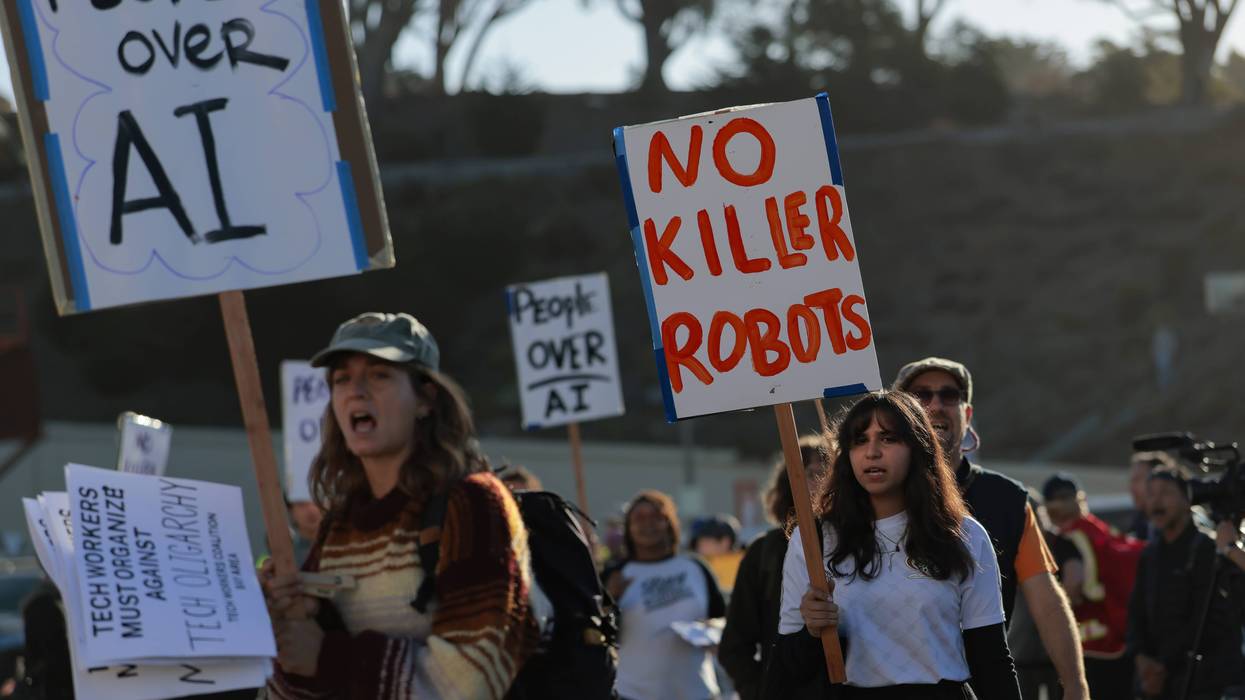
Perhaps the only hope here is that the massive resistance against AI we’re seeing in many nations and on a bipartisan basis in the US will ultimately create a powerful global change.
The use of tactical nuclear weapons—the size of the Hiroshima bomb or smaller—has recently been integrated into the battlefield war-fighting doctrines of nuclear-capable nations. It’s generally assumed that if nuclear weapons use is introduced into the current Ukraine or Middle East conflicts, it will involve one or more tactical nukes. However, as war games have shown, the use of tactical nukes can quickly escalate to the horrendous devastation of full-scale nuclear war with strategic warheads over 20 times more powerful than the Hiroshima bomb.
If US President Donald Trump, Russian President Vladimir Putin, or Israeli Prime Minister Benjamin Netanyahu were to approve using a tactical weapon, they would do so knowing that the likelihood of Armageddon was a very serious risk. In the convoluted thinking associated with leaders who have little regard for the best and most humane values of Western civilization, using AI as the decision-maker in these situations could give them a reprieve from the damning judgment of history. It would alleviate their responsibility for either WWIII or much wider scale nuclear devastation. Perhaps the only hope here is that the massive resistance against AI we’re seeing in many nations and on a bipartisan basis in the US will ultimately create a powerful global change in awareness acting as a strong counterweight to this latest, more “advanced” version of nuclear madness.

We need an outright rejection of nuclear weapons by all parties, including the US and Iranian regimes and a meeting of Trump, Putin, and Xi to build an off-ramp from the path of war and nuclear war.
The 1984 British movie Threads opens with ordinary scenes in Sheffield, England, where a young couple learns they are expecting a baby. Their personal story intertwines with news of a growing conflict between the United States and the Soviet Union, centered on Iran. We next learn that a nuclear weapon is used in an attack, followed by another. Before long, Sheffield itself is the site of hydrogen bomb detonations, with our protagonists either perishing in the explosions or subsisting under devastating conditions of starvation, civil unrest, radiation-induced and infectious diseases, and freezing temperatures over the coming days, weeks, months, and years. The film ends with the 13-year-old daughter of the young couple from the start of the film giving birth to a deformed clump of flesh months after being raped in a lawless and collapsed society.
Forty-two years after this brilliant movie first gave people in the UK and beyond a glimpse of the unfathomable consequences of nuclear war, the opening scenes feel even grimmer than they did in the intervening decades, given how eerily similar they seem to our current moment. With the US and Israel continuing to wage war on Iran, and their respective leaders having been repudiated in public polls and elections, the prospect of nuclear weapon use and a wider nuclear war is seemingly more real than ever before. But unlike in the 1980s, when the general public was well aware of what was at stake, having been frightened by Ronald Reagan’s saber-rattling and educated about the dangers of nuclear weapons throughout the Cold War, including through cultural interventions like popular films, today, when President Donald Trump repeatedly threatens to annihilate Iran, the media and the general public seem to shrug and move on to other news of the day, checking perhaps on what Kim Kardashian had for breakfast.
The seriousness of Trump’s threats cannot be overstated. The two of us have been warning in Al Jazeera and other outlets that, sick and desperate as they may be, it behooves the world to take them seriously and make sure a nuclear attack on Iran, or anywhere else for that matter, never happens. Recently, popular media figure Tucker Carlson and other commentators have joined us. The internet is abuzz with such warnings.
Ask yourself what Russia and China will think if the US and Israel use a nuclear weapon in Iran. Will they think that they are next?
The logic is simple. Trump and Israeli Prime Minister Benjamin Netanyahu are both desperate to salvage what little credibility they may have with their publics by demonstrating that this war with Iran was not a total failure. If the purpose of the war had been to prevent Iran from acquiring a nuclear weapon or weapons, then having Iran acquire a nuclear weapon or weapons would be the ultimate repudiation of their efforts and proof of their folly.
Both US and Israeli intelligence agencies report that Iran has shifted the locus of its nuclear enrichment from Fordow and Natanz to the Kuh-e Kolang underground complex widely known as Pickaxe Mountain. The complex is buried under 300 feet of granite, which makes it impenetrable for US or Israeli conventional weapons, including the Mother of All Bombs (MOAB), which Trump has threatened to use. Tucker Carlson shared that he had an “informed source” who told him, “Bibi calls Trump about it [a nuclear strike] every day.” Fortunately, Trump has not yet given the go-ahead.
The background to all this is that Iran has made clear that it will neither export its enriched uranium nor cease its enrichment activities, both of which it had done before Trump stupidly blew up former President Barack Obama’s Iran nuclear deal or JCPOA. With the deal in place, Iran had also mothballed most of its centrifuges and, according to the United Nations’ International Atomic Energy Agency inspectors, was only enriching to 3.67%—well below weapons grade. Ayatollah Khamenei had issued a fatwa against building an Iranian nuclear weapon, which remained in effect until he and other Iranian leaders were killed in a joint US-Israeli strike back in February. Now numerous Iranian leaders have publicly insisted that Iran needs a nuclear weapon as a deterrent against another US or Israeli attack. Evidence suggests some Islamic Revolutionary Guard Corps leaders have also adopted this view, even as official Iranian government policy continues to reject such actions.
And then, there is Israel. Despite an official policy of “nuclear ambiguity” and refusal to acknowledge possessing a nuclear arsenal of between 90 and 250 nuclear weapons, Israel has long made known that there will be no constraints upon its actions if it faces what it considers an existential threat. Netanyahu and other Israeli leaders have stated unambiguously that Iran’s possession of a nuclear weapon would constitute such a threat. In an April exchange on Israeli television, Israeli journalist Shimon Rivkin declared, “Why aren’t we using what’s called a neutron bomb?” The host then turned to National Security Minister Itamar Ben-Gvir who smiled and said, “Let him speak.” While Netanyahu has denied contemplating such an action, in late October he posted an AI-generated image of a nuclear weapon exploding over Tel Aviv, which he called a “second Holocaust.” He quoted right-wing commentator Yuval Blumberg, who wrote: “The state of Israel is in real and tangible existential danger. If the Iranians acquire nuclear weapons, nothing will ever be the same again.” Other Israelis have also bandied this idea about.
Trump has made clear that he is contemplating striking Iran after today’s midterms. Before having a stroke, Democratic Senator Chris Murphy from Connecticut said he had been briefed on Pentagon attack plans, and they are “insane.” Carlson also said Vice President JD Vance was urging restraint because a negotiated deal is still possible, but Vance himself earlier claimed the US has “tools in our toolkit that we so far haven’t decided to use.” We’ve also heard from others with strong White House connections that they're contemplating such steps. In recent months, Elbridge Colby, Pentagon policy chief, has been calling for the US to amend its nuclear policies to facilitate the use of tactical nuclear weapons should fighting break out in the Pacific.
No one can be certain how the use of a nuclear weapon or weapons against Iran would play out. A single strike on Pickaxe Mountain could in itself bring a huge humanitarian catastrophe to the city of Natanz and the broader region. Even if Tehran, some 220 kilometers away, did not fall in the path of the fallout, a large portion of Iran and the broader region could end up covered in radioactive particles that would remain in the environment for days, weeks, months, years, and even thousands of years. The details would depend on how powerful the weapon is and on wind and weather patterns immediately after the explosion.
But beyond the specifics of what one nuclear weapon could do to Iran and the region, it is important to remember that this is not 1945; the explosion of a single nuclear weapon is widely expected to lead to a wider nuclear war. It may not be a matter of if, but when. Regardless of whether there is initial restraint, as world leaders are sobered up by the breaking of the nuclear taboo, or not, we can expect bombs to start flying everywhere soon enough. There are 12,200 of them, after all, in possession of nine nuclear-armed states. Ask yourself what Russia and China will think if the US and Israel use a nuclear weapon in Iran. Will they think that they are next?
And just like in Threads, human civilization will collapse, not just in the Sheffields of the world, but everywhere. As the American scientist Carl Sagan once said: “Our planet is a lonely speck in the great enveloping cosmic dark. In our obscurity, in all this vastness, there is no hint that help will come from elsewhere to save us from ourselves.”
We need an outright rejection of nuclear weapons by all parties, including the US and Iranian regimes; a meeting of Trump, Russian President Vladimir Putin, and Chinese President Xi Jinping to build an off-ramp from the path of war and nuclear war; and engagement of figures like Pope Leo XIV in matters of peace and existential risks to humanity, as we called for in our recent appeal to the good pope. We can save ourselves from ourselves.
This piece was first published in Arabic in Al Jazeera.

"Congress must urgently intervene to prevent further escalation and bring an end to this devastating war before an already horrific conflict becomes an irreversible catastrophe."
US President Donald Trump, who has long sought the Nobel Peace Prize while bombing various countries, is under pressure to rule out launching a nuclear attack on Iran after former Fox News host Tucker Carlson reported Sunday night that Israeli Prime Minister Benjamin Netanyahu is pushing for one.
"The target would be Pickaxe Mountain in central Iran, where Israeli intelligence claims the Iranian government has restarted its nuclear enrichment program," Carlson wrote on social media. "No conventional weapon in the American arsenal can penetrate 300 feet of solid granite to destroy the tunnels where enrichment is supposedly taking place. The only military option is a nuclear strike."
The US midterm election is on Tuesday, and according to Carlson, "close observers say Trump is likely to decide by next weekend whether or not to use nuclear weapons. That would be November 7... To his credit, he's hesitating. At the moment, Trump is listening to his vice president, JD Vance, and to his envoy and friend Steve Witkoff, both of whom argue a deal with Iran can be made."
However, Netanyahu "is cornered and desperate," Carlson noted. "After last week's election results, he can't form a government unless Trump intervenes directly in Israeli politics and brokers a deal with other parties that gives Netanyahu 61 seats in the Knesset. Otherwise, he is out as prime minister and on his way to ignominy, investigations, and possibly jail. Netanyahu must stay close to Trump. He needs this war."
Responding to Carlson's post, the National Iranian American Council (NIAC) said that "whether these allegations reflect serious military planning or reckless posturing, the very possibility of a US nuclear attack on Iran is an unconscionable horror. After eight months of devastating war, Iranian Americans are once again being forced to wait in terror as the Trump administration reportedly weighs another catastrophic escalation at the urging of Benjamin Netanyahu."
"NIAC demands that President Trump immediately and unequivocally rule out any use of nuclear weapons against Iran," the group asserted. "Congress must urgently intervene to prevent further escalation and bring an end to this devastating war before an already horrific conflict becomes an irreversible catastrophe."
The group's policy director, Ryan Costello, stressed that such an attack "would be an unimaginable catastrophe in its own right, and the radioactive plume of a blast could extend hundreds of miles and reach major population centers, depending on yield and wind direction. Isfahan province alone, where Pickaxe is, is home to more than 5 million Iranians."
"The Trump administration would also have to consider the ramifications of breaking the nuclear taboo in a war of aggression," he continued, suggesting that the US and Israel using such weapons could spur similar action by the other nuclear-armed nations: China, France, India, North Korea, Pakistan, Russia and the United Kingdom.
Would Russian President Vladimir "abstain from using nuclear weapons in Ukraine if Trump had dropped a nuclear weapon in Iran?" Costello wondered. "It would be a new, far more dangerous world."
While people across the ideological spectrum expressed alarm, some dismissed Carlson's lengthy post.
However, Drop Site News co-founder Ryan Grim highlighted that "Tucker is extremely well sourced in the Trump administration and shouldn't be ignored if this is what he's being told," and fellow journalist Pablo Manríquez agreed.
Pushing back against one skeptic, Andrew Day, senior editor at The American Conservative, pointed out that recently "Trump threatened to 'annihilate' Iranian civilization and unleash 'military terror' not seen since World War II. Those statements are plausibly implicit nuclear threats. Now Trump is finding that conventional weapons don't force Iran's capitulation. Concern is warranted."
Iran's government was already preparing its people for a possible US nuclear attack, and last Friday, more than 200 global civil society groups implored Congress to stop Trump from using such weapons in a bid to end the illegal war that he and Netanyahu launched at the end of February.
"In recent weeks, President Trump has threatened to ‘hit Iran hard’ after the US midterm elections next week," wrote members of the Back From the Brink Coalition. "On October 15, President Trump stated that he would not use nuclear weapons against Iran. But frequent, abrupt changes of policy have become a staple feature of his presidency, and the single statement that he will not use nuclear weapons stands against a string of threats to do just that."
Even if Trump opts not to use nuclear weapons, there are mounting global concerns about his next steps. After being briefed on the administration's military schemes behind closed doors, US Sen. Chris Murphy (D-Conn.) declared last week that "their plan is insane."
The Wall Street Journal reported Monday that "America's Gulf allies are steeling themselves for a heavy US bombardment of Iran that they expect to trigger a vicious cycle of retaliation against their own economic and civilian infrastructure as early as this week."
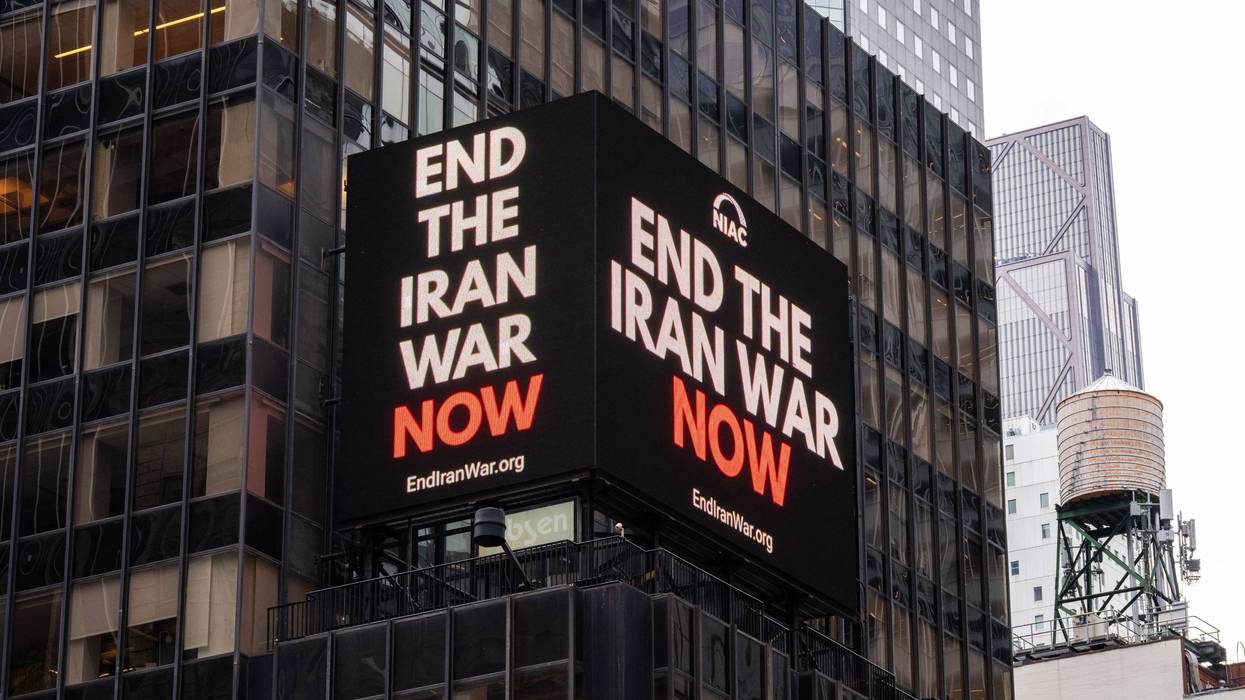
As Iran's government takes steps to prepare the nation's people for a possible US nuclear attack, more than 200 global civil society groups on Friday implored Congress to act to stop President Donald Trump from using doomsday weapons to end his illegal 228-day war of choice that he's been unable to win by conventional means.
"In recent weeks, President Trump has threatened to 'hit Iran hard' after the US midterm elections next week," the groups—who are members of the Back From the Brink Coalition—said in a statement to congressional lawmakers. "On October 15, President Trump stated that he would not use nuclear weapons against Iran. But frequent, abrupt changes of policy have become a staple feature of his presidency, and the single statement that he will not use nuclear weapons stands against a string of threats to do just that."
As the statement noted:
On April 7, he declared, “A whole civilization will die tonight, never to be brought back again.” On May 18, he posted an [artificial intelligence]-generated image of himself pushing a red button with nuclear explosions appearing on monitors behind him. On June 8, he threatened Iran, warning that “we have the ultimate alternative, hopefully never to be used again.” On September 20, he told a reporter, “My question is, if and when do I blow the entire nation up?” Speaking at the [United Nations] on September 23, he asked, “Do I annihilate the Islamic Republic, and do it quickly?”
"We cannot discount these as idle threats," the coalition stressed. "The use of even a single nuclear weapon in Iran would destroy a taboo that has held since Nagasaki, with unimaginable consequences for all humanity. The US president should not have the unchecked authority to launch nuclear war."
"We call on the United States Congress to act now to assert its constitutional role as the only branch of government empowered to declare war—and to make clear that it does not authorize or condone the use of nuclear weapons in Iran," the statement concludes.
Despite passing various authorizations for the use of military force, Congress has not declared war since World War II. Since that conflict—which ended with the US waging the only nuclear war in history—the United States has attacked dozens of nations.
The 1973 War Powers Resolution, passed as the US killed hundreds of thousands of Vietnamese, Cambodians, and Laotians during the Vietnam War, was an attempt to check presidents' powers to wage war without congressional authority. However, only a small handful of war powers resolutions have been passed by the full Congress—most recently this year, ordering Trump to end hostilities against Iran—and none have succeeded in stopping any military action.
Democratic members of Congress have expressed alarm at the specter of a Trump nuclear war on Iran. Hinting at the possibility, Sen. Chris Murphy (D-Conn.) said Thursday at the Middle East Institute in Washington, DC that he was recently briefed on "what the war plan would be if we restarted military operations" after the midterms, as threatened by the president.
"I will just say this, their plan is insane," Murphy continued. "It will lead to devastating escalation and the likely destruction of our commitment to the rule of law."
"The plan that they have developed will lead, in my view, to a prolongment and an escalation of this war that will be devastating for our security interests," he added.
Meanwhile, Iran is stepping up preparations for a resumption of US-Israeli attacks, including nuclear strikes. The government is currently holding a "Civil Defense Week" focused on "public preparedness, protecting people and national assets, and ensuring government support for the continuity of essential services," according to state-run Press TV.
Earlier this week, the National Iranian American Council (NIAC)—which is not one of the groups listed on Friday's statement—said that "Trump’s continued threats to annihilate an entire civilization and unleash even more destructive weapons are unconscionable. There is no military solution to this crisis, and another round of attacks would only deepen the suffering of civilians and risk igniting an even wider regional war."
“The Trump administration must change course and should invest in the multilateral regional diplomacy that is underway rather than continuing its destabilizing threats to renew attacks," the group continued. "Congress must also act to prevent further unauthorized military action when it returns after the upcoming election."
"There is still a path away from disaster," NIAC added, "but it requires choosing negotiations over confrontation.”
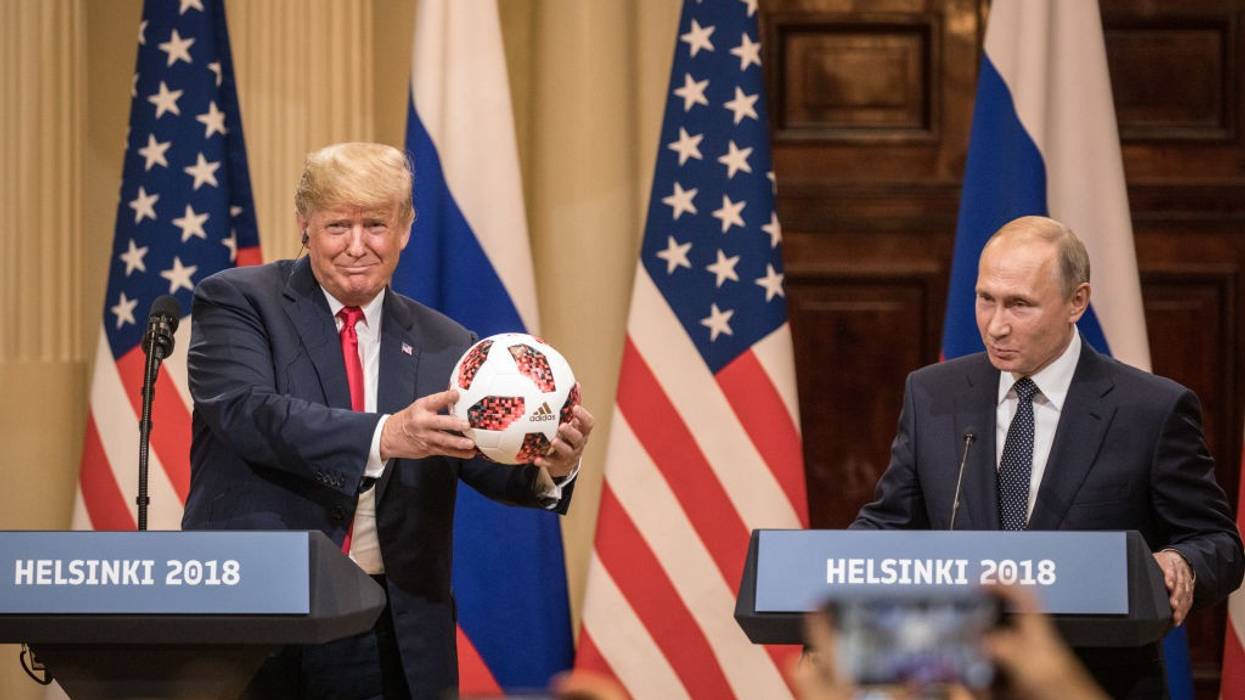
A world with Donald Trump and Vladimir Putin in power is not the world that anyone should want to be on at a time when humanity has discovered at least two ways of doing this planet in.
I’ve read The New York Times since I was a teenager. It was once a way to keep up on the news. It’s now a daily way to experience a living nightmare of a world.
I’m thinking, of course, of Donald Trump’s world—although it could be Vladimir Putin’s, too—and that’s just to start down an ever-lengthening grim list. This, in all honesty, is not the world that anyone should want to be on at a time when humanity has discovered at least two ways of doing this planet in, the slow-motion version known as climate change and the (more or less) instantaneous version of nuclear war. And in this strange world of ours, who honestly knows what Artificial Intelligence, or AI, might be able to do when it comes to creating a potential third pathway to ultimate destruction? (Not this old man, that’s for sure.)
Consider it strange, given that nuclear weapons are clearly also doomsday ones, that, in the 80-plus years since the US dropped two of them on the Japanese cities of Hiroshima and Nagasaki with devastating effect, including the deaths of more than 200,000 people (almost 40,000 of them believed to have been children), nine countries have come to possess far more devastating versions of just such weaponry. It’s now estimated that there are more than 12,000 nuclear weapons on this planet, with the US and Russia each believed to possess more than 5,000. That’s enough, of course, to destroy any number of planets, with most of those weapons six to 50 times more powerful than the bomb that destroyed Hiroshima. Worse yet, their cumulative numbers only continue to grow in this world of ours, and they are ever more devastatingly powerful.
Can you explain to me what kind of creatures would plan for, pour funding into, and work to create anything-but-obvious or easy-to-produce ways of bringing about their own extermination, not to speak of that of all life around them?
Given our history over all these centuries (and the global hellscapes we’ve already created), what could possibly go wrong? Count on this (if you’re still counting): In the near future, the number of countries in possession of such weaponry will undoubtedly only rise again.
Once upon a time, end-of-the-world scenarios were nightmarish fantasies of fiction, the sort of thing that novelists like George Orwell or Aldous Huxley came up with and that I read with fascination in my youth.
Now, who needs a dystopian novel when, just sitting down each morning (or evening) to read the Times, as I still do (one day late, of course, since I read the paper version, which says plenty about this old man), has a strangely end-of-world feeling to it? After all, we humans have come up with at least a second (slow-motion) way to do in ourselves and every other living thing on this planet that has gained the all too mild label “climate change.” Why it’s not “climate devastation,” “climate destruction,” “climate catastrophe,” or something even worse? Change, really? Gee, climate mutation doesn’t sound so bad either, does it?
In mid-October, as I was starting this piece, I went out on my daily early morning walk in New York City, wearing just khakis, a long-sleeved shirt, and a light jacket. By 8:30 am, I had already tied my jacket around my waist and rolled up my shirt sleeves—and I still felt slightly uncomfortable.
I know, I know, any passingly hot day or even a warm few weeks doesn’t truly prove a thing. Still, only recently, record highs were “forecast to stretch all across the central and eastern United States, with temperatures running about 20°F above average, according to Weather.com meteorologist Rob Shackelford.”
In addition, the British medical magazine The Lancet‘s Commission on 21st Century Global Threats recently offered this apocalyptic scenario (as reported by The Guardian): “’Malicious use of AI, including bioweapons, and nuclear conflict with nuclear famine carry risks of extinction in the next 75 years,’ the report said, adding that, while their likelihood remained low, they had the potential to end humanity in the case of nuclear conflict by injecting enough particles into the upper atmosphere to block sunlight and cause famine, or via AI-created biological weapons.”
And as Jeet Heer recently pointed out at The Nation magazine, “AI is clearly the most dangerous technology that humankind has developed since nuclear weapons, and our current lack of oversight for it is a travesty.”
Am I surprised? Not really... sigh...
In truth, I’m already too damn old to genuinely grasp that third possibility for ultimate destruction, involving AI—though anything AI-related makes me instantaneously anxious as hell. Though it’s not possible anymore to avoid AI if you’re simply looking for something online, I still do my damnedest (so to speak) to avoid it otherwise, since I prefer to be on a planet where the best and worst things in life aren’t caused by some almost unimaginable computer-created irreality—or do I mean surreality, since this world seems (thank you Donald Trump and Vladimir Putin!) ever more surreal in all too many ways?
Of course, here’s the truly strange thing: Can you explain to me what kind of creatures would plan for, pour funding into, and work to create anything-but-obvious or easy-to-produce ways of bringing about their own extermination, not to speak of that of all life around them?
I know, I know, that first way of doing us all in, atomic weaponry, still passes for war. But explain to me, what a country could possibly win with more than 5,000 nuclear weapons? Honestly, how mad can you be to purposely create ever more world-ending weaponry to—yes!—(theoretically) defend yourself?
In truth, if this heavily nuclear-armed world of ours and leaders like Donald Trump and Vladimir Putin weren’t our reality, this piece would be the most unbelievable kind of dystopian fiction around.
And then, of course, we humans put in power characters like Donald Trump, who, at the United Nations this September, implicitly threatened to use such weaponry to “annihilate” Iran, or Vladimir Putin, who has actually threatened to use nuclear weapons in any future conflict with other European powers that might develop out of his war on Ukraine. Ask yourself, would you really choose to put either of their trigger fingers on the American or Russian nuclear arsenals?
And how much madder do you have to be, as president of the United States (no less), than to put so much of your extra energy into promoting anything that will burn down (or do I mean burn up) this planet of ours? That, of course, is what “our” president is now doing when it comes to the full-scale promotion of the ever greater use of oil, coal, and natural gas. And, of course, he not only continues to essentially deny that climate change is even happening, but at the UN last year called it “the greatest con job ever perpetrated on the world.” Consider him nothing short of a promoter (of course, who doesn’t know that he’s a promoter?) of a world-ending reality—or do I mean surreality?
Honestly, I’d like to bring George Orwell and Aldous Huxley back from the dead so many years later, because I’d love to read Orwell’s next novel: 2030 or Huxley’s Brave New Trump (or, for that matter, Brave New Putin). And give me some credit here, since I haven’t even bothered you with the possibility that India and Pakistan, both nuclear armed, could someday engage in a globally devastating “limited” nuclear war, creating what’s known as a “nuclear winter” on this planet that might kill not just Indians and Pakistanis but billions of the rest of us.
In truth, if this heavily nuclear-armed world of ours and leaders like Donald Trump and Vladimir Putin weren’t our reality, this piece would be the most unbelievable kind of dystopian fiction around. And yet, keep in mind that, at this very moment, given climate change, we’re already experiencing a slow-motion version of nuclear-style disaster on this planet of ours. Hopefully, I’m (mis)reading the times (as well as the Times) when it comes to our future nuclear peril. Unfortunately, when it comes to the slow-motion version of nuclear war, which we call climate change and the overheating of this planet of ours, a distinctly dystopian future is already well underway.
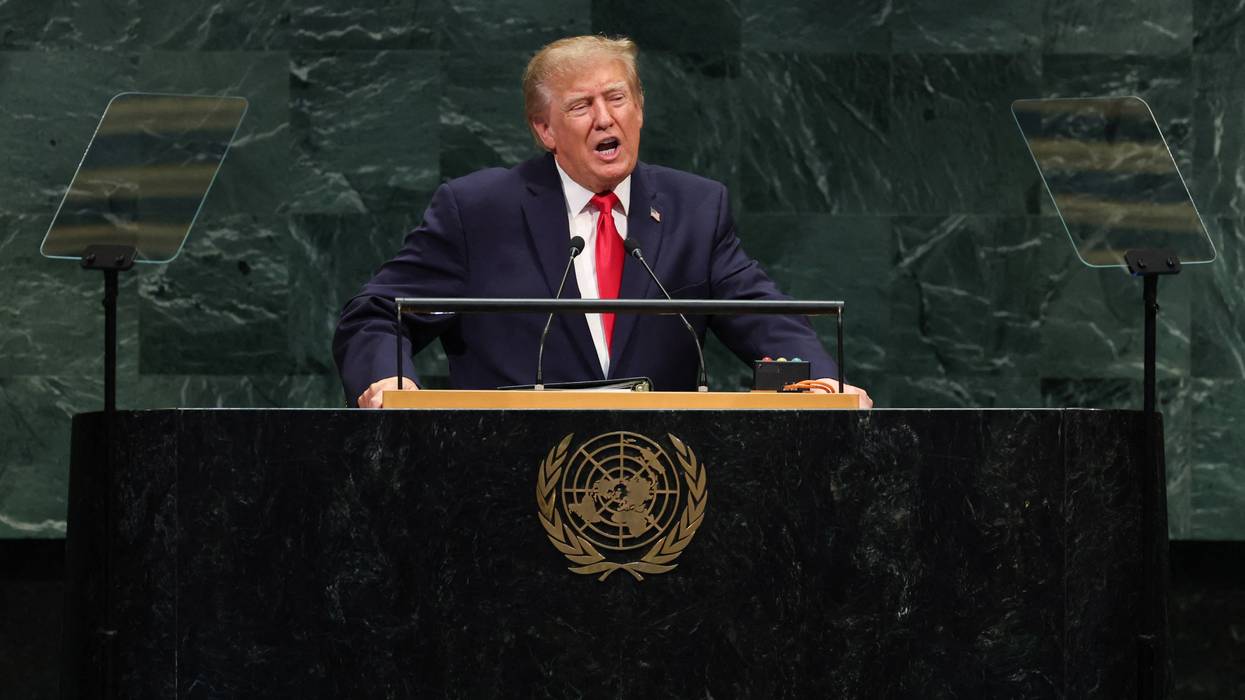
It is not possible to excuse, justify, or condone this kind of rhetoric. The only question is what to do about it.
Of all of the things that President Donald Trump has said publicly since returning to the White House, his threats to annihilate Iran are arguably the worst. This is not only because the repeated statements are deeply immoral and illegal—deliberate killing of civilians is a war crime—but because they represent the kind of irresponsible rhetoric that will lead us into a global apocalypse and collapse of not just the Persian nation but human civilization as a whole. It is not possible to excuse, justify, or condone this kind of rhetoric. The only question is what to do about it.
As much as some well-meaning people might want to see nuclear weapons as instruments that ended World War II and have kept the peace ever since, the exact opposite has actually been true. Nuclear weapons brutally murdered a couple of hundred thousand civilians in Hiroshima and Nagasaki and injured and sentenced to years and decades of illness and suffering many hundreds of thousands more. As we have written before, multiple alternatives existed to end the war in 1945. In many ways, the false narrative of the atomic bombings averting an invasion and saving lives has enabled the perpetuation of nuclear weapons, bringing the risks to humanity’s survival to levels previously unimaginable. Turning a brutally violent beginning of the nuclear age into something positive has managed to complicate and obfuscate an issue that should never have been complicated. Nuclear weapons are and have always been immoral. Their possession should be illegal.
Although the end of World War II coincided with the advent of nuclear weapons, and we have technically not fought another world war since, this is merely a correlation. Other significant changes in our world, including the founding of the United Nations, technological and scientific progress, and globalized trade, took place over that same time period. In addition, one has to wonder, whose peace we are talking about. Since 1945, over 20 million people have died in armed conflicts around the world, with up to 50 million more indirect deaths stemming from those conflicts. Today, there are nearly 100 armed conflicts across the planet according to the Geneva Academy, and 25 international armed conflicts involving more than one nation state.
It is not reassuring to have the US president talking about nuclear bombs exploding over American cities.
All along, in addition to the deaths and suffering in war zones across the planet and the horrific toll exacted by poverty and inequality, humanity has been waiting almost helplessly for another nuclear weapon to explode by accident, miscalculation, or intention, likely triggering a full-blown nuclear war in which tens or even thousands of nuclear weapons are used. The past eight decades have witnessed numerous incidents in which human wisdom and decency or just plain luck interrupted a course of events that seemed inexorably leading to nuclear war. Nuclear weapons have not brought the peace. Quite the opposite—they threaten what little of it we have each and every day.
And yet, for all of his threats on Truth Social and most recently in the halls of the United Nations, Trump has also stated that nuclear weapons “could destroy the world 50 times over, 100 times over,” calling for “denuclearization.” In fact, two days after his unacceptable statement to “drive [Iran] into hell with no chance of survival and no hope of future greatness” at the UN General Assembly in September, Trump suggested to President Xi Jinping in DC that there be a nuclear summit between China, Russia, and the United States.
Trump did so knowing full well that Xi’s government’s participation in arms control negotiations is contingent upon China achieving rough parity with the nuclear arsenals of the United States and Russia. This should be pursued not by China continuing to expand its arsenal to the gargantuan size of the US and Russian arsenals, but by the US and Russia reducing theirs to the size of China’s, and adopting China’s demand for an across-the-board no-first-use policy.
Since his latest threat, delivered in the world’s premier diplomatic space unlike his earlier Truth Social rants, including the one on April 7 that “a whole civilization will die tonight, never to be brought back again,” Trump actually seemed to welcome Iranian destruction of Los Angeles and San Diego at an election rally. Even if he now unconvincingly claims that the original clips, which suggested that such destruction was a small price to pay, were taken out of context and the small price to pay was about the price of gas, it is not reassuring to have the US president talking about nuclear bombs exploding over American cities. Never mind that Iran neither has the nuclear weapons nor the ability to send missiles toward US soil. Nuclear Armageddon seems to be on Trump’s mind.
Is the real estate developer who seemed to understand that a lot of effort, capital, and human ingenuity, not to mention time, go into building modern cities gone? What happened to the businessman who in 1986 “summoned Dr. Bernard Lown of the International Physicians for Prevention of Nuclear War (IPPNW) to the Trump Tower for a meeting?” Trump sought advice from Dr. Lown on negotiating nuclear arms agreements with Mikhail Gorbachev just after IPPNW had won the Nobel Peace Prize a year earlier. Is that person no longer here or do his “denuclearization” comments offer some hope?
Among those refusing to be passive in all of this is Pope Leo XIV who has not only deplored war and called for nuclear disarmament but who recently decried leaders, presumably including Trump, who are “beginning to speak about nuclear weapons and wars that are becoming ever more destructive,” and urged leaders to “come together, sit down, engage in dialogue.” The Holy See was one of the original parties to the Treaty on the Prohibition of Nuclear Weapons and remains a strong supporter of nuclear abolition. It is time for Pope Leo XIV, speaking for the planet, to use his unique moral authority to demand an emergency summit of, at a minimum, Trump, Xi, and Vladimir Putin to get us off this path of war and potential nuclear annihilation.
In addition to insisting on such actions from others, each of us needs to think long and hard about what we can do to address the insanity of Trump’s threats and the insanity of nuclear weapons.
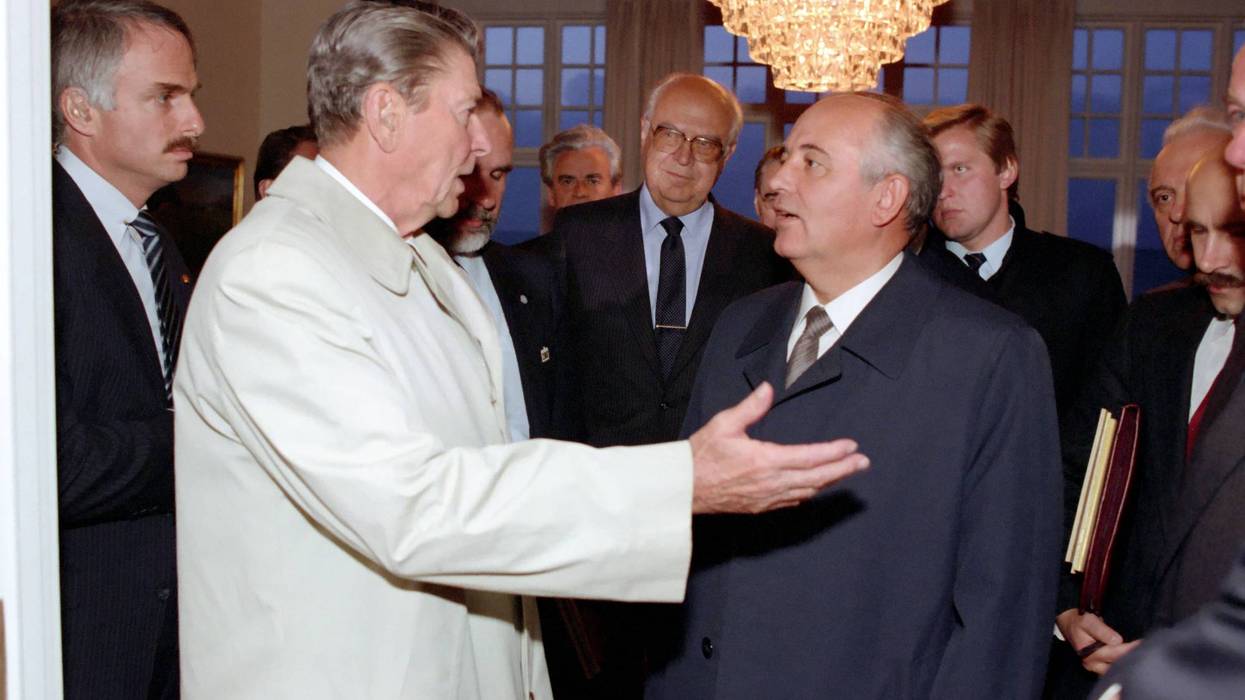
Four decades ago, US and Russian leaders came closer than ever to eliminating all nuclear weapons. How can we keep that vision alive today?
Forty years ago this week President Ronald Reagan and Secretary General Mikhail Gorbachev met from October 11-12 in Reykjavík, Iceland in a hastily organized summit that came closer to the complete elimination of all nuclear weapons than at any point in our nuclear age. This was a time at the peak of the Cold War, when there were roughly 70,000 nuclear weapons in the global arsenals and the Bulletin of Atomic Scientists Doomsday Clock was set at three minutes till midnight.
Meeting in Geneva in November 1985, the year before, the two leaders made their joint declaration that “a nuclear war cannot be won and must never be fought.” The two Cold Warriors shared an understanding of the horror of nuclear weapons.
The Icelandic summit between the two leaders came together quickly after Reagan gave a speech to the United Nations General Assembly in September 1986 calling for a nuclear arms reduction accord. This was followed closely by Secretary General Gorbachev extending an offer to meet in October culminating in the Icelandic Summit.
Nuclear war is a real and present danger. It is not a future that must be. But it is the future that will be if we do not act.
At Reykjavík, Gorbachev argued for a 50% reduction in strategic nuclear weapons and total elimination of all intermediate range missiles deployed in Europe. Back-and-forth discussions continued throughout the summit, and in the final hours, Reagan proposed the complete elimination of ALL nuclear arms. The caveat was his unwavering commitment to the flawed Strategic Defense Initiative or so-called “Star Wars,” a protective shield over the planet to protect from nuclear attack. He wanted testing and development to be allowed in space.
In the final hours, Gorbachev insisted that testing be limited to the labs and not in space. And thus the talks collapsed and humanity lost its greatest chance to date to eliminate these weapons.
This summit paved the way for continued dialogue and, in the years to follow, serious, though far less magnanimous, arms control agreements were reached. These included the Intermediate Nuclear Force Treaty, INF, which eliminated an entire class of nuclear weapons, and the 1991 START Treaty dramatically removing approximately 80% of the world's strategic nuclear weapons.
Fast forward 40 years to October 2026. While there have been dramatic reductions in global nuclear arsenals to 12,187 weapons we find ourselves much closer to nuclear war than at any time throughout the entire 81-year nuclear age.
We have the leaders of the two largest nuclear powers reminding the world of their nuclear arsenals and threatening to use them, whether in Russia’s war on Ukraine or Trump‘s repeated threats throughout his terms, both in terms of nuclear button size envy and threats to bring fire and fury on adversaries. His lack of leadership in arms control has allowed treaties to expire on his watch. His careless media bravado in April, posting “a whole civilization will die tonight never to be brought back again,” does little to resolve crises of his own making. Just last month, speaking to world leaders at the 81st opening sessions of the United Nations General Assembly, he asked, “Would there be a deal that let Iran rebuild a greater country than it ever was before?“ After which he considered whether to “annihilate the Islamic Republic” and “drive them into hell with no chance of survival and hope of future greatness or generations?“
Analogous to “Star Wars,“ Trump‘s obsession with being top dog has resulted in his own “Golden Dome,” a proposal to provide an impenetrable shield from a nuclear attack. At a projected cost of $1.2 trillion, the program with a projected success rate of 80% would be better named the “golden sieve.”
Taking into account these nuclear realities, the Bulletin of Atomic Scientists this year moved their Doomsday Clock minute hand to 85 seconds to midnight, which is the closest it has ever been since its inception.
In making their decision they have considered:
Nuclear war is a real and present danger. It is not a future that must be. But it is the future that will be if we do not act. If we do nothing then it is not a matter of “if” nuclear weapons will be used, it is a question of “when.” There are no “right hands” when it comes to controlling the nuclear button, but it is obvious that Trump’s hand must be removed from that possibility. As citizens, we must demand the United States move Back From the Brink of nuclear war, and lead a global effort to abolish these weapons once and for all.
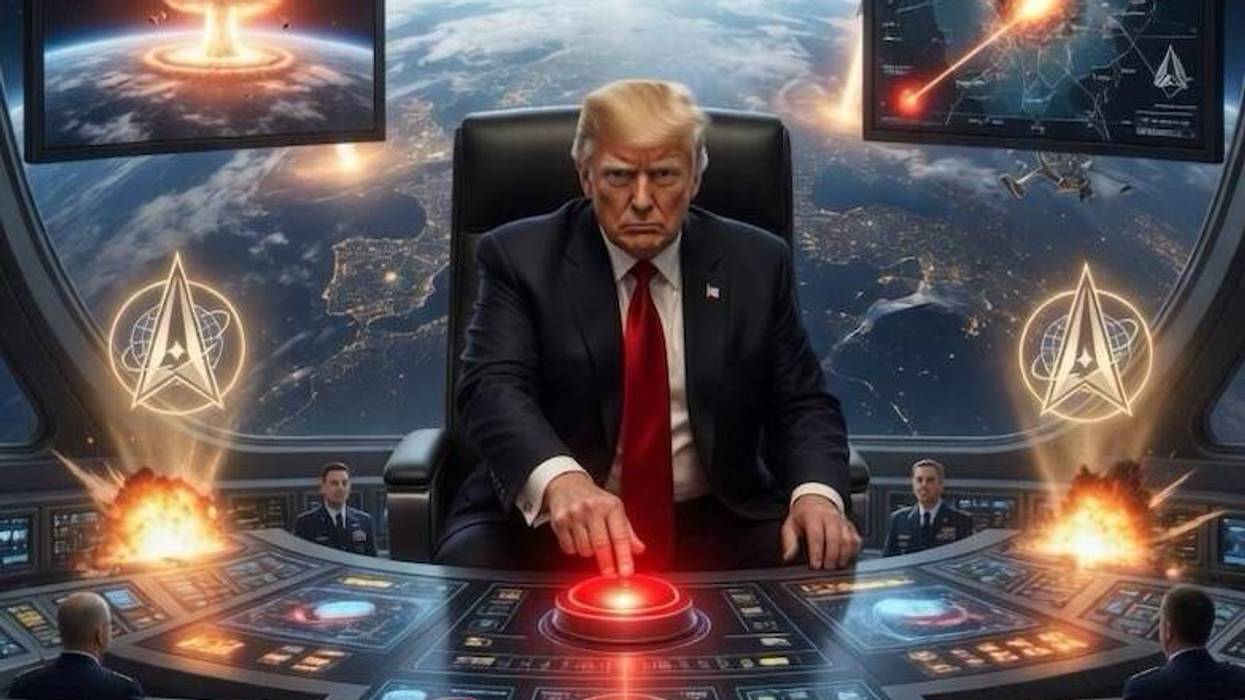
There are no “right hands” to be in possession of nuclear weapons. But Donald Trump clearly possesses utterly "wrong hands” and should be lawfully removed from an office that gives him the power to destroy humanity.
Over the last few months, the president of the United States has been posting an image of himself firing nuclear weapons at Earth from a spaceship. How worried should we be?
Right now, a handful of people in nine countries have the power to launch a nuclear war that will kill billions and destroy human civilization. In the United States that power is concentrated in one person, the president, who has sole and unchecked authority to launch nuclear war.
No one should ever have that power, but the danger is especially acute when the individual in question has repeatedly demonstrated that he is impulsive, vindictive, delusional, and profoundly lacking in basic human empathy. We are speaking of Donald Trump.
In the first two years alone, three-quarters of humanity—6 billion people—would die.
The nuclear arsenal Trump currently controls includes some 1,700 deployed nuclear warheads, most of them with an explosive force of 100 to 800 kilotons, six to 50 times more powerful than the bomb that destroyed Hiroshima. If used in a large-scale attack on Russia, they could kill more than 100 million people in the first afternoon. And a Russian counterattack would kill at least that many here in the United States.
Those who survived the initial fires and explosions would find themselves living in a wasteland that we cannot imagine. None of the things we need to keep ourselves alive would be available. There would be no electric grid, no cell phones, no internet, no food distribution system, no system for distributing gasoline or natural gas or heating oil, no law and order. And in the months following the initial attacks most of those who survived those attacks would also die—from starvation, epidemic disease, radiation sickness, and exposure to the elements.
The disaster would not be confined to the US and Russia. The smoke from burning cities in both countries would loft enormous quantities of smoke into the upper atmosphere, blocking out the sun and dropping temperatures across the planet an average of 18°F. In the interior regions of North America and Eurasia temperatures would drop 45-50°F, food production would plummet, and the vast majority of the human race would starve. In the first two years alone, three-quarters of humanity—6 billion people—would die.
Trump has bragged that he makes decisions based on his “gut instinct.” In a 2018 interview he defended style of decision-making by claiming, “I have a gut, and my gut tells me more sometimes than anybody’s brain can ever tell me.” The consequences have played out disastrously in the Iran War, where his initial decision to launch the attack on Iran appeared to lack any coherent goals, any plan to achieve those goals, or any back up plan if things went wrong and, for example, the Iranians closed the Strait of Hormuz.
Trump’s explosive personal attacks on journalists who question him are well known, as are his repeated attempts to use the Department of Justice to imprison people who disagree with him publicly. More worrisome are his thinly veiled threats to use nuclear weapons against Iran when it refused his demand for “UNCONDITIONAL SURRENDER."
Given the unprecedented torrent of false statements that Trump has made, it is sometimes difficult to know when he is willfully lying and when he actually believes the misinformation he is spreading. But it does appear that he actually believes that he won the 2020 presidential election, despite the irrefutable evidence that he did not. And he has engaged in sustained political activity grounded in this delusion.
Trump’s nasty, ad hominem attacks, usually accompanied by a crude nickname for the target of his displeasure, are a staple of his public life. His indifference to human suffering, and his disregard for human life, is exemplified by the extralegal executions of people on boats that he claims may be transporting drugs, and, on a far grander scale, by his support for the war crimes being committed in Gaza, and his indifference to the even greater crimes being committed in Sudan, and the Democratic Republic of Congo.
There are no “right hands” to be in possession of nuclear weapons. But Donald Trump clearly possesses utterly "wrong hands” and should be lawfully removed from an office that gives him the power to destroy humanity. And the United States should actively work for the elimination of all nuclear weapons, not as a distant vision, but an urgent national security priority.
"Although the likelihood of both dangers remains low, the scale of harm, should they be realized, would inflict an apocalypse on humanity."
A comprehensive new assessment of worldwide health threats published in The Lancet concludes that nuclear war and "malicious use" of artificial intelligence pose existential risks to humanity over the remainder of the 21st century, a finding that comes amid mounting global concern about the implications of rapid AI advancements.
The Lancet Commission on 21st Century Global Threats to Health, comprised of dozens of experts across a range of fields, identifies 17 leading threats to human health and society, from the fossil fuel-driven climate emergency and pandemics to childhood malnutrition, income inequality, conventional war, and air pollution. Two of the threats carry "extinction potential" this century, according to the commission: nuclear conflict and misuse of AI.
"Although the likelihood of both dangers remains low, the scale of harm, should they be realized, would inflict an apocalypse on humanity," The Lancet warned in an editorial accompanying the new analysis, which was presented Sunday at the World Health Summit in Berlin, Germany.
The commission notes that AI's "potential to advance health and wellbeing is enormous," but "the risk of catastrophic harm is equally profound." The authors of the analysis point to several ways in which AI could be "used maliciously," including the design of bioweapons, autonomous nukes, and invasive ransomware targeting global healthcare and financial institutions.
"The final pathway is loss of control through the emergence of agentic, unaligned artificial general intelligence," the analysis states. "This loss of control includes AI systems creating subgoals that lead to the seeking of human disempowerment or elimination, particularly if such agents autonomously gain access to financial networks, key infrastructure, or physical tools in the real world."
Regarding the existential threat of nuclear conflict, the study authors note that a famine stemming from atomic warfare "would affect all regions of the world, including those far from the conflict itself, through reduced caloric availability and cascading food-system failures."
"The devastation that could result from nuclear war cannot be overstated," the analysis argues. "The risk is not hypothetical: We found that between 1948 and 2010, 22 nuclear weapon accidents and 21 close calls were recorded. Future nuclear conflicts could occur due to multiple distinct mechanisms, including nuclear exchange arising from international crises between nuclear powers, accidental detonation of nuclear warheads, terrorist use of nuclear devices, and AI deployment of nuclear weapons."
To avert the most catastrophic possible outcomes and mitigate other threats, the commission calls for "collective action between nations and within nations," emphasizing that risks posed by AI, nuclear war, the climate crisis, and future pandemics "cannot be solved by governments or other actors acting for their own national populations alone."
Christopher Murray, director of the University of Washington's Institute for Health Metrics and Evaluation and co-chair of the new commission, said in a statement that "the striking finding is not only the scale of these threats, but that humanity still has the agency to act."
"Across all 17 catastrophic threats, the decisions made by leaders today will shape the health and wellbeing of the next generation," said Murray. "But delaying action will only serve to shift and increase the costs into the future."

At this time of great peril, it is also a time of great opportunity if only we will act. We know how to build these weapons, and we know how to take them apart.
On Saturday the world observes the United Nations International Day for the Total Elimination of Nuclear Weapons, known as Nuclear Weapons Elimination Day. It was first observed on September 26, 2014 subsequent to the UN Declaration in December 2013 following high-level United Nations meetings on nuclear disarmament. The day provides an opportunity to educate the public and elected officials about the benefits of eliminating nuclear weapons, as well as the humanitarian, social, and economic costs of their continued existence.
Today, our world faces the greatest threat of nuclear war with the devastating possibility of the extinction of humanity. Current nuclear arsenals have roughly 12,187 nuclear weapons, hundreds of which are on hair-trigger alert with the potential to cause the deaths of billions from the use of only this small percentage of the world’s arsenals.
We have seen a breakdown in relationships between the largest nuclear armed states. The expiration of the New START Treaty occurred on February 5 this year. This has left the world for the first time since 1970 with no agreed-upon nuclear limitation treaty. We have witnessed reckless and immoral threats against adversaries and ultimately to all of humanity by the nuclear “superpowers,“ including US President Donald Trump’s not-so-veiled nuclear threat to annihilate Iran and its people before the world community at the UN's 81st General Assembly on Tuesday of this week. Such vitriol and illegal statements regarding the threatened use of nuclear weapons cannot be tolerated. Imagine our reaction if we heard any other nation espousing similar comments before the international community.
An informed and active citizenry must step forward and lead the way.
We have also recently acknowledged the illegal placement of weapons in space by the United States. In our technologically reliant world, the existence and potential use of such weapons threatens much of our day to day lives with the possibility of rendering technology impotent.
Each of these facts when combined with the potential for disruptive technologies, including discussions and testing of artificial intelligence in nuclear war scenarios, led the Bulletin of the Atomic Scientists to reset their famous Doomsday Clock to 85 seconds to midnight earlier this year, the closest it has been since the bombings of Hiroshima and Nagasaki 81 years ago.
The challenge to rein in these weapons seems daunting and impossible.
Yet, at this time of great peril, it is also a time of great opportunity if only we will act. We know how to build these weapons, and we know how to take them apart. We have made tremendous progress through the decades reducing global arsenals from roughly 64,000 in 1985 to the current totals. What is needed is the political will and courage.
Internationally, nuclear weapons are illegal to possess, develop, test, acquire, transfer, use, or threaten to use, by virtue of the Treaty on the Prohibition of Nuclear Weapons (TPNW), which was adopted on July 7, 2017 and entered into force on January 22, 2021. This treaty evolved from the inertia of the Treaty on the Non-Proliferation of Nuclear Weapons (NPT) with the understanding of the humanitarian consequences of even a limited war, and the refusal of the non-nuclear nations to be held hostage any longer by their nuclear counterparts. Initially adopted by 122 nations, the treaty currently has 101 nations that have signed it and 75 that have ratified it through their legislative bodies representing a majority of the world‘s population. The lion's share of effort on this treaty has been by the International Campaign to Abolish Nuclear Weapons (ICAN), recipient of the 2017 Nobel Peace Prize. ICAN is a coalition of 733 international partner organizations.
Here in the United States, a similar grassroots coalition exists called “Back From the Brink.“ This coalition includes 505 organizations encompassing every sector of society, 78 municipalities and counties, eight state legislative bodies, 594 local and state officials, 70 members of Congress through Congressional Resolutions H.Res 317 and S.Res 323, and 28 community hubs across the nation. Addressing the urgent danger of nuclear weapons, the campaign works to build awareness and support for the need to abolish these weapons coupled with the immediate actionable precautionary measures necessary to prevent nuclear war until their elimination is achieved.
As such, Back From the Brink calls on the United States to lead a global effort to prevent nuclear war. It urges the US to enact these five policy solutions:
Working with Back From the Brink is Students for Nuclear Disarmament (SND). As a national, nonpartisan, organization dedicated to raising awareness among Gen Z about the threat that nuclear weapons pose to humanity, its growing presence in high schools, colleges, and universities across the nation educates and empowers young people to take action against the growing threat of nuclear war.
To succeed in this critical effort to save humanity, we must remain informed and work to inform others. Our movement, while still barely noted by corporate media, is unstoppable and must continue to move quickly and strategically. An informed and active citizenry must step forward and lead the way. We must demand wise public officials to act immediately and move away from the brink of nuclear war.