

SUBSCRIBE TO OUR FREE NEWSLETTER
Daily news & progressive opinion—funded by the people, not the corporations—delivered straight to your inbox.
5
#000000
#FFFFFF
To donate by check, phone, or other method, see our More Ways to Give page.

Daily news & progressive opinion—funded by the people, not the corporations—delivered straight to your inbox.
"This is major loss for public health and a huge win for the tobacco industry—whose profits will be boosted at the expense of Kiwi lives," said one public health expert.
The new right-wing government of New Zealand, sworn in on Sunday, surveyed the policies left in place by the Labour Party and announced the reversal of one historic measure that was passed with the goal of preventing thousands of smoking-related deaths every year.
Prime Minister Christopher Luxon, head of the National Party and a former airline executive, announced that the government would scrap the generational smoking ban passed under progressive former Prime Minister Jacinda Ardern in 2021—a law that was praised by public health experts and inspired similar legislation in the United Kingdom.
The law has barred anyone born after 2009 from ever buying cigarettes, with the goal of stopping young people from becoming smokers. It also drastically reduced the legal amount of nicotine in tobacco products and cut the number of stores that are allowed to sell cigarettes from 6,000 nationwide to just 600.
Data modeling showed that the Smokefree Act would save $1.3 billion in health costs over two decades and would reduce mortality rates by 22% for women in New Zealand and by 9% for men.
Currently, about 5,000 people in New Zealand die each year from smoking-related causes.
The possibility of reducing those deaths didn't sway Luxon and his new administration to keep the law in place, with the new prime minister explaining that "coming back to those extra sources of revenue and other savings areas that will help us to fund the tax reduction" that the National Party aims to pass.
Boyd Swinburn, professor of population nutrition and global health at the University of Auckland, said the government is "effectively wanting smokers to continue smoking and more children to start so they can collect more excise tax."
Ben Uffindell, editor of the publication The Civilian, noted that Luxon's goal of increasing revenues and funding tax cuts "doesn't take into account increased cost to the health system."
Public health experts pointed out that the rollback of the law could particularly cost thousands of lives in the Indigenous Maori community.
Health Coalition Aotearoa (HCA), which uses the Maori-language name for New Zealand, said the government's move was "astounding," especially considering that new Minister of Health Dr. Shane Reti had previously stated support for anti-smoking measures.
"This is major loss for public health," said Swinburn, co-chair of the HCA, "and a huge win for the tobacco industry—whose profits will be boosted at the expense of Kiwi lives."
When New Zealand's Prime Minister Jacinda Ardern announced the country's transition away from its coronavirus elimination strategy, also known as "zero-Covid," US and British media outlets framed the decision as a recognition of the inevitable failure of an irrational goal.
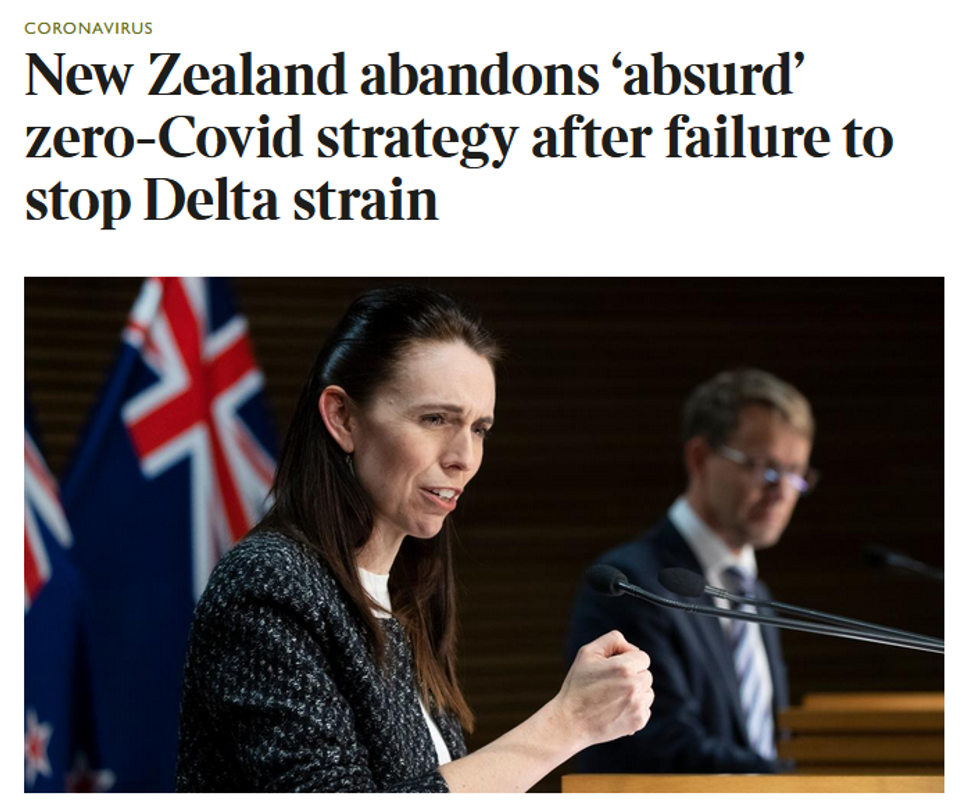
The London Times (10/4/21) made its analysis clear in the headline, "New Zealand Abandons 'Absurd' Zero-Covid Strategy After Failure to Stop Delta Strain." The outlet highlighted the contrast between Ardern's approach and that of her Australian counterpart Scott Morrison: "Until today, Ardern had remained committed to the elimination strategy despite the view of her Australian counterpart, Scott Morrison, that such a goal was 'absurd.'"

New Zealand's "absurd" Covid strategy (London Times, 10/4/21) resulted in a pandemic death toll 330 times smaller than Britain's--while avoiding Britain's 2020 economic crash.
The London Daily Mail (10/4/21) reported on New Zealand's transition in more triumphalist terms, stating:
New Zealand has finally acknowledged what most other countries realized long ago, that it cannot completely eradicate Covid.
Jacinda Ardern is abandoning her draconian "Zero Covid" strategy after admitting she cannot stop the spread of the Delta variant with harsh lockdown measures and aggressive contact tracing.

AP (10/4/21) acknowledged, "While other nations faced rising death tolls and disrupted lives, New Zealanders went back to workplaces, school yards and sports stadiums safe from any community spread."
The Associated Press's "New Zealand Admits It Can No Longer Get Rid of Coronavirus" (10/4/21) similarly framed New Zealand's previous zero-Covid strategy as an unusual deviation that would inevitably fail, although it acknowledged that the elimination strategy worked "remarkably well":
New Zealand's government acknowledged Monday what most other countries did long ago: It can no longer completely get rid of the coronavirus.
Since early in the pandemic, New Zealand had pursued an unusual zero-tolerance approach to the virus through strict lockdowns and aggressive contact tracing.
CNBC (10/5/21) reported that New Zealand has "become the latest country to abandon a zero-Covid strategy" and has been "notoriously strict in its tackling of Covid," citing the time Ardern put the country in a strict lockdown after one coronavirus case was detected (the first caused by the Delta variant) in August.
"Notorious" is an interesting way to describe New Zealand's performance, considering how frequently it featured on numerous lists of countries credited for handling the pandemic the best compared to the rest of the world prior to the outbreak of the Delta variant (Newshub, 1/28/21; New Zealand Herald, 9/29/21; Guardian, 10/8/20).
CNBC made it seem as if New Zealand was trying to maintain zero-Covid forever, and cites experts claiming that the highly infectious Delta variant makes such approaches "futile," even though Ardern explained that New Zealand's elimination strategy was always intended to be temporary. China--with far fewer geographic and population advantages compared to New Zealand--has managed to sustain a zero-Covid approach, with less than 5,000 total deaths from the virus throughout the pandemic, in a population of 1.4 billion, with nationwide cases fading to zero in August.
However, it is erroneous to present the shift as a failure of New Zealand's pandemic response, or to falsely caricature their initial approach as being motivated by a naive belief they could sustain it indefinitely. Rather, countries only need to pursue these measures until a sufficient number of their population are fully vaccinated. Singapore transitioned out of its zero-Covid strategy in phases after targeting an 80% vaccination rate, with the vast majority of their new cases not falling seriously ill due to being vaccinated.
Ardern explained her shift by citing the increased availability of vaccines, and stated that the decision to transition away from New Zealand's zero-Covid approach was inevitable. She said that her policy had shifted due to the greater transmissibility of the Delta variant, which makes it harder to bring cases down to zero, and announced that New Zealand will be ending national lockdowns when it reaches a 90% vaccination rate (Wired, 10/8/21).

"Poetic justice is beautiful," declared Matthew Lesh in the London Telegraph (8/19/21).
The mockery and disdain for New Zealand's pandemic response was nowhere more apparent than when it was widely reported that the country initiated a level 4 lockdown (the highest level in New Zealand) after detecting a single Delta variant case with the Delta variant on August 17 in Auckland (New Zealand's most populous city).
The London Telegraph (8/19/21) scorned New Zealand as a "once-welcoming nation" turned into a "isolated dystopia, where liberties are taken away in a heartbeat and outsiders are shunned." The paper claimed a fetishization of "zero risk" gave the state "limitless justification to interfere in our lives in the most extreme of ways." Ardern's right-wing predecessor, former Prime Minister John Key, wrote a widely shared op-ed (Stuff, 9/26/21) declaring that "the aim should no longer be to exist in a smug hermit kingdom," and not to "continue the North Korea option."
Libertarian pundit Glenn Greenwald continued this line of thought by tweeting that Australian and New Zealand officials seem "demented, oblivious to the costs of sustained isolation" because of the lockdown.
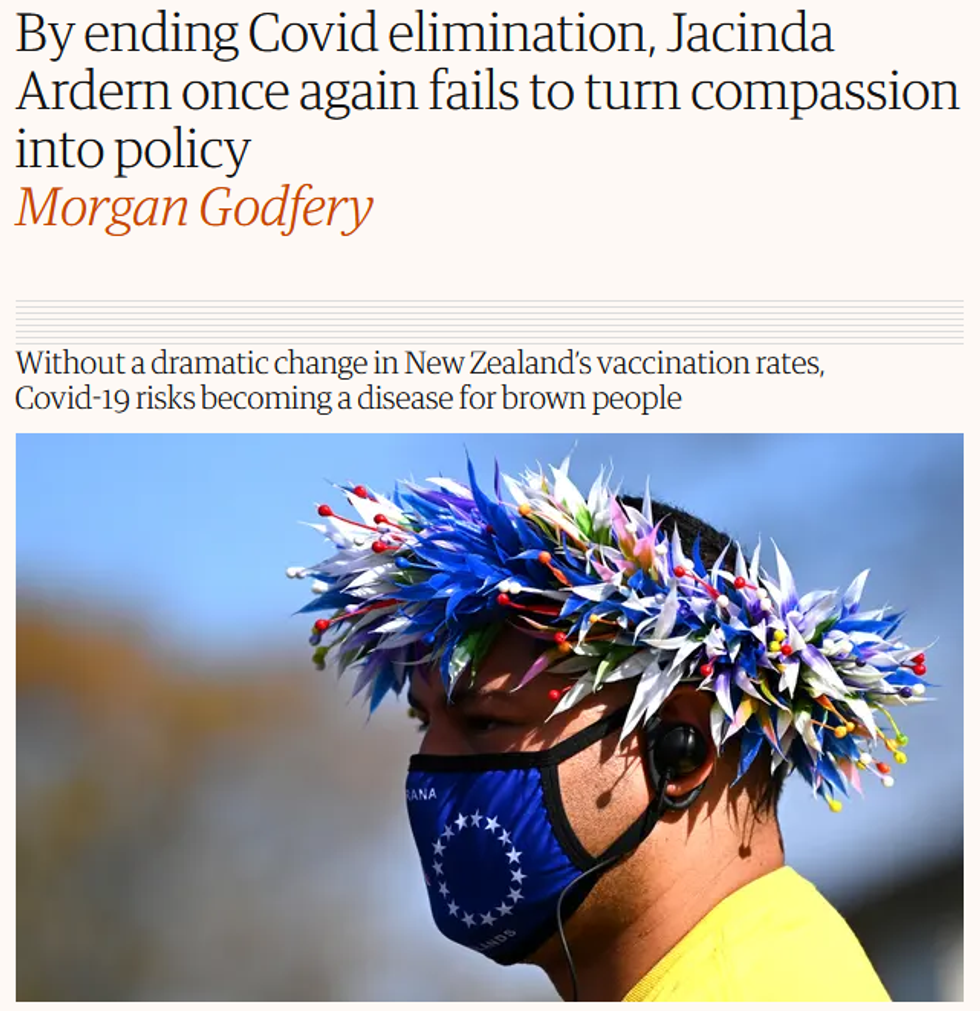
Morgan Godfrey warned in the Guardian (10/5/21) that shifting from a zero-Covid policy to a reliance on vaccination risks Covid-19 "becoming a disease for brown people," as vaccination rates trail among Maori and Pacific people in New Zealand.
However, what critics like Greenwald omitted was that the lockdown was initially supposed to last only three days, and that New Zealanders have not been under "sustained isolation" since their zero-Covid approach quickly stamped out the virus in previous outbreaks. In fact, plenty of people living there have pointed out that it's hard for people outside the country to grasp how normal life has been there for most of the pandemic (Guardian, 10/5/21):
For 18 months, New Zealanders were living life as if there were no pandemic. We were gathering outdoors and indoors in the thousands, mask mandates were literally a foreign concept, and business and public services were operating more or less as normal. We were watching governments that let the virus rip with a good dose of horror and, if we're honest, a modest dose of smugness.
This is not a mere anecdote. When one looks at the Covid-19 Stringency Index provided by the University of Oxford, which measures how restrictive policies are for countries by tracking various metrics like school and workplace closures, as well as travel bans, it's clear that New Zealanders have enjoyed more freedoms throughout most of the pandemic than Americans or Brazilians (where Greenwald is based). Right before the latest lockdown measures in August, New Zealanders had been living normally with not a single Covid case for six months, demonstrating that powerful measures for a brief period of time actually grant citizens more freedom, and are more effective than sustained half-measures that predominate in the US and UK.
Also omitted is that the vast majority of New Zealanders were supportive of their zero-Covid policy, as numerous polls and the Labour Party's landslide 2020 reelection confirm (ABC, 10/8/21; Otago Daily Times, 9/2/21). While economic activity is not a perfect proxy for normal living, it's worth noting that New Zealand's economy grew 1.0% in 2020, while the US's dropped 3.5% and Britain's plunged 9.8%.
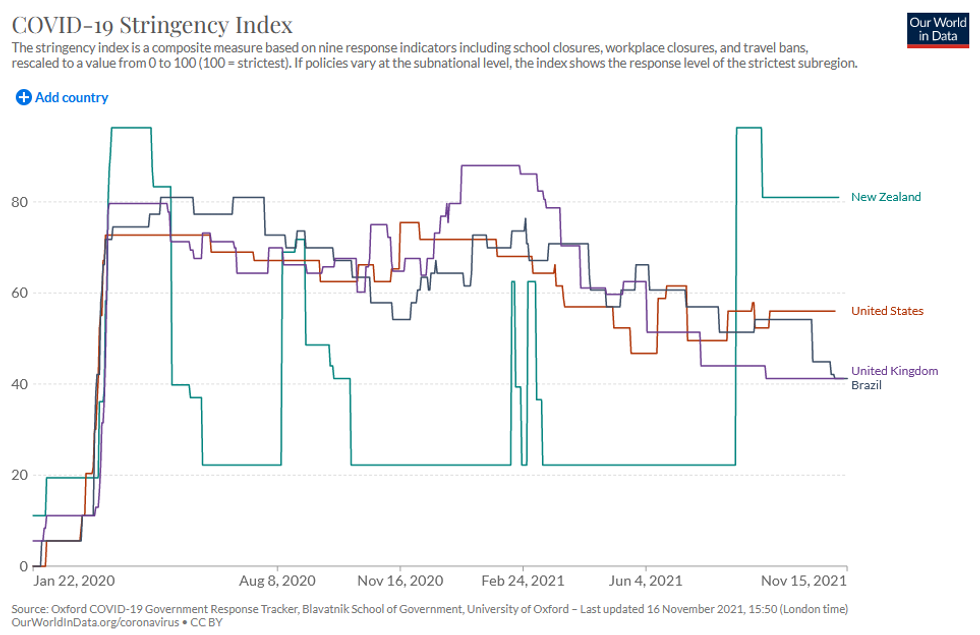
Throughout most of the pandemic, New Zealand's Covid rules have been much less stringent than either the US's, Britain's or Brazil's. (Chart: Our World in Data)
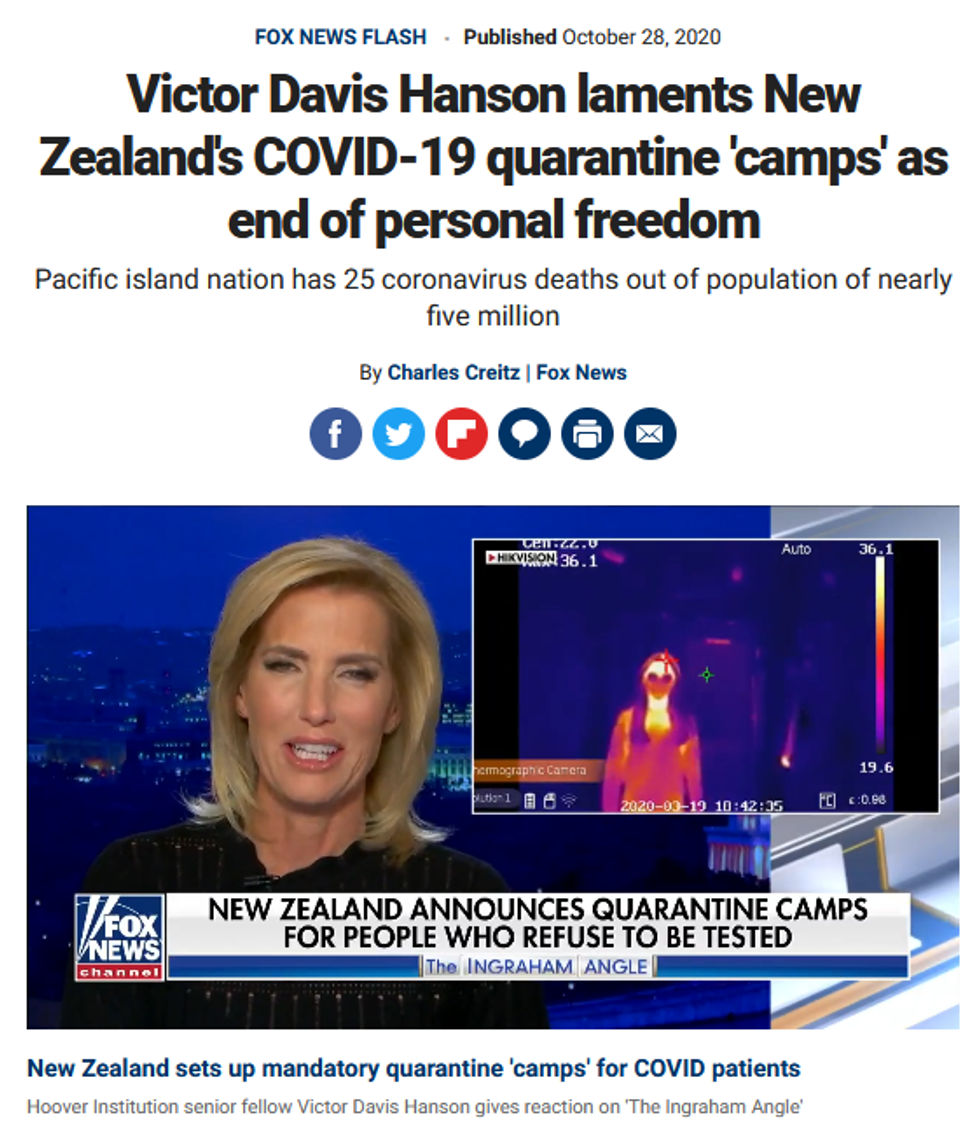
Fox News (10/28/20) depicted people arriving in New Zealand being required to take a Covid test before they could enter the country ass the "end of personal freedom."
Yet these facts don't stop outside commentators from condemning and caricaturing New Zealand's policy as throwing away "personal freedoms" for quarantine "camps," or falsely portraying New Zealanders as if they are languishing in a "Covid prison" (Fox News, 10/28/20; London Times, 8/22/21).
As it happens, New Zealand's decision to initiate a swift lockdown after detecting a single case is similar to how other countries adopting a zero-Covid approach, like China, handle things. And that decision was later vindicated by the discovery of even more previously undetected cases, as one detected case on August 17 turned into 63 new cases by August 25, due to the more transmissible Delta variant, along with not being able to detect more cases without additional testing (Gizmodo, 8/25/21). Since officials are supposed to revise their approach upon gaining additional information in real time, it's not a surprise or a sign of incompetence that the initial three-day lockdown was repeatedly extended upon learning of more Covid cases throughout the lockdown.
This is not to say that a zero-Covid strategy is easily replicable. Many people living in countries that pursue virus elimination strategies, like New Zealand and China, have pointed out that they both depend on "social license," or trust in their government's public health response. The general public complies with public health measures because they feel like they are working together to contain the pandemic, in addition to government action having clear rationales (Time, 10/14/21). Even if the US government possessed the technical capabilities of New Zealand and China, that doesn't mean the US would be capable of replicating their success with widespread compliance, since Americans have consistently displayed low trust and satisfaction in their government compared to New Zealand and China (Pew, 5/17/21).
Nor is it to say that New Zealanders have no criticisms of their pandemic response. Critics have charged that the Labour Party's sudden transition from an elimination to a containment strategy took place too quickly, given New Zealand's slow vaccine rollout. With children and the indigenous Maori population not having the same vaccination rates as adults and white people, this risks Covid-19 "becoming a disease for brown people" (Guardian, 10/5/21; RNZ, 8/24/21). Numerous experts have argued that herd immunity and virus eradication (which differs from virus elimination by seeking to entirely wipe out Covid-19 from the planet like smallpox) may be unrealistic goals, as Covid-19 is most likely going to be endemic like influenza, in part because other countries have not pursued New Zealand's elimination strategy (Nature, 3/18/21; Vox, 10/22/21; MedPage Today, 4/11/21).
One gets the sense that corporate media outlets in countries like the US and Britain mocking or criticizing New Zealand's pandemic response are following a "misery loves company" ethos (FAIR.org, 9/17/21). But one can simply compare New Zealand's 6.9 Covid deaths per million with the US and the UK's 2,313 and 2,131 deaths per million, respectively, to see if New Zealand should listen to the US/UK media's spiteful coverage, and to assess which governments have failed their populations by putting profits before people (BMJ, 2/4/21).
New Zealand Prime Minister Jacinda Ardern--hailed by progressives around the world for her government's response to the Covid-19, gun violence, and climate crises--has won a landslide re-election victory as vote counting in the country's general election came to a close on Saturday.
The New Zealand Herald reports Ardern's center-left Labour Party surged to certain victory, winning 49.1% of the vote and crushing the center-right National Party in an "abolute drubbing." The Nats received just 26.8% of votes cast, which means Labour will enjoy a 64 to 35 seat advantage in the 120-seat parliament.
Ardern arrived at Auckland Town Hall on Friday night to a jubilant reception as she took the stage with Labour MPs and her partner, radio and television presenter Clarke Gayford.
"Tonight New Zealand has shown the Labour Party its greatest support in at least 50 years," Ardern declared to raucous cheers.
Ardern said Labour was committed to building critical infrastructure, transitioning to 100% renewal electricity, the environment, and supporting the nation's most vulnerable people.
"Over the next three years there is much work to do," she said. "We will build back better from the Covid crisis; better stronger with the answers to the [issues] New Zealand already faces."
Labour's result is the best that any party has ever achieved since the South Pacific nation adopted mixed-member proportional representation (MMP) in 1994.
National Party candidate Judith Collins, suffering what the Herald described as "an absolute bloodbath," phoned Ardern to congratulate her on her "outstanding result."
To the left of Labour, the Green Party won approximately 8% of the vote, with Green MP Chloe Swarbrick on track to win the key Auckland Central electorate. Swarbrick will become just the second Green MP to win an electorate seat in the party's 30-year history.
Green Party co-leader Marama Davidson congratulated Ardern for "an extraordinary win" and said her party hopes to be part of a "strong, truly progressive government."
Around the world, progressives hailed Ardern's victory. The 40-year-old won widespread acclaim for the manner in which her government has dealt with some of the greatest crises facing the nation of 4.9 million people.
Foremost among these is the Covid-19 pandemic, which as of Saturday has claimed just 25 lives in the country. In stark contrast, the U.S. state of Alabama, which has the same population as New Zealand, has lost more than 100 times as many people to Covid-19.
Ardern's government has also passed landmark climate legislation that commits the nation to reduce its carbon emissions to zero over the next 30 years, and it drew applause from U.S. gun control advocates when it responded to the March 15, 2019 Christchurch mosque massacre by banning assault weapons just six days later.
Inevitably, envious progressive observers in the U.S. drew comparisons between Ardern and President Donald Trump, who John Nichols, the national affairs correspondent at The Nation, called "polar opposites"
In an era of shout radio and social media degenerates, political endorsements have about as much value as Donald Trump's alternative facts. A few newspapers valiantly press on, but those endorsements are not much more than vanity plates in print, especially in provincial communities like ours. Thankfully FlaglerLive as a nonprofit cannot endorse, and wouldn't do so even if it could. But this year I'm personally going to break that rule and borrow a page from my Zarathustran colleague John Walsh. I'm making just one endorsement. I'm endorsing the same person for president, for governor, for state attorney, for county and city commission, for mosquito control, for P-Section prime minister and of course for Beverly Beach mayor.
I endorse Jacinda Ardern. (She's not a friend.)
The name might not ring too many bells. I still have a hard time with it myself. (Contrary to the way many pronunciation guides have it this side of the planet, you don't pronounce the first r.) She's New Zealand's prime minister. In 2017, when she was 37, she was the world's youngest woman to take any country's leadership. In eight days she's poised to win a second term. Polls have her ahead of her challenger by 15 points. She's the Angela Merkel of the southern hemisphere, but better. She managed not only to tame the coronavirus but essentially to kill it in New Zealand.
As of Wednesday, the country had gone 10 days without a single new case. All restrictions have been lifted. No social distancing, no masks required, no limits on gatherings. It's the result of what the prime minister calls "go hard, go early" (the strategy Flagler's own Dr. Stephen Bickel was pushing early in the pandemic) a strategy that meant immediate and strict but brief lockdowns backed by grown-up enforcement-none of that infantile do-as-I-please selfishness so common in Flagler-flavored bacchanals-and an entirely scientifically-based approach to tracing, containing and smashing the disease before it turns into a mass killer. I wouldn't be surprised if Arnold Schwarzenegger yielded the seventh Terminator movie's title role to ArdNew Zealand is a country of 5 million people, or 45 times the population of Flagler County. Keeping in mind the absurd back-patting of our own elected officials about how this county has kept its numbers low, compared to other counties in Florida, here's how we compare to the real world. This week Flagler recorded its 1,800th case. That's 300 more cases than for the entire country of New Zealand for the entirety of the pandemic. We boast about our infection rate of 1,575 per 100,000 population, because it puts us at the bottom of counties in Florida, that inferno of viral indulgence. You want to know New Zealand's rate per 100,000? Thirty-eight. This week we recorded our 32nd covid-related death in Flagler County. New Zealand, that country of 5 million, has had a total of 25.
It's not fail-safe. Nothing is with this Strangelove of a virus. New Zealand declared the virus defeated a few months ago only to see a small resurgence, though the term "resurgence" is relative: a few dozen cases reemerged, and just because of that, major cities locked down again, briefly. (When we get a spike in Flagler, we just turn up the karaoke machine at the local social club.) New Zealand's grown-up approach worked again. The few dozen cases were traced and contained. And now its society has reopened without virus, without limits.
Of course the country has suffered economically. Every country has. But not anywhere near the sort of cratering that took place in the United States. New Zealand's unemployment rate is at 4 percent after a peak of 6 percent in June. It's going to have a hard time in coming months, but nothing on the scale of American Darwinism, where government abandoned workers when they needed safety most and is abandoning them again when they need economic lifelines. New Zealand was successful because the only thing it battled was the virus, not untruths, not a president's incendiary calls to "liberate" this or that state, and because New Zealand's leader, unlike Donald Trump, was not the enemy of her own people. Not surprisingly, Jacinda Ardern never faced the risk of getting kidnapped and "tried" by rogue militias, as Michigan's governor did by our very own right-wing terrorists (those "very fine people" the acting president admires) when Gretchen Whitmer did her best to go Ardern on her state.
New Zealand is the exception, an island nation with natural barriers, but many other countries have been nearly as successful by being equally deferential to science, because they've refused to let politics drive the response, because grown-up nations don't let a cult of personality dance on 200,000 graves. For all its colossal medical, technological and economic advantages, the United States failed that test, because we have a failure at the helm, a superspreader worried less about his own staff than about the right camera angles catching the bulk of his next advertisement for himself. Even Narcissus wasn't a walking biological weapon. I suspect Jacinda Ardern could run the United States by Zoom better than Trump could run so much as the Rose Garden, covid's favorite Washington petri dish.
Speaking of endorsements, the New England Journal of Medicine has never in its 208-year history done any. It ended that tradition this week, not quite endorsing Joe Biden, but endorsing giving Donald Trump the boot, which amounts to the same thing. As the editors wrote, "Our current leaders have undercut trust in science and in government, causing damage that will certainly outlast them. Instead of relying on expertise, the administration has turned to uninformed 'opinion leaders' and charlatans who obscure the truth and facilitate the promulgation of outright lies.... When it comes to the response to the largest public health crisis of our time, our current political leaders have demonstrated that they are dangerously incompetent. We should not abet them and enable the deaths of thousands more Americans by allowing them to keep their jobs."
The editorial's indictment in the plural is the chilling caution. Trump is merely the bulky goon above the surface. Nine-tenths of Trumpism is a viral load we're not about to be rid of no matter what happens on Nov. 3. And Joe Biden is no Jacinda Ardern. But getting this dying country to convalescence is victory enough for now.
The United States found itself in the company of Brazil and Hungary--two countries run by leaders who, like President Donald Trump, have alarmed international observers with their autocratic tendencies--on the 2020 Social Progress Index, an annual ranking of quality of life in nations around the world.
The three countries are the only ones, according to the Social Progress Imperative, which has compiled the index since 2011, where quality of life has declined over the last decade.
"Autocrats deliver?" tweeted Kenneth Roth, executive director of Human Rights Watch.
At number 28 on the list, the U.S. is also alone among other wealthy countries in the G7 where people's personal safety, access to basic healthcare, personal rights and freedoms, and other measures of quality of life are on the decline.
"The data paint an alarming picture of the state of our nation, and we hope it will be a call to action," Michael Porter, a Harvard Business School professor and the chair of the advisory panel for the Social Progress Index, told Nicholas Kristof at the New York Times. "It's like we're a developing country."
The index ranks countries according to their performance in three key areas: basic human needs, foundation of wellbeing, and opprtunity--breaking those categories down into sub-categories including:
Tier One on the index is populated by countries whose wealth is comparable to that of the United States. Norway was ranked as number one, followed by Denmark and Finland. New Zealand, which this year has won international praise for Prime Minister Jacinda Ardern's handling of the coronavirus pandemic, also ranked high, as well as Japan, Iceland, Canada, and Sweden.
A number of countries with GDPs lower than that of the U.S.--including Greece, Estonia, and Cyprus--rank ahead of the country in the bottom half of Tier Two.
"GDP is not destiny," emphasizes the report, displaying a chart that shows the U.S. has lagged in "turning its economic growth into social progress."
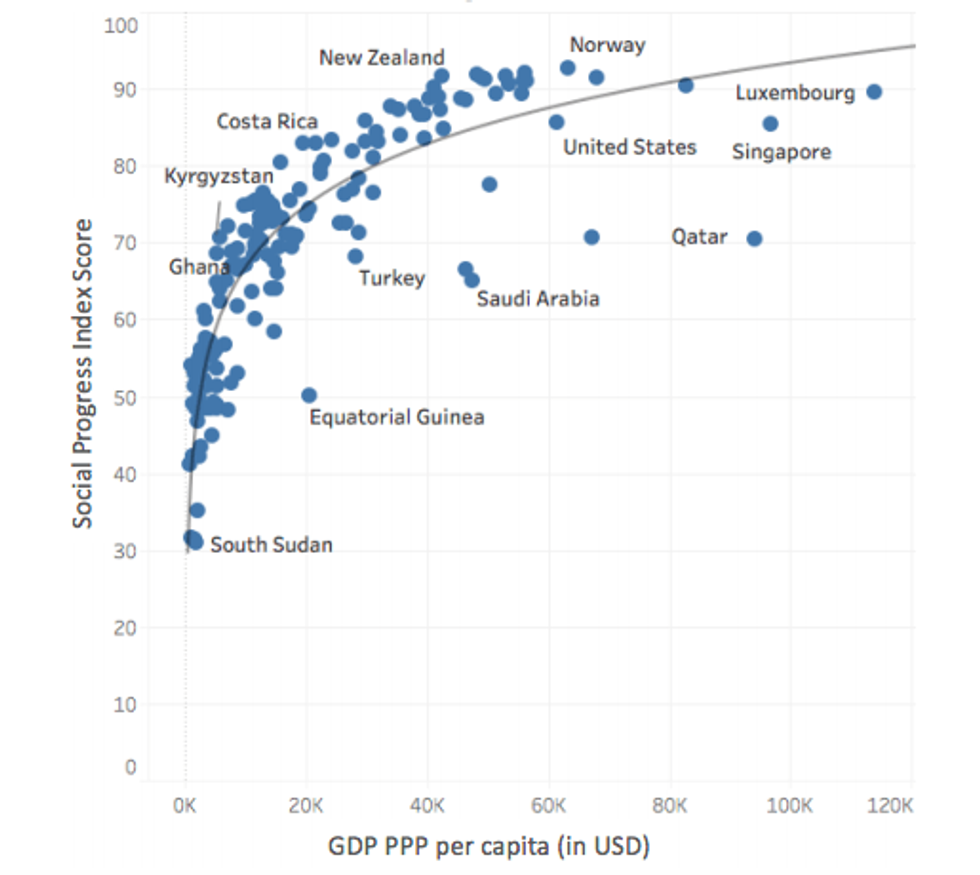
With a lower GDP per capita than the U.S., the chart shows, New Zealand's government funds a universal healthcare program, spends a greater percentage of its GDP on education than any other country in the world, and was able to mitigate the spread of the coronavirus by allowing residents to stay at home with a major relief package, offering subsidies to businesses to continue paying employees and covering the wages of employees that had to self-isolate.
The U.S. government has so far offered a one-time, means-tested direct payment of $1,200 to some American households--as the crisis stretches into its sixth month--and allowed its enhanced unemployment benefit to expire in July even as more than 10% of workers were jobless.
Well before the pandemic, the index shows, quality of life was rapidly declining in a number of areas in the U.S. In 2011, when the country was in 19th place on the list, the U.S. earned 93.25 points for meeting basic human needs such as healthcare and personal safety.
The uninsured rate is lower than it was in 2011, but has steadily climbed since 2016 and skyrocketed in a matter of weeks when the coronavirus pandemic hit, forcing an estimated 12 million Americans off their employer-based health coverage.
Gun violence has also increased in the U.S. over the past six years, according to Giffords Law Center.
The United States' starkest decline since 2011 has been in the area of opportunity; in terms of inclusiveness, access to education, and personal rights, the U.S. was given 81.89 points this year, contrasting with its score of 85.17 in 2011.
Kristof noted that while the U.S. is fully capable of delivering high-quality healthcare and education to everyone in the country, the federal government keeps many Americans from accessing necessities--operating as a nation with far fewer resources in terms of its approach to the wellbeing of the public, while lavishing the wealthiest Americans and corporations with tax breaks.
"The United States ranks No. 1 in the world in quality of universities, but No. 91 in access to quality basic education," Kristof wrote. "The U.S. leads the world in medical technology, yet we are No. 97 in access to quality healthcare. The Social Progress Index finds that Americans have health statistics similar to those of people in Chile, Jordan, and Albania, while kids in the United States get an education roughly on par with what children get in Uzbekistan and Mongolia. "
The index, tweeted John Kostyack of the National Whistleblower Center, offered a "reality check against the drumbeat of U.S. triumphalism."
James Tierney, an economics professor at Penn State University, planned to use the index to teach his students about the limits of measuring a country's success by its GDP or economic growth.
"The hope is to [help] students understand there are other measures outside of the value of production to determine the well-being of a country," Tierney tweeted.
Facing a president who continues to deny that the coronavirus pandemic is a major public health emergency and a federal government which has been reticent to offer robust economic relief to families, tens of thousands of Americans are looking to New Zealand as a potential escape plan as the small island country boasts one of the world's Covid-19 success stories.
According to Immigration New Zealand, visits by Americans to the country's immigration website were 37% higher in April than they were last year at the same time, and skyrocketed by 65% from last year in May. About 80,000 Americans researched the possibility of moving to New Zealand over the two months.
Americans' apparent interest in moving to New Zealand more than 6,000 miles from the U.S. mainland first spiked as New York City became a global epicenter of the coronavirus pandemic, accounting for 5% of the world's cases in late March.
"These are hard-won gains, and we have as a government no intention of squandering them. The idea that we should open our border in this environment has a price, and that price could be a second wave of Covd-19 in our country at worst--at best, added restrictions for the rest of us."
--New Zealand Prime Minister Jacinda Ardern
The number of inquiries nearly doubled again in May, just after New Zealand Prime Minister Jacinda Ardern announced that Covid-19 had been "effectively eliminated" in the country on April 27.
New cases of the disease had been in the single digits for several days when Ardern made the announcement. The government maintained caution even after sharing the good news, requiring physical distancing at businesses that reopened, encouraging people to continue working from home if they were able, and limiting attendance at events like weddings and funerals to 10 people.
The country has reported fewer than 1,500 cases of Covid-19 and 22 people have died. Two women tested positive for the coronavirus in mid-June after arriving in the country from the U.K. and being given permission to leave their 14-day mandatory quarantine early, ending a 24-day streak with no new cases.
Meanwhile, the U.S. leads the world in coronavirus cases, with more than 2.9 million people infected and more than 129,000 deaths.
As the infection rate continues to climb in the U.S.--with surging cases in states including Texas, Florida, and Arizona--President Donald Trump claimed over the weekend that 99% of cases are "totally harmless." According to the Washington Post, the White House's current hope is that "Americans will grow numb to the escalating death toll and learn to accept tens of thousands of new cases a day" as Trump attempts to win reelection in November.
New Zealand's response to the economic toll of the pandemic has contrasted sharply with the U.S. government's. Ardern enforced a strict lockdown in the country on March 25--before any deaths were reported--forbidding New Zealand residents to leave their homes except to exercise outdoors.
The public was able to comply with the order, which was in place for five weeks, thanks to a relief package amounting to about 4% of the country's GDP. All wages for people who had to self-isolate were covered under the plan, and businesses were given subsidies to continue paying their employees. Healthcare spending was also doubled.
In the U.S., the federal government offered some individuals a one-time payment of $1,200 to ostensibly cover expenses for a public health crisis that experts expect to go on for months. Unemployed people were also given $600 per week on top of their standard unemployment benefits--a move which temporarily helped reduce poverty in the U.S.--but Republicans who control the U.S. Senate are reluctant to continue the benefit past July. As the White House downplays the pandemic and calls for daily life and economic activity to return to normal, some Republican-led states have threatened to take away people's unemployment benefits if they don't return to work out of fear of Covid-19, as their industries open.
One public health expert in New Zealand last month called the U.S. response to the pandemic and its effect on millions of Americans "heartbreaking."
Unfortunately for Americans hoping to move to New Zealand, the country's borders are currently closed to foreign nationals. Ardern criticized calls from the opposition party last week to reopen the borders, saying to do so would be "dangerous" considering that there are dozens of countries around the world, including the U.S., where the pandemic continues to worsen.
"These are hard-won gains, and we have as a government no intention of squandering them," Ardern said. "The idea that we should open our border in this environment has a price, and that price could be a second wave of Covd-19 in our country at worst--at best, added restrictions for the rest of us."
Other wealthy countries, such as the 27 member nations of the European Union, have also rejected the possibility of people traveling there from the U.S., citing the high infection rate--and intensified the isolation of the U.S. under Trump.
Amid the Trump administration's calamitous response to the Covid-19 pandemic, media have been looking to other countries for inspiration in responsible leadership during a period of crisis. New Zealand Prime Minister Jacinda Arden has been one popular pick, having capably managed to limit the damage to only 1,504 infections and 22 deaths, as of June 5.
A widely shared article in the Conversation (4/5/20) described Ardern as putting on a "masterclass in crisis leadership." The Washington Post (4/7/20) characterized her government's response as a "triumph of science and leadership." Elsewhere, she has been praised as "the most effective leader on the planet" (Atlantic, 4/19/20) who "should be teaching the rest of the world" (Guardian, 4/10/20). The Financial Times (4/19/20) unironically anointed her "Saint Jacinda."
Despite its obvious geographical and economic advantages, New Zealand certainly deserves praise. But less deserving have been the European countries corporate media consistently highlight as outstanding performers. With over 185,000 cases and 8,763 deaths, Germany has one of the highest per capita fatality rates in the world. Yet Chancellor Angela Merkel has drawn effusive praise as somebody who "embraces science" (Atlantic, 4/19/20; Guardian, 4/16/20; Financial Times, 4/3/20). CNN (5/7/20) proclaimed her a "global leader on coronavirus"; Vox (5/21/20) said she'd been "praised for her clear and effective communication with her country -- and the world."
In its editorial on crisis leadership, the New York Times editorial board (4/30/20) also praised Merkel (while attacking China for supposedly covering up the outbreak). They highlighted and applauded the leadership of several other countries, including Denmark, Norway and Finland. Amazingly, the editorial also singled out and commended Italian Prime Minister Giuseppe Conte, whose inept response has led to Italy having the third-highest number of deaths in the world at the time of its publication.
There was far less praise for leaders in the Global South. Indeed, the only one mentioned by name was Taiwan's Tsai Ing-wen, and this was primarily because she "sent millions of face masks to the United States and Europe"--although with 443 total cases and only seven deaths, Taiwan has had a far more enviable record on Covid-19 than most of the countries featured in the editorial. True Asian leadership, according to the Times editorial board, is helping white people, apparently.
The New York Times (5/15/20) also published an article praising Sweden's "more measured approach" to the virus, which essentially involved keeping most businesses open and carrying on more or less as normal. Maud Cordenius wrote that the "aggressive bombast" other countries have used "would not resonate" in Sweden. "Time will tell if my country's coronavirus plan was wise," she concluded. That time was five days; on May 20, Sweden became the country with the highest Covid-19 death rate per capita in the world, 50% worse than even the US (FAIR.org, 4/30/20, 5/27/20).
The problem with much of the reporting focusing on rich, developed countries where media have foreign correspondents is that it ignores often superior responses to the virus from much of the Global South, countries that have nothing like the resources of advanced Western states. Cuba has successfully bent its curve downwards, and has sent medical staff to dozens of countries around the world (FAIR.org, 4/14/20, 5/31/20), including to crisis-struck Italy, held up as a model of leadership.
The Indian state of Kerala, extremely poor by international standards, recorded its first coronavirus case a month before New Zealand. Yet an impressive feat of organization from local authorities has limited the outbreak to just 1,588 cases and 14 deaths.
Vietnam was hit by COVID-19 even earlier than Kerala, yet the entire country mobilized against the threat in a manner oft-compared to the struggle against the US military during the war. Whole towns were quarantined after a single confirmed case. Citizens have their temperature constantly checked in public buildings and transit hubs like bus stations. Food is provided to anyone self-isolating to make sure nobody needs to endanger themselves or others by leaving their homes. They have also created and mass-produced test kits, all costing less than $25 each, and giving results in 90 minutes, exporting them around the world. To date, Vietnam has still to record a single death.
But when commenting on Vietnam at all, media tend to brush off the country's success as not down to leadership or the nationwide determination to stop the pandemic, but to its authoritarian government (e.g. NPR, 4/16/20; BBC, 5/15/20). Foreign Policy (5/12/20), for instance, published an article called "Vietnam's Success Is Built on Repression," which informed readers that Vietnamese authorities digitally track citizens. Wow--imagine living in a country where security services surveil your phone and social media! (For more on Vietnam, see FAIR.org, 5/15/20.)
The problem, for corporate media, is the orientation of these governments; Vietnam, Cuba and Kerala are all overtly Communist. A system media has been insisting cannot work (FAIR.org, 2/8/19, 2/3/20, 3/6/20) cannot easily be praised, so it is ignored or denigrated. Don't expect to see any fawning articles declaring Raul Castro a saint, or wishing the "inspirational" Nguyen Phu Trong were president of the United States any time soon.
Perhaps the only country that moved quicker than Vietnam was Mongolia, which shut down schools, universities and other public buildings and restricted border crossings in January, before any cases had even been found. Throughout February, the country was doing what we now wish we had done: stockpiling PPE, procuring test kits and cancelling public events. To date, it has still yet to record a single in-country transmission, the only cases detected coming internationally. Yet corporate media ignore these examples in favor of praising white Western leaders with palatable political backgrounds.
One Asian country that has received praise is South Korea, a close US ally (Time, 4/30/20; Business Insider, 5/2/20; Guardian, 5/20/20). The country was hit badly at first, but through strict surveillance and contact tracing has managed to limit the outbreak to 11,668 cases and 273 deaths, far more than Kerala, Vietnam or Mongolia. Despite this, the Atlantic (5/6/20) described their response as "exceptional"--something, in an Asian context at least, it clearly was not. Indeed, per capita, South Korea lost considerably more people to the virus than China, much less Taiwan, Vietnam or Mongolia.
The cold, hard fact is that, in comparison to many countries in the Global South, the West's response has been atrocious. Even New Zealand's performance is surpassed by a number of nations, particularly in Asia. Unfortunately, New Zealand's response should have been the benchmark for rich, developed countries, not the exception.
However, for political reasons, many of the world's best performers are ignored in favor of Ardern, or even far less deserving figures in Europe. A toxic mix of political expediency, ignorance and the general assumption that Western countries must know better has infected our media, leading to a pandemic of biblical proportions.
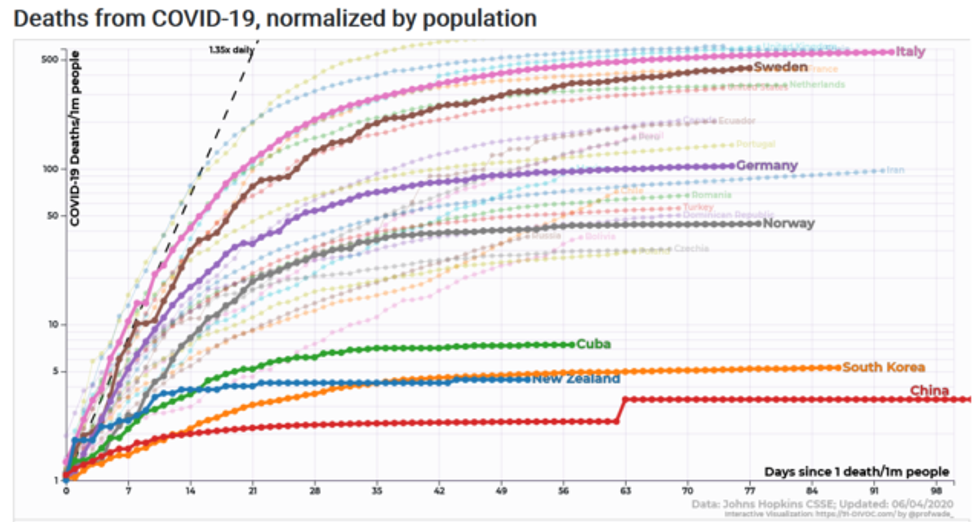
Donald Trump is not a president. He can't even play one on TV. He's a corrupt and dangerous braggart with ill-concealed aspirations for a Crown and, with an election coming up, he's been monopolizing prime time every day, spouting self-congratulation and misinformation. (No, don't inject that Lysol!) His never-ending absurd performances play out as farce against the tragic background of the Covid-19 pandemic sweeping the nation. If we had a real president, which is to say, almost anybody else, things would be different. We would have seen the pandemic coming. It would not have attacked me in my old age. And most of the dead might still be alive.
The records of other countries make this clear. South Korea, Taiwan, Denmark, Finland, Germany, Iceland, New Zealand, and Norway have all had commendable success in protecting their people. Could it be by chance that seven out of eight of the most successful nations in combating the Covid-19 pandemic are headed by women?
The records of other countries make this clear. South Korea, Taiwan, Denmark, Finland, Germany, Iceland, New Zealand, and Norway have all had commendable success in protecting their people. Could it be by chance that seven out of eight of the most successful nations in combating the Covid-19 pandemic are headed by women? Tsai Ing-wen of Taiwan, Mette Frederiksen of Denmark, Sanni Marin of Finland, Angela Merkel of Germany, Katrin Jakobsdottir of Iceland, Jacinda Ardern of New Zealand, and Erna Solberg of Norway have all been described in similar terms: as calm, confident, and compassionate leaders. All of them have been commended for thorough preparations, quick decisive action, and clear, empathic communication. Erna Solberg has even been hailed as the "landetsmor," the mother of her country.
Perhaps in such disturbing times as these we feel some primal yearning for a capable, comforting mother, but we need not resort to such psychological speculation. The fortunate countries turn out to be those with the fairness and foresight to have welcomed women into government decades ago.
What seems anachronistic in this critical time is the presence in leadership posts of so many self-aggrandizing, sociopathic male autocrats: Jair Bolsinaro of Brazil, Recep Tayyip Erdogan of Turkey, Alexander Lukashenko of Belarus, Viktor Orban of Hungary, Vladimir Putin of Russia, Donald Trump of the United States, and more. Faced with the pandemic, none of these "powerful" men had a clue. They encountered an invader that could not be bullied, bribed, banished, or bombed. And for their ignorance and vanity, the people pay (and pay and pay).
Lessons in Leadership
I know something about the difference good leadership makes because I've been locked down now in two different countries. One kept me safe, the other nearly killed me. I happened to be in Norway when the virus arrived and saw firsthand what a well-run government can actually do. (Yes, I know Norway seems small indeed when compared to the United States, but both of the governments that locked me down, Norway and the Commonwealth of Massachusetts, where I now reside, represent roughly 5.5-6.5 million people, and Norway's capital, Oslo, is only slightly more populous than Boston. So some comparisons may be revelatory.)
More to the point, with any population, the difference between success and failure is preparation, swift action, and the techniques applied to overcome the pandemic. On February 26th, the Norwegian Institute of Public Health announced the first case of Covid-19: a woman who had returned a week earlier from China. The next day, it reported two cases in travelers returning from Italy and another from Iran. After that came two skiers also back from Italy. One of them, an employee of Oslo's largest hospital, went right back to work, where tracers would soon witness just how fast the unseen virus could move.
And here's the key that escapes political leaders in America: in Norway, testers and tracers were on the job from the start. As February rolled into March, they were already testing and tracking some 500 Norwegian skiers returning from the Austrian Alps and northern Italy. Some had frequented convivial apres-ski taverns there and, once back home, were quick to catch up with friends. One Norwegian tracer labeled such skiers "very sociable people."
Systematically, Norway would test all its returning travelers (every one of them!), then track down all the contacts of those who had tested positive and test them and their contacts as well, and so on down the line. Working with remarkable speed, the tracers used immediate test results -- a tool apparently available in the U.S. only to the rich and famous -- to track the trajectories of the virus as it spread. When cases began to multiply without known contacts, the tracers knew that the virus had begun to hitchhike through an unwitting community and were quick to surround it and shut it down.
In response to the pandemic, the government gradually closed down the capital and other centers of contagion. In Oslo, places of assembly went first: theaters, cinemas, concert halls. Norwegians were even asked to stay away from the World Cup Ski Championships being held at Holmenkollen, on the edge of Oslo.
Universities and schools moved online, while offices of all sorts soon followed suit. Restaurants and bars shut their doors. By March 12th, only two weeks after the first reported case, the capital and much of the country had closed down. On that day, in fact, officials reported the death of an elderly man, the first Norwegian casualty of Covid-19.
By mid-April, some five weeks after the shutdown went into effect, the government began to open up public life again, proceeding carefully step by step. Toddlers were the first to return to their preschools on April 20th, with grade schoolers to follow. By April 30th, Norway had administered 172,586 tests and recorded 7,667 positive cases of the coranavirus, 2,221 of them in Oslo. The dead numbered 207, suggesting a per capita mortality rate lower than that of any other European country and far from America's tragic loss of life. But how to explain this Norwegian record?
Experts attribute it to the government's early and deep preparations, enabling it to respond immediately to the very first case to appear in the country and, after that, to its quick, unrelenting testing and tracing of the contagion. This painstaking effort, backed by Norway's universal health care system, enabled the state to get ahead of the virus, save lives, and stop the pandemic short.
The country's remarkably effective welfare system has bolstered its population throughout the shutdown. Furloughed workers drew full pay from the government for 20 days, and about 62% of their full salaries after that. They'll return to their jobs ready for work in factories, shops, and businesses as the quarantine is lifted. The government's effective and well-targeted expenditures are ensuring smooth transitions; a quick return to production; and, best of all in this troubled time, some peace of mind for employers, workers, and families. The shutdown is bound to be costly, perhaps the worst blow to the economy since World War II, but such thoroughgoing, bottom-up arrangements are less expensive -- in both financial and human terms -- than America's striking neglect of marginal (aka "essential") workers, thrown under the bus of crony capitalism with nothing but lectures on the overrated American freedom to fend for yourself.
In Norway, the invasion of Covid-19 was seen from the outset as a national problem and part of a global emergency. It was never politicized. Norway's conservative prime minister, Erna Solberg, is now receiving high marks indeed, even from opposition parties, for her calm leadership. Children like her too. During the crisis, she gave two nationwide "press conferences" to children to answer questions they submitted about the pandemic. ("Can I have a birthday party?" "How long does it take to make a vaccine?") From the outset, she told them it was okay to be scared. And then she set an example of what a smart, hard-working leader and a collaborative, many-partied parliament can do for all the people, even in scary times.
Remarkably, Norway very quickly achieved the lowest rate of contagion in Europe. From the start, it aimed to stifle the virus to the point where one infected person might infect only one more. In scientific terms, it aimed for an R-0 rate (a rate of reproduction) of 1.0. By the time Solberg announced that goal on March 24th, however, the magic number had already fallen to 0.71. Today, with only 81 Covid-19 patients hospitalized and their contacts already traced and tested, Norwegians can begin to return with considerable confidence to something that edges ever closer to normal life.
Amateur Night
The United States has become an example for the world of just the opposite: a corrupt government unprepared for and even in denial of warnings from within and without. Years ago, President Obama created within the National Security Council a directorate for global health security and bio-defense to prepare for the pandemics sure to come. That directorate even briefed the incoming Trump team on the urgency of pandemic preparations before the president's inauguration. But on taking office, Trump eliminated the threat by eliminating the directorate.
As president, he was also informed of a viral outbreak in Wuhan, China, in early January of this year, but he ignored the message. As has been widely reported, he wasted at least two months in self-serving fantasies, claiming the pandemic would disappear of its own accord, or was Fake News, or a "new hoax" of Democrats plotting his downfall. By March, his conduct had become increasingly erratic, obtuse, combative, and often just flat-out nasty. In April, he abandoned altogether his most pressing presidential duty, first claiming "total power" as president and then shifting the job of testing and protecting the people from an unrestrained pandemic onto state governors already struggling to find basic medical supplies for front-line health care personnel in their own states.
Worse, he roused his most militant followers, some heavily armed, to defy the emergency directives of several states led by Democratic governors. In short, he first unloaded the responsibilities of his office onto state governors, then made it his mission to undermine and threaten some of them. For good measure, he cut off U.S. funding for the World Health Organization, the single U.N. agency best equipped to deal with global health emergencies. Trump already had a proud record of getting away with highly offensive, even criminal, acts in plain sight. Now, through egotism, bravado, and just plain ignorance he's made an epidemic great again (MEGA!), for Covid-19 cases and fatalities in the United States have by now far outstripped those anywhere else on Earth.
Welcome to America
On March 11th, as Oslo was shutting down, President Trump issued an order to take effect in 72 hours: no one flying from Europe would be allowed to enter the United States. It sounded crazy, but -- worried about worse to come -- I changed my flight home to meet the deadline. The next day, the American embassy clarified the president's ultimatum: the travel ban did not apply to U.S. citizens. By that time, of course, it was impossible for me to change my ticket back.
So I left Oslo on March 14th, after assuring friends that I would be okay because Massachusetts, home of Elizabeth Warren, is a progressive state.
Hah!
Changing planes in London, I found myself in a different world: packed into the tail section of that flight among a crowd of American students summoned home from European universities by their anxious parents. Some were in transit from northern Italy, already the heartland of the European Covid-19 outbreak. From the seats behind me came insistent sounds of boys coughing. The flight attendants wore rubber gloves and made themselves scarce. I wrapped a long scarf round and round my face, feeling as if somehow I'd been suckered into a trap.
Seven hours later, we stumbled into Boston's Logan Airport, destined to spend a few more all-too-intimate hours together. I crept along a zigzag trail, amid those coughing boys, with no way of putting distance between us, to the passport inspectors and then beyond. Finally, one by one, we were ushered into a curtained area to experience that airport's first night of official "screening."
I was pleased to think that we were all, at least, to be tested for the virus. But no such luck. When my turn came, the official screener voiced no greetings, asked no questions, offered nothing but a single order: "Go home and take your temperature." Had I been held all that time among those coughing boys for this? Later that week, a local paper reported approvingly that the new airport screening, the first line of defense against the foreign plague, took "less than a minute."
I was angry to have been forced onto that dangerous flight by the president's arbitrary edict and doubly angry that he had terminated travel from Europe without consulting any of his European counterparts. By the look of things that evening, no one from his administration had even informed key American airports receiving flights from Europe until the last minute. I saw a bunch of those coughing boys board a Silver Line bus into Boston and others grabbing taxis. And so we all went off into the night, apparently leaving behind no trace of the state of our health or where we were headed. Some days later, I was not merely angry but very ill.
Ten days after that, in a hospital parking garage, a masked nurse worked a giant Q-tip up my nose. A doctor told me to quarantine myself at home (as I had been doing anyway) until I got the test results in about 5 days. But why should it take so long? Wasn't the whole point of a test to learn what was going on as quickly as possible? The speed of the test result had been the very point in Norway. Combined with the immediate work of the tracers, it enabled the National Health Service to stay ahead of the pandemic and, in the end, essentially, to shut it down.
I went home and got worse. Five days passed with no word. On the 12th day, I felt well enough to call my doctor, who tracked down the result of my test ("just in"). It was positive, but almost two weeks old. So, over the telephone, the doctor gave me the all-clear to put on my mask (a souvenir of my trip to the ER) and go forth to shop. Knowing no Norwegian doctor would turn me loose so soon without another test, I asked for one. Sorry, short supply, only one to a customer. I've kept myself in quarantine at home ever since.
Covid-19 Hitches a Ride in America
On April 10th, came news of the death of 59-year-old Vitalina Williams, an immigrant from Guatemala, who worked a full-time job at a Walmart in Lynn, Massachusetts, as well as a part-time job at a supermarket in Salem. Like the nurse and doctor in the ER, this cashier was an "essential worker," the first grocery store employee in Massachusetts to work herself to death. Here's an immense difference between Massachusetts and Norway. In that country, one job would have paid her a good wage and also given her paid leave to see her own doctor in the National Health Service when she first felt ill. She would have been taken in, diagnosed, cared for, and very likely saved. That is simply how a national health care system works in a social democracy.
So what was my Covid-19 test for? What useful information did it give anyone? I had walked home from the ER in the dark (so as not to endanger others by taking a bus) and gone to bed. Nobody checked up on me because nobody knew my test was positive -- something I, of course, didn't know either. And throughout those nearly two weeks of waiting for the test results, no tracer called to learn if I lived with other people who might be endangered and available for testing. (There were, in fact, no tracers then.) No one asked me a single question about my family, friends, or others I might have contacted since that "screening" at the airport. And had I died in my bed, no one would or could have traced that bright red line between me, those coughing boys, and Donald Trump's compulsory flight to a state caught totally off guard in a country both dysfunctional and unprepared.
On April 20th, five weeks after I returned to Boston, Massachusetts was designated a Covid-19 "hot spot." With 38,077 cases and 1,706 deaths at that time, the state stood in third place behind New York and New Jersey. This was not an honor, but it may be what prompted Governor Charlie Baker to turn to testing -- and belatedly to tracing.
The number of new cases in this state was rising every day, as it has from the first reported case in February. The governor, who also holds a press conference every day, explained that we are now "right in the middle of an expected surge," apparently unaware that a "surge" is what you get when you have missed the moment for preventative testing and tracing. (This is also what you get when, as in the nation's capital, politicians rather than scientists run the show.)
Belatedly, Massachusetts started testing people at the rate of about 9,000 per day, while private agencies funded by the state are in the process of hiring perhaps 1,000 tracers to conduct phone interviews with the contacts of all Massachusetts residents who have already tested positive. Today, May 6th, we official "positives" number 70,271, though 4,212 of us are already dead.
In the first few days of May, the number of positive patients hospitalized fell slightly and state officials adopted an attitude of "cautious optimism." Presumably, something of importance will be learned from those belated tests. As Norway recognized, however, if you don't jump on this virus fast, it rapidly disperses beyond simple person-to-person contacts. It spreads out sociably like so many Norwegian skiers -- or American students. It rides the chairlift and the bus. It gets on the plane. It hangs out at the airport. It hitches a ride with someone stopping at the grocery store. To tally its contacts may become simply a matter of counting the dead.
Tracers in Norway have already moved on to other tests to find asymptomatic carriers who may be contagious or perhaps have developed antibodies. Anyone in that country with even the mildest symptoms may ask for a test. These precautionary studies are essential in case the virus should find new life as the quarantine is lifted. What scientists might learn from such studies, like the new tracing one in Massachusetts, remains to be seen, but surely one inescapable conclusion is that this virus is smarter, more agile, and faster on its feet than any of its associates we've met before or, for that matter, than most of our public officials, from a failed president on down. And for any readers who believe in politics more than science, let me just say that without science you won't even know what hit you.
Though many public officials and media outlets seem increasingly convinced that we are fighting a war against Covid-19, framing the pandemic in military terms obscures what we need to know and how we can cope with this virus.
At a press conference on Wednesday, March 18, President Donald Trump offered this grammatical hash: "I view it--in a sense as a wartime president." Translating the mangled discourse into a coherent statement, CNN (3/18/20) reported, "Trump said that he sees the country on wartime footing and himself as a wartime president amid the coronavirus crisis."
New York Gov. Andrew Cuomo picked up the theme of war on March 30: "The frontline battle is going to be hospitals. The soldiers in this fight are the healthcare professionals."
One prominent figure who contradicted the war frame in dramatic terms was Capt. Brett Crozier, commander of the USS Theodore Roosevelt, who was relieved of duty after writing a letter begging US military brass to allow his infected crew of 5,000 to disembark and quarantine to prevent the spread of the virus. "We are not at war," the letter read. "Sailors do not need to die. If we do not act now, we are failing to properly take care of our most trusted asset: our sailors."
On CNN (4/2/20), Eric Levenson explored the war frame, saying the "common metaphors" now used to characterize efforts to stop the virus as a military war "fit smoothly" in a number of ways. Like war, he said, the pandemic is about life and death, "an 'enemy' who can strike at any time, 'battles' on the 'front lines' and calls for the 'home front' to support the effort."
The war metaphor positions the virus within an underlying set of cultural assumptions that are widely understood: War as a media frame is easily deployed because it's so familiar. But the application of war metaphors only serves to mask what's truly at stake.
War always has an enemy. Identifying the virus, Levenson calls it "an enemy who can strike at any time," using the personalized who instead of the impersonal that. In war discourse, the enemy is a personalized target, not a virus. Enemies are always at fault. The communist, the illegal alien or the terrorist can never be negotiated with, for they are demonized and outside the bounds of our own humanity.
Like all the enemies identified in Trump's lexicon of hate and xenophobia, Covid-19 is exoticized as the "China Virus." The enemies of war are dehumanized, positioned on the other side of a wall between us and them. They are part of a vision of a world divided in conflict, at a time when the best way to deal with this pandemic is collectively, at the local and global levels. But instead of joining international efforts to contain the pandemic, the US is still targeting enemies, sanctioning Iran and exacerbating the humanitarian crisis there, engaging in regime change in Venezuela, cheered on by media, and bombing Iraq. While the World Health Organization has organized an international consortium called Solidarity, to advance as quickly as possible, global research needed to develop treatments, anti-viral drugs and a vaccine, Trump has vowed to cut off US funding for WHO.
Healthcare Professionals as Soldiers
Soldiers are the ones sent to kill the perfectly evil Others, finding glory in triumph, which always entails the death of the enemy. Their roles, purpose and goals are fundamentally different from the actions and sensibilities of healthcare professionals. Consider the Twitter post (4/2/20) of Dr. Craig Spencer, an experienced doctor who cared for Ebola victims and is now treating those with Covid-19 in New York City:
Your hands upon theirs. You think of their family. At home. Sobbing. Someone starts saying a prayer. You can't help but cry. This isn't what we do. You stand by. You wait. This isn't what we do. You stand by. You wait. Time of death: 7:19 pm.
Compassion, crying and providing solace for family members of victims are not part of a frontline soldier's repertoire. Dr. Megan Ranney rejected the soldier motif, posting a tweet (4/2/20) saying:
We did not ask to be heroes, or soldiers or troops. And in fact, my colleagues are increasingly dismissing this description. We are healthcare providers, with real fears in this moment of #Covid-19.
Healthcare professionals openly admit being afraid; soldiers on the front lines rarely do. PBS (4/7/20) talked to two emergency medical technicians who transport those sick with the virus to hospitals in New York. Both spoke openly about feelings of fear and dread. They work for meager salaries, one $37,000 a year, and neither had medical insurance.
But in popular culture, soldiers have morphed into something other than human, with an ensuing loss of humanity. Thanks to the merging of Marvel Studios and the military/entertainment complex, soldiers are now frequently depicted as superheroes--men of steel-- a trope used for recruitment. Soldiers, especially superhuman ones, are always brave, the antithesis of fearful.
The Washington Post has become particularly attached to war metaphors and soldier motifs. Alex Horton (3/27/20) wrote that the kind of praise doctors receive for "their dangerous and unforgiving work" has been mostly "reserved for combat troops and veterans."
Stand with Doctors retweeted a Twitter post (2/4/20) by Faye M.D. that pushed back directly at such media framing. "If we are soldiers in a war, and dying in this war, don't soldiers receive#HazardPay? Aren't their families guaranteed some sort of benefit after death? We are needlessly sacrificing our lives w/o #compensation #GetMePPE #COVID-19 @andersoncooper @washingtonpost @cnnbrk
In calling for the "home front" to "support the [war] effort," many journalists seem to forget that the battle for hearts and minds in war always leads to the closing down of information and the production of propaganda (FAIR.org, 5-6/03). When Captain Crozier was relieved of his duties for trying to protect his sailors, Acting Navy Secretary Thomas Modly rebuked him, saying he was either "too naive or too stupid" if he thought his letter would not get "out to the public." Though Modly resigned after a tape surfaced of his bungling of Crozier's firing, Trump confirmed his support for censoring Crozier, saying he "shouldn't have been writing letters," even one attempting to save the lives of servicemembers (CNN, 4/7/20).
Instead of reporting on the danger of war censorship, media obscured what was at stake, and gave more column inches to the military. The New York Times (4/12/20) focused on a "Rift in the Military," featuring Gen. John E. Hyten (vice chair of the Joint Chiefs of Staff) expressing "concerns about the possibility of more safety issues on warships." The divisions-within-the-military theme was picked up by Alternet (4/13/20), which repeated another Hyten quote, "To think that it will never happen again is not a good way to plan."
In this war miasma, the Washington Post (3/27/20) openly promoted persuasion as the best pathway to garner public support from the home front to "enlist" in the war effort, printing a number of redrawn, good old fashioned WWII propaganda posters to convince the public. But of what?
Examples of highly successful efforts to prevent the loss of human life from this virus underscore the essential role of open, truthful lines of communication and information. A CBC report (4/6/20) noted that British Columbia had flattened the Covid-19 curve. The report states that a key factor in BC's success comes from dealing with Covid-19 early, because "they had open lines of communication to quickly scale up a unified response relatively early."
The person who speaks at every Canadian news conference is Dr. Bonnie Henry, who oversaw Canada's SARS and H1N1 outbreaks. Henry stays at press conferences and answers questions, "and doesn't shade the truth. She's frank and honest and emotional with people." Her message of helping others is infused with humanitarian principles and concern for "people who we will never meet." Having a leader who can articulate "how we're all in this together, and make a convincing case for why you need to do your part" is essential. As a health official, Henry has now become one of the most famous and beloved people in Canada.
Another example comes from New Zealand, where Prime Minister Jacinda Ardern and her team "have spoken in simple language: Stay home. Don't have contact with anyone outside your household 'bubble'" (Washington Post, 4/7/20). Her message also taps into a collective, unified humanity: "Be kind. We're all in this together." She's usually done this from the podium of news conferences, where she has discussed everything from wage subsidies to the price of cauliflowers.
We can also look to Germany, a country with a high number of infections but a low percentage of fatal cases compared to its European neighbors. In addition to early and widespread "testing and treatment and plenty of intensive care beds," trust in government has led to a public embrace of social distancing guidelines (New York Times, 4/4/20).
The leadership of Chancellor Angela Merkel, a trained scientist, may also account for the low fatality rate. Merkel "communicated clearly, calmly and regularly throughout the crisis," wrote the Times.
The Guardian (3/22/20) published a feature on the scientists who dominate Germany's press conferences, who have become the faces of the crisis. They are the new German rock stars, explainers-in-chief, watched nightly by anxious audiences telling the public "how the governments they advise plan to contain the coronavirus."
A primary care physician in the Bronx, Dr. Bruce Soloway, currently practicing telephonically, told FAIR:
What is needed now is complete transparency. People need a clear explanation of what they need to do and why. We need a sense of mission and purpose if we are going to pull together and do what we need to do.
Four of Soloway's long-time patients have died, and his daily work includes consoling the families of the dead. "This big soup of lies and obfuscation, spinning the numbers, giving people false hope, is a distraction. It's counterproductive."
Those on the frontline of this virus are actually the people themselves. Every time someone enters a public place, they literally risk their own lives and the lives of others, and ultimately, the overwhelmed, exhausted, healthcare professionals who will treat them. The public needs a fundamental understanding of how the virus is spread, and the importance of their behavior. They need truthful information based in scientific research. A leader who uses media to lie to a civilian population in the midst of the most deadly pandemic in a century skirts the United Nation's definition of genocide.
British Columbia, New Zealand and Germany have all used truthful, clear messaging, based in collective themes of how we are all in this together--messages very different from assertions that hospital workers are "the soldiers who are fighting this battle for us," as Governor Cuomo (3/27/20) put it.
Stopping this virus will not depend on superimposing the images of soldiers over doctors. If we have learned anything, it is that the virus thrives on division and conflict, especially politicized, discursive conflict. Trump does little else than create division, conflict, uncertainty and confusion. As Science editor H. Holden Thorp (4/3/20) pointed out, "The nationalism that now has flared up around the White House threatens to undermine the effort to manage a global crisis."
Real solutions are based in the language of medicine, science and humanitarianism, not war, and the language of doctors who have experienced humanitarian disasters brought on by epidemics. It is clear that the only way we can get a handle on the situation is with international collaboration. Thorp went on to point out:
The data coming out of Chinese labs studying the virus--how it spreads and the disease that it causes--as well as the findings of Chinese scientists on the ground, are indispensable in finding a solution. That's why the racist labeling of the virus is doubly dangerous.
The war frame directs our attentions toward all the wrong impulses of division, fear and security-based force, while it reinforces an ideological view condoning censorship and propaganda. These practices deflect critical journalism and the watchdog function of the press when it is needed most. As Mark Hertsgaard (CJR, 4/8/20) asserted, media should "expand their definition of what qualifies as a coronavirus story to include profiteering from the pandemic, whether financially or politically. Presenting Trump as a president at war makes it easier for the administration to usurp congressional oversight, and ironically, more difficult for the media watchdog to bark.
Continuing to present the pandemic within the usual frames of conflict and battlefields will only exacerbate its deadly effects and encourage its spread--as well as taking the country further away from the fundamental changes needed to restore American democracy after the pandemic.