

SUBSCRIBE TO OUR FREE NEWSLETTER
Daily news & progressive opinion—funded by the people, not the corporations—delivered straight to your inbox.
5
#000000
#FFFFFF
To donate by check, phone, or other method, see our More Ways to Give page.
Daily news & progressive opinion—funded by the people, not the corporations—delivered straight to your inbox.
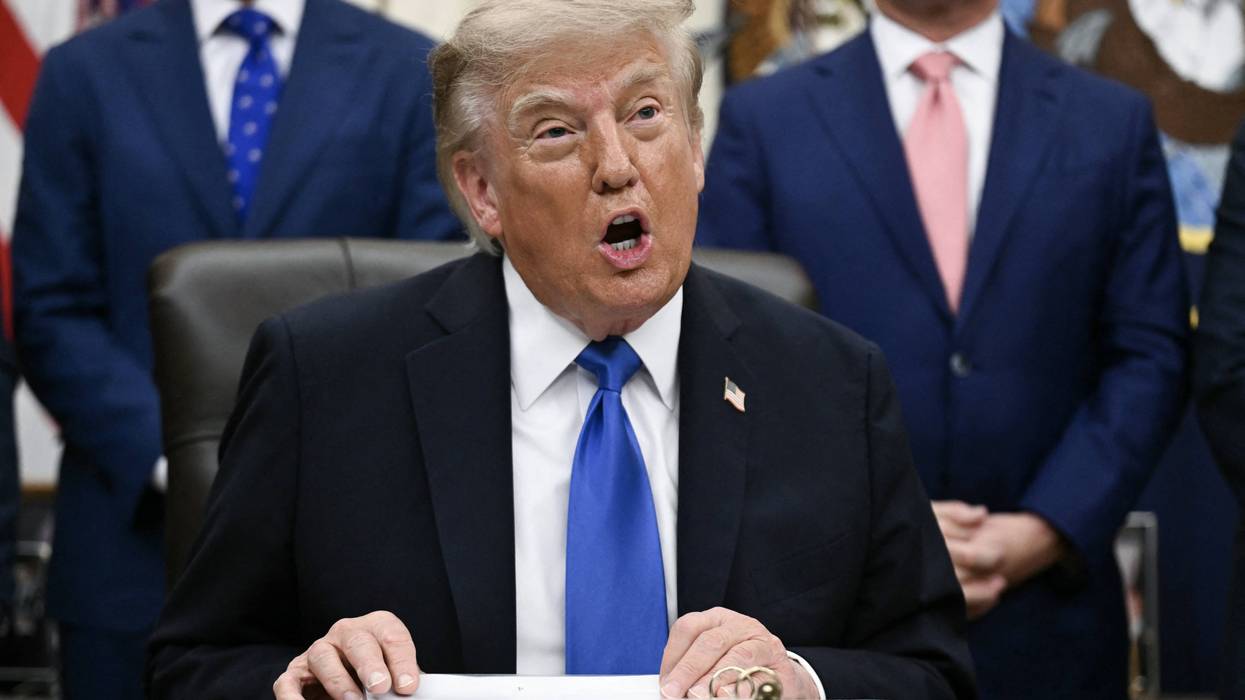
One petroleum industry analyst now projects potential record-breaking prices for diesel fuel by Labor Day.
More than six months after starting an illegal war with Iran, President Donald Trump is now threatening to rename the Strait of Hormuz, whose closure at the start of the conflict led to a global spike in energy prices.
In a Wednesday social media post, Trump falsely claimed that the strait is "under USA control" and then mused on whether to "change the name... to TRUMP STRAIT???"
"Like America itself, it would be 'hotter' than ever before!" the president added. "Thank you for your attention to this matter."
In reality—despite Trump's previous threats to declare the vital commercial waterway a US territory—the US does not have control of the Strait of Hormuz, through which roughly 20% of the world’s oil supply travels.
Al Jazeera reported on Wednesday that Iran's Persian Gulf Strait authority has added eleven more ships to its list of more than 50 vessels that are banned from traveling in the strait.
Iran's Islamic Revolutionary Guard Corps (IRGC) on Wednesday also claimed that two oil tankers that were traversing the strait caught fire after striking sea mines, according to Al Jazeera.
The price of Brent crude petroleum rose once again during Wednesday trading, climbing up over $95 per barrel. Data released Wednesday by the American Automobile Association (AAA) showed that the price of gas in the US has risen to $4.12 per gallon, while the price of diesel fuel has risen to $5.69 per gallon.
While most Americans deal with the price of gasoline on a daily basis, the price of diesel fuel might have an even larger impact on the overall economy given that diesel is used to power the vehicles that ship consumer goods in the US.
In a Wednesday social media post, petroleum industry analyst Patrick De Haan wrote that diesel prices are rising so quickly that "we could even break the all-time diesel record ($5.819/gal) by Labor Day."
Last month, Trump responded to collapsed trade talks with Canada by renaming Lake Ontario as "Lake America." Much like the illegal war with Iran, Trump's trade war with Canada is raising prices on goods paid for by US consumers.
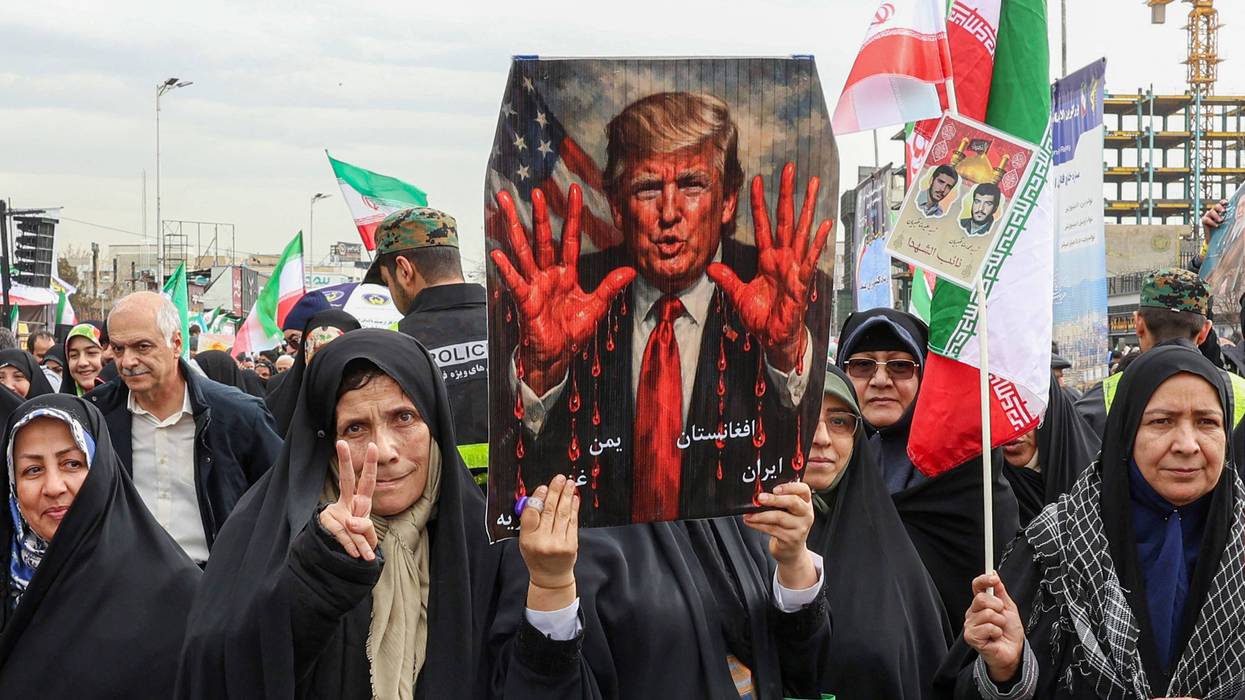
Iran “has not been and will never be the one to initiate attacks on civilian targets," said one Iranian military commander, but Tehran “will not hesitate to retaliate against despicable aggression on civilian facilities.”
Iran on Tuesday responded to US President Donald Trump's threat to destroy its civilization by warning that further attacks on its civilian infrastructure would trigger a crushing response that "will exceed the region’s boundaries."
Trump's rhetoric has grown increasing genocidal as his Tuesday night deadline for Iran to reopen the Strait of Hormuz draws nearer, writing on his Truth Social network that "a whole civilization will die tonight, never to be brought back again," if no deal is reached on the resumption of all shipping in the vital waterway, through which about 20% of the world's oil passes.
In response, Brig. Gen. Seyyed Majid Mousavi, commander of the Islamic Revolutionary Guard Corps (IRGC) Aerospace Force, declared the start of a "new phase" of operations aimed at deterring further US-Israeli escalation by preparing in-kind attacks.
Iran “has not been and will never be the one to initiate attacks on civilian targets," Mousavi said, warning that Tehran “will not hesitate to retaliate against despicable aggression on civilian facilities.”
Mousavi added that should Trump follow through on his threat, the IRGC “will inflict such damage on the infrastructure of the US and its partners that they will be deprived of the region's oil and gas for years to come."
Iranian Ambassador to the United Nations Amir-Saeid Iravani said Tuesday: “Iran will not stand idle in the face of such egregious war crimes. It will exercise, without hesitation, its inherent right of self-defense and will take immediate and proportionate reciprocal measures."
Even as US and Israeli bombing has killed around 2,000 Iranians since February 28—including hundreds of women and children—Tehran has insisted that it does not want to retaliate against American civilians, who Iranian Foreign Minister Seyed Abbas Araghchi recently said "overwhelmingly voted to end involvement in costly foreign wars."
While Iran has responded to US and Israeli bombing of civilian sites with measured missile and drone strikes on energy and economic targets in Israel and Gulf nations allied with the United States, Tehran has notably abstained from carrying out retaliatory attacks on US civilians.
Iranian officials have also shown a surreal penchant for pairing ominous brinkmanship with defiantly deadpan trolling.
Following Trump's Sunday ultimatum for Tehran to “open the Fuckin’ Strait, you crazy bastards," Iran's Embassy in Zimbabwe quipped, "We've lost the keys."
To which the Iranian Embassy in South Africa replied, "Shh… the key’s under the flowerpot."
Highlighting Tehran's policy of allowing ships from friendly nations to pass through the Strait of Hormuz—and throwing in a barb referring to the late child sex criminal and former Trump friend Jeffrey Epstein—Iran’s Embassy in Bulgaria posted: "Door's open for friends. Epstein’s friends need keys."
Echoing calls from across the US political spectrum, Iran's Embassy in South Africa on Sunday urged Trump's Cabinet officials to “seriously think about the 25th Amendment," which allows for the dismissal of a president who is incapacitated, unable, or unwilling to perform their duties.
Iran's UK Embassy chimed in with a quote from the iconic American author—and ardent anti-imperialist—Mark Twain: “It is better to keep your mouth closed and let people think you are a fool than to open it and remove all doubt.”
Ordinary Iranians, meanwhile, shrugged off Trump's threat while trying to go about their lives the best they could under the circumstances.
“The first thing that came to my mind is that I think Trump is under a lot of pressure, and that he has lost his mind,” a Tehran resident who gave only her first name, Lili, told The New York Times on Tuesday, adding that the US-Israeli war has got Iranians rallying behind a government despised by millions of her compatriots.
“So now, we are supporting Iran and whatever government is running it,” she said.
Iranian businessman Pedram Soltani said in a social media message to Americans, "Your president has now placed not only Iran, but also America and the entire world at a tremendous risk."
"If he pushes the war with Iran toward the destruction of bridges and power plants, more than 90 million people in Iran will be severely affected, and a humanitarian catastrophe will unfold," Soltani continued, referring to Trump's threat to attack such sites, which would be a war crime.
"Consequently, the war spreads further across the Middle East, and critical energy infrastructure in the region will be damaged," he said. "This will trigger a surge in the prices of oil, petrochemicals, metals, and other essential commodities. The consequences will hit you and billions of others, through skyrocketing fuel prices and widespread food inflation."
"At the same time, the United States will become one of the most hated countries in the world," Soltani added.
According to numerous surveys, it already is.
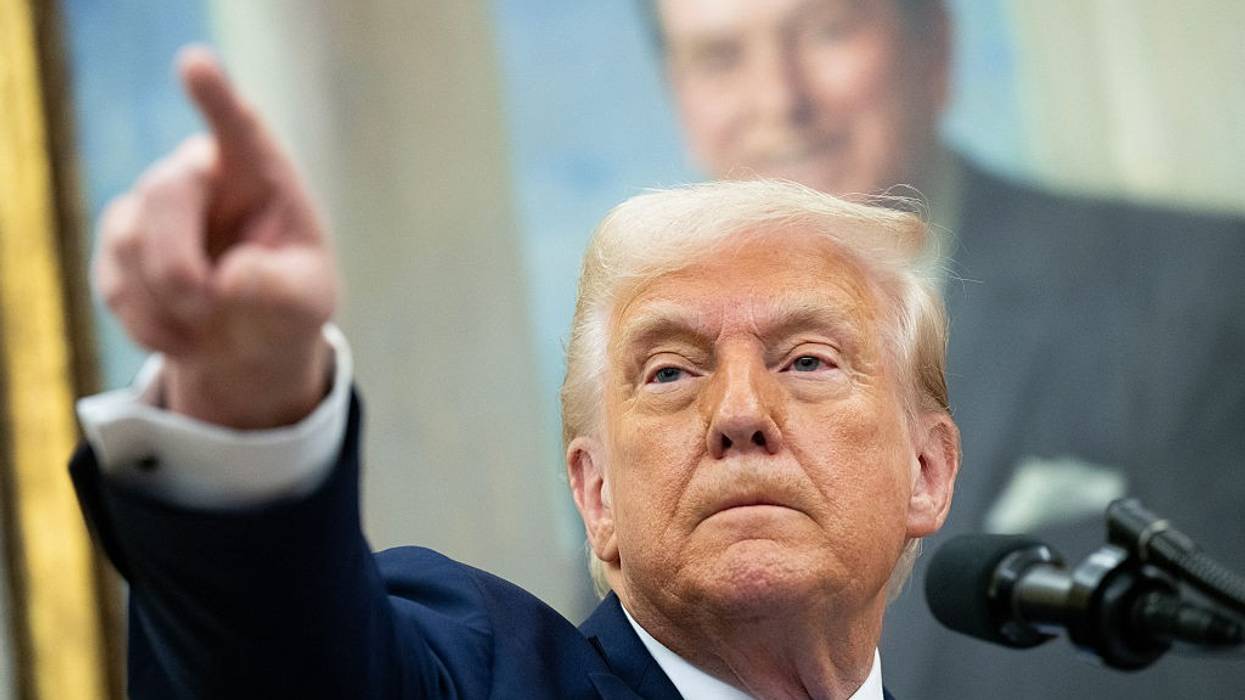
Despite U.S. intelligence once again finding Iran is not currently developing nukes, the president is trying to force Tehran into a nuclear deal after unilaterally abrogating an existing one in 2018.
Iran's military has reportedly readied ballistic missiles for possible launch against U.S. bases in the Middle East after President Donald Trump renewed his threat to wage war on the country if it does not reach an agreement with his administration regarding nuclear weapons—which American intelligence agencies have repeatedly found Tehran is not building.
Trump discussed Iran during a Sunday phone call with NBC News' Kristen Welker, telling her that "if they don't make a deal, there will be bombing, and it will be bombing the likes of which they have never seen before," adding that there is also "a chance that if they don't make a deal, that I will do secondary tariffs on them like I did four years ago."
Ayatollah Seyyed Ali Khamenei, the supreme leader of Iran's theocratic government, warned Monday that "if any hostile act is committed from outside, though the likelihood is not high, it will undoubtedly be met with a strong counterstrike."
Esmaeil Baghaei, a spokesperson for Iran's Foreign Ministry, said on social media Monday that "an open threat of bombing by a head of state against Iran is a shocking affront to the very essence of international peace and security."
"It violates the United Nations Charter and betrays the safeguards under the [International Atomic Energy Agency]," Baghaei added. "Violence breeds violence, peace begets peace. The U.S. can choose the course."
Iranian Gen. Amir Ali Hajizadeh, commander of the Islamic Revolutionary Guard Corps' (IRGC) Aerospace Division, noted Monday that "the Americans have 10 bases in the region, particularly around Iran, and 50,000 troops based in there."
"This means they are sitting in a glass house; and when one sits in a glass house, one does not throw stones at others," he added.
The Tehran Times reported Monday that Iran's military has "readied missiles with the capability to strike U.S.-related positions" and that "a significant number of these launch-ready missiles are located in underground facilities scattered across the country, designed to withstand airstrikes."
The U.S., meanwhile, is amassing firepower including B-2 Stealth Bombers at its base on the forcibly depopulated island of Diego Garcia in the Indian Ocean for possible use in strikes against Iran.
Trump today: If Iran does not agree to a deal “There will be bombing and it will be bombing the likes of which they have never seen before” Can he go 1 day without threatening a new war? How many would he like? - Greenland - Panama - Gaza - Mexico - Yemen - Somalia - Gaza - Venezuela Is 8 enough?
— Secular Talk (@kylekulinskishow.bsky.social) March 30, 2025 at 8:36 PM
Trump's threat to attack Iran—which hasn't started a war since the mid-19th century—comes despite U.S. Director of National Intelligence Tulsi Gabbardtestifying before the Senate Select Committee on Intelligence last week that "Iran is not building a nuclear weapon and Supreme Leader Khamanei has not authorized the nuclear weapons program he suspended in 2003."
U.S. intelligence agencies have repeatedly come to the same conclusion since the George W. Bush administration.
However, Gabbard added that "Iran's enriched uranium stockpile is at its highest levels and is unprecedented for a state without nuclear weapons."
That's at least partly due to the unilateral U.S. withdrawal from the landmark Joint Comprehensive Plan of Action (JCPOA)—also known as the Iran nuclear deal—in 2018 during Trump's first administration.
Since Trump abandoned the JCPOA—which was signed in 2015 during the Obama administration by China, France, Germany, Iran, Russia, the United Kingdom, and the United States—Tehran has been operating advanced centrifuges and rapidly stockpiling enriched uranium.
While there were hopes of a renewed deal during the tenure of former U.S. President Joe Biden, no agreement was reached, and Iranians continue to suffer under economic sanctions that critics have said are killing people and crippling the country's economy.
Earlier this month, Trump sent a letter to Khamenei in which he claims to have said, "I hope you're going to negotiate because if we have to go in militarily, it's going to be a terrible thing."
On Sunday, Iranian President Masoud Pezeshkian left open the possibility of indirect talks but said that the U.S. could not be trusted to keep its word.
"We don't avoid talks; it's the breach of promises that has caused issues for us so far," Pezeshkian said during a televised Cabinet meeting. "They must prove that they can build trust."
This isn't the first time that Trump has threatened Iran. In 2020, during his first term, the president vowed to strike 52 sites across Iran "very fast and very hard" if it retaliated for the U.S. assassination of IRGC commander Gen. Qasem Soleimani in Iraq. Later that year, Trump had another message for Iran: "If you fuck around with us, if you do something bad to us, we are going to do things to you that have never been done before."
On the campaign trail last September, Trump told Iranians he would "blow your largest cities and the country itself to smithereens" if he was reelected and Iran didn't cease what he perceives as threats against the United States.
While the U.S. has never directly attacked Iran, it did help overthrow the country's reformist government in 1953 and supported a repressive monarchy for decades leading up to the Islamic Revolution of 1979. The U.S. backed Iraq during that country's eight-year war against Iran, during which then-Iraqi President Saddam Hussein's forces used chemical weapons against Iranian troops and his own restive Kurdish population. In 1988, a U.S. warship in Iranian waters accidentally shot down Iran Air Flight 655, killing all 290 passengers and crew aboard. Then-President Ronald Reagan blamed the incident on the "barbaric Iranians."
The U.S. has also
supported the People's Mujahedin of Iran (MEK), a State Department-designated terrorist group that had previously assassinated six American officials, and successive U.S. administrations have used international financial institutions to punish Iran, like in 2007 when Bush pressured the World Bank into suspending emergency relief aid after the 2003 Bam earthquake, which killed more than 26,000 Iranians.
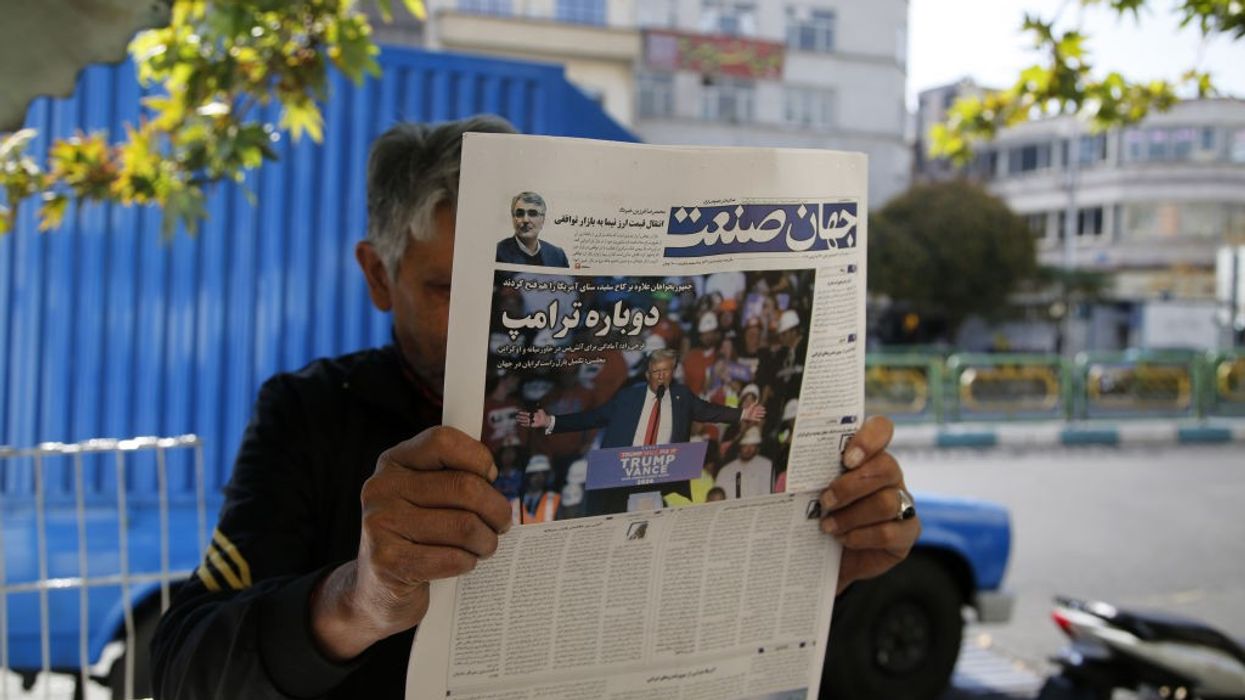
"Trump is inheriting a mess that he helped create," said the National Iranian American Council. "All parties need to focus not on threats but on dialogue to end these crises."
Amid growing concerns about what U.S. President-elect Donald Trump's return to the White House will mean for Washington's rocky relationship with Tehran, the Department of Justice on Friday announced charges against an Afghan national accused of plotting to assassinate the Republican at the direction of Iran's Islamic Revolutionary Guard Corps.
Though Trump survived two shooting attempts during the campaign, neither appears to be tied to Iran's alleged plot to kill him.
"There are few actors in the world that pose as grave a threat to the national security of the United States as does Iran," U.S. Attorney General Merrick Garland said in a Friday statement announcing the charges against Farhad Shakeri, "an asset of the Iranian regime who was tasked by the regime to direct a network of criminal associates to further Iran's assassination plots against its targets," including Trump.
"We have also charged and arrested two individuals who we allege were recruited as part of that network to silence and kill, on U.S. soil, an American journalist who has been a prominent critic of the regime," Garland added, referring to New Yorkers Jonathon Loadholt and Carlisle Rivera, who are both in custody—unlike Shakeri, who is believed to be in Iran. "We will not stand for the Iranian regime's attempts to endanger the American people and America's national security."
The department did not publicly identify the reporter but its statement "matched the description of Masih Alinejad, a journalist and activist who has criticized Iran's head-covering laws for women," Reuters noted Friday. "Four Iranians were charged in 2021 in connection with a plot to kidnap her, and in 2022 a man was arrested with a rifle outside her home."
The Friday announcement about these three men follows another case related to Trump and Iran. As Politico detailed: "In August, Brooklyn federal prosecutors charged a Pakistani man suspected of plotting on behalf of Iran to kill high-ranking U.S. politicians or officials—including perhaps Trump. The man is accused of trying to hire hitmen to carry out the plot."
The next month, after Trump was reportedly briefed about alleged Iranian assassination threats against him, he declared during a campaign rally that "if I were the president, I would inform the threatening country—in this case, Iran—that if you do anything to harm this person, we are going to blow your largest cities and the country itself to smithereens."
"We're gonna blow it to smithereens, you can't do that. And there would be no more threats," added Trump, whose comments were swiftly decried by the National Iranian American Council (NIAC) as "an outrageous threat" and "genocidal."
Responding to Reuters coverage of the Justice Department's Friday statement on social media, NIAC said that "threats of violence against political officials are unacceptable and only risk further opening Pandora's box of war and destruction. Trump is inheriting a mess that he helped create and reports like this demonstrate just how grave the stakes are. All parties need to focus not on threats but on dialogue to end these crises."
During Trump's first presidential term, he ditched the Joint Comprehensive Plan of Action, often called the Iran nuclear deal; ramped up deadly sanctions against the Middle East country; and ordered the assassination of Islamic Revolutionary Guard Corps Gen. Qassem Soleimani in Iraq—actions that heightened fears of a U.S. war with Iran.
Such fears have surged since Trump's Tuesday win. He is set to return as commander-in-chief after more than a year of the Biden-Harris administration backing Israel's assault on the Gaza Strip and strikes on other countries including Lebanon and Iran.
NIAC Action executive director Jamal Abdi said in a statement after the U.S. election that "many in our community feared this day—worried about the return of the travel ban, attacks on our civil liberties, demonization of immigrant communities, and deepening militarism in the Middle East. But we have been here before and our resilience is unwavering in standing up for our community and our rights."
"In the coming weeks, Trump, along with his new vice president, JD Vance will select the advisers who will shape his policies," Abdi noted. "We will not stand down, disengage, or give up but will redouble our efforts for peace and justice by any means necessary. The resilience and unity of our community are more vital now than ever."
CNN and Politico have reported that Brian Hook is expected to lead Trump's transition team at the U.S. Department of State. As Drop Site News' Murtaza Hussain wrote, Hook is "known as a major Iran hawk who helped lead the 'maximum pressure' campaign of sanctions, sabotage, and assassinations that characterized Trump's approach to Tehran."
Speaking with Hussain, Trita Parsi, executive vice president of the Quincy Institute for Responsible Statecraft, pointed out that Trump's previous Iran policy was largely guided by John Bolton, who spent over a year as his national security adviser, and Mike Pompeo, who served as secretary of state and director of the Central Intelligence Agency.
"The Trump administration's approach towards Iran depends very much on who he chooses to staff his administration. In his first term, he was sold on an idea by people like Pompeo and John Bolton that Iran could be sanctioned and pressured into oblivion, but that was an approach more likely to deliver war than an agreement," Parsi said. "The Iranian view is that Trump himself wants to make a deal, but it depends on whether he appoints the same neoconservatives as last time to his administration."
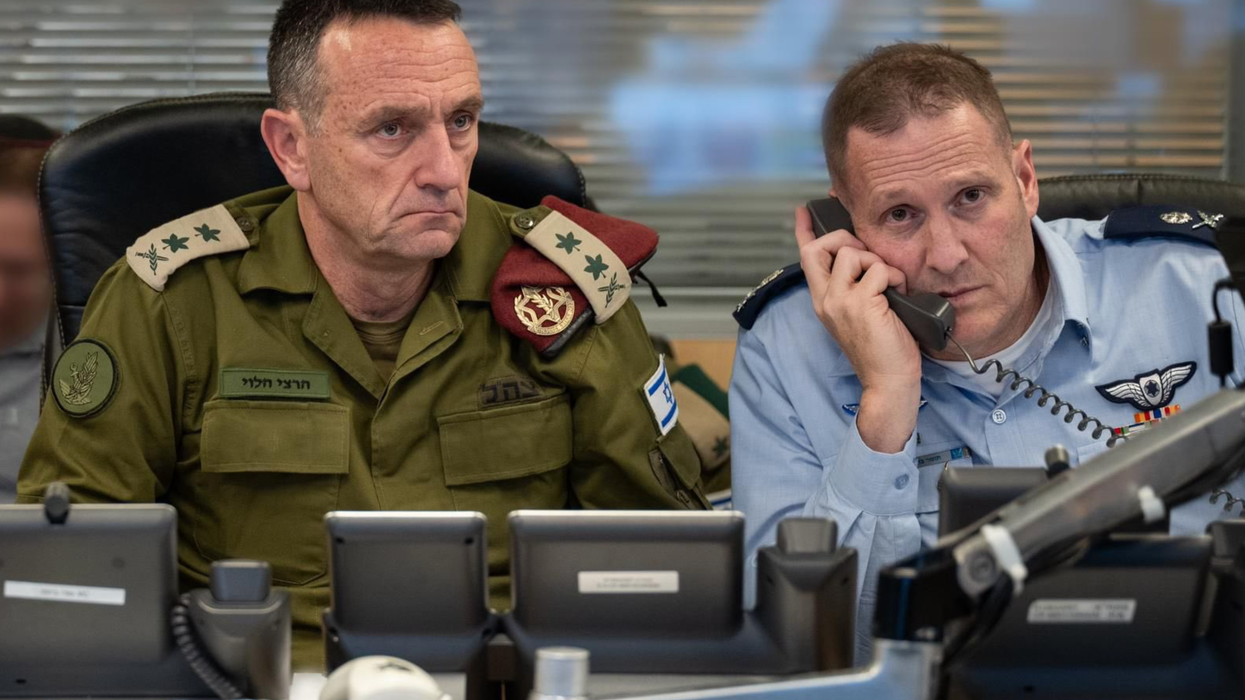
"The targets there are likely both Iranian assets as well as militias supported by Tehran," said one Middle East expert.
Israel—which is already waging war on Gaza and Lebanon—said its military struck targets in and near Iran's capital Tehran early Saturday, while explosions believed to be Israeli attacks were also reported in Syria and Iraq.
Numerous explosions were reported in and near the Iranian capital, including at the Imam Khomeini International Airport, as well as in eastern parts of the city and the Sadeghiyeh neighborhood of western Tehran. Israeli targets reportedly included the headquarters of the elite Islamic Revolutionary Guards Corps (IRGC).
"In response to months of continuous attacks from the regime in Iran against the state of Israel—right now the Israel Defense Forces is conducting precise strikes on military targets in Iran," IDF spokesperson Rear Adm. Daniel Hagari said in a video posted on social media.
"The regime in Iran and its proxies in the region have been relentlessly attacking Israel since October 7th—on seven fronts—including direct attacks from Iranian soil," Hagari added. "Like every other sovereign country in the world, the state of Israel has the right and the duty to respond. Our defensive and offensive capabilities are fully mobilized. We will do whatever [is] necessary to defend the state of Israel and the people of Israel."
Iran said it launched the October 1 missile attack in retaliation for Israel's targeted killing of longtime Hezbollah chief Hassan Nasrallah, the longtime leader of Hezbollah and an IRGC commander who was with him; as well as for the July assassination of Hamas leader Ismail Haniyeh in Tehran.
If the Syrian and Iraqi explosions are confirmed as Israeli strikes, it would mean that Israel is simultaneously attacking at least five nations—Palestine, Lebanon, Iran, Syria, and Iraq. In Palestine, the IDF is waging a yearlong war which has killed or wounded more than 153,000 people. Israel's bombardment and ground invasion of Lebanon have killed or wounded thousands of people and displaced more than 1.2 million others.
U.S. officials told media outlets that the Biden administration was informed of Saturday's attacks.
Meanwhile, peace groups in the U.S. warned of the risk of escalation.
"The U.S. should stay out of the conflict between Israel and Iran," Massachusetts Peace Action executive director Brian Garvey said in a statement. "Israel is bombing Iran, Iraq, Syria, Lebanon, Yemen—picking a fight with almost every one of its neighbors—while escalating its genocide in Gaza."
"The U.S. should not provide assistance for Israel's escalations, which would contravene President [Joe] Biden's stated goal of preventing a wider regional conflict," he continued. "Israeli Prime Minister [Benjamin] Netanyahu has long sought to embroil the U.S. in war with Iran, and his efforts to do so now are likely timed to influence the U.S. election."
"The United States should avoid that trap, stop sending weapons into the region, and support urgent talks for ceasefires in Gaza, Lebanon, and between Israel and Iran," Garvey added.

"Netanyahu will use it as the pretext for another provocation, because he's bent on starting this war," one writer predicted.
Iran on Saturday launched several drones and missiles toward Israel in
retaliation for the nation's deadly bombing of the Iranian consulate in Syria earlier this month.
According to CNN, this statement from Iran's Islamic Revolution Guards Corps was read on Iranian state-owned Press TV: "In response to the Zionist regime's crime in attacking the consular section of the Iranian Embassy in Damascus, the IRGC's air force hit certain targets in the territories of the Zionist regime with dozens of drones and missiles."
"The United States should avoid taking any military action in connection with the Israel/Iran conflict."
Israeli and U.S. officials also
confirmed the IRGC launch, estimated by Israel to involve over 100 drones.
"A short while ago, Iran launched unmanned aerial vehicles from its territory towards the territory of the state of Israel," the Israel Defense Forces (IDF) said in a statement. "The air defense array is on high alert at the same time as the air force planes and navy ships that are on a mission to protect the country's skies."
"The IDF is monitoring all targets," added the IDF, which has been waging war on the Gaza Strip since a Hamas-led attack on Israel October 7. "We ask the public to adhere to and follow the instructions of the Home Front Command and the official IDF announcements regarding the matter."
Iran's drone launch by comes after Iranian officials have reportedly been sending a message to the Biden administration through back channels: "We will attack the forces that attack us, so don't fuck with us and we won't fuck with you."
Further fueling fears of a new regional war, U.S. President Joe Biden said Friday: "We are devoted to the defense of Israel. We will support Israel. We will help defend Israel."
An American defense official said Saturday that "U.S. forces in the region continue to shoot down Iranian-launched drones targeting Israel... Our forces remain postured to provide additional defensive support and to protect U.S. forces operating in the region."
As the death toll in Gaza has mounted—the Israeli assault, which the International Court of Justice has determined is plausibly genocidal, has killed at least 33,686 people—Biden has faced intense pressure to condition or even cut off military aid to Israel.
In response to Iran's attack on Israel, Sarah Leah Whitson, executive director at Democracy for the Arab World Now, said in a statement that "the United States should avoid taking any military action in connection with the Israel/Iran conflict or further entangle U.S. armed forces in unauthorized and dangerous fighting in the Middle East."
"The Biden administration should call on Israel to immediately announce a cease-fire in Gaza and to refrain from using U.S. weapons in any further unlawful attacks against other countries' embassies and diplomatic facilities," she added.
On top of the nearly $4 billion in military aid that the U.S. gives Israel annually, the Biden administration has been shipping arms to the IDF since October and pushing for a new package worth over $14 billion that requires congressional approval.
U.S. House Majority Leader Steve Scalise (R-La.) said Saturday that "in light of Iran's unjustified attack on Israel, the House will move from its previously announced legislative schedule next week to instead consider legislation that supports our ally Israel and holds Iran and its terrorist proxies accountable."
Late Saturday, U.S. Senate Majority Leader Chuck Shucker (D-N.Y.) released a statement commending the Israeli and American troops who stopped most of the missiles and drones, condemning Iran's attack, and saying that "it is even clearer that the best way to help Israel is for the House to quickly pass the Senate's bipartisan national security supplemental next week."
Appearing on Al Jazeera Saturday, Sultan Barakat, a professor at Hamad Bin Khalifa University, suggested that Israeli Prime Minister Benjamin Netanyahu attacked the Iranian consulate to secure more U.S. weapons and try to silence anti-war critics.
The Council on American-Islamic Relations, the nation's largest Muslim civil rights group, argued that "the Biden administration emboldened the far-right Israeli government to manufacture this crisis by repeatedly giving it carte blanche to violate international law without any accountability—from murdering journalist Shireen Abu Akleh, to expanding illegal settlements, to committing a genocide in Gaza, to bombing an Iranian Embassy complex in Syria."
Sana Saeed, a media critic with
AJ+, said on social media Saturday that there will be "lots of incoming analysis for the next several hours, but there's really just one thing to know: None of this was inevitable nor did it start with Iran. This is U.S.-Israeli belligerence; this is Joe Biden's foreign policy and Israel's war expansionism as it conducts a genocide."
Trita Parsi, an expert on Iran and the Middle East and EVP at the Quincy Institute for Responsible Statecraft, also weighed in on social media, pointing to a specific example from over 25 years ago "that shows that the Iranian retaliation against Israel could perhaps have been evaded."
"The U.S., U.K., and France prevented the U.N. Security Council from condemning the Israeli attack on the Iranian consulate in Damascus despite it being a flagrant violation of international law," Parsi highlighted. "The Iranians have hinted that had the UNSC strongly condemned Israel, Iran might have refrained from retaliating against it."
"Certainly, the 1998 episode does not prove that Iran's retaliation against Israel today could have been prevented. But it does suggest that there was an opportunity to de-escalate that the U.S./U.K./FR ignored or dismissed," he added. "Then again, that fits perfectly with Biden's record of the past seven months as opportunity after opportunity to de-escalate and end the war in Gaza has been actively dismissed by him."

One observer said Israel is "trying to provoke a war with Iran to get the U.S. directly involved."
Iranian and Syrian officials on Monday accused Israel of bombing Iran's consulate in Damascus, an attack one expert called a "war-abetting escalation" that U.S. President Joe Biden "claimed he was preventing" in the Middle East.
Seven people including Iranian diplomats and Islamic Revolutionary Guard Corps (IRGC) senior commander Gen. Mohammad Reza Zahedi were killed in the airstrike, which according to the BBC occurred at approximately 5:00 pm local time and flattened the multistory consular building adjacent to the Iranian Embassy in the Syrian capital's Mezzeh district.
Iranian Foreign Minister Hossein Amir-Abdollahian described the strike as "a violation of all international obligations and conventions." Faisal Mekdad, his Syrian counterpart, condemned what he called a "heinous terrorist attack."
🚨🇮🇷
Footage shows the destruction of the Iranian Consulate after being hit by an Israeli Missile
This is a direct attack on Iranian Soil
pic.twitter.com/B24uFT9u7E https://t.co/4kH1XbKHbx
— Alex Barnicoat (@mrbarnicoat) April 1, 2024
Israeli officials declined to comment on the attack. Israel has increased airstrikes targeting IRGC and Iran-backed Hezbollah militants inside Syria since the Hamas-led October 7 attacks. Israeli strikes against Hezbollah have also killed hundreds of militants and civilians in Lebanon.
Hamidreza Azizi, a visiting fellow at the German Institute for International and Security Affairs, called the consulate attack a "significant escalation in tensions."
"This attack is viewed by some in Iran as a declaration of war by Israel against Iran," Azizi wrote on social media. "It represents a shift from previous engagements, directly hitting Iranian soil represented by its consulate in Syria—as opposed to targeting IRGC officers in Syrian sites."
"In earlier stages, Israel would refrain from targeting IRGC officers—only proxies and arms shipments," he continued. "Since the Gaza war, a shift was already there to target high-ranking Iranian commanders. Some sources claim the attack was a response to an assault on an Israeli ship last night at the port of Eilat, attributed to Iraqi militias. This suggests another new rule of engagement by Israel: direct retaliation against Iran for any attacks by its proxies."
Azizi added that the strike "is also seen as a message to both Iran and [President Bashar] al-Assad's regime in Syria: Israel's capability and willingness to escalate its response to the presence of Iranian forces in Syria."
Numerous experts including Azizi wondered whether Israel informed the United States ahead of the attack. A White House spokesperson said that Biden is aware of reports attributing the strike to Israel and that his "team is looking into it."
Trita Parsi of the Quincy Institute for Responsible Statecraft
said on social media that "this is the exact type of conduct that usually prompts the U.S. to label a country a pariah or rogue state."
"The U.S. accuses such states of seeking to destroy the 'rules-based order,'" Parsi noted. "But so far, Biden has acquiesced to Israel's conduct in this area as well as all other aspects of Israel's slaughter in Gaza."
Parsi accused Israel of "seeking to either destroy these norms or create a new normal in which it—much like the U.S.—will be untouchable above these laws and norms."
He also called the Damascus strike "the kind of war-abetting escalation Biden claimed he was preventing."
The U.S. has also bombed Syria—as well as Yemen, Iraq, and Somalia—since October 7.
Palestinian Policy Network fellow Tariq Kenney-Shawa said: "What the Biden administration means by 'taking every measure to avoid regional escalation' is that they're making sure only Israel is allowed to escalate. Deploying aircraft carriers, airstrikes in Yemen/Syria/Iraq, all of that is to make sure Israel can provoke but no one can respond."
While Parsi wondered if Israel attacked Iran's consulate—its sovereign territory—to elicit a response to justify a larger war, Antiwar.com editor Dave DeCamp went further, accusing Israel of "trying to provoke a war with Iran to get the U.S. directly involved."
Iranian journalist Mona Hojat Ansari wrote for the Tehran Times that the far-right government of Israeli Prime Minister Benjamin Netanyahu "believes that by plunging the region into a maelstrom of chaos and entangling the United States in another pointless war in West Asia that would drain American resources, it may find a chance to survive as an apartheid establishment."
"The attack on Iran's consulate should particularly raise a red flag for Washington," she added, "as it demonstrates Israel's readiness to ignite the entire region, even if it means that the U.S. and all its traditional allies in the region would suffer devastating consequences."