SUBSCRIBE TO OUR FREE NEWSLETTER
Daily news & progressive opinion—funded by the people, not the corporations—delivered straight to your inbox.
5
#000000
#FFFFFF
To donate by check, phone, or other method, see our More Ways to Give page.
Daily news & progressive opinion—funded by the people, not the corporations—delivered straight to your inbox.
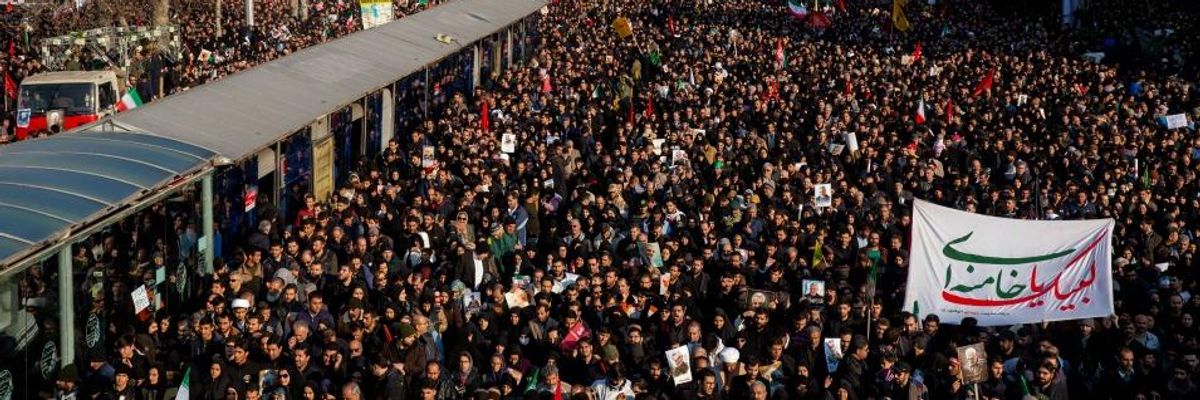
Mourners attend a funeral ceremony of Iranian Major General Qassem Soleimani and others who were killed in Iraq by a U.S. drone strike on January 6, 2020 in Tehran, Iran. (Photo: Majid Saeedi/Getty Images)
Funerals held all over Iran Monday for Major General Qasem Soleimani offered a striking visual of the consequences of President Donald Trump's drastic escalation of tensions between the U.S. and Iran, as millions of people poured into the streets to mourn the Iranian military commander.
Footage from Tehran and the city of Ahvaz showed enormous crowds of men, women, and children hailing Soleimani as a martyr and vowing that Trump would be held accountable for the military commander's assassination.
Farnaz Fassihi, an Iranian-American New York Times journalist who has been covering Iran for a quarter of a century, tweeted that she had "never seen anything like" the "sea of endless people" that had packed the streets of Tehran by 6:00 am.
The mourners gathered around the country as Soleimani's casket was transported to his hometown of Kerman, where he was to be buried.
The funeral came three days after Soleimani was killed in Baghdad in a U.S. drone strike ordered by the White House without the prior knowledge or approval of Congress.
While the Trump administration claims it had evidence Soleimani was planning imminent attacks against Americans in the Middle East, U.S. lawmakers have called the evidence of this "razor thin."
Rather, Iraqi Prime Minister Adel Abdul Mahdi told Iraq's Parliament on Sunday, Soleimani was in Baghdad to discuss diplomacy between Saudi Arabia and Iran.
At Soleimani's state funeral in Tehran, the general's daughter, Zeinab, said Trump has now "brought Iran and Iraq closer together."
"You crazy Trump, the symbol of ignorance, the slave of Zionists, don't think that the killing of my father will finish everything," Zeinab Soleimani said.
A number of observers wrote that the country exhibited a new level of unification against the U.S. at the funeral.
"This is a historic scene," tweeted Dr. Jennifer Cassidy, a politics lecturer at Oxford University. "Trump has united a country like never before. We're witnessing one the most seismic moments in history."
Reporting for NPR from the funeral in Tehran, Mary Louisa Kelly wrote that although many attendees carried signs emblazoned with the words "Down With U.S.A." and "Hard Revenge," their message was clearly aimed at the U.S. government--not at civilians.
The crowds included Iranians from across the political spectrum, reported the New York Times, including reformers who are opposed to President Hassan Rouhani's government but viewed Soleimani's killing as an attack on the entire country.
"People are incensed over what the U.S. did and are uniting to demonstrate that," tweeted Soraya Sarhaddi Nelson, a journalist based in Berlin.
Dear Common Dreams reader, It’s been nearly 30 years since I co-founded Common Dreams with my late wife, Lina Newhouser. We had the radical notion that journalism should serve the public good, not corporate profits. It was clear to us from the outset what it would take to build such a project. No paid advertisements. No corporate sponsors. No millionaire publisher telling us what to think or do. Many people said we wouldn't last a year, but we proved those doubters wrong. Together with a tremendous team of journalists and dedicated staff, we built an independent media outlet free from the constraints of profits and corporate control. Our mission has always been simple: To inform. To inspire. To ignite change for the common good. Building Common Dreams was not easy. Our survival was never guaranteed. When you take on the most powerful forces—Wall Street greed, fossil fuel industry destruction, Big Tech lobbyists, and uber-rich oligarchs who have spent billions upon billions rigging the economy and democracy in their favor—the only bulwark you have is supporters who believe in your work. But here’s the urgent message from me today. It's never been this bad out there. And it's never been this hard to keep us going. At the very moment Common Dreams is most needed, the threats we face are intensifying. We need your support now more than ever. We don't accept corporate advertising and never will. We don't have a paywall because we don't think people should be blocked from critical news based on their ability to pay. Everything we do is funded by the donations of readers like you. When everyone does the little they can afford, we are strong. But if that support retreats or dries up, so do we. Will you donate now to make sure Common Dreams not only survives but thrives? —Craig Brown, Co-founder |
Funerals held all over Iran Monday for Major General Qasem Soleimani offered a striking visual of the consequences of President Donald Trump's drastic escalation of tensions between the U.S. and Iran, as millions of people poured into the streets to mourn the Iranian military commander.
Footage from Tehran and the city of Ahvaz showed enormous crowds of men, women, and children hailing Soleimani as a martyr and vowing that Trump would be held accountable for the military commander's assassination.
Farnaz Fassihi, an Iranian-American New York Times journalist who has been covering Iran for a quarter of a century, tweeted that she had "never seen anything like" the "sea of endless people" that had packed the streets of Tehran by 6:00 am.
The mourners gathered around the country as Soleimani's casket was transported to his hometown of Kerman, where he was to be buried.
The funeral came three days after Soleimani was killed in Baghdad in a U.S. drone strike ordered by the White House without the prior knowledge or approval of Congress.
While the Trump administration claims it had evidence Soleimani was planning imminent attacks against Americans in the Middle East, U.S. lawmakers have called the evidence of this "razor thin."
Rather, Iraqi Prime Minister Adel Abdul Mahdi told Iraq's Parliament on Sunday, Soleimani was in Baghdad to discuss diplomacy between Saudi Arabia and Iran.
At Soleimani's state funeral in Tehran, the general's daughter, Zeinab, said Trump has now "brought Iran and Iraq closer together."
"You crazy Trump, the symbol of ignorance, the slave of Zionists, don't think that the killing of my father will finish everything," Zeinab Soleimani said.
A number of observers wrote that the country exhibited a new level of unification against the U.S. at the funeral.
"This is a historic scene," tweeted Dr. Jennifer Cassidy, a politics lecturer at Oxford University. "Trump has united a country like never before. We're witnessing one the most seismic moments in history."
Reporting for NPR from the funeral in Tehran, Mary Louisa Kelly wrote that although many attendees carried signs emblazoned with the words "Down With U.S.A." and "Hard Revenge," their message was clearly aimed at the U.S. government--not at civilians.
The crowds included Iranians from across the political spectrum, reported the New York Times, including reformers who are opposed to President Hassan Rouhani's government but viewed Soleimani's killing as an attack on the entire country.
"People are incensed over what the U.S. did and are uniting to demonstrate that," tweeted Soraya Sarhaddi Nelson, a journalist based in Berlin.
Funerals held all over Iran Monday for Major General Qasem Soleimani offered a striking visual of the consequences of President Donald Trump's drastic escalation of tensions between the U.S. and Iran, as millions of people poured into the streets to mourn the Iranian military commander.
Footage from Tehran and the city of Ahvaz showed enormous crowds of men, women, and children hailing Soleimani as a martyr and vowing that Trump would be held accountable for the military commander's assassination.
Farnaz Fassihi, an Iranian-American New York Times journalist who has been covering Iran for a quarter of a century, tweeted that she had "never seen anything like" the "sea of endless people" that had packed the streets of Tehran by 6:00 am.
The mourners gathered around the country as Soleimani's casket was transported to his hometown of Kerman, where he was to be buried.
The funeral came three days after Soleimani was killed in Baghdad in a U.S. drone strike ordered by the White House without the prior knowledge or approval of Congress.
While the Trump administration claims it had evidence Soleimani was planning imminent attacks against Americans in the Middle East, U.S. lawmakers have called the evidence of this "razor thin."
Rather, Iraqi Prime Minister Adel Abdul Mahdi told Iraq's Parliament on Sunday, Soleimani was in Baghdad to discuss diplomacy between Saudi Arabia and Iran.
At Soleimani's state funeral in Tehran, the general's daughter, Zeinab, said Trump has now "brought Iran and Iraq closer together."
"You crazy Trump, the symbol of ignorance, the slave of Zionists, don't think that the killing of my father will finish everything," Zeinab Soleimani said.
A number of observers wrote that the country exhibited a new level of unification against the U.S. at the funeral.
"This is a historic scene," tweeted Dr. Jennifer Cassidy, a politics lecturer at Oxford University. "Trump has united a country like never before. We're witnessing one the most seismic moments in history."
Reporting for NPR from the funeral in Tehran, Mary Louisa Kelly wrote that although many attendees carried signs emblazoned with the words "Down With U.S.A." and "Hard Revenge," their message was clearly aimed at the U.S. government--not at civilians.
The crowds included Iranians from across the political spectrum, reported the New York Times, including reformers who are opposed to President Hassan Rouhani's government but viewed Soleimani's killing as an attack on the entire country.
"People are incensed over what the U.S. did and are uniting to demonstrate that," tweeted Soraya Sarhaddi Nelson, a journalist based in Berlin.