

SUBSCRIBE TO OUR FREE NEWSLETTER
Daily news & progressive opinion—funded by the people, not the corporations—delivered straight to your inbox.
5
#000000
#FFFFFF
To donate by check, phone, or other method, see our More Ways to Give page.
Daily news & progressive opinion—funded by the people, not the corporations—delivered straight to your inbox.
On both sides of the Atlantic, volleys of laws threatening long-term imprisonment for nonviolent dissent are being put on the books to cow the climate movement into silence. Trump promises to go further.
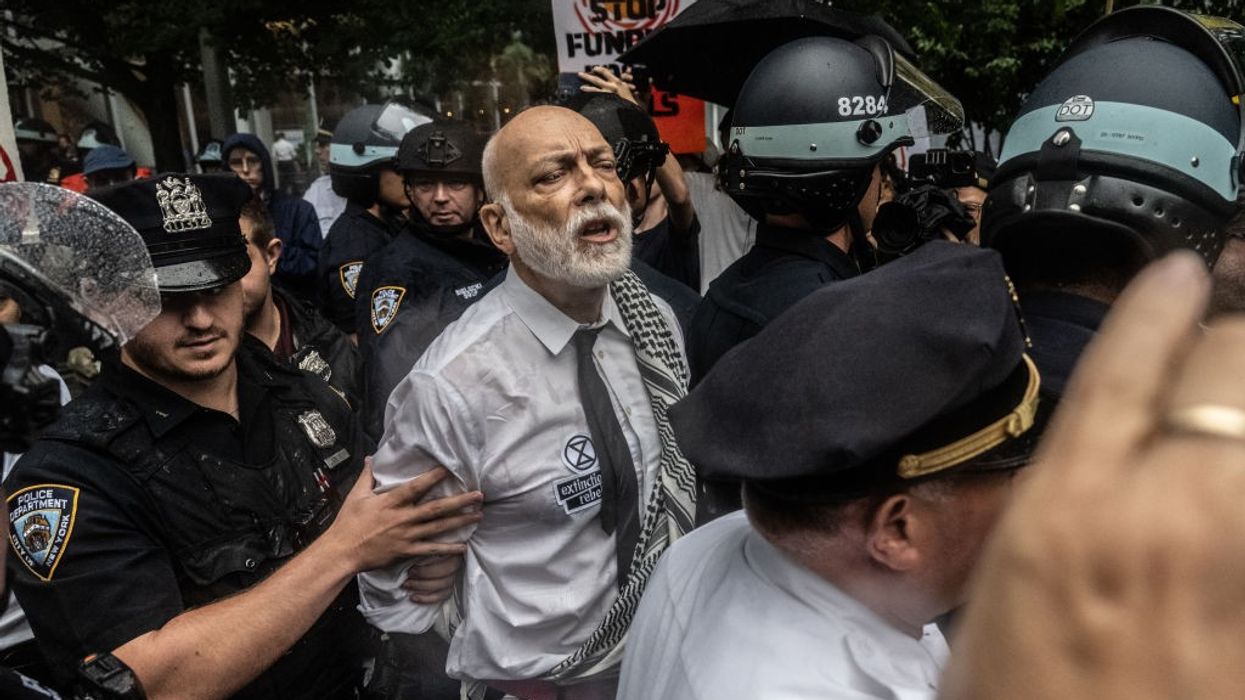
In August, climate activist and cellist John Mark Rozendaal was arrested and charged with criminal contempt for playing a few minutes of Bach outside Citibank’s headquarters in New York City. Rozendaal, 63, was prominent in the “Summer of Heat on Wall Street” campaign that targeted Citibank for its prolific financing of fossil-fuel projects. He and a co-defendant now face up to seven years imprisonment if convicted.
Meanwhile in Atlanta, more than 50 justice and environmental activists are awaiting trial on domestic terrorism and other charges arising from their years-long defense of the city’s South River Forest against the construction of an 85-acre police training center there. They are being prosecuted under Georgia’s Racketeer Influenced and Corrupt Organization (RICO) law. Any of them found guilty of “racketeering” would have five to 20 years of imprisonment added to their sentences for the alleged underlying crimes.
Such situations are symptomatic of a grim trend in both the United States and Europe. Nonviolent, nondestructive climate protest is increasingly being subjected to criminal prosecution, while punishments are being ratcheted up to levels befitting violent and far more serious crimes.
The state abuses described in this article should be considered a preview of what is almost guaranteed to be even worse to come if Donald Trump does indeed retake the White House and the Republicans win majorities in the House and Senate.
Across the Global South, such environmental protests are all too often being met by corporate and state forces with extreme extrajudicial violence, especially in Indigenous communities. Here in the Global North, however, the clampdown on protest has largely been through legal action, at least so far. But that might—especially in an America with Donald Trump as its president again—only be a prelude to more violent kinds of suppression as global warming accelerates.
For embattled American climate activists, this trend further raises the stakes of the November 5 election. The crackdowns on climate protest are so far being carried out by state and local governments. But the state abuses described in this article should be considered a preview of what is almost guaranteed to be even worse to come if Donald Trump does indeed retake the White House and the Republicans win majorities in the House and Senate. As recently as October 13, in fact, Trump insisted that, once back in the White House, he’d call in the military to quash domestic dissent of any sort.
In addition, a Trumpian Congress would be likely to pass laws gutting federal climate policies and imposing extreme penalties on future climate protesters. Both prospects also feature prominently in the Heritage Foundation’s Project 2025, produced in part by a gaggle of former Trump officials. That now-infamous blueprint for his possible second administration calls explicitly for—as the Center for American Progress describes it—“suppressing dissent and fomenting political violence.” Among other things, Project 2025 suggests that a future President Trump could invoke the Insurrection Act of 1807, which would indeed allow him to use the military to punish lawful nonviolent protest. And count on it, he’s almost certain to exploit that act if he does indeed become president again.
Since 2016, 21 states have passed a total of 56 laws criminalizing protest or dramatically increasing the penalties for engaging in it. To be sure, John Mark Rozendaal was arrested in New York, a city located in a blue state, but all the states that have adopted new anti-protest laws are governed by Republican-majority legislatures. And the specific activity most frequently targeted for prosecution is protesting the construction or existence of oil and gas pipelines. (Note that all state laws mentioned below are described in detail in a recent report by the International Center for Not-For-Profit Law, or ICNL.)
The state of Alabama, for example, can now punish a person who simply enters an area containing “critical infrastructure,” including such pipelines, with up to a year in jail and a fine of up to $6,000. If you go near a pipeline in Arkansas, you’re at significantly higher risk: imprisonment of up to six years and a $10,000 fine. Impeding access to a pipeline or a pipeline construction site in Mississippi carries a sentence of up to seven years. Do that in North Carolina as a member of a group and you’ve got even bigger problems. As the ICNL reports, “[A] group of people protesting the construction of a fossil fuel pipeline could face more than 15 years in prison and a mandatory $250,000 fine if they impede or impair the construction of a pipeline.”
Even as protest is being criminalized, assaulting protesters by car is, in effect, being decriminalized.
Many such sentences for protesting are wildly disproportionate to the severity of the act committed. In Florida, trespassing on property that contains pipelines can result in up to five years imprisonment, compared to only 60 days for trespassing just about anywhere else. Enter a pipeline facility in Ohio with the intention of tampering with it in any way and face a potential ten-year sentence. Simply spraying graffiti on an Ohio pipeline installation can carry a six-year sentence, while anyone who “conspires” with the person creating such graffiti could be fined an eye-popping $100,000.
Many climate marches or demonstrations involve walking or standing in roadways. Politicians have been exploiting the fact that “automobile supremacy is inscribed in law by every branch of government and at every level of authority” (in the words of law professor Gregory Shill) to pass highly punitive measures against street protests with little fear of having them overturned. In effect, the laws privilege fossil-fueled vehicles over the human beings who speak out against them.
In May, the Tennessee legislature passed a law that mandates a prison sentence of 2 to 12 years for protesters convicted of knowingly obstructing roadways. In Florida, groups of 25 or more protesters impeding traffic can be charged with “rioting” and face up to 15 years imprisonment. Anyone in Louisiana who does no more than help plan a protest that would impede traffic can be charged with conspiracy or with “aiding and abetting,” even if the protest ends up not hindering traffic or not occurring at all.
In Iowa, being on the street or sidewalk during a vociferous but nonviolent protest can cost you five years in prison, yet (believe it or not) a driver who runs into you during a protest, causing injury, is immune from civil liability if that driver can convince authorities that he or she had taken “due care.”
Laws that permit drivers to run into or over pedestrians engaged in protest have been passed in four states. Three of those laws hit the books in 2021 in the midst of a 16-month period during which American drivers deliberately rammed into groups of protesters a whopping 139 times, according to a Boston Globe analysis. Three victims were killed and at least 100 injured. Drivers were criminally charged in fewer than half of the ramming incidents and in only four was a driver actually convicted of a felony. In other words, even as protest is being criminalized, assaulting protesters by car is, in effect, being decriminalized.
Finally, Louisiana can file RICO charges against people who, as part of a “tumultuous” demonstration, block roads or damage oil or gas pipelines. And protesters beware, since that state’s RICO law carries the possibility of 50 years in prison at hard labor and a $1 million fine. (And yes, you read that right!)
Many laws that impose severe penalties for protest were passed in the wake of the Indigenous-led campaign against the Dakota Access oil pipeline in 2016-2017. Hundreds of people were arrested in that struggle. More than 700 protesters with the Indigenous Environment Network have been criminalized for their untiring efforts to impede or halt pipeline projects across North America.
If the dozens of state anti-protest laws display many suspicious similarities, that’s no coincidence. In response to pipeline protests, oil and gas companies teamed up with the American Legislative Exchange Council, which draws up “model legislation” for Republicans in statehouses across the country to use as templates for bills that push various corporate and hard-right priorities. Once this genre of legislation was directed toward on-site pipeline protests and passed in state after state, it was also seized upon to criminalize street marches and demonstrations, including those against racist violence, fossil fuels, and other ills—all with “traffic safety” as a pretext.
Following the lead of their kindred state legislators, Republicans in Congress have proposed their own raft of bills criminalizing protest. Fortunately, they haven’t succeeded in getting any of them passed—yet. Many of the bills were prompted by campus protests against U.S.-supported genocide in Gaza or over climate policy and against the fossil-fuel industry.
Some of the congressional bills amounted to less-than-serious grandstanding. One, for instance, would have required a person convicted of “unlawful activity” on a university campus at any time since last October 7 to perform six months of “community service” in Gaza. But there were also dead-serious bills like the one prescribing a prison sentence of up to 15 years for inhibiting traffic on an interstate highway. Other proposed bills would have withheld federal funding (in one case, even pandemic aid) from states that refused to prosecute people who took part in protests on public roadways.
Punitive measures against climate protest are reaching new extremes in Europe, too. Since the British Parliament passed harsh new anti-protest laws in 2022, more than 3,000 activists associated with the Just Stop Oil movement have been arrested. According to CNN, “Most of those arrests have been for planning or carrying out direct actions, including slow marching,” which impedes traffic.
In response to such repression, Michel Forst, the United Nations Special Rapporteur on Environmental Defenders, wrote that under the Aarhus Convention (a 1998 agreement most European countries have signed but not the United States), “Whether intended or not, any disruptions that [environmental] actions may cause, such as traffic jams or disturbances to normal economic activity, does not remove the protection for the exercise of fundamental rights during such action under international human rights law.”
In defiance of that principle, the new British laws prescribe a sentence of up to 10 years imprisonment for those convicted of planning protests judged to be a “public nuisance” (which often means disrupting traffic). Such prison terms, noted CNN, are comparable to those for aggravated robbery or rape under British law.
When the climate change group Extinction Rebellion announced an action near The Hague in September 2023, more than 10,000 people of all ages showed up. They’d come to protest the more than $40 billion in subsidies that the Netherlands government gives fossil fuel companies annually. The police blasted the crowd with water cannons, then arrested and hauled away 2,400 protesters, including children.
The group Climate Rights International (CRI) reports that “some democratic countries are even taking measures designed to stop peaceful climate protests before they start.” In June 2023, for instance, German police detained an activist before he could even leave his home to join a climate protest. Five months earlier, a Dutch activist was held in custody for two days to keep him from an action by Extinction Rebellion. He ended up being convicted of sedition (yes, sedition!) for encouraging others to attend the protest. None of that sounds like something “democratic countries,” as CRI called them, should be doing.
People charged with nonviolent protest often invoke the “necessity defense,” declaring that they committed a minor law violation to stop a far greater crime. Unfortunately, that defense almost never succeeds and judges often forbid defendants from even explaining their motives during a trial.
That’s what happened to members of the group Insulate Britain who stood trial this year for a climate protest that disrupted traffic by nonviolently occupying streets and climbing onto overpasses along a major London ring road in 2022. The judge presiding over their trials ordered the defendants not to mention climate change in court. Several of the activists defied that order, citing the climate emergency as their motivation, so the judge promptly held them in contempt of court and sent two of them to jail for seven weeks.
One of the protesters cited for contempt, Nick Till, told CRI that, while trying to bar him and the others from explaining the purpose of their actions, the judge allowed the prosecutors to depict the defendants as threats to society. “There’s an attempt to insinuate we’re a ‘cell,’” Till said, “which is language that implies some kind of revolutionary group. They had an expert in counterterrorism testify. They tried to portray us as dangerous extremists.”
Though also being threatened with increasing penalties under state laws, Americans have somewhat stronger protections under the First Amendment.
In July, four people who planned the London protests were convicted and sentenced to a draconian four years in prison. A fifth defendant, Roger Hallam, one of the most prominent British climate activists, was sentenced to five years even though, bizarrely enough, he was neither a planner of the protest nor a participant. He was charged instead for a speech he gave regarding civil disobedience as an effective form of climate action in a Zoom call with that protest’s planners.
In their trial, the five defendants represented themselves. Over the course of four days, with the judge repeatedly trying and failing to silence them, they presented what could be the most extensive and compelling version of the necessity defense ever heard in a courtroom. (Later, in his prison cell, Hallam wrote up an account of the trial. It’s well worth reading.)
On both sides of the Atlantic, volleys of laws threatening long-term imprisonment for nonviolent dissent are being put on the books to cow the climate movement into silence. So far, European protesters who dare to resist are getting hit hardest with convictions and sentences. Though also being threatened with increasing penalties under state laws, Americans have somewhat stronger protections under the First Amendment. But how long will dissent continue to enjoy such protections in this country? That largely depends on how we all vote between now and November 5.
"It is unconscionable that Global North governments have continuously rejected their responsibility to deliver adequate climate finance for the Global South."
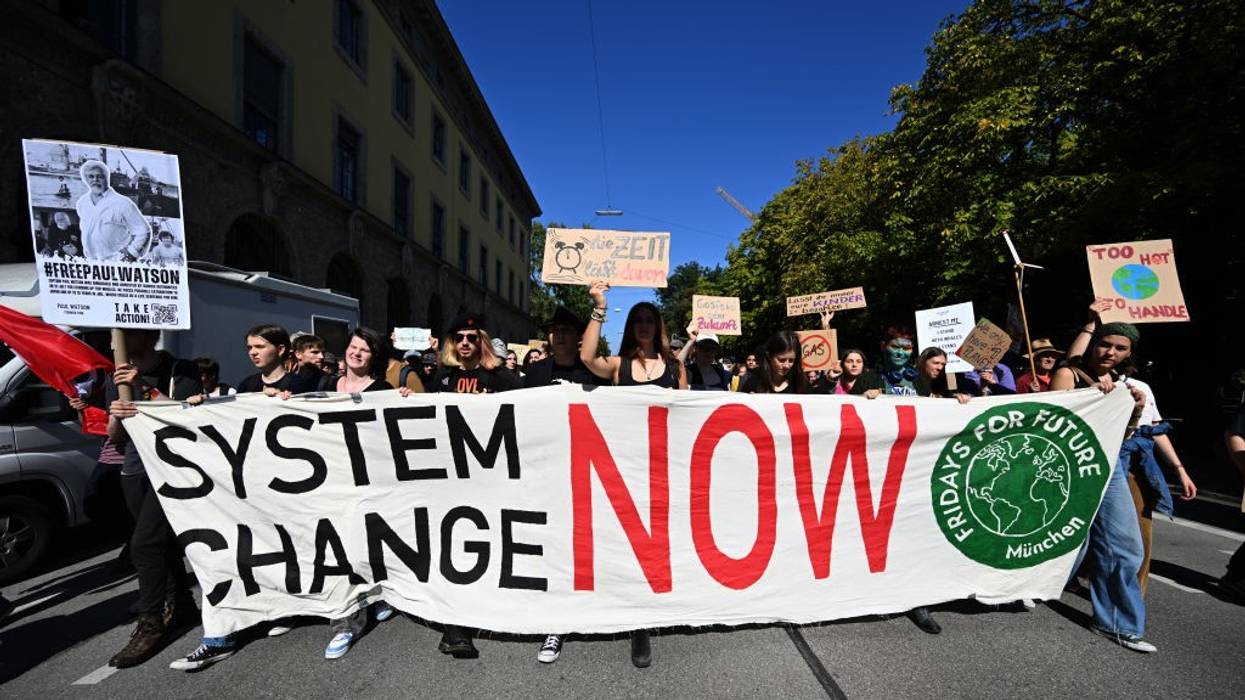
Climate protesters across the world hit the streets on Friday to kick off this year's Global Climate Strike ahead of the opening of high-level United Nations General Assembly meetings next week, where climate finance for the Global South is on the agenda.
Protests for climate justice were planned across 50 countries, with Germany alone seeing more than 100 rallies that together drew some 75,000 people. The protests were spearheaded by the youth-led group Fridays for Future (FFF), started by Greta Thunberg in 2018. The New York chapter of the group marched across the Brooklyn Bridge Friday afternoon aiming to "tear down the pillars of the fossil fuel industry."
One of the main climate items on the international agenda this year regards financing for Global South countries that are disproportionately impacted by climate breakdown. The Climate Action Network International on Friday called for Global North countries—which are responsible for the vast majority of historical emissions—to pay $5 trillion per year to Global South countries in climate reparations.
"It is unconscionable that Global North governments have continuously rejected their responsibility to deliver adequate climate finance for the Global South," Lidy Nacpil, the Philippines-based coordinator of the Asian Peoples Movement on Debt and Development, said in a statement.
"If developed nations are serious about solving the problem of climate change, as they claim to be, they should agree to a climate finance target that covers the costs of mitigation, adaptation, just transition, and loss and damage," she added. "The Global South is owed trillions—not billions."
Today in Berlin! This is big. It’s not easy being a climate activist these days yet hope is all around. #climatestrike #nowforfuture pic.twitter.com/A9jze0yts7
— Luisa Neubauer (@Luisamneubauer) September 20, 2024
The UNGA meetings will set the stage for negotiations at the COP29 climate summit in Azerbaijan in November.
Advocates criticized rich countries for their unwillingness to provide meaningful levels of finance to the Global South following preliminary talks in Bonn, Germany in June.
A study published in Nature last year found that even if all countries decarbonize by 2050, Global North countries would by that time collectively owe Global South countries $192 trillion in climate reparations. This analysis is the basis for the $5 trillion annual payout sought by campaigners.
The New York marchers on Friday chanted climate protest favorites such as "What do we want? Climate justice. When do we want it? Now" and "The people, united, will never be defeated" as they crossed the Brooklyn Bridge. They carried banners with messages such as "Tear Down Fossil Fuels" and "We Strike for the Future."
The most specific demand issued by the New York protesters on Friday was for Gov. Kathy Hochul, a Democrat, to sign the Climate Change Superfund Act, which would require polluting companies in the state to pay into a fund that could be used for extreme weather resiliency and preparation projects. The state Legislature has already passed the bill, and it awaits only the governor's signature. Democrats have also proposed a similar measure at the federal level.
There's some diversity in the political makeup of the global FFF protests, which, even just in New York, include people from a wide array of organizations. The German chapter has distanced itself from comments Thunberg made about Israel's war on Gaza, which she called a genocide. She was arrested at a pro-Palestine rally in Stockholm earlier this month.
FFF Germany did take a swipe at the far-right, which has been ascendant in the country in recent years, running on an anti-immigrant platform, and the national government, led by the center-left Social Democratic Party.
"The climate crisis is the greatest challenge of our time, not right-wing debates about migration," the group wrote on social media on Friday. "If the climate targets were a border, the government would have closed it long ago. We remain loud for climate protection!"
FFF and other climate activist groups have not been able to sustain the numbers they reached in 2019, when coordinated strikes across the world reached record numbers.
Though Friday's actions were smaller, they gave hope to movement veterans. Writer and climate organizer Bill McKibben, remarking on the large number of protesters in Germany, wrote on social media that school strikes were "back with a bang."
"Citi keeps proving their violent business is rooted in violent people," said the Planet Over Profit campaign.
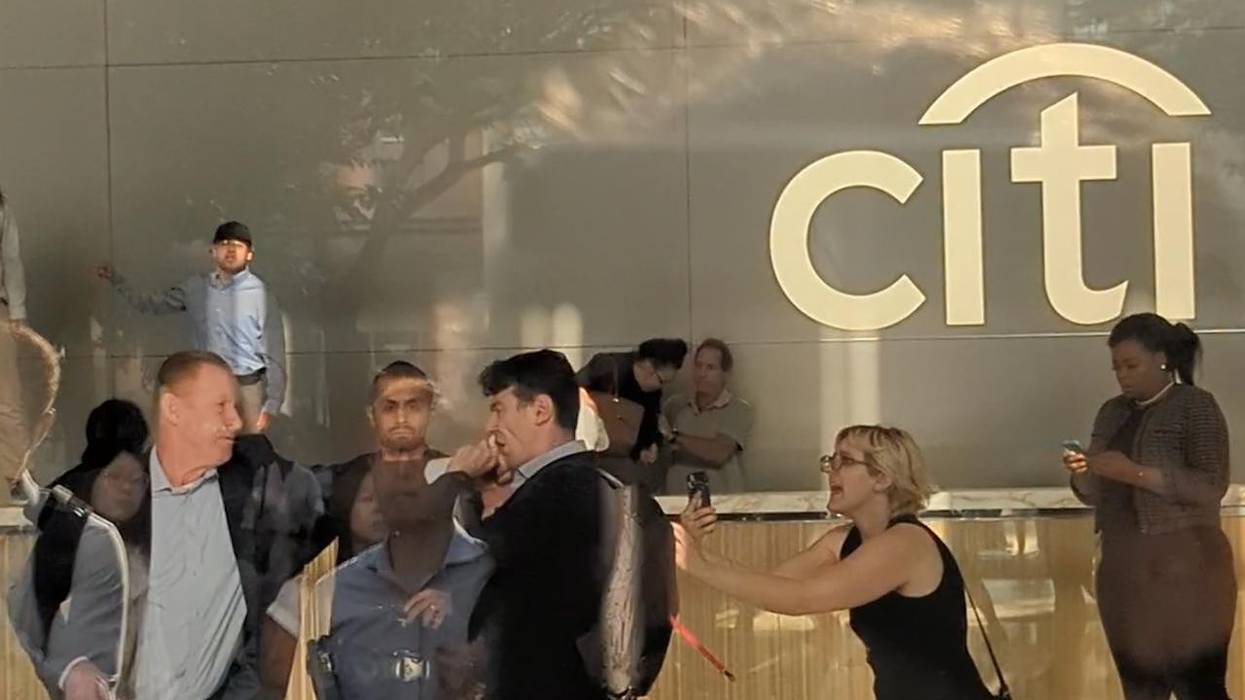
A climate protester was taken to a hospital bleeding on Wednesday, according to organizers, after a security guard at Citibank's global headquarters in New York punched him in the face as campaigners assembled in the lobby of the building.
The climate advocate, Eren Can Illeri, was taking part in an action organized by Summer of Heat, which is supported by a coalition including New York Communities for Change, Planet Over Profit, and Stop the Money Pipeline.
Illeri was joining other campaigners in calling on Citibank executives to meet with them to discuss the bank's funding of fossil fuel projects. Citibank has invested $396.3 billion into coal, gas, and oil infrastructure projects since the Paris climate agreement was finalized in 2015, and Summer of Heat has made the bank its top target this summer as it demands Wall Street divest from the climate emergency.
"We have been asking Citi to meet with us for weeks to talk about what it can do to tackle the climate emergency," said Alicé Nascimento, a spokesperson for the Summer of Heat campaign. "But rather than meet with us, they have sent their security guards to physically attack peaceful climate activists after weeks of intimidation and threats."
Illeri appeared to be filming with a cellphone when the security staff member approached him and tried to grab the phone out of his hands, according to a video of the incident. The guard then punched Illeri in the face while holding the phone, and pushed him to the ground.
BREAKING: Citibank staff punches peaceful climate activist in the face for taking video. He was taken to the hospital bleeding.@Citi keeps proving their violent business is rooted in violent people. This can't go on. pic.twitter.com/E1KCwQ1dCY
— Planet Over Profit (@pop4climate) August 14, 2024
The violence displayed mirrors "the violence of fossil fuels and climate chaos," said Alice Hu, a climate campaigner for New York Communities for Change.
"Citi backs violence and it's sickening," she said.
Summer of Heat began on June 10, and since then more than 4,000 campaigners have joined protests to demand Citibank end its financing of fossil fuel projects.
More than 475 people have been arrested for protesting the bank's investments—including a cello-playing grandfather last week—and protesters last month reported being shoved by one of the bank's top lawyers.
"Citi keeps proving their violent business is rooted in violent people," said Planet Over Profit. "This can't go on."
The mobilized tend to stay mobilized, they tend to mobilize others, and their actions may reframe what the elections are about.
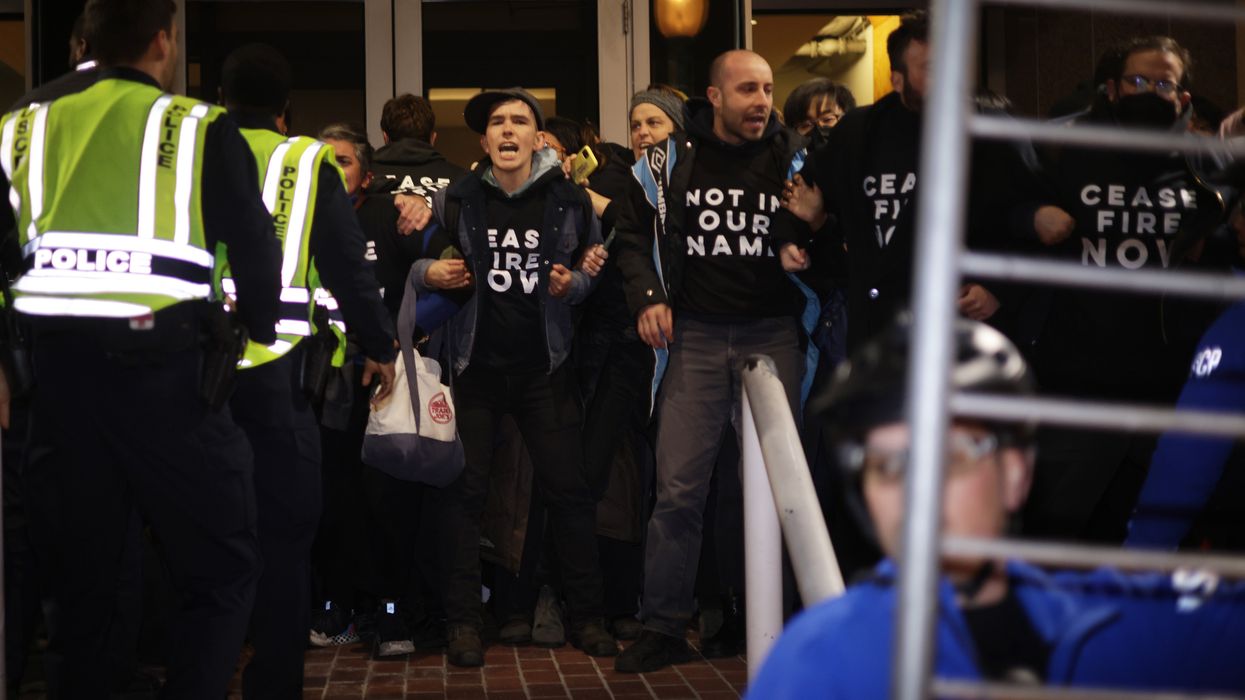
Recent protests at U.S. universities have seized global attention. And now, with summer in full swing, a new protest wave is becoming visible on the horizon at the Republican and Democratic conventions in Milwaukee and Chicago. If those and other expected protests are as large as they’re anticipated to be, how will they affect the elections in November?
Among the many reasons activists organize protests is their desire to focus attention on a cause. Election seasons present opportunities for doing just that. Many people who otherwise do not tune in to policy debates begin to pay particular attention when the Oval Office is at stake.
At the same time, mainstream politicians and campaigns can be wary of election year street protests. Politicians, of course, generally want to avoid becoming the target of protests. More importantly, political operatives dislike volatility. They worry that protests will backfire and their candidate will be blamed for any disturbances of the peace.
Empirical research suggests that those relying on support from aggrieved groups may find it helpful to emphasize nonviolence, but that discouraging protest, in general, may be counterproductive.
Political operatives also employ a “dollars or votes” calculus that tells them not to let energy be wasted on things presumed not to deliver campaign donations or Election Day votes. For these reasons and others, the major parties sometimes pressure the officers of nonprofit organizations, unions, and activists to demobilize protest movements in election years.
Yet while it turns out that street protests do tend to influence elections, they more often do so in unexpected ways.
A 2021 study by John Holbein, Kei Kawashima-Ginsberg, and Tova Wang examined Black Lives Matter, climate, and gun control protests, as well as protests for and against former U.S. President Donald Trump from 2017 to 2020. Their national study found that counties with more frequent and larger protests tended to see significantly increased registration and turnout among young voters, voters of color, and Democrats.
Taking a longer view, Daniel Gillion and Sarah Soule studied congressional elections over four decades from the 1960s to the 1990s. They concluded that liberal protests tended to benefit left-of-center candidates and that conservative protests tended to benefit right-of-center candidates. A protest on their respective side sometimes led to as much as 6% more votes for a candidate, or 6% less for an opponent, depending on the race.
Why might this be? One answer seems to be that protests impact those motivated to vote and those turned off from politics around election time. Street protests spill over into the polling place. Voting is a relatively low-cost activity compared to joining protests.
Another, perhaps more powerful, effect of street protests has to do with how they change the way people think about what’s at stake. Social scientists have long understood that human beings navigate our world by excluding excess information and by focusing on what really matters. By drawing attention to particular issues, protests can prompt large numbers of people to reconsider what the elections mean to them.
A study of Black civil rights movement protests of the 1960s shows how this kind of election year reframing can work. Omar Wasow found that nonviolent civil rights protests produced marked gains at the polls for liberal candidates, who benefited because people began to pay more attention than they would have otherwise to the question of equality. This was in part because nonviolent protesters were more likely to be portrayed sympathetically in the media. On the other hand, violent protests, which were likely to be described as “riots,” prompted people to think more in terms of a social order frame, benefiting conservative candidates.
This brings us to what might be the most unexpected insight about protests and elections. The protest waves of recent generations are often described as the acts of the alienated. Our own research shows that this is true, but only to a certain extent: Those who organize mass street protests are usually critical of the establishment and wary of being taken advantage of. This means people generally do not instigate protests in order to produce particular election results.
Nonetheless, protests impact elections. The mobilized tend to stay mobilized, they tend to mobilize others, and their actions may reframe what the elections are about. Indeed, longstanding research shows us that the kind of alienation expressed in protest more often leads not to disengagement, but to greater immediate and long-term political involvement.
This is an election year in which protests will continue to occur. At best, the major political parties may be able to influence what protesters do. Empirical research suggests that those relying on support from aggrieved groups may find it helpful to emphasize nonviolence, but that discouraging protest, in general, may be counterproductive. The protests of the excluded and alienated will count on and beyond Election Day.
After all, in this contentious moment, the relative momentum of movements is likely to matter not only in voter turnout but also in the potentially tumultuous events that may follow November 5.

"Sweden is unfortunately not unique in completely ignoring the climate crisis," Thunberg said.
Greta Thunberg and over 40 other activists blocked the entrance to the Swedish parliament on Monday, demanding action on the climate crisis.
The activists held signs that said "Climate Justice Now," and Thunberg expressed her dissatisfaction with how the Swedish government is handling the global emergency.
" Sweden is unfortunately not unique in completely ignoring the climate crisis, not treating it as an emergency at all. But actively trying to greenwash, deceive, and lie in order to make it seem like they are doing enough and that they are moving in the right direction, when in fact the exact opposite is happening," Thunberg said.
Right now young people are blocking the Swedish parliament to draw attention to that the climate crisis and underlying social injustices are killing people, and the situation is only getting worse.
We've had enough of those in power not listening to the science and our voices 1/6
— Greta Thunberg (@GretaThunberg) March 11, 2024
Thunberg went on to say that Sweden is "very good at greenwashing," even though the country has "very high emissions per capita." She said the country cannot claim to be a climate leader.
“The climate justice movement has for decades tried to get our message across, and scientists and the most affected people have been sounding the alarm for even longer than that,” she said. “But the people in power have not been listening. They have been actively ignoring and silence those speaking out.”
Thunberg has faced the risk of going to jail over her climate protests repeatedly in recent years, and she has continued to sound the alarm that countries are not doing enough to fight the climate crisis.
The Swedish government has been facing intense criticism recently for enacting policies that will likely increase its carbon emissions. Thunberg vowed to continue her resistance to such policies.
"The climate crisis is only going to get worse and so it is all our responsibilities, all of those who have an opportunity to act must do so. We encourage everyone who can to join us and to join the climate justice movement," Thunberg said.

"It's clear that the crisis is spiraling out of control and the policies of your administration with regard to fossil fuels fail to align with what the science tells us must happen to avert calamity."
In an open letter published Wednesday, around 400 scientists implored U.S. President Joe Biden to endorse the demands of this weekend's March to End Fossil Fuels in New York—which include halting new fossil fuel projects, ending oil and gas drilling on public lands, and declaring a climate emergency.
Noting that "on your first day in office, you issued an executive order pledging that it is 'the policy of my administration to listen to the science' in tackling the climate crisis," the letter's signers lamented that "more than two years later, it's clear that the crisis is spiraling out of control and the policies of your administration with regard to fossil fuels fail to align with what the science tells us must happen to avert calamity."
"With the climate crisis raging all around us—in the form of fires, floods, hurricanes, drought, heatwaves, crop failures, and more—we call on you directly, clearly, and unequivocally to stop enacting policies contrary to science and do what is needed to address the crisis," the signatories added.
The scientists called on Biden to:
"Given how bad global heating has now gotten, it's simply insane that President Biden still refuses to declare a climate emergency."
Peter Kalmus of NASA's Jet Propulsion Laboratory—another initial signer—said that "given how bad global heating has now gotten, it's simply insane that President Biden still refuses to declare a climate emergency, and indeed, continues to make everything worse by expanding fossil fuels."
"Nothing takes away my hope for humanity's collective future more than Biden's choice to stand with the fossil fuel industry," Kalmus added. "He must pivot and become the climate leader the planet needs, or else he'll continue locking in higher temperatures and ever more irreversible damage to Earth's habitability."
Nearly 800 international, national, and local organizations have endorsed Sunday's March to End Fossil Fuels, which comes ahead of United Nations Secretary-General António Guterres' Climate Ambition Summit and this fall's U.N. Climate Change Conference—also known as COP28—in Dubai. More than 400 marches, rallies, and other climate mobilizations are slated for this weekend.

"The climate crisis is already a matter of life and death for countless people. We choose to not be bystanders, and instead physically stop the fossil fuel infrastructure. We are reclaiming the future."
A spokesperson for Greta Thunberg said Wednesday that the 20-year-old Swedish climate campaigner is one of at least two activists being charged with disobeying police orders to disperse during a protest in the southern city of Malmö last month.
Thunberg—who founded the School Strike for Climate movement when she was 15 years old—was arrested on June 19 while taking part in a multiday protest organized by Swedish climate group Ta Tillbaka Framtiden, or Reclaiming the Future. During the demonstration, activists tried to block the entrance to Malmö harbor, home of a major oil terminal.
"The climate crisis is a matter of life and death for countless people," Thunberg tweeted at the time. "We choose to physically stop fossil fuel infrastructure. We are reclaiming the future."
Responding to the charges against Thunberg, Ta Tillbaka Framtiden said that "after blocking the activities that are burning our future, we are now being charged with criminal offenses."
"While charges are being brought against us, the real crime is going on inside the doors we have blocked," the group told Agence France-Presse.
If found guilty, the activists could face up to six months in prison, although prosecutor Charlotte Ottesen said a fine was much likelier.
The Swedish paper Sydsvenska Dagbladet Snällposten reports at least one other demonstrator from the June harbor protest is being prosecuted.

"It is clear that a lot of the progress that we have seen on awareness on climate change and positive movement on climate change is due to the fact that people have been demonstrating peacefully throughout the world."
The spokesperson for United Nations Secretary-General António Guterres on Monday commended climate activists in Germany after police raided their homes following months of traffic-disrupting protests against the government's failure to adequately address the climate emergency.
"Climate activists—led by the moral voice of young people—have continued to pursue their goals even in the darkest days," the spokesperson, Stéphane Dujarric told reporters in New York. "They need to be protected and we need them now more than ever."
"It is clear that a lot of the progress that we have seen on awareness on climate change and positive movement on climate change is due to the fact that people have been demonstrating peacefully throughout the world," he added.
"The government's approach is intended to intimidate and create fear. But we cannot and will not allow ourselves to remain in this fear."
Last Wednesday, around 170 masked and armed police officers raided the homes of activists from the Germany-based international direct action group Letzte Generation—or Last Generation—in seven German states while shutting down the organization's website and freezing multiple bank accounts.
Among those targeted were Last Generation spokesperson Carla Hinrichs, who said around two dozen armed police broke down the door of her apartment in Berlin's Kreuzberg district while she was in bed at around 7:00 am, with one officer pointing a gun at her.
"I'm afraid that this state is sending its civil servants with weapons drawn to storm my apartment," Hinrichs said in a video posted on Twitter. "But I'm even more afraid that it is letting us speed into this disaster without doing anything."
No arrests were reported. However, authorities accused seven activists of raising at least $1.5 million to finance "criminal acts."
Police also claimed two Last Generation members are suspected of plotting to sabotage an oil pipeline running from the southern state of Bavaria to the Italian port of Trieste.
Last Generation has become a household name in Germany due to the group's nationwide acts of civil disobedience. Last week, activists blocked 12 streets in the capital Berlin, gluing themselves to the road and to vehicles, and enraging motorists and many other people.
In January, Last Generation was at the center of protests against the expansion of an open-pit coal mine in Lützerath, a depopulated village in the western state of North Rhine-Westphalia.
Members of the group made headlines last year after they threw mashed potatoes on a protected Claude Monet painting in the Museum Barberini in Potsdam.
Last Generation has also held protests in countries including Austria and Italy, where members poured charcoal in Rome's Trevi Fountain to demand an end to government fossil fuel subsidies.
Earlier this month, German Chancellor Olaf Scholz of the center-left Social Democratic Party called Last Generation's protest tactics "completely crazy."
In response, Last Generation asked when police would target "lobby structures and confiscate government fossil funds."
"The government's approach is intended to intimidate and create fear. But we cannot and will not allow ourselves to remain in this fear," the group said on its new website. "The federal government is leading us into climate hell and is stepping on the accelerator."
Citing an investigation that revealed federal agents went undercover to spy on environmental activists, the Center for Biological Diversity (CBD) on Thursday filed nine Freedom of Information Act requests seeking information on surveillance of peaceful protests at federal fossil fuel auctions.
As they wrote at The Intercept in July, journalists Lee Fang and Steve Horn obtained emails showing that in May, local law enforcement and federal agents monitored and infiltrated a "Keep it in the Ground" protest at a Bureau of Land Management (BLM) auction in Lakewood, Colorado.
"The emails, which were obtained through an open records act request, show that the Lakewood Police Department collected details about the protest from undercover officers as the event was being planned," they wrote. "During the auction, both local law enforcement and federal agents went undercover among the protesters."
What's more, The Intercept reported:
The emails further show that police monitored Keep it in the Ground participating groups such as 350.org, Break Free Movement, Rainforest Action Network, and WildEarth Guardians, while relying upon intelligence gathered by Anadarko, one of the largest oil and gas producers in the region.
Now, CBD wants to know not only what happened at the Lakewood protest, but whether similar surveillance strategies have been pursued at other fossil fuel auction protests.
"Every oil and gas lease sale on public lands since September 2015 has faced climate protests as part of the 'Keep it in the Ground' movement that is calling on President Obama to end all new fossil fuel leasing on public lands," a CBD press statement reads, noting that such protests "have halted several BLM fossil fuel auctions, and spurred BLM and [Bureau of Ocean Energy Management] to begin conducting fossil fuel auctions online to avoid public controversy."
In turn, Thursday's filings (pdf) apply to all federal fossil fuel auctions conducted by BLM and BOEM since August 2015, including 14 fossil fuel auctions that faced public "Keep it in the Ground" protests.
"There's a large and growing movement of peaceful protesters calling on their government to make a moral choice to save our climate and end new fossil fuel leasing on public lands," said Taylor McKinnon of CBD. "The public has a right to know whether the government has launched a surveillance program targeting climate activists who are courageously speaking up for what's right."
In the end, McKinnon said, "Neither undercover surveillance nor moving fossil fuel auctions online will hide the dangerous disconnect between the Obama administration's climate rhetoric and its fossil fuel leasing policies. Until those policies align with U.S. climate goals, they'll continue to face growing public protest--and rightfully so."
Law enforcement surveillance and shifty procedural moves aren't the only threats facing climate activists. DeSmog Blog recently reported on how environmentalists like Bill McKibben and Tom Steyer "are being stalked by a team of GOP-trained camera operators."
Still, as McKibben wrote in a New York Times op-ed this weekend addressing such claims: "The fossil-fuel industry may threaten us as a planet, as a nation, and as individuals, but when we rise up together we've got a fighting chance against the powers that be."
"And perhaps," he said, "that realization is just a little bit scary for them."