
SUBSCRIBE TO OUR FREE NEWSLETTER
Daily news & progressive opinion—funded by the people, not the corporations—delivered straight to your inbox.
5
#000000
#FFFFFF
To donate by check, phone, or other method, see our More Ways to Give page.


Daily news & progressive opinion—funded by the people, not the corporations—delivered straight to your inbox.
"We're here for you and your children," one campaigner told a police officer who was arresting her. "We're here for our world."
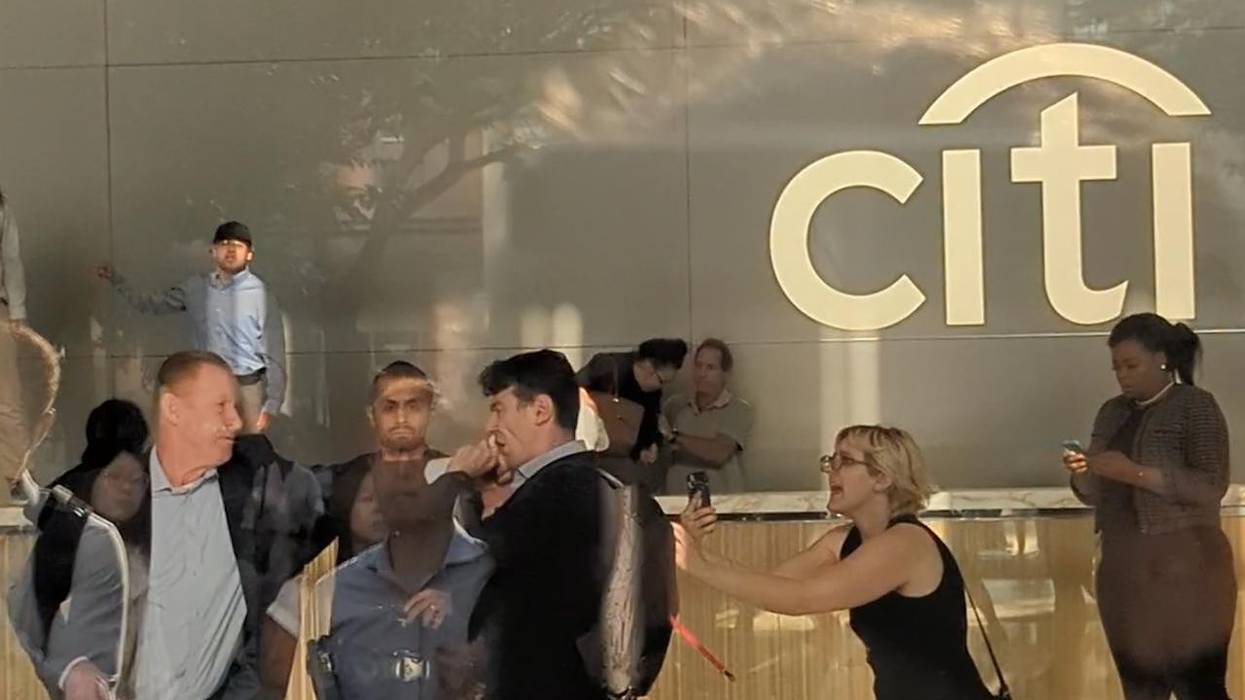
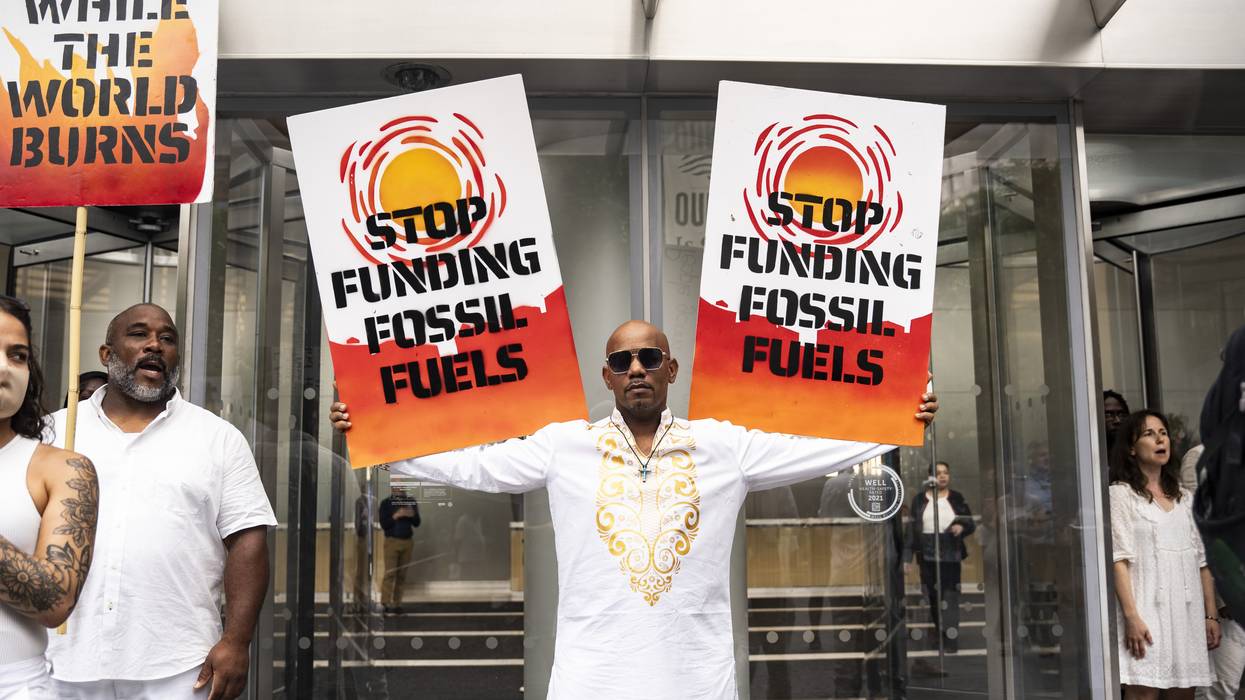
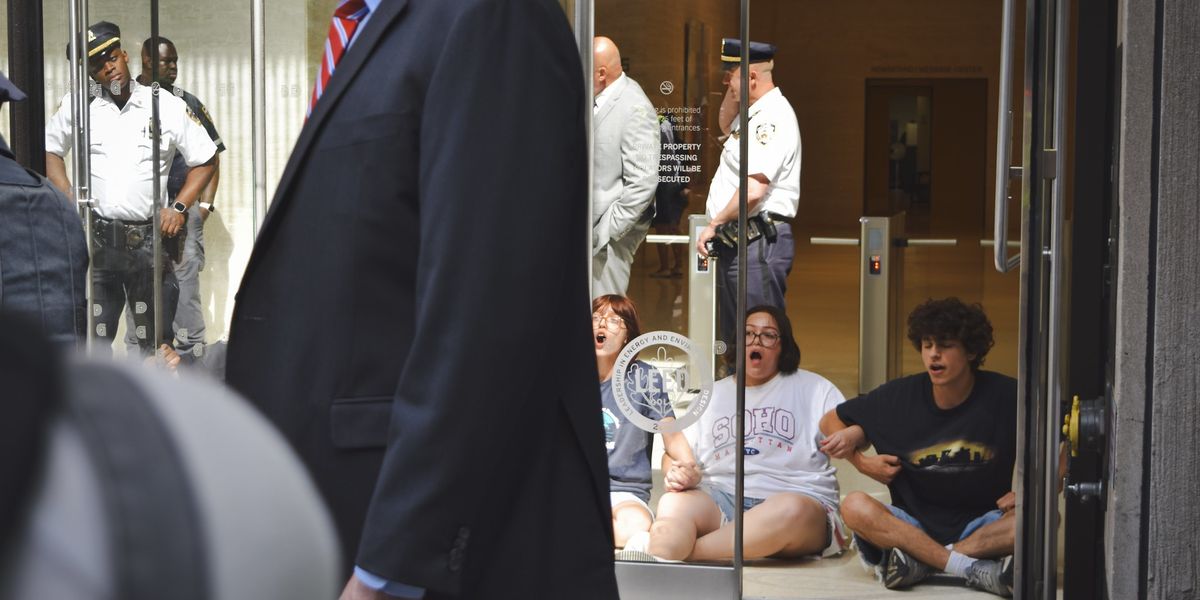
Closing out a "historic" summer of civil disobedience—but with no plans to back off their demands that Wall Street divest from planet-heating fossil fuels—the "Summer of Heat" campaign blockaded the entrance of Citibank's headquarters in New York for an hour on Thursday.
At the 32nd protest held by Stop the Money Pipeline, New York Communities for Change, and other groups since June 10, organizers said 50 people were arrested, including climate scientists and an advocate dressed as an orca—a reference to numerous cases of whales ramming and sinking luxury yachts in recent years.
"The water is too damn hot!" said the costumed protester. "Stop funding fossil fuels."
Summer of Heat has targeted Citibank due to its status as Wall Street's largest funder of methane gas extraction since 2016 and the second-worst funder of oil, coal, and gas projects in recent years, spending $396.3 billion from 2016-23.
For an hour, roughly 1,000 Citibank employees were barred from entering the building as protesters blocked the doors.
"I've been studying climate change since 1982 and no one is listening to the data," said biologist and anti-fracking advocate Sandra Steingraber—who has joined multiple Summer of Heat actions—as she was arrested. "So today they're going to have to listen to my body blocking the doors of the world's largest funder of new fossil fuel projects."
More than 5,000 people have joined Summer of Heat protests since June, and there have been more than 600 arrests. Citibank's response to the demonstrators has escalated to violence at times, with a security guard punching one protester in the building's lobby last month.
One woman told police arresting her on Thursday that her grandson suffers from asthma resulting from wildfire smoke, which climate scientists have linked to fossil fuel extraction and planetary heating.
"We're here for you and your children," she told an officer. "We're here for our world."
As the campaigners blocked the Citibank entrance, cellist John Mark Rozendaal and Stop the Money Pipeline director Alec Connon were preparing to attend a court hearing on Friday regarding assault and criminal contempt charges. Connon has said he was "falsely accused of assault by Citibank security so they could get a restraining order" keeping him from returning to protests at the headquarters.
Mary Lawlor, United Nations special rapporteur on human rights defenders, expressed "strong concern at the charges" and said she would be "closely following" the trial.
Wall Street giant responsible for massive funding of fossil fuels accused of "robbing our grandchildren's future."
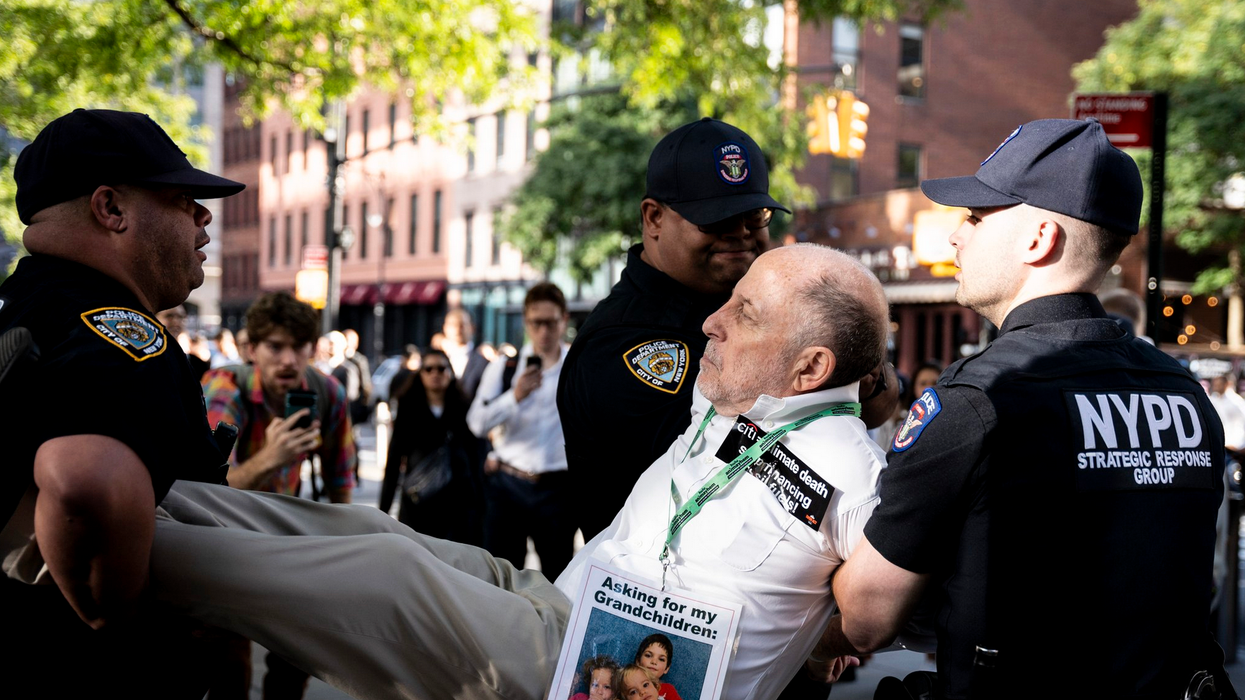
The " Summer of Heat on Wall Street" protests continued Tuesday with at least 69 elders arrested while blocking Citibank's New York City headquarters to demand an end to the bank's financing of climate-wrecking fossil fuel projects.
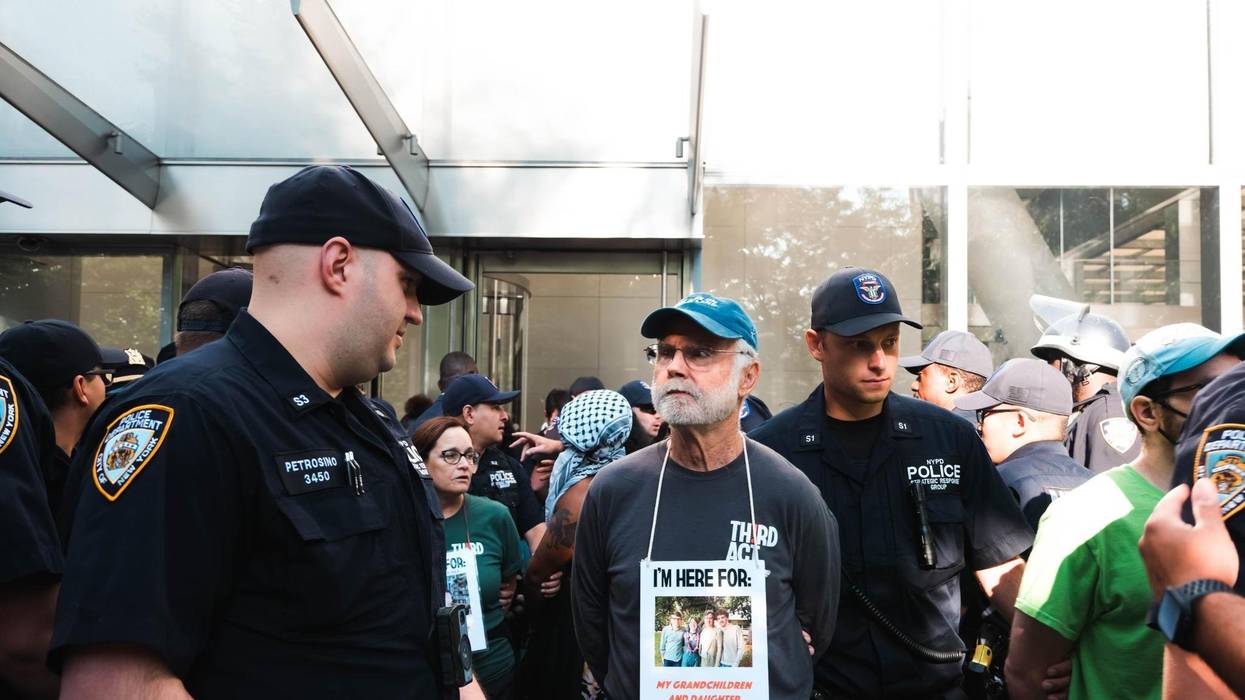
"I'm here for my children and grandchildren," one woman explained as she was led away by a New York Police Department officer, wrists zip-tied behind her back. "I have kids and they need to live a better future!"
She was among several protesters who wore signs hanging from their necks that said "I'm here for:" followed by photos of loved ones.
BREAKING: NYPD arrests 29 grandparents at @Citibank HQ for demanding an end to Citi’s financing of oil, gas and coal projects.
“I have kids and they need to live a better future!” #SummerofHeat #CitiDropFossilFuels pic.twitter.com/j93mMl1YhS
— New York Communities for Change (@nychange) August 27, 2024
Bill McKibben, a 350.org co-founder arrested at a related action earlier this summer, welcomed Tuesday's protest on social media. Borrowing a phrase from Hip Hop Caucus' Rev. Lennox Yearwood Jr., he
declared, "Can't stop won't stop!"
"Old and bold!!" he added in response to footage of some arrests, also highlighting Third Act, his group for "Americans over the age of 60 determined to change the world for the better," which organized Tuesday's protest.
The Summer of Heat campaign was
initiated by a coalition that includes Climate Defenders, New York Communities for Change, Planet Over Profit, and Stop the Money Pipeline with support from more than 100 environmental and racial justice groups.
"Since the campaign launch on June 10, over 4,000 people have joined protests as part of the Summer of Heat," according to organizers. "And over 500 people have been arrested for engaging in nonviolent civil disobedience protests, urging banks like Citigroup to stop bankrolling new coal, oil, and gas."
Sharing a photo of one protester on social media Tuesday, Stop the Money Pipeline director Alec Connon said that "when I'm older I hope I will be like Pat, who was just arrested for blocking the doors to the headquarters of the world's largest funder of fossil fuel expansion since the Paris agreement. In a time of climate crisis, this is what real eldership looks like."
Tuesday's action in New York—which came as over 60 million people in the U.S. Midwest and Northeast faced heat advisories—followed a July demonstration in which Third Act members led a "funeral procession" near Citigroup's headquarters to honor elders who have died during recent dangerous heatwaves. That protest also led to arrests.
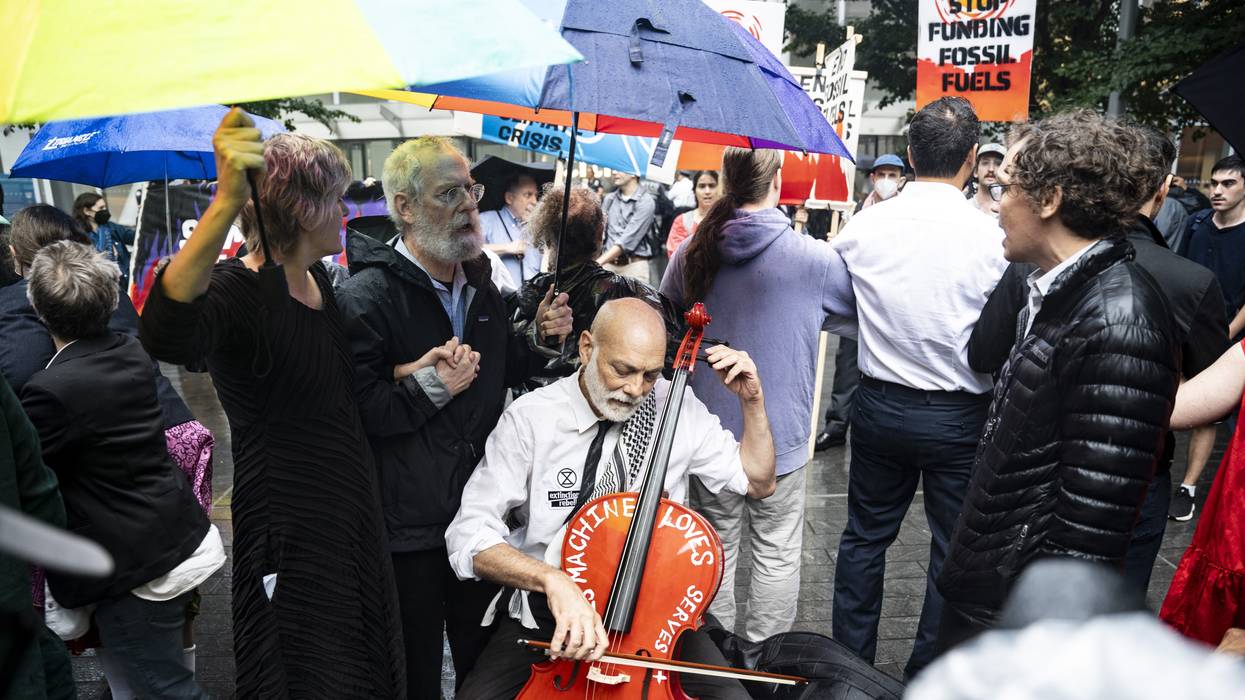
Other Summer of Heat actions targeting Citibank that resulted in arrests have been held by cello-playing grandfather, faith leaders, and mothers who gathered with their children outside bank CEO Jane Fraser's luxury apartment building.
This past weekend, over 30 self-described "climate feminists" were arrested in another demonstration outside Fraser's home, where they chanted: "Methane Jane, you can't hide. We charge you with ecocide."
More than 30 feminists sit down in the street in front of Methane Jane Fraser’s TriBeCa apartment. There’s nothing feminist about funding ecocide. pic.twitter.com/CtuQGWVaqh
— New York Communities for Change (@nychange) August 25, 2024
An annual report released in May showed that in 2023—the hottest year on record—the world's 60 biggest banks committed $705 billion to companies conducting business in fossil fuels, bringing the total since the Paris agreement to $6.9 trillion. Citi's totals were more than $30 billion last year and $396 billion overall.
This post has been updated to clarify when Bill McKibben was arrested and to include additional arrests after publication.
"Citi keeps proving their violent business is rooted in violent people," said the Planet Over Profit campaign.
A climate protester was taken to a hospital bleeding on Wednesday, according to organizers, after a security guard at Citibank's global headquarters in New York punched him in the face as campaigners assembled in the lobby of the building.
The climate advocate, Eren Can Illeri, was taking part in an action organized by Summer of Heat, which is supported by a coalition including New York Communities for Change, Planet Over Profit, and Stop the Money Pipeline.
Illeri was joining other campaigners in calling on Citibank executives to meet with them to discuss the bank's funding of fossil fuel projects. Citibank has invested $396.3 billion into coal, gas, and oil infrastructure projects since the Paris climate agreement was finalized in 2015, and Summer of Heat has made the bank its top target this summer as it demands Wall Street divest from the climate emergency.
"We have been asking Citi to meet with us for weeks to talk about what it can do to tackle the climate emergency," said Alicé Nascimento, a spokesperson for the Summer of Heat campaign. "But rather than meet with us, they have sent their security guards to physically attack peaceful climate activists after weeks of intimidation and threats."
Illeri appeared to be filming with a cellphone when the security staff member approached him and tried to grab the phone out of his hands, according to a video of the incident. The guard then punched Illeri in the face while holding the phone, and pushed him to the ground.
BREAKING: Citibank staff punches peaceful climate activist in the face for taking video. He was taken to the hospital bleeding.@Citi keeps proving their violent business is rooted in violent people. This can't go on. pic.twitter.com/E1KCwQ1dCY
— Planet Over Profit (@pop4climate) August 14, 2024
The violence displayed mirrors "the violence of fossil fuels and climate chaos," said Alice Hu, a climate campaigner for New York Communities for Change.
"Citi backs violence and it's sickening," she said.
Summer of Heat began on June 10, and since then more than 4,000 campaigners have joined protests to demand Citibank end its financing of fossil fuel projects.
More than 475 people have been arrested for protesting the bank's investments—including a cello-playing grandfather last week—and protesters last month reported being shoved by one of the bank's top lawyers.
"Citi keeps proving their violent business is rooted in violent people," said Planet Over Profit. "This can't go on."
Biologist Sandra Steingraber was invited to speak as climate activist John Mark Rozendaal disobeyed a restraining order to play cello outside CitiBank’s headquarters. However, that speech was never delivered.
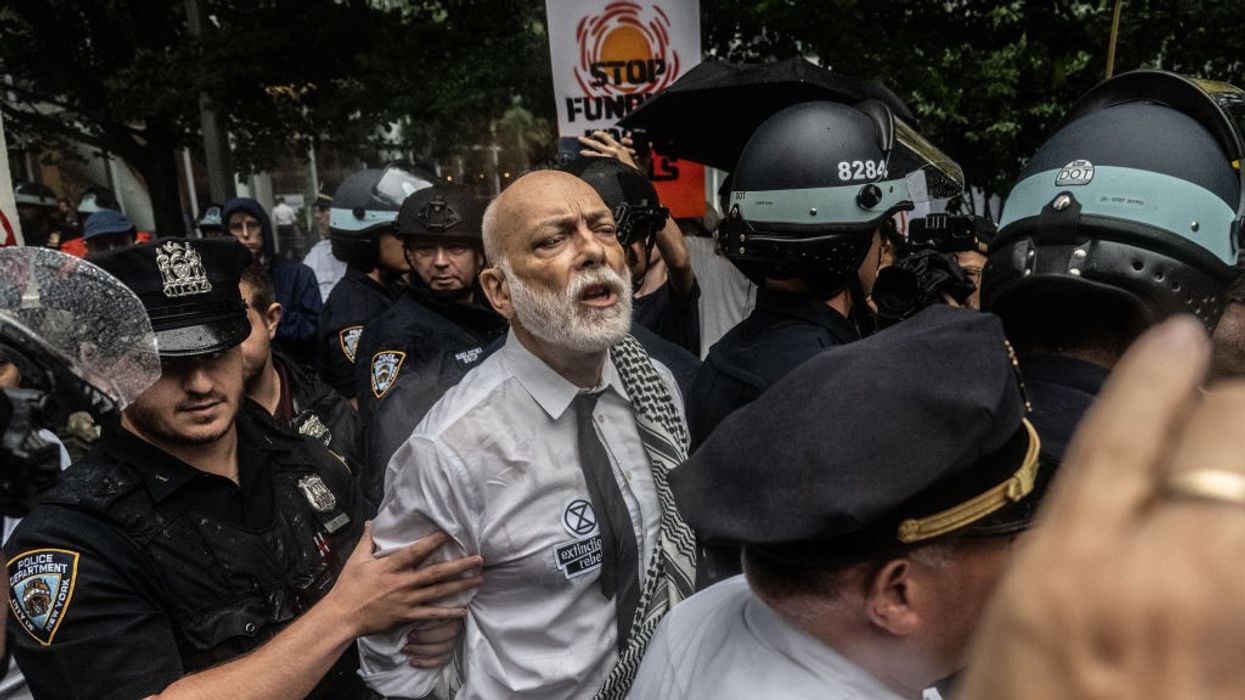
On August 8, 63-year-old professional cellist, climate activist, and grandfather, John Mark Rozendaal, was arrested while playing the opening strains of Bach’s “Suites for Cello” outside of CitiBank’s world headquarters in Manhattan. Rozendaal is one of the leaders of the ongoing Summer of Heat civil disobedience campaign that has targeted CitiBank for financing new fossil fuel projects. Earlier this month, Citibank used false allegations to obtain a restraining order to prevent Rozendaal, along with author and campaign leader Alec Connon, from returning to Citibank headquarters or risk being charged with criminal contempt, a crime which carries a maximum seven-year jail sentence. Biologist Sandra Steingraber was invited to bear witness to his restraining order-defying performance and speak at a press event about the significance of his actions. However, that speech was never delivered. Just as Rozendaal began to play the first measures of the suite, police rushed in. Rozendaal and Connon were arrested, as were Steingraber and 13 others in attendance who had formed a circle around the musician as he played. This is the speech that was not delivered.
Good morning. My name is Sandra Steingraber. I’m a PhD biologist, and I like nothing more than to talk about data.
But today, we are here to witness an extraordinary act of courage, and I’m going to speak very personally.
I grew up in coal-country Illinois and was adopted out of a Methodist orphanage. I was a sensitive, introverted child who struggled with human attachment and a sense of belonging. By the time I was 14, I had fallen in love with two things: the Polish composer Frederic Chopin and photosynthesis.
Of all things central to our humanity that climate change threatens, music is on the list.
The idea that I could, with my own fingers, turn black notes on a page—assembled more than a century earlier—into something divinely beautiful was thrilling to me. When I played Chopin, I felt a connection to all the other pianists who had, for generations before me, memorized and practiced this same score for their own recitals.
Meanwhile, the opera of photosynthesis, which takes place inside the miniature Quonset huts called chloroplasts, connected me to the origins of life itself. The idea that green plants can draw in all our exhaled breath through the stomata of their leaves and, in the presence of sunlight, spin carbon dioxide together with water was awesome to me.
With the aid of cytochrome transport systems and leaping electrons, plants undertake an exquisitely beautiful act of biochemical self-creation. They make themselves. They exhale oxygen. And they feed us all.
The biological phenomenon of photosynthesis gave me a sense of ancestry.
By the time I went to college, I had discovered two things: 1) My ear for music was much better than my execution, which was not great; 2) I really loved trees.
So, I forsook the piano for plant ecology and, for my PhD research I learned the skills of dendrochronology, which allowed me to reconstruct the centuries-long history of a forest by studying the patterns of tree rings inside the heartwood of 200-year-old red pines.
The inside of a tree is a living scroll that tells the story—if you are trained to read the language of xylem and phloem—of the entire ecosystem. You can learn, for example, which years great forest fires swept through or which years had especially long winters. I became a historian of forests by studying the rings of the deep inside the trunks of individual trees.
I would have liked nothing better than to spend my life studying trees. But the acceleration of the climate crisis is now torching forests around the world. And drowning them with saltwater. And ravaging them with emergent diseases. And driving their pollinators into extinction. And otherwise stressing them to the point where they can no longer remove and sequester carbon dioxide from the air around them.
So, that’s why I became a civil disobedient with the Summer of Heat campaign. My responsibility as a plant biologist in this moment in human history is to do more than just teach photosynthesis and praise trees. All the oxygen we breathe is provided to us by plants, and they are in trouble. And governments aren’t acting. And banks like Citi keep on financing new fossil fuel projects that are ravaging ecosystems.
For me, the extraordinary concert we are about to witness is the place where botany and music come together.
Orchestral instruments like cellos and violins—as well as the bows drawn across their strings—are made from trees. And not just any trees but tree species that have what musicians call tonewood.
Pernambuco. Ebony. Certain species of maple and spruce.
These trees have cell walls with acoustical properties that vibrate in certain frequencies and, if they are all uniform in size and density, provide the richness of sound that we experience as musical. Different woods have different resonant qualities due to the ratio of cellulose and lignan. Typically, trees used to make classicial musical instruments are 200-400 years old with 20-inch trunks and tree rings that show slow and steady growth.
In a warming climate, however, annual growth rings have become less consistent in size, and the wood has become softer. Instrument-making trees are also increasingly targeted by emerging insect pests.
Trees with tonewood are now growing in more extreme weather conditions and enduring more frequent droughts. Those conditions alter their cellular architecture in ways that alter the tonal qualities of the wooden soundboards of the musical instruments made from their wood. As a result, orchestral music will sound different in the future. Of all things central to our humanity that climate change threatens, music is on the list.
Fifty years ago, playing a Chopin nocturne had the power to stop me from self-injuring. Listening to my friend John Mark Rozendaal defy Citi’s attempt to silence peaceful protest again the financing of climate ruin by performing Bach’s “Suites for Cello” will, I believe, have the power to call us all to stop injury to the planet.
"Rather than doing something about its role in the climate crisis, Citi is choosing instead to target climate activists with false charges and unwarranted arrests," said cellist John Mark Rozendaal.
Climate campaigners expressed incredulous outrage Thursday following the arrest of a 63-year-old Extinction Rebellion activist who violated a dubious restraining order by playing a cello outside Citibank's New York headquarters during a protest against the bank's funding of fossil fuel projects.
John Mark Rozendaal, a professional cellist and grandfather, performed Bach's "Suites for Cello" before he was arrested in the public plaza outside Citibank's headquarters in Lower Manhattan during a "Summer of Heat on Wall Street" protest against banks' fossil fuel financing. New York Police Department (NYPD) officers also arrested 14 peaceful protesters who encircled Rozendaal.
Last month, a Citibank security guard obtained what Extinction Rebellion said was an unconstitutional restraining order against Rozendaal and another activist, Stop the Money Pipeline director Alec Connon. According to the activists, the security guard claimed he was assaulted after hitting his head on a plastic pipe that demonstrators were using to block an entrance to the bank.
Rozendaal and Connon were warned that any violation of the restraining order could result in criminal contempt charges carrying a maximum sentence of seven years in prison.
"Over the last decade, Citibank has been the world's number one funder of fossil fuel expansion," Rozendaal said Thursday. "Yet rather than doing something about its role in the climate crisis, Citi is choosing instead to target climate activists with false charges and unwarranted arrests."
Thousands of people have rallied to demand an end to fossil fuel financing during two months of ongoing Summer of Heat demonstrations. More than 475 activists—including scientists, faith leaders, elders, students, and parents—have been arrested during the protests.
"It's alarming that Citibank is resorting to scare tactics to intimidate climate activists that are simply trying to get the bank to stop financing the fossil fuel industry that is killing our planet and polluting our communities," Democratic New York City Councilwoman Sandy Nurse said in response to Rozendaal's arrest.
"Citi should stop targeting activists and focus instead on ending its support for fossil fuels," Nurse added.
The Center for International Environmental Law, a Washington, D.C.-based nonprofit advocacy group, said that "the use of vague restraining orders to keep protesters away from Citi's New York headquarters represents a troubling effort to suppress these lawful demonstrations and mute advocacy for a just and sustainable world."
"Such measures not only threaten democratic freedoms and hinder crucial advocacy against environmental racism, but most importantly undermine efforts to challenge the financial underpinnings of the climate crisis," the group added.
New York Communities for Change climate campaigner Alice Hu said on social media that "it's wild Citi would have NYPD arrest the 63-year-old peaceful protester for *checks notes* playing the cello."
"But, ultimately unsurprising from the top funder of new fossil fuels since 2016," Hu added. "After all, the floods, fires, and famines that Citi funds are the epitome of violence."
Rafael Shimunov, who hosts the "Beyond the Pale" program on left-wing New York radio station WBAI, quipped, "Thank you NYPD and Citibank, our streets are so much safer without this 63-year-old cellist on them."
The Summer of Heat on Wall Street is set to continue next week, as immigration rights groups are planning to lead a "Migrants Grieve and Rage Against Climate Destruction" day of action outside Citibank's headquarters on August 13.
"We cannot profit off of death and destruction," one participant said. "We must love each other and the Earth."
Two dozen faith leaders and their supporters were arrested on Tuesday after chaining themselves to the doors of Citigroup's New York City headquarters to protest its financing of the climate emergency.
Around 50 people participated in the protest, which is part of the Summer of Heat series of actions demanding that Wall Street—and Citi in particular—stop funding oil, gas, and coal.
"I am here because I believe that there is a god in everyone and that calls us to take responsibility for destruction done in our name," Lina Blout of Earth Quaker Action Team said as she was being arrested. "We are all connected. We must live for the planet and each other, and not short-term profit."
Citi was the leading financier of fossil fuel expansion since the Paris agreement entered into force in 2016, spending $204 billion on the development of new oil, gas, and coal. It was also the second leading funder of fossil fuels over all, at nearly $400 billion. In addition to ditching climate-warming energy sources, participants in Summer of Heat want banks like Citi to "exponentially" up funding for renewables, respect the human rights of Indigenous and local communities, and contribute to a "climate reparations fund."
"We cannot profit off of death and destruction," Blout said. "We must love each other and the Earth."
Tuesday's action, led by GreenFaith, was part of the Summer of Heat's Faith Week, running from July 28 to August 3.
"We the people will not tolerate the bad practices of companies like Citi to fund and invest in oil companies who kill our world and it's future."
"Our faiths teach us that the Earth is a sacred trust and we are responsible for its care," GreenFaith wrote on social media. "Why is Citi continuing to violate that trust by giving hundreds of millions of dollars to oil and gas companies? We're here telling Citi: We can do better. We must do better!"
The faith leaders, dressed in white, converged on Citi at around 7:50 am Eastern Time. A total of eight people locked themselves to the doors, causing "chaos" as employees tried to enter for work. The blockade lasted for around half an hour.
"If you've got to walk through a gauntlet of protesters and cops to get to your job maybe you're working at the wrong place," nonprofit consultant Valerie Costa wrote in response to footage of the protest.
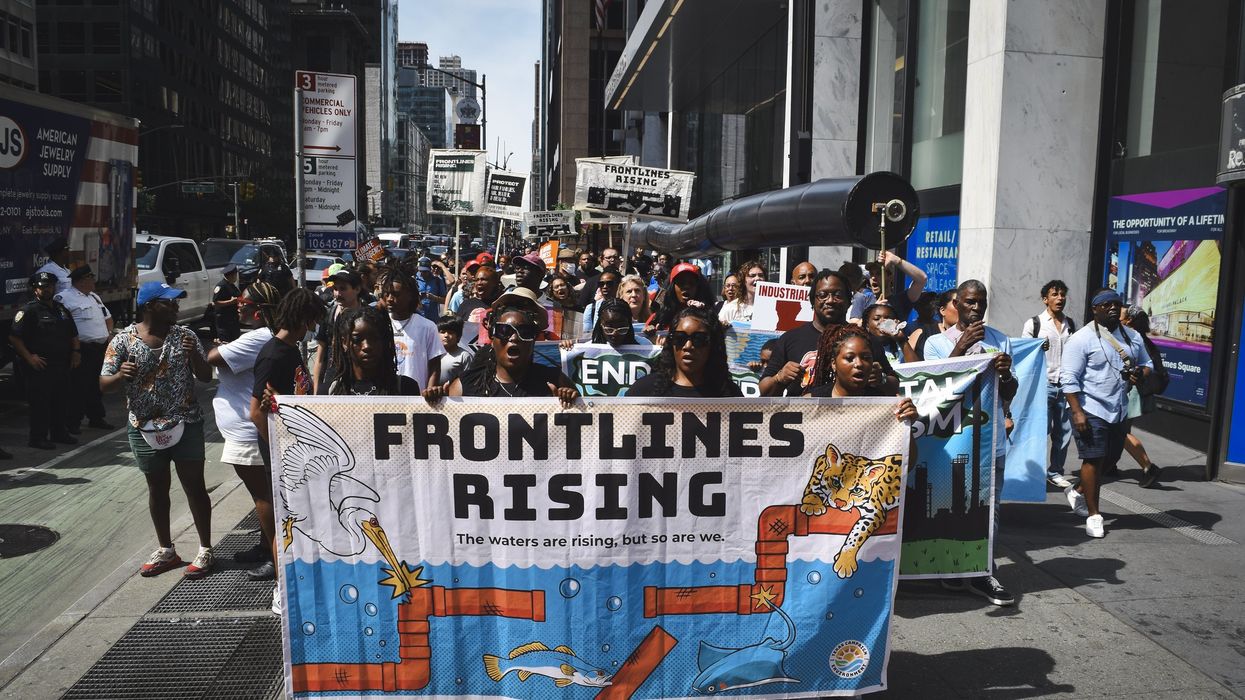
Among those arrested at the action were two frontline leaders from the U.S. Gulf Coast, which has been treated as a sacrifice zone by the oil and gas industry for decades.
"There is no future if we were to allow big oil and gas industries who produce death chemicals and products that will wipe out society," Debra Sullivan Ramirez, the president, CEO, and founder of Mossville Environmental Action Now, who was arrested Tuesday, told Common Dreams. "We the people will not tolerate the bad practices of companies like Citi to fund and invest in oil companies who kill our world and it's future."
In one incident, Citi security tried to force open a door while a protester was still chained to it, and then to yank him away from the door. When police joined in, the protester fell down.
"Police were contorting his legs behind the door," another demonstrator said, adding that "it looked painful."
Tuesday's protest brings the total number of arrests from Summer of Heat actions up to more than 450 since June 10, according to organizers.
It also follows a week that saw the four hottest days on record and comes as a heat dome is expected to descend upon much of the U.S., putting the Southwest, Southeast, and Great Plains at particular risk for potentially deadly heat, the Union of Concerned Scientists (UCS) warned.
"Fossil-fuel driven climate change has increased the frequency and severity of extreme heat events over the last half century," UCS said.
The group urged local, state, and national authorities to take immediate measures to protect people such as implementing heat plans, ensuring access to cooling centers, and enshrining protections for outdoor workers.
"But ultimately," UCS said, "limiting the number of days of extreme heat in the long term necessitates that policymakers and decision-makers in all sectors of society do their part to cut heat-trapping emissions, halt the decades-long deception and obstruction by fossil fuel companies that has enabled runaway climate change, phase out fossil fuels, and accelerate the transition to a clean and just energy system."
Dozens of climate campaigners were arrested for protesting the multinational bank's financing of new fossil fuel development.
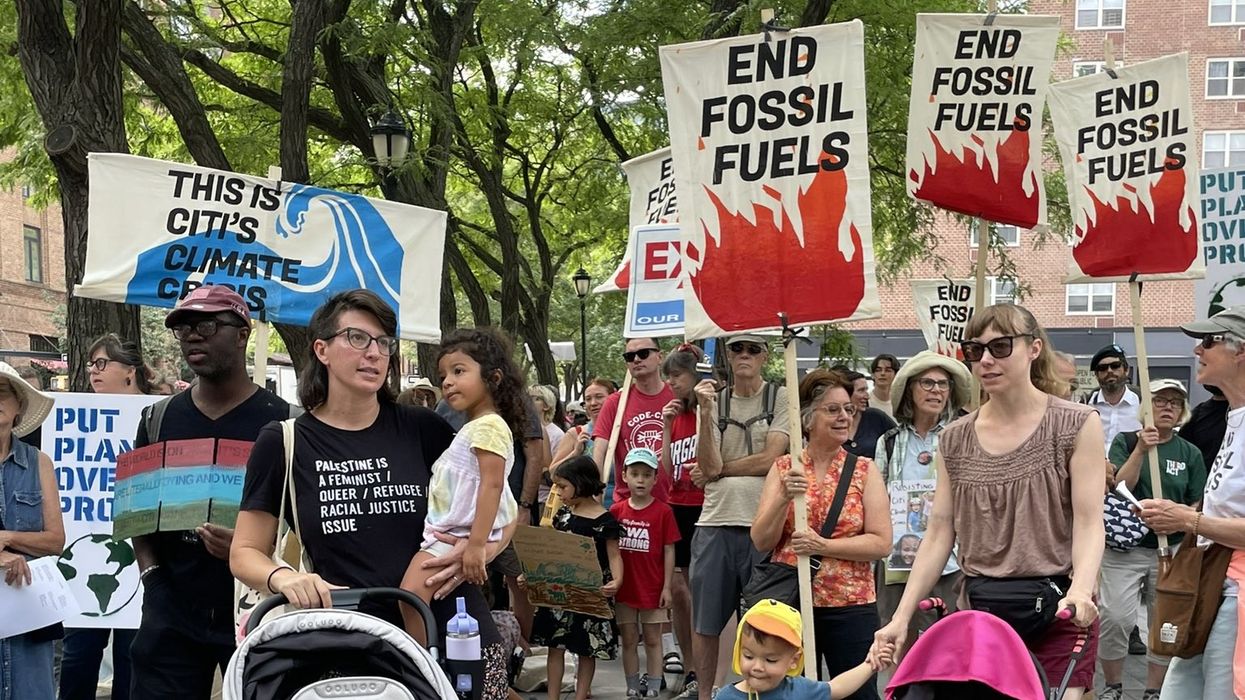
Hundreds of activists, largely mothers and their kids, protested outside Citigroup CEO Jane Fraser's luxury apartment building in New York City on Saturday, calling for the multinational bank she leads to stop funding fossil fuel expansion.
The protest, at which 59 people were arrested, was part of the Summer of Heat, a program of nonviolent direct action led by five climate advocacy groups that has targeted Citigroup because it's a leading funder of the fossil fuel industry.
The activists set up a memorial on the sidewalk outside Fraser's building dedicated to the tens of millions of children who've been displaced because of climate change in recent years.
Marlena Fontes, a director at Climate Defenders who organized the action, explained the impact of climate change on her family in a speech to gathered protesters. She said that when haze from Canadian wildfires covered New York City last year, her son was afraid, and her one-year-old daughter had an asthma attack.
"She was just one of many, many children on this planet who are being affected by the climate crisis," Fontes said.
BREAKING: NYPD arrests grandparents, parents, students, scientists and clergy outside of @Citibank CEO Jane Fraser’s NYC penthouse.
Citi keeps pouring billions into oil, gas and coal projects killing our kids. Jane can’t hide from responsibility. #SummerofHeat pic.twitter.com/0FUBStYvuK
— New York Communities for Change (@nychange) July 27, 2024
The protestors marched from Citigroup's headquarters to the apartment building, located a few blocks away. About 200 or 300 people took part in the protest, and 59 were arrested; the police were on site before they even arrived, Alicé Nascimento, policy director at New York Communities for Change, one of the Summer of Heat organizing groups, told Common Dreams. The other organizing groups are Climate Defenders, Climate Organizing Hub, Stop the Money Pipeline, and the youth-led Planet Over Profit.
BREAKING: Hundreds of parents and climate activists are about to descend onto the luxury apartment complex of Jane Fraser, the high powered CEO of @Citibank, the world’s biggest funder of fossil fuel expansion.
We’re taking the crisis to her doorstep. #SummerofHeat pic.twitter.com/50zGKVBwjT
— New York Communities for Change (@nychange) July 27, 2024
Summer of Heat, which began actions in early June, has turned out to be aptly named, as the summer has been full of deadly heatwaves in the U.S. and across the northern hemisphere. Saturday's action came following a week of extreme global temperatures: Monday was the hottest day in recorded history, breaking a record set just the day before. United Nations Secretary-General António Guterres on Thursday called for coordinated global action to deal with extreme heat, including by transitioning away from fossil fuels.
Corporations like Citigroup make that transition far more difficult, campaigners say. Citigroup was responsible for providing more financing to companies developing new fossil fuel projects than any other bank in the world for the period from 2015 to 2023, according to a Banking on Climate Chaos report published in May. In terms of overall financing to fossil fuel companies, Citigroup ranked second in the world, behind only JPMorgan Chase, at nearly $400 billion during that period.
Saturday's action was the first of the summer targeted at Fraser's home, though a smaller group of campaigners did protest there in February. Fraser has in the past expressed a willingness to take a climate into account in Citigroup's dealings.
Rachel Rivera, a member of New York Communities for Change, spoke to the gathered protesters about the struggles that her family has faced in the past and in the recent extreme heat. She was displaced during Hurricane Sandy in 2012 and lost loved ones in Puerto Rico to Hurricane Maria in 2017. A mother of six, she said that last week her 10-year-old daughter had to be hospitalized and intubated due to respiratory seizures brought on by the extreme heat.
"Jane Fraser should walk a mile in my shoes," she said.
"We will continue to stand in solidarity and fight together with our African comrades to stop EACOP, to stop the plunder of our homelands, to stop the displacement of our peoples, and to stop imperialist climate destruction."
The "Summer of Heat" continues—both in terms of record-breaking temperatures driven by fossil fuels and a series of nonviolent direct actions targeting Wall Street for its contributions to the climate emergency.
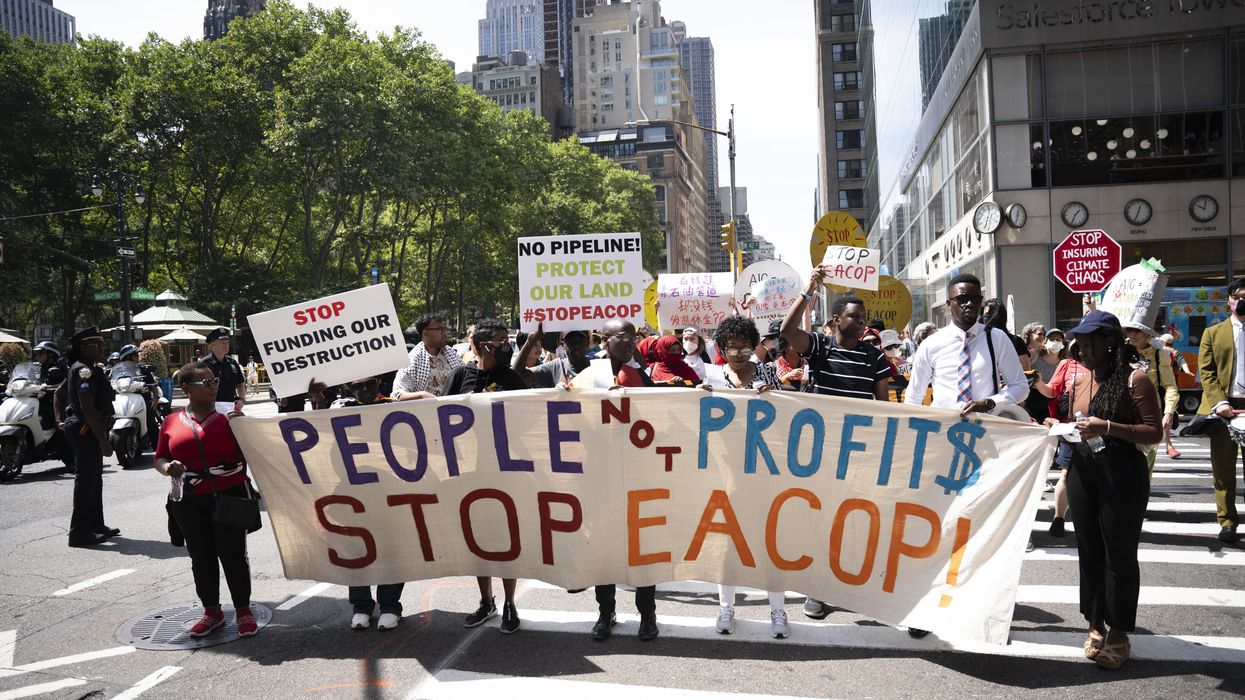
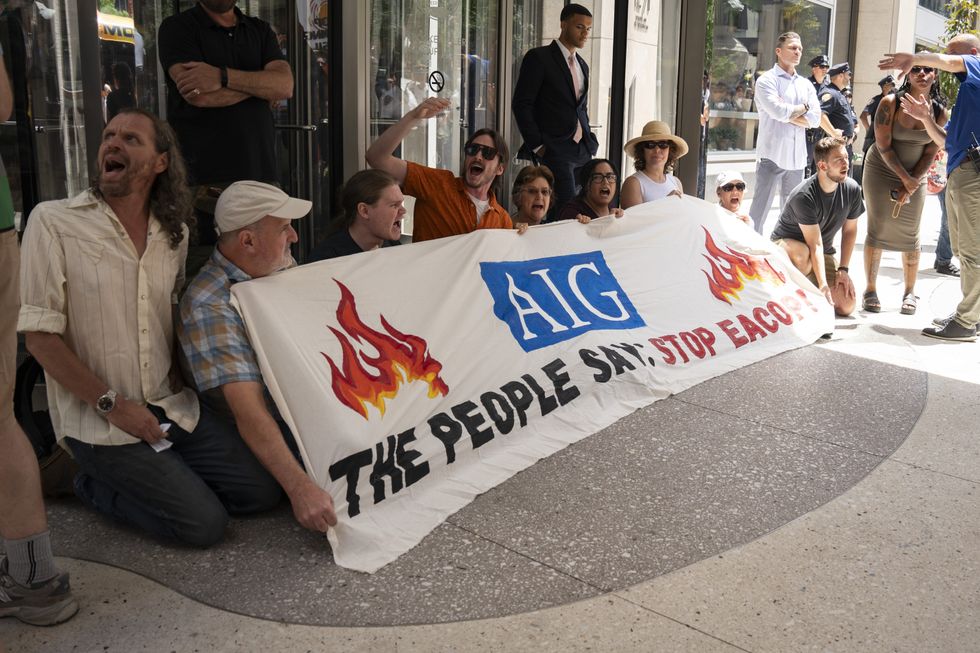
After protests last month calling out Citibank for "financing the arsonists," climate campaigners on Friday set their sights on finance and insurance giant AIG for "stubbornly" refusing to join over two dozen other insurers that won't cover the East African Crude Oil Pipeline (EACOP).
EACOP is set to run nearly 900 miles from Uganda's Lake Albert oilfields to the port of Tanga in Tanzania. Rights groups have sounded the alarm about how the project has devastated the lives and livelihoods of people in its path as well as violence endured by African activists, who have been "kidnapped, arbitrarily arrested, detained, or subjected to different forms of harassment."
Ugandan climate activist Hillary Taylor Seguya declared Friday that "EACOP is a carbon bomb being built in my backyard."
"Thousands of communities in Uganda are being displaced because of corporate greed," added the campaigner, who is affiliated with StopEACOP. "Today, as Ugandans, as Tanzanians, as Africans, we want to be loud and clear that we shall not allow any pipeline to put oil in our backyards."
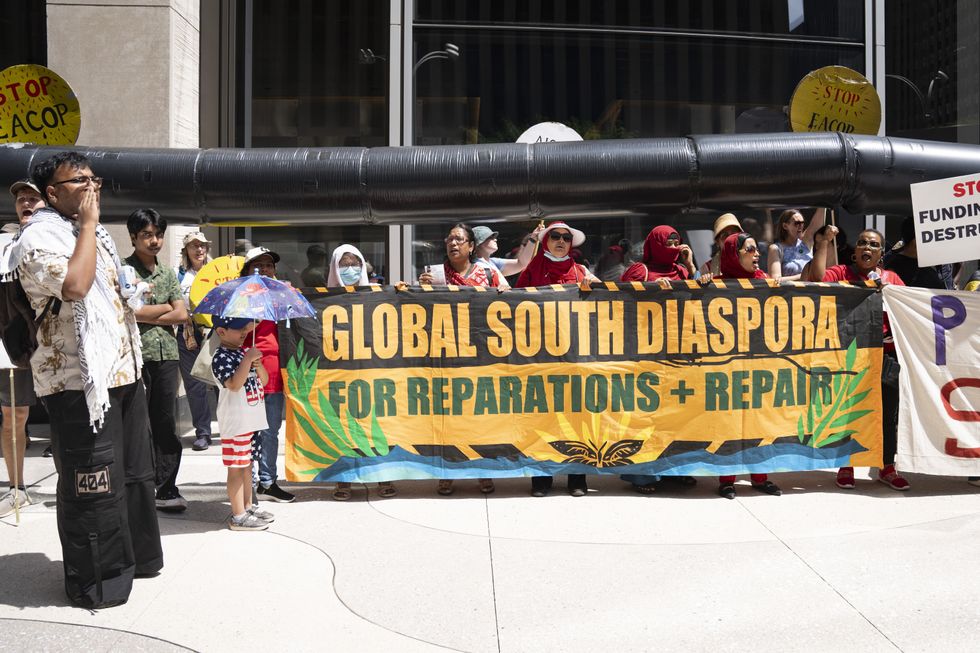
Friday's demonstration targeting AIG's office in New York City was organized by activists from the Ugandan diaspora and groups including 350.org, the Black Hive, and Desis Rising Up and Moving (DRUM).
"I am here to ask AIG to refuse to insure EACOP, and to insure our future instead," said Joseph Senyonjo, a Ugandan diaspora activist. "AIG is one of the biggest insurance companies in the world, and they still haven't ruled out insuring EACOP. So we are here to say: We don't want carbon bombs, we don't want fossil fuels. We want renewable energy. Insure our futures instead."
Protesters held signs and banners with messaging that included: "AIG = Climate Crimes," "Protect Our Land," "People Not Profits," "Stop Funding Our Destruction," "Stop Insuring Climate Chaos," and "The People Say: Stop EACOP!"

"From the pipeline's path in East Africa, to the corporate offices here, to our government institutions, we need to make our message clear: Stop EACOP!" said Evan Bell of 350 Mass. "I am willing to do what it takes to make sure AIG does not insure EACOP."
Bell noted that he is afraid of the New York Police Department, "especially after their brutal response to campus protesters peacefully demonstrating for an end to genocide in Gaza."
"But I am more afraid of runaway climate change," he added. "I'm more concerned about the current human rights abuses in Uganda and Tanzania. But we are more determined than we are scared."
Molly Ornati of 350 Brooklyn emphasized that "the EACOP pipeline is a doubly destructive disaster—for the people of Uganda and Tanzania, and the planet. The construction of the 900-mile pipeline will disrupt and destroy the homes, land, and livelihood of 100,000 people along the route, as well as the surrounding water and ecosystems."
"Once built, it will be a carbon bomb for humanity," Ornati warned. "In the climate crisis there are no borders, and we are a global movement, united in support of frontline communities, fighting to stop the greed of fossil fuel finance."
DRUM's Mohiba Ahmed delivered a similar message of unity, saying that "we add our communities' voices to the growing international demand 'Stop EACOP!' because we know that our struggles are one and interconnected."
"Our peoples in Bangladesh, Pakistan, Nepal, Guyana, and Trinidad are similarly harmed by foreign domination, imperialism, and capitalist projects that reduce our lives to investments, profit margins, and coins," she stressed.
"Our people and homelands contribute the least to the human-caused climate crisis but disproportionately suffer the most," she added, "and that is why we will continue to stand in solidarity and fight together with our African comrades to stop EACOP, to stop the plunder of our homelands, to stop the displacement of our peoples, and to stop imperialist climate destruction."

Beth Yirga of the Black Hive—part of the Movement for Black Lives—highlighted the frontline resistance to the pipeline, declaring that "we stand with Ugandans and Tanzanians, whose bravery and stories of resistance to stop EACOP are inspiring."
"The climate crisis we are facing exacerbates the oppressive systems designed to extract the most from our planet and global majority community, and unites us that are most impacted," she said. "From Cancer Alley on the riverbanks of the Mississippi River to the lead in Flint, Michigan's water, to the attempts of crude oil extraction in Western Uganda, to the ongoing cobalt mining crisis in Congo, the destructive practices of environmental racism on Black communities is collectively held and felt across the world."
"As we fight to stop climate injustices globally," Yirga added, "we also collaborate to imagine and build a world free of the capitalistic pillaging of Mother Earth."
Before being put in handcuffs, I knew there was no other place on Earth that I’d rather be than in that lobby and that I would proudly give up a few hours of freedom if it meant contributing to bending the long arc of history toward justice.
Earlier this month, I was arrested alongside four fellow Gulf South organizers because we chose to engage in a non-violent direct action inside Chubb’s towering building in New York City. I was not planning on breaking the law that day, but I’m glad I did and I want to explain why I’d do it again.
There are eight existing methane export terminals in the U.S., the second largest in the country is owned and operated by Cheniere near my hometown of Corpus Christi, Texas. Additionally, there are seven terminals under construction and 17 more terminals in the proposal phase in the U.S. Gulf Coast. Behind each of them is an insurance company. The pollution from the existing projects has already led to severe health issues and even deaths all while worsening climate change and extreme weather. The scorching heatwave that beat down on us during the protest was a stark reminder of that.
Insurers like Chubb have an integral role in securing a livable future. Everything oil and gas companies do needs insurance. Without insurance new projects would be all but impossible to build. We’ve repeatedly invited Chubb, AIG, and other insurers to our communities to show them the harm these projects are causing. We’ve shown them the documents—the explosions, shutdowns, and emission flarings—and have been met with silence, patronizing promises, or feet dragging.
Unified, determined, and honestly pissed off, over 200 of us marched down 6th Avenue to Chubb’s office. There I linked arms with fellow community members, two of whom were also from Corpus Christi and occupied the lobby. Originally, I was going to leave the group once the NYPD started to warn that they would begin arrests if we didn’t disperse. But as I sat there, I thought about the community that I love back home. I thought about the many heartbreaking conversations I’ve had with community members who are suffering the consequences of living so close to dozens of different poisonous facilities and having no direct avenue to holding the industry or those who insure it accountable.
I knew that this was my opportunity to use my body to demand justice on behalf of those who couldn’t be there with us in person. I was really scared, but I heard the chants outside coming from hundreds of my fellow Gulf South residents and I felt my good friends squeeze my hand tighter, letting me know that I wasn’t alone. I knew there was no other place on Earth that I’d rather be than in that lobby and that I would proudly give up a few hours of freedom if it meant contributing to bending the long arc of history toward justice.

As the arresting officer placed my hands behind my back and tightly zip-tied my hands together, I thought about the cruel irony inherent in arresting people who are working to protect our communities while those enabling the poisoning of our air and water are allowed to continue business as usual in their offices above us. It’s an apt encapsulation of the environmental and economic injustice we experience every day.
We traveled over 1,500 miles to New York to make sure these insurance executives understood the real-world consequences of their decisions. Our fight isn’t just about numbers; it’s about our lives, our homes, and our future. We won't stop disturbing their peace until they stop disturbing ours. Chubb, we’ll be back unless you stop insuring the destruction of our communities.
"We are on the cusp of a ruined planet, and the big banks like Citi are funding it, to the tune of trillions," said one organizer.
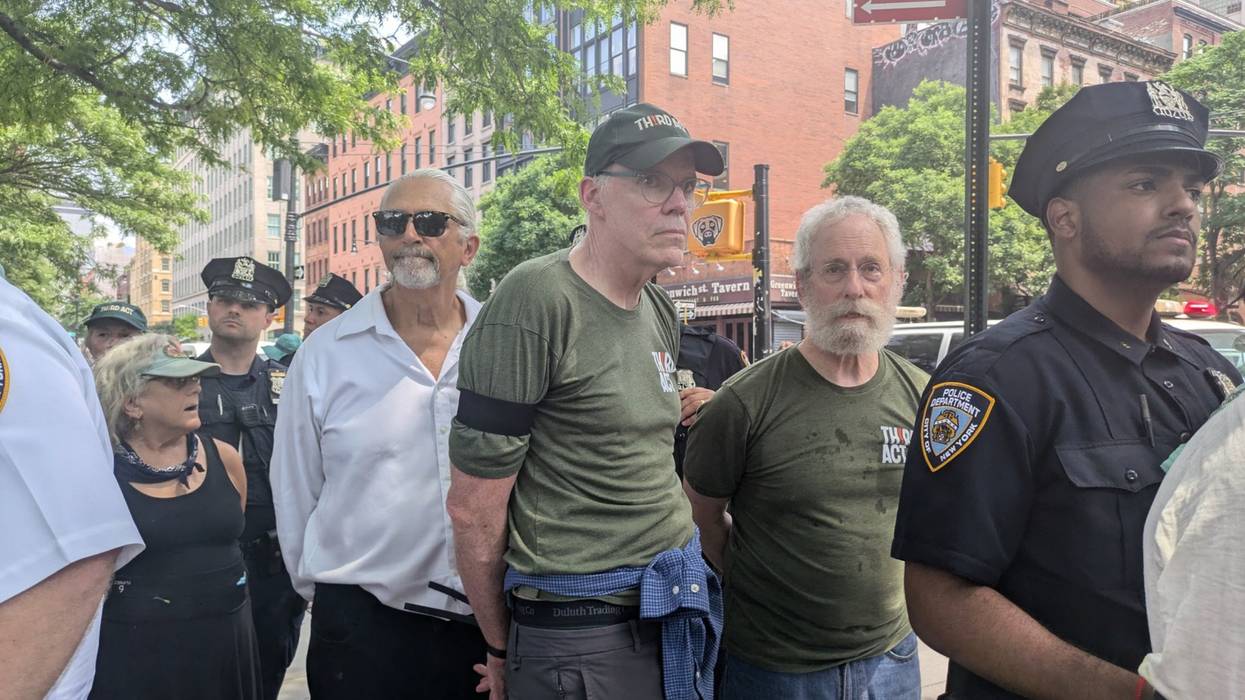
As Earth sizzles during what's likely to be its hottest summer on record amid a worsening planetary emergency, dozens of elder climate campaigners including 350.org co-founder Bill McKibben were arrested Monday in New York while protesting Wall Street giant Citigroup's continued fossil fuel financing.
Members of the group Third Act—who are mostly aged 60 and older—led a "funeral procession" near Citigroup's Manhattan headquarters in remembrance of the senior citizens who have died during recent dangerous heatwaves and to call out the bank "for being the number one funder of fossil fuel expansion in the world," according to Summer of Heat, which is organizing a series of ongoing climate protests.
Summer of Heat said McKibben was one of 46 demonstrators arrested Monday, and that "with today's protest, there have now been 305 total arrests in this summer's historic campaign of relentless, disruptive protests to stop Wall Street funding the oil, coal, and gas projects that are making our planet unlivable."
According to Summer of Heat:
Older Americans are worried about growing climate extremes and how Wall Street is using their savings to harm the planet and their grandchildren's future. Third Act supporters are retired teachers, healthcare professionals, lawyers, union members, parents, grandparents, great aunts, uncles, and now activists. They are taking action—together with youth and families—to make a difference! They are calling on banks like Citi to invest in a peaceful and livable world for all.
"It might feel very hot to us, but it was 122 degrees (Fahrenheit) in New Delhi two weeks ago. Lots and lots and lots of people died," McKibben told protest participants before his arrest. "Things like this now happen every day around the world, and they happen worst [and] first in the places that have done the least to cause this crisis."
"This is the deepest question of justice the world has ever come across," McKibben added. "And the bank that we're outside has done more than almost any institution on Earth to make it worse. Given full warning by scientists of all kinds for the last 30 years, they have decided instead to try to make profit off the end of the world."
Margaret Bullit-Jonas, an Episcopalian priest and author who took part in Monday's protest, said that "Citibank is destroying the world that God loved into being and entrusted to our care."
"At this decisive moment in history, we teeter on the brink of climate chaos," she added. "Now is the time for Citibank to choose life and to stop financing fossil fuels."
Third Act members were joined by activists from various climate, environmental, and social justice groups. Summer of Heat organizer Liv Senghor said that the campaign "is an intergenerational and intersectional movement."
"We know that there is no climate justice without social justice," Senghor said. "And we know that if we do not stop financial institutions like Citibank right now, we will all feel the deadly consequences today, tomorrow, and for generations to come."
HipHop Caucus president and CEO Rev. Lennox Yearwood Jr. asserted that "to limit ongoing damage, and ensure a bright future for the next generations, we need bold action now to curb emissions, transition to clean energy, and to help households and communities mitigate current and future risks."
Gus Speth, a former U.S. Council on Environmental Quality chair, warned that "we are on the cusp of a ruined planet, and the big banks like Citi are funding it, to the tune of trillions."
"It's time for the Citigroup board of directors to wake up to their responsibility," he added. "Citi talks about environmental sustainability but practices environmental destruction."
Citigroup contends that it is "supporting the transition to a low-carbon economy through our net zero commitments and our $1 trillion sustainable finance goal," and that its "approach reflects the need to transition while also continuing to meet global energy needs."
However, since the 2015 signing of the Paris agreement, Citi has provided $204.46 billion in financing for new fossil fuel projects, according to Stop the Money Pipeline, a Summer of Heat co-organizer.
"From the Bronx to the Gulf South, Black, Latine, Asian, Indigenous, and low-income communities living on the frontlines of the climate crisis—and the ones least responsible for it—face the highest asthma rates and staggering cancer rates while an unprecedented number of people are dying from heat waves," Summer of Heat said.
"Instead of staying home and hiding from the heat, organizers are calling on all New Yorkers and climate defenders from across the globe to take to the streets and demand that Wall Street stop destroying our future," the group added.