

SUBSCRIBE TO OUR FREE NEWSLETTER
Daily news & progressive opinion—funded by the people, not the corporations—delivered straight to your inbox.
5
#000000
#FFFFFF
To donate by check, phone, or other method, see our More Ways to Give page.

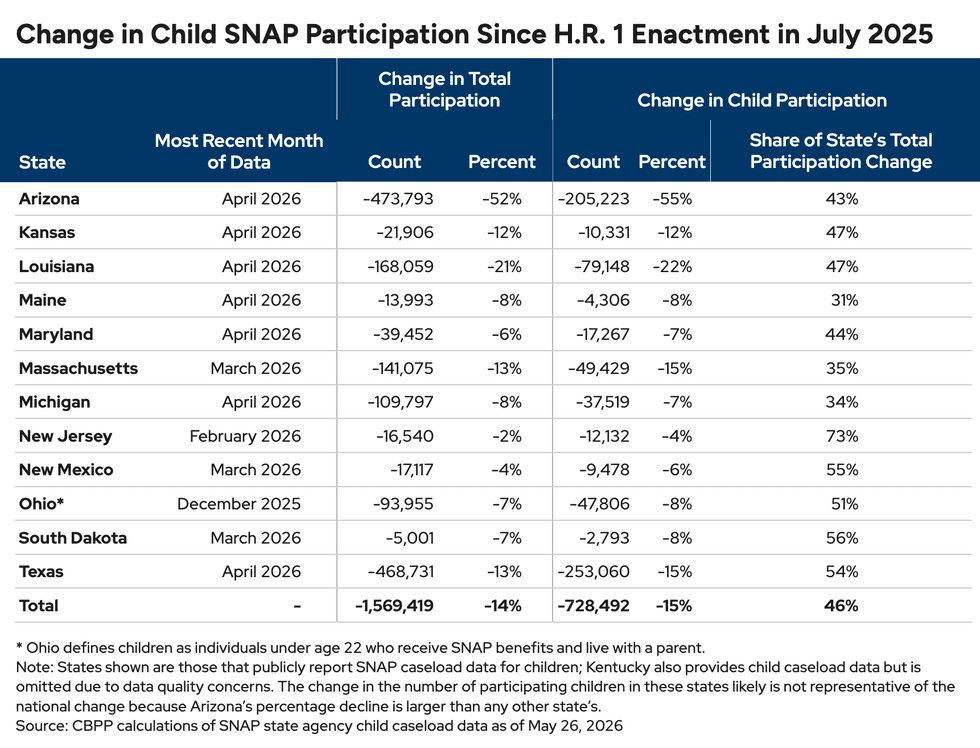
The new analysis notes that children account for "nearly half of the 1.6-million-person decline" in SNAP enrollment since last July among people of all ages in the 12 states with data available.
"The new law’s cost shift has led states to take steps that are making it harder for eligible people to receive SNAP, including families with children," CBPP explained. "Losing SNAP also makes it harder for low-income children to qualify for other food assistance, such as WIC and free school meals—jeopardizing the short- and long-term health, education, and economic benefits of nutrition programs for our children and society."
Republican lawmakers repeatedly denied that their legislation would strip food aid from needy children, with House Speaker Mike Johnson (R-La.) saying the package was laser-focused on "fraud, waste, and abuse."
"We are not cutting SNAP," Johnson falsely claimed in May 2025, just over a month before Trump signed the Republican legislation into law. The package will cut $186 billion from SNAP over the next decade and strip food aid from millions of low-income people, according to the nonpartisan Congressional Budget Office.
Katie Bergh, a senior policy analyst at CBPP, emphasized that the SNAP cuts triggered by the Republican law have not "fully taken effect," meaning recent benefit losses among families across the country are just the start unless Congress moves quickly to avert disaster.
"Congress must act before even more eligible low-income families—including families with children—lose the food assistance they need to afford groceries, starting by delaying this SNAP cost shift for all states," Bergh wrote on social media.
The Trump-GOP cuts to SNAP, combined with rising grocery costs stemming in large part from the president's tariffs and war of choice against Iran, have resulted in surging food bank demand across the country.
"We’ve been going to food banks every week,” a single mom in Arizona whose SNAP benefits were recently cut off told NBC News. “We’re eating less, we’re eating more frozen stuff.”
Far from reversing course on their assault on federal nutrition assistance, Republicans and the Trump administration are doubling down, pursuing massive cuts to fruit and vegetable benefits for low-income mothers. CBPP has projected that roughly 5.4 million people would lose fruit and vegetable aid if Republicans' newly proposed cuts become law.





In order to do things like change their addresses, check the status of claims, request benefit verification letters, or ask for tax forms, they will soon need to perform a complicated multifactor online verification process.
As a report published Tuesday by the Center on Budget and Policy Priorities (CBPP) points out:
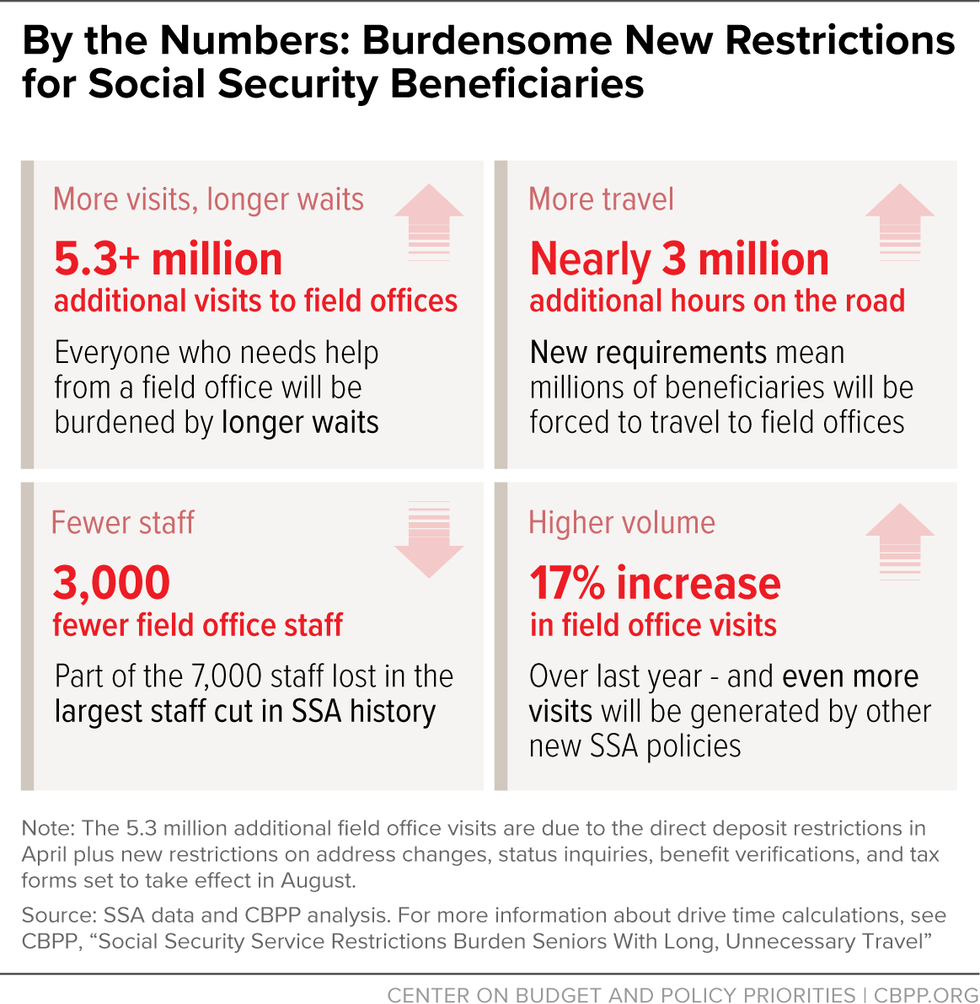
The new PIN code process will be impossible for many beneficiaries to complete. And if they can't, they'll need to travel to a field office. That will require 3.4 million more people to travel to SSA offices annually, by the agency's own estimates. This will create a significant new burden, particularly for those who live in rural areas or have transportation or mobility difficulties.
CBPP estimated that the restrictions on phone service will result in seniors spending an additional 3 million combined hours traveling to Social Security offices each year.
A previous policy change rolled out in April has already forbidden recipients from using the phone to change their bank account information, which the SSA revealed would require 2 million more people to make in-person visits each year.
The new restrictions to be rolled out next month, the administration's numbers say, will force another 3.4 million people to travel to the offices.
 (Graphic: Center on Budget and Policy Priorities)
Once they reach the office, their waits are also likely to increase. Social Security offices around the country are already increasingly overburdened due to massive cuts to staff by the Department of Government Efficiency (DOGE) earlier this year.
Nearly 2,000 field office staff took buyouts offered by Elon Musk—who stated his goal to "eliminate" Social Security altogether—and an undisclosed additional number either took early retirements or left.
According to an investigation by the office of Sen. Elizabeth Warren (D-Mass.), these cuts have also increased wait times for phone calls by a hour and 45 minutes on average.
The administration is also now relying on an artificial intelligence program to answer phone calls, which callers have described as "maddening" to use. A Washington Post reporter who tested the system in May found that it struggled repeatedly to answer her basic query about not receiving her check and needing to speak to an agent.
(Video: MSNBC)
Another 1,000 field office staff were reassigned to answer phones in early July after phone lines became overwhelmed following earlier workforce cuts.
While it remains to be seen what effect this will have on call response times, it is expected that this will only exacerbate the increased wait times for in-person services, which will become more heavily burdened due to the new requirements.
Last week, Kathleen Romig, a former SSA official who's now the director of Social Security and disability policy at CBPP, described it as "a deep hole of their own creation," as SSA's cuts meant "you just don't have enough people to go around to serve the public." She said increasing call staff by poaching from already understaffed field offices was like trying to "rearrange the deck chairs on the Titanic."
Warren, meanwhile, has accused the SSA of fudging numbers to downplay long wait times. The administration has claimed its wait times are as low as 12 minutes. But when Warren's office tested the call lines in June, it took an average of 102 minutes for calls to be answered—over 8.5 times longer than what the agency claimed—while more than half were not answered by a human at all.
"The SSA is failing to provide policymakers and the public with accurate information about the extent of the problem, using convoluted calculations to obfuscate the real data, or withholding information entirely," Warren said Tuesday.
In a letter sent Friday to SSA Commissioner Frank Bisignano, Warren pressed for him to provide "a thorough and expeditious evaluation of wait times for key Social Security services" in compliance with an audit requested by the agency's inspector general.
According to Warren, Bisignano committed to the audit in a meeting between the two, but it was not specified when it would take place.
In the meantime, the issue of long wait times is likely to only grow worse, as the Trump administration plans to eliminate a total of 7,000 employees from the administration by the end of the fiscal year.
Romig and CBPP senior fellow Devin O'Connor wrote Tuesday that "millions of beneficiaries will start to be affected" by the new restrictions on phone calls "within a matter of weeks."
"SSA did not consult with stakeholders before rushing to make this switch," they continued, "and it has yet to announce or explain the change to Social Security beneficiaries, instead burying notice of the change in a technical notice on a regulatory website."
"The agency," they said, "has provided no clear justification for the change other than vaguely citing 'fraud risk,' despite there being no publicly documented problems with completing any of these tasks by phone."