SUBSCRIBE TO OUR FREE NEWSLETTER
Daily news & progressive opinion—funded by the people, not the corporations—delivered straight to your inbox.
5
#000000
#FFFFFF
To donate by check, phone, or other method, see our More Ways to Give page.
Daily news & progressive opinion—funded by the people, not the corporations—delivered straight to your inbox.
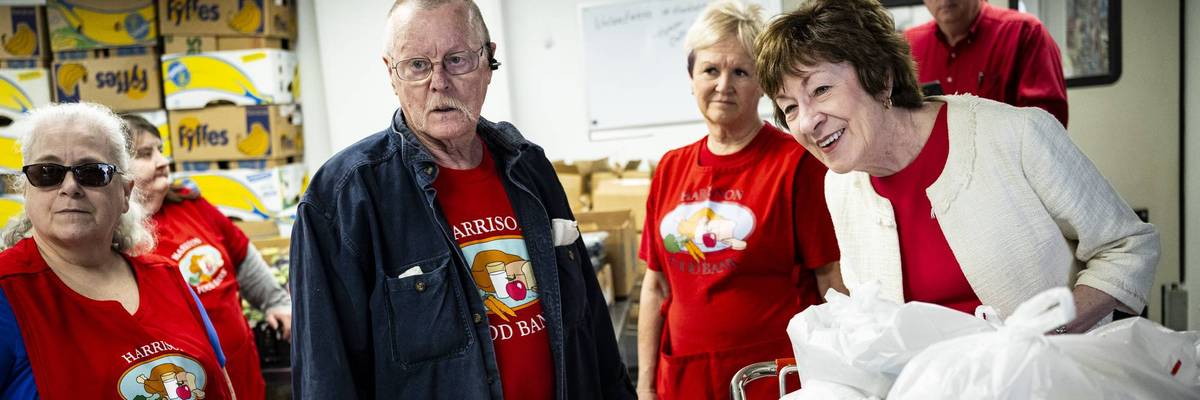
Sen. Susan Collins (R-Maine) was pictured during a visit to the Harrison Food Bank on May 5, 2026 in Harrison, Maine.
"People who really, really need SNAP could potentially no longer receive it and not have a way to buy their groceries," warned one anti-hunger campaigner.
Maine taxpayers could be on the hook for around $50 million per year in spending on federal nutrition assistance under the Republican budget law that Sen. Susan Collins voted to advance as it moved through Congress last year.
The GOP law requires states to pay a portion of Supplemental Nutrition Assistance Program (SNAP) benefit costs for the first time in the program's history, starting in October 2027. The size of states' obligation will range between 5% and 15% of their benefit costs; states with higher payment error rates—which experts say largely reflect administrative mistakes rather than fraud or abuse, as the Trump administration claims—will be forced to pay a larger percentage of benefit costs.
According to the latest data from the US Department of Agriculture, Maine's SNAP payment error rate in Fiscal Year 2025 was 10.81%—just above the national average of 10.62%. Maine's error rate puts the state in the 15% category for benefit cost obligations, according to the Center on Budget and Policy Priorities (CBPP).
“It’s shocking, and it’s wildly unfair,” Anna Korsen, deputy director of the Maine-based advocacy group Full Plates Full Potential, told Maine Morning Star last week. “If the state can’t find a way to pay for these benefits, that will mean that eligible people will go hungry. People who really, really need SNAP could potentially no longer receive it and not have a way to buy their groceries.”
Facing criticism from Democratic challenger Graham Platner—whose campaign has accused Collins of siding with President Donald Trump to give "billionaires and corporations a handout paid for by cuts to Medicaid and SNAP"—the Republican incumbent has emphasized that she voted against final passage of the Republican budget package.
But last June, Collins cast what Maine Public Radio described at the time as a "pivotal vote to begin debating" the budget measure, which will cut SNAP and Medicaid by roughly $1 trillion combined over the next decade. Thousands of Mainers—and millions of people nationwide—have lost SNAP and Medicaid benefits since the Republican law's enactment last summer.
Advocates have warned that the unprecedented shift of a portion of SNAP benefit costs onto states could be devastating, potentially forcing governments to cut SNAP benefits further, slash spending on education and other priorities, or potentially end their participation in the program completely.
Democrats are working to include a provision in the annual Farm Bill that would delay the SNAP cost-shift to give states more time to prepare. Last month, as Common Dreams reported, Senate Republicans unveiled legislation that omitted Democrats' proposed delay.
CBPP estimated in a recent analysis that states "may soon face a collective bill of roughly $9 billion, threatening benefits for millions of SNAP households, 79% of which include a child, a senior, or a person with a disability, who count on SNAP to help them meet their basic needs."
"Without immediate congressional action to delay this cost shift for all states," the think tank warned, "the unfolding emergency will only worsen as more people lose the SNAP benefits they need to afford groceries."
George Kelemen, senior vice president of the national No Kid Hungry campaign, called the GOP law's cost-shift "an existential threat to our most powerful anti-hunger program."
"Most states could be forced to cut funding for SNAP or other essential services, and at least four states have said they may be unable to continue administering SNAP entirely if this benefit cost shift goes into effect," Kelemen said last month. "This means millions of eligible kids and their families will lose access to vital grocery benefits."
Dear Common Dreams reader, It’s been nearly 30 years since I co-founded Common Dreams with my late wife, Lina Newhouser. We had the radical notion that journalism should serve the public good, not corporate profits. It was clear to us from the outset what it would take to build such a project. No paid advertisements. No corporate sponsors. No millionaire publisher telling us what to think or do. Many people said we wouldn't last a year, but we proved those doubters wrong. Together with a tremendous team of journalists and dedicated staff, we built an independent media outlet free from the constraints of profits and corporate control. Our mission has always been simple: To inform. To inspire. To ignite change for the common good. Building Common Dreams was not easy. Our survival was never guaranteed. When you take on the most powerful forces—Wall Street greed, fossil fuel industry destruction, Big Tech lobbyists, and uber-rich oligarchs who have spent billions upon billions rigging the economy and democracy in their favor—the only bulwark you have is supporters who believe in your work. But here’s the urgent message from me today. It's never been this bad out there. And it's never been this hard to keep us going. At the very moment Common Dreams is most needed, the threats we face are intensifying. We need your support now more than ever. We don't accept corporate advertising and never will. We don't have a paywall because we don't think people should be blocked from critical news based on their ability to pay. Everything we do is funded by the donations of readers like you. When everyone does the little they can afford, we are strong. But if that support retreats or dries up, so do we. Will you donate now to make sure Common Dreams not only survives but thrives? —Craig Brown, Co-founder |
Maine taxpayers could be on the hook for around $50 million per year in spending on federal nutrition assistance under the Republican budget law that Sen. Susan Collins voted to advance as it moved through Congress last year.
The GOP law requires states to pay a portion of Supplemental Nutrition Assistance Program (SNAP) benefit costs for the first time in the program's history, starting in October 2027. The size of states' obligation will range between 5% and 15% of their benefit costs; states with higher payment error rates—which experts say largely reflect administrative mistakes rather than fraud or abuse, as the Trump administration claims—will be forced to pay a larger percentage of benefit costs.
According to the latest data from the US Department of Agriculture, Maine's SNAP payment error rate in Fiscal Year 2025 was 10.81%—just above the national average of 10.62%. Maine's error rate puts the state in the 15% category for benefit cost obligations, according to the Center on Budget and Policy Priorities (CBPP).
“It’s shocking, and it’s wildly unfair,” Anna Korsen, deputy director of the Maine-based advocacy group Full Plates Full Potential, told Maine Morning Star last week. “If the state can’t find a way to pay for these benefits, that will mean that eligible people will go hungry. People who really, really need SNAP could potentially no longer receive it and not have a way to buy their groceries.”
Facing criticism from Democratic challenger Graham Platner—whose campaign has accused Collins of siding with President Donald Trump to give "billionaires and corporations a handout paid for by cuts to Medicaid and SNAP"—the Republican incumbent has emphasized that she voted against final passage of the Republican budget package.
But last June, Collins cast what Maine Public Radio described at the time as a "pivotal vote to begin debating" the budget measure, which will cut SNAP and Medicaid by roughly $1 trillion combined over the next decade. Thousands of Mainers—and millions of people nationwide—have lost SNAP and Medicaid benefits since the Republican law's enactment last summer.
Advocates have warned that the unprecedented shift of a portion of SNAP benefit costs onto states could be devastating, potentially forcing governments to cut SNAP benefits further, slash spending on education and other priorities, or potentially end their participation in the program completely.
Democrats are working to include a provision in the annual Farm Bill that would delay the SNAP cost-shift to give states more time to prepare. Last month, as Common Dreams reported, Senate Republicans unveiled legislation that omitted Democrats' proposed delay.
CBPP estimated in a recent analysis that states "may soon face a collective bill of roughly $9 billion, threatening benefits for millions of SNAP households, 79% of which include a child, a senior, or a person with a disability, who count on SNAP to help them meet their basic needs."
"Without immediate congressional action to delay this cost shift for all states," the think tank warned, "the unfolding emergency will only worsen as more people lose the SNAP benefits they need to afford groceries."
George Kelemen, senior vice president of the national No Kid Hungry campaign, called the GOP law's cost-shift "an existential threat to our most powerful anti-hunger program."
"Most states could be forced to cut funding for SNAP or other essential services, and at least four states have said they may be unable to continue administering SNAP entirely if this benefit cost shift goes into effect," Kelemen said last month. "This means millions of eligible kids and their families will lose access to vital grocery benefits."
Maine taxpayers could be on the hook for around $50 million per year in spending on federal nutrition assistance under the Republican budget law that Sen. Susan Collins voted to advance as it moved through Congress last year.
The GOP law requires states to pay a portion of Supplemental Nutrition Assistance Program (SNAP) benefit costs for the first time in the program's history, starting in October 2027. The size of states' obligation will range between 5% and 15% of their benefit costs; states with higher payment error rates—which experts say largely reflect administrative mistakes rather than fraud or abuse, as the Trump administration claims—will be forced to pay a larger percentage of benefit costs.
According to the latest data from the US Department of Agriculture, Maine's SNAP payment error rate in Fiscal Year 2025 was 10.81%—just above the national average of 10.62%. Maine's error rate puts the state in the 15% category for benefit cost obligations, according to the Center on Budget and Policy Priorities (CBPP).
“It’s shocking, and it’s wildly unfair,” Anna Korsen, deputy director of the Maine-based advocacy group Full Plates Full Potential, told Maine Morning Star last week. “If the state can’t find a way to pay for these benefits, that will mean that eligible people will go hungry. People who really, really need SNAP could potentially no longer receive it and not have a way to buy their groceries.”
Facing criticism from Democratic challenger Graham Platner—whose campaign has accused Collins of siding with President Donald Trump to give "billionaires and corporations a handout paid for by cuts to Medicaid and SNAP"—the Republican incumbent has emphasized that she voted against final passage of the Republican budget package.
But last June, Collins cast what Maine Public Radio described at the time as a "pivotal vote to begin debating" the budget measure, which will cut SNAP and Medicaid by roughly $1 trillion combined over the next decade. Thousands of Mainers—and millions of people nationwide—have lost SNAP and Medicaid benefits since the Republican law's enactment last summer.
Advocates have warned that the unprecedented shift of a portion of SNAP benefit costs onto states could be devastating, potentially forcing governments to cut SNAP benefits further, slash spending on education and other priorities, or potentially end their participation in the program completely.
Democrats are working to include a provision in the annual Farm Bill that would delay the SNAP cost-shift to give states more time to prepare. Last month, as Common Dreams reported, Senate Republicans unveiled legislation that omitted Democrats' proposed delay.
CBPP estimated in a recent analysis that states "may soon face a collective bill of roughly $9 billion, threatening benefits for millions of SNAP households, 79% of which include a child, a senior, or a person with a disability, who count on SNAP to help them meet their basic needs."
"Without immediate congressional action to delay this cost shift for all states," the think tank warned, "the unfolding emergency will only worsen as more people lose the SNAP benefits they need to afford groceries."
George Kelemen, senior vice president of the national No Kid Hungry campaign, called the GOP law's cost-shift "an existential threat to our most powerful anti-hunger program."
"Most states could be forced to cut funding for SNAP or other essential services, and at least four states have said they may be unable to continue administering SNAP entirely if this benefit cost shift goes into effect," Kelemen said last month. "This means millions of eligible kids and their families will lose access to vital grocery benefits."