SUBSCRIBE TO OUR FREE NEWSLETTER
Daily news & progressive opinion—funded by the people, not the corporations—delivered straight to your inbox.
5
#000000
#FFFFFF
To donate by check, phone, or other method, see our More Ways to Give page.
Daily news & progressive opinion—funded by the people, not the corporations—delivered straight to your inbox.
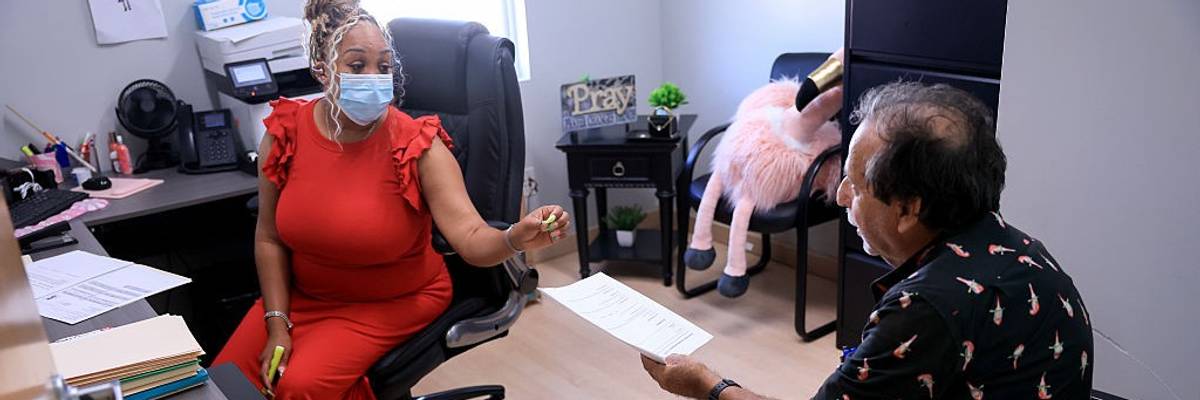
Alicia Lester, case manager and service coordinator, helps Henry Pedoff fill out a Medicaid and a food assistance application at the LifeNet4Families center on May 14, 2025 in Lauderhill, Florida.
"If congressional Republicans think these burdens are appropriate for struggling families, then members of Congress should shoulder them too," said BURDEN Act sponsor Rep. Raja Krishnamoorthi.
In response to Republicans' new law giving tax breaks to the rich while gutting the social safety net, U.S. Congressman Raja Krishnamoorthi on Thursday introduced legislation that would force members of Congress "to personally comply with the same burdensome work requirement paperwork they imposed on low-income Americans."
Under the Illinois Democrat's Bringing Unfair Reporting Duties to Electeds Now (BURDEN) Act, federal lawmakers "would be barred from enrolling in the Federal Employees Health Benefits Program unless they submit monthly proof of 'community engagement,' the same bureaucratic reporting required of Medicaid recipients," his office said.
Krishnamoorthi's two-page bill would also force members of Congress to file the same paperwork as Supplemental Nutrition Assistance Program (SNAP) recipients to verify eligibility, employment, and income. The proposal comes less than two weeks after President Donald Trump signed congressional Republicans' budget reconciliation package.
During the debate over the GOP megabill, Matt Bruenig, founder of the People's Policy Project, argued in The New York Times that "refusing medical care to people in their time of need based on how much they happened to work the month before is a cruel and pointless policy."
The so-called One Big Beautiful Bill Act is expected to leave 17 million Americans without health insurance, and, according to an Urban Institute analysis, an estimated 22.3 million families are projected to lose some or all of their SNAP benefits.
"President Trump's reckless 'Large Lousy Law' forces millions of vulnerable Americans to jump through hoops just to keep food on the table or get the medical care they need," Krishnamoorthi said in a statement. "If congressional Republicans think these burdens are appropriate for struggling families, then members of Congress should shoulder them too. The BURDEN Act simply says, if you want taxpayer-funded health coverage, prove you meet the same standards you're imposing on the American people."
Krishnamoorthi's bill is unlikely to go anywhere in either the House of Representatives or the Senate, both controlled by the GOP, but it sends a message to the public. His office said that "by exposing the double standard in how burdensome requirements are applied, the BURDEN Act seeks to restore basic fairness and highlight the real-world consequences of Republican policies that target working families."
He introduced the bill amid intense debates among Democratic politicians and their supporters about how to battle Trump and the GOP's agenda and prepare for the 2026 midterm elections, following devastating losses for Democrats in the last cycle.
On Wednesday, the Congressional Progressive Caucus—of which Krishnamoorthi is not a member—announced four task forces as part of an effort to "reclaim the House majority in 2026—with a sharp, populist, pro-working-class agenda that meets the moment."
Similarly but separately, a coalition of labor groups and other progressive organizations on Wednesday launched the Battleground Alliance PAC, a political action committee that plans to pour at least $50 million into flipping the lower chamber for Democrats.
Dear Common Dreams reader, It’s been nearly 30 years since I co-founded Common Dreams with my late wife, Lina Newhouser. We had the radical notion that journalism should serve the public good, not corporate profits. It was clear to us from the outset what it would take to build such a project. No paid advertisements. No corporate sponsors. No millionaire publisher telling us what to think or do. Many people said we wouldn't last a year, but we proved those doubters wrong. Together with a tremendous team of journalists and dedicated staff, we built an independent media outlet free from the constraints of profits and corporate control. Our mission has always been simple: To inform. To inspire. To ignite change for the common good. Building Common Dreams was not easy. Our survival was never guaranteed. When you take on the most powerful forces—Wall Street greed, fossil fuel industry destruction, Big Tech lobbyists, and uber-rich oligarchs who have spent billions upon billions rigging the economy and democracy in their favor—the only bulwark you have is supporters who believe in your work. But here’s the urgent message from me today. It's never been this bad out there. And it's never been this hard to keep us going. At the very moment Common Dreams is most needed, the threats we face are intensifying. We need your support now more than ever. We don't accept corporate advertising and never will. We don't have a paywall because we don't think people should be blocked from critical news based on their ability to pay. Everything we do is funded by the donations of readers like you. When everyone does the little they can afford, we are strong. But if that support retreats or dries up, so do we. Will you donate now to make sure Common Dreams not only survives but thrives? —Craig Brown, Co-founder |
In response to Republicans' new law giving tax breaks to the rich while gutting the social safety net, U.S. Congressman Raja Krishnamoorthi on Thursday introduced legislation that would force members of Congress "to personally comply with the same burdensome work requirement paperwork they imposed on low-income Americans."
Under the Illinois Democrat's Bringing Unfair Reporting Duties to Electeds Now (BURDEN) Act, federal lawmakers "would be barred from enrolling in the Federal Employees Health Benefits Program unless they submit monthly proof of 'community engagement,' the same bureaucratic reporting required of Medicaid recipients," his office said.
Krishnamoorthi's two-page bill would also force members of Congress to file the same paperwork as Supplemental Nutrition Assistance Program (SNAP) recipients to verify eligibility, employment, and income. The proposal comes less than two weeks after President Donald Trump signed congressional Republicans' budget reconciliation package.
During the debate over the GOP megabill, Matt Bruenig, founder of the People's Policy Project, argued in The New York Times that "refusing medical care to people in their time of need based on how much they happened to work the month before is a cruel and pointless policy."
The so-called One Big Beautiful Bill Act is expected to leave 17 million Americans without health insurance, and, according to an Urban Institute analysis, an estimated 22.3 million families are projected to lose some or all of their SNAP benefits.
"President Trump's reckless 'Large Lousy Law' forces millions of vulnerable Americans to jump through hoops just to keep food on the table or get the medical care they need," Krishnamoorthi said in a statement. "If congressional Republicans think these burdens are appropriate for struggling families, then members of Congress should shoulder them too. The BURDEN Act simply says, if you want taxpayer-funded health coverage, prove you meet the same standards you're imposing on the American people."
Krishnamoorthi's bill is unlikely to go anywhere in either the House of Representatives or the Senate, both controlled by the GOP, but it sends a message to the public. His office said that "by exposing the double standard in how burdensome requirements are applied, the BURDEN Act seeks to restore basic fairness and highlight the real-world consequences of Republican policies that target working families."
He introduced the bill amid intense debates among Democratic politicians and their supporters about how to battle Trump and the GOP's agenda and prepare for the 2026 midterm elections, following devastating losses for Democrats in the last cycle.
On Wednesday, the Congressional Progressive Caucus—of which Krishnamoorthi is not a member—announced four task forces as part of an effort to "reclaim the House majority in 2026—with a sharp, populist, pro-working-class agenda that meets the moment."
Similarly but separately, a coalition of labor groups and other progressive organizations on Wednesday launched the Battleground Alliance PAC, a political action committee that plans to pour at least $50 million into flipping the lower chamber for Democrats.
In response to Republicans' new law giving tax breaks to the rich while gutting the social safety net, U.S. Congressman Raja Krishnamoorthi on Thursday introduced legislation that would force members of Congress "to personally comply with the same burdensome work requirement paperwork they imposed on low-income Americans."
Under the Illinois Democrat's Bringing Unfair Reporting Duties to Electeds Now (BURDEN) Act, federal lawmakers "would be barred from enrolling in the Federal Employees Health Benefits Program unless they submit monthly proof of 'community engagement,' the same bureaucratic reporting required of Medicaid recipients," his office said.
Krishnamoorthi's two-page bill would also force members of Congress to file the same paperwork as Supplemental Nutrition Assistance Program (SNAP) recipients to verify eligibility, employment, and income. The proposal comes less than two weeks after President Donald Trump signed congressional Republicans' budget reconciliation package.
During the debate over the GOP megabill, Matt Bruenig, founder of the People's Policy Project, argued in The New York Times that "refusing medical care to people in their time of need based on how much they happened to work the month before is a cruel and pointless policy."
The so-called One Big Beautiful Bill Act is expected to leave 17 million Americans without health insurance, and, according to an Urban Institute analysis, an estimated 22.3 million families are projected to lose some or all of their SNAP benefits.
"President Trump's reckless 'Large Lousy Law' forces millions of vulnerable Americans to jump through hoops just to keep food on the table or get the medical care they need," Krishnamoorthi said in a statement. "If congressional Republicans think these burdens are appropriate for struggling families, then members of Congress should shoulder them too. The BURDEN Act simply says, if you want taxpayer-funded health coverage, prove you meet the same standards you're imposing on the American people."
Krishnamoorthi's bill is unlikely to go anywhere in either the House of Representatives or the Senate, both controlled by the GOP, but it sends a message to the public. His office said that "by exposing the double standard in how burdensome requirements are applied, the BURDEN Act seeks to restore basic fairness and highlight the real-world consequences of Republican policies that target working families."
He introduced the bill amid intense debates among Democratic politicians and their supporters about how to battle Trump and the GOP's agenda and prepare for the 2026 midterm elections, following devastating losses for Democrats in the last cycle.
On Wednesday, the Congressional Progressive Caucus—of which Krishnamoorthi is not a member—announced four task forces as part of an effort to "reclaim the House majority in 2026—with a sharp, populist, pro-working-class agenda that meets the moment."
Similarly but separately, a coalition of labor groups and other progressive organizations on Wednesday launched the Battleground Alliance PAC, a political action committee that plans to pour at least $50 million into flipping the lower chamber for Democrats.