SUBSCRIBE TO OUR FREE NEWSLETTER
Daily news & progressive opinion—funded by the people, not the corporations—delivered straight to your inbox.
5
#000000
#FFFFFF
To donate by check, phone, or other method, see our More Ways to Give page.
Daily news & progressive opinion—funded by the people, not the corporations—delivered straight to your inbox.
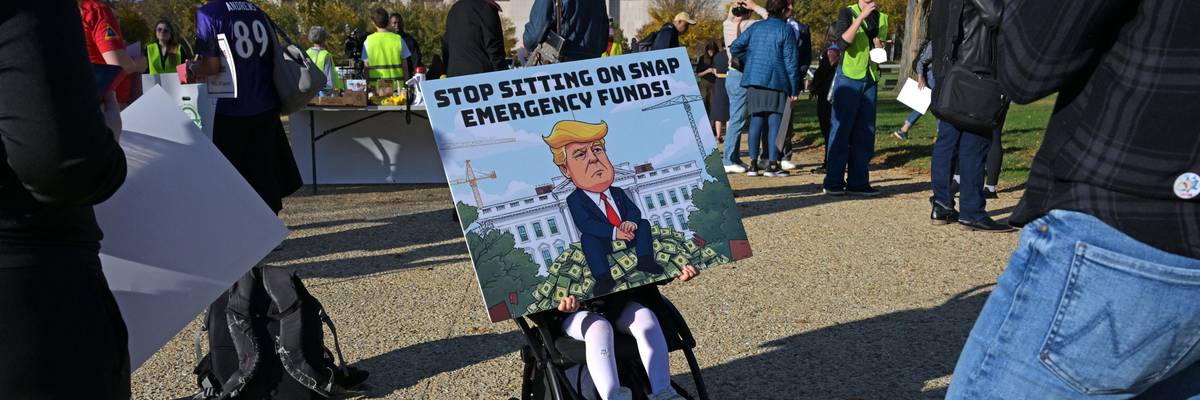
People attend the People's Pantry Food drive to replenish food banks ahead of the Supplemental Nutrition Assistance Program (SNAP) lapse at the USDA Headquarters, on the National Mall, Washington, DC, on October 30, 2025.
"The administration has chosen to hold food for more than forty million vulnerable people hostage to try to force Democrats to capitulate without negotiations," says one Georgetown law professor.
Two federal judges have said the Trump administration cannot use the government shutdown to suspend food assistance for 42 million Americans. But hours into Saturday, when payments were due to be disbursed, President Donald Trump appears to be defying the ruling, potentially leaving millions unable to afford this month's grocery bills.
A pair of federal judges in Massachusetts and Rhode Island ruled Friday that the Department of Agriculture's (USDA) freeze on benefits from the Supplemental Nutrition Assistance Program (SNAP), also known as food stamps, was unlawful and that the department must use money from a contingency fund of $6 billion to pay for at least a portion of the roughly $8 billion meant to be disbursed this month.
“There is no doubt that the six billion dollars in contingency funds are appropriated funds that are without a doubt necessary to carry out the program’s operation,” said US District Judge John McConnell of Rhode Island in his oral ruling. “The shutdown of the government through funding doesn’t do away with SNAP. It just does away with the funding of it. There could be no greater necessity than the prohibition across the board of funds for the program’s operations.”
McConnell added: “There is no doubt, and it is beyond argument, that irreparable harm will begin to occur if it hasn’t already occurred in the terror it has caused some people about the availability of funding for food for their family."
SNAP benefits are available to people whose monthly incomes fall below 130% of the federal poverty line. More than 1 in 8 Americans rely on the program, and 39% of them are children. According to USDA research, cited by the Washington Post, those who receive SNAP benefits rely on it for 63% of their groceries, with the poorest, who make below 50% of the poverty line, relying on it for as much as 80%.
McConnell shot down the administration's contention that the contingency funds may be needed for some other hypothetical emergency in the future, saying "It’s clear that when compared to the millions of people that will go without funds for food versus the agency’s desire not to use contingency funds in case there’s a hurricane need, the balances of those equities clearly goes on the side of ensuring that people are fed."
While the judge in Massachusetts, Indira Talwani, ruled that Trump merely had to use the contingency funds to fund as much of the program as possible, McConnell went further, saying that in addition, they had to tap other sources of funding to disburse benefits in full, and do so "as soon as possible." Both judges gave the administration until Monday to provide updates on how it planned to follow the ruling.
However, after the ruling on Friday, Trump insisted on social media that "government lawyers do not think we have the legal authority to pay SNAP with certain monies we have available, and now two courts have issued conflicting opinions on what we can and cannot do."
He added: "I do NOT want Americans to go hungry just because the Radical Democrats refuse to do the right thing and REOPEN THE GOVERNMENT. Therefore, I have instructed our lawyers to ask the Court to clarify how we can legally fund SNAP as soon as possible."
Attorney and activist Miles Mogulescu pointed out in Common Dreams that, "until a few days ago, even the Trump administration agreed that these funds should be used to continue SNAP funding during the shutdown."
On September 30, the day before the shutdown began, the USDA posted a 55-page "Lapse of Funding" plan to its website, which plainly stated that if the government were to shut down, "the department will continue operations related to... core nutrition safety net programs.”
But this week, USDA abruptly deleted the file and posted a new memo that concocted a new legal reality out of whole cloth, stating that “due to Congressional Democrats’ refusal to pass a clean continuing resolution (CR), approximately 42 million individuals will not receive SNAP benefits come November 1st.”
As Mogulescu notes: "The new memo cited absolutely no law supporting its position. Instead, it made up a rule claiming that the 'contingency fund is not available to support FY 2026 regular benefits, because the appropriation for regular benefits no longer exist.'"
Sharon Parrott, the president of the Center on Budget and Policy Priorities, who previously served as an official in the White House Office of Management, said last week that it's "unequivocally false" that the administration's hands are tied.
"I know from experience that the federal government has the authority and the tools it needs during a shutdown to get these SNAP funds to families," Parrott said. "Even at this late date, the professionals at the Department of Agriculture and in states can make this happen. And, to state the obvious, benefits that are a couple of days delayed are far more help to families than going without any help at all."
She added: "The administration itself admits these reserves are available for use. It could have, and should have, taken steps weeks ago to be ready to use these funds. Instead, it may choose not to use them in an effort to gain political advantage."
In hopes of pressuring Democrats to abandon their demands that Congress extend a critical Affordable Care Act tax credit and prevent health insurance premiums from skyrocketing for more than 20 million Americans, Republicans have sought to use the shutdown to inflict maximum pain on voters.
Trump has attempted to carry out mass layoffs of government workers, which have been halted by a federal judge. Meanwhile, his director of the Office of Management and Budget, Russell Vought, has stripped funding from energy and transportation infrastructure projects aimed at blue states and cities.
"Terminating SNAP is a choice, and an overtly unlawful one at that," says David Super, a constitutional law professor at Georgetown University. "The administration has chosen to hold food for more than forty million vulnerable people hostage to try to force Democrats to capitulate without negotiations.”
Dear Common Dreams reader, It’s been nearly 30 years since I co-founded Common Dreams with my late wife, Lina Newhouser. We had the radical notion that journalism should serve the public good, not corporate profits. It was clear to us from the outset what it would take to build such a project. No paid advertisements. No corporate sponsors. No millionaire publisher telling us what to think or do. Many people said we wouldn't last a year, but we proved those doubters wrong. Together with a tremendous team of journalists and dedicated staff, we built an independent media outlet free from the constraints of profits and corporate control. Our mission has always been simple: To inform. To inspire. To ignite change for the common good. Building Common Dreams was not easy. Our survival was never guaranteed. When you take on the most powerful forces—Wall Street greed, fossil fuel industry destruction, Big Tech lobbyists, and uber-rich oligarchs who have spent billions upon billions rigging the economy and democracy in their favor—the only bulwark you have is supporters who believe in your work. But here’s the urgent message from me today. It's never been this bad out there. And it's never been this hard to keep us going. At the very moment Common Dreams is most needed, the threats we face are intensifying. We need your support now more than ever. We don't accept corporate advertising and never will. We don't have a paywall because we don't think people should be blocked from critical news based on their ability to pay. Everything we do is funded by the donations of readers like you. When everyone does the little they can afford, we are strong. But if that support retreats or dries up, so do we. Will you donate now to make sure Common Dreams not only survives but thrives? —Craig Brown, Co-founder |
Two federal judges have said the Trump administration cannot use the government shutdown to suspend food assistance for 42 million Americans. But hours into Saturday, when payments were due to be disbursed, President Donald Trump appears to be defying the ruling, potentially leaving millions unable to afford this month's grocery bills.
A pair of federal judges in Massachusetts and Rhode Island ruled Friday that the Department of Agriculture's (USDA) freeze on benefits from the Supplemental Nutrition Assistance Program (SNAP), also known as food stamps, was unlawful and that the department must use money from a contingency fund of $6 billion to pay for at least a portion of the roughly $8 billion meant to be disbursed this month.
“There is no doubt that the six billion dollars in contingency funds are appropriated funds that are without a doubt necessary to carry out the program’s operation,” said US District Judge John McConnell of Rhode Island in his oral ruling. “The shutdown of the government through funding doesn’t do away with SNAP. It just does away with the funding of it. There could be no greater necessity than the prohibition across the board of funds for the program’s operations.”
McConnell added: “There is no doubt, and it is beyond argument, that irreparable harm will begin to occur if it hasn’t already occurred in the terror it has caused some people about the availability of funding for food for their family."
SNAP benefits are available to people whose monthly incomes fall below 130% of the federal poverty line. More than 1 in 8 Americans rely on the program, and 39% of them are children. According to USDA research, cited by the Washington Post, those who receive SNAP benefits rely on it for 63% of their groceries, with the poorest, who make below 50% of the poverty line, relying on it for as much as 80%.
McConnell shot down the administration's contention that the contingency funds may be needed for some other hypothetical emergency in the future, saying "It’s clear that when compared to the millions of people that will go without funds for food versus the agency’s desire not to use contingency funds in case there’s a hurricane need, the balances of those equities clearly goes on the side of ensuring that people are fed."
While the judge in Massachusetts, Indira Talwani, ruled that Trump merely had to use the contingency funds to fund as much of the program as possible, McConnell went further, saying that in addition, they had to tap other sources of funding to disburse benefits in full, and do so "as soon as possible." Both judges gave the administration until Monday to provide updates on how it planned to follow the ruling.
However, after the ruling on Friday, Trump insisted on social media that "government lawyers do not think we have the legal authority to pay SNAP with certain monies we have available, and now two courts have issued conflicting opinions on what we can and cannot do."
He added: "I do NOT want Americans to go hungry just because the Radical Democrats refuse to do the right thing and REOPEN THE GOVERNMENT. Therefore, I have instructed our lawyers to ask the Court to clarify how we can legally fund SNAP as soon as possible."
Attorney and activist Miles Mogulescu pointed out in Common Dreams that, "until a few days ago, even the Trump administration agreed that these funds should be used to continue SNAP funding during the shutdown."
On September 30, the day before the shutdown began, the USDA posted a 55-page "Lapse of Funding" plan to its website, which plainly stated that if the government were to shut down, "the department will continue operations related to... core nutrition safety net programs.”
But this week, USDA abruptly deleted the file and posted a new memo that concocted a new legal reality out of whole cloth, stating that “due to Congressional Democrats’ refusal to pass a clean continuing resolution (CR), approximately 42 million individuals will not receive SNAP benefits come November 1st.”
As Mogulescu notes: "The new memo cited absolutely no law supporting its position. Instead, it made up a rule claiming that the 'contingency fund is not available to support FY 2026 regular benefits, because the appropriation for regular benefits no longer exist.'"
Sharon Parrott, the president of the Center on Budget and Policy Priorities, who previously served as an official in the White House Office of Management, said last week that it's "unequivocally false" that the administration's hands are tied.
"I know from experience that the federal government has the authority and the tools it needs during a shutdown to get these SNAP funds to families," Parrott said. "Even at this late date, the professionals at the Department of Agriculture and in states can make this happen. And, to state the obvious, benefits that are a couple of days delayed are far more help to families than going without any help at all."
She added: "The administration itself admits these reserves are available for use. It could have, and should have, taken steps weeks ago to be ready to use these funds. Instead, it may choose not to use them in an effort to gain political advantage."
In hopes of pressuring Democrats to abandon their demands that Congress extend a critical Affordable Care Act tax credit and prevent health insurance premiums from skyrocketing for more than 20 million Americans, Republicans have sought to use the shutdown to inflict maximum pain on voters.
Trump has attempted to carry out mass layoffs of government workers, which have been halted by a federal judge. Meanwhile, his director of the Office of Management and Budget, Russell Vought, has stripped funding from energy and transportation infrastructure projects aimed at blue states and cities.
"Terminating SNAP is a choice, and an overtly unlawful one at that," says David Super, a constitutional law professor at Georgetown University. "The administration has chosen to hold food for more than forty million vulnerable people hostage to try to force Democrats to capitulate without negotiations.”
Two federal judges have said the Trump administration cannot use the government shutdown to suspend food assistance for 42 million Americans. But hours into Saturday, when payments were due to be disbursed, President Donald Trump appears to be defying the ruling, potentially leaving millions unable to afford this month's grocery bills.
A pair of federal judges in Massachusetts and Rhode Island ruled Friday that the Department of Agriculture's (USDA) freeze on benefits from the Supplemental Nutrition Assistance Program (SNAP), also known as food stamps, was unlawful and that the department must use money from a contingency fund of $6 billion to pay for at least a portion of the roughly $8 billion meant to be disbursed this month.
“There is no doubt that the six billion dollars in contingency funds are appropriated funds that are without a doubt necessary to carry out the program’s operation,” said US District Judge John McConnell of Rhode Island in his oral ruling. “The shutdown of the government through funding doesn’t do away with SNAP. It just does away with the funding of it. There could be no greater necessity than the prohibition across the board of funds for the program’s operations.”
McConnell added: “There is no doubt, and it is beyond argument, that irreparable harm will begin to occur if it hasn’t already occurred in the terror it has caused some people about the availability of funding for food for their family."
SNAP benefits are available to people whose monthly incomes fall below 130% of the federal poverty line. More than 1 in 8 Americans rely on the program, and 39% of them are children. According to USDA research, cited by the Washington Post, those who receive SNAP benefits rely on it for 63% of their groceries, with the poorest, who make below 50% of the poverty line, relying on it for as much as 80%.
McConnell shot down the administration's contention that the contingency funds may be needed for some other hypothetical emergency in the future, saying "It’s clear that when compared to the millions of people that will go without funds for food versus the agency’s desire not to use contingency funds in case there’s a hurricane need, the balances of those equities clearly goes on the side of ensuring that people are fed."
While the judge in Massachusetts, Indira Talwani, ruled that Trump merely had to use the contingency funds to fund as much of the program as possible, McConnell went further, saying that in addition, they had to tap other sources of funding to disburse benefits in full, and do so "as soon as possible." Both judges gave the administration until Monday to provide updates on how it planned to follow the ruling.
However, after the ruling on Friday, Trump insisted on social media that "government lawyers do not think we have the legal authority to pay SNAP with certain monies we have available, and now two courts have issued conflicting opinions on what we can and cannot do."
He added: "I do NOT want Americans to go hungry just because the Radical Democrats refuse to do the right thing and REOPEN THE GOVERNMENT. Therefore, I have instructed our lawyers to ask the Court to clarify how we can legally fund SNAP as soon as possible."
Attorney and activist Miles Mogulescu pointed out in Common Dreams that, "until a few days ago, even the Trump administration agreed that these funds should be used to continue SNAP funding during the shutdown."
On September 30, the day before the shutdown began, the USDA posted a 55-page "Lapse of Funding" plan to its website, which plainly stated that if the government were to shut down, "the department will continue operations related to... core nutrition safety net programs.”
But this week, USDA abruptly deleted the file and posted a new memo that concocted a new legal reality out of whole cloth, stating that “due to Congressional Democrats’ refusal to pass a clean continuing resolution (CR), approximately 42 million individuals will not receive SNAP benefits come November 1st.”
As Mogulescu notes: "The new memo cited absolutely no law supporting its position. Instead, it made up a rule claiming that the 'contingency fund is not available to support FY 2026 regular benefits, because the appropriation for regular benefits no longer exist.'"
Sharon Parrott, the president of the Center on Budget and Policy Priorities, who previously served as an official in the White House Office of Management, said last week that it's "unequivocally false" that the administration's hands are tied.
"I know from experience that the federal government has the authority and the tools it needs during a shutdown to get these SNAP funds to families," Parrott said. "Even at this late date, the professionals at the Department of Agriculture and in states can make this happen. And, to state the obvious, benefits that are a couple of days delayed are far more help to families than going without any help at all."
She added: "The administration itself admits these reserves are available for use. It could have, and should have, taken steps weeks ago to be ready to use these funds. Instead, it may choose not to use them in an effort to gain political advantage."
In hopes of pressuring Democrats to abandon their demands that Congress extend a critical Affordable Care Act tax credit and prevent health insurance premiums from skyrocketing for more than 20 million Americans, Republicans have sought to use the shutdown to inflict maximum pain on voters.
Trump has attempted to carry out mass layoffs of government workers, which have been halted by a federal judge. Meanwhile, his director of the Office of Management and Budget, Russell Vought, has stripped funding from energy and transportation infrastructure projects aimed at blue states and cities.
"Terminating SNAP is a choice, and an overtly unlawful one at that," says David Super, a constitutional law professor at Georgetown University. "The administration has chosen to hold food for more than forty million vulnerable people hostage to try to force Democrats to capitulate without negotiations.”