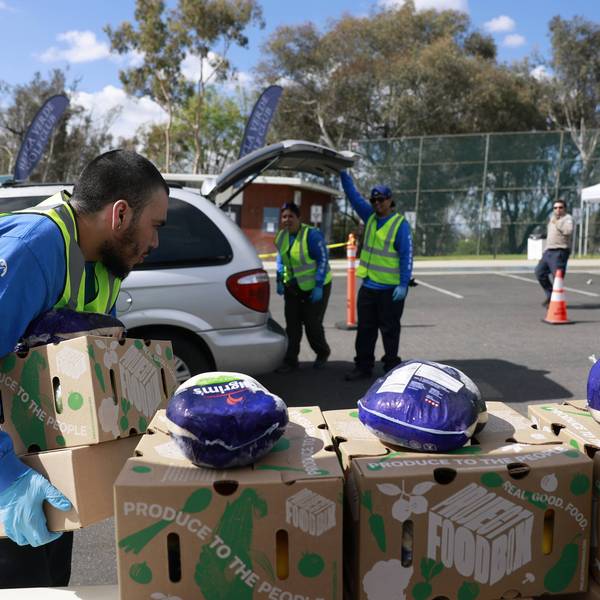


Shoppers wait in line at a grocery store in Washington, DC on January 23, 2026.
Outrage Grows Over GOP Plan to Take Food Aid From Millions of Women and Children
"There is no doubt that this appropriations bill would only deepen America’s hunger crisis," said the president of one anti-hunger organization.
House Republicans faced mounting anger on Thursday after proposing hundreds of millions of dollars in cuts to a program that provides food aid to millions of vulnerable women and children across the United States.
The cuts were proposed in an appropriations bill to fund the US Department of Agriculture and other federal agencies. The Republican legislation would cut $200 million from the Special Supplemental Nutrition Program for Women, Infants, and Children (WIC) in the coming fiscal year at a time when families nationwide are struggling to afford groceries.
The GOP bill would cut by $141 million a WIC benefit that helps provide fruit and vegetables to toddlers, preschoolers, and pregnant and postpartum women. Around 5.4 million people would lose fruit and vegetable benefits under the Republican bill, according to the Center on Budget and Policy Priorities (CBPP).
"There is no doubt that this appropriations bill would only deepen America’s hunger crisis," Crystal FitzSimons, president of the Food Research & Action Center, said in a statement. "Families are already struggling in the face of rising grocery prices and would be forced to stretch tight budgets even further. In turn, they would be forced to make difficult choices such as paying for food, housing, or other basic needs."
Rep. Sanford Bishop Jr. (D-Ga.), the top Democrat on the House agriculture subcommittee, said Thursday that "it is hard to make America healthy again when this bill takes fruit and vegetables from over 5 million women, infants, and children and eliminates the Healthy Food Financing Initiative."
For 30 years, Congress has fully funded #WIC to ensure all eligible families who apply can receive full benefits. The House agriculture appropriations bill would break this promise: it would underfund WIC & cut benefits for WIC participants in every state. https://t.co/lHjESmgkuN
— Ty Jones Cox (@TyJonesCox) April 22, 2026
The damage from the Republican proposal wouldn't be limited to people in the United States. Eric Mitchell, president of the Alliance to End Hunger, noted that "globally, the bill would cut a drastic 25% from Food for Peace at a time when worldwide hunger emergencies are spiking, and the availability of emergency food is in doubt."
"Countless families in the United States and around the world are struggling to get the food they need for themselves and their families. Conflict abroad is spurring emergencies while raising costs for food and agriculture across the globe, and continued economic uncertainty is continuing to put a strain on the limited resources of those most in need of food assistance," said Mitchell. "Hungry people and families cannot afford to shoulder the burden of decreasing federal spending."
The House GOP's proposed cuts would compound the ongoing damage inflicted by the unprecedented $200 billion in cuts to the Supplemental Nutrition Assistance Program (SNAP) that congressional Republicans and President Donald Trump approved last summer.
CBPP noted in an analysis released Wednesday "that SNAP participation nationwide fell by 2.5 million people (6%) between the law’s July 2025 enactment and December of that year, the latest month of data from the US Department of Agriculture."
"The declines started before HR 1’s enactment, suggesting factors at play in addition to that law," the think tank observed. "But in many states they accelerated after HR 1, and we expect that trend to continue."
We are at a crossroads
This country and this world are at a monumental crossroads. In a few short weeks, US voters will have an opportunity to beat back the forces of fascism and confront the billionaires who are rigging the economy, our media system, and our democracy, making it increasingly impossible for ordinary people to get by. We’re not just talking about the election. We’re talking about what must be done once these fascist elements are vanquished from power. We need a bolder set of solutions than what either major party has so far been willing to offer and a working-class movement ready to fight like hell for it. Trump didn't emerge from nowhere. The conditions that fueled MAGA authoritarianism were created by decades of radical neoliberal economic policies and a corrupt political system dominated by corporate interests. They slashed taxes on the super-rich, promising that the benefits would trickle down. They said giveaways to the corporate titans would make life more affordable for the rest of us. It was all bullshit. And when a bitter, betrayed populace searches for someone to blame, right-wing demagogues have little trouble finding scapegoats. People know when they're being lied to, but you won't hear any of this from the corporate media. Only independent journalism—powered and funded by people who believe in building a better world—can deliver truly trustworthy daily news. Our Fall Campaign is underway, and we need your help. To power our newsroom through the rest of the year, we need to raise $125,000 by midnight on October 31. So if you share our vision, please contribute whatever you can to sustain our work. |
House Republicans faced mounting anger on Thursday after proposing hundreds of millions of dollars in cuts to a program that provides food aid to millions of vulnerable women and children across the United States.
The cuts were proposed in an appropriations bill to fund the US Department of Agriculture and other federal agencies. The Republican legislation would cut $200 million from the Special Supplemental Nutrition Program for Women, Infants, and Children (WIC) in the coming fiscal year at a time when families nationwide are struggling to afford groceries.
The GOP bill would cut by $141 million a WIC benefit that helps provide fruit and vegetables to toddlers, preschoolers, and pregnant and postpartum women. Around 5.4 million people would lose fruit and vegetable benefits under the Republican bill, according to the Center on Budget and Policy Priorities (CBPP).
"There is no doubt that this appropriations bill would only deepen America’s hunger crisis," Crystal FitzSimons, president of the Food Research & Action Center, said in a statement. "Families are already struggling in the face of rising grocery prices and would be forced to stretch tight budgets even further. In turn, they would be forced to make difficult choices such as paying for food, housing, or other basic needs."
Rep. Sanford Bishop Jr. (D-Ga.), the top Democrat on the House agriculture subcommittee, said Thursday that "it is hard to make America healthy again when this bill takes fruit and vegetables from over 5 million women, infants, and children and eliminates the Healthy Food Financing Initiative."
For 30 years, Congress has fully funded #WIC to ensure all eligible families who apply can receive full benefits. The House agriculture appropriations bill would break this promise: it would underfund WIC & cut benefits for WIC participants in every state. https://t.co/lHjESmgkuN
— Ty Jones Cox (@TyJonesCox) April 22, 2026
The damage from the Republican proposal wouldn't be limited to people in the United States. Eric Mitchell, president of the Alliance to End Hunger, noted that "globally, the bill would cut a drastic 25% from Food for Peace at a time when worldwide hunger emergencies are spiking, and the availability of emergency food is in doubt."
"Countless families in the United States and around the world are struggling to get the food they need for themselves and their families. Conflict abroad is spurring emergencies while raising costs for food and agriculture across the globe, and continued economic uncertainty is continuing to put a strain on the limited resources of those most in need of food assistance," said Mitchell. "Hungry people and families cannot afford to shoulder the burden of decreasing federal spending."
The House GOP's proposed cuts would compound the ongoing damage inflicted by the unprecedented $200 billion in cuts to the Supplemental Nutrition Assistance Program (SNAP) that congressional Republicans and President Donald Trump approved last summer.
CBPP noted in an analysis released Wednesday "that SNAP participation nationwide fell by 2.5 million people (6%) between the law’s July 2025 enactment and December of that year, the latest month of data from the US Department of Agriculture."
"The declines started before HR 1’s enactment, suggesting factors at play in addition to that law," the think tank observed. "But in many states they accelerated after HR 1, and we expect that trend to continue."
House Republicans faced mounting anger on Thursday after proposing hundreds of millions of dollars in cuts to a program that provides food aid to millions of vulnerable women and children across the United States.
The cuts were proposed in an appropriations bill to fund the US Department of Agriculture and other federal agencies. The Republican legislation would cut $200 million from the Special Supplemental Nutrition Program for Women, Infants, and Children (WIC) in the coming fiscal year at a time when families nationwide are struggling to afford groceries.
The GOP bill would cut by $141 million a WIC benefit that helps provide fruit and vegetables to toddlers, preschoolers, and pregnant and postpartum women. Around 5.4 million people would lose fruit and vegetable benefits under the Republican bill, according to the Center on Budget and Policy Priorities (CBPP).
"There is no doubt that this appropriations bill would only deepen America’s hunger crisis," Crystal FitzSimons, president of the Food Research & Action Center, said in a statement. "Families are already struggling in the face of rising grocery prices and would be forced to stretch tight budgets even further. In turn, they would be forced to make difficult choices such as paying for food, housing, or other basic needs."
Rep. Sanford Bishop Jr. (D-Ga.), the top Democrat on the House agriculture subcommittee, said Thursday that "it is hard to make America healthy again when this bill takes fruit and vegetables from over 5 million women, infants, and children and eliminates the Healthy Food Financing Initiative."
For 30 years, Congress has fully funded #WIC to ensure all eligible families who apply can receive full benefits. The House agriculture appropriations bill would break this promise: it would underfund WIC & cut benefits for WIC participants in every state. https://t.co/lHjESmgkuN
— Ty Jones Cox (@TyJonesCox) April 22, 2026
The damage from the Republican proposal wouldn't be limited to people in the United States. Eric Mitchell, president of the Alliance to End Hunger, noted that "globally, the bill would cut a drastic 25% from Food for Peace at a time when worldwide hunger emergencies are spiking, and the availability of emergency food is in doubt."
"Countless families in the United States and around the world are struggling to get the food they need for themselves and their families. Conflict abroad is spurring emergencies while raising costs for food and agriculture across the globe, and continued economic uncertainty is continuing to put a strain on the limited resources of those most in need of food assistance," said Mitchell. "Hungry people and families cannot afford to shoulder the burden of decreasing federal spending."
The House GOP's proposed cuts would compound the ongoing damage inflicted by the unprecedented $200 billion in cuts to the Supplemental Nutrition Assistance Program (SNAP) that congressional Republicans and President Donald Trump approved last summer.
CBPP noted in an analysis released Wednesday "that SNAP participation nationwide fell by 2.5 million people (6%) between the law’s July 2025 enactment and December of that year, the latest month of data from the US Department of Agriculture."
"The declines started before HR 1’s enactment, suggesting factors at play in addition to that law," the think tank observed. "But in many states they accelerated after HR 1, and we expect that trend to continue."