SUBSCRIBE TO OUR FREE NEWSLETTER
Daily news & progressive opinion—funded by the people, not the corporations—delivered straight to your inbox.
5
#000000
#FFFFFF
To donate by check, phone, or other method, see our More Ways to Give page.
Daily news & progressive opinion—funded by the people, not the corporations—delivered straight to your inbox.
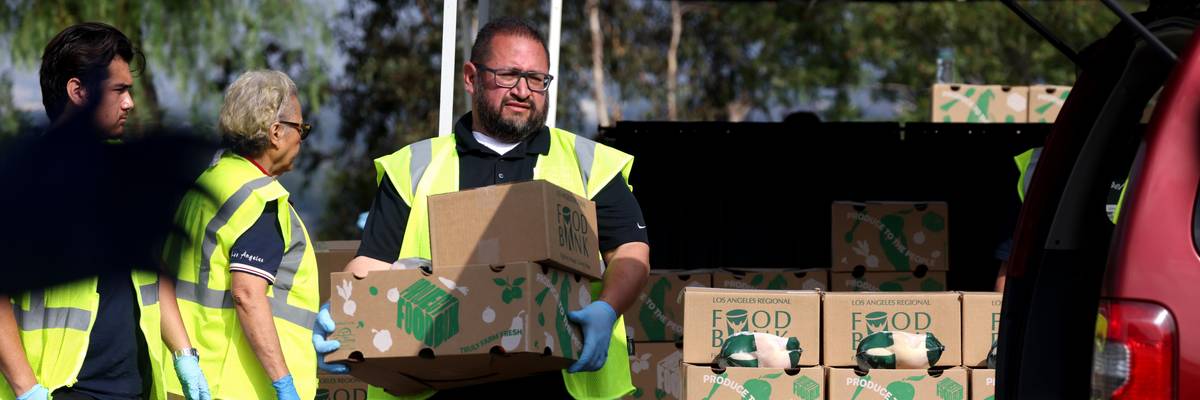
Volunteers hand out boxes of food at a drivethrough food distribution site provided by LA Food Bank at the Industry Hills Expo Center in the City of Industry on November 5, 2025.
The Trump administration "has once again gone out of its way to inflict further harm on low-income families," said the Center on Budget and Policy Priorities.
The average recipient of federal food aid will see a massive 61% benefit cut this month—and millions will lose November benefits entirely—under the Trump administration's plan to only partially fund the Supplemental Nutrition Assistance Program as the government remains shut down.
That's according to an analysis published Wednesday by the Center on Budget and Policy Priorities (CBPP), which found that the expected 61% benefit cut exceeds what's necessary to keep November SNAP spending within the limits of the program's contingency fund.
The think tank said that roughly 1.2 million low-income US households with around 5 million people will receive no benefits at all this month because the across-the-board benefit cut is larger than their typical monthly benefit. The average SNAP recipient receives around $180 per month, or approximately $6 daily.
"Nearly 5.4 million households with one or two members will receive a minimum benefit of $12 for November," CBPP added. "This appears to violate SNAP's regulations, which require these households to receive the typical minimum benefit of $24 unless benefits are cancelled, suspended entirely, or reduced by more than 90%."
"By cutting benefits even more deeply than necessary, the administration—which previously argued (contrary to federal law and the administration's own prior practice) that SNAP's contingency funds aren't legally available to cover regular benefits—has once again gone out of its way to inflict further harm on low-income families," the think tank added.
"There is no excuse that justifies the administration delaying the release of benefits and then choosing not to utilize every resource available to provide full benefits."
The new analysis was released after President Donald Trump sparked confusion and outrage with a Truth Social post earlier this week threatening to defy court orders and withhold SNAP funding entirely until the end of the government shutdown, which is now the longest in US history.
The White House later insisted that the administration is complying with court directives, but advocates and Democratic lawmakers have denounced the partial SNAP funding plan outlined by the US Department of Agriculture as badly inadequate—particularly as families are also facing unprecedented cuts to Medicaid benefits and Affordable Care Act premium hikes stemming from congressional Republicans' refusal to extend subsidies.
"There is no excuse that justifies the administration delaying the release of benefits and then choosing not to utilize every resource available to provide full benefits to the 42 million people who rely on SNAP to put food on the table," said Crystal FitzSimons, president of the Food Research & Action Center. "The decision to provide only partial benefits forces state agencies to scramble under unclear guidance, which will further delay benefits."
"It also means that families are missing out on much needed nutrition support," FitzSimons said. "Enough time has already been lost—the funds must be released immediately to avert further harm, chaos, and confusion."
Rep. Pramila Jayapal (D-Wash.) wrote Thursday that "families can't pay half of the bill at the grocery store or make half of a meal to feed their kids."
"Americans deserve their full SNAP benefits," Jayapal added.
Dear Common Dreams reader, It’s been nearly 30 years since I co-founded Common Dreams with my late wife, Lina Newhouser. We had the radical notion that journalism should serve the public good, not corporate profits. It was clear to us from the outset what it would take to build such a project. No paid advertisements. No corporate sponsors. No millionaire publisher telling us what to think or do. Many people said we wouldn't last a year, but we proved those doubters wrong. Together with a tremendous team of journalists and dedicated staff, we built an independent media outlet free from the constraints of profits and corporate control. Our mission has always been simple: To inform. To inspire. To ignite change for the common good. Building Common Dreams was not easy. Our survival was never guaranteed. When you take on the most powerful forces—Wall Street greed, fossil fuel industry destruction, Big Tech lobbyists, and uber-rich oligarchs who have spent billions upon billions rigging the economy and democracy in their favor—the only bulwark you have is supporters who believe in your work. But here’s the urgent message from me today. It's never been this bad out there. And it's never been this hard to keep us going. At the very moment Common Dreams is most needed, the threats we face are intensifying. We need your support now more than ever. We don't accept corporate advertising and never will. We don't have a paywall because we don't think people should be blocked from critical news based on their ability to pay. Everything we do is funded by the donations of readers like you. When everyone does the little they can afford, we are strong. But if that support retreats or dries up, so do we. Will you donate now to make sure Common Dreams not only survives but thrives? —Craig Brown, Co-founder |
The average recipient of federal food aid will see a massive 61% benefit cut this month—and millions will lose November benefits entirely—under the Trump administration's plan to only partially fund the Supplemental Nutrition Assistance Program as the government remains shut down.
That's according to an analysis published Wednesday by the Center on Budget and Policy Priorities (CBPP), which found that the expected 61% benefit cut exceeds what's necessary to keep November SNAP spending within the limits of the program's contingency fund.
The think tank said that roughly 1.2 million low-income US households with around 5 million people will receive no benefits at all this month because the across-the-board benefit cut is larger than their typical monthly benefit. The average SNAP recipient receives around $180 per month, or approximately $6 daily.
"Nearly 5.4 million households with one or two members will receive a minimum benefit of $12 for November," CBPP added. "This appears to violate SNAP's regulations, which require these households to receive the typical minimum benefit of $24 unless benefits are cancelled, suspended entirely, or reduced by more than 90%."
"By cutting benefits even more deeply than necessary, the administration—which previously argued (contrary to federal law and the administration's own prior practice) that SNAP's contingency funds aren't legally available to cover regular benefits—has once again gone out of its way to inflict further harm on low-income families," the think tank added.
"There is no excuse that justifies the administration delaying the release of benefits and then choosing not to utilize every resource available to provide full benefits."
The new analysis was released after President Donald Trump sparked confusion and outrage with a Truth Social post earlier this week threatening to defy court orders and withhold SNAP funding entirely until the end of the government shutdown, which is now the longest in US history.
The White House later insisted that the administration is complying with court directives, but advocates and Democratic lawmakers have denounced the partial SNAP funding plan outlined by the US Department of Agriculture as badly inadequate—particularly as families are also facing unprecedented cuts to Medicaid benefits and Affordable Care Act premium hikes stemming from congressional Republicans' refusal to extend subsidies.
"There is no excuse that justifies the administration delaying the release of benefits and then choosing not to utilize every resource available to provide full benefits to the 42 million people who rely on SNAP to put food on the table," said Crystal FitzSimons, president of the Food Research & Action Center. "The decision to provide only partial benefits forces state agencies to scramble under unclear guidance, which will further delay benefits."
"It also means that families are missing out on much needed nutrition support," FitzSimons said. "Enough time has already been lost—the funds must be released immediately to avert further harm, chaos, and confusion."
Rep. Pramila Jayapal (D-Wash.) wrote Thursday that "families can't pay half of the bill at the grocery store or make half of a meal to feed their kids."
"Americans deserve their full SNAP benefits," Jayapal added.
The average recipient of federal food aid will see a massive 61% benefit cut this month—and millions will lose November benefits entirely—under the Trump administration's plan to only partially fund the Supplemental Nutrition Assistance Program as the government remains shut down.
That's according to an analysis published Wednesday by the Center on Budget and Policy Priorities (CBPP), which found that the expected 61% benefit cut exceeds what's necessary to keep November SNAP spending within the limits of the program's contingency fund.
The think tank said that roughly 1.2 million low-income US households with around 5 million people will receive no benefits at all this month because the across-the-board benefit cut is larger than their typical monthly benefit. The average SNAP recipient receives around $180 per month, or approximately $6 daily.
"Nearly 5.4 million households with one or two members will receive a minimum benefit of $12 for November," CBPP added. "This appears to violate SNAP's regulations, which require these households to receive the typical minimum benefit of $24 unless benefits are cancelled, suspended entirely, or reduced by more than 90%."
"By cutting benefits even more deeply than necessary, the administration—which previously argued (contrary to federal law and the administration's own prior practice) that SNAP's contingency funds aren't legally available to cover regular benefits—has once again gone out of its way to inflict further harm on low-income families," the think tank added.
"There is no excuse that justifies the administration delaying the release of benefits and then choosing not to utilize every resource available to provide full benefits."
The new analysis was released after President Donald Trump sparked confusion and outrage with a Truth Social post earlier this week threatening to defy court orders and withhold SNAP funding entirely until the end of the government shutdown, which is now the longest in US history.
The White House later insisted that the administration is complying with court directives, but advocates and Democratic lawmakers have denounced the partial SNAP funding plan outlined by the US Department of Agriculture as badly inadequate—particularly as families are also facing unprecedented cuts to Medicaid benefits and Affordable Care Act premium hikes stemming from congressional Republicans' refusal to extend subsidies.
"There is no excuse that justifies the administration delaying the release of benefits and then choosing not to utilize every resource available to provide full benefits to the 42 million people who rely on SNAP to put food on the table," said Crystal FitzSimons, president of the Food Research & Action Center. "The decision to provide only partial benefits forces state agencies to scramble under unclear guidance, which will further delay benefits."
"It also means that families are missing out on much needed nutrition support," FitzSimons said. "Enough time has already been lost—the funds must be released immediately to avert further harm, chaos, and confusion."
Rep. Pramila Jayapal (D-Wash.) wrote Thursday that "families can't pay half of the bill at the grocery store or make half of a meal to feed their kids."
"Americans deserve their full SNAP benefits," Jayapal added.