

SUBSCRIBE TO OUR FREE NEWSLETTER
Daily news & progressive opinion—funded by the people, not the corporations—delivered straight to your inbox.
5
#000000
#FFFFFF
To donate by check, phone, or other method, see our More Ways to Give page.
Daily news & progressive opinion—funded by the people, not the corporations—delivered straight to your inbox.

Attempts to develop independent Palestinian economic growth through the Builders for Peace program 30 years ago were derailed by Israeli restrictions.
When I first heard President Donald Trump’s “Gaza Riviera” scheme, it brought back memories of the hopes Palestinians had three decades ago during the heyday of the Oslo Accords. Back then, I was serving as co-chair of “Builders for Peace,” a project launched by then-Vice President Al Gore to encourage American businesses to invest in the Palestinian economy to support the fledgling peace process.
We had prepared for our mission by reading the exhaustive World Bank study on the pre-Oslo Palestinian economy. The observations and conclusions were sobering, and yet hopeful. It noted obstacles that stifled the development of a Palestinian economy—problems like: Israel’s control of Palestinian land, resources, and power; its refusal to allow Palestinians to independently import and export; and the impediments Israel had created to Palestinian travel and even to conducting commerce within the occupied lands. The bank, however, concluded that if these Israeli restrictions on Palestinian entrepreneurs were removed, external investment would provide opportunities for rapid growth and prosperity.
We also read Sara Roy’s brilliant study of the cruel measures Israel had implemented to “de-develop” Gaza so as to stifle the development of an independent economy, thereby creating a cheap pool of day laborers for Israeli businesses or a network of small workshops that produced items for export by Israeli companies.
When Yasser Arafat spoke to us of the future of Gaza, he would say that with investment and freedom from occupation it could become Singapore; if denied both, it could become Somalia.
We also made a few exploratory visits to the Occupied Palestinian Territories to meet with business and political leaders to assess the possibilities before us and the challenges we would confront. In short order, both became quite clear.
When the project was ready to launch, my fellow co-chair, Mel Levine, and I led the first of a number of delegations of American business leaders (which included both Arab Americans and American Jews) to the Palestinian lands. Our first exposure to the problems we would encounter came as we attempted to enter via the Allenby Bridge from Jordan. American Jews and others passed easily, while Arab Americans were separated from the group and forced to undergo humiliating screening.
We convened a session in Jerusalem for Palestinians to meet with the Americans interested in investment opportunities, only to discover that in order to enter the city Palestinians had to secure a pass from the occupation authority. Since the passes only permitted them a few hours in the city, the time they were able to devote to our discussions proved limited.
Entry into and exit from Gaza was equally problematic. One scene on leaving Gaza has stayed with me. Hundreds of Palestinian men filled what I can only describe as cattle chutes, waiting in the sun for permission to enter into Israel. Straddling these chutes were young Israeli soldiers shouting at the Palestinians below, ordering them to look down and hold their passes above their heads. It was deeply disturbing.
In both Gaza and the West Bank, our meetings with Palestinian business leaders were hopeful. They were eager to discuss possibilities with their American counterparts, and the Americans were impressed. A number of partnerships were discussed.
Two projects were notable. One sought to manufacture leather products and another to assemble furniture. Both sought to take advantage of Gaza’s proximity to Eastern Europe so as to export there. As both projects required that the Israelis permit import of raw material and export of finished products, both projects failed. It appeared that the Israelis might have been willing to entertain such projects but only if the Americans and Palestinians operated through an Israeli middleman, thereby reducing the profitability of the ventures.
Even opportunities that the U.S. government tried to implement failed. One day I received a call from an official in the Department of Agriculture who told me that they had provided 50,000 bulbs for Gazans to develop a flower export industry. These bulbs he told me had been sitting in an Israeli port for months and were rotting. He said that the department was able to send another 25,000 bulbs but could only do so if the Israelis ensured their entry. This too proved fruitless as Israelis wanted no competition with their flower export industry, and therefore wouldn’t allow a competing Palestinian industry to develop.
After a few frustrating years, I saw then-President Bill Clinton who asked me how the project was developing. I told him about the frustrations we were encountering due to the Israeli impediments on investment in independent Palestinian economic growth. He appeared troubled and asked that I write him a detailed memo. The letter I sent to the president both outlined the specific problems we were facing and my complaint that his peace team was not taking these challenges seriously, as they insisted that any U.S. challenge to the Israelis would impede efforts to promote negotiations for peace. I told the president that since Oslo: Palestinian unemployment had doubled, poverty had risen, and Palestinians hope for peace was evaporating. To my dismay, the response I received from the White House appeared to have been drafted by his peace team, and was no response at all. At the end of Clinton’s first term, Builders for Peace (BfP) was disbanded and with it the hopes for Palestinian independent economic growth.
Over the next decade, absent any U.S. pressure on the Israelis to change their behavior, negotiations between Israelis and Palestinians continued to falter, Palestinians became poorer, Israeli became more emboldened and oppressive, and Palestinian attitudes hardened, leading to renewed violence.
There are two other memories from that period that need to be recalled.
One of the more optimistic projects BfP endorsed was a proposal by a Virginia-based Palestinian-American company to build a Marriott resort on the Gaza beachfront. Securing initial investment, they began construction, starting with the foundation and a massive parking garage. Because of the risks involved, they sought risk insurance from OPIC, the U.S. agency created to guarantee investment against risk. The project was endorsed by then-Secretary of Commerce Ron Brown, a champion of our BfP, and supported by PLO head, Yasser Arafat—both of whom saw the resort hotel as laying the foundation for the future economic growth of a Palestinian state.
When Yasser Arafat spoke to us of the future of Gaza, he would say that with investment and freedom from occupation it could become Singapore; if denied both, it could become Somalia. Israel did everything it could to guarantee that Gaza would become Somalia—and they appear to have succeeded.
Against this backdrop, it was painful to hear of Trump’s insulting plan to build an American-owned Gaza Riviera. It reminded me of what might have been, but, three decades later, is being discussed without benefiting any Palestinians from its development.

In a terrible historical irony, Israel has been caught and is paying the price for holding the European colonial bag.
At least 25,000 Gazans, the vast majority children and women, have been killed or wounded. Twenty-five thousand is one-in-a-hundred Gazans and just over 20 times the number of Israelis killed in October. If we translate that proportionately into U.S. numbers, it’s the equivalent of more than 3 million U.S. people. Three percent of all Gazans have been either killed or wounded, and no end is in sight.
Nowhere is safe from Israeli bombs and shelling: 70% of all homes in Gaza have been destroyed. The United Nations humanitarian chief describes Gaza as uninhabitable with water, food, and fuel still in desperately short supply. UNRWA, the U.N. relief and aid agency in Gaza, reports that 570,000 people face “catastrophic hunger.” Hundreds of thousands, it reports, face death from famine, thirst, disease, and lack of medical care.
Under pressure from the Biden administration and world public opinion, Israeli Prime Minister Benjamin Netanyahu has pledged to pursue Hamas with more surgical strikes, but the devastating and indiscriminate bombings go on and the daily death toll mounts.
Deep and profound Zionist racism lies at the core of the Israeli-Palestinian conflict and today’s genocidal war in Gaza.
How can we understand the reality that descendants of a people who suffered genocide can inflict it—albeit in a different form—on another people? Was it inevitable? What besides an immediate cease-fire, which is an urgent necessity, is the alternative?
The answers are not complicated: First, we need to recognize that brutalizing people does not necessarily ennoble them, though many do transcend their suffering and become powerful agents for justice. Trauma, as Palestinians certainly know, reverberates through generations.
As a Jew, it is also painful to recognize, as I have for many years, that deep and profound Zionist racism lies at the core of the Israeli-Palestinian conflict and today’s genocidal war in Gaza.
Many who escaped European pogroms, survived the Holocaust and Soviet antisemitism, and the banalities of American life carried Euro-American racism and colonial values with them to Israel and to the lands and people conquered in 1967. Years ago, I participated in interviews with Israel’s esteemed former Foreign Minister Abba Eban, with Jerusalem Mayor (later Prime Minister) Ehud Olmert, Prime Minister Ariel Sharon, and others. The racism of three Israeli leaders was shocking, although Eban’s was more elegantly expressed. In another interview. Sharon’s water minister Meir Meir pledged that Palestinians in the Occupied Territories would have “enough water… to drink.” Six weeks after leaving California, one West Bank settler explained that with every war God had liberated the land for Jews, and that it is their responsibility to settle and hold it.
God has been on the side of conquering imperialists from time immemorial.
In 1981 Beirut, months before Ariel Sharon’s disastrous invasion of Lebanon, during an unimpressive interview with U.S. peace advocates, Yasser Arafat nailed it, saying “It’s cowboys and Indians all over again.” In Gaza today we are witnessing the 21st century version of how the West was won.
I am Jewish, born in 1946 in the immediate aftermath of the Holocaust. My father fought in that war and satisfied his ambition of pissing in the Rhine. When visiting one of my best friends, I would often see the Auschwitz numbers tattooed on his grandmother’s arm. Eichmann’s capture in Argentina generated a flood tide of paperback Holocaust literature, and as a young teenager I shoplifted books from the local drug store and read about people like me being transformed into lampshades or reduced to the ashes that lined concentration camp paths. I was taught three fundamental lessons from the Judeocide: Never again to anyone. Never turn your head away from witnessing and responding to injustice. That there is a correlation between truth and who lives or dies and how.
Thus, I found my way into the civil rights movement and, beginning in the 1970s, to the Middle East. Back then, there was little or no substantive literature about the Middle East in the United States. You could find Israeli propaganda and a few tomes about King Tut’s tomb. But landing in London in 1973 after the Paris Peace Accords were signed, which we mistakenly thought had ended the Indochina War, and eager to learn what was being done in my name in the Middle East, the legacy of British colonialism meant that histories and analyses there were readily available. I made a feast of them. I also had the unique privilege of working with and learning from Israeli pacifists on the War Resisters International Council and Said Hammami, then the Palestinian Liberation Organization (PLO) representative in London.
There was much to learn. Stereotypes and mythologies were shattered. Once during a four person conference working group with Hammami, the Algerian ambassador and his assistant amazingly echoed the words of Golda Meir: “The Palestinian people don’t exist.” The ambassador had fully embraced the Arab nations’ lesson from their catastrophic 1967 defeat and humiliation. No more sacrifices for Palestinians.
Israel has self-defeatingly transformed itself into a pariah nation.
I first traveled to the Middle East in 1975 as part of a Breira (precursor to Jewish Voices for Peace) and National Council of Churches fact-finding delegation. We arrived in Beirut 15 minutes before the civil war started, and it was surprising how quickly a war-resisting pacifist could become accustomed to gunfire. Most memorable in Beirut was our recorded interview with PLO adviser Sabri Jiryis, who that year met with U.S. leaders in Washington, D.C. and was deported on Henry Kissinger’s orders. With us, Jiryis put forward the case for a two-state solution in an interview that was cut short when gunfire moved from four blocks away, to three, to two, and then surrounded us.
We arrived in Jerusalem following a Palestinian bombing in Zion Square. Most of the dead were Israelis, but three Palestinians were also killed—women shopping for a wedding dress. In the wee hours of the following morning, I was awakened by the haunting sounds of Palestinian women ululating in the cemetery behind my hotel.
There was also cognitive dissonance at Yad Vashem, the Israeli Holocaust museum. The first exhibit rightly documented Nazi marginalization of Jews and the confiscation of Jewish properties. But Yad Vashem was built on seized Palestinian land and is a little more that a stone’s throw from the site of the 1948 Deir Yasin massacre of Palestinians.
Years later in Gaza, I endured what may have been the worst night of my life. The territory was under curfew, and we were being briefed by an UNRWA official when we were called to come out to witness young Yusef’s dead body laid out in a stone shed. With his buddies, he’d been violating the curfew and castigating patrolling IDF troops. One soldier couldn’t take it, knelt on the ground for greater stability, and, from 50 yards, shot Yusef twice between the eyes. The rest of the night was a struggle over who would get Yusef’s body, the IDF or his family,
And on another occasion, with colleagues, I was almost kidnapped in Gaza.
Beginning in 1976, after returning to the U.S., I was privileged to work with some of Israel’s founders, men who had created the Israeli Council for Israel-Palestine Peace (ICIPP). They had issued a manifesto describing what they could accept as a foundation for Israeli-PLO negotiations. Their manifesto was published in 14 languages to ensure that Palestinian leaders wouldn’t miss it. Arafat sent signals indicating an openness to exploring possibilities on the basis of the manifesto. What were initially secret negotiations ensued and eventually became what we know as the “Peace Process.” Uri Avnery, who in his youth fought in the Irgun. was a leading figure in those negotiations and later described them in his compelling book: My Enemy, My Friend. It was anything but a smooth process. In 1978, Hammami was murdered in London by Syrian intelligence. Issam Sartawi, the leading Palestinian figure in secret negotiations, was killed by an Abu Nidal assassin..
The Hamas massacre of October 7 was unconscionable, certainly illegal, and at the far end of immoral brutality. Even if it is seen as a “jail break” from the “open air prison” of the 16-year Gaza blockade, with all of the suffering that has entailed, the massacre was unconscionable, to be condemned, self-defeating (witness 25,000 dead and counting), and never repeated.
That said, as Thomas Friedman has repeatedly written in The New York Times these last three months, there were other alternative responses that would have reinforced Israeli security and allowed it to retain the moral high ground. Instead, Netanyahu and the most right-wing and racist government in Israel’s history opted to destroy Palestinian Gaza. Israeli General and War Cabinet member Yoav Gallant’s description of Palestinians as “human animals” announced the IDF’s racist, genocidal campaign. And as the South Africans documented in the Hague, similar expressions of racism and commitments to elimination have flowed from the mouths of Israeli President Isaac Herzog, other cabinet members, military leaders, and military units, as well as in the Israeli press.
Daily images testify to the reality that Netanyahu’s and his government’s attacks have been targeted against the people of Gaza more than Hamas.
Beyond tragedy, compounding its history of what Jimmy Carter termed apartheid not long after his presidency, Israel has self-defeatingly transformed itself into a pariah nation. As Friedman explains, beyond the consequences of international isolation, with increasing numbers of Israelis already leaving for the West, the Zionist experiment itself may be at risk. Israel’s Population and Immigration Authority reports that half a million Israelis have left the country since October 7.
Another tragic but predictable consequence of the genocide is something that the refugee Jewish philosopher Hannah Arendt predicted in 1948. Just or not (and it is not), the world’s Jews would be judged by how Israel related to its Arab neighbors. Israel’s indiscriminate murder of thousands of civilians will fuel antisemitism for decades to come. That said, and to be appreciated, are the words of Dr. Mustafa Barghouti, the nonviolent Palestinian leader in Ramallah who cited and appreciated cease-fire demonstrations by U.S. rabbis and Jewish Voice for Peace.
Daily images testify to the reality that Netanyahu’s and his government’s attacks have been targeted against the people of Gaza more than Hamas. The goal goes far beyond destroying Hamas. Rather, as we witness Gazans being driven to the border with Egypt and read Israeli cabinet members’ appeals and plans for “thinning” the Palestinian population in Gaza, the ultimate goal is a second and greater Nakba. But, unlike 1948, Egypt is not cooperating as Jordan did 75 years ago.
The roots of today’s crimes trace to centuries of European antisemitism and the Balfour Doctrine which was designed to reinforce British (and since 1948/56) U.S. hegemony in the oil-rich Arab world. Theodor Herzel’s Zionism sought “a land without people for a people without a land.” But as with all other colonial settler initiatives (think the U.S. South Africa, Australia) there were people on the land. Worth noting is that the Nuseibeh (Muslim) family, which traces its presence in Jerusalem to the 4th century C.E., has long held the keys to the Church of the Holy Sepulcher. In a terrible historical irony, Israel has been caught and is paying the price for holding the European colonial bag. Indeed, it is cowboys and Indians all over again. But the 21st century is not the 18th or 19th centuries. Genocides are witnessed in real time and rightly generate global outrage.
Mattityahu Peled was Israel’s third ranking general in 1967. He was later a principal figure in the secret negotiations with the PLO and an uncompromising peace advocate in the Israeli Knesset.. During a speaking tour in the United States, he described how the Israeli military pressed Prime Minister Levi Eshkol not to accept President Lyndon Johnson’s efforts to mediate the crisis initiated by Egypt’s President Gamal Abdel Nasser. The Israeli army knew what it could do. And with Eshkol’s green light they it did it: destroying the Egyptian Air Force in the first hour of the war and then conquering the Golan Heights, the West Bank including East Jerusalem. and Gaza all within six days.
Peled once described an exchange he once had with Ezer Weizman, formerly the commander of the Israeli Air Force and later the IDF’s chief of staff, within days of Israel’s conquests. The exchange illuminates the essence of the totally unnecessary Israeli-Palestinian tragedy. Walking in East Jerusalem, Peled turned to Weizman and said, “Now we can create the Palestinian state on our own terms and be done with the Palestinian problem.” Weizman responded, “What? Are you crazy?” And from there followed the commitment and campaign for colonial settlements at enormous human cost and in violation of international law in the pursuit of creating Greater Israel from the Jordan River to the sea..
Recall, that even David Ben-Gurion, long honored as the father of his nation, refused to declare what Israel’s borders would be. No Israeli leader has done so since. The goal has always been a Greater Israel, just as settler colonialists here in the United States expanded the country from the Atlantic coast, across the continent to the Pacific Ocean with genocidal campaigns, conquests, and settlements.
Would that the plug could be pulled on the Netanyahu government today. Even as we properly condemn the Biden administration’s complicity in Israel’s genocide and write in “Cease-fire” in presidential primaries, Secretary of State Antony Blinken has been playing with the plug. While in Jerusalem, he has been meeting with members of Israel’s increasingly divided war cabinet and with at least one opposition leader in what appears to be some drilling at work in the wall of Israeli solidarity.
Extending the war means extending Netanyahu’s time in office and delaying his hoped-for ouster and imprisonment for corruption. Having launched a poorly conceived war of revenge and conquest, the Israeli prime minister has placed himself and Israel in an impossible situation: Even General Gadi Eisenkot of the war cabinet concedes that the IDF cannot achieve its announced goal of totally destroying Hamas. Netanyahu thus finds himself in an impossible position: fighting a war that cannot be won and which politically he cannot afford to lose.
There is of course a way out: Biden could and should declare, “Enough!”, cease providing diplomatic cover in the United Nations and elsewhere for the IDF’s genocide, and end the deluge of weapons flowing to the IDF that makes the Gaza massacre possible.
One possible Netanyahu escape hatch is to widen the war in order to bring the U.S. more deeply into it on Israel’s behalf. This helps us to explain the drone assassination of Iran’s Revolutionary Guards intelligence chief in Damascus and the ultimatum Israel has delivered to the Lebanese government to contain Hezbollah in Lebanon, or else.
Would that it was otherwise. President Joe Biden appears to be falling toward Netanyahu’s trap as our president widens the conflict with an unwinnable war against the Houthis in Yemen.
There is of course a way out: Biden could and should declare, “Enough!”, cease providing diplomatic cover in the United Nations and elsewhere for the IDF’s genocide, and end the deluge of weapons flowing to the IDF that makes the Gaza massacre possible. These and the firm resolve that constructive U.S.-Israel relations depend on an Israeli commitment to engage in credible diplomacy for either a two-state solution or another political framework that guarantees Palestinians national self-determination and the full exercise of their human rights.
It is worth noting that in the midst the war and genocide, the Saudis have reiterated their peace plan, which includes normalization of relations with Israel..
Noam Chomsky once remarked that there are rational solutions to the existential threats that confront humanity. The question, he concluded, is whether we have the will to implement them.

'Netanyahu not just admitting to monumental deception but gloating about it'
Israeli Prime Minister Benjamin Netanyahu said that he was "proud" of preventing the creation of a Palestinian state during a press conference in Tel Aviv Saturday night.
Speaking alongside Defense Minister Yoav Gallant and war cabinet minister Benny Gantz, Netanyahu claimed that he had halted the progression of the Oslo peace process, which began in 1993, calling the Oslo Accords "a fateful mistake" and said the results of the “little Palestinian state in Gaza” brought about by the Israeli withdrawal from Gaza in 2005 demonstrated the danger of allowing Palestinian sovereignty in the West Bank.
The Oslo Accords were an agreement signed by Israel and the PLO (Palestinian Liberation Organisation) that saw the establishment of the Palestinian Authority in the West Bank and Gaza as part of a process that was meant to lead to a two-state solution to the Palestinian-Israeli conflict.
Netanyahu's comments come after several Israeli officials said that there would be no two-state solution following the end of Israel's indiscriminate war on Gaza, which has destroyed much of the occupied territory and killed at least 18,800 Palestinians, primarily women and children, in Israeli attacks since October 7, according to the territory's health ministry.
Israel's right-wing ambassador to the UK, Tzipi Hotovely, answered "absolutely no" when asked during an interview on Sky News last Wednesday about whether a two-state solution would arise following the end of the Gaza War. "Israel knows today, and the world should know now that the reason the Oslo Accords failed is because the Palestinians never wanted to have a state next to Israel," Hotovely said.

Donald Trump's supposed "deal of the century," offering the Palestinians economic bribes in return for political submission, is the endgame of western peace-making, the real goal of which has been failure, not success.
For decades, peace plans have made impossible demands of the Palestinians, forcing them to reject the terms on offer and thereby create a pretext for Israel to seize more of their homeland.
The more they have compromised, the further the diplomatic horizon has moved away--to the point now that the Trump administration expects them to forfeit any hope of statehood or a right to self-determination.
Even Jared Kushner, Trump's son-in-law and architect of the peace plan, cannot really believe the Palestinians will be bought off with their share of the $50 billion inducement he hoped to raise in Bahrain last week.
That was why the Palestinian leadership stayed away.
But Israel's image managers long ago coined a slogan to obscure a policy of incremental dispossession, masquerading as a peace process: "The Palestinians never miss an opportunity to miss an opportunity."
It is worth examining what those landmark "missed opportunities" consisted of.
The first was the United Nations' Partition Plan of late 1947. In Israel's telling, it was Palestinian intransigence over dividing the land into separate Jewish and Arab states that triggered war, leading to the creation of a Jewish state on the ruins of most of the Palestinians' homeland.
But the real story is rather different.
The recently formed UN was effectively under the thumb of the imperial powers of Britain, the United States, and the Soviet Union. All three wanted a Jewish state as a dependent ally in the Arab-dominated Middle East.
Fuelled by the dying embers of western colonialism, the Partition Plan offered the largest slice of the Palestinian homeland to a minority population of European Jews, whose recent immigration had been effectively sponsored by the British empire.
As native peoples elsewhere were being offered independence, Palestinians were required to hand over 56 per cent of their land to these new arrivals. There was no chance such terms would be accepted.
However, as Israeli scholars have noted, the Zionist leadership had no intention of abiding by the UN plan either. David Ben Gurion, Israel's founding father, called the Jewish state proposed by the UN "tiny." He warned that it could never accommodate the millions of Jewish immigrants he needed to attract if his new state was not rapidly to become a second Arab state because of higher Palestinian birth rates.
Ben Gurion wanted the Palestinians to reject the plan, so that he could use war as a chance to seize 78 per cent of Palestine and drive out most of the native population.
For decades, Israel was happy to entrench and, after 1967, expand its hold on historic Palestine.
In fact, it was Palestinian leader Yasser Arafat who made the biggest, unreciprocated concessions to peace. In 1988, he recognised Israel and, later, in the 1993 Olso accords, he accepted the principle of partition on even more dismal terms than the UN's--a state on 22 per cent of historic Palestine.
Even so, the Oslo process stood no serious chance of success after Israel refused to make promised withdrawals from the occupied territories. Finally, in 2000 President Bill Clinton called together Arafat and Israeli prime minister Ehud Barak to a peace summit at Camp David.
Arafat knew Israel was unwilling to make any meaningful compromises and had to be bullied and cajoled into attending. Clinton promised the Palestinian leader he would not be blamed if the talks failed.
Israel ensured they did. According to his own advisers, Barak "blew up" the negotiations, insisting that Israel hold on to occupied East Jerusalem, including the Al Aqsa mosque, and large areas of the West Bank. Washington blamed Arafat anyway, and refashioned Israel's intransigence as a "generous offer."
A short time later, in 2002, Saudi Arabia's Peace Initiative offered Israel normal relations with the Arab world in return for a minimal Palestinian state. Israel and western leaders hurriedly shunted it into the annals of forgotten history.
After Arafat's death, secret talks through 2008-09--revealed in the Palestine Papers leak--showed the Palestinians making unprecedented concessions. They included allowing Israel to annex large tracts of East Jerusalem, the Palestinians' expected capital.
Negotiator Saeb Erekat was recorded saying he had agreed to "the biggest [Jerusalem] in Jewish history" as well as to only a "symbolic number of [Palestinian] refugees' return [and a] demilitarised state ... What more can I give?"
It was a good question. Tzipi Livni, Israel's negotiator, responded, "I really appreciate it" when she saw how much the Palestinians were conceding. But still her delegation walked away.
Trump's own doomed plan follows in the footsteps of such "peace-making."
In a New York Times commentary last week Danny Danon, Israel's ambassador to the UN, candidly encapsulated the thrust of this decades-long diplomatic approach. He called on the Palestinians to "surrender," adding: "Surrender is the recognition that in a contest, staying the course will prove costlier than submission."
The peace process was always leading to this moment. Trump has simply cut through the evasions and equivocations of the past to reveal where the West's priorities truly lie.
It is hard to believe that Trump or Kushner ever believed the Palestinians would accept a promise of "money for quiet" in place of a state based on "land for peace."
Once more, the West is trying to foist on the Palestinians an inequitable peace deal. The one certainty is that they will reject it--it is the only issue on which the Fatah and Hamas leaderships are united--again ensuring the Palestinians can be painted as the obstacle to progress.
The Palestinians may have refused this time to stumble into the trap, but they will find themselves the fall guys, whatever happens.
When Trump's plan crashes, as it will, Washington will have the chance to exploit a supposed Palestinian rejection as justification for approving annexation by Israel of yet more tranches of occupied territory.
The Palestinans will be left with a shattered homeland. No self-determination, no viable state, no independent economy, just a series of aid-dependent ghettos. And decades of western diplomacy will finally have arrived at its preordained destination.
A version of this article first appeared in the National, Abu Dhabi.

This week a well-known Israeli journalist revealed what he said were "new details about the Trump administration's Israeli-Palestinian peace plan." His report, he said, came from notes he had obtained from an American Jewish leader who had been part of a small group of community leaders briefed by a "senior Administration official" just two weeks earlier.
Since I had heard about the briefing and anticipated the "expected leak," I began reading, preparing to be outraged. Instead I found my reaction to be somewhere between bored and amused by the content. At the same time, I was also alarmed, not so much by what was or wasn't in the "plan," but by what I suspected was the intent of the leak.
After waiting almost two years for the "Deal of the Century," what the notes of the briefing contained was a watered-down version of what Israeli Prime Minister Ehud Barak had offered to Palestinian President Yasser Arafat almost two decades ago and less than what Secretary of State John Kerry offered two years ago. The elements of the purported deal included: a Palestinian state on 85% of the West Bank with some land-swaps to compensate Palestinians for the West Bank settlement blocks that will go to Israel; Israeli settlements outside of the blocks will not be evacuated, but "illegal outposts" will be; and Jerusalem will be a shared capital - Israel will have West Jerusalem and Palestinians will have some of the "Arab neighborhoods" in East Jerusalem - but the Old City and holy sites will remain under Israeli control. There was no mention of Gaza or Palestinian refugees. Nor was there any provision for Palestinian sovereign control over borders or resources.
Had difficulty understanding how, after two years on the job, Trump's team had come up with something so embarrassingly unsurprising and inadequate.
As I read the notes, I had difficulty understanding how, after two years on the job, Trump's team had come up with something so embarrassingly unsurprising and inadequate. They must know, I thought, that there is no Israeli government on the horizon that would be willing to cede control of 85% of the West Bank, and no Palestinian leader who could accept a deal that retains Israeli control over critical areas of occupied Jerusalem, and fails to address Gaza, refugees, or sovereignty. For the Israelis, this plan gives too much; for the Palestinians, too little. That much is obvious. What, however, piqued my curiosity was a final comment in the Jewish leader's notes in which he observed that the White House official, who was the source of this plan, urged the Israelis not to reject it and let the Palestinians be the rejectionist party.
Since it was so patently obvious that the plan wasn't a serious solution to the conflict, there had to be, I thought, another reason for floating such a poorly inflated trial balloon. The only reason I could imagine that would account both for the leak and for the caution to Israel not to reject it had more to do with why it was might have been leaked in the first place - and that is to make the Trump administration and the Israelis appear to be reasonable and eager to accommodate Palestinians so as to facilitate US and Israeli entreaties to Arab states to work more openly with Israel. This would have the effect of subverting the Arab Peace Initiative (API).
The API provided an Arab commitment to normalize relations with Israel - but only after: Israel withdrew from territories occupied in the 1967 war; there was an agreed upon solution to the Palestinian refugee issue; and there was the establishment of a Palestinian state in the West Bank and Gaza with its capital in East Jerusalem. The " leaked deal," on the other hand, would ask Arabs to begin normalization based on an inadequate plan that Israel wouldn't reject but would never implement. In the end, relations would be normalized, with the "rejectionist" Palestinians remaining under occupation, in limbo.
In this context, it is important to recall that for President Trump the matter of Palestinian rights, per se, has never been a priority or even a concern. If anything, it was a merely a pesky matter to overcome in order to achieve the "deal of the century" that brought the Arabs together with Israel, ostensibly to confront Iran and extremism. It appears that the administration's thinking might be that if a real peace deal can't be reached, then maybe, just maybe, it can be finessed by sleight of hand.
Far-fetched? Possibly. But what other explanation can there be for something so trite being leaked at this time?
The bottom line, however, is that this lame effort will fail since it underestimates Arab leaders and ignores what they know about their region and their people. As our most recent polling demonstrates, despite all of the issues roiling the Middle East, Palestine remains a priority concern across the region and there is no tolerance among Arabs, in any of the region's countries, for normalized relations with Israel until the terms of the API are met, in full. And even then, it will be a hard sell. There may be regional concern with Iran's meddlesome behavior and the continuing threat posed by extremist ideologies. But what the Trump administration still hasn't figured out is that normalized relations with Israel without real justice for Palestinians would only be a boon for Iranian propagandists and extremist recruiters.

I've been looking at lists of 2020 prospects for Democratic hopefuls to unseat Donald Trump in 2020 and getting flashbacks to pre-internet antiquity when those same Tussaud Museum pieces wagged animatronically from cathode-ray tube TV sets with a relevance as presumed then as it is now: John Kerry, Joe Biden, Elizabeth Warren, Bernie Sanders, Michael Bloomberg, and of course Hillary Clinton.
I've been looking at lists of 2020 prospects for Democratic hopefuls to unseat Donald Trump in 2020 and getting flashbacks to pre-internet antiquity when those same Tussaud Museum pieces wagged animatronically from cathode-ray tube TV sets with a relevance as presumed then as it is now: John Kerry, Joe Biden, Elizabeth Warren, Bernie Sanders, Michael Bloomberg, and of course Hillary Clinton.
The Democratic Party these days has a lot in common with Yasser Arafat, the late Palestinian leader: it has a gift for self-destruction, even when handed victory. Clinton, Kerry and Biden all ran for president a combined five times between them, going back to 1988. It was a debacle every time.Thankfully that's not the complete list. There are almost three dozen names being thrown around, some of them very appealing, with more to come. But we keep hearing a lot about those six. They'd never make it to a nomination, and if they did they'd never win. Meanwhile they're cluttering up the field, making it more difficult for the next generation of Democrats-the less known, the better-to emerge. With self-centered saboteurs like that I'm not sure Donald Trump has much to worry about.
Their age is telling. Most of them will be closer to 80 than 70 on inauguration day, with an average age of 76. I'm all for people working as long as they like, but this is the presidency, and these candidates' age reflects a has-been tiredness that makes the Democratic Party look like a collection of clinging holdovers who don't realize they've had their time. The country is still trying to define itself in a new century, the events of 9/11 having hijacked its trajectory for a decade of loss and almost another decade of recovery before the Trump regression. The time that these six did have along the way is not exactly stellar.
The Democratic Party these days has a lot in common with Yasser Arafat, the late Palestinian leader: it has a gift for self-destruction, even when handed victory. Clinton, Kerry and Biden all ran for president a combined five times between them, going back to 1988. It was a debacle every time, mostly because of their own errors. Kerry had no business losing against George W. Bush anymore than Clinton had against Trump, but both managed it brilliantly. Clinton thought it was enough to shine neon on Trump's luridness, just as Kerry thought it was enough to sanctify his Vietnam War record. The condescension made even lunch pails wince.
There's also the tendency to turn despair about reactionary immaturity into a marketing pitch. There's a place for that sort of cultural criticism. It's what university columns, sit-coms and overheated opinion columns are for. But campaign-trail focus on cultural and pandering issues like guns, religion, abortion and "values," that all-purpose bait that can mean everything but really means nothing-that focus is a red herring and a trap. Since Pat Buchanan vomited that strategy in 1992 as the perpetual sequel to the race-baiting Southern Strategy, Republicans have loved to ambush Democrats on those counts because it makes them look elitist, like when Clinton calls cultural conservatives "deplorables" or Obama refers to them as clinging to their guns or religion.
Clinton and Obama weren't wrong. Obama's fuller statement is even more indisputable now, with a president incarnating the statement with every tweet, than it was when Obama made it in 2008: "They get bitter, they cling to guns or religion or antipathy to people who aren't like them or anti-immigrant sentiment or anti-trade sentiment as a way to explain their frustrations." But Obama quickly learned what Clinton didn't: these statements get us nowhere if they divert from the more relevant issues that do matter even to the clingers and the deplorables: economic security, decent health care, humane immigration.
Of course Democrats talk jobs, the promise of a green economy, the evils of inequality. But after so many decades in power, even liberals like Bernie Sanders sound as if they speak on behalf of the middle or working class rather than as being of it. They're no longer believable, speaking in white papers and cliches, turning those classes into pliant monolith, sentimentalizing them rather than reflecting their concerns. (The historian Barbara Tuchman described English intellectuals doing the exact same thing with their working class at the turn of the last century, on the way to socialism's demise there.)
Republican candidates don't bother with everyday concerns. They skirt the problem by pandering to cultural issues: anyone can wrap himself in the flag, anyone can talk guns god and babies, not mean a word of it but still sound like Winston Churchill talking about defending the beaches of Dover. It's all generalities and propaganda, not something you can ask the Congressional Budget Office to analyze, and it saves you the trouble of having a governing plan. If it worked for Trump-the country is more adrift than it was under Andrew Johnson-it's because Democrats didn't come up with a convincing alternative.
The ancient Democrats still aren't getting it. The other day Clinton was in Europe sounding like a born-again reactionary about immigrants and refugees. What she told Europeans could have been an endorsement of Trump's wall: stop taking in migrants. Biden's popularity is high, but that's mostly nostalgia for the Obama years. It's not about Biden himself. Now he's hesitating about a run the way he did before 2016, playing the coquet the way Mario Cuomo did about running for president in 1988 and 92 or accepting a nomination to the Supreme Court in 1993. (Thankfully, Clinton ended up going with his seventh choice, Ruth Bader Ginsburg).
Early lists of candidates are deceptive. The stronger candidates often emerge unexpectedly, though social media and the 24-hour news cycle have pretty much ended the age of the unexpected. Beyond Democrats' Methuselahs, we hear names like Senators Cory Booker and Kirsten Gillibrand, Texas's Beto O'Rourke and Ohio's Sherrod Brown, Julian Castro and Terry McAuliffe. McAuliffe aside, the list is short on leaders who've actually run governments and long on the seductions of charisma, that desire for an Obama-like knight to save Democrats-from themselves as much as from Trump. That too is not necessarily encouraging. We can all use a few years of dull, grunt-like leadership to save democracy. Replacing one cult with another won't do it.
If even these younger, interesting names tell us anything so far it's that Democrats don't know what else to do beyond getting rid of Trump. That's no small thing, but it isn't enough, and it won't carry a candidate to victory. It certainly didn't in 2016. Taking back the House is an indication of broad dissatisfaction with Trump (as opposed to the Trump administration, which does not exist: it's a court of sycophants), and it was no small achievement considering the gerrymandering and voter suppression Democrats had to overcome.
But 2020 candidates have yet to develop a coherent message that makes Trump irrelevant not because of his failings, which were no secret even in 2016, but because Democrats have something better, urgent and essential to offer. It's not as if, from health care to inequality to affordable education to climate change to immigration-yes, even immigration, Democrats-we're lacking in crises begging for solutions. So far, they've not making the case.

CNN has fired contributor Marc Lamont Hill for a speech he gave on Palestinian rights at the UN. The speech can be found here.
You can protest this outrageous firing at this petition site.
And here is a link to his book, Nobody: Casualties of America's War on the Vulnerable, from Ferguson to Flint and Beyond, which everyone should buy and read.
CNN would have been under special pressure to fire Hill because he is a prominent African-American intellectual with a following in his own community, and the Israeli Ministry of Strategic Affairs (the propaganda arm of the Likud government) is worried about the boycott and sanctions movement spreading among American minorities who might sympathize with the oppressed Palestinians.
In his speech, Hill carefully explained all the ways in which Israeli Apartheid practices (my word, not his) devastate the basic human rights of the 5 million Palestinians living under Occupation. Not only are the 20 percent of Israeli citizens who are of Palestinian heritage second class citizens (and, increasingly, third class citizens), but those kept under the jackboot of the Israeli military in the Palestinian West Bank and in Gaza are kept stateless and without even the right to have rights.
These crimes, epochal and unparalleled in our own time, are being committed by Binyamin Netanyahu and his henchmen in plain sight, violating every principle of agreed-upon international law in the post-1945 period. (I say unparalleled because I know of no other government on earth in the 21st century deliberately keeping millions of persons stateless and depriving them of citizenship. Some countries give minorities a citizenship many of the latter do not want, but they still do have a passport and property rights). Israel occupied the Palestinian West Bank and the Gaza Strip in 1967 and refuses to relinquish them or grant citizenship to the inhabitants, ensuring they remain in the twilight zone of statelessness. They are by far the largest stateless population in the world, (Undocumented migrants are not stateless since they have citizenship in their home country). The Nazis made Jews stateless as a prelude to the Holocaust.
One way that the Israeli right wing gets away with these atrocities is to use techniques of blackballing, smearing, and propaganda to marginalize any voices they don't like. Jewish American mainstream organizations like the Jewish Community Federation of San Francisco secretly have created web sites and techniques for getting people fired or blocking their career advancement if they aren't on board with Israeli colonization of the Palestinian West Bank. Canary Mission is even now targeting our undergraduate students, hoping to blight their lives for taking a stand for justice. I do not believe it is too much to say that Canary Mission is evil.
Pro-Israel bigots in the United States who freely speak about Arabs as "animals" or speak of "filthy Arabs" suddenly develop a saintly halo and accuse anyone who points to Netanyahu's systematic dispossession of the Palestinians of being an anti-Semite. And they've been remarkably successful in marginalizing anyone who takes them on. They connive at unelecting congressmen and -women, they block appointments to the Federal government, and organize massive letter-writing campaigns to news outlets to pressure them into firing and blackballing journalists or changing the way they speak about Israeli colonizing activities. (The organization "CAMERA" targets journalists in particular).
This success is not because "Jews" are "powerful." First of all, only a minority of Jewish Americans sympathize with the far right politics of the Likud Party. Jon Stewart used to complain tongue in cheek that if Jews were so powerful he ought to have been able to get off basic cable and have a network show.
The success is because right wing white people are so powerful, and many of them still have a latent belief in the goodness of colonialism and in the White Man's Burden. Melanie McAlister argued brilliantly that for right wing Christian whites in the United States, the Israeli domination of the Palestinians is a symbolic reenactment of the Vietnam War, in which this time the "white people" (as they characterize themselves) win instead of losing. I.e., Israel functions as did those old Rambo movies. I was shocked to discover that my opposition to Bush's Iraq War and critique of it as neo-colonialism was offensive to the Northeast power elite because they supported the war and apparently couldn't deal with their unfaced assumption of racial superiority over Iraqis.
On the other side, a Christian Zionist such as Rick Santorum is paid to go on CNN and say things like, "If they want to negotiate with Israelis, and all the people who live in the West Bank are Israelis, they're not Palestinians. There is no 'Palestinian.' This is Israeli land."
That is all right in White America, but substitute Palestinians for Israelis and vice versa in Santorum's vile quote and imagine what would happen to someone who said *that* on t.v.
Hill was raked over the coals by the bigoted and racist Israel lobbies for saying this:
You will notice that Palestine, i.e. the Palestinian West Bank and Gaza (the Green parts), stretches from the river to the sea:
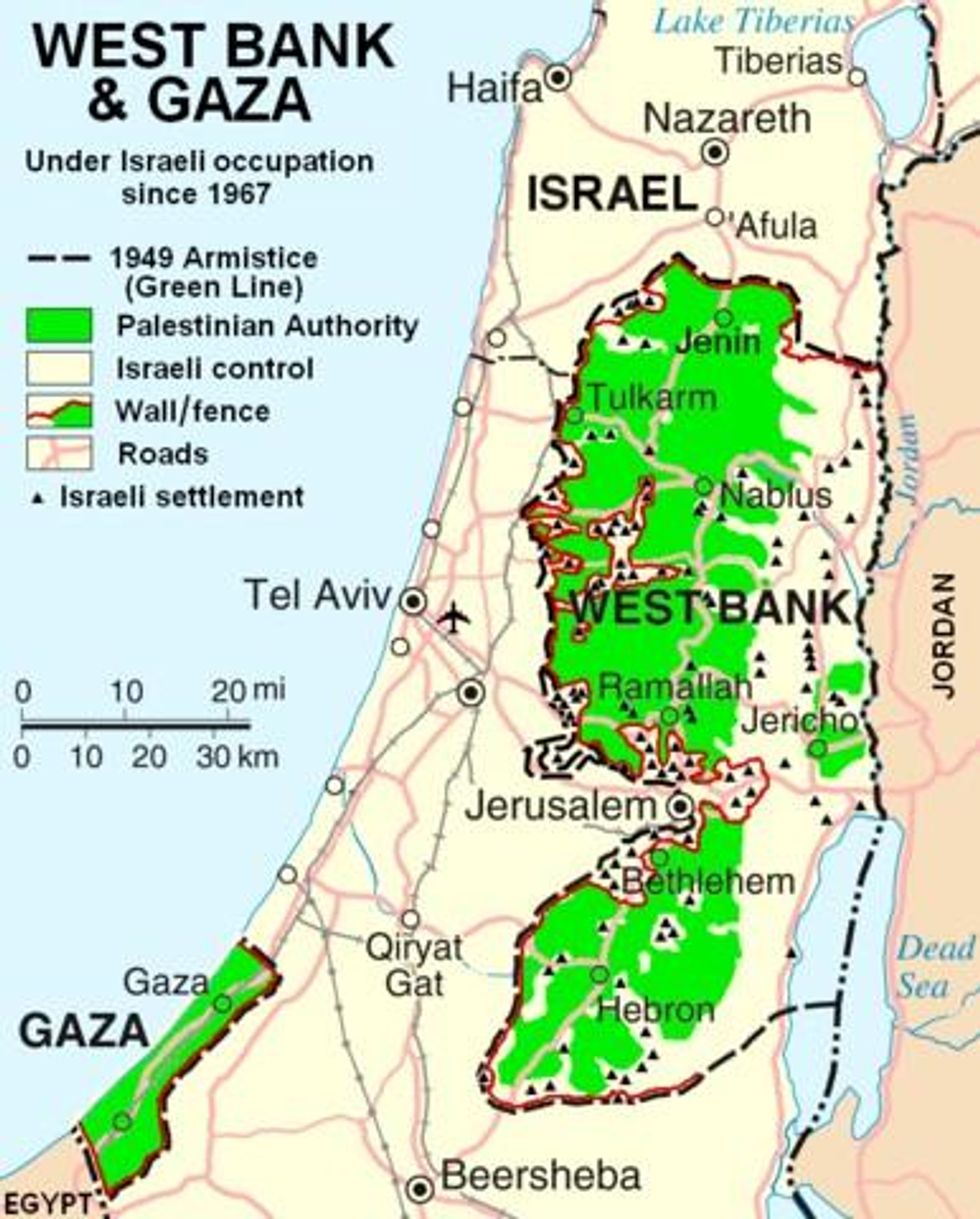
Dishonest propagandists accused Hill of using the language of Hamas, which rejects Israel and has said, "Palestine is ours, from the river to the sea and from the south to the north." But you'll note that Hill did not say anything about north to south.
Hill admittedly does not think a two-state solution is any longer plausible. But what he was calling for was for the people living in the Occupied territories to be full citizens, and to have these citizenship rights pertain to everyone living between the river and the sea. He did not say anything about Israelis not having equal rights.
It is not a firing offense to ask for Palestinians living between the river and the sea to enjoy the full rights of citizenship. In fact, Yitzhak Rabin and Shimon Peres pledged exactly that. Rabin shook Yasser Arafat's and Bill Clinton's hand over it on the White House lawn. Rabin was later assassinated by the sort of person now howling for Hill's blood. Rabin's vision of a Palestinian state and a two-state solution may well be impossible. That outcome has been engineered by Netanyahu and his thugs. But whatever the diplomacy, it cannot be allowed to keep Palestinians stateless and virtually without secure rights forever.
Hill was also slammed for urging Palestinian activism to oppose the Occupation. One of the standard Israeli propaganda techniques is to equate any resistance to their frankly fascist techniques of social control imposed on the colonized Palestinians with "terrorism." There is nothing new or strange about this. The British in India considered Gandhi a terrorist. Of course the colonial state views opposition as terrorism.
That same dishonest columnist at The Forward managed to reconfigure Hill's activism as violence. The fact is that international law recognizes the right of occupied peoples to mount even violent resistance to occupation militaries. But that isn't what Hill was calling for. And then, any violence is then twisted around as violence toward civilians. And there you have it. Terrorism.
The golden magic circle of Hasbara (Zionist propaganda) gives us: resistance= violence= terrorism.
The only thing the Palestinians and their sympathizers can do to make Zionists happy is to bend over and allow themselves to be royally screwed- or better yet, allow themselves to be deported from their homeland of millennia at the hands of the Russian and Polish immigrants.
The Likudniks don't actually want nonviolent resistance. That prospect horrifies them since they can't do a magic circle number on it. When Mubarak Awad tried to start a center for Palestinian nonviolent resistance on the West Bank, the Israeli government illegally expelled him from his own home. One of the reasons the Israeli army is just shooting down unarmed Palestinians in cold blood inside Gaza is that they want to create the image of a violent confrontation where there is none (the marches have not involved clashes with the Israeli army).
CNN does a criminally negligent job of covering Palestine, giving us little better than Israeli propaganda. For the most part, it shapes the presentation of the story by simply ignoring it. But it also shapes the story with a systematically biased language intended to demonize the Palestinians and exonerate Israeli crimes against humanity.
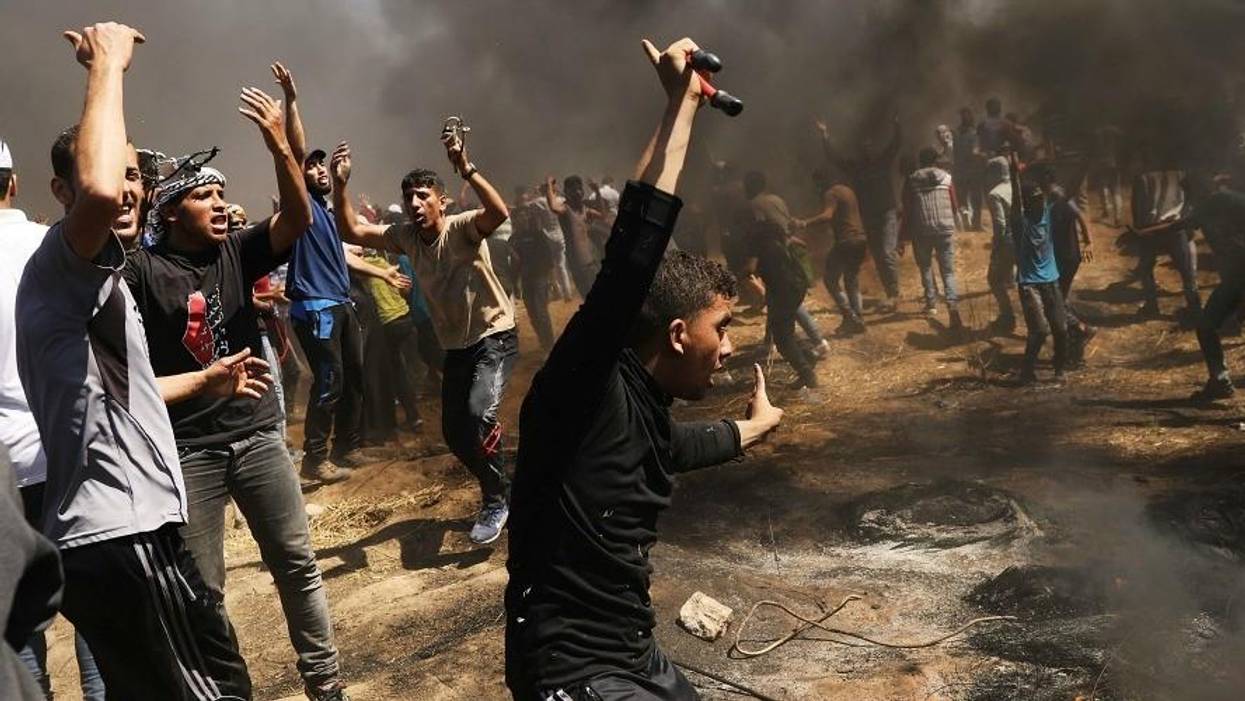
Last March when Palestinians imprisoned in the open air concentration camp of Gaza by the Israeli army, navy and air force- and blockaded from key commodities- began marching to draw attention to their imprisonment, the Israeli Prime Minister Binyamin Netanyahu and his officer corps decided to deal with these protests by shooting down unarmed protesters, many of them women and children, with live fire, on the Gaza side of the border. Using live ammunition on protesters is a war crime. All the civilized countries in the world should have withdrawn their ambassadors and slapped severe economic sanctions on the Netanyahu regime in response.
CNN's reporting on one of the first such Israeli crimes? "Gaza: 17 Palestinians killed in confrontations with Israeli forces - CNN". That makes it sound as though the dead Palestinians had come over to the Israeli side of the border and attacked Israeli "forces" (Israel has an army, let us call it an army). But there is a problem with this framing. Those shot down were on the Gaza side of the border and there has been no direct physical encounter with Israeli troops. The dozens of Palestinians shot down in cold blood and the hundreds shot and injured in these demonstrations since March have largely gone unreported at CNN. Otherwise there'd be a segment every Friday afternoon.
In the first six months of the ongoing weekly rallies, Mezan reported that "150 Palestinians have been killed in the demonstrations. At least 10,000 others have been injured, including 1,849 children, 424 women, 115 paramedics and 115 journalists. Of those injured, 5,814 were hit by live ammunition..."
Amnesty International notes that many of the injuries inflicted on the protesters are to lower limbs and that:
The nature of these injuries shows that Israeli soldiers are using high-velocity military weapons designed to cause maximum harm to Palestinian protesters who do not pose an imminent threat to them. These apparently deliberate attempts to kill and maim are deeply disturbing, not to mention completely illegal. Some of these cases appear to amount to wilful killing, a grave breach of the Geneva Conventions and a war crime."
Again, the weekly carnage committed by the Israeli army in direct violation of the Geneva Convention of 1949 on the treatment of Occupied populations and in direct violation of the 2002 Rome Statute that created the International Court of Justice, is not covered by CNN. If you got your news from that source, you would not know anything is going on in Gaza.
Nor does CNN cover the tripling of Israeli squatter colonies on Palestinian land in the Palestinian West Bank during the Trump administration, nor the daily acts of violence, sabotage and usurpation committed by Israelis squatting on Palestinian land against Palestinians in their own homes.
This United Nations set of reports is what the real news from the Occupied Territories looks like.
If Netanyahu could shut the UN up, he would. His minions have shut up Marc Lamont Hill, a brave voice for freedom and human rights in our time who will now be replaced by the Rick Santorums.
When I first traveled to Israel-Palestine in 1994, during the heady early days of the Oslo peace process, I was expecting to see more of the joyful celebrations I'd watched on television at home. The emotional welcoming of Palestinian Liberation Organization (PLO) Chairman Yasser Arafat back to Palestine. The massive demonstrations for peace on the streets of Tel Aviv. The spontaneous moment when Palestinians placed carnations in the gun barrels of departing Israeli soldiers. And though the early euphoria had already begun to ebb, clearly there was still hope.
It was the era of dialogue. Many Palestinians stood witness to Israeli trauma rooted in the Holocaust. Groups of Israelis began to understand the Nakba, or Catastrophe, when 750,000 Palestinians fled or were driven out of their homes during the creation of Israel in 1948. In the wake of the Oslo Declaration of Principles, signed on September 13, 1993 -- a quarter of a century ago today -- polls showed that large majorities of Israelis and Palestinians supported the agreement. Israelis, weary of a six-year Palestinian intifada, wanted Oslo to lead to lasting peace; Palestinians believed it would result in the creation of a free nation of their own, side by side with Israel.
"People thought this was the beginning of a new era," says Salim Tamari, Palestinian sociologist and editor of the Jerusalem Quarterly.
"It was miraculous," recalls Gershon Baskin, founder of the Israel Palestine Center for Research and Information, "a high peak of optimism and hope." Baskin, an American who emigrated to Israel nearly 40 years ago, remembers the emotional power of "these two parties who refused to recognize each other's right to exist coming into a room and breaking through that and putting down a formula which, at the time, looked reasonable."
Euphoria Never Lasts
Even then, however, there were disturbing signs. During that first trip, still in the glow of Oslo, I found myself in the heart of the West Bank, driving down new, smooth-as-glass "bypass roads" built for Israeli settlers and VIPs on my way from Bethlehem to Hebron. I was confused. Wasn't this the territory-to-be of a future independent Palestinian state? Why, then, would something like this be authorized? Similarly, the next year, when Israeli forces undertook their much-heralded "withdrawal" from Ramallah, why did they only redeploy to the edge of that town, while retaining full military control of 72% of the West Bank?
Such stubborn facts on the ground stood in the way of the seemingly overwhelming optimism generated by that "peace of the brave," symbolized by a handshake between Arafat and Israeli Prime Minister Yitzhak Rabin in front of President Clinton on the White House lawn. Was it possible we were witnessing the beginning of the end of generations of bloodshed and trauma?
Already, however, there were dissenters. Mourid Barghouti, a Palestinian poet who, like thousands of his brethren, returned from exile in the early days of Oslo, was shocked to find former PLO liberation fighters reduced to the status of petty bureaucrats lording it over ordinary citizens. Israel, he wrote in his memoir, I Saw Ramallah, had "succeeded in tearing away the sacred aspect of the Palestinian cause, turning it into what it is now -- a series of 'procedures' and 'schedules' that are usually respected only by the weaker party in the conflict... The others are still masters of the place."
Another Oslo critic, Edward Said, the Palestinian intellectual and professor of comparative literature at Columbia, refused a White House invitation to attend the signing ceremony between Arafat and Rabin. Oslo, he wrote, should be considered "an instrument of Palestinian surrender... a kingdom of illusions, with Israel firmly in command. Clearly the PLO has transformed itself from a national liberation movement into a kind of small-town government... What Israel has gotten is official Palestinian consent to continued occupation."
"It was completely designed to make sure the Palestinians wouldn't have their freedom."
At the time, many Palestinians wrote off Said as someone intent on obstructing real, if incremental, progress. Arafat himself said that, living as he did in America, the famed professor "does not feel the suffering of his people."
Or maybe he did. In my nearly 20 trips to the Holy Land over the quarter-century since Oslo, I watched the West Bank settler population quadruple, new settlements come to ring Jerusalem, and Israel keep full military control over 60% of the West Bank (instead of the previous 72%). All those settler "bypass" roads and limited troop redeployments turned out to point not simply to obstacles on the road to the culmination of the "peace process" but to fatal flaws baked into Oslo from the beginning. Indeed, the Oslo Declaration of Principles, which mentioned security 12 times but never once independence, sovereignty, self-determination, freedom, or Palestine, simply wasn't designed to stop such expansion. In fact, the accords only seemed to facilitate it.
"It was designed to make sure there would never be a Palestinian state," says Diana Buttu, Palestinian analyst and former legal adviser to the PLO. "They made it clear that they weren't going to include the phrases 'two-state solution,' 'Palestinian state,' or 'independence.' It was completely designed to make sure the Palestinians wouldn't have their freedom."
The Failure of Oslo
The question worth asking on this 25th anniversary of those accords, which essentially drove policy in the U.S., Israel, the Palestinian occupied territories, and European capitals for a quarter of a century, is this: Were they doomed from the beginning? Billions of dollars and endless rounds of failed negotiations later, did Oslo ever really have a chance to succeed?
"I think it's wrong to retroactively say that it was all a trick," says Salim Tamari from the Jerusalem Quarterly's editorial offices, once located in that holy city, now in Ramallah. The initial agreement was void of specifics, leaving the major issues -- settlements, Jerusalem, control of water, refugees and their right of return -- to "final status negotiations." Israel, Tamari believes, unlike the Palestinians, achieved a major goal from the outset. "The Israelis wanted above all to have a security arrangement."
In "Oslo II," implemented in 1995, Israel got its cherished security cooperation, which meant that Palestinian police would control Palestinian demonstrators and so keep them from directly confronting Israeli forces. Those were, of course, the very confrontations that had helped fuel the success of the First Intifada, creating the conditions for Oslo. Today, that's a bitter irony for Palestinians who sacrificed family members or limbs for what turned out to be such a weak agreement. But at the time, for many, it seemed worth the price.
For Palestinians, Oslo remained a kind of tabula rasa of hopes and dreams based on the formula of getting an agreement first and working out the details later. "Arafat thought that if he was able to get into the Palestinian territories, he would manage his relations with the Israelis," says Ghassan Khatib, former minister of labor and planning for the Palestinian Authority (PA) as well as a prominent analyst and pollster. "And he did not pay attention to the details in the written documents."
More important to Arafat was simply to return from exile in Tunisia and then convince Israel to end its settlement policies, give Palestinians East Jerusalem, share the region's water supplies, and come to an equitable agreement on the right of return for Palestinian refugees dispossessed in 1948. Yet Arafat and his cadre of fellow PLO officials from the diaspora, Khatib argues, "had no real understanding of or expertise in the Israeli way of doing things, the Israeli mentality, etcetera, etcetera."
Just as bad, says Omar Shaban of the Gaza think tank Pal-Think, was the ineptitude of Palestinian institutions in convincing Israelis that they could govern competently. "We didn't do a very good job... We did not build good institutions. We did not build real democracy. And we did not speak enough to the Israeli public... [to] convince them that we are here to work together, to build together," and that "peace is good for the Israeli people."
For Gershon Baskin, however, the failure of Oslo had far less to do with any cultural misunderstandings or bureaucratic mismanagement and far more to do with an act of political violence: the assassination of Rabin by an Israeli right-wing extremist in 1995. His death was "the major event that changed the course of Oslo."
As Baskin, who served as an adviser to Rabin's intelligence team for the Israeli-Palestinian negotiations, recalls, "I know what kind of direction Rabin was moving in when he agreed to Oslo." In the early Oslo years, the prime minister's deputies were at work on secret negotiations with the Palestinians -- the Geneva Accords and the Beilin-Abu Mazen agreement -- that would have made major territorial concessions and called for East Jerusalem to be the future Palestinian capital. Some Palestinians were not impressed; they noted that by approving of the Oslo accords, they had already agreed to cede 78% of historic Palestine, settling for the 22% that remained: the West Bank and Gaza. And they pointed out that some settlements remained in both of these unofficial agreements and that neither included any kind of Palestinian right of return -- considered by Israelis as a potential death blow to their state and by countless Palestinians uprooted in 1948 as a non-negotiable issue.
"There's so much revisionist history," Diana Buttu says. She points out that when American settler Baruch Goldstein assassinated 29 Palestinians praying in a mosque in Hebron in 1994, Rabin could have seized the moment to end the settlements. Instead, she points out, he "entrenched the army, entrenched the settlements. It's very cute for them to say it all related to the assassination of Rabin. But it really relates to what he intended to do in the first place."
The Soldiers Take Control
Yet Baskin believes that when Rabin, having just addressed 100,000 Israelis at a peace rally in Tel Aviv, was gunned down, Israeli priorities changed strikingly. "It was a peace process taken over by the military and the security people who had a very different understanding of how to do it." This "change of mentality," he adds, went "from cooperation and bridge building to walls and fence building -- creating a system of separation, of permits, of restriction of movement." The division of the West Bank into Areas A, B, and C, or ostensiblyfull Palestinian control (18%), joint control (22%), and full Israeli military control (60%), was supposed to be temporary, but it has remained the status quo for a quarter of a century.
Whatever the motives and intentions of the Israeli architects of Oslo, they were soon superseded by Israelis who saw the claim of Eretz Israel -- all the land from the Mediterranean to the Jordan River -- as a prime territorial goal. As a result, the endless expansion of settlements (and the creation of new ones), as well as seizures of Palestinian lands in the West Bank and even of individual Palestinian houses in East Jerusalem neighborhoods, has become the endgame for successive Israeli governments, abetted by their American counterparts. "The basic fact is that Israel has their cake and they're eating it," says Tamari. "They have the territories. They're not withdrawing. They're happy with the security of A, B, and C. There's no pressure on them from the Americans. On the contrary.
In the Oslo era, American presidents and secretaries of state, at most, issued mild diplomatic rebukes for settlement building, never threatening to suspend U.S. aid if Israel didn't stop undermining the "peace process." The last time that happened was when Secretary of State James Baker threatened to suspend $10 billion in loan guarantees to Israel during the presidency of George H.W. Bush in 1992.
And so, steadily, with every new visit to the Holy Land, I would witness the latest evidence of an expanding occupation -- new or larger settlements and military bases, more patrols by jeeps and armored vehicles, new surveillance towers, additional earthen barriers,giant red and white warning signs, and most of all, hundreds of military checkpoints, ever more ubiquitous, on virtually every mile of the West Bank. Less visible were the night raids on Palestinian refugee camps and the nearly 40% of Palestinian adult males who have spent time in Israeli prisons, where the military court conviction rate for them is 99.74%. Also on the increase was the Palestinian Authority's expanding "security cooperation" with Israel. That, in turn, often pitted Palestinians against each other, embittering villagers and city dwellers alike against the governing PA.
As the system of control grew, draconian restrictions on movement only increased. Adults and children alike were forced to wait hours to return home from school or work or a visit to a hospital or relatives in Jordan. Meanwhile, occupied Palestine was slowly being converted into an archipelago of Israeli military control. Clearly, the "peace process" had made things far worse for Palestinians.
"I remember the nice days where there was peace without agreement," says Shaban of Pal-Think, his tongue only partly in cheek. "Now we have agreement without peace."
When "Peace" Is a Dirty Word
And so, in the post-Oslo decades, even "peace" became a dirty word to many Palestinians. "They thought that this agreement would lead into an independent Palestinian state," says Ghassan Khatib, whose initial tracking poll, shortly after the iconic handshake on the White House lawn, showed 70% Palestinian support for Oslo. But when, he adds, "the public realized that this agreement was not good enough to stop the expansion of settlements, they realized it's good for nothing. Because the peace process for the Palestinians is about ending the occupation. And settlement expansion is actually the essence of occupation." Twenty-five years later, his polling finds that support for the "peace process" among Palestinians is now at about 24%.
On the ground, what now exists is not two states, but essentially a single state that leaves Israel in de facto control of land, water, borders, and freedom of movement. What connections existed between the West Bank, Gaza, and Jerusalem have been splintered, with little prospect of any kind of reunification any time soon.
Today, when you travel to the West Bank and drive through what was to be the landscape of a free and independent Palestine, you find yourself surrounded by a militarized colonial settler regime. The word "apartheid" inevitably comes to mind, despite its unpopularity among the pro-Israel lobby and their charges in Congress. Sometimes, I wonder whether "Jim Crow" doesn't best describe the new Palestinian reality.
For me, each successive trip has revealed a political situation grimmer and less hopeful than the time before. Israel's pursuit of land over peace and the complicity of the American government essentially killed "the two-state solution."
The final blow came this May when the Trump administration moved the U.S. embassy from Tel Aviv to Jerusalem. In the process, it became clear that U.S. Mideast policy is now largely directed not only by the pro-settler triumvirate of Trump son-in-law Jared Kushner, Ambassador to Israel David Friedman, and Middle East adviser Jason Greenblatt, but also by the Armageddon lobby. Those evangelical Christians are spearheaded by John Hagee's Christians United for Israel, which has surpassed the American Israel Public Affairs Committee as the largest pro-Israel group in the U.S. They believe that Israel must remain in control of the Holy Land so that Jesus can return and mete out justice to sinners, after which believers will rise to heaven in the rapture. Hagee, who has described such a moment in detail from his pulpit, is a major contributor to the Israeli settlement of Ariel (population 20,000). It was no happenstance that he was the minister who gave the benediction at the U.S. embassy dedication ceremony in Jerusalem in May, as Israeli forces were gunning down unarmed protesters in Gaza.
Now, in an effort to end the long-standing right of return of Palestinian refugees, the Trump administration is canceling funding to UNRWA, the U.N. refugee agency that has provided food, shelter, education, and housing in the Palestinian refugee camps for nearly seven decades. The move, spearheaded by Kushner, is part of a broader "deal of the century" to pressure Palestinians into a peace agreement on American and Israeli terms. Clearly a bad deal for Palestinians, it is sure to sharply increase poverty and hunger in the camps, especially in Gaza. Strategically, it appears to be an attempt to force Gazans to give up their long-standing national rights, while increasing their dependence on humanitarian aid.
Instead of approaching this as primarily a humanitarian problem, the international community could "put pressure on Israel to end the [economic] siege, and allow us to live in freedom. If we were able to have a seaport, an airport," to import, export, and travel freely, "we wouldn't need handouts." Yet most of the world, she says, is "too terrified to confront Israel."There is another solution, says Buttu. Instead of approaching this as primarily a humanitarian problem, the international community could "put pressure on Israel to end the [economic] siege, and allow us to live in freedom. If we were able to have a seaport, an airport," to import, export, and travel freely, "we wouldn't need handouts." Yet most of the world, she says, is "too terrified to confront Israel."
Failed peace, dashed hopes, hunger, apartheid, Armageddon. Not much to celebrate, is there? And there may not be for quite a while. "The dream is still there," insists Tamari, but he adds that, for the foreseeable future, "I think we're going to continue to have the status quo. State of repression, colonization for many, many years to come. Until the global scene changes." Say, a major decline in U.S. influence (something not so hard to imagine right now) or some other less predictable set of events. "Or until the Palestinians undertake a massive civil insurrection. That may tip the balance."
An Ode to Joy
Many Palestinians see the recent Gaza March of Return and the nonviolent boycott, divestment, and sanctions (BDS) movement, which advocates cultural and economic boycotts of Israel, as examples of such civil insurrections. BDS supporters recently celebrated a genuine victory, with the announcements by Lana del Rey and 15 other artists that they were bowing out of the Meteor concert festival in Israel. Yet taken together, BDS and the March of Return don't come close to the First Intifada, a six-year uprising involving virtually every sector of Palestinian society, which brought Israel to the negotiating table -- ironically, for the failed Oslo Agreement.
Still, few are the Palestinians likely to tell you that the national dream is dead. In late July, for instance, I spoke with Laila Salah, a 21-year-old Palestinian cellist, then rehearsing to play Beethoven's 9th Symphony in Jerusalem in an orchestra led by Palestinian violist Ramzi Aburedwan, the founder of the Al Kamandjati music school. Many of Laila's fellow Palestinian musicians, risking arrest, snuck into the holy city, in part to play Beethoven but also to assert their right to be in their beloved Jerusalem, which they still dream of as their capital. When I asked Laila if she thought Palestine would have its own state one day, she compared her people's freedom to the fourth movement, or Ode to Joy, in the 9th Symphony. "The fourth movement embodies our freedom," she told me. "Or at least, being able to go freely around Palestine. It's a wish to come true. I don't know when. We might not be alive to see our fourth movement."
With the endless march of settlements, Israel's continued impunity, a fractured Palestine divided between the West Bank and Gaza, and a Trump administration empowering people who believe Armageddon is near, a solution to the Israel-Palestine nightmare may seem impossible. But maybe, Laila, a just peace is coming sooner than you think.
After all, who predicted the fall of the Berlin Wall or the end of apartheid in South Africa?

Yossi Beilin is back. This unrepentant Israeli 'peacemaker' is like the mythical phoenix, constantly resurrecting from its own ashes. In a recent article in Al-Monitor, Beilin wrote in support of the idea of a confederation between Israel and Palestine.
A confederation "could prevent the need to evacuate settlers and allow those interested to live in Palestine as Israeli citizens, just as a similar number of Palestinian citizens could live in Israel," he wrote.
Bizarrely, Beilin is promoting a version of an idea that was promoted by Israel's extremist Defense Minister, Avigdor Lieberman.
The difference between Beilin and Lieberman is in how we choose to perceive them: the former was the godfather of the Oslo Accords 25 years ago, a well-known political 'dove' and the former Chairman of the 'left-leaning' Meretz party. Lieberman, on the other hand, is purportedly the exact opposite.
It is not the agreement itself that matters, but the mindset behind it - the political and diplomatic discourse that is wholly manufactured to serve Israel exclusively.
Yet, when Lieberman suggested population transfer and territorial swaps, all hell broke loose. When Beilin did it, his efforts were perceived as an honest attempt at reviving the dormant 'peace process.'
That is the brilliance of Beilin, his followers and the whole 'peace process' that culminated in the Oslo Accords and the famous White House handshake between the late PLO Chairman, Yasser Arafat, and the late Israeli Prime Minister, Yitzhak Rabin, in September 1993. They successfully branded this hideous infringement on international law as a sincere effort at achieving peace between two conflicting parties.
The Donald Trump Administration has long surpassed Oslo and its tired cliches of 'peace process', 'painful compromises' and 'trust building' exercises, etc., as it is promoting something else entirely, the so-called 'Deal of the Century'.
But Oslo will not go away. It remains a problem because the intellectual foundation that led to its conception is still firmly in place - where only Israel matters and the aspirations of the Palestinian people are still inconsequential.
While Beilin is no longer an influential politician, there are many Yossi Beilins who are still lurking, playing the role of 'peacemakers', meeting behind closed doors, on the sideline of conferences, offering their services as interlocutors, wheelers and dealers, and saviors.
The late Palestinian Professor, Edward Said, was not prophesying when he warned of the disastrous future consequences of Oslo as it was being signed. He was dismissed by mainstream media and pundits as radical, lumped with the other 'enemies of peace' on 'both sides'. But, he, like many other Palestinians, was right.
"Labor and Likud leaders alike made no secret of the fact that Oslo was designed to segregate the Palestinians in noncontiguous, economically unviable enclaves, surrounded by Israeli-controlled borders, with settlements and settlement roads punctuating and essentially violating the territories' integrity," he wrote in the Nation.
The colonization of Palestine, for the first time, was accelerating with the consent of the Palestinian leadership. The PLO was turned into a local body with the inception of the Palestinian Authority in 1994. The rights of millions of Palestinian refugees in the diaspora were relegated. The West Bank was divided to areas A, B and C, each governed by different rules, mostly under the control of the Israeli military.
The 'Palestinian revolution' turned into an agonizing process of 'state building', but without state or even contiguous territories. Palestinians who rejected the horrific outcomes of Oslo - protracted expansion of Jewish colonies, continued violent Occupation, normalized through 'security coordination' between Israel and the PA - were often abused and deemed extremists.
Meanwhile, successive US administrations continued to fund and defend Israel, unconcerned about its self-tailored job title as the 'honest peace broker.'
The PA played along because the perks were far too lucrative to be abandoned on principle. A new class of Palestinians had risen, dependent on Oslo for its wealth and affluence.
Even when the Trump Administration cut off the Palestinian Refugees Agency, UNRWA, of all funds, and scrapped the $200 million in humanitarian aid to the PA, the US still released $61 million dollar to the PA to maintain its 'security cooperation' with Israel. 'Israel's security' is just too sacred a bond to be broken.
This is why Oslo remains dangerous. It is not the agreement itself that matters, but the mindset behind it - the political and diplomatic discourse that is wholly manufactured to serve Israel exclusively.
In January 2017, Daniel Pipes of the pro-Israel Middle East Forum came up with what seemed like a puerile idea: a 'way to peace' between Israel and the Palestinians, based on the simple declaration that Israel has won.
The new strategy requires little by way of negotiations. It merely entails that Israel declares 'victory', which Pipes defined as "imposing one's will on the enemy, compelling him through loss to give up his war ambitions.'
As unconscionable as Pipes' logic was, a few months later, Congressional Republicans in the US launched the "Israel Victory Caucus." The co-Chair of the Caucus, Rep. Bill Johnson, 'predicted' in April 2017 that Trump would soon be heading to Israel to announce the relocation of the US Embassy from Tel Aviv to Jerusalem.
Since then, the US is obviously following a blueprint of a strategy in which the US advances Israel's 'victory', while imposing conditions of surrender on defeated Palestinians. Despite its more diplomatic and legal language, that was also the essence of Oslo.
Trump, to the satisfaction of Israel's right-wing Prime Minister, Benjamin Netanyahu, may think that he has single handedly destroyed the Oslo Accords or whatever remained of it. However, judging by his words and actions, Trump has indicated that the spirit of Oslo remains alive: the bribes, the bullying and the fighting for that coveted and final Israeli 'victory.'
Oslo is not a specific legal document that can be implemented or rejected. It is a spectrum in which the likes of Beilin, Lieberman and Pipes have more in common than they may think, and in which the fate of the Palestinian people is left to inept leaders, incapable of thinking outside the permissible space allocated to them by the Israelis and the Americans.
Unfortunately, Abbas and his Authority are still reveling at the expense of the empty space that is Oslo, not the 'accords' - provisions, stipulations and heaps of paper - but the corrupt culture - money, perks and unmitigated defeat.

"If you don't get my weekly column, it means I am dead," wrote Israeli writer Uri Avnery to a friend. As I eagerly awaited Uri's column each week, I feared that each new column might be his last.
And so it finally came to be. The renowned 94-year old writer and peace advocate finally succumbed to old age after a stroke and massive heart attack.
The roar of the last Lion of Judah had been silenced.
I always considered Avnery as the wisest voice in the Mideast, and Israel's last prophet. His voice was always rich in wisdom, morality and common sense. Few Israelis and even fewer Arabs attained his level of clarity and logic.
Whenever I grew weary writing columns and felt I could no longer go on, I told myself, "if 94-year old Uri can keep writing brilliant columns each week, then you too can keep writing. Back to your keyboard!"
Uri's story was in good part that of modern Israel. He was born Helmut Osterman to a prosperous German Jewish family near Hanover. When Hitler came to power, they migrated in 1933 to Palestine with the 11-year old Helmut - who changed his name to the Hebrew, Uri Avnery.
In 1948, the young Avnery joined the underground Jewish guerilla force Irgun, fighting British and Palestinians and, later, Arab regular soldiers. Irgun committed numerous notorious terrorist acts and massacres that played a key role in driving the Palestinian population from their ancestral homes. He was seriously wounded and nearly died.
Two years later, he and three friends started a political magazine, "One World."
Avnery was increasingly political and sided with Israeli expansionists. But he gradually came to see that peace and cooperation was the only solution for Israel. After Israel's smashing victories over the Arabs in the 1956 and 1967 wars, he formed a leftist pro-peace party and won a seat in Israel's parliament, the Knesset. He helped found the Israeli-Palestinian Peace Council and the renowned Gush Shalom peace movement.
Avnery was one of the first Israelis to call for fair treatment of the Palestinians, over a million who had become refugees in 1948 and 1967. He urged Israel to sign a lasting peace accord with the Palestinians and return to them control of the West Bank, the old city of Jerusalem, Golan and Gaza - all occupied by the Israeli Army and growing waves of Jewish settlers.
Uri became the target of decades of hatred by right-wing Israelis. He was stabbed. He said things that were not said in public. He kept reminding Israelis that their Jewish ethics demanded fair and decent treatment of Palestinians, whom Israeli leaders preferred to call 'cockroaches' and 'wild animals.'
Interestingly, the two men who have best explained the Muslim world to westerners, Uri Avnery and the Austrian-born Leopold Weiss, known as Muhammad Asad, who wrote the great book, "the Road to Mecca," were both Germanic Jews.
There would never be peace in the region, warned prophet Avnery, until Israel returned at least some land taken from Palestinians, and created a viable Palestinian state with full democratic rights and freedoms. Instead, Uri watched as Israel's US-backed far right government arrested ever more Palestinians, grabbed more Arab lands, and prepared to create a full-fledged South African-style apartheid state.
Never one to mince words, Uri called Israel's right, which just enacted a law making Israel an exclusively Jewish state (thus excluding its 21% Muslim and Christian population) 'semi-fascist Jews.' Israel's far right now exercises decisive influence over the Trump White House and the US Congress.
Avnery became fast friends with Palestinian leader Yasser Arafat. The two leaders could have created a viable Jewish-Arab state or federation. Sadly, Arafat was probably murdered and Avnery politically sidelined. In fact, Israel's entire pro-peace left has dwindled to a fringe movement, isolated by its right-wing governments and Washington. Days after Uri died, Israel's Likud coalition announced the expropriation of more Arab land on the West Bank to build 1,000 new homes for Jewish settlers.
Like most Jewish prophets, Avnery was loved or hated. He had no equal in the Arab world. Like Gandhi, his message was too logical and too uncomfortable for nationalist fanatics. His icy skepticism and clear thinking was a godsend in the overheated emotional hothouse of the Mideast.
Israel's last prophet is gone. Rest in peace, Uri.