

SUBSCRIBE TO OUR FREE NEWSLETTER
Daily news & progressive opinion—funded by the people, not the corporations—delivered straight to your inbox.
5
#000000
#FFFFFF
To donate by check, phone, or other method, see our More Ways to Give page.
Daily news & progressive opinion—funded by the people, not the corporations—delivered straight to your inbox.

Simple-minded and cruel governmental policies—policies wrapped in razor wire—keep no one safe.
“A 4-year-old girl passed out in 100-degree heat after she was pushed back toward Mexico by Texas National Guard personnel. A pregnant woman became trapped in razor wire and had a miscarriage. A state trooper said he was under orders not to give migrants any water.”
Yes, these are scenes from something called “Operation Lone Star,” but the director isn’t John Ford; it’s Texas Gov. Greg Abbott—and this is real life, as reported by USA Today.
And in real life, at least 853 migrants died trying to cross the U.S.-Mexico border in the past 12 months. And God knows how many merely endured—and continue to endure—various forms of hell.
Something there is that doesn’t love a wall...
The “border problem” cannot be resolved by minimizing our connection to all of humanity and all of the natural world.
The wall Robert Frost wrote about in his classic poem “Mending Wall,” published in 1914, was a hand-built stone wall separating an apple orchard from a pine forest. The narrator of the poem expressed ambivalence about walls in general—what’s their point?—and smirked when his neighbor said: “Good fences make good neighbors.” But here he was, working with his neighbor to repair it. This was an annual ritual; hunters were always knocking part of the wall down, and the winter weather—the frost—also inflicted regular damage. The wall was simply part of their lives, so every spring they put it back together.
Interestingly, the poem started claiming a spot in the national political consciousness in the early ’60s, after the Soviets constructed a wall dividing East and West Berlin. Yeah, something there is that doesn’t love a wall. The line had Cold War resonance, at least when it was directed at the communists, who were arrogantly creating a barrier that must not be crossed.
Quite obviously, this was not a wall constructed by equals. It was a one-sided declaration to an enemy: Stay out. Ameria, the good guys, told the Soviets with moral certainty: Tear down that wall. This puts the present moment, and the obsession of certain powerful Americans with “border security” (and, for God’s sake, razor wire), in an interesting context.
Consider these words of Martin Luther King, Jr.,, when he visited Berlin in 1964: “It is indeed an honor to be in this city, which stands as a symbol of the divisions of men on the face of the earth. For here on either side of the wall are God’s children and no manmade barrier can obliterate that fact. Whether it be East or West, men and women search for meaning, hope for fulfillment, yearn for faith in something beyond themselves, and cry desperately for love and community to support them in this pilgrim journey.”
I guess those are easy words to embrace when they’re directed at a declared enemy. But King’s context was a little larger than that. He told his audience of Berliners that, while he was hardly an expert in German politics, he knew about walls. I think he could very well have said the same words in El Paso or Laredo or Eagle Pass—any Texas border city.
“For here on either side of the wall are God’s children and no manmade barrier can obliterate that fact.”
Are you aware of that, Gov. Abbott?
Simple-minded and cruel governmental policies—policies wrapped in razor wire—keep no one safe.
So am I saying that border protection is one hundred percent wrong and our borders should be wide open? In my heart, yes, but I’m also aware that the matter is way more complicated than that, and the flow of refugees into a country can create complex difficulties for the current social structure, financial and otherwise. What I am saying is that the flow of refugees is a global matter—kind of on the order of climate change, not to mention war—and we... all of us... have to devote far more energy and awareness to addressing it than we have so far. Dehumanizing the refugees, then simply focusing on keeping them out, as though they were vermin, betrays an excruciating lack of moral intelligence.
And the damage is widespread, cultural and environmental. As the Center for Biological Diversity points out: “Border walls built over the past several decades along the U.S.-Mexico border are a dark stain on American history. Hundreds of miles of wall have been built through protected public lands, communities, and sovereign tribal nations. These barriers cut through sensitive ecosystems, disrupt animal migration patterns, cause catastrophic flooding, and separate families.”
And a diverse array of endangered and rare species are threatened by our militarized protection of an imaginary line, including, as the center notes: “Sonoran pronghorns, lesser long-nosed bats, Quino checkerspot butterflies, cactus ferruginous pygmy owls, and larger predators like jaguars, Mexican gray wolves, and ocelots...”
The “border problem” cannot be resolved by minimizing our connection to all of humanity and all of the natural world. What we call government is our collective identity. It’s more than just bureaucracy. It’s more than just rules and guns and razor wire. And now is the time for it to wake up, but this will only happen if we demand that it expand its awareness... expand its sense of empathy. This is the only way it can “protect” us from our self-created problems.
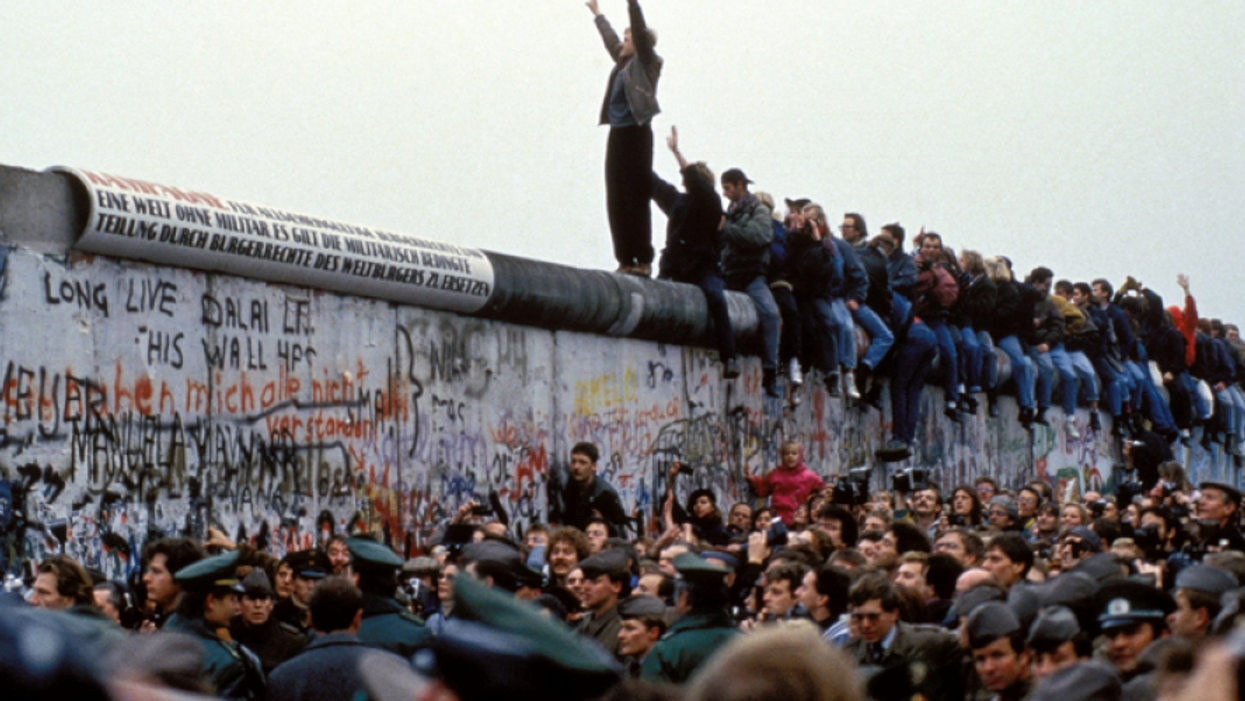
Some anniversaries are less about the past than the future. So it should be with November 9, 1989. In case you've long forgotten, that was the day when East and West Germans began nonviolently dismantling the Berlin Wall, an entirely unpredicted, almost unimaginable ending to the long-entrenched Cold War. Think of it as the triumph of idealistic hope over everything that then passed for hard-nosed "realism." After all, Western intelligence services, academic Kremlinologists, and the American national security establishment had always blithely assumed that the Cold War would essentially go on forever--unless the absolute malevolence of Soviet Communism led to the ultimate mayhem of nuclear Armageddon. For almost half a century, only readily dismissed peaceniks insisted that, in the nuclear age, war and endless preparations for more of it were not the answer. When the Berlin Wall came down, such idealists were proven right, even if their triumph was still ignored.
Yet war-as-the-answer reasserted itself with remarkable rapidity. Within weeks of the Wall being breached by hope--in an era that saw savage conflicts in Central America, the Philippines, and South Africa transformed by a global wave of nonviolent resolution--the United States launched Operation Just Cause, the invasion of Panama by a combat force of more than 27,000 troops. The stated purpose of that act of war was the arrest of Panama's tinhorn dictator Manuel Noriega, who had initially come to power as a CIA asset. That invasion's only real importance was as a demonstration that, even with global peace being hailed, the world's last remaining superpower remained as committed as ever to the hegemony of violent force.
Who Ended the Cold War?
While President George H.W. Bush rushed to claim credit for ending the Cold War, the Soviet Union's Mikhail Gorbachev was the lynchpin of that historic conclusion. It was he who, in the dramatic autumn of 1989, repeatedly ordered Communist forces to remain in their barracks while throngs of freedom-chanters poured into the streets of multiple cities behind the Iron Curtain. Instead of blindly striking out (as the leaders of crumbling empires often had), Gorbachev allowed democratic demands to echo through the Soviet empire--ultimately even in Russia itself.
Yet the American imagination was soon overtaken by the smug fantasy that the U.S. had "won" the Cold War and that it was now a power beyond all imagining. Never mind that, in 1987, when President Ronald Reagan issued his famed demand in then still-divided Berlin, "Mister Gorbachev, tear down this wall," the Soviet leader was already starting to do precisely that.
As the wall came down, the red-scare horrors that had disturbed American dreams for three generations seemed to dissolve overnight, leaving official Washington basking in triumphalism. The U.S. then wrapped itself in a self-aggrandizing mantle of virtue and power that effectively blinded this country's political leadership to the ways the Cold War's end had left them mired in an outmoded, ever more dangerous version of militarism.
After Panama, the self-styled "indispensable nation" would show itself to be hell-bent on unbridled--and profoundly self-destructive--belligerence. Deprived of an existential enemy, Pentagon budgets would decline oh-so-modestly (though without a "peace dividend" in sight) but soon return to Cold War levels. A bristling nuclear arsenal would be maintained as a "hedge" against the comeback of Soviet-style communism. Such thinking would, in the end, only empower Moscow's hawks, smoothing the way for the future rise of an ex-KGB agent named Vladimir Putin. Such hyper-defensive anticipation would prove to be, as one wag put it, the insurance policy that started the fire.
Even as the disintegration of the once-demonized USSR was firmly underway, culminating in the final lowering of the hammer-and-sickle flag from the Kremlin on Christmas Day 1991, the United States was launching what would prove to be a never-ending and disastrous sequence of unnecessary Middle Eastern wars. They began with Operation Desert Storm, George H.W. Bush's assault on Saddam Hussein's Iraq in 1990. In American memory, that campaign, which crushed the Iraqi autocrat's army and forced it out of Kuwait, would be a techno-war made in heaven with fewer than 200 U.S. combat deaths.
That memory, however, fits poorly with what was actually happening that year. An internationally mounted sanctions regime had already been on the verge of thwarting Hussein without the U.S.-led invasion--and, of course, what Bush the father began, Bush the son would, with his 2003 shock-and-awe recapitulation, turn into the permanent bedrock of American politics.
As the 30th anniversary of the end of the Cold War approaches, it should be obvious that there's been a refusal in the United States to reckon with a decades-long set of conflagrations in the Greater Middle East as the inevitable consequence of that first American invasion in 1990. Above all, Desert Storm, with its monumental victory parade in Washington D.C., brought the Pentagon's Cold War raison d'etre back from the brink of obsolescence. That campaign and what followed in its wake guaranteed that violence would continue to occupy the heartlands of the U.S. economy, its politics, and its culture. In the process, the world-historic aspirations kindled by the miracle of the Berlin Wall's dismantling would be thoroughly dashed. No wonder, so many years later, we hardly remember that November of hope--or the anniversary that goes with it.
Out of the Memory Hole
By revisiting its astonishing promise as the anniversary approaches, however, and by seeing it more fully in light of what made it so surprising, perhaps something of that vanished positive energy can still be retrieved. So let me call to mind the events of various earlier Novembers that make the point. What follows is a decade-by-decade retracing of the way the war machine trundled through recent history--and through the American psyche--until it was finally halted in a battle-scarred, divided city in the middle of Europe, stopped by an urge for peace that refused to be denied.
Let's start with November 1939, only weeks after the German invasion of Poland that began what would become World War II. A global struggle between good and evil was just then kicking into gear. Unlike the previous Great War of 1914-1918, which was fought for mere empire, Hitler's war was understood in distinctly Manichaean terms as both apocalyptic and transcendent. After all, the moral depravity of the Nazi project had already been laid bare when Jewish synagogues, businesses, and homes everywhere in Germany were subject to the savagery of Kristallnacht, or "the night of broken glass." That ignition of what became an anti-Jewish genocide took place, as it happened, on November 9, 1938.
The good-versus-evil absolutism of World War II stamped the American imagination so profoundly that a self-righteous moral dualism survived not only into the Cold War but into Washington's twenty-first-century war on terror. In such contests against enemies defined as devils, Americans could adopt the kinds of ends-justify-the-means strategies called for by "realism." When you are fighting along what might be thought of as an axis of evil, anything goes--from deceit and torture to the routine sacrifice of civilians, whose deaths in America's post-9/11 wars have approached a total of half a million. Through it all, we were assured of one certain thing: that God was on our side. ("God is not neutral," as George W. Bush put it just days after the 9/11 attacks.)
From Genocide to Omnicide
But what if God could not protect us? That was the out-of-the-blue question posed near the start of all this--not in August 1945 when the U.S. dropped its "victory weapon" on two cities in Japan, but in August 1949 when the Soviet Union acquired an atomic bomb, too. By that November, the American people were already in the grip of an unprecedented nuclear paranoia, which prompted President Harry Truman to override leading atomic scientists and order the development of what one called a "genocidal weapon," the even more powerful hydrogen bomb. Then came the manic build-up of the U.S. nuclear arsenal to proportions suitable less for genocide than for "omnicide." Such weapons mushroomed (if you'll excuse the word in a potentially mushroom-clouded world) from fewer than 200 in 1950 to nearly 20,000 a decade later. Of course, that escalation, in turn, drove Moscow forward in a desperate effort to keep up, leading to an unhinged arms race that turned the suicide of the human species into a present danger, one measured by the Doomsday Clock, of the Bulletin of the Atomic Scientists, which was set at two minutes to midnight in 1953--and then again in 2019, all these Novembers later.
Now, let's flash forward another decade to November 1959 when the mortal danger of human self-extinction finally became openly understood, as Soviet leader Nikita Khrushchev began issuing blatant threats of nuclear war over--you guessed it--Berlin. Because part of that city, far inside Communist East Germany, was still occupied by American, French, and British forces, it amounted to a tear in what was then called the Iron Curtain, separating the Soviet empire from Western Europe. With thousands fleeing through that tear to the so-called Free World, the Soviets became increasingly intent on shutting the escape hatch, threatening to use the Red Army to drive the Allies out of Berlin. That brought the possibility of a nuclear conflict to the fore.
Ultimately, the Communists would adopt a quite different strategy when, in 1961, they built that infamous wall, a concrete curtain across the city. At the time, Berliners sometimes referred to it, with a certain irony, as the "Peace Wall" because, by blocking escape from the East, it made the dreaded war between the two Cold War superpowers unnecessary. Yet within a year the unleashed prospect of such a potentially civilization-ending conflict had hopscotched the globe to Communist Cuba. The Cuban Missile Crisis of 1962 caused the world to shudder as incipient nuclear war between Washington and Moscow suddenly loomed. That moment, just before Khrushchev and American President John F. Kennedy stepped back from doomsday, might have changed something; a relieved world's shock of recognition, that is, might have thrown the classic wooden shoe of sabotage into the purring engine of "realism." No such luck, however, as the malevolent power of the war state simply motored on--in the case of the United States directly into Vietnam.
By November 1969, President Richard Nixon's cynical continuation of the Vietnam War for his own political purposes had already driven the liberal-conservative divide over that misbegotten conflict into the permanent structure of American politics. The ubiquitous "POW/MIA: You Are Not Forgotten" flag survives today as an icon of Nixon's manipulations. Still waving over ball parks, post offices, town halls, and VFW posts across the nation, that sad black banner now flies as a symbol of red state/blue state antagonism--and as a lasting reminder of how we Americans can make prisoners of ourselves.
By 1979, with the Vietnam War in the past, President Jimmy Carter showed how irresistible November's tide--the inexorable surge toward war--truly was. It was in November of that year that militant Iranian students overran the American embassy in Tehran, taking sixty-six Americans hostage--the event that was credited with stymying the formerly peace-minded president. In reality, though, Carter had already initiated the historic anti-Soviet arms build-up for which President Ronald Reagan would later be credited.
Then, of course, Carter would ominously foreshadow America's future reversals in the deserts of the Levant with a failed rescue of those hostages. Most momentously, however, he would essentially license future Middle East defeats with what came to be known as the Carter Doctrine--the formally declared principle that the Persian Gulf (and its oil) were "vital interests" of this country, worthy of defense "by any means necessary, including military force." (And of course, his CIA would lead us into America's first Afghan War, still in a sense going on some 40 years later.)
Retrieving Hope?
Decade by decade, the evidence of an unstoppable martial dynamic only seemed to accumulate. In that milestone month of November 1989, Washington's national security "realists" were still stuck in the groove of such worst-case thinking. That they were wrong, that they would be stunned by the fall of the Berlin Wall and the subsequent implosion of the Soviet Union, should mandate thoughtful observance of this coming 30th anniversary.
During the late 1980s, a complex set of antiwar and antinuclear countercurrents seemed to come out of nowhere. Each of them should have been impossible. The ruthlessly totalitarian Soviet system should not have produced in Mikhail Gorbachev a humane statesman who sacrificed empire and his own career for the sake of peace. The most hawkish American president in history, Ronald Reagan, should not have responded to Gorbachev by working to end the arms race with him--but he did.
Pressuring those two leaders to pursue that course--indeed, forcing them to--was an international grassroots movement demanding an end to apocalyptic terror. People wanted peace so much, as President Dwight D. Eisenhower had predicted in 1959, that, miracle of all miracles, governments got out of their way and let them have it. With the breaching of the Berlin Wall that November 9th--a transformation accomplished by ordinary citizens, not soldiers--the political realm of the possible was substantially broadened, not only to include prospective future detente among warring nations, but an eventual elimination of nuclear weapons themselves.
Yet, in November 2019, all of that seems lost. A new Cold War is underway, with East-West hostilities quickening; a new arms race has begun, especially as the United States renounces Reagan-Gorbachev arms-control agreements for the sake of a trillion-plus dollar "modernization" of its nuclear arsenal. Across the globe, democracy is in retreat, driven by pressures from both populist nationalism and predatory capitalism. Even in America, democracy seems imperiled. And all of this naturally prompts the shudder-inducing question: Were the worst-case realists right all along?
This November anniversary of the dismantling of the Berlin Wall should offer an occasion to say no to that. The Wall's demise stopped in its tracks the demonic dynamic set in motion on the very same date in 1938 by that Kristallnacht. If idealistic hope could so triumph once, it can so triumph again, no matter what the die-hard realists of our moment may believe. I've referred to that November in Berlin as a miracle, but that is wrong. The most dangerous face-off in history ended not because of the gods or good fortune, but because of the actions and efforts of human beings. Across two generations, countless men and women--from anonymous community activists and union organizers to unsung military officials, scientists, and even world leaders--overcame the seemingly endless escalations of nuclear-armed animus to make brave choices for peace and against a war of annihilation, for life and against death, for the future and against the doom-laden past.
It can happen again. It must.

Despite the Robert Mueller report's conclusion that Donald Trump and his campaign did not collude with Russia during the 2016 presidential race, the new Cold War with Moscow shows little sign of abating. It is used to justify the expansion of NATO to Russia's borders, a move that has made billions in profits for U.S. arms manufacturers. It is used to demonize domestic critics and alternative media outlets as agents of a foreign power. It is used to paper over the Democratic Party's betrayal of the working class and the party's subservience to corporate power. It is used to discredit detente between the world's two largest nuclear powers. It is used to justify both the curtailment of civil liberties in the United States and U.S. interventions overseas--including in countries such as Syria and Venezuela. This new Cold War predates the Trump presidential campaign. It was manufactured over a decade ago by a war industry and intelligence community that understood that, by fueling a conflict with Russia, they could consolidate their power and increase their profits. (Seventy percent of intelligence is carried out by private corporations such as Booz Allen Hamilton, which has been called the world's most profitable spy operation.)
"Why do we like communist leaders in Russia better than we like Russia's anti-communist leader? It's a riddle."
"This began long before Trump and 'Russiagate,' " Stephen F. Cohen said when I interviewed him for my television show, "On Contact." Cohen is professor emeritus of politics at Princeton University, where he was the director of the Russian studies program, and professor emeritus of Russian studies and history at New York University. "You have to ask yourself, why is it that Washington had no problem doing productive diplomacy with Soviet communist leaders. Remember Richard Nixon and Leonid Brezhnev? It was a love fest. They went hunting together [in the Soviet Union]. Yet along comes a post-Soviet leader, Vladimir Putin, who is not only not a communist but a professed anti-communist. Washington has been hating on him ever since 2003, 2004. It requires some explanation. Why do we like communist leaders in Russia better than we like Russia's anti-communist leader? It's a riddle."
"If you're trying to explain how the Washington establishment has dealt with Putin in a hateful and demonizing way, you have to go back to the 1990s before Putin," said Cohen, whose new book is "War With Russia? From Putin & Ukraine to Trump & Russiagate." The first post-Soviet leader is Boris Yeltsin. Clinton is president. And they have this fake, pseudo-partnership and friendship, whereas essentially the Clinton administration took advantage of the fact that Russia was in collapse. It almost lost its sovereignty. I lived there in the '90s. Middle-class people lost their professions. Elderly people lost their pensions. I think it's correct to say that industrial production fell more in the Russian 1990s than it did during our own Great Depression. It was the worst economic and social depression ever in peacetime. It was a catastrophe for Russia."
In September 1993 Russians took to the streets to protest the collapse of the economy--the gross domestic product had fallen by 50% and the country was convulsed by hyperinflation--along with the rampant corruption that saw state enterprises sold for paltry fees to Russian oligarchs and foreign corporations in exchange for lavish kickbacks and bribes; food and fuel shortages; the nonpayment of wages and pensions; the lack of basic services, including medical services; falling life expectancy; the explosion of violent crime; and Yeltsin's increasing authoritarianism and his unpopular war with Chechnya.
"Putin went to Texas," Cohen said. "He had a barbecue with Bush, second Bush. Bush said he 'looked into his eyes and saw a good soul.' There was this honeymoon. Why did they turn against Putin? He turned out not to be Yeltsin. We have a very interesting comment about this from Nicholas Kristof, the New York Times columnist, who wrote, I think in 2003, that his own disillusion with Putin was that he had turned out not to be 'a sober Yeltsin.' What Washington was hoping for was a submissive, supplicant, post-Soviet Russian leader, but one who was younger, healthier and not a drinker. They thought they had that in Putin. Yeltsin had put Putin in power, or at least the people around Yeltsin did."
"When Putin began talking about Russia's sovereignty, Russia's independent course in world affairs, they're aghast," Cohen said of the Washington elites. "This is not what they expected. Since then, my own thinking is we were pretty lucky after the 1990s to get Putin because there were worst contenders in the wings. I knew some of them. I don't want to name names. But some of these guys were really harsh people. Putin was kind of the right person for the right time, both for Russia and for Russian world affairs."
"We have had three years of this," Cohen said of Russiagate. "We lost sight of the essence of what this allegation is. The people who created Russiagate are literally saying, and have been for almost three years, that the president of the United States is a Russian agent, or he has been compromised by the Kremlin. We grin because it's so fantastic. But the Washington establishment, mainly the Democrats but not only, have taken this seriously."
"I don't know if there has ever been anything like this in American history," Cohen said. "That accusation does such damage to our own institutions, to the presidency, to our electoral system, to Congress, to the American mainstream media, not to mention the damage it's done to American-Russian relations, the damage it has done to the way Russians, both elite Russians and young Russians, look at America today. This whole Russiagate has not only been fraudulent, it's been a catastrophe."
"There were three major episodes of detente in the 20th century," Cohen said. "The first was after Stalin died, when the Cold War was very dangerous. That was carried out by Dwight Eisenhower, a Republican president. The second was by Richard Nixon, advised by Henry Kissinger--it was called 'the Nixon detente with Brezhnev.' The third, and we thought most successful, was Ronald Reagan with Mikhail Gorbachev. It was such a successful detente Reagan and Gorbachev, and Reagan's successor, the first Bush, said the Cold War was over forever."
"The wall had come down," Cohen said of the 1989 collapse of East Germany and the fall of the Berlin Wall. "Germany was reunifying. The question became 'where would a united Germany be?' The West wanted Germany in NATO. For Gorbachev, this was an impossible sell. Twenty-seven point five million Soviet citizens had died in the war against Germany in the Second World War on the eastern front. Contrary to the bunk we're told, the United States didn't land on Normandy and defeat Nazi Germany. The defeat of Nazi Germany was done primarily by the Soviet army. How could Gorbachev go home and say, 'Germany is reunited. Great. And it's going to be in NATO.' It was impossible. They told Gorbachev, 'We promise if you agree to a reunited Germany in NATO, NATO will not move--this was Secretary of State James Baker--one inch to the east. In other words, NATO would not move from Germany toward Russia. And it did."
"As we speak today, NATO is on Russia's borders," Cohen said. "From the Baltics to Ukraine to the former Soviet Republic of Georgia. So, what happened? Later, they said Gorbachev lied or he misunderstood. [That] the promise was never made. But the National Security Archive in Washington has produced all the documents of the discussion in 1990. It was not only [President George H.W.] Bush, it was the French leader Francois Mitterrand, it was Margaret Thatcher of England. Every Western leader promised Gorbachev NATO would not move eastward."
"What do you end up with today?" he asked. "Betrayal. Any kind of discussion about Russian-American relations today, an informed Russian is going to say, 'We worry you will betray us again.'... Putin said he had illusions about the West when he came to power."
"Trump comes out of nowhere in 2016 and says, 'I think we should cooperate with Russia,' " Cohen said. "This is a statement of detente. It's what drew my attention to him. It's then that this talk of Trump being an agent of the Kremlin begins. One has to wonder--I can't prove it--but you have to think logically. Was this [allegation] begun somewhere high up in America by people who didn't want a pro-detente president? And [they] thought that Trump, however small it seemed at the time that he could win--they really didn't like this talk of cooperation with Russia. It set in motion these things we call Russiagate."
"The forefathers of detente were Republicans," Cohen said. "How the Democrats behaved during this period of detente was mixed. There was what used to be called the Henry Jackson wing. This was a very hard-line, ideological wing of the Democratic Party that didn't believe in detente. Some Democrats did. I lived many years in Moscow, both Soviet and post-Soviet times. If you talk to Russian, Soviet policymakers, they generally prefer Republican candidates for the presidency."
Democrats are perceived by Russian rulers as more ideological, Cohen said.
"Republicans tend to be businessmen who want to do business in Russia," he said. "The most important pro-detente lobby group, created in the 1970s, was called the American Committee for East-West Accord. It was created by American CEOs who wanted to do business in Soviet Russia."
"The single most important relationship the United States has is with Russia," Cohen went on, "not only because of the nuclear weapons. It remains the largest territorial country in the world. It abuts every region we are concerned about. Detente with Russia--not friendship, not partnership, not alliance--but reducing conflict is essential. Yet something happened in 2016."
The accusations made repeatedly by James Clapper, the former director of the National Security Agency, and John Brennan, the former director of the Central Intelligence Agency, concerning the Kremlin's supposed control of Trump and Russia's alleged theft of our elections are deeply disturbing, Cohen said. Clapper and Brennan have described Trump as a Kremlin "asset." Brennan called Trump's performance at a news conference with the Russian president in Finland "nothing short of treasonous."
Clapper in his memoir, "Facts and Fears: Hard Truths From a Life in Intelligence," claims Putin's interference in the 2016 presidential election on behalf of Trump was "staggering."
"Of course, the Russian efforts affected the outcome," writes Clapper. "Surprising even themselves, they swung the election to a Trump win. To conclude otherwise stretches logic, common sense and credulity to the breaking point. Less than eighty thousand votes in three key states swung the election. I have no doubt that more votes than that were influenced by this massive effort by the Russians."
Brennan and Clapper have on numerous occasions been caught lying to the public. Brennan, for example, denied, falsely, that the CIA was monitoring the computers that Senate staff members were using to prepare a report on torture. The chairwoman of the Senate Intelligence Committee, Dianne Feinstein, took to the Senate floor to accuse Brennan and the CIA of potentially violating the U.S. Constitution and of criminal activity in its attempts to spy on and thwart her committee's investigations into the agency's use of torture. She described the situation as a "defining moment" for political oversight. Brennan also claimed there was not a "single collateral death" in the drone assassination program, that Osama bin Laden used his wife as a human shield before being gunned down in a U.S. raid in Pakistan, and insisted that torture, or what is euphemistically called "enhanced interrogation," has produced valuable intelligence. None of these statements are true.
Clapper, who at the time of the U.S. invasion of Iraq was the head of the National Geospatial-Intelligence Agency, the Pentagon unit responsible for interpreting spy-satellite photos and intelligence such as air particles and soil samples, concocted a story about Saddam Hussein spiriting his nonexistent weapons of mass destruction and the documents that verified his program to Syria on the eve of the invasion. He blatantly committed perjury before the Senate when being questioned about domestic surveillance programs of the American public. He was asked, "Does the NSA [National Security Agency] collect any type of data at all on millions, or hundreds of millions of Americans?" Clapper responded, "No, sir. ... Not wittingly." It was, as Clapper knew very well, a lie.
Our inability to oversee or control senior intelligence officials and their agencies, which fabricate information to push through agendas embraced by the shadow state, signals the death of democracy. Intelligence officials seemingly empowered to lie--Brennan and Clapper have been among them--ominously have in their hands instruments of surveillance, intimidation and coercion that effectively silence their critics, blunt investigations into their activities, even within the government, and make them and their agencies unaccountable.
"We have the Steele dossier that was spookily floating around American media," Cohen said of the report compiled by Christopher Steele.
The report was commissioned by Fusion GPS and paid for by the Hillary Clinton presidential campaign and the Democratic National Committee. Bob Woodward reported that Brennan pushed to include the Steele dossier in the intelligence community assessment of Russian election interference.
"He [Steele] got it from newspapers," Cohen said. "I don't think he had a single source in Russia. Steele comes forward with this dossier and says, 'I've got information from high-level sources.' The Clinton campaign is funding this operation. But Steele is very important. He's a former U.K. intelligence officer, if he's really former, who had served in Russia and ran Russian cases. He says he has this information in the dossier about Trump frolicking with prostitutes. About Trump having been corrupted decades ago. He got it from 'high-level' Kremlin sources. This is preposterous. It's illogical."
"The theory is Putin desperately wanted to make Trump president," Cohen said. "Yet, guys in the Kremlin, around Putin, were feeding Trump dirt to a guy called Steele. Even though the boss wants--does it make any sense to you?"
"Why is this important?" Cohen asked. "Right-wing American media outlets today, in particularly Fox News, are blaming Russia for this whole Russiagate thing. They're saying that Russia provided this false information to Steele, who pumped it into our system, which led to Russiagate. This is untrue."
"Who is behind all this? Including the Steele operation?" Cohen asked. "I prefer a good question to an orthodox answer. I'm not dogmatic. I don't have the evidence. But all the surface information suggests that this originated with Brennan and the CIA. Long before it hit America--maybe as early as late 2015. One of the problems we have today is everybody is hitting on the FBI. Lovers who sent emails. But the FBI is a squishy organization, nobody is afraid of the FBI. It's not what it used to be under J. Edgar Hoover. Look at James Comey, for God's sake. He's a patsy. Brennan and Clapper played Comey. They dumped this stuff on him. Comey couldn't even handle Mrs. Clinton's emails. He made a mess of everything. Who were the cunning guys? They were Brennan and Clapper. [Brennan,] the head of the CIA. Clapper, the head of the Office of [the Director of] National Intelligence, who is supposed to oversee these agencies."
"Is there any reality to these Russiagate allegations against Trump and Putin?" he asked. "Was this dreamed up by our intelligence services? Today investigations are being promised, including by the attorney general of the United States. They all want to investigate the FBI. But they need to investigate what Brennan and the CIA did. This is the worst scandal in American history. It's the worst, at least since the Civil War. We need to know how this began. If our intelligence services are way off the reservation, to the point that they can try to first destroy a presidential candidate and then a president, and I don't care that it's Trump, it may be Harry Smith next time, or a woman; if they can do this, we need to know it."
"The second Bush left the Anti-Ballistic Missile Treaty in 2002," Cohen said. "It was a very important treaty. It prevented the deployment of missile defense. If anybody got missile defense that worked, they might think they had a first strike [option]. Russia or the United States could strike the other without retaliation. Once Bush left the treaty, we began to deploy missile defense around Russia. It was very dangerous."
"The Russians began a new missile program which we learned about last year," he said. Hypersonic missiles. Russia now has nuclear missiles that can evade and elude any missile defense system. We are in a new and more perilous point in a 50-year nuclear arms race. Putin says, 'We've developed these because of what you did. We can destroy each other.' Now is the time for a serious, new arms control agreement. What do we get? Russiagate. Russiagate is one of the greatest threats to national security. I have five listed in the book. Russia and China aren't on there. Russiagate is number one."

Earlier this month, I spent a day visiting Marseilles to videotape a documentary about recent American military history, specifically the ongoing wars that most of us prefer not to think about.
Lest there be any confusion, let me be more specific. I am not referring to Marseilles (mar-SAY), France, that nation's largest port and second largest city with a population approaching 900,000. No, my destination was Marseilles (mar-SAYLZ), Illinois, a small prairie town with a population hovering around 5,000.
Our own lesser Marseilles nestles alongside the Illinois River, more or less equidistant between Chicago and Peoria, smack dab in the middle of flyover country. I have some personal familiarity with this part of America. More than half a century ago, the school I attended in nearby Peru used to play the Panthers of Marseilles High. Unfortunately, their school closed three decades ago.
Back then, the town had achieved minor distinction for manufacturing corrugated boxes for Nabisco. But that factory was shuttered in 2002 and only the abandoned building remains, its eight-story hulk still looming above Main Street.
Today, downtown Marseilles, running a few short blocks toward the river, consists of tired-looking commercial structures dating from early in the previous century. Many of the storefronts are empty. By all appearances, the rest may suffer a similar fate in the not-too-distant future. Although the U.S. economy has bounced back from the Great Recession, recovery bypassed Marseilles. Here, the good times ended long ago and never came back. The feel of the place is weary and forlorn. Hedge-fund managers keen to turn a quick profit should look elsewhere.
Perhaps not too surprisingly, this is Trump country. Marseilles is located in LaSalle County, which in 2016 voted for Donald Trump over Hillary Clinton by a hefty 14% margin. It's easy to imagine residents of Marseilles, which is more than 96% white, taking umbrage at Clinton's disparaging reference to The Donald's supporters as so many "deplorables." They had reason to do so.
A Midwestern Memorial to America's Wars in the Greater Middle East
Today, Marseilles retains one modest claim to fame. It's the site of the Middle East Conflicts Wall Memorial, dedicated in June 2004 and situated on an open plot of ground between the river and the old Nabisco plant. The memorial, created and supported by a conglomeration of civic-minded Illinois bikers, many of them Vietnam veterans, is the only one in the nation that commemorates those who have died during the course of the various campaigns, skirmishes, protracted wars, and nasty mishaps that have involved U.S. forces in various quarters of the Greater Middle East over the past several decades.
Think about it: Any American wanting to pay personal tribute to those who fought and died for our country in World War II or Korea or Vietnam knows where to go -- to the Mall in Washington D.C., that long stretch of lawn and reflecting pools connecting the Washington Monument and the Lincoln Memorial. Any American wanting to honor the sacrifice of those who fought and died in a series of more recent conflicts that have lasted longer than World War II, Korea, and Vietnam combined must travel to a place where the nearest public transportation is a Greyhound bus station down the road in Ottawa and the top restaurant is Bobaluk's Beef and Pizza. Nowhere else in this vast nation of ours has anyone invested the money and the effort to remember more than a generation's worth of less-than-triumphant American war making. Marseilles has a lock on the franchise.
Critics might quibble with the aesthetics of the memorial, dismissing it as an unpretentious knock-off of the far more famous Vietnam Wall. Yet if the design doesn't qualify as cutting edge, it is palpably honest and heartfelt. It consists chiefly of a series of polished granite panels listing the names of those killed during the various phases of this country's "forever wars" going all the way back to the sailors gunned down in the June 1967 Israeli attack on the USS Liberty.
Those panels now contain more than 8,000 names. Each June, in conjunction with the annual "Illinois Motorcycle Freedom Run," which ends at the memorial, more are added. Along with flags and plaques, there is also text affirming that all those commemorated there are heroes who died for freedom and will never be forgotten.
On that point, allow me to register my own quibble. Although my son's name is halfway down near the left margin of Panel 5B, I find myself uneasy with any reference to American soldiers having died for freedom in the Greater Middle East. Our pronounced penchant for using that term in connection with virtually any American military action strikes me as a dodge. It serves as an excuse for not thinking too deeply about the commitments, policies, and decisions that led to all those names being etched in stone, with more to come next month and probably for many years thereafter.
In Ernest Hemingway's famed novel about World War I, A Farewell to Arms, his protagonist is "embarrassed by the words sacred, glorious, and sacrifice and the expression in vain." I feel something similar when it comes to the use of freedom in this context. Well, not embarrassed exactly, but deeply uncomfortable. Freedom, used in this fashion, conceals truth behind a veil of patriotic sentiment.
Those whose names are engraved on the wall in Marseilles died in service to their country. Of that there is no doubt. Whether they died to advance the cause of freedom or even the wellbeing of the United States is another matter entirely. Terms that might more accurately convey why these wars began and why they have persisted for so long include oil, dominion, hubris, a continuing and stubborn refusal among policymakers to own up to their own stupendous folly, and the collective negligence of citizens who have become oblivious to where American troops happen to be fighting at any given moment and why. Some might add to the above list an inability to distinguish between our own interests and those of putative allies like Saudi Arabia and Israel.
Candidates at the Wall
During the several hours I spent there, virtually no one else visited the Middle East Conflicts Wall Memorial. A single elderly couple stopped by briefly and that was that. If this was understandable, it was also telling. After all, Marseilles, Illinois, is an out-of-the-way, isolated little burg. Touristy it's not. There's no buzz and no vibe and it's a long way from the places that set the tone in present-day America. To compare Marseilles with New York, Washington, Hollywood, Las Vegas, or Silicon Valley is like comparing a Dollar General with Saks Fifth Avenue. Marseilles has the former. The closest Saks outlet is about a two-hour drive to Chicago's Loop.
On the other hand, when you think about it, Marseilles is exactly the right place to situate the nation's only existing memorial to its Middle Eastern wars. Where better, after all, to commemorate conflicts that Americans would like to ignore or forget than in a hollowing-out Midwestern town they never knew existed in the first place?
So, with the campaign for the 2020 presidential election now heating up, allow me to offer a modest proposal of my own -- one that might, briefly at least, make Marseilles a destination of sorts.
Just as there are all-but-mandatory venues in Iowa and New Hampshire where candidates are expected to appear, why not make Marseilles, Illinois, one as well. Let all of the candidates competing to oust Donald Trump from the White House (their ranks now approaching two dozen) schedule at least one campaign stop at the Middle East Conflicts Wall, press entourage suitably in tow.
Let them take a page from presidents John F. Kennedy and Ronald Reagan at the Berlin Wall and use the site as a backdrop to reflect on the historical significance of this particular place. They should explain in concrete terms what the conflicts memorialized there signify; describe their relationship to the post-Cold War narrative of America as the planet's "indispensable nation" or "sole superpower"; assess the disastrous costs and consequences of those never-ending wars; fix accountability; lay out to the American people how to avoid repeating the mistakes made by previous administrations, including the present one that seems to be itching for yet another conflict in the Middle East; and help us understand how, under the guise of promoting liberty and democracy, Washington has sown chaos through much of the region.
And, just to make it interesting, bonus points for anyone who can get through their remarks without referring to "freedom" or "supreme sacrifice," citing the Gospel of John, chapter 15, verse 13 ("Greater love hath no man than this..."), or offering some fatuous reference to GIs as agents of the Lord called upon to smite evildoers. On the other hand, apt comparisons to Vietnam are not just permitted but encouraged.
I'm betting that the good bikers of Illinois who long ago served in Vietnam will happily provide a mic and a podium. If they won't, I will.

The following is an abridged version of remarks by TV newsman Bill Moyers, as prepared for delivery at the "Covering Climate Now" conference co-sponsored by The Nation and Columbia Journalism Review on April 30. You can view the video version of the speech here. The "Covering Climate Now" project will bring journalists and news outlets together to dramatically improve how the media covers the climate emergency and its solutions. To learn more, you can reach out to coveringclimatenow@cjr.org.
I have been asked to bring this gathering to a close by summing up how we can do better at covering the possible "collapse of our civilizations and the extinction of much of the natural world," to quote the noted environmentalist David Attenborough, speaking at the recent United Nations climate summit in Poland.
I don't come with a silver bullet. And I'm no expert on the topic. Like you, I am just a journalist whose craft calls for us to explain things we don't understand. There's so much I don't understand that journalism became my continuing course in adult education. The subjects were so fascinating, and the work so fulfilling, that I kept at it "full speed ahead" for half a century, until two years ago, at the age of 83, I yielded finally to the side effects of a long life and retired (more or less). This is the first opportunity I have had since then to be with so many kindred spirits of journalism, and the camaraderie reminds me how much I have missed your company.
Many of us have recognized that our coverage of global warming has fallen short. There's been some excellent reporting by independent journalists and by enterprising reporters and photographers from legacy newspapers and other news outlets. But the Goliaths of the US news media, those with the biggest amplifiers--the corporate broadcast networks--have been shamelessly AWOL, despite their extraordinary profits. The combined coverage of climate change by the three major networks and Fox fell from just 260 minutes in 2017 to a mere 142 minutes in 20l8--a drop of 45 percent, reported the watchdog group Media Matters.
Meanwhile, about 1,300 communities across the United States have totally lost news coverage, many from newspaper mergers and closures, according to the University of North Carolina School of Media and Journalism. Hundreds of others are still standing only as "ghost newspapers." They no longer have resources for even local reporting, much less for climate change. "Online news sites, as well as some TV newsrooms, are working hard to keep local reporting alive, but these are taking root far more slowly than newspapers are dying," observes Tom Stites of Poynter in a report about the study. And, alas, many of the news outlets that are still around have ignored or misreported the climate story and failed to counter the tsunami of deceptive propaganda unleashed by fossil-fuel companies and the mercenaries, ideologues, and politicians who do their bidding.
But events educate, experience instructs, and so much destructive behavior has been caused by climate disruption that more Americans today than ever seem hungry to know what's causing it, what's coming and what can be done about it. We journalists have perhaps our last chance to help people grasp the magnitude of the threat. My friend and journalist-turned-citizen-activist Bill McKibben told me last week that because of the looming possibility of extinction, and in response to it from the emerging leadership among young people, we have reached a 'climate moment' with real momentum, and our challenge as we go forward is to dramatically change the zeitgeist--"to lock in and consolidate public opinion that's finally beginning to come into focus."
So, while I did not come with a silver bullet--there's no such thing--I do want to share a couple of stories that might help us respond to this daunting task.
I'll begin with how I first heard of global warming--before many of you in this room were born. It was 54 years ago, early in 1965, at the White House. Before I became President Lyndon Johnson's press secretary ("over my dead body," I might add,) I was his special assistant coordinating domestic policy. One day, two members of the president's science-advisory committee came by the office. One of them was the famous oceanographer, Roger Revelle. Famous because only a few years earlier he had shaken up the prevailing consensus that the oceans were massive enough to soak up any amount of excess of carbon released on earth. Not so, Revelle discovered; the peculiar chemistry of sea water actually prevents this from happening.
Now, he said, humans have begun a "vast geophysical experiment." We were about to burn, within a few generations, the fossil fuels that had slowly accumulated in the earth over the past 500 million years. Burning so much oil, gas, and coal would release massive amounts of carbon dioxide into the atmosphere, where it would trap heat that otherwise would escape into space. Earth's temperature could rise, causing polar ice to melt and sea levels to rise, flooding the earth's coastal regions.
President Johnson took scientists seriously; as vice president, he had been chosen by President Kennedy to chair the intergovernmental committee overseeing NASA's charge to put a man on the moon. So Revelle and his colleagues got the green light, and by the fall of 1965 they produced the first official report to any government anywhere on the possible threat to humanity from rising CO2 levels. On November 6, Lyndon Johnson became the first president to mention the threat in a message to Congress.
President Johnson urged us to circulate the report widely throughout the government and to the public, despite its controversial emphasis on the need for "economic incentives" to discourage pollution, including--shudder!--taxes levied against polluters. (You can go online to "Restoring the Quality of Our Environment--1965," and read the entire 23-page section, headlined Appendix Y4--Atmospheric Carbon Dioxide.)
This was in 1965! Nearly six decades ago! The future in plain sight.
But we failed the moment. One year later, largely preoccupied with the war in Vietnam, the president grew distracted, budgets for other priorities were squeezed, and the nation was fast polarizing. We flunked that first chance to confront global warming. Our failure to act--and the failure of administrations that followed us--metastasized into the crisis of today, the crisis journalists must figure out how to cover as if life on earth depends on it, which it does.
Which brings me to the second story I hope will be helpful in confronting this daunting challenge.
It's about the Murrow Boys: Edward R. Murrow and the young men, none of them yet famous, Murrow hired to staff CBS Radio in Europe on the eve of the Second World War.
I was a kid of about six in Marshall, Texas, when my parents bought a used console radio so they could listen to Franklin Roosevelt's speeches and I could follow the Saturday serials--especially "The Green Hornet," my favorite masked vigilante. That's how we discovered the Murrow Boys, by listening to the news every evening on CBS. Although I didn't yet know what to make of the events being reported, I showed up faithfully to sit on the floor between my parents in their chairs, all of us listening together.
I can still hear the voices coming from that stained brown console in the corner of our living room; still see the pictures their words painted in my mind's eye. Their names, hardly known when they started, became hallowed in the annals of journalism. Murrow of course, Eric Sevareid, William L. Shirer, Larry LeSeuer, Charles Collingwood, Howard K. Smith, William Randall Downs, Richard C. Hottelet, Winston Burdett, Cecil Brown, Thomas Grandin, and the one woman among them, Mary Marvin Breckinridge. You can read about them in The Murrow Boys: Pioneers on the Front Lines of Broadcast Journalism, a superb book by Stanley Cloud and Lynne Olson.
These reporters spread across Europe as the "phony war" of 1939-40 played out, much like the slow-motion catastrophe of global warming plays out in our time. They saw the threat posed by the Nazis, and they struggled to get the attention of an American public back home exhausted and drained by the Great Depression.
In September of 1939, with Europe hours away from going up in flames, the powers at CBS in New York ordered Murrow and Shirer to feature an entertainment broadcast spotlighting dance music from nightspots in London, Paris, and Hamburg. Here's the account from Cloud and Olson:
They say there's so much bad news out of Europe, they want some good news," Murrow [in London] snapped to Shirer [in Berlin] over the phone. The show, scheduled to be broadcast just as Germany was about to rape Poland, would be called 'Europe Dances' ... Finally, Murrow decreed, "The hell with those bastards in New York. It may cost us our jobs, but we're just not going to do it.
And they didn't. They defied the bosses--and gave CBS one of the biggest stories of the 20th century, the invasion of Poland.
And still the powers in New York resisted. Through the rest of 1939 and into the spring of 1940, Hitler hunched on the borders of France and the Low Countries, his Panzers idling, poised to strike. Shirer fumed, "My God! Here was the old continent on the brink of war...and the network was most reluctant to provide five minutes a day from here to report it." Just as the networks and cable channels provide practically no coverage today of global warming.
In time I would meet Ed Murrow and follow him as senior correspondent for the documentary series he created after the war with Fred Friendly. Eric Sevareid became a mentor, before and after I succeeded him as commentator on The CBS Evening News. Howard K. Smith and I frequently corresponded and traded books. And I had casual conversations with Charles Collingwood at the little French cafe he frequented near our office on West 57th street. These men rarely talked details of the past. But I will never forget my debt as a journalist to their work, or what they did for our country.
Never in my own long career have I been as tested as they were. Or as you will be. Our own global warming "phony war" is over. The hot war is here.
My colleague and co-writer, Glenn Scherer, compares global disruption to a repeat hit-and-run driver: anonymous, deadly, and requiring tireless investigation to identify the perpetrator. There are long stretches of nothing, then suddenly Houston is inundated and Paradise burns. San Juan blows away and salt water creeps into the subways of New York. The networks put their reporters out in raincoats or standing behind police barriers as flames consume far hills. Yet we rarely hear the words "global warming" or "climate disruption" in their reports. The big backstory of rising CO2 levels, escalating drought, collateral damage, cause and effect, and politicians on the take from fossil-fuel companies? Forget all that. Not good for ratings, say network executives.
But last October, the UN Intergovernmental Panel on Climate Change, a scientifically conservative body, gave us 12 years to make massive changes to reduce global greenhouse-gas emissions 45 percent below 2010 levels and to net zero by 2050. On his indispensable site, TomDispatch.com, Tom Engelhardt writes that humanity is now on a suicide watch.
Soon, some of you will be traveling to the ends of the earth to report on this Great Disruption. To Indonesia, where oil-palm growers and commodities companies are stripping away forests vital to carbon storage. To the Amazon, where President Bolsonaro's government plans to open indigenous reserves to industrial exploitation, threatening the lungs of the Earth. To India, where President Modi pretends to be an environmentalist even as he embraces destructive development. To China, where President Xi's Belt and Road initiative, the biggest transportation-infrastructure program in the history of the world, threatens disaster for earth systems. You will go to the Arctic and the Antarctic to report on melting ice, and to the shores of African cities, Pacific atolls, and poor Miami neighborhoods being swallowed by rising oceans. And to Nebraska, and Iowa, and Kansas, and Missouri, where this spring's crop is despair as farmers and their families grieve their losses.
And some of you will go to Washington, to report on the madness--yes, I said madness--of a US government that scorns reality as fake news, denies the truths of nature, and embraces a theocratic theology that welcomes catastrophe as a sign of the returning Messiah.
Madness! Superstition! Destruction and death.
Can we get this story right? Can we tell it whole? Can we connect the dots and inspire people with the possibility of change?
What's journalism for? Really, in the war, what was journalism for, except to awaken the world to the catastrophe looming ahead of it?
Here's the good news: While describing David Wallace-Wells's stunning new book The Uninhabitable Earth as a remorseless, near-unbearable account of what we are doing to our planet, The New York Times reports it also offers hope. Wallace-Wells says that "We have all the tools we need...to aggressively phase out dirty energy..."; [cut] global emissions...[and] scrub carbon from the atmosphere.... [There are] 'obvious' and 'available,' [if costly,] solutions."
What we need, he adds, is the "acceptance of responsibility."
Our responsibility as journalists is to tell the story so people get it.
I wish I could go there with you to tell it. This is a very exciting time for journalism, despite our beleaguered newsrooms, our diminished ranks, and the power arrayed against truth. And I really do think this project (Covering Climate Now) could be the beginning of our redemption.
Over my long life I've seen things change quickly. After the Birmingham bombing. After Selma. Vietnam. Nixon and Watergate. The Berlin Wall. The pendulum can swing suddenly. The public can change its mind.
Which brings us back to the Murrow Boys. Late 1940. The start of the Blitz, with bombs blasting London to bits. A Gallup poll that September found that a mere 16 percent of Americans supported sending US aid to beleaguered Britain. Olson and Cloud tell us that, "One month later, as bombs fell on London, and Murrow and the Boys brought the reality of it into American living rooms, 52 percent thought more aid should be sent."
Americans had taken one step toward defeating fascism, and the Murrow Boys helped us take it. Of course, the journalists were only part of the cast, and I don't want to overrate their importance. But they were there. On the right side. At the right time. In the right way--reporting on the biggest story of all, the fight for freedom. For life itself.
Reporting the truth is always the basis for any moral authority we can claim as journalists. Reporting the truth about climate disruption, and its solutions, could be contagious. Our gathering today could be a turning point for American journalism.
With no silver bullet, what do we do? We cooperate as kindred spirits on a mission of public service. We create partnerships to share resources. We challenge media owners and investors to act in the public interest. We keep the whole picture in our heads--how melting ice sheets in the Arctic can create devastation in the Midwest--and connect the dots for our readers, viewers, and listeners. We look every day at photographs of our children and grandchildren, to be reminded of the stakes. And we tell the liars, deniers, and do-nothings to shove off: There's no future in naysaying.
As some of you know, I am president of the Schumann Media Center, a small nonprofit devoted to the support of independent journalism. The Center is the progeny of the Florence and John Schumann Foundation, founded in Montclair, NJ, in l961 by a civic-minded couple whose offspring were brought up with a strong commitment to democratic values. Their support of my journalism on public television led us to join forces, which is how I became president of the foundation and now of the center. The family resolved to give away their wealth in their lifetime, and we are just about there; our resources are modest now, and we're almost done.
One of our last major gifts will be a million dollars to launch the Covering Climate Now project of Columbia Journalism Review and The Nation and to get the project through the first year. Other foundations and individual philanthropists will then have to step up to the challenge, and I believe they will.
This has been a good day of talking and thinking--now must come action. My colleagues at the Schumann Media Center wish all of you and all of those you represent--in newspapers, radio stations, local news, and major corporations--we wish all of you, because it will take all of you, every success.
I am grateful to the veteran environmental journalist Glenn Scherer for the research and ideas he contributed to this speech. His own impressive work can be found at MongaBay.org.
This interview was originally published on the Great Transition Initiative website. See more of GTI's work here.
The growth of the military-industrial complex poses an existential threat to humanity. Daniel Ellsberg, peace activist and Vietnam War whistleblower discusses with Tellus Senior Fellow Allen White the continuing existential threat posed by the military-industrial complex--and what needs to be done about it.
You became a pivotal figure in the anti-Vietnam War movement when you released the Pentagon Papers, a large batch of classified documents that revealed a quarter century of official deception and aggression. What inspired you to take such a risky action?
After graduating from Harvard with an economics degree and completing service in the U.S. Marines, I worked as a military analyst at the RAND Corporation. In 1961, in that role, I went to Vietnam as part of a Department of Defense task force and saw that our prospects there were extremely dim. It was clear to me that military intervention was a losing proposition.
Three years later, I moved from RAND to the Department of Defense. On my first day, I was assigned to a team tasked with devising a response to the alleged attack on the U.S. naval warship USS Maddox in the Gulf of Tonkin by the North Vietnamese. This completely fabricated incident became the excuse for bombing North Vietnam, which the Joint Chiefs of Staff (JCS) and Secretary of Defense Robert McNamara had wanted to do for some months.
That night, I saw President Lyndon Johnson and my boss, Secretary McNamara, knowingly lie to the public that North Vietnam had without provocation attacked the U.S. ship.
That night, I saw President Lyndon Johnson and my boss, Secretary McNamara, knowingly lie to the public that North Vietnam had without provocation attacked the U.S. ship. In fact, the U.S. had covertly attacked North Vietnam the night before and on previous nights. Johnson and McNamara's claim that the U.S. did not seek to widen the war was the exact opposite of reality. In short, the Gulf of Tonkin crisis was based on lies. I was not yet moved to leave government, though I had come to view U.S. military action as ineffective, illegitimate, and deadly, without rationale or endgame.
By 1969, as the war progressed under Richard Nixon, I saw such evil in government deceit that I asked myself, "What can I do to shorten a war that I know from an insider's vantage point is going to continue and expand?" When the Pentagon Papers were released in 1971, the extent of government lies shocked the public. The retaliatory crimes Nixon committed against me out of fear that I would expose his own continuing threats--including nuclear threats--ultimately helped to bring him down and shorten the Vietnam War. This outcome had seemed impossible after his landslide reelection in 1972.
Today, similar revelations do not occasion equal shock because in the current administration in Washington, lying is routine rather than exceptional. Whether we are headed for a turning point toward bringing liars to justice will become clear when the investigations of President Donald Trump's administration are concluded.
Since then, you have been a vocal critic of both U.S. military interventions and the continued embrace of nuclear weapons, an issue with which you had first-hand familiarity through your work at RAND and the Pentagon. How did your experience with nuclear policy contribute to your disillusionment with U.S. foreign policy writ large?
At RAND, Cold War presuppositions dominated all our work. We were certain that the U.S. was behind in the arms race and that the Soviet Union, in pursuit of world domination, would exploit its lead by achieving a capacity to disarm the United States entirely of its nuclear retaliatory force. We were convinced that we were facing a Hitler with nuclear weapons.
However, in 1961, I learned about a highly classified new estimate of Soviet weapons: four intercontinental ballistic missiles (ICBMs). At the time, the U.S. had forty ICBMs, as well as thousands of intermediate-range ballistic missiles in Italy, Britain, and Turkey (compared to the Soviet Union's total of zero). General Thomas Power, head of the Strategic Air Command (SAC), believed that the Russians had 1,000 ICBMs. He was wrong by a factor of 250. This early mistaken belief signaled to me that something was very wrong with our perception of the world and, more specifically, with how we perceived the threat posed by the nation viewed as our most formidable adversary.
At the time, I regarded the erroneous "missile gap" as a misunderstanding or cognitive error of some kind. But, in fact, it was very much a motivated error--motivated in particular by the desires of the Air Force and SAC to justify their budget requests for huge increases in the numbers of U.S. bombers and missiles. But why did we at RAND uncritically accept the wildly inflated Air Force Intelligence estimates, rather than the contrary estimates by Army and Navy Intelligence that the Soviets had produced only "a few" ICBMs? Again, a motivated error. Through self-deception, we viewed ourselves as independent thinkers focused exclusively on national security, assuming that our role as contractors on the Air Force payroll had no influence on our analysis.
In retrospect, it is clear that our focus and our recommendations would have been very different had we been working for the Navy. As Upton Sinclair said, "It is difficult to get a man to understand something when his salary depends on his not understanding it." It was very important to us not to understand that our work was above all serving to justify the exaggerated budget demands by the Air Force.
That killings of this magnitude--100 times the toll of Jewish victims of the Holocaust--were willingly contemplated by our military transcended prevailing notions of crimes against humanity.
My distrust of the wisdom of Pentagon planners was also aroused by JCS estimates of the death toll resulting from deployment of our nuclear weapons. I had heard that the JCS avoided calculating this figure because they didn't want to know how many people they would be killing. To confront them, I drafted a question that appeared in a letter from the White House Deputy for National Security, Robert Komer, transmitted in the name of President Kennedy: "If your war plans were carried out as written and were successful, how many people would be killed in the Soviet Union and China?"
Within a week, I held in my hand a top secret, eyes-only-for-the-president document with an estimate of 325 million fatalities in the first six months. A week later, a second communication added an estimated 100 million deaths in Eastern Europe and another 100 million in our allied nations of Western Europe, depending upon the wind patterns in the aftermath of the strike. Additional deaths in Japan, India, Afghanistan, and other countries brought the total to 600 million.
That killings of this magnitude--100 times the toll of Jewish victims of the Holocaust--were willingly contemplated by our military transcended prevailing notions of crimes against humanity. We had no words--indeed, there are no words--for such devastation. These data confronted me with not only the question of whom I was working with and for, but also the fundamental question of how such human depravity was possible.
Your recent book, The Doomsday Machine, describes "a very expensive system of men, machines, electronics, communications, institutions, plans, training, discipline, practices and doctrine designed to obliterate the Soviet Union under various circumstances, with most of the rest of humanity as collateral damage." How did this system come about?
World War II created a highly profitable aerospace sector upon which the U.S. military relied for strategic bombing of cities, thereby setting the stage for the idea of bombers as a delivery mechanism for nuclear weapons. As orders precipitously declined by the end of the war, the industry was in dire financial straits, facing bankruptcy within a year or two. Accustomed to the guaranteed profits of the war years, they found themselves unable to compete with corporations experienced in building non-military products for the market, and demand for civilian aircraft on the part of commercial airlines was insufficient to replace the wartime military business.
With the benefit of hindsight, I now see the Cold War as, in part, a marketing campaign for the continual, massive subsidies to the aerospace industry.
The Air Force grew concerned that the industry would be unable to survive on a scale adequate to deliver military superiority in future conflicts. In the eyes of the government--and industry lobbyists--the only solution was a large peacetime (Cold War) Air Force with wartime-level sales to keep the industry afloat.
Thus emerged the military-industrial complex. Mobilization to confront a Hitler-like external enemy--a role filled by the Soviet Union--was viewed as indispensable to national security. Government military planning followed, essentially socialism for the whole armaments industry, including but not limited to aircraft production. With the benefit of hindsight, I now see the Cold War as, in part, a marketing campaign for the continual, massive subsidies to the aerospace industry. That's what it became after the war, and that's what we are seeing again today. The contemporary analog is the idea of China as an existential enemy, which, I believe, is the dream and expectation of the U.S. Defense Department.
The threat of nuclear conflict persists as a near-term existential threat yet remains muted in political discourse and largely absent in public consciousness. How do you explain this glaring inconsistency?
Contemporary U.S. media focuses on contradictions and conflicts between the two major parties. On the issue of nuclear weapons, little difference exists between them. They support the same programs and both receive donations from Boeing, General Dynamics, and Raytheon, among others. They both favor more aircraft than the Pentagon requests, itself an amazing situation given the existing level of spending. Right now, the F35, the largest military project in history, may end up costing $1.5 trillion (an incredible sum even by historical standards of lavish Pentagon spending), yet still unable to achieve the promised performance. This kind of massive pork program is used by senators and representatives to secure political advantage--a "jobs" program that often is a euphemism for a "profits" program.
Nuclear weapons and climate change are two quintessential planetary threats requiring a coordinated global response. Do you see potential for alignment and cooperation between the anti-nuclear movement and the climate justice movement?
We, as a society, are conscious of the risk of the devastating impacts that could come from climate disruption. In contrast to the absence of public discourse around nuclear conflict since the end of the Cold War, climate has been a subject of intense public debate. Although the danger of the nuclear threat remains undiminished, the proposed $1.7 trillion nuclear modernization program in the U.S. is not a matter of serious debate.
It is difficult to compare climate and nuclear threats. The climate catastrophe toward which we are moving, while uncertain in terms of timing and outcomes, is indisputable. We have survived the nuclear danger for seventy years, although we have come close to conflict more frequently than the public realizes. I am not talking about just the Cuban Missile Crisis; in 1983, for example, we were also at the brink of a nuclear exchange, and there have been other instances. The risk of conflagration remains continuous and potentially catastrophic.
It is true that climate change may totally disrupt civilization as we know it, but how many lives would it cost? Whatever the number, some form of civilization would probably survive. By contrast, a nuclear winter, which has a non-zero possibility of occurring, would occasion near extinction.
That being said, both climate and nuclear threats are existential in nature, even as the degree and type of destruction differ. And both share another critical feature: the role of corporate interests and influence in sustaining the threat. As we speak, a pristine Arctic snowfield is under threat of oil drilling. Will Exxon and the other corporations be content to leave their known oil reserves in the ground, as needs to be done? I think that's as unlikely as Boeing eschewing military contracts.
Both climate and nuclear threats are existential in nature, even as the degree and type of destruction differ. And both share another critical feature: the role of corporate interests and influence in sustaining the threat.
To the question of alignment of the nuclear and climate movements, in my view, we cannot deal with the climate problem, globally or nationally, without massive government spending to speed up the production and lower the cost of renewables, and thereby accelerate the transition from a fossil fuel economy to a renewable energy one. This will also require subsidies to the underdeveloped countries to ease their transitions. In short, we need a new super-sized Marshall Plan combined with government regulation to constrain the most damaging impulses of the fossil-based market economy embraced by Reagan, Thatcher, and other market fundamentalists. We need a national mobilization akin to that achieved during World War II. We confronted Hitler then as a civilizational threat. Climate disruption demands an equivalent response.
And here's where the climate-nuclear nexus comes into play again. We cannot afford the wasteful and dangerous development of new nuclear weapons that "modernize" the Doomsday Machine at the same time that we need to apply vast sums to reduce the threat of climate disruption. In the face of imminent climate catastrophe, the $700-plus-billion military budget is both untenable and irresponsible. We must convert the military economy to a climate economy. We cannot have both. To do so, we must recognize that the risks posed by the military-industrial complex far exceed those posed by Russia.
The Great Transition envisions a fundamental shift in societal values and norms. To what extent does eliminating the nuclear threat ultimately depend on such a shift?
Few would disagree that to activate plans for deployment of nuclear weapons leading to a nuclear winter--and thereby killing nearly everyone on Earth--is immoral to a degree that words cannot convey. It is a crime that transcends any human conception or language. But what about the threat of deployment? For many, propagating the threat of an immoral act is itself immoral. But in the nuclear era, the nuclear states have not accepted that as a norm. Our entire nuclear posture, and that of our NATO allies, is based on deterrence of a nuclear war and, if it occurs, responding with our nuclear arsenal.
Revisiting this norm is very difficult. It is deeply embedded in the mindset of the U.S., Russia, and other nuclear-armed states and reinforced by the interests of powerful corporations. When Reagan and Gorbachev agreed that nuclear war cannot be won and must not be fought, they did not say that it cannot be threatened or risked. Both nations continued such preparations and do so to this day. We have been taught that nuclear weapons are a necessary evil. Without a shift in norms and values, this situation will not change.
The Great Transition depicts a hopeful future rooted in solidarity, well-being, and ecological resilience. Given the dystopian scenarios you outline in The Doomsday Machine and your other work, where do you see the basis for hope?
My intention in addressing the threat of nuclear annihilation is that it will at least open up the possibility of change. While such a shift in values and norms would be almost miraculous, miracles can happen, and have happened in my lifetime. In 1985, the falling of the Berlin wall a mere four years later would have seemed improbable, if not impossible, given decades of nuclear tensions and near conflicts. But then it happened. And Nelson Mandela coming to power in South Africa, without a violent revolution, was impossible. But it happened.
So, unpredictable changes like these can happen, and their possibility inspires my commitment to continue my peace activities against long odds. My activity is based on the belief that small probabilities can be enlarged and that, however remote success may be, it is worthwhile pursuing because so much is at stake.
My experience with the Pentagon Papers showed that an act of truth-telling, of exposing the realities about which the public had been misled, can indeed help end an unnecessary, deadly conflict. This example is a lesson applicable to both the nuclear and climate crises we face. When everything is at stake, it is worth risking one's life or sacrificing one's freedom in order to help bring about radical change.

When Nancy Pelosi and Mitch McConnell teamed up to invite NATO Secretary General Jens Stoltenberg to address a joint session of Congress, they had every reason to expect the April 3 speech to be a big hit with U.S. media and political elites. The establishment is eager to affirm the sanctity of support for the transatlantic military alliance.
Huge reverence for NATO is matched by how dangerous NATO has become. NATO's continual expansion--all the way to Russia's borders--has significantly increased the chances that the world's two nuclear superpowers will get into direct military conflict.
But in the United States, when anyone challenges the continued expansion of NATO, innuendos or outright smears are likely.
Two years ago, when the Senate debated whether to approve bringing Montenegro into NATO, the mud flew at Sen. Rand Paul of Kentucky after he showed up to object. An infuriated Sen. John McCain declared on the Senate floor: "I have no idea why anyone would object to this, except that I will say--if they object, they are now carrying out the desires and ambitions of Vladimir Putin, and I do not say that lightly."
Moments later, when Paul said "I object," McCain proclaimed: "The senator from Kentucky is now working for Vladimir Putin."
With those words, McCain conveyed the common madness of reverence for NATO--and the common intolerance for anything that might approach a rational debate on whether it's a good idea to keep expanding an American-led military alliance to, in effect, push Russia into a corner. Doing so is understandably viewed from Russia as a dire threat. (Imagine a Russian-led military alliance expanding to Canada and Mexico, complete with some of the latest missile systems on the planet.)
Ever since the fall of the Berlin Wall--and the quickly broken promises by the U.S. government in 1990 that NATO would move "not one inch eastward"--NATO has been closing in on Russia's borders while bringing one nation after another into full military membership. During the last three decades, NATO has added 13 countries--and it's not done yet.
NATO members "have clearly stated that Georgia will become a member of NATO," Stoltenberg asserted days ago while visiting the Georgian capital of Tbilisi. He added: "We will continue working together to prepare for Georgia's NATO membership." For good measure, Stoltenberg tweeted on March 25 that he was "delighted to observe the joint NATO-Georgia exercise" and "honored to meet veterans & serving soldiers," adding that "Georgia is a unique partner for #NATO & we are stepping up our cooperation."
Very few members of Congress can be heard raising any concerns about such reckless expansion. The Senate is key, because adding a country to full NATO membership requires Senate approval.
My colleagues at RootsAction.org have just launched a constituent email campaign on this issue. In every state, people are contacting their senators with individual emails urging them to oppose NATO expansion. Such constituent pressure needs to escalate.
But lobbying is only part of what's needed. As NATO marks its 70th anniversary next week with a range of activities--including a White House welcome for Stoltenberg on Tuesday, his speech to Congress the next day and an official "celebration" on April 4--counter-actions including forums and protests as part of a "No to NATO" week will be happening in Washington.
A statement from the campaign says that "NATO and a just, peaceful and sustainable world are incompatible.... It is an unjust, undemocratic, violent and aggressive alliance trying to shape the world for the benefit of a few." Such evaluations of NATO in the real world are a far cry from the adulation that will be coming from mass media next week.
Trump's decision to roll out the White House red carpet for NATO's secretary general is consistent with the administration's actions during the last two years. Media narratives that fixate on occasional warm rhetoric from Trump about Russian President Vladimir Putin have fueled illusions that Trump isn't pursuing aggressive anti-Russian policies.
While many Democratic politicians and U.S. media outlets have portrayed Trump as soft on Russia and uncommitted to Western militarism, such claims don't hold up to facts. Trump and his top deputies have repeatedly affirmed a commitment to NATO, while his overall policies (if not always his rhetoric) have been dangerously bellicose toward Russia.
In an email message to the D.C. area encouraging participation in "No to NATO" events next week, RootsAction pointed out: "Trump has evicted Russian diplomats, sanctioned Russian officials, put missiles practically on Russia's border, sent weapons into Ukraine, lobbied European nations to drop Russian energy deals, left the Iran agreement, torn up the INF Treaty, rejected Russia's offers on banning weapons in space and banning cyberwar, expanded NATO eastward, added a NATO partner in Colombia, proposed adding Brazil, demanded and successfully moved most NATO members to buy significantly more weapons, splurged on more nukes, bombed Russians in Syria, overseen the largest war rehearsals in Europe in half a century, condemned all proposals for a European military and insisted that Europe stick with NATO."
When NATO Secretary General Stoltenberg gives his speech to the assembled members of Congress next Wednesday, you can count on the House Speaker and Senate Majority Leader to be right behind him. The bipartisan enthusiasm will be obvious--in tribute to a militarized political culture that is vastly profitable for a few, while vastly destructive in countless ways. Only public education, activism, protests and a wide range of political organizing have the potential to disrupt and end the reflexive support for NATO in Washington.

Once upon a time in America, we could all argue about whether or not U.S. global power was declining. Now, most observers have little doubt that the end is just a matter of timing and circumstance. Ten years ago, I predicted that, by 2025, it would be all over for American power, a then-controversial comment that's commonplace today. Under President Donald Trump, the once "indispensable nation" that won World War II and built a new world order has become dispensable indeed.
The decline and fall of American global power is, of course, nothing special in the great sweep of history. After all, in the 4,000 years since humanity's first empire formed in the Fertile Crescent, at least 200 empires have risen, collided with other imperial powers, and in time collapsed. In the past century alone, two dozen modern imperial states have fallen and the world has managed just fine in the wake of their demise.
The global order didn't blink when the sprawling Soviet empire imploded in 1991, freeing its 15 "republics" and seven "satellites" to become 22 newly capitalist nations. Washington took that epochal event largely in stride. There were no triumphal demonstrations, in the tradition of ancient Rome, with manacled Russian captives and their plundered treasures paraded down Pennsylvania Avenue. Instead, a Manhattan real-estate developer bought a 20-foot chunk of the Berlin Wall for display near Madison Avenue, a sight barely noticed by busy shoppers.
For those trying to track global trends for the next decade or two, the real question is not the fate of American global hegemony, but the future of the world order it began building at the peak of its power, not in 1991, but right after World War II. For the past 75 years, Washington's global dominion has rested on a "delicate duality." The raw realpolitik of U.S. military bases, multinational corporations, CIA coups, and foreign military interventions has been balanced, even softened, by a surprisingly liberal world order -- with sovereign states meeting as equals at the United Nations, an international rule of law that muted armed conflict, a World Health Organization that actually eradicated epidemic diseases which had plagued humanity for generations, and a developmental effort led by the World Bank that lifted 40% of humanity out of poverty.
Some observers remain supremely confident that Washington's world order can survive the inexorable erosion of its global power. Princeton political scientist G. John Ikenberry, for example, has essentially staked his reputation on that debatable proposition. As U.S. decline first became apparent in 2011, he argued that Washington's ability to shape world politics would diminish, but "the liberal international order will survive and thrive," preserving its core elements of multilateral governance, free trade, and human rights. Seven years later, amid a rise of anti-global nationalists across significant parts of the planet, he remains optimistic that the American-made world order will endure because international issues such as climate change make its "protean vision of interdependence and cooperation... more important as the century unfolds."
This sense of guarded optimism is widely shared among foreign-policy elites in the New York-Washington corridor of power. The president of the influential Council on Foreign Relations, Richard Haass, has typically argued that the "post-Cold War order cannot be restored, but the world is not yet on the edge of a systemic crisis." Through deft diplomacy, Washington could still save the planet from "deeper disarray" or even "trends that spell catastrophe."
But is it true that the decline of the planet's "sole superpower" (as it was once known) will no more shake the present world order than the Soviet collapse once did? To explore what it takes to produce just such an implosion of a world order, it's necessary to turn to history -- to the history, in fact, of collapsing imperial orders and a changing planet.
Admittedly, such analogies are always imperfect, yet what other guide to the future do we have but the past? Among its many lessons: that world orders are far more fundamental than we might imagine and that their uprooting requires a perfect storm of history's most powerful forces. Indeed, the question of the moment should be: Is climate change now gathering sufficient destructive force to cripple Washington's liberal world order and create an opening for Beijing's decidedly illiberal one or possibly even a new world in which such orders will be unrecognizable?
Empires and World Orders
Despite the aura of awe-inspiring power they give off, empires have often been the ephemeral creations of an individual conqueror like Alexander the Great or Napoleon that fade fast after his death or defeat. World orders are, by contrast, far more deeply rooted. They are resilient global systems created by a convergence of economic, technological, and ideological forces. On the surface, they entail a diplomatic entente among nations, while at a deeper level they entwine themselves within the cultures, commerce, and values of countless societies. World orders influence the languages people speak, the laws they live by, and the ways they work, worship, and even play. World orders are woven into the fabric of civilization itself. To uproot them takes an extraordinary event or set of events, even a global catastrophe.
Looking back over the last millennium, old orders die and new ones arise when a cataclysm, marked by mass death or a maelstrom of destruction, coincides with some slower yet sweeping social transformation. Since the age of European exploration started in the fifteenth century, some 90 empires, large and small, have come and gone. In those same centuries, however, there have been only three major world orders -- the Iberian age (1494-1805), the British imperial era (1815-1914), and the Washington world system (1945-2025).
Such global orders are not the mere imaginings of historians trying, so many decades or centuries later, to impose some logic upon a chaotic past. Those three powers -- Spain, Britain, and the United States -- consciously tried to re-order their worlds for, they hoped, generations to come through formal agreements -- the Treaty of Tordesillas in 1494, the Congress of Vienna in 1815, and the San Francisco conference that drafted the U.N. charter in 1945. Should Beijing succeed Washington as the world's preeminent power, future historians will likely look back on its Belt and Road Forum, which brought 130 nations to Beijing in 2017, as the formal start of the Chinese era.
Each of these treaties shaped a world in the most fundamental ways, articulating universal principles that would define the nature of nations and the rights of all humans within them for decades to come. Over this span of 500 years, these three world orders conducted what could be seen, in retrospect, as a continuing debate over the nature of human rights and the limits of state sovereignty over vast stretches of the planet.
In their spread across disparate lands, world orders become coalitions of contending, even contradictory, social forces -- diverse peoples, rival nations, competing classes. When deftly balanced, such a system can survive for decades, even centuries, by subsuming those contending forces within broadly shared interests. As tensions swell into contradictions, however, a cataclysm in the form of war or natural disaster can catalyze otherwise simmering conflicts -- allowing challenges from rival powers, revolts by subordinate social orders, or both.
The Iberian Age
During the last thousand years, the first of these transformative cataclysms was certainly the Black Death of 1350, one of history's greatest waves of mass mortality via disease, this one spread by rats carrying infected lice from Central Asia across Europe. In just six years, this pandemic killed up to 60% of Europe's population, leaving some 50 million dead. As lesser yet still lethal epidemics recurred at least eight times over the next half-century, the world's population fell sharply from an estimated 440 million to just 350 million people, a crash from which it would not fully recover for another two centuries.
Historians have long argued that the plague caused lasting labor shortages, slashing revenues on feudal estates and so forcing aristocrats to seek alternative income through warfare. The result: a century of incessant conflict across France, Italy, and Spain. But few historians have explored the broader geopolitical impact of this demographic disaster. After nearly a millennium, it seems to have ended the Middle Ages with its system of localized states and relatively stable regional empires, while unleashing the gathering forces of merchant capital, maritime trade, and military technology to, quite literally, set the world in motion.
As Tamerlane's horsemen swept across Central Asia and the Ottoman Turks occupied southeast Europe (while also capturing Constantinople, the Byzantine empire's capital, in 1453), Iberia's kingdoms turned seaward for a century of exploration. Not only did they extend their growing imperial power to four continents (Africa, Asia, and both Americas), but they also created the first truly global order worthy of the name, commingling commerce, conquest, and religious conversion on a global scale.
Starting in 1420, thanks to advances in navigation and naval warfare, including the creation of the agile caravel gunship, Portuguese mariners pushed south, rounded Africa, and eventually built some 50 fortified ports from Southeast Asia to Brazil. This would allow them to dominate much of world trade for more than a century. Somewhat later, Spanish conquistadores followed Columbus across the Atlantic to conquer the Aztec and Incan empires, occupying significant parts of the Americas.
Just weeks after Columbus completed his first voyage in 1493, Pope Alexander VI issued a decree awarding the Spanish crown perpetual sovereignty over all lands west of a mid-Atlantic line so "that barbarous nations be overthrown and brought to the [Catholic] faith." He also affirmed an earlier Papal bull (Romanus Pontifex, 1455) that gave Portugal's king rights to "subdue all Saracens and pagans" east of that line, "reduce their persons to perpetual slavery," and "possess these islands, lands, harbors, and seas."
To settle just where that line actually lay, Spanish and Portuguese diplomats met for months in 1494 in the tiny city of Tordesillas for high-stakes negotiations, producing a treaty that split the non-Christian world between them and officially launched the Iberian age. In its expansive definition of national sovereignty, this treaty allowed European states to acquire "barbarous nations" by conquest and make entire oceans into a mare clausum, ora closed sea, through exploration. This diplomacy would also impose a rigid religious-cum-racial segregation upon humanity that would persist for another five centuries.
Even as they rejected Iberia's global land grab, other European states contributed to the formation of that distinctive world order. King Francis I of France typically demanded "to see the clause of Adam's will by which I should be denied my share of the world." Nonetheless, he accepted the principle of European conquest and later sent navigator Giovanni da Verrazzano to explore North America and claim what became Canada for France.
A century after, when Protestant Dutch mariners defied Catholic Portugal's mare clausum by seizing one of its merchant ships off Singapore, their jurist Hugo Grotius argued persuasively, in his 1609 treatise Mare Liberum ("Freedom of the Seas"), that the sea like the air is "so limitless that it cannot become a possession of any one." For the next 400 years, the twin diplomatic principles of open seas and conquered colonies would remain foundational for the international order.
Sustained by mercantile profits and inspired by missionary zeal, this diffuse global order proved surprisingly resilient, surviving for three full centuries. By the start of the eighteenth century, however, Europe's absolutist states had descended into destructive internecine conflicts, notably the War of Spanish Succession (1701-1714) and a global Seven Years War (1756-1763). Moreover, the royal chartered companies -- British, Dutch, and French -- that by then ran those empires were proving ever less capable of effective colonial rule and increasingly inept at producing profits.
After two centuries of dominion, the French East India Company liquidated in 1794 and its venerable Dutch counterpart collapsed only five years later. Final fatal blows to these absolutist regimes were delivered by the American, French, and Haitian revolutions that erupted between 1776 and 1804.
The British Imperial Era
The British imperial age emerged from the cataclysmic Napoleonic Wars that unleashed the transformative power of England's innovations in industry and global finance. For 12 years, 1803 to 1815, those wars proved to be a Black Death-style maelstrom that roiled Europe, leaving six million dead in their wake and reaching India, Southeast Asia, and the Americas.
By the time the Emperor Napoleon disappeared into exile, France, stripped of many of its overseas colonies, had been reduced to secondary status in Europe, while its erstwhile ally, Spain, was so weakened that it would soonlose its Latin American empire. Propelled by a tumultuous and historic economic transformation, Britain suddenly faced no serious European rival and found itself free to create and oversee a bifurcated world order in which sovereignty remained a right and reality only in Europe and parts of the Americas, while much of the rest of the planet was subject to imperial dominion.
Admittedly, the destruction caused by the Napoleonic wars may seem relatively modest compared to the devastation of the Black Death, but the long-term changes engendered by Britain's industrial revolution and the finance capitalism that emerged from those wars proved far more compelling than the earlier era's merchant companies and missionary endeavors. From 1815 to 1914, London presided over an expanding global system marked by industry, capital exports, and colonial conquests, all spurred by the integration of the planet via railroad, steamship, telegraph, and ultimately radio. In contrast to the weak royal companies of the earlier age, this version of imperialism combined modern corporations with direct colonial rule in a way that allowed for far more efficient exploitation of local resources. No surprise, then, that some scholars have called Britain's century of dominion the "first age of globalization."
While British industry and finance were quintessentially modern, its imperial age extended key international principles of centuries past, even if in grim secular guise. While the Dutch doctrine of "freedom of the seas" allowed the British navy to rule the waves, the earlier religious justification for domination was replaced by a racialist ideology that legitimized European efforts to conquer and colonize the half of humanity whom the imperialist poet Rudyard Kipling branded the "lesser breeds."
Although the 1815 Congress of Vienna officially launched the British era by eliminating France as a rival, the 1885 Berlin Conference on Africa truly defined the age. Much as the Portuguese and Spanish had done at Tordesillas in 1494, the 14 imperial powers (including the United States) present at Berlin four centuries later justified carving up the entire continent of Africa by proclaiming a self-serving commitment "to watch over the preservation of the native tribes and to care for the improvement of the conditions of their moral and material well-being." Just as that designation of Africans as "native tribes" instead of "nations" or "peoples" denied them both sovereignty and human rights, so the British century witnessed eight empires subjecting nearly half of humanity to colonial rule premised on racial inferiority.
Only a century after its founding, however, the contradictions that lurked within Great Britain's global rule erupted, thanks to the way that two cataclysmic world wars coincided with the long-term rise of anti-colonial nationalism to create our current world order. The alliance system among rival empires proved volatile, exploding into murderous conflicts in 1914 and again in 1939. Worse yet, industrialization had spawned the battleship and the airship as engines for warfare of unprecedented range and destructive power, while modern science would also create nuclear weapons with the power to potentially destroy the planet itself. Meanwhile, the colonies that covered nearly half the globe refused to abide by the institutionalized denial of the very liberty, humanity, and sovereignty that Europe prized for itself.
While most of the 15 million combat deaths in World War I emerged from the destructive nature of trench warfare on the western front in France (compounded by 100 million fatalities worldwide from an influenza pandemic), World War II spread its devastation globally, killing more than 60 million people and ravaging cities across Europe and Asia. With Europe struggling to recover, its empires could no longer constrain colonial cries for independence. Just two decades after the war's end, the six European overseas empires that had dominated much of Asia and Africa for five centuries gave way to 100 new nations.
Washington's World Order
In the aftermath of history's most destructive war, the United States used its unmatched power to form the Washington world system. American deaths in World War II numbered 418,000, but those losses paled before the 24 million dead in Russia, the 20 million more in China, and the 19 million in Europe. While industries across Europe, Russia, and Japan were damaged or destroyed and much of Eurasia was ravaged, the United States found itself left with a vibrant economy on a war footing and half the world's industrial capacity. With much of Europe and Asia suffering from mass hunger, the swelling surpluses of American agriculture fed a famished humanity.
Washington's visionary world order took form at Bretton Woods, New Hampshire, in 1944. There, 44 Allied nations created an international financial system exemplified by the World Bank and then, at San Francisco in 1945, by a U.N. charter to form a community of sovereign nations. In a striking blow for human progress, this new order resoundingly rejected the religious and racial divisions of the previous five centuries, proclaiming in the U.N.'s Universal Declaration of Human Rights the "equal and inalienable rights of all members of the human family," which "should be protected by the rule of law."
Within a decade after the end of World War II, Washington also had 500 overseas military bases ringing Eurasia and a chain of mutual defense pacts stretching from the North Atlantic Treaty Organization (NATO) to the Australia, New Zealand, United States Security Treaty (ANZUS), and a globe-girding armada of nuclear-armed warships and strategic bombers. To exercise its version of global dominion, Washington retained the seventeenth-century Dutch doctrine of "freedom of the seas," later extending it even to space where, for more than half a century, its military satellites have orbited without restraint.
Just as the British imperial system was far more pervasive and powerful than its Iberian predecessor, so Washington's world order went beyond both of them, becoming rigorously systematic and deeply embedded in every aspect of planetary life. While the 1815 Congress of Vienna was an ephemeral gathering of two dozen diplomats whose influence faded within a decade, the United Nations and its 193 member states have, for nearly 75 years, sustained 44,000 permanent staff to supervise global health, human rights, education, law, labor, gender relations, development, food, culture, peacekeeping, and refugees. In addition to such broad governance, the U.N. also hosts treaties that are meant to regulate sea, space, and the climate.
Not only did the Bretton Woods conference create a global financial system, but it also led to the formation of the World Trade Organization that regulates commerce among 124 member states. You might imagine, then, that such an extraordinarily comprehensive system, integrated into almost every aspect of international intercourse, would be able to survive even major upheavals.
Cataclysm and Collapse
Yet there is mounting evidence that climate change, as it accelerates, is creating the basis for the sort of cataclysm that will be capable of shaking even such a deeply rooted world order. The cascading effects of global warming will be ever more evident, not in the distant future of 2100 (as once thought), but within just 20 years, impacting the lives of most adults alive today.
Last October, scientists with the U.N.'s Intergovernmental Panel on Climate Change issued a "doomsday report," warning that humanity had just 12 years left to cut carbon emissions by a striking 45% or the world's temperature would rise by at least 1.5 degrees Celsius above preindustrial levels by about 2040. This, in turn, would bring significant coastal flooding, ever more intense storms, fierce drought, wildfires, and heat waves with damage that might add up to as much as $54 trillion -- well over half the current size of the global economy. Within a few decades after that, global warming would, absent heroic measures, reach a dangerous 2 degrees Celsius, with even more devastation.
In January, scientists, using new data from sophisticated floating sensors,reported that the world's oceans were heating 40% faster than estimated only five years earlier, unleashing powerful storms with frequent coastal flooding. Sooner or later, sea levels might rise by a full foot thanks to nothing but the thermal expansion of existing waters. Simultaneous reports showed that the rise in world air temperature has already made the last five years the hottest in recorded history, bringing ever more powerful hurricanes and raging wildfires to the United States with damages totaling $306 billion in 2017. And that hefty sum should be considered just the most modest of down payments on what's to come.
Surprisingly fast-melting ice sheets in Greenland and the Antarctic will only intensify the impact of climate change. An anticipated rise in sea level of eight inches by 2050 could double coastal flooding in tropical latitudes -- with devastating impacts on millions of people in low-lying Bangladesh and the mega-cities of southeastern Asia from Mumbai to Saigon and Guangzhou. Meltwater from Greenland is also disrupting the North Atlantic's "overturning circulation" that regulates the region's climate and is destined to produce yet more extreme weather events. Meanwhile, Antarctic meltwater will trap warm water under the surface, accelerating the break-up of the West Antarctic ice shelf and contributing to a rise in ocean levels that could hit 20 inches by 2100.
In sum, an ever-escalating tempo of climate change over the coming decades is likely to produce massive damage to the infrastructure that sustains human life. Seven hundred years later, humanity could be facing another catastrophe on the scale of the Black Death, one that might, once again, set the world in motion.
The geopolitical impact of climate change may be felt most immediately in the Mediterranean basin, home to 466 million people, where temperatures in 2016 had already reached 1.3 degrees Celsius above pre-industrial levels. (The current global average was still around 0.85 degrees.) This means that the threat of devastating drought is going to be brought to a historically dry region bordered by sprawling deserts in North Africa and the Middle East. In a telling example of how climate catastrophe can erase an entire world order, around 1200 BC the eastern Mediterranean suffered a protracted drought that "caused crop failures, dearth, and famine," sweeping away Late Bronze Age civilizations like the Greek Mycenaean cities, the Hittite empire, and the New Kingdom in Egypt.
From 2007 to 2010, ongoing global warming caused the "worst three-year drought" in Syria's recorded history -- precipitating unrest marked by "massive agricultural failures" that drove 1.5 million people into city slums and, next, by a devastating civil war that, starting in 2011, forced five million refugees to flee that country. As more than a million migrants, led by 350,000 Syrians, poured into Europe in 2015, the European Union (EU) plunged into political crisis. Anti-immigrant parties soon gained in popularity and power across the continent while Britain voted for its own chaotic Brexit.
Projecting the Middle East's history, ancient and modern, into the near future, the ingredients for a regional crisis with serious global ramifications are clearly present. Just last month, the U.S. National Intelligence Council warned that "climate hazards," such as "heat waves [and] droughts," were increasing "social unrest, migration, and interstate tension in countries such as Egypt, Ethiopia, Iraq, and Jordan."
If we translate those sparse words into a future scenario, sometime before 2040 when average global warming is likely to reach that dangerous 1.5 degrees Celsius mark, the Middle East will likely experience a disastrous temperature rise of 2.3 degrees. Such intense heat will produce protracted droughts far worse than the one that destroyed those Bronze Age civilizations, potentially devastating agriculture and sparking water wars among the nations that share the Tigris and Euphrates rivers, while sending yet more millions of refugees fleeing toward Europe. Under such unprecedented pressure, far-right parties might take power across the continent and the EU could rupture as every nation seals its borders. NATO, suffering a "severe crisis" since the Trump years, might simply implode, creating a strategic vacuum that finally allows Russia to seize Ukraine and the Baltic states.
As tensions rise on both sides of the Atlantic, the U.N. could be paralyzed by a great-power deadlock in the Security Council as well as growing recriminations over the role of its High Commissioner for Refugees. Pummeled by these and similar crises from other climate-change hot spots, the international cooperation that lay at the heart of Washington's world order for the past 90 years would simply wither, leaving a legacy even less visible than that block of the Berlin Wall in midtown Manhattan.
Beijing's Emerging World System
As Washington's global power fades and its world order weakens, Beijing is working to build a successor system in its own image that would be strikingly different from the present one.
Most fundamentally, China has subordinated human rights to an overarching vision of expanding state sovereignty, vehemently rejecting foreign criticism of its treatment of its Tibetan and Uighur minorities, just as it ignores equally egregious domestic transgressions by countries like North Korea and the Philippines. If climate change does, in fact, spark mass migrations, then China's untrammeled nationalism, with its implicit hostility to the rights of refugees, might prove more acceptable to a future era than Washington's dream of international cooperation that has already begun to sink from sight in the era of Donald Trump's "great wall."
In a distinctly ironic twist, a rising China has defied the long-standing doctrine of open seas, now sanctioned under a U.N. convention, instead effectively reviving the mare clausum version of imperial power by claiming adjacent oceans as its sovereign territory. When the Permanent Court of Arbitration, the original world court, unanimously rejected its claim to the South China Sea in 2016, Beijing insisted that the ruling was "naturally null and void" and would not affect its "territorial sovereignty" over an entire sea. Not only did Beijing in that way extend its sovereignty over the open seas, but it also signaled its disdain for the international rule of law, an essential ingredient in Washington's world order.
More broadly, Beijing is building an alternative international system quite separate from established institutions. As a counterpoise to NATO on Eurasia's western extremity, China founded the Shanghai Cooperation Organization in 2001, a security and economic bloc weighted toward the eastern end of Eurasia thanks to the membership of nations like Russia, India, and Pakistan. As a counterpoint to the World Bank, Beijing formed the Asian Infrastructure Development Bank in 2016 that quickly attracted 70 member nations and was capitalized to the tune of $100 billion, nearly half the size of the World Bank itself. Above all, China's $1.3 trillion Belt and Road Initiative, 10 times the size of the U.S. Marshall Plan that rebuilt a ravaged Europe after World War II, is now attempting to mobilize up to $8 trillion more in matching funds for 1,700 projects that could, within a decade, knit 76 nations across Africa and Eurasia, a full half of all humanity, into an integrated commercial infrastructure.
By shedding current ideals of human rights and the rule of law, such a future world order would likely be governed by the raw realpolitik of commercial advantage and national self-interest. Just as Beijing effectivelyrevived the 1455 doctrine of mare clausum, so its diplomacy will be infused with the self-aggrandizing spirit of the 1885 Berlin conference that once partitioned Africa. China's communist ideals might promise human progress, but in one of history's unsettling ironies, Beijing's emerging world order seems more likely to bend that "arc of the moral universe" backward.
Of course, on a planet on which by 2100 that country's agricultural heartland, the north China plain with its 400 million inhabitants, could become uninhabitable thanks to unendurable heat waves and its major coastal commercial city, Shanghai, could be under water (as could other key coastal cities), who knows what the next world order might truly be like. Climate change, if not brought under some kind of control, threatens to create a new and eternally cataclysmic planet on which the very word "order" may lose its traditional meaning.

Geopolitics, like thermodynamics, has its laws of conservation. If a wall comes down in one place, you can bet that it will go up somewhere else.
It wasn't long after the Berlin Wall fell that different kinds of walls went up in Eastern Europe. New borders separated the Czech Republic from Slovakia, and then, after much bloodshed, the new successor states of former Yugoslavia.
By the end of the 1990s, barriers were being established in small towns in the Czech Republic, in Slovakia, and in Romania to separate Roma and non-Roma populations. Germans on both sides of the former Berlin Wall were declaring that they were one people. But in other countries in the region, the majority population was insisting, rule of law notwithstanding, that the citizenry was not one people and a wall was necessary to emphasize the distinction.
These discriminatory walls anticipated the next round of walls in the region: to keep out immigrants. Hungary built a wall on its border with Serbia in 2015, and then a second one in 2017 just to be sure. Germany was letting in more than a million desperate people. Hungary and most of the rest of Eastern Europe, after making the earlier case that they belonged in the European Union, were shutting the door after themselves.
It's not just Eastern Europe. The Brexit vote was basically an effort to build a big wall across the English Channel to separate the United Kingdom from Europe. Keeping out immigrants was a major motivating factor.
Walls are practically everywhere, alas. You can find a very sad set of walls separating Israel from the Occupied Territories. Spain has walled off its cities of Ceuta and Melilla from the rest of Morocco (yes, there are two Spanish towns in North Africa). There's a wall between Saudi Arabia and Iraq. According to Elisabeth Vallet, a geography professor at the University of Quebec-Montreal, there were 15 border walls around the world in 1989. That has jumped to 77 today.
As with so many of his fixations, Donald Trump's call for a wall is hardly original. And this wall, too, is a response to the collapse of walls elsewhere. Economic globalization was responsible, from the 1980s on, for gradually tearing down all manner of barriers: to trade, to finance, and to the movement of manufacturers. Trump and his economic populists have done as much as they can to put back some of those barriers, for instance by withdrawing from the Trans Pacific Partnership and by slapping tariffs on products from allies and adversaries.
But Trump's wall along the Mexico border is first and foremost about keeping people out. Economic globalization removed some barriers to the movement of people, but primarily those with highly sought-after skills. As for the truly desperate who were trying to climb over walls and breach borders, they were often motivated more by war and the violence of non-state actors.
These two types of "open borders" -- one for money, the other for bodies -- have often been confused in the public imagination. Or politicians have deliberately conflated the two, as Trump supporters did in the case of the infamous Hillary Clinton quote about "open borders." She quite obviously meant economic globalization, not immigration, which was troubling in its own right, but for different reasons.
Trump is not a big fan of openness, in any of its manifestations. He loves the idea of exclusivity: private jets, elite parties, membership-only clubs like Mar-a-Lago. He prefers not to reveal his tax returns. He'd like to keep all of his financials well hidden. In Trump's mind, walls define the parameters of privilege. Whenever he can wall off the press, his "low-intelligence" critics, the populations of "shit-hole" countries, he does so in a New York minute. He devises travel bans. He instructs his press secretary to dispense with the traditional daily press briefings. He stays within his Fox News enclosure. Even when he prances before the public in mass events, he wants to make sure that everyone in the crowd is on his side.
The Trump brand has always been about exclusivity, though of a rather tawdry variety: the appearance of prestige instead of the reality. As the writer Fran Lebowitz once remarked, Trump is "a poor person's idea of a rich person." It could also be said that he's a non-political person's idea of a president. He projects the appearance of a president -- handshakes with other leaders, photo ops in the Oval Office -- without any of the substance. All of his talk of "fake news" is just an indirect admission of his own doubts about his own authenticity as a president.
America, in other words, has not really adjusted to a multipolar world, its more modest place within it, or the resulting anxieties that torment the souls of Americans.
No surprise, then, that Trump is offering the appearance of security rather than the reality of security. A wall is largely a symbol. It means nothing when the United States refuses to address the true causes of insecurity, both at home and abroad. Nicholas Kristof did a nice column in The New York Times, drawn in part from my IPS colleagues' National Priorities Project data, about all the sensible ways to spend $5.7 billion: on America's children, on gun buybacks and drug treatment programs, on job training for prisoners, and on helping people overseas. That's what a real president would support, not a "fake president."
But let's dig a little deeper. The wall addresses a core psychological insecurity. Trump supporters -- and many others -- feel as if their own privileges are evaporating. Those privileges are connected to race and gender (the angry white men who now swell the ranks of the Republican Party). But they are also connected to class (the blue-collar workers that once formed the backbone of the Democratic Party).
And don't forget the oft-overlooked privilege of being American. U.S. citizens are feeling increasingly anxious as they watch the United States fail to achieve its objectives in one war after another -- even as China expands its influence and Russia regains its great power status. Americans watch conflict, extremism, disease, and the other horsemen of the Apocalypse engulf other countries, and they feel as if America can no longer ride in on its white horse to save the day (the last time was perhaps World War II). Worse, they can hear the drumbeat of those hooves approaching the very shores of this country.
Trump and his supporters want that wall to prevent all these privileges--individual, communal, national --from leaking out. It's the architectural equivalent of a gun. It's for defense, a way for people to "stand their ground." But it's also compensation for powerlessness and lack of control. As with guns, the sense of safety and security is almost entirely illusory.
Liberals, unfortunately, don't offer much of an alternative. They use more inclusive language when it comes to individual and communal privilege -- though liberals are also guilty of constructing walls when they live in the ghettoes of the wealthy, send their children to private schools, or expunge any discordant viewpoints from their social media networks. These walls are largely invisible -- just like the financial red lines that helped to create America's urban wastelands -- but they are no less powerful.
In terms of national privilege, liberals also believe in American supremacy, though they speak more in terms of restoring American leadership. America, in other words, has not really adjusted to a multipolar world, its more modest place within it, or the resulting anxieties that torment the souls of Americans.
The U.S. military, after all its failures around the world, no longer preserves American privilege. The U.S. dollar, weakened by U.S. debt and the strengthening of other national currencies, may soon lose its special glow. A wall is a fallback position, and a rather pathetic one at that. The United States desperately needs a leader -- actually, a cadre of leaders -- who can reconceive America's relationship with the world, who can redefine U.S. privilege, who can see the importance of a shift from global power over to global power with. It would be a true privilege to elect such visionaries to leadership positions.
The world is waiting.

Events in Venezuela may be heading toward a catastrophic conflict. Venezuelan society is deeply divided between President Nicolas Maduro and his supporters, backed by the military, versus an opposition led by self-declared president, Juan Guaido, leader of the National Assembly.
According to a report in The Wall Street Journal, which cited a senior administration official, the US promised it would back Guaido as part of a secret plan developed over several weeks. The US, along with Canada and several Latin American governments, quickly recognized Guaido as president, while China and Russia are backing Maduro. One spark could set off a civil war.
Neither side appears willing to go down without a fight and new elections in these circumstances would be fraught with peril. If Venezuela had a parliamentary system, new elections might produce a broad coalition among several small parties. Unfortunately, with Venezuela's presidential system, an election now, if somehow organized, would amplify both the stark polarization between Maduro and the opposition -- and the threat of civil war.
The US' move to recognize Guaido is provocative. The problem is that the US has a track record of bullying Latin America and staging interventions in the region. These US interventions, both direct and indirect, have resulted in dozens of regime changes over the course of more than a century.
Even if Guaido proves successful in his bid for power, millions in Latin America and around the world will view Maduro's overthrow as the latest case of US-led regime change.
Even if Guaido proves successful in his bid for power, millions in Latin America and around the world will view Maduro's overthrow as the latest case of US-led regime change.
n Poland's case, the rapid transformation started with Mikhail Gorbachev's policies of perestroika and glasnost, or restructuring and openness. The Communist regime and the Solidarity opposition brokered a Round Table Agreement in 1989, which led to a partially free election for the Polish parliament later that year, which set the country on a path of deep economic reform.