
SUBSCRIBE TO OUR FREE NEWSLETTER
Daily news & progressive opinion—funded by the people, not the corporations—delivered straight to your inbox.
5
#000000
#FFFFFF
To donate by check, phone, or other method, see our More Ways to Give page.


Daily news & progressive opinion—funded by the people, not the corporations—delivered straight to your inbox.
"There can be victories in the world of climate protest," said one organizer. "This is a big one."
After winning a landmark lawsuit to stop oil and gas production at two North Sea fossil fuel projects in the United Kingdom Thursday, the global climate action group Greenpeace called for applause for the campaigners who have spent years demanding no new pollution-causing developments.
"This is game-changing," said Greenpeace U.K. "And it's ONLY been possible thanks to YEARS of fighting by THOUSANDS of climate campaigners! Power to the people."
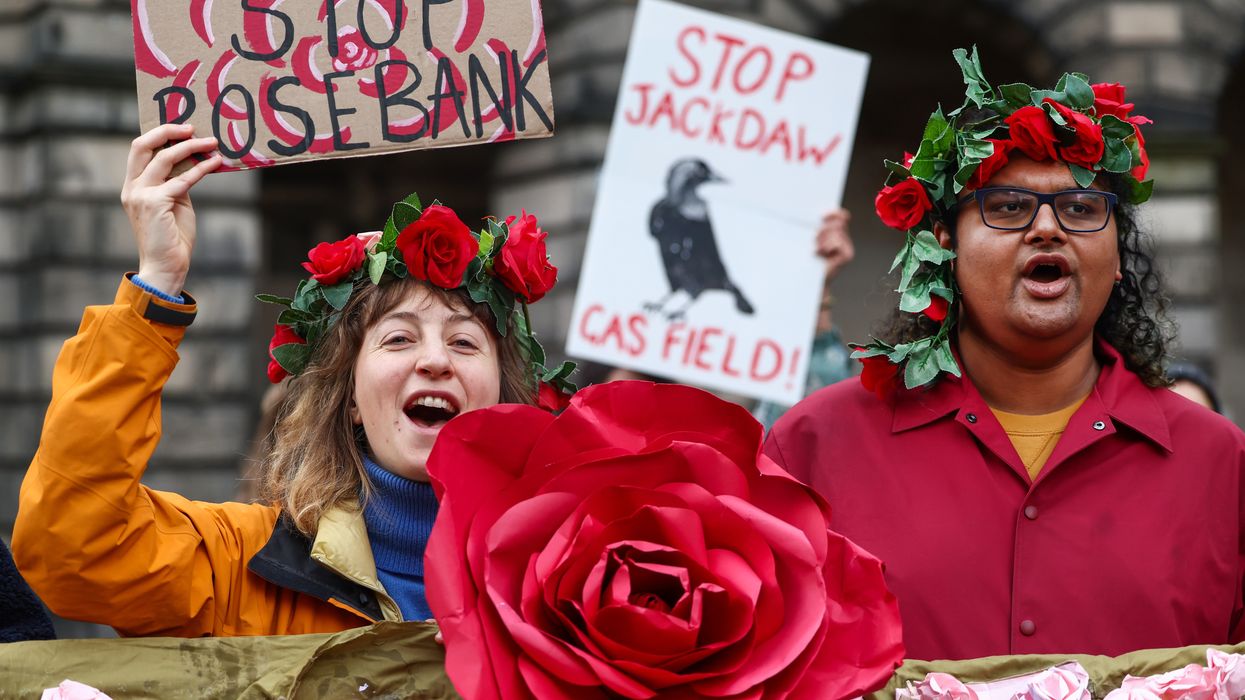
The comments came after Judge Andrew Stewart of Scotland's Court of Session ruled that Equinor and Shell, the fossil fuel giants behind the Rosebank oil and gas field and the Jackdaw gas project, respectively, cannot move ahead with extraction because the government did not take into account the emissions that would result from the projects.
The companies have poured hundreds of millions of dollars into Rosebank and Jackdaw, with Equinor saying it had lined up $2.7 billion in contracts for the former field, with an estimated 300 million barrels of oil and gas expected to be extracted beginning in 2026 or 2027.
The Stop Rosebank coalition, made up of grassroots campaigners and organizations, said the climate pollution from Rosebank "would be more than the combined annual CO2 emissions of all 28 low-income countries in the world, including Uganda, Ethiopia, and Mozambique."
"In other words, emissions from this one U.K. field would be more than those created by the 700 million people in the world's poorest countries in a year," said the coalition. "These are among the same countries that have contributed the least to the climate crisis but are already experiencing the worst impacts of a warming planet."
Stewart said in his ruling that "the public interest in authorities acting lawfully and the private interest of members of the public in climate change outweigh the private interest of the developers."
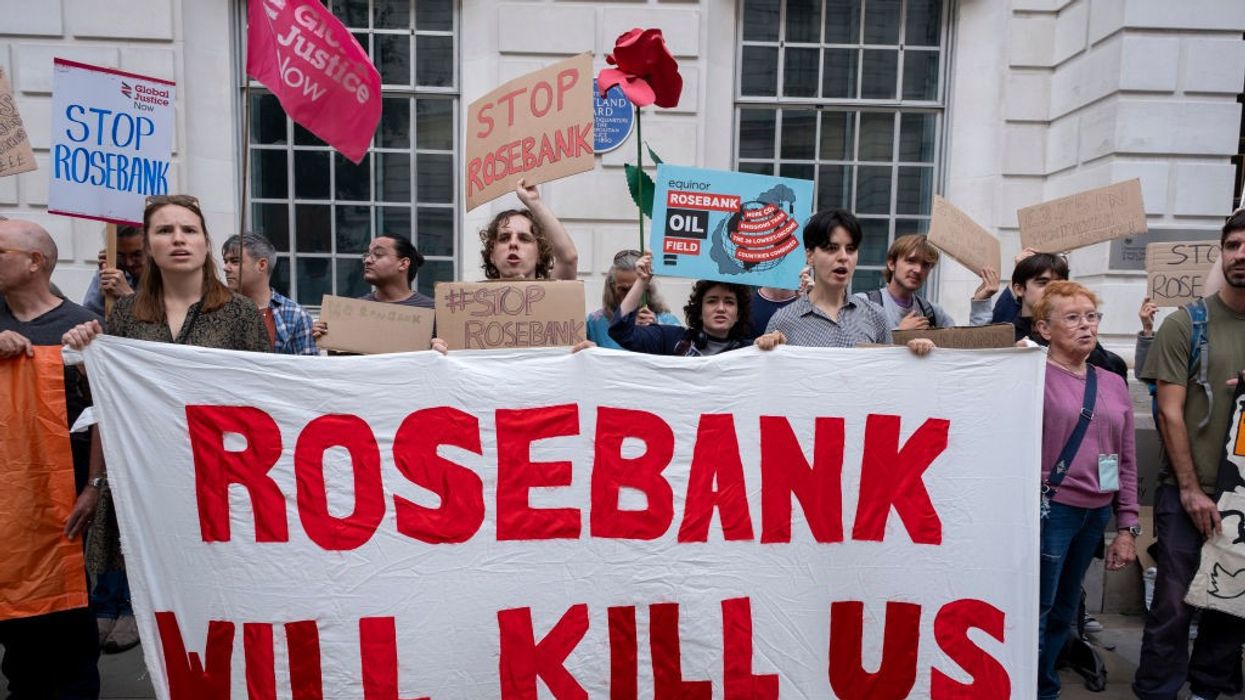
The campaign group Fossil Free London promptly organized a rally outside the Norwegian embassy in the U.K. capital to celebrate the verdict and call on Norway-based Equinor not to appeal the ruling.
"There can be victories in the world of climate protest," said one organizer. "This is a big one."
The ruling was in line with a decision handed down by the U.K. Supreme Court last year, which said local authorities must consider the full environmental impact of all new fossil fuel projects before they are approved.
Thursday's ruling is the latest evidence, said Freya Aitchison, oil and gas campaigner at Friends of the Earth Scotland, that "new oil is over."
"This signals the beginning of the end for fossil fuel production in the U.K.," said Aitchison. "Political attention must immediately turn to developing an urgent and fair transition plan for workers."
"This is a momentous victory for climate justice. It shows the power of the hundreds of thousands of people who have fought against the climate-wrecking Rosebank and Jackdaw oil fields for years. The U.K. Government must now end this disastrous project, rule out all new oil fields and fossil fuel developments and focus on delivering a planned, funded transition for oil workers," added Aitchison. "This ruling is a turning point, we can and must choose a better future."
Carla Denyer, a Member of Parliament for the Green Party, called on the U.K. government, now led by the Labour Party, to "refuse consent for the 13 other oil and gas drilling projects licensed by the previous government."
Global Justice Now said the government should also turn its attention to the entire planet and support calls for a Fossil Fuel Non-Proliferation Treaty.
"This is a huge milestone towards a livable planet and away from polluting fossil fuels," said Liz Murray, head of the group's Scottish campaigns. "Now we need global coordination to end new oil and gas not just here but around the world. The U.K. government should back calls from some of the most climate vulnerable countries for a fossil fuel treaty to plan a clean energy future that leaves no worker, community or country behind."
On Wednesday Ed Milliband, the new Labour energy secretary, announced that the government would not back the companies that want to develop two huge new North Sea oilfields.
I’m pretty sure this newsletter will be obsessing over the American election between now and November—it is the most crucial contest in the crucial years, after all. But this has already been a year of democracy around the globe with half the world’s people going to the polls, and the results have so far been not as bad as they might have been—Prime Minister Narendra Modi rebuked in India, the far right checked in European elections and in France, and a smashing victory for Labour in the U.K., which is already yielding serious climate benefits.
On Wednesday Ed Milliband, the new Labour energy secretary, announced that the government would not back the companies that want to develop two huge new North Sea oilfields. This takes a bit of explanation, so bear with me. Oil giants Shell and Equinor want to develop the vast Jackdaw and Rosebank oil fields. The Tory government backed these projects, even though it led former Energy Secretary Chris Skidmore to resign from the party. In June, a court ruled that the environmental review for the projects was insufficient, because, crucially, the companies had failed to account for the emissions not just from the oil wells themselves, but from the eventual combustion of that oil in cars around the world. These so-called Scope 3 emissions are obviously the key problem with new gas and oil projects, but the industry has worked hard to keep them off the table—and after the court ruling the then-Tory government announced they would back those companies in court. Now the new sheriff, veteran environmentalist Milliband, has said no.
The fight isn’t over—the companies are appealing the court rulings. But here’s my prediction: This will be one of the first large oilfields that humans decide to leave in the ground because of climate concerns.
I say this because Labour has just won its massive majority, and can now govern for as much as five years before they have to face the voters again. Let’s say they don’t call a new election along the way and govern until 2029; with the massive growth in renewable energy now firmly underway, I don’t think that there will be the appetite among financiers for new oil fields then. They’ll certainly try—as Desmog Blog pointed out Thursday, a leading candidate for the new head of the beleaguered Tory party, Tom Tugendhat, has been merrily collecting money from various oil interests and is plumping for new North Sea drilling. But I think that by the time he or someone likes him returns to 10 Downing Street, the moment will have passed.
Here’s how the Tory MP for East Surrey and shadow energy secretary Claire Coutinho put it on Twitter Thursday morning:
The final blow for the North Sea. No other major economy is taking this approach to its domestic energy supply.
She’s right that it’s groundbreaking, but she’s wrong that it’s entirely novel. Yes, too many rich countries continue to pump out hydrocarbons for export—tiny Tuvalu called out its Pacific neighbor Australia today for its endless willingness to serve as coal and gas merchant to the world. But there are signs of seismic shift. Remember that last fall in Dubai the world’s governments agreed in Dubai that the time had come to “transition away” from fossil fuels. A few weeks later the Biden administration paused approval of new LNG export terminals, which if it became permanent would in effect keep some serious portion of the gas in the Permian Basin of the southwest permanently underground. That is an even bigger climate bomb than North Sea oil, and though the pushback from fossil fuel interests has been fierce the White House has so far kept its nerve—and the basic issue (along with the ferocious justice impacts on Gulf communities) is the same Scope 3 emissions. It’s just too much carbon and methane to let loose in the atmosphere.
I fear that America’s noble stand may not last. In the wake of the Harris victory I’m working hard to help achieve, I think a lame duck session of Congress might well adopt the proposal from Big Oil Sens. Joe Manchin (I-W.Va.) and John Barasso (R-Wyo.) to trade permitting reform that will help expand renewables with new permits for those LNG facilities. I hope they don’t; important as those permitting reforms are, this one is a bad deal, as a new Sierra Club report released Thursday makes clear:
The LNG projects that would likely be immediately subject to the 90 day review deadline if this bill passes would have climate-damaging emissions equivalent to 154 coal-fired power plants. For comparison, as of August 2024, there are 145 coal plants left in the entire U.S. that don’t have a retirement date by 2030. When looking at all the projects that DOE is likely to review in the coming years, the climate toll goes up to that of 422 coal plants.
There are, again, two equally important and interlinked parts of the climate fight: keeping fossil fuels in the ground, and building out renewable energy to replace that locked-away coal, gas and oil. And the fight is unavoidably global.
"Going full steam ahead with new North Sea oil and gas is a sure fire route to the worst climate scenarios," one campaigner said.
Climate activists in six North Sea countries came together on Saturday to carry out acts of civil disobedience in protest of their governments' continued fossil fuel development.
Demonstrators in the United Kingdom, Norway, Sweden, Denmark, Germany, and the Netherlands blockaded roads, ports, and refineries; dropped banners; and held solidarity concerts as part of the North Sea Fossil Free campaign to demand that their governments align their plans for the shared body of water with the Paris agreement goal of limiting global heating to 1.5°C above preindustrial levels.
"For too long, the U.K., Norway, and other North Sea countries have avoided scrutiny for their oil drilling plans as the emissions are not included in their national inventories," a spokesperson for Extinction Rebellion U.K. told Common Dreams. "Going full steam ahead with new North Sea oil and gas is a sure fire route to the worst climate scenarios."
"The only serious response we can make is for citizens to unite, but we need to see many many more people doing this work."
The day of action, which was organized by Extinction Rebellion (XR), came days after a new report from Oil Change International revealed that none of five North Sea countries—Norway, the U.K., the Netherlands, Germany, and Denmark—have plans consistent either with limiting warming to 1.5°C or with the agreement to transition away from fossil fuels reached at last year's United Nations COP28 climate conference. If the five countries were counted as one, they would be the seventh biggest producer of oil and gas in the world.
In particular, these governments continue to issue permits to explore for and develop oil and gas fields, despite the fact that the International Energy Agency has said that no new fossil fuel development is compatible with limiting global temperature rise to 1.5°C. In one high-profile example, the U.K. approved the undeveloped Rosebank oil field in September 2023. Taken together, these permits could lead to more than 10 billion metric tons of greenhouse gas emissions.
The worst offenders were Norway and the U.K., which could be among the top 20 developers of oil and gas fields through mid-century if they do not change course.
"The five major North Sea countries are at a crossroads: One path leads toward global leadership in climate action and green industries, where they take bold action to phase out oil and gas production that creates sustainable jobs and communities. The other path leads to catastrophic climate change, economic crisis, and the loss of status as climate leaders globally, as they cling to outdated practices while the world moves forward," Silje Ask Lundberg, North Sea campaign manager at Oil Change International, said when the report was released.
Extinction Rebellion co-founder Clare Farrell said that the North Sea governments' policies were a betrayal of their citizens and the world following the hottest year on record.
"Temperatures have tracked 1.5°C above average recently, almost 2°C," Farrell said. "Our global commitments, such that they are, are being flushed away with no regard for what the public really want. Where's the consent for that here in our democracies? No government has a mandate to do that. So people deserve to know that our governments are willfully destroying everything. The people of these North Sea nations have not consented to destroying civilization, but that's what is going to happen. Their governments are unhinged and unchecked."
Saturday's protests, Farrell continued, were a way for the people in these countries to make their voices heard.
"The only serious response we can make is for citizens to unite, but we need to see many many more people doing this work," Farrell said. "Direct action like this should shake us awake; our governments will destroy democracy and society if we let them continue, that's the course we are on, and they are redoubling their efforts despite the facts and knowing how much suffering they are already causing all over the world as climate breaks down."
The demands of Saturday's protests were threefold: An end to new oil and gas infrastructure in the North Sea, for governments to tell the truth about the realities of the climate crisis, and for the countries to pursue a just transition to renewable energy. In addition, many activists made additional demands specific to their nations' policies.
In the Netherlands, activists with Extinction Rebellion and Scientist Rebellion blocked all roads and railways leading to the largest oil refinery in Europe: Shell's Pernis refinery. They targeted Shell because the oil major has received new permits to drill in the Victory Gas Field and has also restarted its drilling in the Pierce Field. What's more, the company has refused to clean up its aging equipment in the North Sea, leaving old pipelines and drilling platforms to rust and pollute the sea with mercury, polonium, and radioactive lead. While there are 75 aging Shell oil and gas platforms in the Dutch North Sea that should be removed by 2035, current efforts are not on track to meet this deadline.
"Like the rest of the fossil industry, Shell is only interested in profits and shareholder returns," said Bram Kroezen of XR Netherlands, adding that Shell's appeal of a landmark court ruling ordering it to reduce emissions showed that the company "completely lacks a moral compass."
Activists with Ende Gelände blocked off access to a floating liquefied natural gas (LNG) terminal in the port of Brunsbüttel, Germany, beginning at 9:00 am local time. The activists are calling for an end to LNG imports, as new science reveals the so-called "bridge" fuel may in fact be at least as damaging to the climate as coal due to previously unaccounted for methane leaks.
"LNG is a double climate killer," Rita Tesch, spokesperson for Ende Gelände, said in a statement. "Because it consists of methane. Methane is even more harmful to the climate than carbon dioxide. It escapes into the atmosphere during transportation by LNG ships and at terminals such as here in Brunsbüttel, and heats it up rapidly. The carbon dioxide from burning it is on top of that. It's clear: LNG imports are a climate crime!"
Activists with XR Norway targeted Rafnes Petroleum Refinery, with some blockading access on land while another group entered the security area by boat.
"I'm ashamed to be a Norwegian," XR Norway spokesperson Jonas Kittelsen said in a statement. "Norway profits massively from aggressively expanding our oil and gas sector, causing mass suffering and death globally. My government portrays us as better than the rest of the world, which we are not."
Performance collective Becoming Species and Extinction Rebellion Denmark worked together to stage a creative protest targeting the oil company Total Energies, which is the leading oil and gas producer in the Danish North Sea and currently has plans to reopen "Tyra Feltet," Denmark's largest gas field. Four members of the band Octopussy Riot climbed a Total-owned container and staged a punk concert in Denmark's Esbjerg Harbor.
"We octopuses have formed the band Octopussy Riot and have arrived here to play our song, a demand for you two-legs to stop oil and gas extraction," performer Linh Le, said. "The sea is dying, our climate collapsing. We will not accept that the most rich and powerful destroy our home. We do not want to go extinct."
Members of XR Sweden blocked the road to Gothenburg's Oil Harbor, where the group has been protesting since May of 2022. The activists called on Sweden to stop investing in the harbor and on city officials to develop a plan to dismantle the harbor and refineries.
"Twenty-two million tons of oil enter Gothenburg's port every year, which is owned by the city," one activist said. "There is no plan for decommissioning. This does not go together with the climate goals."
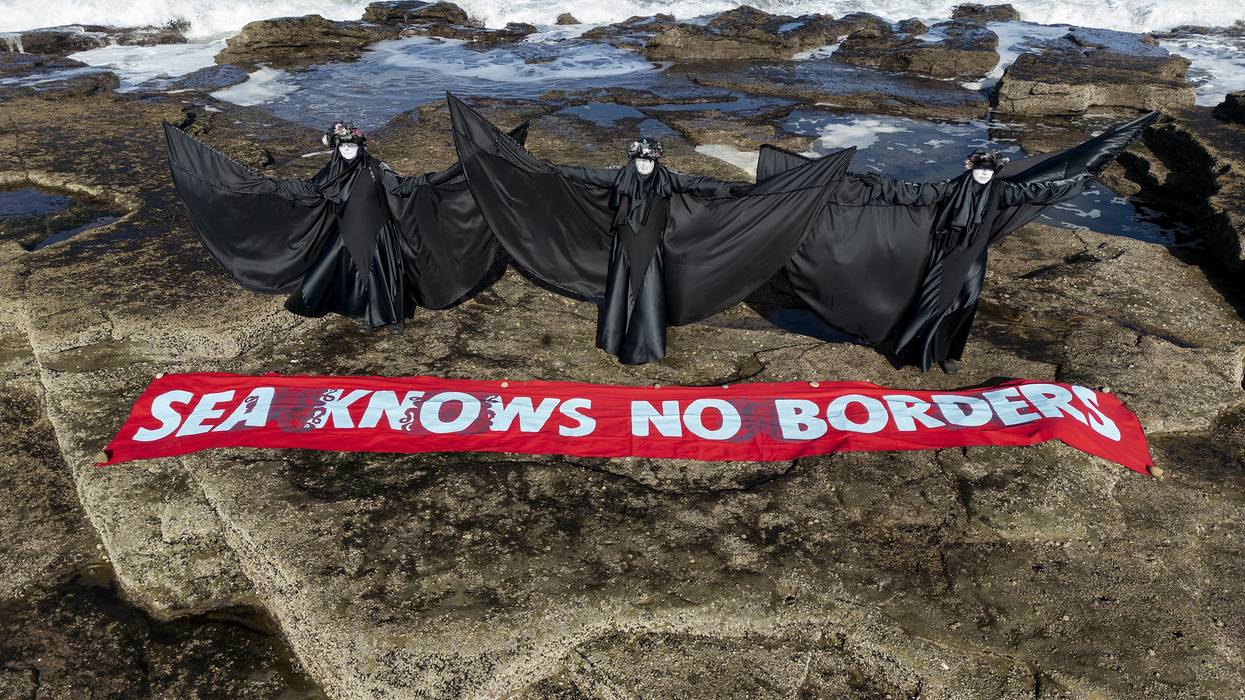
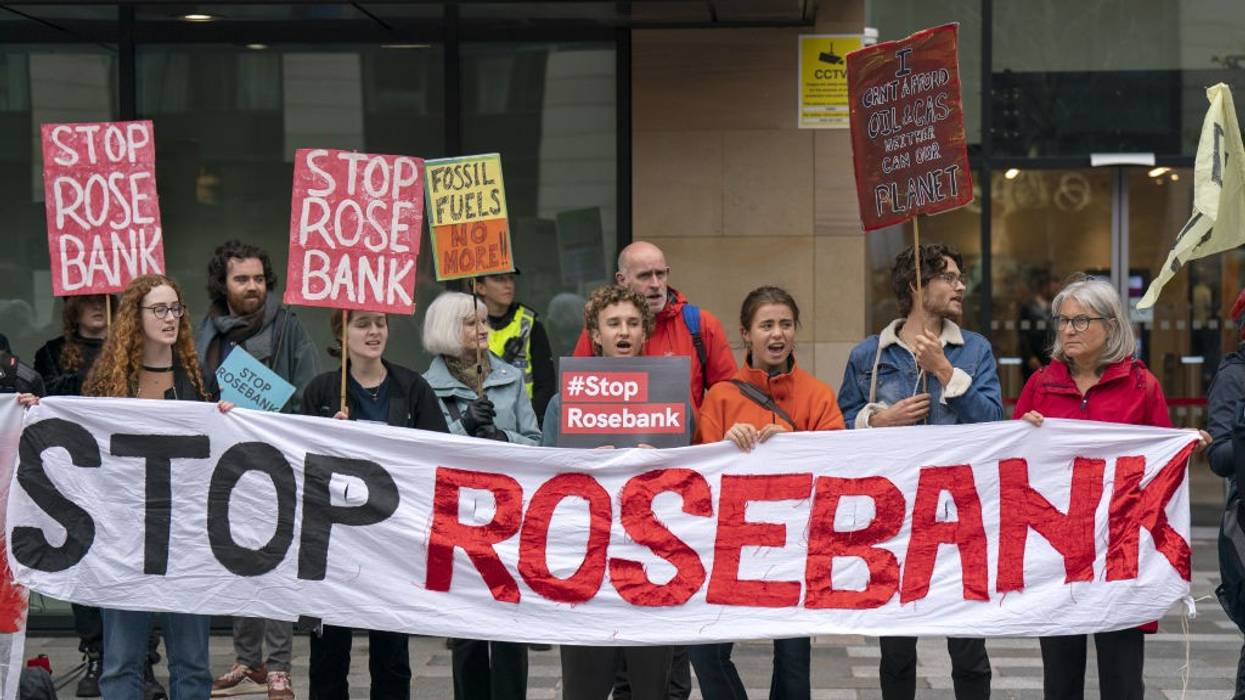
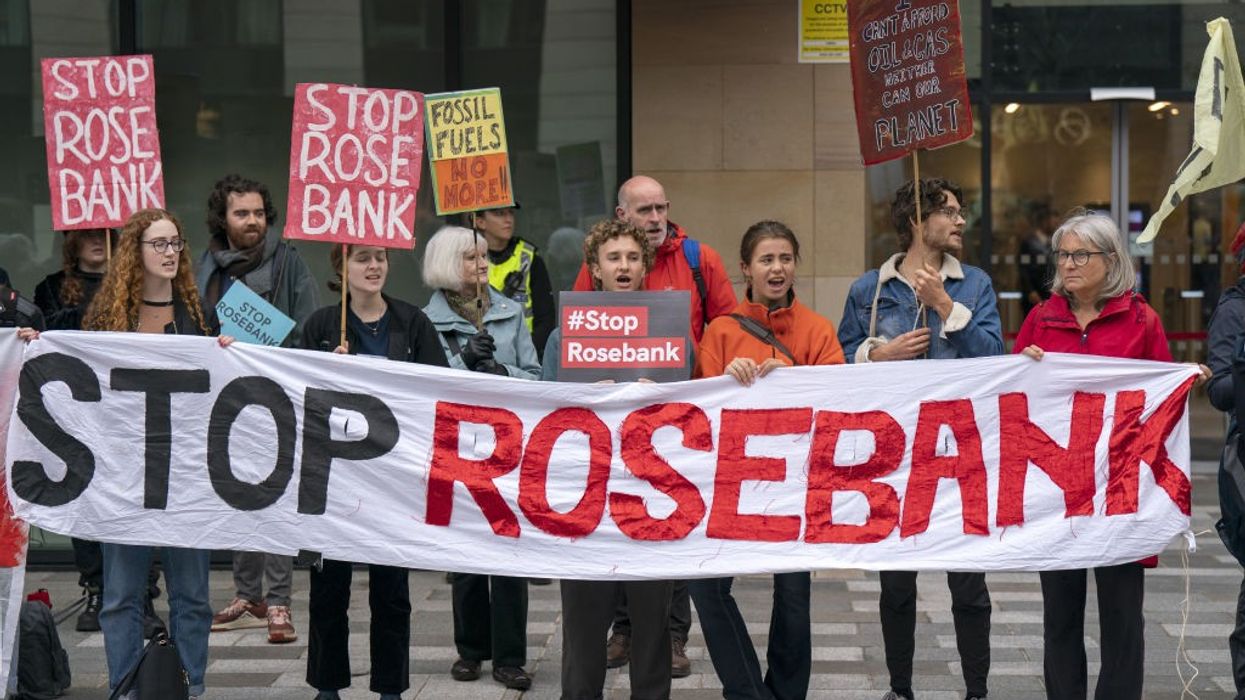
Finally, protesters across Scotland stood in solidarity with the other actions with performances and banner drops. In Aberdeen, activists unfurled banners outside the offices of Equinor, which owns 80% of Rosebank, and Ithaca, which owns the remaining 20%. The banners read, "North Sea Fossil Free," "Stop Rosebank," and "Sea knows no borders." In Dundee, protesters targeted the Valaris 123 oil platform off the coast with banners. Shetland Stop Rosebank also brought signs to Lerwick Harbor, from where the first stage of Rosebank's development is launching. XR Forres organized a performance of the group the "oil slicks" along the Moray Firth, to demonstrate what an oil spill would do to its unique coastal landscape.
"All countries should align their drilling plans with the Paris agreement now," the XR U.K. spokesperson said. "We thank everyone who has taken action today in defense of a livable planet."
A new report also concludes that the United States should put $97.1 billion per year toward helping poor countries with their energy transitions.
In order to limit global heating to 1.5°C in a way that prioritizes climate justice, wealthy nations like the United States must stop extracting oil, gas, and coal by 2031.
That's the conclusion of a report released Tuesday by the Civil Society Equity Review titled Equitable Phaseout of Fossil Fuel Extraction: Toward a Reference Framework for a Fair and Rapid Global Phaseout. The report, published to coincide with the ongoing United Nations Climate Change Conference (COP28) in the United Arab Emirates, provides both timelines of when it would be fair for different countries to end fossil fuel extraction and payment schedules for how much wealthier nations should provide to help poorer ones finance their energy transitions.
"Limiting warming to 1.5°C requires all countries to reduce their fossil fuel extraction and use, starting now. But fairness dictates that some should reduce faster than others," Greg Muttitt of the International Institute for Sustainable Development and Global Gas and Oil Network said in a statement. "To make a just transition possible in countries whose economies depend heavily on fossil fuel revenues and jobs, wealthy countries should phase out their fossil fuels within just eight years, and provide significant amounts of support to poorer countries."
"The only hope that we'll back away from the brink is a globally fair arrangement that gives poorer countries the time and resources to manage rapid transitions away from fossil fuel production and consumption."
The new report came the day after the publication of the annual Global Carbon Budget report, which found that carbon dioxide emissions from the burning of fossil fuels reached a record 36.8 billion metric tons in 2023 and that, if human societies continue to burn fossil fuels at current rates, they have a 50% chance of pushing temperatures consistently above 1.5°C in around seven years.
"All countries need to decarbonize their economies faster than they are at present to avoid the worse impacts of climate change," Corinne Le Quéré, Royal Society research professor at the University of East Anglia's School of Environmental Sciences, said in response to the Carbon Budget findings.
The Civil Society Equity Review agreed that emissions must fall rapidly everywhere, but argued that "this will be politically achievable only if it is widely accepted as fair."
"The speed and scale of the transformations required to move away from the fossil economy can look daunting, particularly in countries that are dependent on fossil fuel revenues, while millions of people within them depend on fossil fuel extraction for jobs and livelihoods," Anabella Rosemberg, senior adviser on just transition for Climate Action Network International, said in a statement.
The report concluded that
"Everyone knows that countries' mitigation pledges under the Paris agreement are far off track from keeping warming below 1.5°C, or even 2°C. But there is far less awareness that countries' and corporations' plans for producing oil, gas, and coal are even farther off track," said Sivan Kartha of the Stockholm Environment Institute.
"Practically speaking," Kartha continued, "the only hope that we'll back away from the brink is a globally fair arrangement that gives poorer countries the time and resources to manage rapid transitions away from fossil fuel production and consumption."
The report also provides guidelines for those resources based on "fair share" contributions from wealthier nations derived from their capacity and their responsibility for the climate crisis. The U.S., which is the No. 1 historical emitter of carbon pollution, would owe 46.3% of the total, or $97.1 billion per year. The E.U. comes next, owing 20.7% or $43.4 billion per year. It is followed by Japan (9.3% and $19.5 billion), Canada (4.1% and $8.6 billion), and the U.K. (3.8% and $8 billion.)
"The Civil Society Equity Review report clearly shows that the richest countries are largely responsible for the climate crisis. They also have the greatest capacity to deliver the solutions we need," Oxfam International climate policy lead Nafkote Dabi said in a statement. "Rich countries should be the first to commit to the phaseout of fossil fuels. They should also commit to providing crucial financial support to developing countries to facilitate their transition to clean energy."
The Civil Society Equity Review was first convened in 2015 and now has the backing of more than 500 organizations and movements. Its latest report comes amid the greatest push to negotiate a total phaseout of fossil fuels at a U.N. climate conference to date.
"As the climate negotiations pivot, finally, to the central issues of fossil fuel extraction and developmental justice, this report steps back and takes a long-overdue hard look at the overall structure of the problem," Tom Athanasiou of the Climate Equity Reference Project said in a statement. "Its goal is to move the discussion forward and we think that, by giving real numbers—both phaseout dates and support needs—it does just that."
There is no doubt that with this decision, the U.K. government is siding with oil and gas giants over a liveable future for all.
Timing, they say, is everything. Yesterday, the world’s energy watchdog, the International Energy Agency (IEA), published its latest report, the 2023 Net Zero Roadmap.
The IEA categorically stated that the time for no new oil and gas was over. If we are to keep temperatures to 1.5°C, then world leaders must not develop new oil, gas, or coal beyond existing fields.
If we want a liveable planet, we must shift from fossil fuels to renewables.
This is not the first time, either, that the IEA has confirmed that no new oil, gas, or coal fields are compatible with limiting global temperature rise to 1.5ºC.
It is also clear that Rosebank won’t do anything to lower energy bills in the U.K. or make the U.K.’s energy supply safer, despite how the government tries to spin it.
“Keeping alive the goal of limiting global warming to 1.5 °C requires the world to come together quickly. The good news is we know what we need to do–and how to do it,” said IEA Executive Director, Fatih Birol at the launch of the report. The IEA reiterated the way to do it is not to approve new oil and gas fields.
The IEA are not the only ones saying this. Earlier this year, the U.N. Secretary General, António Guterres, called on governments to halt new oil and gas exploration licences.
But even stopping new licenses may not be enough. Oil Change International’s latest research shows that even beyond stopping oil and gas expansion, 60% of fossil fuels in existing fields must stay in the ground to limit global temperature rise to 1.5°C.
Speaking in response to yesterday’s IEA’s report, my colleague, Kelly Trout, said: “This report reaffirms a stark truth: To limit global temperature rise as agreed upon internationally, there’s no room for new oil, gas, or coal fields. The time for a swift, equitable, and fully funded phase-out of fossil fuels is now, with rich countries moving first and fastest and paying their fair share to finance a global just transition.”
Barely is the ink dry on the IEA’s report, and yet Wednesday, the U.K. government gave the go-ahead to the huge Rosebank oil field, which is seen as the U.K.’s last untapped oil field.
Rosebank is some 80 miles off the West of the Shetland Isles, located off Scotland. The field could contain 500 million barrels of oil and could produce 69,000 barrels of oil a day at its peak and about 44 million cubic feet of gas per day in its first 10 years.
The field is going to be developed by the Norwegian company Equinor and British firm Ithaca Energy.
For months, opposition to the project has grown, including 200 organisations and celebrities, 40 MEPs and MPs from every major political party. Just last month, 50 MPs and others from all major British political parties raised concerns. They wrote to then Energy Secretary Grant Shapps urging him to block Rosebank. All their concerns were ignored.
There is no doubt that with this decision, the U.K. government is siding with oil and gas giants over a liveable future for all—whether that’s a habitable planet or not having to choose between heating and eating. The project will emit more carbon dioxide than the combined emissions of some 28 countries of the Global South.
It is also clear that Rosebank won’t do anything to lower energy bills in the U.K. or make the U.K.’s energy supply safer, despite how the government tries to spin it. In contrast, it will make millions for Equinor, and Ithaca, whose shares rose sharply this morning.
It is unsurprising that the decision was met with universal outrage from scientists, activists, and politicians. The Green Party MP Caroline Lucas called it “the greatest act of environmental vandalism in my lifetime.”
Philip Evans, a Greenpeace U.K. climate campaigner, told The Guardian, “Rishi Sunak has proven once and for all that he puts the profits of oil companies above everyday people. We know that relying on fossil fuels is terrible for our energy security, the cost of living, and the climate.”
Simon Francis, the coordinator of the End Fuel Poverty Coalition, added: “Households struggling with their energy bills will be shocked that the new Energy Secretary has chosen to hand a multi-billion pound tax break to this Norwegian firm, rather than help people in the U.K. suffering in fuel poverty.”
Dr Paul Balcombe, from Queen Mary University of London, said, “Signalling the expansion of North Sea oil and gas won’t make energy cheaper for us and will make it more difficult to transition to net zero.”
Others took to X, formally known as Twitter, to express outrage and shock, many pointing out the deep irony of the timing.
The U.K. government’s announcement comes after a number of anti-green announcements by the U.K. prime minister, including pushing back the deadline for selling new petrol and diesel cars, the phasing out of gas boilers, and the scrapping of the Energy Efficiency TaskForce.
Jess Ralston, from the Energy and Climate Intelligence Unit, said it is clear now that “the prime minister has shown that he’d instead give tax breaks to oil companies than lower energy bills. Taxpayers will fork out around £4bn to the developers of the oil field, money that could have insulated millions of homes, with many set to be colder and poorer this winter.”
Even for some Conservatives it has gone too far, with Sir Alok Sharma, who headed the COP26 talks in Scotland for the government, now saying he will no longer stand for reelection at the next General Election.
The Rosebank go-ahead confirms the U.K.’s stance as a leading Planet Wrecker. According to a recent OCI analysis, the U.K. is among five global north countries posed to be responsible for the majority of new oil and gas extraction to 2050.
It is no wonder that my colleague Silje Ask Lundberg, the North Sea Program Manager at OCI, said: “The science could not be more clear: There is no room for a single drop of oil from new fields… The fact that the U.K. government has approved the biggest undeveloped field in the U.K., and coming just one week after the government’s weakening of its net zero policies, is proof positive it is siding with oil and gas giants over a liveable future for all.”
Meanwhile, Rosebank will not happen without a huge fight from civil society groups:
"The disgraceful decision to give Rosebank the green light shows the extent of the U.K. government's climate denial," one activist said.
Regulators in the United Kingdom on Wednesday greenlit the Rosebank oilfield in the North Sea, which campaigners warn contains enough oil and gas to match the yearly emissions of 28 low-income countries.
The U.K. government said it welcomed the approval, in a statement that comes one week after Prime Minister Rishi Sunak announced he was delaying some elements of the country's net-zero plan.
"By approving Rosebank, Rishi Sunak has confirmed he couldn't care less about climate change," climate lawyer and executive director of the advocacy group Uplift Tessa Khan said in a statement. "As we've heard repeatedly, our world can no longer sustain new oil and gas drilling. And when we're witnessing scorching temperatures, wildfires, devastating flooding, and heatwaves in our seas, it could not be clearer that this is a decision by the prime minister to add more fuel to the fire."
Rosebank, which is located off the northwest coast of the Shetland Islands, is the largest currently undeveloped oil field in the U.K., CNBC reported. Equinor, Norway's state-owned oil company, has an 80% share in the project, with British company Ithaca Energy holding the remaining 20%.
Equinor said it expected development to begin in 2026-2027 and for the field to produce more than 300 million barrels of oil overall, while Friends of the Earth Scotland said it contained 500 million barrels.
The approval comes despite the fact that the International Energy Agency concluded in 2021 that no new fossil fuel projects should be launched if world leaders wanted to limit global heating to 1.5°C. It also comes on the heels of a government report finding that a record number of people in England died of heat-related causes in 2022.
"This decision is nothing but carte blanche to fossil fuel companies to ruin the climate, punish bill payers, and siphon off obscene profits."
Green Member of Parliament Caroline Lucas called the approval "the greatest act of environmental vandalism in my lifetime" in a statement posted on X, formerly known as Twitter.
"This is morally obscene," she added in a second post. "It won't improve energy security or lower bills—but it will shatter our climate commitments and demolish global leadership. Govt is complicit in this climate crime—as is Labour unless they pledge to do all possible to revoke it."
Sunak, a conservative, promised to approve hundreds of oil and gas drilling licenses in the North Sea in July, arguing it was necessary for energy security. The opposition Labour Party says it will prioritize renewable energy if it takes power, but will respect any licenses or approvals already in place, according to Reuters.
"The disgraceful decision to give Rosebank the green light shows the extent of the U.K. government's climate denial," Friends of the Earth Scotland's oil and gas campaigner Freya Aitchison said in a statement. "Fossil fuels are driving both climate breakdown and the cost of living crisis yet the U.K. Government is slamming its foot down on the accelerator."
Aitchison also called on the Scottish government specifically to oppose the project.
"Delivering a fair and fast transition away from fossil fuels is one of the defining challenges of Humza Yousaf's term as First Minister," Aitchison said. "This must start with unequivocally condemning Rosebank and opposing the U.K. government's decision to go ahead with a project that deliberately prioritizes the interests of Equinor while bringing little or no benefit to Scottish people."
Campaigners also questioned who would benefit from the project. While the government argued that it would inject cash into the economy and create almost 1,600 jobs, activists pointed out that Equinor made £62 billion in pre-tax profits last year and would get more than £3.75 billion in tax breaks for its work on Rosebank, meaning the U.K. would ultimately lose £750 million in tax money from the field's development.
"The ugly truth is that Sunak is pandering to vested interests, demonstrating the stranglehold the fossil fuel lobby has on government decision-making. And it's bill payers and the climate that will suffer because of it," Greenpeace U.K. climate campaigner Philip Evans said in a statement. "Why else would he make such a reckless decision?
"This decision is nothing but carte blanche to fossil fuel companies to ruin the climate, punish bill payers, and siphon off obscene profits," Evans added.
Opponents of the project have promised to take legal action to stop it.
"There are strong grounds to believe that the way this government has come to this decision is unlawful," Khan said in a statement. "We shouldn't have to fight this government for cheap, clean energy, and a liveable climate, but we will."
"All public and enforced consumer spending on new nuclear power and carbon capture and storage should be scrapped and instead funding should be put into renewable energy, energy efficiency, and storage capacity," said one expert.
A best-case scenario in which the United Kingdom fully transitions to renewable energy with no nuclear generation would save more than £100 billion—over $124 billion—toward achieving net-zero by 2050 and produce 20% fewer carbon emissions, an analysis published this week concludes.
The report—entitled 100% Renewable Energy for the United Kingdom—was authored by Philipp Diesing, Dmitrii Bogdanov, Rasul Satymov, Michael Child, and Christian Breyer of LUT University in Lappeenranta, Finland. The publication compares a set of potential scenarios with the U.K. government's current net-zero pathway, which includes nuclear power and fossil fuel carbon capture and storage. The report was released ahead of a Saturday seminar hosted in London and online by 100% Renewable U.K.
"While the effects of the climate emergency can be observed more and more clearly through increasingly frequent extreme weather events and other climate change impacts, there is still a lack of dedicated countermeasures by decision-makers," a summary of the report states. "The government of the United Kingdom... has self-committed to climate neutrality in 2050, but without initiating the essential steps and without eliminating fossil fuel-based technologies and high-risk nuclear power."
"The U.K. does, however, benefit from the availability of renewable energy resources, namely onshore and offshore wind, which are considered the best in Europe," the publication continues. "Based on this background, this study presents several energy system transition pathways to 100% renewable energy in 2050 in high-spatial and temporal resolution, by describing the energy system of the U.K. in full detail from the starting point of today in five-year time steps until 2050."
The study's authors modeled four scenarios:
"The implications of this report are huge," he added. "All public and enforced consumer spending on new nuclear power and carbon capture and storage should be scrapped and instead funding should be put into renewable energy, energy efficiency, and storage capacity."
The new report comes as Extinction Rebellion U.K. and dozens of other groups prepare for a four-day demonstration in London beginning Friday to demand an end to new fossil fuel projects and citizens' assemblies to discuss solutions to the climate emergency.
It also comes as ministers in the Conservative government of U.K. Prime Minister Rishi Sunak are considering a revamp of the bidding process for new renewables projects in an effort to create more green jobs. Opportunities in the low-carbon job sector have shrunk significantly since then-U.K. Prime Minister David Cameron, also a Conservative, eliminated what he reportedly called "green crap" policies in 2012.
Like the United States and other nations, the U.K. continues to develop fossil fuel projects despite the climate emergency. Climate campaigners warn that the country's entire carbon budget could be blown on just one oil and gas project: Rosebank, the North Sea's largest undeveloped oilfield, has the estimated potential to produce half a billion total barrels of oil.
Earlier this week, Germany drew applause—and some criticism—from climate campaigners as its last three nuclear power plants were permanently shut down.