SUBSCRIBE TO OUR FREE NEWSLETTER
Daily news & progressive opinion—funded by the people, not the corporations—delivered straight to your inbox.
5
#000000
#FFFFFF
To donate by check, phone, or other method, see our More Ways to Give page.
Daily news & progressive opinion—funded by the people, not the corporations—delivered straight to your inbox.
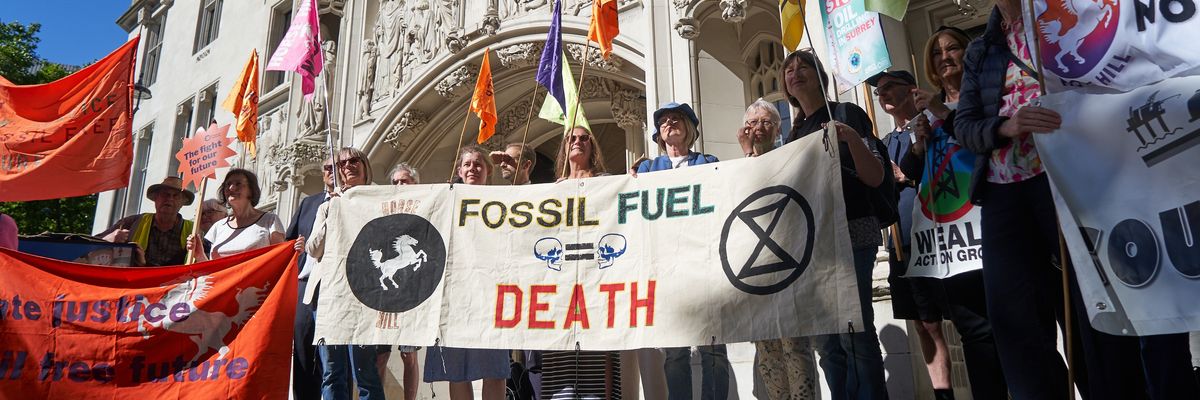
Climate advocates rally outside the United Kingdom Supreme Court in London on June 20, 2024.
"This is a welcome step towards a safer, fairer future," said the climate campaigner who brought the legal challenge.
In a landmark decision that could spell doom for all new fossil fuel projects in the country, the United Kingdom's highest court ruled Thursday that local planning authorities unlawfully failed to consider the full planet-warming emissions impact when they approved a drilling initiative that was expected to yield more than 3 million tonnes of oil over two decades.
The most recent challenge to the closely watched drilling project was brought to the U.K. Supreme Court in 2023 by climate campaigner Sarah Finch, who argued that the Surrey County Council's granted permission for new oil wells at Horse Hill without taking into account future emissions from burning the fossil fuel produced at the sites—so-called "downstream" emissions.
In a 3-2 decision, the U.K.'s high court ruled that the Surrey council's approval of the Horse Hill drilling "was unlawful because the emissions that will occur when the oil produced is burnt as fuel are within the scope of the [environmental impact assessment] required by law."
"The oil and gas companies may act like business-as-usual is still an option, but it will be very hard for planning authorities to permit new fossil fuel developments."
Finch said Thursday that she is "absolutely over the moon to have won this important case."
"This is a welcome step towards a safer, fairer future," Finch continued. "The oil and gas companies may act like business-as-usual is still an option, but it will be very hard for planning authorities to permit new fossil fuel developments—in the Weald, the North Sea, or anywhere else—when their true climate impact is clear for all to see."
Friends of the Earth U.K., which backed Finch's legal challenge, called the court's ruling "a heavy blow for the fossil fuel industry," noting that the decision "could have ramifications for other proposed fossil fuel projects, such as the Whitehaven coal mine, as well as projects to extract oil from the North Sea."
Scientists have made clear that no new oil and gas projects are consistent with efforts to limit planetary warming to 1.5°C by century's end.
"If developers are now obliged to present the full climate impacts of their projects (instead of just a fraction of those impacts, as has largely happened up until now), then decision-makers may well think twice before granting them planning permission," Friends of the Earth U.K. said in a statement Thursday.
Extinction Rebellion U.K., another supporter of Finch's challenge, said Thursday's ruling effectively "slams brakes" on new fossil fuel projects in the country.
"Not only does today's Supreme Court ruling destroy [U.K. Oil and Gas'] plans to drill for up to 3.3 million tonnes of crude oil for 20 years at its Horse Hill site, near Gatwick Airport, but also has huge implications for all future fossil fuel projects in the U.K.," the organization said. "Neither the Cumbrian coal mine in Whitehaven nor the Rosebank oil field in the North Sea sought consent for their projects. Nor did they provide any information on downstream emissions in their environmental statements. Both projects are the subjects of legal challenges."
Dear Common Dreams reader, It’s been nearly 30 years since I co-founded Common Dreams with my late wife, Lina Newhouser. We had the radical notion that journalism should serve the public good, not corporate profits. It was clear to us from the outset what it would take to build such a project. No paid advertisements. No corporate sponsors. No millionaire publisher telling us what to think or do. Many people said we wouldn't last a year, but we proved those doubters wrong. Together with a tremendous team of journalists and dedicated staff, we built an independent media outlet free from the constraints of profits and corporate control. Our mission has always been simple: To inform. To inspire. To ignite change for the common good. Building Common Dreams was not easy. Our survival was never guaranteed. When you take on the most powerful forces—Wall Street greed, fossil fuel industry destruction, Big Tech lobbyists, and uber-rich oligarchs who have spent billions upon billions rigging the economy and democracy in their favor—the only bulwark you have is supporters who believe in your work. But here’s the urgent message from me today. It's never been this bad out there. And it's never been this hard to keep us going. At the very moment Common Dreams is most needed, the threats we face are intensifying. We need your support now more than ever. We don't accept corporate advertising and never will. We don't have a paywall because we don't think people should be blocked from critical news based on their ability to pay. Everything we do is funded by the donations of readers like you. When everyone does the little they can afford, we are strong. But if that support retreats or dries up, so do we. Will you donate now to make sure Common Dreams not only survives but thrives? —Craig Brown, Co-founder |
In a landmark decision that could spell doom for all new fossil fuel projects in the country, the United Kingdom's highest court ruled Thursday that local planning authorities unlawfully failed to consider the full planet-warming emissions impact when they approved a drilling initiative that was expected to yield more than 3 million tonnes of oil over two decades.
The most recent challenge to the closely watched drilling project was brought to the U.K. Supreme Court in 2023 by climate campaigner Sarah Finch, who argued that the Surrey County Council's granted permission for new oil wells at Horse Hill without taking into account future emissions from burning the fossil fuel produced at the sites—so-called "downstream" emissions.
In a 3-2 decision, the U.K.'s high court ruled that the Surrey council's approval of the Horse Hill drilling "was unlawful because the emissions that will occur when the oil produced is burnt as fuel are within the scope of the [environmental impact assessment] required by law."
"The oil and gas companies may act like business-as-usual is still an option, but it will be very hard for planning authorities to permit new fossil fuel developments."
Finch said Thursday that she is "absolutely over the moon to have won this important case."
"This is a welcome step towards a safer, fairer future," Finch continued. "The oil and gas companies may act like business-as-usual is still an option, but it will be very hard for planning authorities to permit new fossil fuel developments—in the Weald, the North Sea, or anywhere else—when their true climate impact is clear for all to see."
Friends of the Earth U.K., which backed Finch's legal challenge, called the court's ruling "a heavy blow for the fossil fuel industry," noting that the decision "could have ramifications for other proposed fossil fuel projects, such as the Whitehaven coal mine, as well as projects to extract oil from the North Sea."
Scientists have made clear that no new oil and gas projects are consistent with efforts to limit planetary warming to 1.5°C by century's end.
"If developers are now obliged to present the full climate impacts of their projects (instead of just a fraction of those impacts, as has largely happened up until now), then decision-makers may well think twice before granting them planning permission," Friends of the Earth U.K. said in a statement Thursday.
Extinction Rebellion U.K., another supporter of Finch's challenge, said Thursday's ruling effectively "slams brakes" on new fossil fuel projects in the country.
"Not only does today's Supreme Court ruling destroy [U.K. Oil and Gas'] plans to drill for up to 3.3 million tonnes of crude oil for 20 years at its Horse Hill site, near Gatwick Airport, but also has huge implications for all future fossil fuel projects in the U.K.," the organization said. "Neither the Cumbrian coal mine in Whitehaven nor the Rosebank oil field in the North Sea sought consent for their projects. Nor did they provide any information on downstream emissions in their environmental statements. Both projects are the subjects of legal challenges."
In a landmark decision that could spell doom for all new fossil fuel projects in the country, the United Kingdom's highest court ruled Thursday that local planning authorities unlawfully failed to consider the full planet-warming emissions impact when they approved a drilling initiative that was expected to yield more than 3 million tonnes of oil over two decades.
The most recent challenge to the closely watched drilling project was brought to the U.K. Supreme Court in 2023 by climate campaigner Sarah Finch, who argued that the Surrey County Council's granted permission for new oil wells at Horse Hill without taking into account future emissions from burning the fossil fuel produced at the sites—so-called "downstream" emissions.
In a 3-2 decision, the U.K.'s high court ruled that the Surrey council's approval of the Horse Hill drilling "was unlawful because the emissions that will occur when the oil produced is burnt as fuel are within the scope of the [environmental impact assessment] required by law."
"The oil and gas companies may act like business-as-usual is still an option, but it will be very hard for planning authorities to permit new fossil fuel developments."
Finch said Thursday that she is "absolutely over the moon to have won this important case."
"This is a welcome step towards a safer, fairer future," Finch continued. "The oil and gas companies may act like business-as-usual is still an option, but it will be very hard for planning authorities to permit new fossil fuel developments—in the Weald, the North Sea, or anywhere else—when their true climate impact is clear for all to see."
Friends of the Earth U.K., which backed Finch's legal challenge, called the court's ruling "a heavy blow for the fossil fuel industry," noting that the decision "could have ramifications for other proposed fossil fuel projects, such as the Whitehaven coal mine, as well as projects to extract oil from the North Sea."
Scientists have made clear that no new oil and gas projects are consistent with efforts to limit planetary warming to 1.5°C by century's end.
"If developers are now obliged to present the full climate impacts of their projects (instead of just a fraction of those impacts, as has largely happened up until now), then decision-makers may well think twice before granting them planning permission," Friends of the Earth U.K. said in a statement Thursday.
Extinction Rebellion U.K., another supporter of Finch's challenge, said Thursday's ruling effectively "slams brakes" on new fossil fuel projects in the country.
"Not only does today's Supreme Court ruling destroy [U.K. Oil and Gas'] plans to drill for up to 3.3 million tonnes of crude oil for 20 years at its Horse Hill site, near Gatwick Airport, but also has huge implications for all future fossil fuel projects in the U.K.," the organization said. "Neither the Cumbrian coal mine in Whitehaven nor the Rosebank oil field in the North Sea sought consent for their projects. Nor did they provide any information on downstream emissions in their environmental statements. Both projects are the subjects of legal challenges."