SUBSCRIBE TO OUR FREE NEWSLETTER
Daily news & progressive opinion—funded by the people, not the corporations—delivered straight to your inbox.
5
#000000
#FFFFFF
To donate by check, phone, or other method, see our More Ways to Give page.
Daily news & progressive opinion—funded by the people, not the corporations—delivered straight to your inbox.
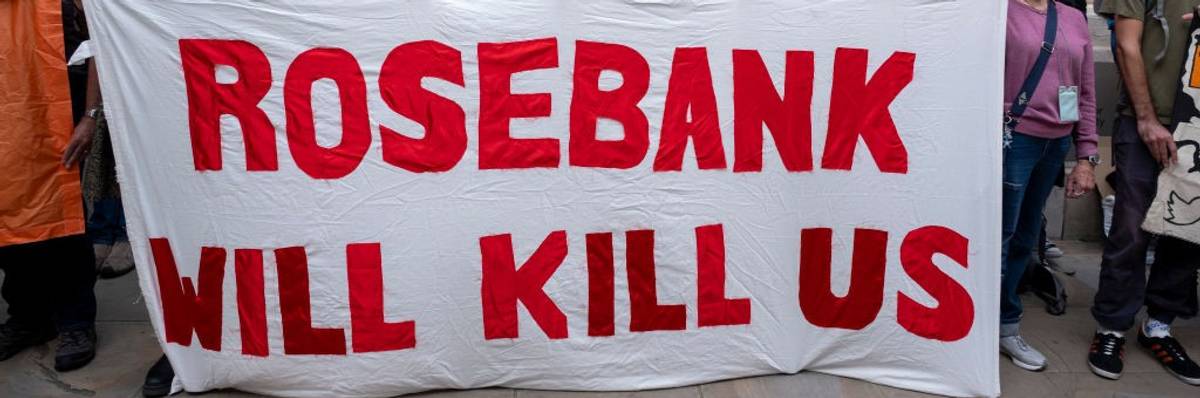
Protesters demonstrate against the Rosebank North Sea offshore oil project operated by Equinor which has been given the go-ahead and consent for drilling granted by the British government amidst huge concern over the continued use of fossil fuels on September, 27, 2023 in London, United Kingdom.
There is no doubt that with this decision, the U.K. government is siding with oil and gas giants over a liveable future for all.
Timing, they say, is everything. Yesterday, the world’s energy watchdog, the International Energy Agency (IEA), published its latest report, the 2023 Net Zero Roadmap.
The IEA categorically stated that the time for no new oil and gas was over. If we are to keep temperatures to 1.5°C, then world leaders must not develop new oil, gas, or coal beyond existing fields.
If we want a liveable planet, we must shift from fossil fuels to renewables.
This is not the first time, either, that the IEA has confirmed that no new oil, gas, or coal fields are compatible with limiting global temperature rise to 1.5ºC.
It is also clear that Rosebank won’t do anything to lower energy bills in the U.K. or make the U.K.’s energy supply safer, despite how the government tries to spin it.
“Keeping alive the goal of limiting global warming to 1.5 °C requires the world to come together quickly. The good news is we know what we need to do–and how to do it,” said IEA Executive Director, Fatih Birol at the launch of the report. The IEA reiterated the way to do it is not to approve new oil and gas fields.
The IEA are not the only ones saying this. Earlier this year, the U.N. Secretary General, António Guterres, called on governments to halt new oil and gas exploration licences.
But even stopping new licenses may not be enough. Oil Change International’s latest research shows that even beyond stopping oil and gas expansion, 60% of fossil fuels in existing fields must stay in the ground to limit global temperature rise to 1.5°C.
Speaking in response to yesterday’s IEA’s report, my colleague, Kelly Trout, said: “This report reaffirms a stark truth: To limit global temperature rise as agreed upon internationally, there’s no room for new oil, gas, or coal fields. The time for a swift, equitable, and fully funded phase-out of fossil fuels is now, with rich countries moving first and fastest and paying their fair share to finance a global just transition.”
Barely is the ink dry on the IEA’s report, and yet Wednesday, the U.K. government gave the go-ahead to the huge Rosebank oil field, which is seen as the U.K.’s last untapped oil field.
Rosebank is some 80 miles off the West of the Shetland Isles, located off Scotland. The field could contain 500 million barrels of oil and could produce 69,000 barrels of oil a day at its peak and about 44 million cubic feet of gas per day in its first 10 years.
The field is going to be developed by the Norwegian company Equinor and British firm Ithaca Energy.
For months, opposition to the project has grown, including 200 organisations and celebrities, 40 MEPs and MPs from every major political party. Just last month, 50 MPs and others from all major British political parties raised concerns. They wrote to then Energy Secretary Grant Shapps urging him to block Rosebank. All their concerns were ignored.
There is no doubt that with this decision, the U.K. government is siding with oil and gas giants over a liveable future for all—whether that’s a habitable planet or not having to choose between heating and eating. The project will emit more carbon dioxide than the combined emissions of some 28 countries of the Global South.
It is also clear that Rosebank won’t do anything to lower energy bills in the U.K. or make the U.K.’s energy supply safer, despite how the government tries to spin it. In contrast, it will make millions for Equinor, and Ithaca, whose shares rose sharply this morning.
It is unsurprising that the decision was met with universal outrage from scientists, activists, and politicians. The Green Party MP Caroline Lucas called it “the greatest act of environmental vandalism in my lifetime.”
Philip Evans, a Greenpeace U.K. climate campaigner, told The Guardian, “Rishi Sunak has proven once and for all that he puts the profits of oil companies above everyday people. We know that relying on fossil fuels is terrible for our energy security, the cost of living, and the climate.”
Simon Francis, the coordinator of the End Fuel Poverty Coalition, added: “Households struggling with their energy bills will be shocked that the new Energy Secretary has chosen to hand a multi-billion pound tax break to this Norwegian firm, rather than help people in the U.K. suffering in fuel poverty.”
Dr Paul Balcombe, from Queen Mary University of London, said, “Signalling the expansion of North Sea oil and gas won’t make energy cheaper for us and will make it more difficult to transition to net zero.”
Others took to X, formally known as Twitter, to express outrage and shock, many pointing out the deep irony of the timing.
The U.K. government’s announcement comes after a number of anti-green announcements by the U.K. prime minister, including pushing back the deadline for selling new petrol and diesel cars, the phasing out of gas boilers, and the scrapping of the Energy Efficiency TaskForce.
Jess Ralston, from the Energy and Climate Intelligence Unit, said it is clear now that “the prime minister has shown that he’d instead give tax breaks to oil companies than lower energy bills. Taxpayers will fork out around £4bn to the developers of the oil field, money that could have insulated millions of homes, with many set to be colder and poorer this winter.”
Even for some Conservatives it has gone too far, with Sir Alok Sharma, who headed the COP26 talks in Scotland for the government, now saying he will no longer stand for reelection at the next General Election.
The Rosebank go-ahead confirms the U.K.’s stance as a leading Planet Wrecker. According to a recent OCI analysis, the U.K. is among five global north countries posed to be responsible for the majority of new oil and gas extraction to 2050.
It is no wonder that my colleague Silje Ask Lundberg, the North Sea Program Manager at OCI, said: “The science could not be more clear: There is no room for a single drop of oil from new fields… The fact that the U.K. government has approved the biggest undeveloped field in the U.K., and coming just one week after the government’s weakening of its net zero policies, is proof positive it is siding with oil and gas giants over a liveable future for all.”
Meanwhile, Rosebank will not happen without a huge fight from civil society groups:
Dear Common Dreams reader, It’s been nearly 30 years since I co-founded Common Dreams with my late wife, Lina Newhouser. We had the radical notion that journalism should serve the public good, not corporate profits. It was clear to us from the outset what it would take to build such a project. No paid advertisements. No corporate sponsors. No millionaire publisher telling us what to think or do. Many people said we wouldn't last a year, but we proved those doubters wrong. Together with a tremendous team of journalists and dedicated staff, we built an independent media outlet free from the constraints of profits and corporate control. Our mission has always been simple: To inform. To inspire. To ignite change for the common good. Building Common Dreams was not easy. Our survival was never guaranteed. When you take on the most powerful forces—Wall Street greed, fossil fuel industry destruction, Big Tech lobbyists, and uber-rich oligarchs who have spent billions upon billions rigging the economy and democracy in their favor—the only bulwark you have is supporters who believe in your work. But here’s the urgent message from me today. It's never been this bad out there. And it's never been this hard to keep us going. At the very moment Common Dreams is most needed, the threats we face are intensifying. We need your support now more than ever. We don't accept corporate advertising and never will. We don't have a paywall because we don't think people should be blocked from critical news based on their ability to pay. Everything we do is funded by the donations of readers like you. When everyone does the little they can afford, we are strong. But if that support retreats or dries up, so do we. Will you donate now to make sure Common Dreams not only survives but thrives? —Craig Brown, Co-founder |
Timing, they say, is everything. Yesterday, the world’s energy watchdog, the International Energy Agency (IEA), published its latest report, the 2023 Net Zero Roadmap.
The IEA categorically stated that the time for no new oil and gas was over. If we are to keep temperatures to 1.5°C, then world leaders must not develop new oil, gas, or coal beyond existing fields.
If we want a liveable planet, we must shift from fossil fuels to renewables.
This is not the first time, either, that the IEA has confirmed that no new oil, gas, or coal fields are compatible with limiting global temperature rise to 1.5ºC.
It is also clear that Rosebank won’t do anything to lower energy bills in the U.K. or make the U.K.’s energy supply safer, despite how the government tries to spin it.
“Keeping alive the goal of limiting global warming to 1.5 °C requires the world to come together quickly. The good news is we know what we need to do–and how to do it,” said IEA Executive Director, Fatih Birol at the launch of the report. The IEA reiterated the way to do it is not to approve new oil and gas fields.
The IEA are not the only ones saying this. Earlier this year, the U.N. Secretary General, António Guterres, called on governments to halt new oil and gas exploration licences.
But even stopping new licenses may not be enough. Oil Change International’s latest research shows that even beyond stopping oil and gas expansion, 60% of fossil fuels in existing fields must stay in the ground to limit global temperature rise to 1.5°C.
Speaking in response to yesterday’s IEA’s report, my colleague, Kelly Trout, said: “This report reaffirms a stark truth: To limit global temperature rise as agreed upon internationally, there’s no room for new oil, gas, or coal fields. The time for a swift, equitable, and fully funded phase-out of fossil fuels is now, with rich countries moving first and fastest and paying their fair share to finance a global just transition.”
Barely is the ink dry on the IEA’s report, and yet Wednesday, the U.K. government gave the go-ahead to the huge Rosebank oil field, which is seen as the U.K.’s last untapped oil field.
Rosebank is some 80 miles off the West of the Shetland Isles, located off Scotland. The field could contain 500 million barrels of oil and could produce 69,000 barrels of oil a day at its peak and about 44 million cubic feet of gas per day in its first 10 years.
The field is going to be developed by the Norwegian company Equinor and British firm Ithaca Energy.
For months, opposition to the project has grown, including 200 organisations and celebrities, 40 MEPs and MPs from every major political party. Just last month, 50 MPs and others from all major British political parties raised concerns. They wrote to then Energy Secretary Grant Shapps urging him to block Rosebank. All their concerns were ignored.
There is no doubt that with this decision, the U.K. government is siding with oil and gas giants over a liveable future for all—whether that’s a habitable planet or not having to choose between heating and eating. The project will emit more carbon dioxide than the combined emissions of some 28 countries of the Global South.
It is also clear that Rosebank won’t do anything to lower energy bills in the U.K. or make the U.K.’s energy supply safer, despite how the government tries to spin it. In contrast, it will make millions for Equinor, and Ithaca, whose shares rose sharply this morning.
It is unsurprising that the decision was met with universal outrage from scientists, activists, and politicians. The Green Party MP Caroline Lucas called it “the greatest act of environmental vandalism in my lifetime.”
Philip Evans, a Greenpeace U.K. climate campaigner, told The Guardian, “Rishi Sunak has proven once and for all that he puts the profits of oil companies above everyday people. We know that relying on fossil fuels is terrible for our energy security, the cost of living, and the climate.”
Simon Francis, the coordinator of the End Fuel Poverty Coalition, added: “Households struggling with their energy bills will be shocked that the new Energy Secretary has chosen to hand a multi-billion pound tax break to this Norwegian firm, rather than help people in the U.K. suffering in fuel poverty.”
Dr Paul Balcombe, from Queen Mary University of London, said, “Signalling the expansion of North Sea oil and gas won’t make energy cheaper for us and will make it more difficult to transition to net zero.”
Others took to X, formally known as Twitter, to express outrage and shock, many pointing out the deep irony of the timing.
The U.K. government’s announcement comes after a number of anti-green announcements by the U.K. prime minister, including pushing back the deadline for selling new petrol and diesel cars, the phasing out of gas boilers, and the scrapping of the Energy Efficiency TaskForce.
Jess Ralston, from the Energy and Climate Intelligence Unit, said it is clear now that “the prime minister has shown that he’d instead give tax breaks to oil companies than lower energy bills. Taxpayers will fork out around £4bn to the developers of the oil field, money that could have insulated millions of homes, with many set to be colder and poorer this winter.”
Even for some Conservatives it has gone too far, with Sir Alok Sharma, who headed the COP26 talks in Scotland for the government, now saying he will no longer stand for reelection at the next General Election.
The Rosebank go-ahead confirms the U.K.’s stance as a leading Planet Wrecker. According to a recent OCI analysis, the U.K. is among five global north countries posed to be responsible for the majority of new oil and gas extraction to 2050.
It is no wonder that my colleague Silje Ask Lundberg, the North Sea Program Manager at OCI, said: “The science could not be more clear: There is no room for a single drop of oil from new fields… The fact that the U.K. government has approved the biggest undeveloped field in the U.K., and coming just one week after the government’s weakening of its net zero policies, is proof positive it is siding with oil and gas giants over a liveable future for all.”
Meanwhile, Rosebank will not happen without a huge fight from civil society groups:
Timing, they say, is everything. Yesterday, the world’s energy watchdog, the International Energy Agency (IEA), published its latest report, the 2023 Net Zero Roadmap.
The IEA categorically stated that the time for no new oil and gas was over. If we are to keep temperatures to 1.5°C, then world leaders must not develop new oil, gas, or coal beyond existing fields.
If we want a liveable planet, we must shift from fossil fuels to renewables.
This is not the first time, either, that the IEA has confirmed that no new oil, gas, or coal fields are compatible with limiting global temperature rise to 1.5ºC.
It is also clear that Rosebank won’t do anything to lower energy bills in the U.K. or make the U.K.’s energy supply safer, despite how the government tries to spin it.
“Keeping alive the goal of limiting global warming to 1.5 °C requires the world to come together quickly. The good news is we know what we need to do–and how to do it,” said IEA Executive Director, Fatih Birol at the launch of the report. The IEA reiterated the way to do it is not to approve new oil and gas fields.
The IEA are not the only ones saying this. Earlier this year, the U.N. Secretary General, António Guterres, called on governments to halt new oil and gas exploration licences.
But even stopping new licenses may not be enough. Oil Change International’s latest research shows that even beyond stopping oil and gas expansion, 60% of fossil fuels in existing fields must stay in the ground to limit global temperature rise to 1.5°C.
Speaking in response to yesterday’s IEA’s report, my colleague, Kelly Trout, said: “This report reaffirms a stark truth: To limit global temperature rise as agreed upon internationally, there’s no room for new oil, gas, or coal fields. The time for a swift, equitable, and fully funded phase-out of fossil fuels is now, with rich countries moving first and fastest and paying their fair share to finance a global just transition.”
Barely is the ink dry on the IEA’s report, and yet Wednesday, the U.K. government gave the go-ahead to the huge Rosebank oil field, which is seen as the U.K.’s last untapped oil field.
Rosebank is some 80 miles off the West of the Shetland Isles, located off Scotland. The field could contain 500 million barrels of oil and could produce 69,000 barrels of oil a day at its peak and about 44 million cubic feet of gas per day in its first 10 years.
The field is going to be developed by the Norwegian company Equinor and British firm Ithaca Energy.
For months, opposition to the project has grown, including 200 organisations and celebrities, 40 MEPs and MPs from every major political party. Just last month, 50 MPs and others from all major British political parties raised concerns. They wrote to then Energy Secretary Grant Shapps urging him to block Rosebank. All their concerns were ignored.
There is no doubt that with this decision, the U.K. government is siding with oil and gas giants over a liveable future for all—whether that’s a habitable planet or not having to choose between heating and eating. The project will emit more carbon dioxide than the combined emissions of some 28 countries of the Global South.
It is also clear that Rosebank won’t do anything to lower energy bills in the U.K. or make the U.K.’s energy supply safer, despite how the government tries to spin it. In contrast, it will make millions for Equinor, and Ithaca, whose shares rose sharply this morning.
It is unsurprising that the decision was met with universal outrage from scientists, activists, and politicians. The Green Party MP Caroline Lucas called it “the greatest act of environmental vandalism in my lifetime.”
Philip Evans, a Greenpeace U.K. climate campaigner, told The Guardian, “Rishi Sunak has proven once and for all that he puts the profits of oil companies above everyday people. We know that relying on fossil fuels is terrible for our energy security, the cost of living, and the climate.”
Simon Francis, the coordinator of the End Fuel Poverty Coalition, added: “Households struggling with their energy bills will be shocked that the new Energy Secretary has chosen to hand a multi-billion pound tax break to this Norwegian firm, rather than help people in the U.K. suffering in fuel poverty.”
Dr Paul Balcombe, from Queen Mary University of London, said, “Signalling the expansion of North Sea oil and gas won’t make energy cheaper for us and will make it more difficult to transition to net zero.”
Others took to X, formally known as Twitter, to express outrage and shock, many pointing out the deep irony of the timing.
The U.K. government’s announcement comes after a number of anti-green announcements by the U.K. prime minister, including pushing back the deadline for selling new petrol and diesel cars, the phasing out of gas boilers, and the scrapping of the Energy Efficiency TaskForce.
Jess Ralston, from the Energy and Climate Intelligence Unit, said it is clear now that “the prime minister has shown that he’d instead give tax breaks to oil companies than lower energy bills. Taxpayers will fork out around £4bn to the developers of the oil field, money that could have insulated millions of homes, with many set to be colder and poorer this winter.”
Even for some Conservatives it has gone too far, with Sir Alok Sharma, who headed the COP26 talks in Scotland for the government, now saying he will no longer stand for reelection at the next General Election.
The Rosebank go-ahead confirms the U.K.’s stance as a leading Planet Wrecker. According to a recent OCI analysis, the U.K. is among five global north countries posed to be responsible for the majority of new oil and gas extraction to 2050.
It is no wonder that my colleague Silje Ask Lundberg, the North Sea Program Manager at OCI, said: “The science could not be more clear: There is no room for a single drop of oil from new fields… The fact that the U.K. government has approved the biggest undeveloped field in the U.K., and coming just one week after the government’s weakening of its net zero policies, is proof positive it is siding with oil and gas giants over a liveable future for all.”
Meanwhile, Rosebank will not happen without a huge fight from civil society groups: