SUBSCRIBE TO OUR FREE NEWSLETTER
Daily news & progressive opinion—funded by the people, not the corporations—delivered straight to your inbox.
5
#000000
#FFFFFF
To donate by check, phone, or other method, see our More Ways to Give page.
Daily news & progressive opinion—funded by the people, not the corporations—delivered straight to your inbox.
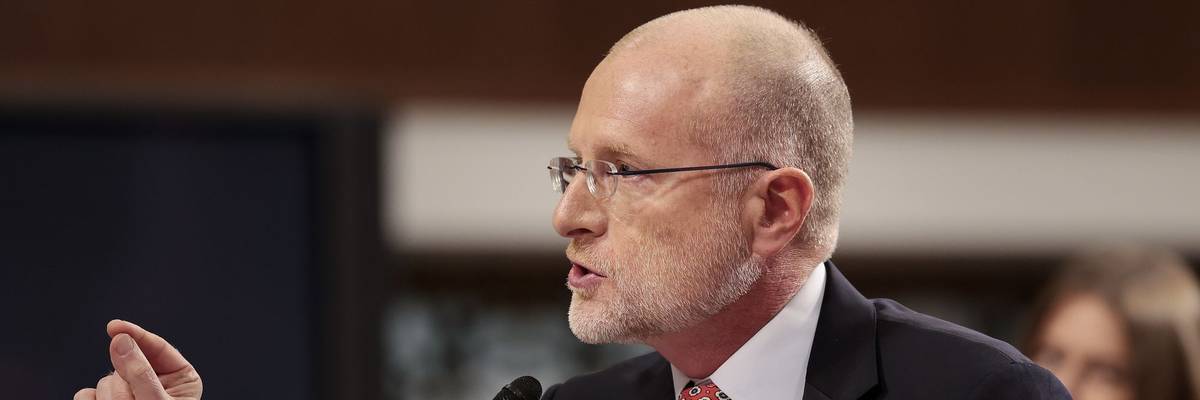
Brendan Carr, commissioner of the Federal Communications Commission, speaks at the Senate Commerce, Science, and Transportation Committee oversight hearing in the US Capitol Building on December 17, 2025 in Washington, DC.
"We don't need Middle East dictators to control American media."
US Sen. Bernie Sanders on Friday joined a growing chorus of critics angered by the Federal Communications Commission's approval of foreign investment in the company that would be created if Paramount Skydance and Warner Bros. Discovery are allowed to merge.
Led by Chair Brendan Carr, an appointee of President Donald Trump, the FCC on Thursday approved Paramount's petition to allow foreign investors to hold over 25% of ownership. The commission concluded it would be in the "public interest" to greenlight a plan for 49.5% foreign ownership, including 38.5% from investment funds based in Qatar, Saudi Arabia, and the United Arab Emirates (UAE).
"Trump's FCC just approved Trump pal David Ellison's deal to allow Saudi Arabia, Qatar, and the UAE to own nearly 50% of a merged Paramount-Warner Bros," Sanders (I-Vt.) wrote on social media Friday, referring to Paramount's chair and CEO—and the son of billionaire Republican megadonor Larry Ellison.
The merged company would include CBS, CNN, HBO, the Discovery Channel, BET, Fandango, MTV, Nickelodeon, Paramount, PlutoTV, Showtime, TBS, The CW, TNT, Warner Bros., and more, the senator noted. He added: "Outrageous: We don't need Middle East dictators to control American media."
Anna Gomez, the sole Democratic commissioner, was similarly critical: "The FCC just let some of the most repressive governments in the world indirectly control nearly all of a combined Paramount-Warner Bros. An investment this large in one of America's biggest media companies doesn't just buy equity, it secures influence over what gets said and made."
"That's why I called for this new and novel issue to go to a full commission vote given what's at stake," she noted. "Instead, the FCC snuck this ruling out as a staff-level decision, with no public vote and no accountability for a call of this magnitude."
Welcoming Gomez's comments, Michael Sozan pointed to his and Andrew Miller's June article for the Center for American Progress highlighting that "the three Middle Eastern authoritarian regimes have deep financial relationships with Trump and his family, and... long records of human rights abuses and engage in media censorship."
"These autocracies could leverage Paramount's news outlets and other media properties to advance their own interests at the expense of the United States' national security and foundational rights, including press freedoms," the pair warned. "Given these factors, these foreign ownership levels are another reason why regulators must rigorously review this merger and take all lawful actions to block it."
As the Los Angeles Times reported:
Several groups, including the 1st Amendment nonprofit Free Press, asked the FCC to consider additional safeguards to shield the news organizations—CNN and CBS—from foreign control. One suggestion was to spin off CBS and CNN into a subsidiary that would be wholly owned by Americans.
Paramount and the FCC were dismissive, arguing "the concerns raised in the record... are speculative and unsupported," according to the FCC ruling.
While a Paramount spokesperson welcomed the FCC's decision not to block the plan—and pointed out that "when the proposed transaction with Warner Bros. Discovery closes, the Ellison family and RedBird will collectively hold the largest equity stake in the combined company and 100% of the voting shares, with no other equity participant having any governance rights"—fresh outrage mounted over the already widely criticized $111 billion merger.
Lee Hepner, an antitrust lawyer and senior legal counsel for the American Economic Liberties Project, addressed the questions: "But it's just indirect equity interests, right? What about the condition that the Saudis, UAE, and Qatar cannot interfere with or even comment on any decisions related to content?"
As he explained: "The only way that firewall is conceivably enforceable is if the FCC assigns an independent monitor to sit in on every meeting, taps every burner phone, and is invited to every Signal chat between any representative of Paramount and its new financial backers. The point is not that that should happen, but that this condition is patently unenforceable. Which is all to say, the FCC just approved the sale of a crown jewel of the entertainment and media industry to foreign interests that relish in exercising economic, political, and regional military leverage over the United States. All based on a pinky promise."
"The reality is that ownership alone, even of nonvoting, indirect equity interests, creates its own financial leverage and influence," he warned. "To the extent Paramount's new owners are prohibited from exercising influence, it's patently paradoxical. Paramount won't approve anything that risks losing half of its financial backing, including criticizing a regime that not too long ago ordered the execution of a Washington Post columnist, Jamal Khashoggi, who became an international figurehead for politically persecuted journalists."
"Does anyone think CBS' new leadership has the will, much less fortitude, to prioritize truth over financial ruin?" he added. "If this all sounds like a total mess, that's because it is. And it only becomes doubly worse if Paramount acquires Warner Bros.-Discovery."
Due to legal pushback from state attorneys general and unions, the merger—which some opponents have condemned as an "existential" threat—is on hold until the outcome of a trial scheduled to begin in March.
Dear Common Dreams reader, It’s been nearly 30 years since I co-founded Common Dreams with my late wife, Lina Newhouser. We had the radical notion that journalism should serve the public good, not corporate profits. It was clear to us from the outset what it would take to build such a project. No paid advertisements. No corporate sponsors. No millionaire publisher telling us what to think or do. Many people said we wouldn't last a year, but we proved those doubters wrong. Together with a tremendous team of journalists and dedicated staff, we built an independent media outlet free from the constraints of profits and corporate control. Our mission has always been simple: To inform. To inspire. To ignite change for the common good. Building Common Dreams was not easy. Our survival was never guaranteed. When you take on the most powerful forces—Wall Street greed, fossil fuel industry destruction, Big Tech lobbyists, and uber-rich oligarchs who have spent billions upon billions rigging the economy and democracy in their favor—the only bulwark you have is supporters who believe in your work. But here’s the urgent message from me today. It's never been this bad out there. And it's never been this hard to keep us going. At the very moment Common Dreams is most needed, the threats we face are intensifying. We need your support now more than ever. We don't accept corporate advertising and never will. We don't have a paywall because we don't think people should be blocked from critical news based on their ability to pay. Everything we do is funded by the donations of readers like you. When everyone does the little they can afford, we are strong. But if that support retreats or dries up, so do we. Will you donate now to make sure Common Dreams not only survives but thrives? —Craig Brown, Co-founder |
US Sen. Bernie Sanders on Friday joined a growing chorus of critics angered by the Federal Communications Commission's approval of foreign investment in the company that would be created if Paramount Skydance and Warner Bros. Discovery are allowed to merge.
Led by Chair Brendan Carr, an appointee of President Donald Trump, the FCC on Thursday approved Paramount's petition to allow foreign investors to hold over 25% of ownership. The commission concluded it would be in the "public interest" to greenlight a plan for 49.5% foreign ownership, including 38.5% from investment funds based in Qatar, Saudi Arabia, and the United Arab Emirates (UAE).
"Trump's FCC just approved Trump pal David Ellison's deal to allow Saudi Arabia, Qatar, and the UAE to own nearly 50% of a merged Paramount-Warner Bros," Sanders (I-Vt.) wrote on social media Friday, referring to Paramount's chair and CEO—and the son of billionaire Republican megadonor Larry Ellison.
The merged company would include CBS, CNN, HBO, the Discovery Channel, BET, Fandango, MTV, Nickelodeon, Paramount, PlutoTV, Showtime, TBS, The CW, TNT, Warner Bros., and more, the senator noted. He added: "Outrageous: We don't need Middle East dictators to control American media."
Anna Gomez, the sole Democratic commissioner, was similarly critical: "The FCC just let some of the most repressive governments in the world indirectly control nearly all of a combined Paramount-Warner Bros. An investment this large in one of America's biggest media companies doesn't just buy equity, it secures influence over what gets said and made."
"That's why I called for this new and novel issue to go to a full commission vote given what's at stake," she noted. "Instead, the FCC snuck this ruling out as a staff-level decision, with no public vote and no accountability for a call of this magnitude."
Welcoming Gomez's comments, Michael Sozan pointed to his and Andrew Miller's June article for the Center for American Progress highlighting that "the three Middle Eastern authoritarian regimes have deep financial relationships with Trump and his family, and... long records of human rights abuses and engage in media censorship."
"These autocracies could leverage Paramount's news outlets and other media properties to advance their own interests at the expense of the United States' national security and foundational rights, including press freedoms," the pair warned. "Given these factors, these foreign ownership levels are another reason why regulators must rigorously review this merger and take all lawful actions to block it."
As the Los Angeles Times reported:
Several groups, including the 1st Amendment nonprofit Free Press, asked the FCC to consider additional safeguards to shield the news organizations—CNN and CBS—from foreign control. One suggestion was to spin off CBS and CNN into a subsidiary that would be wholly owned by Americans.
Paramount and the FCC were dismissive, arguing "the concerns raised in the record... are speculative and unsupported," according to the FCC ruling.
While a Paramount spokesperson welcomed the FCC's decision not to block the plan—and pointed out that "when the proposed transaction with Warner Bros. Discovery closes, the Ellison family and RedBird will collectively hold the largest equity stake in the combined company and 100% of the voting shares, with no other equity participant having any governance rights"—fresh outrage mounted over the already widely criticized $111 billion merger.
Lee Hepner, an antitrust lawyer and senior legal counsel for the American Economic Liberties Project, addressed the questions: "But it's just indirect equity interests, right? What about the condition that the Saudis, UAE, and Qatar cannot interfere with or even comment on any decisions related to content?"
As he explained: "The only way that firewall is conceivably enforceable is if the FCC assigns an independent monitor to sit in on every meeting, taps every burner phone, and is invited to every Signal chat between any representative of Paramount and its new financial backers. The point is not that that should happen, but that this condition is patently unenforceable. Which is all to say, the FCC just approved the sale of a crown jewel of the entertainment and media industry to foreign interests that relish in exercising economic, political, and regional military leverage over the United States. All based on a pinky promise."
"The reality is that ownership alone, even of nonvoting, indirect equity interests, creates its own financial leverage and influence," he warned. "To the extent Paramount's new owners are prohibited from exercising influence, it's patently paradoxical. Paramount won't approve anything that risks losing half of its financial backing, including criticizing a regime that not too long ago ordered the execution of a Washington Post columnist, Jamal Khashoggi, who became an international figurehead for politically persecuted journalists."
"Does anyone think CBS' new leadership has the will, much less fortitude, to prioritize truth over financial ruin?" he added. "If this all sounds like a total mess, that's because it is. And it only becomes doubly worse if Paramount acquires Warner Bros.-Discovery."
Due to legal pushback from state attorneys general and unions, the merger—which some opponents have condemned as an "existential" threat—is on hold until the outcome of a trial scheduled to begin in March.
US Sen. Bernie Sanders on Friday joined a growing chorus of critics angered by the Federal Communications Commission's approval of foreign investment in the company that would be created if Paramount Skydance and Warner Bros. Discovery are allowed to merge.
Led by Chair Brendan Carr, an appointee of President Donald Trump, the FCC on Thursday approved Paramount's petition to allow foreign investors to hold over 25% of ownership. The commission concluded it would be in the "public interest" to greenlight a plan for 49.5% foreign ownership, including 38.5% from investment funds based in Qatar, Saudi Arabia, and the United Arab Emirates (UAE).
"Trump's FCC just approved Trump pal David Ellison's deal to allow Saudi Arabia, Qatar, and the UAE to own nearly 50% of a merged Paramount-Warner Bros," Sanders (I-Vt.) wrote on social media Friday, referring to Paramount's chair and CEO—and the son of billionaire Republican megadonor Larry Ellison.
The merged company would include CBS, CNN, HBO, the Discovery Channel, BET, Fandango, MTV, Nickelodeon, Paramount, PlutoTV, Showtime, TBS, The CW, TNT, Warner Bros., and more, the senator noted. He added: "Outrageous: We don't need Middle East dictators to control American media."
Anna Gomez, the sole Democratic commissioner, was similarly critical: "The FCC just let some of the most repressive governments in the world indirectly control nearly all of a combined Paramount-Warner Bros. An investment this large in one of America's biggest media companies doesn't just buy equity, it secures influence over what gets said and made."
"That's why I called for this new and novel issue to go to a full commission vote given what's at stake," she noted. "Instead, the FCC snuck this ruling out as a staff-level decision, with no public vote and no accountability for a call of this magnitude."
Welcoming Gomez's comments, Michael Sozan pointed to his and Andrew Miller's June article for the Center for American Progress highlighting that "the three Middle Eastern authoritarian regimes have deep financial relationships with Trump and his family, and... long records of human rights abuses and engage in media censorship."
"These autocracies could leverage Paramount's news outlets and other media properties to advance their own interests at the expense of the United States' national security and foundational rights, including press freedoms," the pair warned. "Given these factors, these foreign ownership levels are another reason why regulators must rigorously review this merger and take all lawful actions to block it."
As the Los Angeles Times reported:
Several groups, including the 1st Amendment nonprofit Free Press, asked the FCC to consider additional safeguards to shield the news organizations—CNN and CBS—from foreign control. One suggestion was to spin off CBS and CNN into a subsidiary that would be wholly owned by Americans.
Paramount and the FCC were dismissive, arguing "the concerns raised in the record... are speculative and unsupported," according to the FCC ruling.
While a Paramount spokesperson welcomed the FCC's decision not to block the plan—and pointed out that "when the proposed transaction with Warner Bros. Discovery closes, the Ellison family and RedBird will collectively hold the largest equity stake in the combined company and 100% of the voting shares, with no other equity participant having any governance rights"—fresh outrage mounted over the already widely criticized $111 billion merger.
Lee Hepner, an antitrust lawyer and senior legal counsel for the American Economic Liberties Project, addressed the questions: "But it's just indirect equity interests, right? What about the condition that the Saudis, UAE, and Qatar cannot interfere with or even comment on any decisions related to content?"
As he explained: "The only way that firewall is conceivably enforceable is if the FCC assigns an independent monitor to sit in on every meeting, taps every burner phone, and is invited to every Signal chat between any representative of Paramount and its new financial backers. The point is not that that should happen, but that this condition is patently unenforceable. Which is all to say, the FCC just approved the sale of a crown jewel of the entertainment and media industry to foreign interests that relish in exercising economic, political, and regional military leverage over the United States. All based on a pinky promise."
"The reality is that ownership alone, even of nonvoting, indirect equity interests, creates its own financial leverage and influence," he warned. "To the extent Paramount's new owners are prohibited from exercising influence, it's patently paradoxical. Paramount won't approve anything that risks losing half of its financial backing, including criticizing a regime that not too long ago ordered the execution of a Washington Post columnist, Jamal Khashoggi, who became an international figurehead for politically persecuted journalists."
"Does anyone think CBS' new leadership has the will, much less fortitude, to prioritize truth over financial ruin?" he added. "If this all sounds like a total mess, that's because it is. And it only becomes doubly worse if Paramount acquires Warner Bros.-Discovery."
Due to legal pushback from state attorneys general and unions, the merger—which some opponents have condemned as an "existential" threat—is on hold until the outcome of a trial scheduled to begin in March.