5
#000000
#FFFFFF
To donate by check, phone, or other method, see our More Ways to Give page.
Daily news & progressive opinion—funded by the people, not the corporations—delivered straight to your inbox.
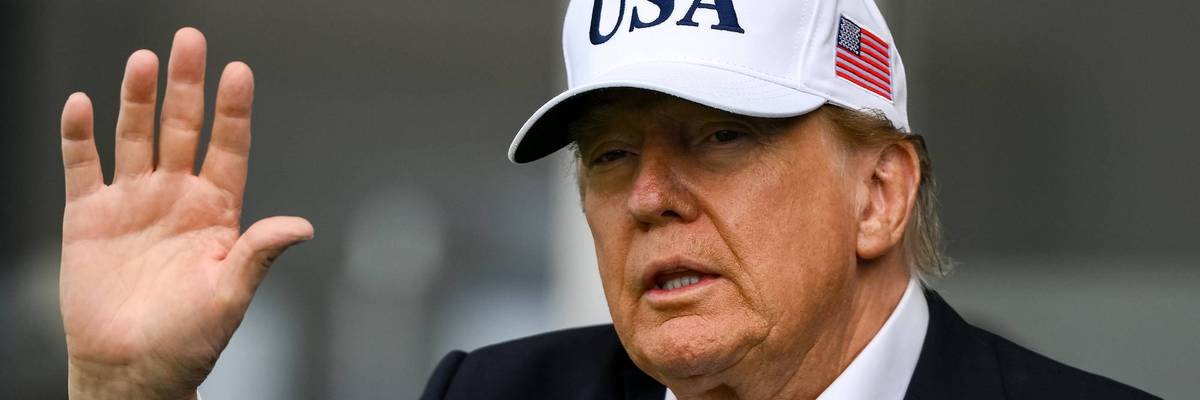
US President Donald Trump during day four of the Amgen Irish Open Golf Championship 2026 at Trump International Golf Links in Doonbeg, Clare.
"Canada exports more potash to the US than Belarus produces."
President Donald Trump drew ridicule on Monday when he announced he was working on an agreement to import potash, an important fertilizer for US farmers, from Belarus.
In a social media post, Trump claimed that the "massive deal" with Belarus would let the US import potash for "substantially less than we are currently paying to Canada," which he described as "very good news for our Farmers and Ranchers."
Canada supplies roughly 80% of all potash used by US farmers, and Trump's trade war against America's largest trading partner has been putting upward pressure the prices of all Canadian imports.
However, even if Trump's deal to buy potash from Belarus comes to fruition, it is unclear how much relief it would provide to US farmers, who have been also been paying a heavy price his illegal war with Iran, which has led to record-high diesel fuel prices.
As noted by a Monday report from Bloomberg, Belarus in 2021 only shipped around 700,000 tons of potassium fertilizers to the US before trade with the nation was restricted following Russia's invasion of Ukraine. Canada, meanwhile, supplied the US with more than 10 million tons of such fertilizers last year.
Bloomberg also pointed out that "Belarus doesn’t have enough capacity to supply large volumes to the US" at the moment "because production for the year is already under contract."
There are also several logistical challenges to shipping large quantities of fertilizer from Belarus.
Oil market researcher Rory Johnston observed in a social media post that Belarus is a landlocked country with no easy way to export its products to the west after Lithuania terminated its transit agreement with the country at the start of the Ukraine conflict.
Canada, Johnston added, is "right next door."
Journalist Diana Henriques offered a similar assessment of the challenges of importing potash from Belarus.
"It is 5,080 miles from Nebraska to Minsk," Henriques wrote. "It is about 700 miles from Nebraska to Saskatchewan, the source of most Canadian potash. That's gonna have to be one heckuva discount to cover the transportation differential."
Ross O'Connor, former foreign affairs and national security advisor to Canadian Prime Minister Stephen Harper, was openly dismissive of Trump's Belarus gambit.
"Good luck with that," O'Connor wrote. "Canada exports more potash to the US than Belarus produces."
David Ryan Miller, professor of government at American University, offered a satirical summary of Trump's latest geopolitical maneuver.
"We are spurning our longtime democratic ally directly to our north in favor of an autocratic regime aligned with [Russian President Vladimir] Putin that is 4,000+ miles away," Miller wrote. "We are very smart, serious people!"
Dear Common Dreams reader, It’s been nearly 30 years since I co-founded Common Dreams with my late wife, Lina Newhouser. We had the radical notion that journalism should serve the public good, not corporate profits. It was clear to us from the outset what it would take to build such a project. No paid advertisements. No corporate sponsors. No millionaire publisher telling us what to think or do. Many people said we wouldn't last a year, but we proved those doubters wrong. Together with a tremendous team of journalists and dedicated staff, we built an independent media outlet free from the constraints of profits and corporate control. Our mission has always been simple: To inform. To inspire. To ignite change for the common good. Building Common Dreams was not easy. Our survival was never guaranteed. When you take on the most powerful forces—Wall Street greed, fossil fuel industry destruction, Big Tech lobbyists, and uber-rich oligarchs who have spent billions upon billions rigging the economy and democracy in their favor—the only bulwark you have is supporters who believe in your work. But here’s the urgent message from me today. It's never been this bad out there. And it's never been this hard to keep us going. At the very moment Common Dreams is most needed, the threats we face are intensifying. We need your support now more than ever. We don't accept corporate advertising and never will. We don't have a paywall because we don't think people should be blocked from critical news based on their ability to pay. Everything we do is funded by the donations of readers like you. When everyone does the little they can afford, we are strong. But if that support retreats or dries up, so do we. Will you donate now to make sure Common Dreams not only survives but thrives? —Craig Brown, Co-founder |
President Donald Trump drew ridicule on Monday when he announced he was working on an agreement to import potash, an important fertilizer for US farmers, from Belarus.
In a social media post, Trump claimed that the "massive deal" with Belarus would let the US import potash for "substantially less than we are currently paying to Canada," which he described as "very good news for our Farmers and Ranchers."
Canada supplies roughly 80% of all potash used by US farmers, and Trump's trade war against America's largest trading partner has been putting upward pressure the prices of all Canadian imports.
However, even if Trump's deal to buy potash from Belarus comes to fruition, it is unclear how much relief it would provide to US farmers, who have been also been paying a heavy price his illegal war with Iran, which has led to record-high diesel fuel prices.
As noted by a Monday report from Bloomberg, Belarus in 2021 only shipped around 700,000 tons of potassium fertilizers to the US before trade with the nation was restricted following Russia's invasion of Ukraine. Canada, meanwhile, supplied the US with more than 10 million tons of such fertilizers last year.
Bloomberg also pointed out that "Belarus doesn’t have enough capacity to supply large volumes to the US" at the moment "because production for the year is already under contract."
There are also several logistical challenges to shipping large quantities of fertilizer from Belarus.
Oil market researcher Rory Johnston observed in a social media post that Belarus is a landlocked country with no easy way to export its products to the west after Lithuania terminated its transit agreement with the country at the start of the Ukraine conflict.
Canada, Johnston added, is "right next door."
Journalist Diana Henriques offered a similar assessment of the challenges of importing potash from Belarus.
"It is 5,080 miles from Nebraska to Minsk," Henriques wrote. "It is about 700 miles from Nebraska to Saskatchewan, the source of most Canadian potash. That's gonna have to be one heckuva discount to cover the transportation differential."
Ross O'Connor, former foreign affairs and national security advisor to Canadian Prime Minister Stephen Harper, was openly dismissive of Trump's Belarus gambit.
"Good luck with that," O'Connor wrote. "Canada exports more potash to the US than Belarus produces."
David Ryan Miller, professor of government at American University, offered a satirical summary of Trump's latest geopolitical maneuver.
"We are spurning our longtime democratic ally directly to our north in favor of an autocratic regime aligned with [Russian President Vladimir] Putin that is 4,000+ miles away," Miller wrote. "We are very smart, serious people!"
President Donald Trump drew ridicule on Monday when he announced he was working on an agreement to import potash, an important fertilizer for US farmers, from Belarus.
In a social media post, Trump claimed that the "massive deal" with Belarus would let the US import potash for "substantially less than we are currently paying to Canada," which he described as "very good news for our Farmers and Ranchers."
Canada supplies roughly 80% of all potash used by US farmers, and Trump's trade war against America's largest trading partner has been putting upward pressure the prices of all Canadian imports.
However, even if Trump's deal to buy potash from Belarus comes to fruition, it is unclear how much relief it would provide to US farmers, who have been also been paying a heavy price his illegal war with Iran, which has led to record-high diesel fuel prices.
As noted by a Monday report from Bloomberg, Belarus in 2021 only shipped around 700,000 tons of potassium fertilizers to the US before trade with the nation was restricted following Russia's invasion of Ukraine. Canada, meanwhile, supplied the US with more than 10 million tons of such fertilizers last year.
Bloomberg also pointed out that "Belarus doesn’t have enough capacity to supply large volumes to the US" at the moment "because production for the year is already under contract."
There are also several logistical challenges to shipping large quantities of fertilizer from Belarus.
Oil market researcher Rory Johnston observed in a social media post that Belarus is a landlocked country with no easy way to export its products to the west after Lithuania terminated its transit agreement with the country at the start of the Ukraine conflict.
Canada, Johnston added, is "right next door."
Journalist Diana Henriques offered a similar assessment of the challenges of importing potash from Belarus.
"It is 5,080 miles from Nebraska to Minsk," Henriques wrote. "It is about 700 miles from Nebraska to Saskatchewan, the source of most Canadian potash. That's gonna have to be one heckuva discount to cover the transportation differential."
Ross O'Connor, former foreign affairs and national security advisor to Canadian Prime Minister Stephen Harper, was openly dismissive of Trump's Belarus gambit.
"Good luck with that," O'Connor wrote. "Canada exports more potash to the US than Belarus produces."
David Ryan Miller, professor of government at American University, offered a satirical summary of Trump's latest geopolitical maneuver.
"We are spurning our longtime democratic ally directly to our north in favor of an autocratic regime aligned with [Russian President Vladimir] Putin that is 4,000+ miles away," Miller wrote. "We are very smart, serious people!"