
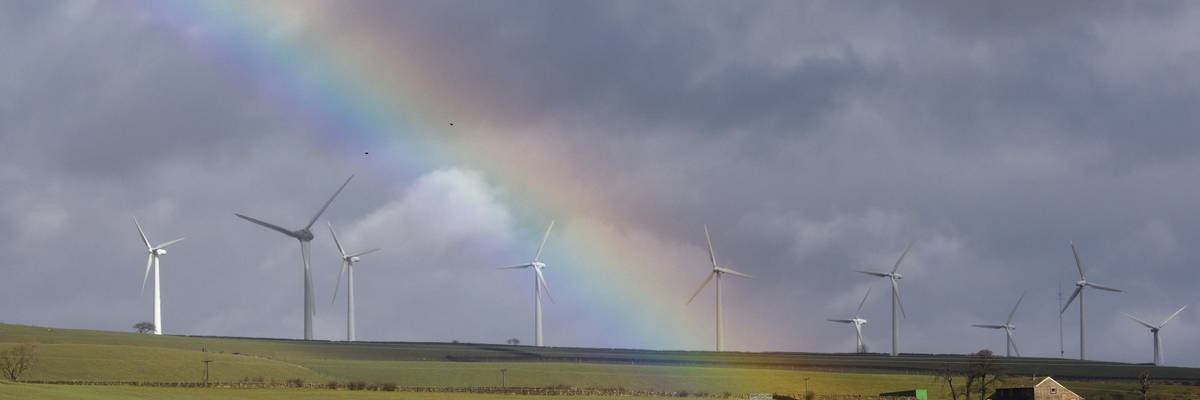
A rainbow illuminates the sky above a windfarm in Wortley, near Sheffield, northern England, on March 1, 2016.
UK Report Shows Promise of 100% Clean Energy—Without Nuclear Power—by 2050
"All public and enforced consumer spending on new nuclear power and carbon capture and storage should be scrapped and instead funding should be put into renewable energy, energy efficiency, and storage capacity," said one expert.
A best-case scenario in which the United Kingdom fully transitions to renewable energy with no nuclear generation would save more than £100 billion—over $124 billion—toward achieving net-zero by 2050 and produce 20% fewer carbon emissions, an analysis published this week concludes.
The report—entitled 100% Renewable Energy for the United Kingdom—was authored by Philipp Diesing, Dmitrii Bogdanov, Rasul Satymov, Michael Child, and Christian Breyer of LUT University in Lappeenranta, Finland. The publication compares a set of potential scenarios with the U.K. government's current net-zero pathway, which includes nuclear power and fossil fuel carbon capture and storage. The report was released ahead of a Saturday seminar hosted in London and online by 100% Renewable U.K.
"While the effects of the climate emergency can be observed more and more clearly through increasingly frequent extreme weather events and other climate change impacts, there is still a lack of dedicated countermeasures by decision-makers," a summary of the report states. "The government of the United Kingdom... has self-committed to climate neutrality in 2050, but without initiating the essential steps and without eliminating fossil fuel-based technologies and high-risk nuclear power."
"The U.K. does, however, benefit from the availability of renewable energy resources, namely onshore and offshore wind, which are considered the best in Europe," the publication continues. "Based on this background, this study presents several energy system transition pathways to 100% renewable energy in 2050 in high-spatial and temporal resolution, by describing the energy system of the U.K. in full detail from the starting point of today in five-year time steps until 2050."
The study's authors modeled four scenarios:
- The "Best Policy Scenario" (BPS) shows a 100% renewable energy system by 2050, with offshore wind as the main resource, limiting onshore wind and solar photovoltaics according to available land area;
- The "Inter-Annual Storage Scenario" adds to the BPS the required inter-annual storage needed to provide good levels of insurance against the possibilities of low-wind years;
- The "BPS Plus Scenario" tested the limits of higher land area availability for onshore wind and solar photovoltaics, and includes some renewable electricity-based e-fuel imports; and
- The "Current Policy Scenario" adopts the U.K. government's strategy for net-zero as published in 2020.
"The implications of this report are huge," he added. "All public and enforced consumer spending on new nuclear power and carbon capture and storage should be scrapped and instead funding should be put into renewable energy, energy efficiency, and storage capacity."
The new report comes as Extinction Rebellion U.K. and dozens of other groups prepare for a four-day demonstration in London beginning Friday to demand an end to new fossil fuel projects and citizens' assemblies to discuss solutions to the climate emergency.
It also comes as ministers in the Conservative government of U.K. Prime Minister Rishi Sunak are considering a revamp of the bidding process for new renewables projects in an effort to create more green jobs. Opportunities in the low-carbon job sector have shrunk significantly since then-U.K. Prime Minister David Cameron, also a Conservative, eliminated what he reportedly called "green crap" policies in 2012.
Like the United States and other nations, the U.K. continues to develop fossil fuel projects despite the climate emergency. Climate campaigners warn that the country's entire carbon budget could be blown on just one oil and gas project: Rosebank, the North Sea's largest undeveloped oilfield, has the estimated potential to produce half a billion total barrels of oil.
Earlier this week, Germany drew applause—and some criticism—from climate campaigners as its last three nuclear power plants were permanently shut down.
We are at a crossroads
This country and this world are at a monumental crossroads. In a few short weeks, US voters will have an opportunity to beat back the forces of fascism and confront the billionaires who are rigging the economy, our media system, and our democracy, making it increasingly impossible for ordinary people to get by. We’re not just talking about the election. We’re talking about what must be done once these fascist elements are vanquished from power. We need a bolder set of solutions than what either major party has so far been willing to offer and a working-class movement ready to fight like hell for it. Trump didn't emerge from nowhere. The conditions that fueled MAGA authoritarianism were created by decades of radical neoliberal economic policies and a corrupt political system dominated by corporate interests. They slashed taxes on the super-rich, promising that the benefits would trickle down. They said giveaways to the corporate titans would make life more affordable for the rest of us. It was all bullshit. And when a bitter, betrayed populace searches for someone to blame, right-wing demagogues have little trouble finding scapegoats. People know when they're being lied to, but you won't hear any of this from the corporate media. Only independent journalism—powered and funded by people who believe in building a better world—can deliver truly trustworthy daily news. Our Fall Campaign is underway, and we need your help. To power our newsroom through the rest of the year, we need to raise $125,000 by midnight on October 31. So if you share our vision, please contribute whatever you can to sustain our work. |
A best-case scenario in which the United Kingdom fully transitions to renewable energy with no nuclear generation would save more than £100 billion—over $124 billion—toward achieving net-zero by 2050 and produce 20% fewer carbon emissions, an analysis published this week concludes.
The report—entitled 100% Renewable Energy for the United Kingdom—was authored by Philipp Diesing, Dmitrii Bogdanov, Rasul Satymov, Michael Child, and Christian Breyer of LUT University in Lappeenranta, Finland. The publication compares a set of potential scenarios with the U.K. government's current net-zero pathway, which includes nuclear power and fossil fuel carbon capture and storage. The report was released ahead of a Saturday seminar hosted in London and online by 100% Renewable U.K.
"While the effects of the climate emergency can be observed more and more clearly through increasingly frequent extreme weather events and other climate change impacts, there is still a lack of dedicated countermeasures by decision-makers," a summary of the report states. "The government of the United Kingdom... has self-committed to climate neutrality in 2050, but without initiating the essential steps and without eliminating fossil fuel-based technologies and high-risk nuclear power."
"The U.K. does, however, benefit from the availability of renewable energy resources, namely onshore and offshore wind, which are considered the best in Europe," the publication continues. "Based on this background, this study presents several energy system transition pathways to 100% renewable energy in 2050 in high-spatial and temporal resolution, by describing the energy system of the U.K. in full detail from the starting point of today in five-year time steps until 2050."
The study's authors modeled four scenarios:
- The "Best Policy Scenario" (BPS) shows a 100% renewable energy system by 2050, with offshore wind as the main resource, limiting onshore wind and solar photovoltaics according to available land area;
- The "Inter-Annual Storage Scenario" adds to the BPS the required inter-annual storage needed to provide good levels of insurance against the possibilities of low-wind years;
- The "BPS Plus Scenario" tested the limits of higher land area availability for onshore wind and solar photovoltaics, and includes some renewable electricity-based e-fuel imports; and
- The "Current Policy Scenario" adopts the U.K. government's strategy for net-zero as published in 2020.
"The implications of this report are huge," he added. "All public and enforced consumer spending on new nuclear power and carbon capture and storage should be scrapped and instead funding should be put into renewable energy, energy efficiency, and storage capacity."
The new report comes as Extinction Rebellion U.K. and dozens of other groups prepare for a four-day demonstration in London beginning Friday to demand an end to new fossil fuel projects and citizens' assemblies to discuss solutions to the climate emergency.
It also comes as ministers in the Conservative government of U.K. Prime Minister Rishi Sunak are considering a revamp of the bidding process for new renewables projects in an effort to create more green jobs. Opportunities in the low-carbon job sector have shrunk significantly since then-U.K. Prime Minister David Cameron, also a Conservative, eliminated what he reportedly called "green crap" policies in 2012.
Like the United States and other nations, the U.K. continues to develop fossil fuel projects despite the climate emergency. Climate campaigners warn that the country's entire carbon budget could be blown on just one oil and gas project: Rosebank, the North Sea's largest undeveloped oilfield, has the estimated potential to produce half a billion total barrels of oil.
Earlier this week, Germany drew applause—and some criticism—from climate campaigners as its last three nuclear power plants were permanently shut down.
- 'Completely Contradictory': OECD Slammed for Labeling Fossil-Based Technologies 'Climate-Friendly' ›
- 'Not a Report to Despair Over': IPCC Gives Humanity Clear Directive to Act Boldly and Urgently ›
- Celebration as Last German Nuclear Plants Power Down ›
- 'Dangerous and Desperate': Sunak's Net-Zero Flip Condemned by Left, Right, and Center ›
- ‘Morally Obscene’: UK Approves Massive Undeveloped Oil and Gas Field in North Sea ›
- Opinion | The Rosebank Go-Ahead Confirms the UK as a leading Planet Wrecker | Common Dreams ›
A best-case scenario in which the United Kingdom fully transitions to renewable energy with no nuclear generation would save more than £100 billion—over $124 billion—toward achieving net-zero by 2050 and produce 20% fewer carbon emissions, an analysis published this week concludes.
The report—entitled 100% Renewable Energy for the United Kingdom—was authored by Philipp Diesing, Dmitrii Bogdanov, Rasul Satymov, Michael Child, and Christian Breyer of LUT University in Lappeenranta, Finland. The publication compares a set of potential scenarios with the U.K. government's current net-zero pathway, which includes nuclear power and fossil fuel carbon capture and storage. The report was released ahead of a Saturday seminar hosted in London and online by 100% Renewable U.K.
"While the effects of the climate emergency can be observed more and more clearly through increasingly frequent extreme weather events and other climate change impacts, there is still a lack of dedicated countermeasures by decision-makers," a summary of the report states. "The government of the United Kingdom... has self-committed to climate neutrality in 2050, but without initiating the essential steps and without eliminating fossil fuel-based technologies and high-risk nuclear power."
"The U.K. does, however, benefit from the availability of renewable energy resources, namely onshore and offshore wind, which are considered the best in Europe," the publication continues. "Based on this background, this study presents several energy system transition pathways to 100% renewable energy in 2050 in high-spatial and temporal resolution, by describing the energy system of the U.K. in full detail from the starting point of today in five-year time steps until 2050."
The study's authors modeled four scenarios:
- The "Best Policy Scenario" (BPS) shows a 100% renewable energy system by 2050, with offshore wind as the main resource, limiting onshore wind and solar photovoltaics according to available land area;
- The "Inter-Annual Storage Scenario" adds to the BPS the required inter-annual storage needed to provide good levels of insurance against the possibilities of low-wind years;
- The "BPS Plus Scenario" tested the limits of higher land area availability for onshore wind and solar photovoltaics, and includes some renewable electricity-based e-fuel imports; and
- The "Current Policy Scenario" adopts the U.K. government's strategy for net-zero as published in 2020.
"The implications of this report are huge," he added. "All public and enforced consumer spending on new nuclear power and carbon capture and storage should be scrapped and instead funding should be put into renewable energy, energy efficiency, and storage capacity."
The new report comes as Extinction Rebellion U.K. and dozens of other groups prepare for a four-day demonstration in London beginning Friday to demand an end to new fossil fuel projects and citizens' assemblies to discuss solutions to the climate emergency.
It also comes as ministers in the Conservative government of U.K. Prime Minister Rishi Sunak are considering a revamp of the bidding process for new renewables projects in an effort to create more green jobs. Opportunities in the low-carbon job sector have shrunk significantly since then-U.K. Prime Minister David Cameron, also a Conservative, eliminated what he reportedly called "green crap" policies in 2012.
Like the United States and other nations, the U.K. continues to develop fossil fuel projects despite the climate emergency. Climate campaigners warn that the country's entire carbon budget could be blown on just one oil and gas project: Rosebank, the North Sea's largest undeveloped oilfield, has the estimated potential to produce half a billion total barrels of oil.
Earlier this week, Germany drew applause—and some criticism—from climate campaigners as its last three nuclear power plants were permanently shut down.
- 'Completely Contradictory': OECD Slammed for Labeling Fossil-Based Technologies 'Climate-Friendly' ›
- 'Not a Report to Despair Over': IPCC Gives Humanity Clear Directive to Act Boldly and Urgently ›
- Celebration as Last German Nuclear Plants Power Down ›
- 'Dangerous and Desperate': Sunak's Net-Zero Flip Condemned by Left, Right, and Center ›
- ‘Morally Obscene’: UK Approves Massive Undeveloped Oil and Gas Field in North Sea ›
- Opinion | The Rosebank Go-Ahead Confirms the UK as a leading Planet Wrecker | Common Dreams ›