

SUBSCRIBE TO OUR FREE NEWSLETTER
Daily news & progressive opinion—funded by the people, not the corporations—delivered straight to your inbox.
5
#000000
#FFFFFF
To donate by check, phone, or other method, see our More Ways to Give page.
Daily news & progressive opinion—funded by the people, not the corporations—delivered straight to your inbox.

The World Trade Organization posted a Valentine's Day-themed poem just hours after failing to challenge the pharmaceutical industry's monopoly control over Covid-19 tests and treatments.
The World Trade Organization drew the ire of public health campaigners on Wednesday by failing to loosen the pharmaceutical industry's grip on Covid-19 tests and treatments—and subsequently posting to social media what one group described as a "love letter to patents."
The WTO said Wednesday that "consensus could not be reached" on whether to waive patent rights on coronavirus therapeutics and tests, an announcement that Health Justice Initiative founder Fatima Hassan called "a real slap in the face."
"It's proof of what we have been saying all along, that the WTO does not serve the interest of patients in the Global South because it is hijacked by high-income countries. This decision is a sign of whose lives are seen to matter the most," Hassan told The Guardian. "Global South governments are going to have to urgently reconsider what it means to be part of this bizarre one-sided system."
Adding insult to injury, the WTO marked Valentine's Day by posting on X—formerly Twitter—a poem that reads, in part: "Your love is like a patent, so rare and true/A work of art that only I can view/And just like some IP rights, it can never expire/Our love is like a never-ending fire."
"Is this a parody account?" the U.S.-based consumer advocacy group Public Citizen wrote in response. "Or did the WTO really just tweet a love letter to patents... on the same day it decided to prioritize patents over access to lifesaving Covid treatments in developing countries?"
"Rich countries, including our own, were not brave enough to stand up to Big Pharma to save lives."
In the summer of 2022, the WTO reached an extremely narrow agreement that clarified governments' power to use compulsory licensing to increase Covid-19 vaccine production without the consent of patent-holding pharmaceutical corporations.
The deal, condemned as a "sham" by public health campaigners, came after India, South Africa, and other nations pushed for an ambitious patent waiver that would have removed barriers to coronavirus vaccine production and access in developing countries, which were hit hardest by the pandemic.
The agreement that the WTO reached in June 2022 stated that "no later than six months from the date of this decision, members will decide on its extension to cover the production and supply of Covid-19 diagnostics and therapeutics."
But the WTO blew through that deadline as rich countries, including the U.S. and Switzerland, stood in the way of an extension.
Melinda St. Louis, Public Citizen's Global Trade Watch director, said in a statement Wednesday that "we will never forget the critical time the WTO wasted or the untold lives lost because rich countries refused to share the doses and knowledge that scientists around the world and public funds helped produce."
"Big Pharma's unfathomable profit margins would have hardly budged under this modest proposal, but their CEOs and lobbyists did not want the precedent of another WTO decision shifting the needle even slightly away from their sacrosanct intellectual property rights and toward public health," said St. Louis. "The urgency of the proposal became clearer after the U.S. government's October 2023 study revealed the ongoing unmet need for Covid treatments. Yet, rich countries, including our own, were not brave enough to stand up to Big Pharma to save lives."
"We thank South Africa, India, and the many governments, public health organizations, and global justice advocates who supported the original comprehensive waiver and helped shine a light on our trade regime's deadly prioritization of intellectual property over public health," she added.

"As negotiations over a pandemic treaty begin in earnest, governments must look to the greed, nationalism, and profiteering that characterized the world's response to Covid-19 and say: 'never again.'"
As a draft of the World Health Organization's pandemic treaty circulated Wednesday, human rights champions praised the text as a welcome departure from the corporate-friendly intellectual property regime that has constrained the global supply of lifesaving medical tools and worsened preventable suffering throughout the coronavirus pandemic.
"After the collective trauma of the Covid-19 pandemic, we have a glimmer of hope," Mohga Kamal-Yanni, policy co-lead for the People's Vaccine Alliance, said in a statement. "This text contains measures to provide everyone, everywhere with access to the tools needed to prevent and combat pandemics."
"This draft marks a powerful recognition that pandemic response cannot succeed on charity, rather it requires global solidarity."
Kamal-Yanni was not alone. James Love, director of Knowledge Ecology International, said that the WHO pandemic treaty draft "is surprisingly strong on several topics."
Love pointed to the draft treaty's intellectual property provisions, which stipulate that in the event of a pandemic, parties "will take appropriate measures to support time-bound waivers of intellectual property rights that can accelerate or scale up manufacturing of pandemic-related products."
Among other things, the text also states that parties "shall encourage all holders of patents related to the production of pandemic-related products to waive, or manage as appropriate, payment of royalties by developing country manufacturers on the use, during the pandemic, of their technology for production of pandemic-related products, and shall require, as appropriate, those that have received public financing for the development of pandemic-related products to do so."
Dose hoarding by high-income nations and knowledge hoarding by pharmaceutical corporations whose Covid-19 vaccines, tests, and treatments owe their existence to billions of dollars in public funding has resulted in artificial scarcity, prolonging the pandemic while turning several executives into billionaires. According to the latest figures from Our World in Data, less than 27% of people in low-income countries have received a single jab to date, and similar inequalities have been observed with respect to therapeutics and diagnostics.
Policymakers from wealthy countries have refused to force profitable drugmakers like Pfizer and Moderna to relinquish their monopoly power over publicly funded technology even as the pandemic's global death toll soared to well over 15 million. The coronavirus continues to kill nearly 2,600 people around the world each day. Moreover, excess mortality—an estimate of the difference in the number of deaths that occur amid a crisis compared with what would have been expected under "normal" conditions—has been four times higher in poorer countries than rich ones throughout the pandemic.
The emerging pandemic treaty acknowledges this injustice, declaring that the document's creation began in December 2021 in response to "the catastrophic failure of the international community in showing solidarity and equity in response to the coronavirus disease."
Kamal-Yanni stressed Wednesday that the new WHO document "is a draft, not a final text."
"Governments need to demonstrate their commitment to a treaty based on equity and human rights" during negotiations, she said.
The WHO's Intergovernmental Negotiating Body (INB), which assembled the draft and will lead negotiations, is scheduled to meet next on February 27. It has until the WHO's 2024 World Health Assembly to finalize the pact.
Health Policy Watch reported that the draft "is unlikely to survive in its current form given the strong pharmaceutical lobby, particularly in the European Union," while Kamal-Yanni tweeted, "Now the real fight begins!"
James Cole, advocacy manager at STOPAIDS, echoed his colleagues.
"This draft marks a powerful recognition that pandemic response cannot succeed on charity, rather it requires global solidarity," Cole said in a statement. "With vaccines, tests, and treatments being delivered thanks to billions in public funding, it is welcome to see this text include support for intellectual property waivers, increased local production capacity, and conditions on public funding for research."
"The text is a strong first step to loosening the grip on intellectual property that Big Pharma companies have used to uphold monopolies and deny access to lifesaving health tools through the Covid pandemic," Cole continued. "By loosening this chokehold, the world will not have to fight the next pandemic with one hand behind its back."
"However," he warned, "language of 'promoting' and 'encouraging' manufacturers to enact the measures outlined lets industry off the hook and should be strengthened to ensure all stakeholders are committed to achieving an equitable pandemic response. Now, low- and middle-income member states must stand firm through negotiations and ensure that rich nations do not dilute the text in the interests of private profits."
"Low- and middle-income member states must stand firm through negotiations and ensure that rich nations do not dilute the text in the interests of private profits."
Kamal-Yanni, for her part, stated that "building manufacturing capacity in developing countries is critical to controlling pandemics, which will ultimately save lives everywhere."
Notably, the WHO has sought to facilitate knowledge sharing and ramp up local production capacity in low- and middle-income nations through its mRNA Vaccine Technology Transfer Hub.
The first consortium—based at Afrigen Biologics in Cape Town, South Africa—has successfully replicated the mRNA Covid-19 vaccine co-created by Moderna and the U.S. National Institutes of Health despite Big Pharma's best attempts to undermine their work.
As of last April, 15 manufacturers in developing countries have been named as "spokes," or recipients of mRNA technology and training from the Afrigen hub. In addition, the WHO has teamed up with South Korea to establish a global teaching facility that can share best practices.
Bolstering such efforts "will address the injustice of the Covid-19 and AIDS pandemics that saw people in lower-income countries forced to wait at the back of the line for vaccines, tests, and treatments," said Kamal-Yanni.
“To achieve this, we need more than just words," she continued. "Governments must commit to sharing medical technology and know-how. The intellectual property rules that uphold pharmaceutical company monopolies must be waived automatically when a health emergency is declared. And governments must place conditions to ensure that publicly funded innovations are available to manufacturers in the Global South."
"As negotiations over a pandemic treaty begin in earnest," Kamal-Yanni added, "governments must look to the greed, nationalism, and profiteering that characterized the world's response to Covid-19 and say: 'never again.'"

We have to recognize that the upward redistribution of the last four decades was not something that just happened, it was the outcome of deliberate policy choices.
The idea of industrial policy has taken on almost a mystical quality for many progressives. The idea is that it is somehow new and different from what we had been doing, and if we had been doing industrial policy for the last half-century, everything would be better.
This has led to widespread applause on the left for aspects of President Biden’s agenda that can be considered industrial policy, like the CHIPS Act, the Inflation Reduction Act (IRA), and the infrastructure package approved last year. While these bills have considerable merit, they miss the boat in reducing income inequality in important ways.
First, the idea that we had not been doing industrial policy before Biden, in the sense of favoring specific sectors, is wrong. We have been dishing out more than $50 billion a year to support biomedical research through the National Institutes of Health and other government agencies. If that isn’t supporting our pharmaceutical industry, what would be?
We also have a whole set of structures in place — most obviously Fannie Mae and Freddie Mac, but also many other financial institutions — as well as tax policies to support home ownership. We also support the (bloated) financial sector through tax policy, deposit insurance, and all but explicit too-big-to-fail guarantees.
Even the subsidies for the shift to clean energy in the IRA were not new. They hugely expanded and extended subsidies that had already been in place. This was a good policy from the standpoint of saving the planet, but it was not a sharp break from what we had previously been doing.
The government has always favored some industries, implicitly at the expense of others, so we are not doing something new if we declare “industrial policy.” But, there is an argument for making the subsidies explicit so that they can be debated.
For example, it might have been easier to move away from fossil fuels if we had to debate whether we would continue to subsidize the industry by not making it pay for the damage it was doing to the environment. If someone proposed subsidizing a new development by letting it dump its untreated sewage on neighboring properties, there would likely be less support than if the city let the development do the dumping without any explicit policy. So, there is an advantage to having subsidies be explicit, even if the idea of subsidizing specific industries is hardly new.
There are a variety of motives for the industrial policy measures Biden has pushed through. The climate ones in the Inflation Reduction Act and the infrastructure bill are both obvious and important.
There is also the belief that these measures will hasten economic growth. There is a good case for this. Much research shows that infrastructure spending increases productivity and growth. There are certainly visible bottlenecks that can constrain the economy, which became clear with the supply chain problems during the pandemic.
There is also a national security issue. This can be overplayed. We don’t really need to worry about being cut off from supplies of key inputs from Canada, and probably not from Western Europe, in the event of a military conflict. On the other hand, being heavily dependent on semiconductors from Taiwan, in a context where a conflict with China is, unfortunately, a possibility, is a problem. For this reason, some reorientations towards domestic production make sense.
However, one of the main motivations for these measures is to reduce income inequality by increasing domestic manufacturing. This is not likely to be the outcome.
One of the great tragedies of the last four decades was the war on manufacturing, pursued by politicians of both parties, that centered on a policy of selective free trade. While we continued to protect doctors and other highly paid professionals from foreign (and domestic) competition, our trade policy was quite explicitly designed to put our manufacturing workers in direct competition with low-paid workers in the developing world.
This competition had the predicted and actual effect of costing us millions of manufacturing jobs and putting downward pressure on the wages in the jobs that remained. Since manufacturing had historically been a source of relatively high-paying jobs for workers without college degrees, our trade policy had the effect of increasing wage inequality.
It also decimated many towns and cities across the country that had been heavily dependent on manufacturing. There is no shortage of places, especially in the industrial Midwest, where the major employer closed up shop and left a community without a viable economy.
It is easy to identify villains in this story – NAFTA, the high dollar policy pursued by Clinton Treasury Secretary Robert Rubin, and admitting China to the WTO all contributed in a big way to the loss of manufacturing jobs. They also placed downward pressure on wages in the jobs that remained, but that doesn’t mean that getting manufacturing jobs back will be a step toward reducing inequality.
The problem is that the wage premium in manufacturing has largely disappeared due in large part to U.S. trade policy. The average hourly wage in manufacturing used to be higher than the average wage in the private sector as a whole. In 1980, it was 4.1 percent higher. They crossed in 2006 and have continued to diverge in the years since. The average hourly wage for production and non-supervisory workers in manufacturing is now 8.9 percent less than the average for the private sector as a whole.
This is not a comprehensive measure of the wage premium since we would have to also consider benefits, which have historically been higher in manufacturing, and also specific worker characteristics, like age, education, and location, but this sort of change in relative wages almost certainly implies a large reduction in the manufacturing wage premium.[1]
A big part of the reduction in the manufacturing wage premium is the decline of unionization in manufacturing. In 1980, close to 20 percent of the manufacturing workforce was unionized. This had fallen to just 7.7 percent by 2021, only slightly higher than the private sector average of 6.1 percent.
Furthermore, while the Biden administration has been very supportive of unions, there is little reason to believe that the return of manufacturing jobs will mean a substantial increase in unionized manufacturing jobs. From the recession trough in 2010 to 2021, the manufacturing sector added back over 800,000 jobs. However, the number of union members in manufacturing actually dropped by 400,000 over this period.
While there will undoubtedly be some good-paying manufacturing jobs associated with the reshoring efforts in these bills, there is no reason to think they will have a major impact on income inequality. The impact of trade on manufacturing over the last four decades is not reversible. Losing millions of jobs in the sector was terrible from the standpoint of income inequality, but getting some of these jobs back will not be of much help.
Perhaps the most disturbing aspect of these bills is the fact that there is literally no discussion of who will own intellectual property being created through government spending in these areas. For some reason, there is virtually zero interest in policy circles in discussing the impact of intellectual property on inequality, even though it has almost certainly been a huge factor.
Just as Republicans don’t like to talk about climate change, Democratic policy types don’t like to talk about intellectual property. They are much more comfortable just making assertions like “inequality is due to technology,” rather than discussing how some people have been situated to get most of the gains from technology.
The idea that intellectual property derived from government-supported research can lead to inequality should not sound far-fetched. The Trump administration, through Operation Warp Speed, paid Moderna over $400 million to cover the cost of developing a Covid vaccine and its initial Phase 1 and 2 trials. It then paid over $450 million to pay for the larger Phase 3 trials, in effect fully covering Moderna’s cost for developing a vaccine and bringing it through the FDA’s approval process.
It was necessary for Moderna to do years of research so that it was in a position to quickly develop an mRNA vaccine, but even here the government played a very important role. Much of the funding for the discovery and development of mRNA technology came from the National Institutes of Health. Without its spending on the development of this technology, it is almost inconceivable that any private company would have been in a position to develop an mRNA vaccine against the coronavirus.
In spite of this massive contribution from the public sector, Moderna has complete control over its vaccine and can charge whatever price it wants. It is likely to end up with more than $20 billion in profit from sales of its coronavirus vaccine. According to Forbes, the vaccine had made at least five Moderna billionaires by the middle of 2021, with the company’s CEO, Stephane Bancel, leading the way with an increase in his wealth of $4.3 billion. In addition, there were undoubtedly many others at Moderna who made millions or tens of millions due to this government-supported research.
And, it is important to recognize that the money for the Moderna billionaires comes directly out of the pockets of everyone else. Its control of intellectual property associated with the vaccine allowed it to charge around $20 a shot (much more for boosters) for vaccines that would likely sell for less than $2 in a free market without intellectual property protections. Higher drug prices reduce the real wage of ordinary workers.
The wealth of Moderna’s nouveau riche also has the effect of pushing up housing prices for the rest of us. When the rich can buy more and bigger houses, it raises house prices for everyone, effectively reducing their real wage. So, the issue of inequality is not an abstraction. More money for those on top means lower living standards for everyone else.
If we see many more Modernas from the funding in the CHIPS Act and the other bills, it will not reduce inequality in the economy, it will make it worse. Serious people cannot pretend to not notice the huge amounts of money redistributed upward when the government pays for research and then lets private actors get property rights in the product. This is almost literally giving away the store.
There is a different route the government can follow with its research spending. It can pay private companies to do work developing technologies in important areas, but it can insist that the products be in the public domain. (Where there are security issues at stake, the government can control the technology.)
This would allow private companies to profit from research, which would be awarded through a competitive bidding process, and it would also allow them to make profits off the manufacture of the finished products. However, there would be no profit to be made from ownership of the technology itself. That could be freely used by anyone with the capability to benefit from it.
This path would avoid having our industrial policy make inequality even worse. It also is exactly what we should want to see with climate technologies. We should want the technologies to generate wind and solar power, as well as to store it, to be available as cheaply as possible. This will maximize the pace at which it can be adopted.
We should also want the whole world to have access to this technology to hasten the rate at which other countries can adopt clean energy. (Ideally, we would negotiate reciprocal agreements whereby they commit to funding research in some proportion to their GDP, and also make the technology freely available.) We should go the same rate with biomedical research.
We have to recognize that the upward redistribution of the last four decades was not something that just happened, it was the outcome of deliberate policy choices. Trade and government policy on intellectual property are a huge part of that story.
It’s great that we are finally getting some honest discussion of the role of trade in increasing inequality, but we still need to get recognition of the impact of our policies on intellectual property. If the Biden administration and members of Congress insist on ignoring its impact, their policies are virtually certain to make inequality worse. The talk about bringing back manufacturing doesn’t change the picture.
[1] In a comprehensive analysis of the manufacturing wage premium, Mishel (2018) found a 7.8 percent straight wage premium for non-college-educated workers for the years 2010 to 2016, after controlling for age, race, gender, and other factors. That compares to a premium for non-college-educated workers of 13.1 percent in the 1980s.
The analysis found that differences in non-wage compensation added 2.6 percentage points to the manufacturing wage premium for all workers, but the compensation differential may be less for non-college-educated workers since they are less likely to get health care coverage and retirement benefits.
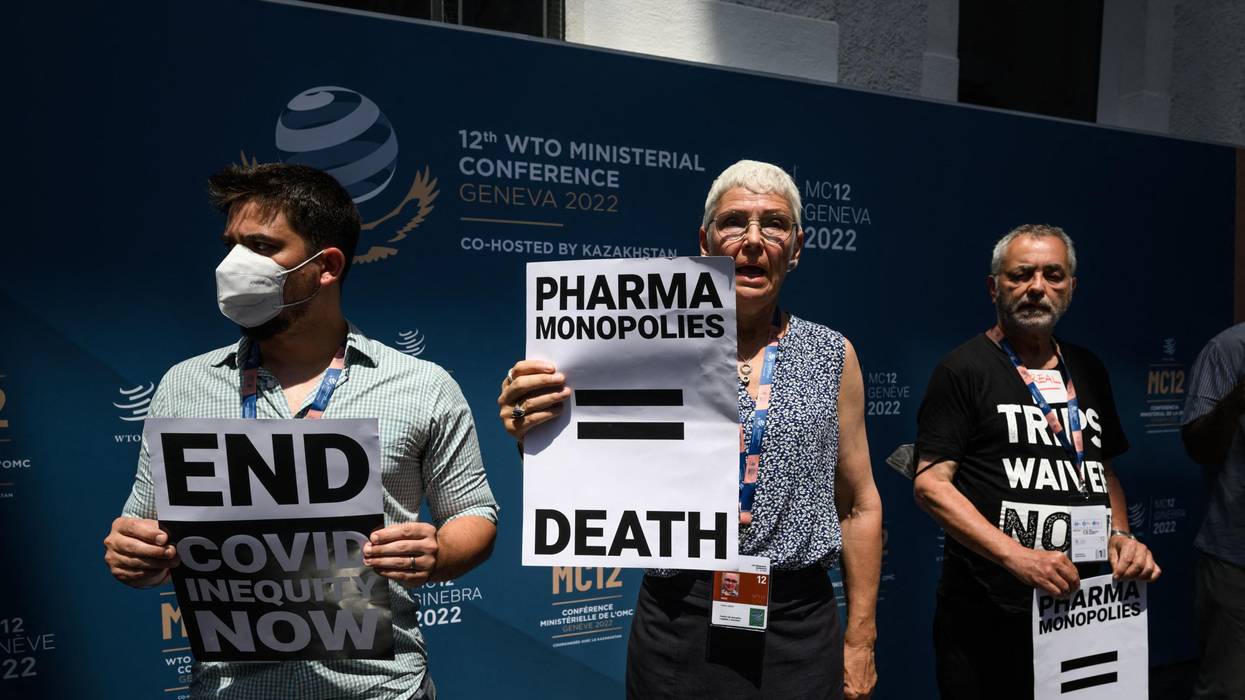
Global health campaigners denounced U.S. President Joe Biden's administration for refusing to support a temporary suspension of patents for Covid-19 tests and treatments this year, a move that further delays the possibility of securing a World Trade Organization intellectual property waiver aimed at increasing access to lifesaving medical tools in developing nations.
In a statement released on Tuesday morning, U.S. Trade Representative Katherine Tai said that "over the past five months, USTR officials held robust and constructive consultations with Congress, government experts, a wide range of stakeholders, multilateral institutions, and WTO members."
Tai continued:
Real questions remain on a range of issues, and the additional time, coupled with information from the USITC [United States International Trade Commission], will help the world make a more informed decision on whether extending the ministerial decision to Covid-19 therapeutics and diagnostics would result in increased access to those products. Transparency is critical and USTR will continue to consult with Congress, stakeholders, and others as we continue working to end the pandemic and support the global economic recovery.
As Bloomberg reported, investigations of the sort that Tai wants the USITC to pursue "can take nine months to a year to complete," pushing the prospects for a comprehensive waiver of the WTO's Agreement on Trade-Related Aspects of Intellectual Property Rights (TRIPS) well into 2023 or beyond.
Dr. Mohga Kamal-Yanni, policy co-lead for the People's Vaccine Alliance, said in response that "it is heartbreaking to see the Biden administration succumb to pressure from pharmaceutical company lobbyists and their henchmen in Congress."
"This moment of weakness will cost countless lives in low- and middle-income countries, leading to continued economic devastation."
"This moment of weakness will cost countless lives in low- and middle-income countries, leading to continued economic devastation," said Kamal-Yanni, "while a handful of pharmaceutical CEOs and shareholders will get even richer."
"The U.S. has had more than two years to meaningfully engage in WTO negotiations over access to lifesaving tests and treatments," she added. "Kicking the issue further into the long grass, just as the negotiating deadline approaches, is pathetic."
This sentiment was echoed by Arthur Stamoulis, executive director of the Trade Justice Education Fund.
"There have been at least 290,000 deaths from Covid-19 since the WTO punted on the question of global access to tests and treatments back in June," said Stamoulis. "How many more need to die before the U.S. joins the right side of history?"
"We're in the third year of the pandemic and billions of people worldwide still don't have access to Covid tests, vaccines, and medicines," Stamoulis continued.
Large swaths of the Global South have been deprived of lifesaving Covid-19 medical tools and remain completely unprotected, with less than 25% of people in low-income countries having received at least one vaccine dose to date.
Experts have long argued that pausing enforcement of the corporate-friendly TRIPS Agreement for the duration of the pandemic would remove the intellectual property barriers standing in the way of increased generic manufacturing. However, in June, Big Pharma-aligned policymakers--most of them from highly vaccinated rich countries--defeated a popular proposal to waive coronavirus-related patents to boost the global supply of jabs, diagnostics, and therapeutics.
Instead, the WTO, which operates on the consensus of its 164 members, adopted a watered-down alternative pertaining only to vaccines--described by critics as worse than the status quo--and vowed to decide whether to extend the decision to cover tests and treatments within six months. The Biden White House's new demand for a delay--in which they joined the European Union, United Kingdom, Japan, South Korea, Singapore, and Switzerland--comes just days before the December 17 deadline.
As Knowledge Ecology International director James Love pointed out on social media, the U.S. government blocked the proposed TRIPS waiver for tests and treatments after telling the World Health Organization that it is opposed to including intellectual property flexibilities in an emerging WHO pandemic treaty "because that's a conversation for the WTO."
Meanwhile, the need for improved access to tests and treatments is particularly acute in poor countries, given the ongoing severity of global vaccine apartheid.
The WHO estimates that just one in every 50 tests is administered in low- and middle-income nations home to 84% of the global population. While publicly available data on treatment access is sparse, a recent analysis from Oxfam and the People's Vaccine Alliance shows that just a quarter of Pfizer's Paxlovid pill orders are destined for developing countries.
Pfizer's licensing agreement with the United Nations-backed Medicines Patent Pool enables other drugmakers to produce its pill for generic consumption in just 95 countries representing 53% of the global population. As a result, excluded countries, many of which are not wealthy, may be forced to pay $250 per course rather than $25.
Globally, the ongoing Covid-19 pandemic has caused more than 15 million deaths directly and indirectly, and the disease alone continues to kill roughly 1,500 people per day.
The profoundly inequitable allocation of medicines--fueled by high-income nations snatching up a disproportionate share of vaccines, tests, and treatments and pharmaceutical corporations refusing to share knowledge and technology--has exacerbated avoidable suffering. Artificially imposed scarcity and uneven distribution also enables the coronavirus to continue circulating and mutating, increasing the likelihood of a vaccine-resistant variant emerging.
A recent investigation revealed the extent to which Big Pharma has lobbied against a robust intellectual property waiver for Covid-19 jabs, diagnostics, and therapeutics--and worsened deadly inequality in the process.
Tai's "call for 'more information' cannot be an excuse for inaction," Stamoulis said Tuesday. "While pharmaceutical monopolies make billions, people are still dying, others are getting long Covid, the economy is suffering, and new variants remain a constant threat."
"It's long past time," he added, "for the Biden administration to support the modest changes to WTO pharmaceutical monopoly protections standing in the way of Covid test and treatment access around the world."
Monsanto is in the news again. The Competition Commission of India (CCI), the country's antitrust regulator, has recently said that it suspects a Monsanto joint venture abused its dominant position as a supplier of genetically modified (GM) cotton seeds in India and has issued an order citing prima facie violation of Sections 3(4) and 4 of the Competition Act, to be investigated by CCI's director-general.
Monsanto also faces cases brought by state governments and domestic seed manufacturers for the astronomical royalty it charges. In previous cases, Monsanto defended itself by saying that it was "trait fees" (for using its technology in cotton hybrids) and not royalty.
The fact is that Monsanto has viewed the laws of our land as mere hurdles in its way to swindle India and our farmers. On March 10, 1995, Mahyco (Monsanto-Mahyco) brought 100 grams of cotton seeds, containing the MON531-Bt gene, into India without the approval of the Genetic Engineering Appraisal Committee (GEAC).
Eager to establish a monopoly in India based on the smuggled MON531 gene, Monsanto-Mahyco started large-scale, multi-centric, open field trials of Bt cotton in 40 locations spread across nine states, again without GEAC approval.
Article (7) of the Environment Protection Act, 1986, states: "No person shall import, export, transport, manufacture, process, use or sell any hazardous microorganisms or genetically engineered organisms/substances or cells except with the approval of the GEAC." GMO traits, once released into the environment, cannot be contained or recalled.
Genetically engineered cotton from the trials was sold in open markets. In some states, the trial fields were replanted the very next season with wheat, turmeric and groundnut, violating Para-9 of the Biosafety Guidelines (1994) on "post-harvest handling of the transgenic plants" according to which the fields on which GMO trials were conducted should have been left fallow for at least one year.
In face of these blatant violations of Indian laws and the risks of genetic pollution India faced, the Research Foundation for Science, Technology and Ecology (RFSTE) filed a petition in the Supreme Court of India against Monsanto and Mahyco in 1999, for their violations of the 1989 rules for the use of GMOs under the Environmental Protection Act.
India's laws, rightly, do not permit patents on seeds and in agriculture. This has always been a problem for Monsanto and, through the US administration, it has attempted to pressure India into changing her robust intellectual property regime since the World Trade Organisation came into existence, and continues to do so today.
Monsanto-Mahyco Biotech (MMB) Ltd collected royalties for Bt cotton by going outside the law and charging "technology fees" and "trait fee" to the tune of $900 million from marginal Indian farmers, crushing them with debt.
In 2006, out of the Rs 1,600 per 450 gram package of Bt cotton seed (Rs 3,555.55/kg), almost 80 per cent (Rs 1,250) was charged by MMB as "trait fee". In stark contrast, before Monsanto destroyed alternative sources of seed (including local hybrid seed supply) through unfair business practices, local seeds used to cost farmers Rs 5-9/kg.
In response to the unfair pricing, the government of Andhra Pradesh filed a complaint with the Monopolies and Restrictive Trade Practices Commission (MRTPC) against MMB, pointing out that Monsanto was charging Andhra Pradesh farmers nine times what it was charging US farmers for the same seeds. MMB said the royalty it charged reflected its research and development costs for Bt cotton, admitting that they were charging royalty to Indian farmers.
Monsanto's ruthlessness is central to the crisis Indian farmers are facing. Farmers leveraged their land holdings to buy Bt cotton seeds and the chemicals it demanded, but the golden promise of higher yield and reduced pesticide use failed to deliver.
Of the 300,000 farmer suicides in India since Monsanto smuggled the Bt gene into India in 1995, 84 percent, almost 252,000, are directly attributed to Monsanto's Bt cotton.
While the Government of India is suing Monsanto, the government of Maharashtra has signed an MoU with Monsanto to set up the biggest seed hub in the country in Buldana, announced at "Make in India Week". How can a corporation breaking India, taking the lives of Indian farmers, destroying our agriculture and food security, and violating our laws be rewarded with the "Make in India" label?
For arrogantly breaking Indian laws and corrupting our regulatory systems, Monsanto must be held accountable. For the failure of Bt cotton, Monsanto must be made to pay damages to the farmers and seed companies that have had to pay "technology fees" for a failed technology.
The land that our farmers have lost to the agents selling Monsanto seeds and chemicals must be returned to the farmers' families. All the illegal royalty collected from our farmers and India's seed companies must be returned to India.
With its flagship product failing across the country year after year, and the dimming prospects of the super-profits the company has become used to, why would Monsanto make a large investment in Vidarbha unless it is sure of continued monopoly?
The technical expert committee has recommended that Herbicide Tolerance (Ht) and GM varieties of crops for which India is the centre of diversity, not be allowed in India. Is Monsanto counting on the GEAC approving Bayer's herbicide-tolerant terminator mustard in contempt of the recommendations of the Technical Expert Committee? Allowing Bayer's Ht terminator mustard will open the floodgates for herbicide tolerant crops, worsening India's agrarian crisis and debilitating India's food security.
Herbicide tolerance, which goes hand in hand with Monsanto's Glyphosate based RoundUp herbicide, has failed across the world at controlling weeds, creating super weeds. Glyphosate, classified by the World Health Organisation as a carcinogen, is already being used across India and we are seeing an explosion of cancers in villages where Glyphosate is used. If we allow another failed technology and its associated poisons to further destroy India's rural economy, and allow extraction of profits from Indian farmers, we will fail our nation and India's future generations.
As the TRAI decides the fate of Free Basics, Mark Zuckerberg is in India with Rs100 crore in pocket change for advertising. Facebook's Free Basics is a repackaged internet.org, or in other words, a system where Facebook decides what parts of the internet are important to users.
Reliance, Facebook's Indian partner in the Free Basics venture, is an Indian mega-corporation interested in telecom, energy, food, retail, infrastructure, and land. Reliance obtained land for its rural cell phone towers from the government of India and grabbed land from farmers for SEZs through violence and deceit. As a result and at no cost, Reliance has a huge rural, semi-urban and suburban user base -- especially farmers. Although Free Basics has been banned (for the time being), Reliance continues to offer the service across its networks.
A collective corporate assault is underway globally. Having lined up all their ducks, veterans of corporate America, such as Bill Gates, are being joined by the next wave of philanthropy-corporate Imperialists, including Mark Zuckerberg. The similarities in Gates and Zuckerberg's perfectly rehearsed, PR firm-managed announcements of giving away their fortunes are uncanny. Whatever entity the Zuckerbergs form to handle the US$45 billion they will be investing will most likely look like the Bill and Melinda Gates Foundation. ie: powerful enough to influence the climate negotiations, responsible for nothing.
What could Bill Gates and Mark Zuckerberg have to gain from dictating terms to governments during the climate summit? "The Breakthrough Energy Coalition will invest in ideas that have the potential to transform the way we all produce and consume energy," Zuckerberg wrote on his Facebook page. It was an announcement of Bill Gates' Breakthrough Energy Coalition, the combined wealth of hundreds of billions of dollars of 28 private investors who will influence how the world produces and consumes energy.
At the same time, Gates is currently behind a push to force chemical, fossil fuel-dependent agriculture and patented GMOs (#FossilAg) through the Alliance for a Green Revolution in Africa (AGRA). It is an attempt to lock African farmers into a dependence on fossil fuels that should be left underground, as well as creating a dependence on Monsanto for seeds and petrochemicals.
95% of the cotton in India is Monsanto's proprietary Bt Cotton. This year, in regions from Punjab to Karnataka, 80% of this Bt crop failed -- that's 76% of Bt Cotton farmers with no crop left at harvest time. If they had a choice, they would switch. But what resembles a choice between cotton seeds is the same BT cotton seed, marketed by different companies under different names, purchased in desperation as farmers try combination after combination of seeds, pesticides, herbicides, and fungicides -- all of which have chemical names designed to make you feel inadequate -- until you have no 'choices' left but to take your own life.
What Monsanto has done by pushing Intellectual Property Rights (IPR) laws and patents on seeds, Zuckerberg is attempting to do to internet freedom in India. And like Monsanto, he is targeting the most marginalized Indians.
Free Basics will limit the internet to the vast majority of India. From the outset, Free Basics has said it won't allow video content because it would interfere with the telecom companies' services (read: profits)—despite the TRAI's own recommendation that video content is more accessible to different parts of the population.
Once allowed as a free service, what will stop telecom companies from redefining the internet to suit their own interests and those of their corporate partners? After all, the ban on Free Basics has not stopped Reliance from continuing to offer the service to its huge user base, many of whom are farmers.
Why should Mark Zuckerberg decide what the internet is to a farmer in Punjab, who has just lost 80% of his cotton harvest because Monsanto's Bt Cotton and the chemicals he was told to spray completely failed? Should the internet allow him to see how GMO technology has failed everywhere in the world and is only kept afloat through unfair market and trade policies, or should the internet suggest the next patented molecule he should spray on his crop?
The Monsanto-Facebook connection is deep. The top 12 investors in Monsanto are the same as the top 12 investors in Facebook, including the Vanguard Group. The Vanguard Group is also a top investor in John Deere, Monsanto's new partner for 'smart tractors.' This partnership will bring all food production and consumption, from seed to data, under the control of a handful of investors.
It's no surprise that the Facebook page March Against Monsanto, a major American movement in support of labeling and regulating GMOs, was deleted.
Recently India has seen an explosion in e-retailing. From large corporations to entrepreneurs, people all over the country are able to sell what they make to a market that was earlier unreachable to them. Craftsman have been able to grow their businesses, farms have found consumers nearby.
Just like Monsanto with patented seeds, Zuckerberg wants not just a slice, but the whole pie of the basic economy of the Indian people, especially its farmers and peasants. What would Monsanto's monopoly over climate data mean for farmers enslaved through a Facebook gateway to Monsanto data delivered through an internet that is controlled by Facebook? What would this mean for internet and food democracy?
The right to food is the right to choose what we want to eat; to know what is in our food (#LabelGMOsNow) and to choose nourishing, tasty food -- not the few packaged goods that corporations want us to consume.
The right to the internet is the right to choose what spaces and media we access; to choose spaces that enrich us -- not what companies think should be our 'basics'.
Our right to know what we are eating is as essential our right to information, all information. Our right to an open internet is as essential to our democracy as our right to save, exchange, and sell open-pollinated farmers' seeds.
In the ultimate Orwellian doublespeak, "free" for Zuckerberg means "privatised", a far cry from privacy -- a word Zuckerberg does not believe in. And like corporate-written "free" trade agreements, Free Basics is anything but free for citizens. It is an enclosure of the commons, which are 'commons' because they guarantee access to the commoner, whether it be seed, water, information or internet. What Monsanto's IPRs are to seed, Free Basics is to information.
Smart Tractors from John Deere, used on farms growing patented Monsanto seed, sprayed and damaged using Bayer chemicals, with soil and climate data owned and sold by Monsanto, beamed to the farmer's cellphone from Reliance, logged in as your Facebook profile, on land owned by The Vanguard Group.
Every step of every process right up until the point you pick something up off a supermarket shelf will be determined by the interests of the same shareholders.
Talk about choice.
Agricultural non-governmental organizations (NGOs) working in India and elsewhere criticize the newly-opened Global Seed Vault (GSV) at Svalbard in Norway as fundamentally unjust in its objectives.
The Barcelona-based agriculture lobby GRAIN, with branches in major developing nations in Africa, Asia, and Latin America, says the seed vault has a serious deficiency because it deals mainly with state and private depositors, thereby excluding the rights of poor farmers who cannot access these seeds.
GRAIN says the GSV's ex-situ storage system removes unique plant varieties from farming communities that originally created, selected, protected, and shared the seeds. Farmers are excluded because they do not know how to access the scientific and institutional framework for setting up the system.
"This system forgets that farmers are the world's original, and ongoing, plant breeders,'' GRAIN's Asia Program Officer, Shalini Bhutani, who is based in New Delhi, told IPS.
She says that negotiating intellectual property and other rights over seeds, originally conserved by farmers, becomes the business of governments and the seed industry itself.
The Norwegian government will make Decisions on the GSV, which is currently regarded as trustworthy but without guarantee that its policies will change. It has a ten-year agreement with depositors, including clauses allowing them to be terminated if policies change.
A tripartite agreement between the Norwegian government, the Global Crop Diversity Trust (GCDT), and the Nordic Genetic Resource Center, a cooperative effort of Nordic countries, outlines the management of the GSV.
GRAIN alleges that decisions on the GSV will be shared with the GCDT, a private entity with strong corporate funding, which brings to the forefront all the 'terrible controversies' over access to and benefits from global agricultural biodiversity.
Trans-national seed corporations currently control over half of the world's 30 billion US dollar yearly seed market, buying up many public plant-breeding programs with governments relinquishing control. "The ultimate beneficiaries will thus be the very same corporations at the roots of crop-diversity destruction,'' says a GRAIN publication.
But Cary Fowler, head of the Global Crop Diversity Trust (GCDT), which is in charge of the GSV, says such criticism "seriously misrepresents the purpose and workings of the Svalbard Global Seed Vault and portrays the GCDT in an inaccurate, misleading, and unflattering manner."
"The Seed Vault has been welcomed by over 165 countries and the Food and Agricultural Organizations (FAO)'s Commission on Genetic Resources, and it is already being used by developed and developing countries and by NGO seed savers (though not by corporations)", said Fowler in an e-mail interview with IPS.
The GSV is built into the Arctic permafrost, which has a natural temperature of minus 6 degrees centigrade. It is some 1,000 km from the North Pole. Three cold rooms are further cooled to minus 18 degrees C, and the facility can store 4.5 million batches of seeds.
Should some major disaster hit world agriculture, such as a nuclear war or a natural disaster, countries could turn to what is popularly called the 'doomsday vault', to pull out seeds and restart food production.
However, many are unhappy with the GSV continuing to exist in the science of agricultural conservation.
The Bangalore-based GREEN Foundation, which won the United Nations Equator Prize in 2004 for its work on seed conservation on farms through community seed-bank networks, which are mainly run by women, says the vault's claim to protect genetic biodiversity is more 'illusion than reality'.
"It is already a decade since the UNCED in Rio de Janeiro and the Convention on Biological Diversity (CBD) realized that gene banks had their limitations, starting from major power breakdowns to excluding farmers' access to these banks to realizing that seeds conserved under freeze conditions did not evolve when grown under changed environmental conditions," Vanaja Ramprasad, founder-director of the GREEN Foundation told IPS. "It is a sad commentary on the science behind the assumption that the world's food is secure inside a freezer,'' she said.
NGOs like Green Foundation, GRAIN, and the Hyderabad-based Deccan Development Society believe that involving farmers to grow seeds in their fields and conserving and exchanging these with others is the most secure method of conserving genetic diversity and resources.
In the last ten years, says Ramprasad, there have been worldwide efforts to collect and conserve germplasm on farmers' fields, breaking the notion that germplasm was meant only for breeding purposes. "This reinforced the fact that in situ conservation of germplasm was not only the food security of millions of the world's population, but also identified as imperative to food sovereignty," she said.
The Hyderabad-based Deccan Development Society (DDS), working in rural empowerment of poor dalit (the lowest caste in India's social hierarchy) women, and conserving indigenous cereals such as millets, does not believe that the scientific community can save crop diversity by cold-storage systems.
"Global seed wealth can survive only in the farms and homes of global rural communities. The GSV takes away these seeds from the farmer and breaks the first link in the food chain," says P.V. Satheesh, founder of DDS.
A depositor in the GSV currently is the Consultative Group on International Agricultural Research (CGIAR), run under the FAO and has approximately 15 global gene banks holding the world's most widely-used food crops under a legal trusteeship arrangement on behalf of the international community.
GRAIN faults CGIAR's system as having excluded farmers totally from the trusteeship, a system being linked with the GSV which will give the CGIAR 'almost exclusive' access to the vault's deposits.
Accessions from India and Asia are part of the collections from India's Rice Research Institute and from the Hyderabad-based International Crop Research Institute for Semi-Arid Tropics (ICRISAT), under the aegis of CGIAR, that are to be locked in the GSV. "This vault is more the need of the life-sciences industry, known for its 'pirating' of farmers' material and traditional knowledge,'' said GRAIN's Bhutani.
An ICRISAT press note says that the organization's participation in the duplicate conservation of seeds in the vault increases global agriculture's protection from climate change. But the seeds or germplasm to be transferred by ICRISAT are those of hardy dryland sorghum, pearl millet, chickpea, pigeon pea, groundnut, and six small millets that can withstand climate change.
Bhutani says that conservation methods should be adopted along with this strategy, adding that there is nothing on offer to believe that Svalbard will be invincible in its protection.
ICRISAT has given examples of protection offered through its 1,400-odd genebanks in various countries. It says sorghum germplasm lost during civil wars in Ethiopia and Rwanda was replenished from the collection stored in its genebanks.
GRAIN recommends that governments first support their national farmers and markets rather than international gene banks, leaving seeds in the hands of local farmers with their innovative farming and seed-exchange practices. Developing countries with agro-biodiversity assets need to safeguard their farmers' interests before agreeing to corporate-controlled agricultural agreements, it said.
Fowler said the GCDT endorses the view that ex-situ and in-situ conservation are complementary.