
SUBSCRIBE TO OUR FREE NEWSLETTER
Daily news & progressive opinion—funded by the people, not the corporations—delivered straight to your inbox.
5
#000000
#FFFFFF
To donate by check, phone, or other method, see our More Ways to Give page.


Daily news & progressive opinion—funded by the people, not the corporations—delivered straight to your inbox.
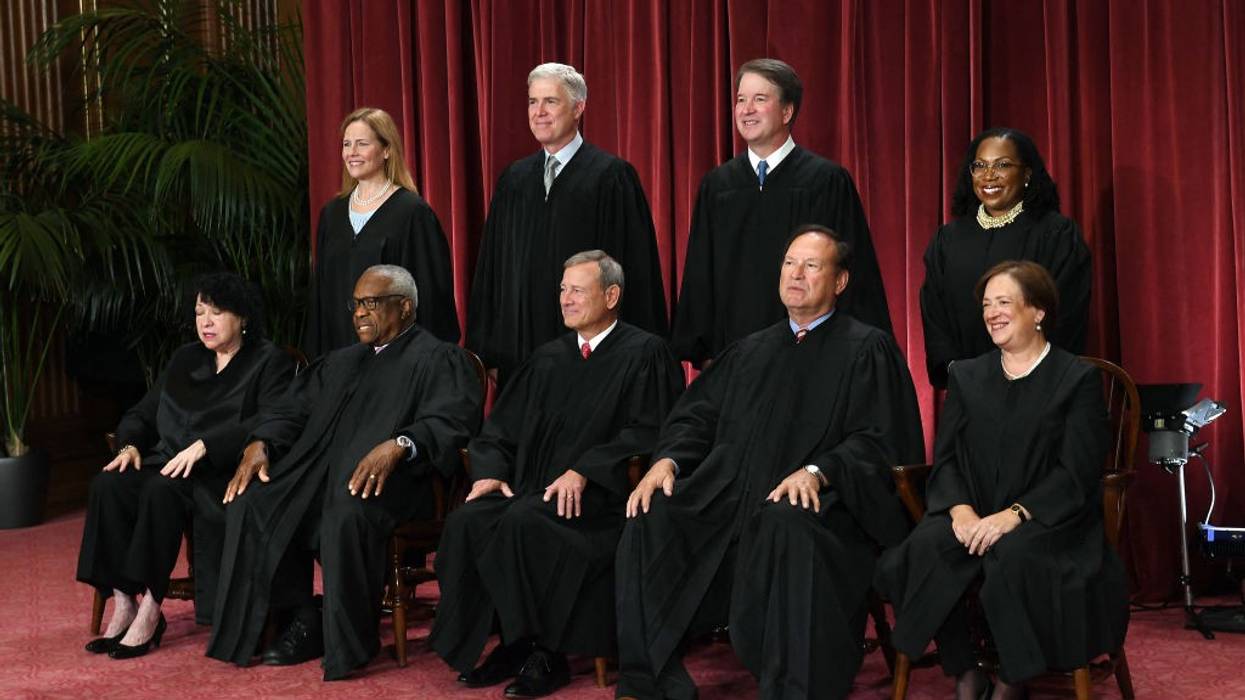
The nine justices of the nation's highest court are powerful government officials with a duty to stand up against abuse and for the rule of law. They claim they are independent. Will they act?
FBI director nominee-in-waiting Kash Patel writes children’s books in which his character, a wizard, vows to protect “King Donald.” (Patel also peddled pills to reverse the Covid-19 vaccine and produced a song recorded by imprisoned January 6 insurrectionists called “Justice for All.”) Ominous credentials to head the nation’s most powerful law enforcement agency, one with a history of abuse.
We’ve been vocal about what’s gone wrong at the Supreme Court. It has been captured by a faction of a faction. But if we’ve ever needed an independent judiciary, we need it now. If guardrails crumble and the powerful quail before Donald Trump, the high court may be one of the last — indeed, at times, the only — protectors of the Constitution.
All of which makes the latest revelations about the Court so dismaying — the inside story of how the justices adopted an ethics code that is more loophole than law.
In the past two years, ProPublica and other news outlets have revealed startling misconduct. Justice Clarence Thomas for years had his lifestyle secretly subsidized by billionaire Harlan Crow. The billionaire provided lavish vacations, paid for the education of Thomas’s surrogate son, and even bought and renovated the justice’s mother’s house (with her living in it). If this happened with state legislators in Albany or Sacramento, we’d call it corruption. Justice Samuel Alito, too, took luxury travel from yet another billionaire, also without disclosing it. Leonard Leo of the Federalist Society played matchmaker between the judges and the billionaires. ProPublica won the Pulitzer Prize for its exposés.
Public outcry was loud enough that the Court last year felt compelled to issue a first-ever code of conduct. The justices explained that this was only to clear up a “misunderstanding” by citizens. Instead of being the only judges with no ethics code, they now had the weakest.
Now The New York Times has revealed the fevered deliberations that produced this result. It reads like the doings of sneaky pols on House of Cards. Justices sent each other memos in sealed envelopes because they were so fearful of leaks. Thomas and Alito “wrote off the Court’s critics as politically motivated and unappeasable,” write Jodi Kantor and Abbie VanSickle. The liberal justices pushed for a strong code with an enforcement mechanism, such as a panel of retired judges, to no avail.
Justice Neil Gorsuch, the newspaper reported, was most vocal in opposition and judicial self-regard. “The justices’ strength was their independence, he said, and he vowed to have no part in diminishing it,” the article reports. Gorsuch wrote a long memo of complaint as the rules were being drafted.
The result was a tepid code that did little to boost public confidence. It violates a core principle: Nobody is so wise that they should be the judge in their own case. The justices decide on their own when they must “recuse,” or refrain from hearing a case. Nor must they explain why they stepped back, though some justices have begun to do that. Most important, there is no mechanism for enforcement.
So the Court has served up mush. But the story need not end there. Congress has set rules for the federal courts throughout history, as envisioned by the Constitution. Samuel Alito has waxed indignant about this. “I know this is a controversial view, but I’m willing to say it. No provision in the Constitution gives [Congress] the authority to regulate the Supreme Court — period,” he told The Wall Street Journal. Justice Elena Kagan felt compelled to respond publicly. “It just can’t be that the Court is the only institution that somehow is not subject to checks and balances from anybody else,” she said. “We’re not imperial.”
This again shows why the Court needs fundamental reform. An 18-year term limit for justices would make the Court much more accountable. It accords with a fundamental American precept: Nobody should hold too much power for too long. It’s also widely popular. The most recent Fox News poll on the issue showed that 78 percent of respondents backed term limits — in other words, strong majorities of Republicans and independents as well as Democrats.
In recent years, congressional Republicans have been hostile to Supreme Court reform. With Congress in Republican hands for the next two years at least, there’s an opportunity to deepen support among conservatives and liberals, legal scholars, bar leaders, and others. It’s an idea whose time has come.
We need a strong, independent, principled Supreme Court. The ruling last summer granting vast criminal immunity empowers the president to law-break with impunity. Major rulings are due on vital issues — including the oral arguments today on state laws banning gender-affirming medical care for transgender minors. Civil liberties violations likely to accompany mass deportation of noncitizens will surely reach the justices. This term will test whether this is a principled Court or, as seems increasingly likely, a MAGA Court.
No, Kash Patel is not a wizard. The justices wear robes, but they aren’t either. They are powerful government officials with a duty to stand up against abuse and for the rule of law. They claim they are independent. Will they act? The backstage saga of their ethics code doesn’t augur well.
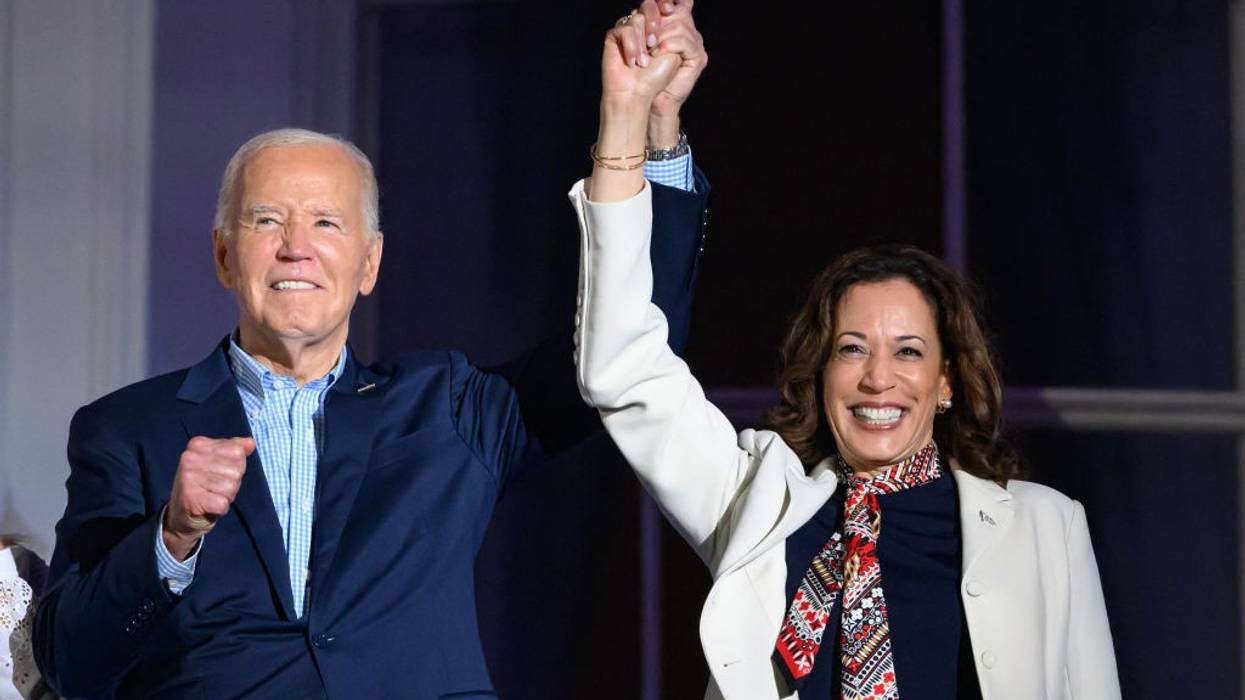
"These popular reforms will help to restore confidence in the court, strengthen our democracy, and ensure no one is above the law," said Vice President Kamala Harris, the presumptive Democratic nominee.
U.S. President Joe Biden on Monday detailed his plan to reform the U.S. Supreme Court and address one of its most controversial recent decisions in an op-ed published by The Washington Post.
Vice President Kamala Harris, the presumptive Democratic presidential nominee, quickly endorsed his plan, which calls for term limits for Supreme Court justices, an enforceable code of ethics, and a constitutional amendment reversing the court's decision to grant presidents broad immunity for official acts.
"These popular reforms will help to restore confidence in the court, strengthen our democracy, and ensure no one is above the law," Harris said in a statement.
"Americans deserve a Supreme Court they can trust. It's time for Congress to follow the White House's lead and take action to rein in this out-of-touch court."
After long resisting calls to push court reform, Biden told progressive lawmakers he would propose a plan earlier this month. His shift came weeks after a series of court rulings that granted current and former U.S. presidents broad immunity; overturned the Chevron doctrine empowering federal agencies to rely on their expertise in crafting environmental, public health, labor, and other regulations; and supported the criminalization of homelessness.
The majority-conservative Supreme Court—three of whose members were appointed by former U.S. President Donald Trump—has also in recent years reversed Roe v. Wade, ended affirmative action, and struck down Biden's student loan forgiveness program. It has done all this even as Justices Clarence Thomas and Samuel Alito have been at the center of a series of ethics scandals involving undisclosed gifts from right-wing billionaires and a refusal to recuse themselves from Trump's immunity case despite signals that they or their loved ones supported the January 6, 2021 insurrection to overturn the 2020 election results.
"What is happening now is not normal, and it undermines the public's confidence in the court's decisions, including those impacting personal freedoms," Biden wrote on Monday. "We now stand in a breach."
Biden first called for an amendment to the Constitution called the "No One Is Above the Law" amendment, which would address the court's decision on presidential immunity by clarifying that no president is broadly immune from criminal prosecution, including for official acts.
"We are a nation of laws—not of kings or dictators," Biden wrote.
Next, Biden backed a system of term limits for the court whereby a president would appoint one justice every two years to serve a total of 18 years.
"The United States is the only major constitutional democracy that gives lifetime seats to its high court," Biden noted. "Term limits would help ensure that the court's membership changes with some regularity. That would make timing for court nominations more predictable and less arbitrary. It would reduce the chance that any single presidency radically alters the makeup of the court for generations to come."
Finally, the president called for a binding ethics code, as every other federal judge is subject to.
"This is common sense," Biden wrote. "The court's current voluntary ethics code is weak and self-enforced. Justices should be required to disclose gifts, refrain from public political activity, and recuse themselves from cases in which they or their spouses have financial or other conflicts of interest."
Biden stopped short of endorsing court expansion, a move backed by many court reform advocates. It is also unlikely that any of Biden's proposals would currently pass the Republican-controlled House or win over the 60 votes needed in the Senate.
"President Biden's plan renews the system of checks and balances and also establishes binding ethics reforms for a court that has been embroiled in scandal in recent years."
Still, his proposal was welcomed by accountability and good governance groups.
"This is a remarkable and historical step forward on the path to reforming SCOTUS," Wendy Weiser, vice president for democracy at the Brennan Center for Justice, said on social media. "No one should have public power for so long; no one should be the judge in their own case; and no one should be above the law."
Craig Holman, Ph.D., government affairs lobbyist for Public Citizen, said in a statement: "The White House's endorsement of these critical court reforms comes at a time of increasing questions about the lack of transparency and accountability at the court. The White House's new calls for court reform will vastly boost the prospects of moving this reform legislation forward."
Public Citizen co-president Lisa Gilbert said that the group "enthusiastically supports this effort by the Biden-Harris administration and lawmakers to impose term limits and a binding code of ethics on the Supreme Court, and we applaud the support for an amendment to ensure that no president is above the law."
Stand Up America noted that court reform is widely popular with U.S. voters: A vast majority want Congress to pass reform, including 18-year term limits, and 78% want it to impose a code of ethics.
"Americans' confidence in the Supreme Court is at historic lows, which is no surprise given the Roberts Court's blatant disregard for ethical standards, long-standing precedent, and Americans' fundamental freedoms," Stand Up America's executive director, Christina Harvey, said. "We applaud President Biden and Vice President Harris for supporting urgently needed reforms to restore trust in our nation's highest court."
Stand Up America's founder and president Sean Eldridge said on social media that the 18-year term-limit proposal in particular was a "huge step forward for meaningful court reform."
Both Eldridge and Harvey noted that 49 out of 50 U.S. states impose either term limits or retirement ages on their top judges, or have them chosen via election.
"The Supreme Court should be the gold standard for judicial ethics, yet conservative justices have accepted millions of dollars in gifts, attended private retreats with billionaire conservative donors, and failed to meet legal disclosure requirements," Harvey said. "Americans deserve a Supreme Court they can trust. It's time for Congress to follow the White House's lead and take action to rein in this out-of-touch court."
The Congressional Progressive Caucus seemed ready to take up that challenge.
"We are grateful to President Biden for taking action on this longtime priority of the progressive movement to address the crisis facing our democracy," Reps. Pramila Jayapal (D-Wash.) and Hank Johnson (D-Ga.) said in a statement. "We call on our colleagues in Congress to protect the foundation of our country by passing the Judiciary Act to expand the Supreme Court; Supreme Court Ethics, Transparency, & Recusal Act (SCERT) to require a binding code of ethics and transparency measures for justices; and the TERM Act setting term limits for justices."
Another way Congress could act would be to put forward Rep. Ro Khanna's (D-Calif.) Supreme Court Term Limits and Regular Appointments Act, which journalist John Nichols noted had many things in common with Biden's proposal.
In a thread on social media, Nichols put the movement for court term limits in the context of U.S. history.
"The U.S. has since its founding regularly amended the Constitution to guard against an imperial presidency—including the term limits outlined in the 22nd Amendment and ratified in 1951. Now, President Biden proposes judicial term limits to guard against an imperial Supreme Court," he wrote.
After describing the president's plan, Nichols continued: "President Biden's plan renews the system of checks and balances and also establishes binding ethics reforms for a court that has been embroiled in scandal in recent years—as justices have refused to recuse themselves from cases where they have conflicts of interest."
One of his Majesty's first so-called “official acts" should be to issue an arrest warrant for his insurrectionist predecessor, Donald Trump, for trying to overthrow the U.S. government and the constitution. After that, pack the court with sane justices to restore law and order in the land.
If Joe Biden wants to recuperate his lagging campaign and demonstrate his presidential strength, he should immediately seize upon the opportunity just presented to him by the six wingnuts on the Supreme Court in their ruling in Trump v. United States (the most appropriately named case this term). He should begin by unilaterally (or unitarily as the theory goes) defining what constitute “official acts” of the President. As the power now vested in him by this decision this should be well within his purview and should be conceived as broadly and deeply as possible.
Of course, one of his first such “official” acts should be to issue an arrest warrant for his insurrectionist predecessor for trying to overthrow the U.S. government and the constitution. Under his new authority, he should be able to waive any trial (or associated delays and appeals) and summarily jail the now convicted felon, forthwith. And, it should be crystal clear that he would be able to deal appropriately with any of the MAGA crowd that attempts to rise up in response to this action. National Guard anyone?
Of course, Biden being Biden, he has already snatched defeat from the jaws of victory by declaring that he will “follow the law” no matter what kinds of powerful openings this ruling provides. You can bet that his predecessor and successor will have no such compunction.
He should then turn his attention to making the government and our “democracy” functional. A first task here would be rectifying the stolen U.S. Supreme Court seats by packing the Court with sane justices who will follow the law instead of their cultish “leader.” I recognize the risk here that such a Court might seek to reign in a newly empowered President, but careful vetting and selection could circumvent these possible inconveniences. He might then turn his attention to the electoral system to make sure that one person/one vote is the rule rather than the too rare exception. Get rid of the Electoral College, outlaw partisan gerrymandering, and expand access to the vote and make voting itself easier. Then it’s on to Congressional reform: eliminate the filibuster, greatly expland the power of Presidential signing statements to shape legislation to his liking, declare Presidential vetoes the final word on legislation he dislikes.
Beyond these good government tasks, it is tantalizing to imagine a slate of non-reversible executive orders covering all those vital national needs that an oppositional Congress and the courts have impeded for years: women’s’ bodily autonomy, universal health care, child tax credits, climate legislation and a real green deal, strengthening pro-labor and environmental protection laws, real immigration reform, curbing wealth and income inequality, reshaping tax policy and spiraling corporate greed, addressing homelessness, and on and on.
Of course, Biden being Biden, he has already snatched defeat from the jaws of victory by declaring that he will “follow the law” no matter what kinds of powerful openings this ruling provides. You can bet that his predecessor and successor will have no such compunction.
And further, Biden being Biden, the whole notion of a vivid and vibrant imagination guiding political or policy action is largely inconceivable. But perhaps some of his close advisors (if they can’t persuade him to drop out which would be eminently preferable) will see this as a chance to hone their puppeteering skills during the his final months in office. Could do the country some good.
"We saw a glimpse of what’s possible when audio access was permitted during the pandemic, and it’s clearly within the court’s power to make this a reality once more."
Amid the buzz of an always-on news cycle, it’s baffling that the most pivotal trial of the year has gone largely unnoticed.
The antitrust trial against Google’s search engine monopoly has slipped under the radar, and it’s a damning reflection of the state of our public court system. At its core, this trial delves deep into the crisis of economic concentration plaguing our society. The government contends that Google’s monopoly stifles innovation and raises costs for advertisers, ultimately burdening consumers.
But here’s the catch: Gaining access to this trial is an arduous task. In an era of unprecedented connectivity, we find ourselves isolated from proceedings.
Remote audio access, once a pandemic-era lifeline, has vanished. Even for the lucky few who attend in person, a peculiar ritual unfolds when they step into Courtroom 10 on the fourth floor of the federal district court in Washington, D.C.—cellphones are switched off and all electronics are stashed away. It was my privilege to be among the select audience during the first week of the 10-week marathon, and my notepad brims with hastily scribbled notes as testament to this rarified and restricted access.
Imagine a courtroom with no audio access, no cameras, no phones, and limited access to crucial exhibits. The witness list, the cornerstone of any trial, remains hidden until the eleventh hour. Federal District Court Judge Amit Mehta, who is overseeing and will rule on the case, adopted an early policy of deference to Google, granting them near unilateral power to decide what’s sensitive. As a result, in a trial about the existence of monopoly power, we lack data on Google’s market share. The terms of Google’s agreement with Apple, which, according to an unidentified senior Apple employee, enables the titans to “work as if we are one company,” is similarly concealed from public view. Even information about their original agreement from 2007 is deemed commercially sensitive—in 2023.
This case hinges on the power of agreements that establish valuable default status for Google’s lucrative search engine, which has enabled Google to maintain about 90% of the entire market, by some estimates — yet the court prevents the public from knowing how market dynamics change when those defaults are altered. In the midst of public skepticism regarding the Supreme Court’s conflicts of interest, we entrust the courts with safeguarding our fundamental right to public access, yet these glaring gaps undermine both transparency and accountability in our judicial system. The graphs and data we do end up getting to see are the result of intense struggles behind closed doors.
Last week, lawyers for the New York Times stepped into the fray to demand greater media access to trial testimony and exhibits. Judge Mehta was largely unmoved, relegating the question to daily squabbles over whether upcoming testimony should be sealed. To have a voice in those on-the-fly decisions, though, requires media outlets to allocate substantial resources, including making their lawyers present daily for the remainder of the trial. Worse, they’ll be arguing against Google’s sole knowledge of the forthcoming testimony and unilateral ability to argue its sensitivity.
To the extent government agencies should also be advocating for public access to court hearings, those agencies are already massively under-resourced to conduct their core obligations. To wit, the Federal Trade Commission, charged with protecting our entire economy from unfair and abusive monopolies, has lost a third of its appropriated staff—approximately 500 full-time staff—since 1980. By comparison, the Department of Justice is down 352 staff since 1979. In the same period, the economy has expanded six-fold and concentration has become ubiquitous across industries. In 2021, over 3,500 merger transactions were reported to the agencies, an 87% increase over the average number reported over the prior five years. In the FTC’s various litigation against Meta/Facebook, the FTC claims to be outgunned 10 to 1. The dynamic established by the courts renders the best-resourced private monopolies equipped to argue for the secrecy of trials that are public, if in name only.
Greater public access to trial proceedings is possible. During the pandemic, we glimpsed an alternative, as rules were established to allow audio feeds to trials. People hung on every word of Microsoft’s $69 billion acquisition of game studio Activision-Blizzard. Social media was abuzz with debates about key testimony as it unfolded. The sudden expiration of these rules just as the Google trial began was the reason for Judge Mehta’s rejection of a timely request for a live audio feed by American Economic Liberties Project. It was a blow to those who had savored the taste of greater public access to big courtroom drama.
In an altogether separate matter, NBC Universal has filed an application to gain audio-visual access to the upcoming trial of former President Donald Trump, stressing the First Amendment implication of denying such access. Debates over secrecy are more than just a sideshow distraction from the facts and substantive merits of these cases. It’s more than just time-consuming, costly and draining for both the public and the court itself. It invokes constitutional issues that go to the heart of our judicial system.
The path forward is clear and achievable. The Judicial Conference, a body of federal judges overseeing the operation of our federal courts, must adapt to the way the modern world accesses information and revise its rules to permit the broadcast of trials. They have studied the effect of cameras in the courtroom since at least 1988, with numerous committees recommending their introduction for both civil and criminal proceedings. The technology for enabling that access has undergone paradigm shifts in that time. We saw a glimpse of what’s possible when audio access was permitted during the pandemic, and it’s clearly within the court’s power to make this a reality once more.
We should not burden the public with the fight for access. The court must lead the way, by embracing transparency in the 21st century.
By ruling against the independent state legislature theory, said one activist, "the U.S. Supreme Court made clear that state courts and state constitutions should serve as a critical check against abuses of power by legislators."
Democracy defenders across the United States on Tuesday breathed a collective sigh of relief after half of the U.S. Supreme Court's right-wing supermajority joined with the three liberal justices to reject a "dangerous" legal theory that could dramatically impact federal elections.
"The Supreme Court took an important and crucial step today in protecting our system of checks and balances," said Hilary Harris Klein, senior counsel for voting rights at Southern Coalition for Social Justice. "Today's decision will ensure that voters will continue to have the full protection of state constitutions against harmful and anti-democratic voter suppression and election manipulation."
Oral arguments for Moore v. Harper in December had some campaigners worried that at least five justices would embrace the independent state legislature theory (ISLT), whose proponents claim the U.S. Constitution only empowers state legislatures to regulate federal elections, without checks from state constitutions, courts, or governors.
However, in the case—which stemmed from a fight over North Carolina's congressional map—Chief Justice John Roberts, fellow conservatives Amy Coney Barrett and Brett Kavanaugh, and liberals Elena Kagan, Ketanji Brown Jackson, and Sonia Sotomayor rejected the ISLT. Right-wing Justices Samuel Alito, Clarence Thomas, and Neil Gorsuch dissented.
The elections clause of the U.S. Constitution "does not vest exclusive and independent authority in state legislatures to set the rules regarding federal elections," Roberts wrote for the majority. "When state legislatures prescribe the rules concerning federal elections, they remain subject to the ordinary exercise of state judicial review."
"When a state legislature carries out its federal constitutional power to prescribe rules regulating federal elections, it acts both as a lawmaking body created and bound by its state constitution, and as the entity assigned particular authority by the federal Constitution," he continued. "Both constitutions restrain the state legislature's exercise of power."
"Although the elections clause does not exempt state legislatures from the ordinary constraints imposed by state law, federal courts must not abandon their duty to exercise judicial review," Roberts added. "This court has an obligation to ensure that state court interpretations of state law do not evade federal law."
Both the majority opinion and campaigners pointed to precedent. Fair Elections Center litigation director Jon Sherman said that "for 233 years and counting, no court has ever found that state election laws are unconstrained by state constitutional requirements, because this is a fantasy that is antithetical to our system of government."
Elias Law Group partner Abha Khanna, counsel of record for the plaintiffs, called the 6-3 decision "a resounding victory for free and fair elections in the United States."
The ISLT "is a dangerous, fringe legal theory that has no place in our democracy," Khanna said. "In its most extreme form, the independent state legislature theory could have weakened the foundation of our democracy, removing a crucial check on state legislatures and making it easier for rogue legislators to enact policies that suppress voters and subvert elections without adequate oversight from state court."
The case was argued in the wake of former President Donald Trump—who is seeking the Republican nomination for 2024—and his supporters refusing the accept the results of the 2020 election, which led to the January 6, 2021 attack on the U.S. Capitol. Notably, two of the three Trump-appointed justices, Barrett and Kavanaugh, rejected the ISLT.
While celebrating the new ruling as "a historic victory for the people of North Carolina and for American democracy," Bob Phillips, Common Cause North Carolina's executive director, also looked ahead.
"Today, the U.S. Supreme Court made clear that state courts and state constitutions should serve as a critical check against abuses of power by legislators," he said. "Now, we must ensure our state courts fulfill their duty to protect our freedoms against attacks by extremist politicians."
Campaign Legal Center senior vice president Paul Smith similarly said that "while the Supreme Court's ruling is a victory for democracy, the fight for fair maps in North Carolina and across the country is far from over," and vowed his group "will continue fighting for fair maps so voters can feel confident that they choose their representatives, not the other way around."
Common Cause vice president of programs Kathay Feng highlighted that there is also work to be done at the national level, saying that "now Congress must act and pass long overdue protections for voters, so that we can put an end once and for all to the persistent attempts to undermine and restrict our right to vote."
Since the election chaos of 2020, the U.S. Senate's filibuster rule, right-wing obstructionist Democrats, and Republicans reclaiming control of the House of Representatives have impeded the passage of national voting rights legislation, as GOP state legislators have continued voter suppression efforts across the country.
Still, Senate Majority Leader Chuck Schumer (D-N.Y.) on Tuesday pledged to keep up the fight, quoting the late civil rights icon and Democratic Congressman John Lewis, for whom a key voting rights package is named.
"Today those who support democracy, fair elections and the rule of law can stand a bit taller," Schumer said of the Moore decision. "There is still much work to do to protect American democracy. As John Lewis said, 'Democracy is not a state. It is an act,' which is why Senate Democrats will continue to fight for free and fair elections."
Campaigners in recent years have urged Congress to act on not only voting rights legislation but also Supreme Court reforms.
"Today marks a rare example of our politicized court falling on the right side of history," said Carrol Olinger, Fayetteville director at Action N.C., a Center for Popular Democracy Action affiliate. "This decision was too close of a call, and there was far too much at stake. It is essential to recognize that the need for crucial court reforms remains."
Take Back the Court Action Fund president Sarah Lipton-Lubet agreed. "The fact that this case wasn't laughed out of the court is a sign of how far we have fallen," she said. "Worse, the right-wing justices crowned themselves the ultimate arbiters of future state election disputes. Don't be surprised if we see Bush v. Gore 2.0 in 2024 or beyond."
"What rulings like this one actually highlight is just how afraid Roberts is of the momentum behind Court reform—and how far he'll go to try to quell our power," she added. "The bar for a 'victory' with this court is on the floor. We deserve better. We deserve a judiciary that puts the American people first. And we can only get it if we expand the court."
"We are the majority!" said one abortion rights leader. "It's time to take our court back. It's time to take our government back."
As rights advocates took stock on Saturday of the catastrophic effects of the U.S. Supreme Court's overturning of Roe v. Wade exactly a year after the court's right-wing majority gutted abortion rights for millions, campaigners rallied to demand bold action from the Democratic Party and the White House to protect reproductive freedom.
" Republicans are across the way right now lobbying for a national abortion ban with their hero Mike Pence," said NARAL Pro-Choice America President Mini Timmaraju, despite the fact that "poll after poll after poll has shown Americans are with us. They don't want a national abortion ban, they want Congress to codify abortion access."
NARAL is among the rights groups that have demanded the passage of the Women's Health Protection Act (WHPA), which was obstructed last year when right-wing Democratic Sen. Joe Manchin of West Virginia joined the Republican Party in blocking it. The law would affirm the right to abortion care at the federal level.
The Dobbs v. Jackson Women's Health Organization ruling last year, handed down just weeks after the WHPA was blocked, paved the way for at least 14 states to ban most abortions. Republicans including Sen. Lindsey Graham (R-S.C.) and former Vice President Mike Pence, who is running for president in 2024, have called for a nationwide 15-week abortion ban.
After leading the crowd in a chant of, "We are the majority!" Timmaraju said, "It's time to take our court back. It's time to take our government back."
Along with Planned Parenthood and other national rights organizations, NARAL in recent months has joined the push for an expansion of the Supreme Court, which has been done by Congress seven times in the past.
In Charlotte, North Carolina, Vice President Kamala Harris on Saturday addressed a packed house at the Grady Cole Center, where she noted that "more than 350 new laws to restrict these freedoms and the right to have access to reproductive healthcare" have been proposed or passed in states, leaving 23 million women of reproductive age living in states with extreme abortion bans.
"Extremist Republicans in Congress have proposed to ban abortion nationwide. But I have news for them. We're not having that. We're not standing for that. We won't let that happen. And by the way, the majority of Americans are with us," said Harris. "The United States Congress must put back in place what the Supreme Court took away."
The effects of abortion bans have been well-documented in the past 12 months, as pregnant patients have been denied care by doctors fearing prosecution, even as their pregnancies threatened their health. A survey of OB/GYNs this week found that 68% of doctors said Dobbs has made managing pregnancy-related medical emergencies more difficult and 64% said the ruling has worsened pregnancy-related mortality.
As the anniversary drew near this week, President Joe Biden signed an executive order expanding access to birth control and Arizona Gov. Katie Hobbs (D) took action to block county prosecutions of people who have abortions. A 15-week abortion ban is in effect in Hobbs's state.
Amnesty International USA national programs director Tarah Demant said that even in states where bans are not in effect, "a climate of fear is being purposefully sewn to restrict women, girls, and people who can get pregnant from finding legal abortion care."
"Yet despite these coordinated and vitriolic attacks on our rights, Americans continue to overwhelmingly support access to safe and legal abortion, multiple states have added new protections, and activists across states continue to advocate for their rights," said Demant. "Abortion is a human right and basic healthcare, and activists across the country and around the world are more determined than ever to ensure that people across the USA will be able to access this right."
Since assuming the Court's top post, Chief Justice John Roberts has led the court on a rightwing trajectory. Enough is enough.
Counting on John Roberts to fix what’s wrong with the Supreme Court is a fool’s errand. This was true before the latest round of scandals involving Clarence Thomas, and it remains true in their aftermath. Roberts may be an “institutionalist,” as he is often labeled by mainstream legal commentators, but he appears to be just fine with the direction and management of the institution he leads. Far from being a potential savior of the court, Roberts is at the center of its many burgeoning problems.
On April 10, the eleven Democratic Senators who hold a slim majority on the upper chamber’s judiciary committee cosigned a respectful letter to Roberts, imploring him to open an investigation into Thomas’s failure to disclose a stunning array of gifts that he and his wife Ginni Thomas, the crackpot uber-right election denier, had received from Texas billionaire and Republican mega-donor Harlan Crow over the past twenty years. On April 20, they sent a second letter, inviting Roberts to testify on May 2 about the need for ethics reform on the court.
On April 25, Roberts rebuffed the solicitations, writing “I must respectfully decline your invitation. Testimony before the Senate Judiciary Committee by the chief justice of the United States is exceedingly rare as one might expect in light of separation of powers concerns and the importance of preserving judicial independence.”
Roberts attached a six-page “Statement on Ethics Principles and Practices” to his letter, signed by all nine sitting justices. The statement asserted that the justices “consult a wide a wide variety of authorities to address specific ethical issues. They may turn to judicial opinions, treatises, scholarly articles, disciplinary decisions, and the historical practice of the Court and the federal judiciary. They may also seek advice from the Court’s Legal Office and from their colleagues.”
Roberts’s refusal to testify in May was not his first snub of the Senate Judiciary Committee. In 2012, he rejected its request that the Supreme Court officially adopt the federal code of conduct.
The ethics statement further claimed that the court “takes guidance from” the Judicial Code of Conduct for U.S. Judges, although it also correctly noted that the code “applies by its terms only to lower court federal judges.” The Supreme Court stands alone as the only federal judicial body not bound by an ethics code.
Roberts’s response was not his first snub of the Senate Judiciary Committee. In February 2012, he rejected the committee’s request that the court officially adopt the federal code of conduct. That request was triggered by Thomas’s failure to report his wife’s income from the Heritage Foundation, Hillside College, and other employers on his annual financial disclosure forms, as required by the Ethics in Government Act. After the watchdog group Common Cause publicly complained about the issue in January 2011, Thomas amended some thirteen-years’ worth of disclosures.
The embarrassing episode, however, had no discernible impact on Roberts. Without specifically referring to Thomas, Roberts praised his colleagues in his 2011 Year-End report on the Federal Judiciary as “jurists of exceptional integrity and experience whose character and fitness have been examined through a rigorous appointment and confirmation process . . . We are all deeply committed to the common interest in preserving the Court’s vital role as an impartial tribunal governed by the rule of law.”
If the Senate Judiciary Committee is serious about reforming the Supreme Court and restoring the court’s image as a neutral arbiter of justice, it must take off the kid gloves.
In fact, Roberts has spent nearly his entire legal career as a highly partial rightwing operative, dating back to his stint as a clerk for the late Supreme Court Chief Justice William Rehnquist after he graduated from Harvard Law School. In 1981, Roberts took a job as special assistant to then-Attorney General William French Smith, becoming, in the words of Washington Post columnist Ruth Marcus, a “loyal foot soldier in President Ronald Reagan’s legal revolution” aimed at rolling back the regulatory framework of the New Deal, and restricting the gains of the civil rights movement. In one particularly aggressive legal memo, he urged the Reagan Justice Department to support legislation to strip the Supreme Court of jurisdiction over abortion, busing, and school prayer cases. The proposal was deemed too radical even for the Reagan Administration, and failed to gain traction.
Other early stops in Roberts’s career included his service as an associate White House counsel from 1982 to 1986, and his work from 1989 to 1992 as principal deputy solicitor general in the administration of George H.W. Bush.
Roberts left the public sector after the election of Bill Clinton, but maintained his role as a Republican insider. According to investigative reporter Marc Caputo, Roberts operated as a behind-the-scenes GOP “consultant, lawsuit editor, and prep coach for arguments before the Supreme Court” in the run-up to Bush v. Gore, the case that decided the 2000 presidential election. Roberts was recruited to the Bush team by none other than Ted Cruz, then a young and very conservative Harvard-educated lawyer who had once also clerked for Rehnquist.
Since assuming the post of Chief Justice, Roberts has led the court on a rightwing trajectory, betraying the pledge he made at his 2005 confirmation hearing to serve in the fashion of a baseball umpire, “calling only balls and strikes, and not to pitch or bat.” Under his stewardship, the court has issued a blistering array of extremist rulings on voting rights, gerrymandering, union organizing, the death penalty, environmental protection, gun control, abortion, campaign finance, and the use of dark money in politics. His 2013 majority opinion in Shelby County v. Holder, which gutted the Voting Rights Act, ranks among the worst.
Nor is Roberts above suspicion when it comes to potential personal conflicts of interest. His wife Jane Sullivan Roberts has a long history as an anti-abortion activist. She also reportedly made more than $10 million in commissions between 2007 to 2014 as a legal recruiter for blue-chip law firms, some of which had business before the Supreme Court.
If the Senate Judiciary Committee is serious about reforming the Supreme Court and restoring the court’s image as a neutral arbiter of justice, it must take off the kid gloves. Instead of weakly worded requests for Roberts’s cooperation, the committee should subpoena him to testify, and serve notice that its oversight of the court’s operations is just getting started.