

SUBSCRIBE TO OUR FREE NEWSLETTER
Daily news & progressive opinion—funded by the people, not the corporations—delivered straight to your inbox.
5
#000000
#FFFFFF
To donate by check, phone, or other method, see our More Ways to Give page.
Daily news & progressive opinion—funded by the people, not the corporations—delivered straight to your inbox.
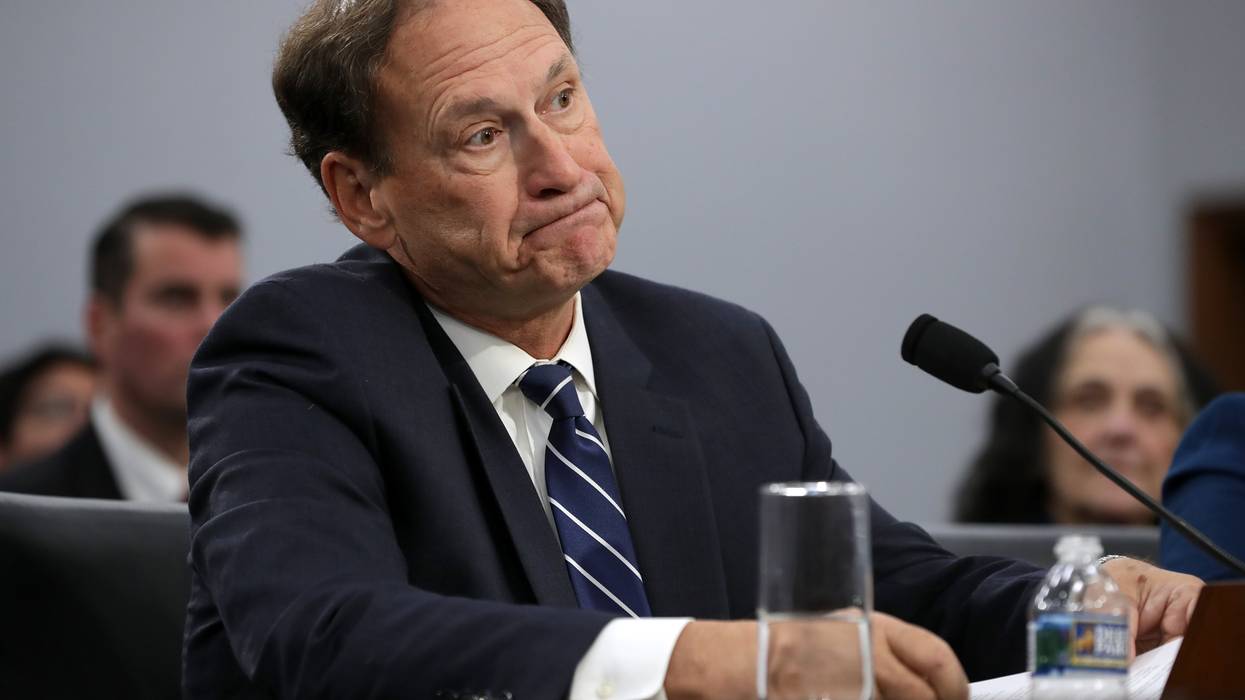
“A reasonable person would think if you’re invested in the industry that could benefit from the outcome of a lawsuit, then you could personally stand to benefit from the outcome," said one critic.
Calls for US Supreme Court Justice Samuel Alito to recuse himself from a major climate case mounted Tuesday after an analysis found that he made as much as $2.9 from oil and gas stocks from roughly the time he joined the nation's highest court in 2005 through 2024.
The analysis by judicial watchdog Court Accountability, reviewed exclusively by The Guardian, found that Alito earned between around $390,000 and $2.9 million from fossil fuel interests during his tenure as a justice.
"Between 2005 and 2024, Alito’s assets—not including his personal residence or other personal property not required to be reported on his financial disclosure—grew from a nominal value of $1.1 million to a value somewhere between $3.4 million and $8.4 million," the analysis states.
"Importantly, much of the Alitos’ oil- and gas-related wealth in this estimate comes from a single asset: a Grady County, Oklahoma property in which Martha-Ann Alito holds a 'mineral interest,'" the publication notes, referring to the right-wing justice's wife. It adds that "divergent values" on his financial disclosures apparently "indicate that Alito has significantly understated the value of the Grady County property."
These revelations come just weeks before the Supreme Court is scheduled to hear Suncor Energy (USA) Inc. v. County Commissioners of Boulder County, a potentially consequential case over whether federal law bars state and local governments from holding fossil fuel companies accountable for climate-related harms.
Progressive watchdogs say Alito's participation presents an obvious appearance of conflict—even though the justice does not currently own shares of either ExxonMobil or Suncor, the companies directly involved in the case. His disclosures show realized gains of between $105,004 and $216,000 from shares of ExxonMobil he owned and sold, and no previous ownership of Suncor shares. The records also show Alito has invested in around a dozen fossil fuel industry companies during his Supreme Court tenure.
“His impartiality may be reasonably questioned in terms of his affinity towards the industry that has helped build his nest egg,” Lisa Graves, co-founder of the judicial ethics watchdog Court Accountability, told The Guardian's Dharna Noor.
“A reasonable person would think if you’re invested in the industry that could benefit from the outcome of a lawsuit, then you could personally stand to benefit from the outcome, even if you don’t hold the stock in the specific company that happens to be the named plaintiff," Graves added.
“His impartiality may be reasonably questioned in terms of his affinity towards the industry that has helped build his nest egg."
Alito has repeatedly ruled in favor of the fossil fuel companies. He also recused himself in this year's Chevron USA v. Plaquemines Parish due to his stock in ConocoPhillips, one of whose subsidiaries is involved in the case.
Court Accountability and other groups recently called on the US Senate to investigate "Alito’s inconsistent history of recusals from cases from which he should be compelled to recuse under long-standing federal law, given his substantial holdings in individual oil and gas companies and other personal ties."
"His irregular recusal practice in oil and gas industry-related cases is undermining public confidence in the impartiality of the court," the groups warned in a May letter to Senate leaders. "They could not occur were he compelled to adhere to enforceable ethics standards against adjudicating cases where he has financial interests or the appearance of a conflict of interest where his impartiality might reasonably be questioned."
Alito has also come under fire for his relationship with Leonard Leo, a key architect of the conservative judicial movement who helped arrange a 2008 Alaska fishing trip for Alito involving billionaire donor Paul Singer, who later had business before the court. Alito did not disclose the private jet travel.
In 2023, the Supreme Court unveiled a code of conduct that was derided by the watchdog group Revolving Door Project (RDP) as a "toothless PR stunt."
“This unenforceable public relations document serves absolutely no purpose other than to permit the media to revert to pretending that our unaccountable and unethical Supreme Court retains legitimacy,” RDP founder and executive director Jeff Hauser said at the time.
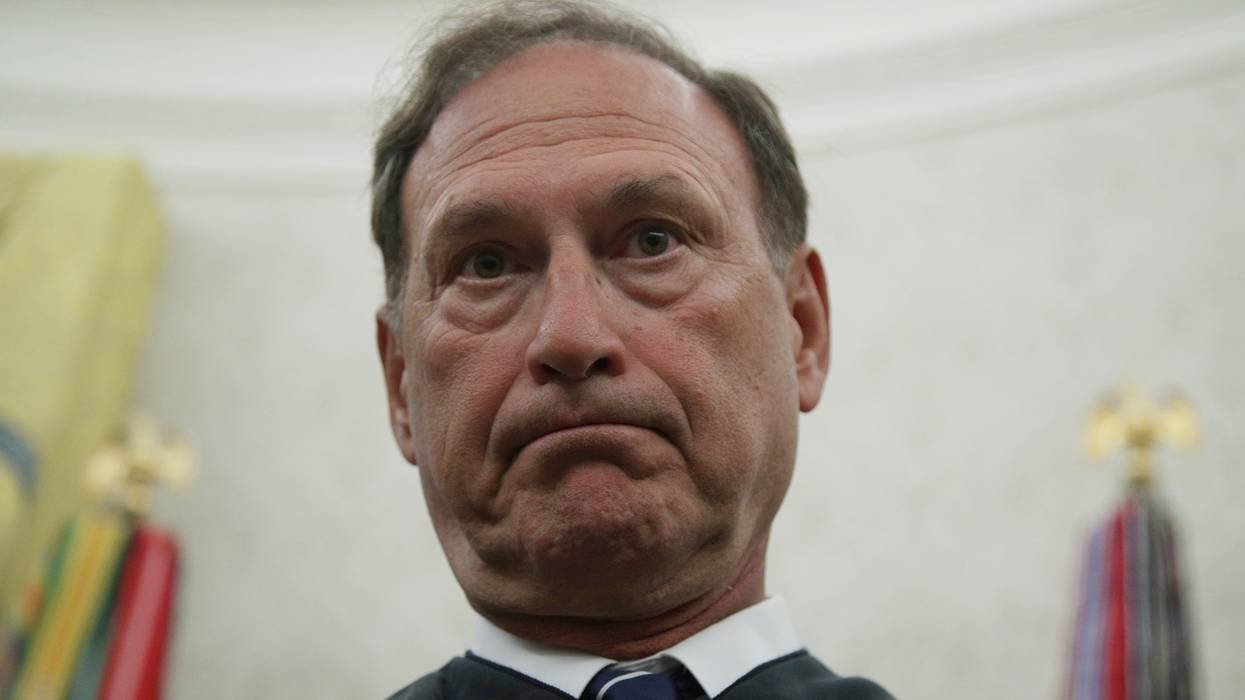
The right-wing Supreme Court justice has a well-established pattern of outbursts that has not subsided with his remarkable success in dragging this country backward.
You might think that an archconservative who has used his lifetime seat on the Supreme Court to send US law back to the 1920s would take a victory lap and maybe chill just a bit. But no. Despite his success in helping to dismantle abortion rights, attacking public-sector labor unions, elevating gun rights, promoting “religious liberty,” and destroying the Voting Rights Act, Justice Samuel Alito Jr. is still seething mad, motivated by ideological extremism and a stack of personal grievances, some dating to his childhood in Trenton, New Jersey.
Alito’s well-established pattern of outbursts was on full view during the court’s June 26 announcement of several late-term rulings. He set the tone for the session by reading a summary of his cruel 6-3 majority opinion that denied political asylum-seekers the right to enter the country before reaching the US-Mexico border (Mullin v. Al Otro Lado). Finishing quickly, he paused before moving on to summarize another of his opinions. Justice Sonia Sotomayor apparently took the break in the action as a cue to read a synopsis of her dissent. Dissenters often refrain from reading their summaries, but there is nothing unusual about them opting to speak up, provided they give advance notice of their intentions.
Sotomayor blasted Alito’s handiwork. “The consequences of today’s decision are predictable,” she said. “More people will die. More people will attempt to cross the border illegally, and some will make it while others will not.” Her remarks apparently enraged Alito, making him look, in the words of NPR’s legal affairs correspondent Nine Totenberg, like “he had just bitten into a lemon.”
“There is much that I would have added to my bench statement had I known there would be a dissent read,” Alito said, uttering remarks that, in the staid confines of the nation’s most august judicial body, were veritable obscenities that prompted audible gasps from spectators and reporters in the gallery. A court spokesperson later clarified that Alito was in fact notified of Sotomayor’s plans, but to date, he has not publicly apologized. Like the president whose policies he almost always supports, Alito invariably overreacts and never recants.
The problem is not that Alito has personal hang-ups—we all do—but that so many of his hang-ups have become the law of the land.
Who can forget Alito sneering on live TV during Obama’s 2010 State of the Union address, mouthing the words “not true” as the president decried the court’s Citizens United opinion and the impact it would have on future elections, including greater foreign influence? Since then, Alito has only gotten more unhinged and offensive, becoming a regular featured speaker at Federalist Society events, railing against the legalization of gay marriage, labeling the Second Amendment and freedom of religion as “unfavored” constitutional rights, and condemning liberals as a threat to civil liberties.
In September 2021, Alito went ballistic after The Atlantic magazine staff writer Adam Serwer penned a column accusing the court’s right-wing majority of releasing a 5-4 shadow-docket ruling on Texas’ newly enacted vigilante abortion law in the middle of the night to minimize public outcry. In an hour-long live-streamed speech delivered at University of Notre Dame, he excoriated the press for portraying the court’s conservatives as “a dangerous cabal that resorts to sneaky and improper methods to get its ways,” and for feeding “unprecedented efforts to intimidate the court or damage it as an independent institution.”
In June 2023, Alito again went off the rails with an op-ed for The Wall Street Journal that lambasted a ProPublica report that in 2008 he took a luxury fishing trip to Alaska, flying for free aboard a private jet owned by Republican megadonor Paul Singer. The problem, according to ProPublica, wasn’t just that Alito had failed to recuse himself from reviewing lawsuits involving Singer’s hedge fund, but that he also failed to note anything about the excursion on the annual financial disclosure forms required under the Ethics in Government Act of 1978.
Claiming he had no duty to reveal the junket, he argued that his spot on the private jet “would have otherwise been an unoccupied seat” if he had not accepted the billionaire’s offer of a free ride, and that gifts of “hospitality” need not be reported. In a follow-up interview with the Journal, he added, “Congress did not create the Supreme Court” and “No provision in the Constitution gives them the authority to regulate the Supreme Court—period.”
Alito’s official court opinions have been equally acerbic and hyperbolic. They arguably reached a crescendo in his 2022 majority opinion overturning Roe v. Wade (Dobbs v. Jackson Women’s Health Organization). Not content with simply overruling the 50-year-old precedent on which US women had come to rely as an essential part of their healthcare, he wrote: “Roe was egregiously wrong from the start. Its reasoning was exceptionally weak, and the decision has had damaging consequences.”
When used by a high court justice, the phrase “egregiously wrong” is an insult and a sign of contempt. And to add further insult, Alito reached deep into the bowels of Anglo-American common law to override Roe, citing the work of Henry de Bracton, a 13th-century English cleric and judge who condemned abortions as homicide, and a 17th-century English jurist who sentenced at least three women accused of using witchcraft to death.
What’s behind Alito’s fury and habit of issuing norm-breaking invective? As Georgia State University law professor Eric Segall told The Wall Street Journal in an article published this month, “Alito thinks of the other side as the enemy.” And true to Segall’s observation, Alito unwittingly admitted as much at the Supreme Court Historical Society’s annual dinner in 2024, when documentary filmmaker Lauren Windsor asked whether there was any way the country could overcome its terrible polarization, then surreptitiously recorded Alito’s answer that “there are differences on fundamental things that really can’t be compromised.”
Like most extremists, Alito has views that derive not just from his abstract political beliefs, but from his lived experiences growing up in a predominantly white Christian community as the son of deeply religious Catholic Italian immigrants, and later as an out-of-place right winger at Princeton University and Yale Law School.
In a revealing new biography, Revenge for the Sixties: Sam Alito and the Triumph of the Conservative Legal Movement, journalist Peter S. Canellos offers a compelling psychological portrait of Alito as a man dismayed by the demographic and secular changes that have transformed and, by his estimation, degraded the country of his boyhood. Alito has been on a mission to reverse those trends ex cathedra from his perch on the Supreme Court.
The problem is not that Alito has personal hang-ups—we all do—but that so many of his hang-ups have become the law of the land. On June 30, NPR’s Totenberg erroneously reported that Alito planned to retire so that President Donald Trump might nominate a younger right-wing zealot to the bench. The story turned out not to be true and was promptly retracted. Too bad for her—and even worse for the country.
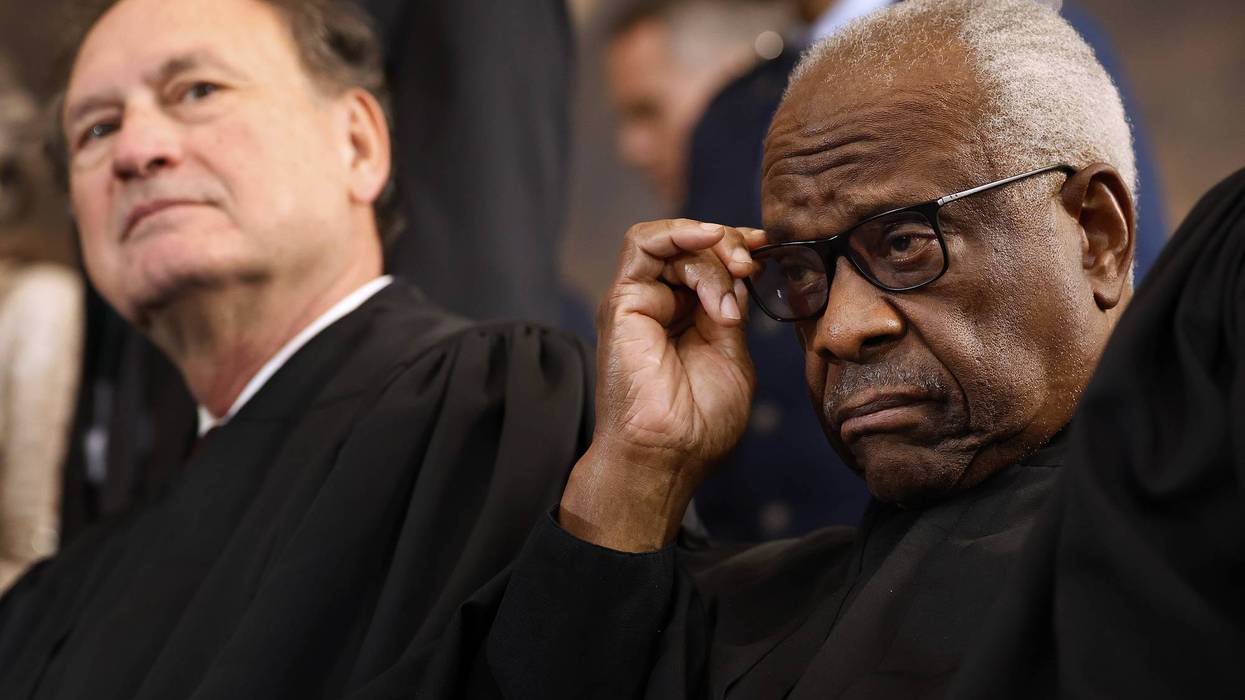
"NPR’s reporting that Justice Alito is retiring was early. But it wasn’t wrong."
Following a series of major US Supreme Court decisions, NPR retracted an erroneous report on Tuesday that conservative Justice Samuel Alito was planning to retire.
But while that report turned out to be false, a progressive legal action group is warning that it pointed to something potentially very real: That President Donald Trump could try to push aging right-wing justices like 76-year-old Alito, as well as 78-year-old Justice Clarence Thomas, to retire early so he can replace them with young judges who can cement a right-wing majority for decades.
"NPR’s reporting that Justice Alito is retiring was early. But it wasn’t wrong," said Josh Orton, the president of Demand Justice, and Ezra Levin, the co-executive director of Indivisible, in a statement on Wednesday. "We know that Donald Trump will do whatever he can to hold onto power, and we are prepared for him trying to force Alito, Thomas, or both off the bench this year, while Republicans still control the Senate and can ram through a replacement."
It's not an unfounded fear. It's something Trump has discussed openly.
In April, the president told Fox Business interviewer Maria Bartiromo that he was "prepared" to appoint as many as three justices before his term is up—perhaps alluding to the possibility that the liberal 72-year-old Justice Sonia Sotomayor could die before the next president is inaugurated or that the 71-year-old conservative Chief Justice John Roberts could retire.
"In theory, it's two—you just read the statistics—it could be two, could be three, could be one," Trump said. "I don't know. I'm prepared to do it."
He called Alito—who authored major decisions to gut abortion rights, allow religious businesses to deny contraceptive coverage to employees, and kneecap public sector unions—"one of the great justices of all time," but added, "It’d be nice to say, now I have somebody for 40 years.”
He also invoked the late Justice Ruth Bader Ginsburg, whom he said “really hurt herself within the Democrat Party" by refusing to retire when Barack Obama was president. After Ginsburg's death in 2020, Trump replaced her with Justice Amy Coney Barrett, who expanded the court's conservative majority to 6-3.
Trump was asked about possible Supreme Court vacancies again in an interview with Breitbart News on Wednesday after NPR jumped the gun on Alito's retirement. The president suggested he was torn.
“Well I think you know, if you listen to people, there are three potential vacancies for various reasons, so I’m certainly prepared,” he said. “There are a lot of great people out there who would like to have that position.”
While he praised Alito, describing himself as the justice's "single biggest fan," he reiterated that putting “a young conservative judge on the bench for 40 years” is a “very important thing." He said that the idea of replacing either Alito or Thomas was a "mixed blessing."
Rumblings of a concerted push for both Alito and Thomas to pack up can be traced back to 2024, when The Washington Post reported that Trump adviser Mike Davis was championing the idea in conservative legal circles.
But neither man has indicated plans to retire at this moment. And if Thomas, who has sat on the bench since 1991, were to retire before the next Congress is sworn in, he'd be stopping less than two years shy of eclipsing William O. Douglas to become the longest-serving Supreme Court justice.
Demand Justice, however, is betting on long-term political power winning the day. The group said it has invested $3 million "to prepare for a 2026 Supreme Court fight."
This will include pressuring Republican senators to reject Trump's pick—particularly those like Sens. Mitch McConnell (Ky.) and Thom Tillis (NC) who are retiring at the end of this term, Sens. John Cornyn (Texas) and Bill Cassidy (La.) who lost their primaries, and Sens. Susan Collins (Maine) and Lisa Murkowski (Alaska), who have (at least rhetorically) broken with Trump more frequently than their GOP colleagues.
Orton and Levin said that "Trump will choose his nominee for one reason: loyalty." They said he'd likely pick somebody who'd validate even his most lawless actions even more than the current justices do—including supporting his efforts to overturn an election result, which the court rejected in 2020.
"We’ll be ready to expose them," Orton and Levin said. "And we’ll be ready to fight."
In majority opinions gutting abortion rights and voting rights, Supreme Court Justice Samuel Alito made crucial errors.
Justice Samuel Alito wrote the conservative majority’s opinions in two of the most consequential Supreme Court decisions in recent years: 1) Dobbs v. Jackson Women’s Health Organization—overruling Roe v. Wade; and 2) Louisiana v. Callais—neutering the Voting Rights Act of 1965. In both cases, Alito recited and relied on asserted “facts” that did not exist.
Ohio State University Prof. Treva Lindsey observed, ”From the nation’s founding through the early 1800s, pre-quickening abortions—that is, abortions before a pregnant person feels fetal movement—were fairly common and even advertised.“
But Alito claimed incorrectly in Dobbs that “no common-law case or authority... remotely suggests a positive right to procure an abortion at any stage of pregnancy” and, in the United States specifically, “an unbroken tradition of prohibiting abortion on pain of criminal punishment persisted from the earliest days of the common law until 1973.”
Writing for the three dissenters, Justice Elena Kagan called Alito “embarrassingly” wrong. There was no such “unbroken tradition,” and historical evidence undermined his claim. But the conservative majority got its desired outcome.
In 2013, Chief Justice John Roberts and the conservative majority began undermining the Voting Rights Act in the Shelby County case. Prior to that decision, states and localities with a history of racial discrimination in voting had to obtain federal approval before making changes to election rules—a process known as preclearance. The state or locality had to prove that any changes would not disadvantage racial and ethnic minorities.
Rewrite history; distort reality; make up facts; overturn longstanding precedent. For Justice Alito—with an occasional assist from Chief Justice Roberts—it’s all in a day’s work.
Roberts argued that the elections of 2008 and 2012—when there was no difference in voter participation rates between Black and white voters (i.e., no “turnout gap”)—meant that the Voting Rights Act had done its job and preclearance could be suspended.
Even at the time, Roberts’ reasoning was suspect. The elections of 2008 and 2012 were anomalies—not the end of the turnout gap—because Barack Obama’s candidacy had driven up Black turnout.
In her dissent, Justice Ruth Bader Ginsburg noted another flaw in Roberts’ logic: “Throwing out preclearance when it has worked and is continuing to work to stop discriminatory changes is like throwing away your umbrella in a rainstorm because you are not getting wet.”
Justice Ginsburg was correct, and now democracy is getting wet. A 2024 study concluded:
The formerly covered states [subject to preclearance] have large nonwhite populations and large turnout gaps, leading to some of the largest statewide turnout distortions in the nation. Put differently, a decade after Shelby County, the turnout gap continues to have a disproportionate impact in precisely the parts of the country that were once covered due to their histories of racially discriminatory voting practices.
Stated simply, “[S]ince 2013, the racial turnout gap around the nation has exploded.”
Justice Alito ignored the exploding turnout gap in striking the fatal blow to the Voting Rights Act on April 29, 2026. For decades previously, the court had ruled repeatedly that a state could not undermine minority voters’ power to choose their desired candidates by drawing legislative districts that dispersed such voters across majority-white districts. Instead, states had to create “majority-minority” districts, thereby assuring minority representation in statehouses and Congress.
In its amicus brief to the court in the Callais case, the Department of Justice (DOJ) ignored the trend after 2013 and argued that majority-minority districts were no longer necessary because “the racial gap in voter registration and turnout had largely disappeared, with minorities registering and voting at levels that sometimes surpassed the majority. Shelby County, 570 U.S. at 547-548.” To emphasize the point, the DOJ observed, “Since 2004, black voters have turned out at higher rates than white voters in two of five presidential elections nationwide and in Louisiana.”
Armed with the Callais decision, Republicans are now racing to eliminate majority-Black districts throughout the country.
Alito parroted the DOJ’s sophistry: “Black voters now participate in elections at similar rates as the rest of the electorate, even turning out at higher rates than white voters in two of the five most recent Presidential elections nationwide and in Louisiana.”
As election experts have observed, Alito’s claim that Black and white turnout reached parity in 2 of the 5 most recent presidential elections “represents egregious cherry-picking. [H]e was not referring to recent elections, but to those in 2008 and 2012—the years that Barack Obama ran for president. In the three most recent presidential elections, the trend shows exactly the opposite. The indisputable fact is the racial turnout gap is widening, and the Roberts Court is partially responsible [because of its Shelby County decision].”
Armed with the Callais decision, Republicans are now racing to eliminate majority-Black districts throughout the country.
Rewrite history; distort reality; make up facts; overturn longstanding precedent. For Justice Alito—with an occasional assist from Chief Justice Roberts—it’s all in a day’s work.
The Monday evening decision "is tantamount to an approval of Louisiana’s rush to pause the ongoing election in order to pass a new map."
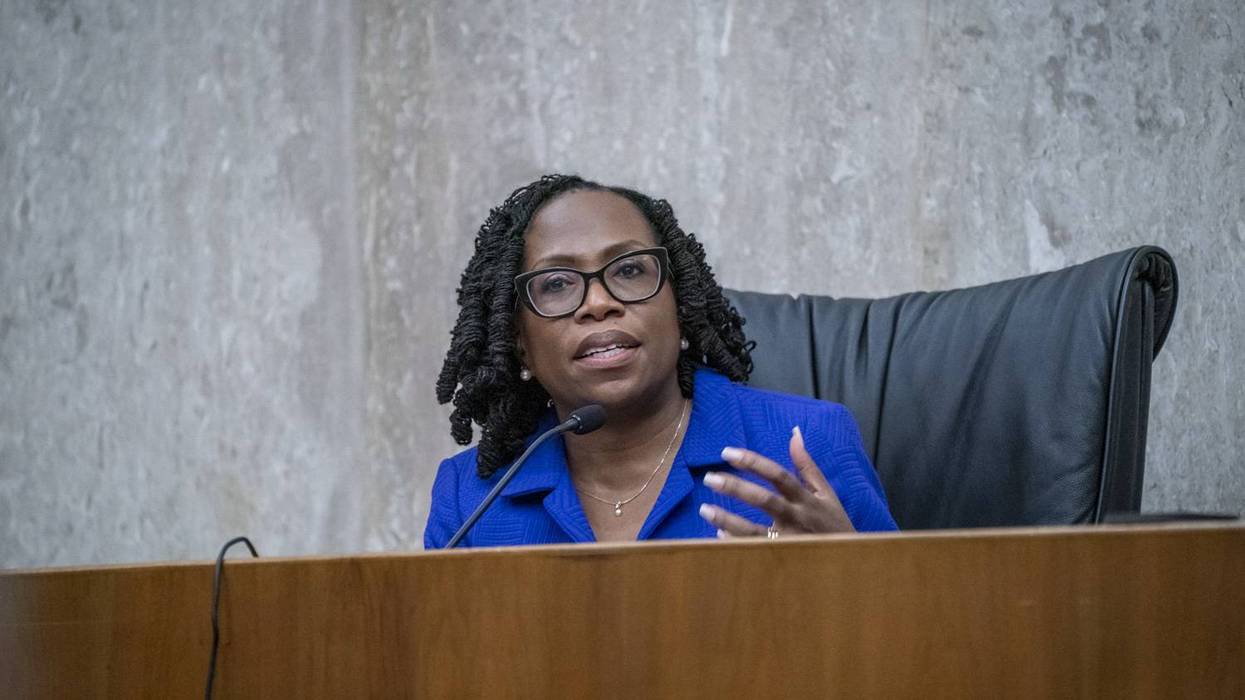
Warning that the US Supreme Court's right-wing majority was appearing to give its approval of Louisiana's decision to suspend federal primary elections in the state following the court's ruling on the state's congressional map last week, Justice Ketanji Brown Jackson on Monday evening was the lone dissenter as the court agreed to immediately finalize the ruling instead of waiting the customary 32 days.
By expediting the ruling, suggested Jackson, the court was taking an obviously political stance in support of efforts to ensure Louisiana Republicans can quickly redraw the state's congressional map to yield more electoral wins for the GOP.
"The court’s decision to buck our usual practice," wrote Jackson, "is tantamount to an approval of Louisiana’s rush to pause the ongoing election in order to pass a new map."
Ordinarily, the court would wait 32 days to transmit an opinion to the lower courts, giving the losing party time to request that the justices reconsider the case.
In a brief, unsigned opinion Monday evening, the court said that the Black voters who had defended the state's 2024 congressional map at the center of Louisiana v. Callais had "not expressed any intent to ask this court to reconsider its judgment.”
In Louisiana v. Callais last week, the court ruled along ideological lines that the 2024 map—which was drawn to better represent the population of Louisiana, where one-third of residents are Black—was an unconstitutional racial gerrymander. The ruling effectively struck down the last remaining provision of Section 2 of the Voting Rights Act, which held that voters of color can challenge racially discriminatory electoral maps.
The map that was struck down ensured there were two majority-minority districts in the state. Louisiana's Republican-controlled legislature is expected to try to eliminate at least one of those districts, with a new map yielding five Republicans and one Democrat in the US House.
In transmitting last week's ruling to the lower courts without delay, the court granted a request from the group of white voters who had challenged the state's map.
"Because it is for the District Court to either draw an interim remedial map or approve a legislative remedy, jurisdiction should be returned to the District Court as soon as possible so that it can oversee an orderly process," wrote the plaintiffs.
The Supreme Court granted the plaintiffs' request days after Republican Gov. Jeff Landry took executive action to suspend the state's US House primaries in an effort to ensure they take place after the new map is drawn.
That action, wrote Jackson on Monday, had "a strong political undercurrent" that the court's latest move appeared to openly endorse.
"Louisiana’s hurried response to the Callais decision unfolds in the midst of an ongoing statewide election, against the backdrop of a pitched redistricting battle among state governments that appear to be acting as proxies for their favored political parties," wrote Jackson, noting that the court has only expedited a decision twice in the last 25 years. "As always, the court has a choice... To avoid the appearance of partiality here, we could, as per usual, opt to stay on the sidelines and take no position by applying our default procedures."
"But, today, the court chooses the opposite. Not content to have decided the law, it now takes steps to influence its implementation," she wrote.
John Bisognano, president of the National Democratic Redistricting Committee, said that the court was going against its practice of following the "Purcell doctrine," which came out of a 2006 Supreme Court order and holds that "courts should not change voting or election rules too close to an election in order to avoid confusion for voters and election officials alike."
The Supreme Court, said Bisognano, "decided to inject itself into an ongoing election and at this point no one can say otherwise."
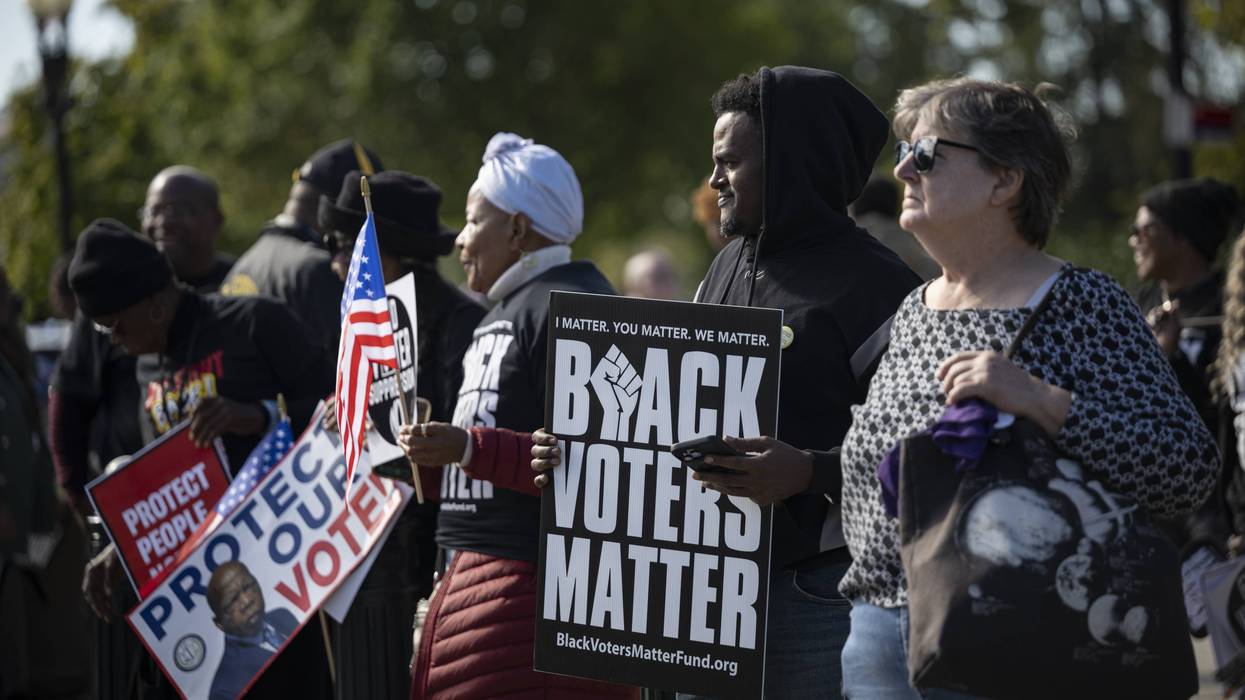
“Make no mistake: This ruling isn’t about the law, it’s about power, and giving Republicans more US House seats they couldn’t otherwise win at the ballot box," said one critic.
The US Supreme Court ruled Wednesday that Louisiana must redraw its 2024 congressional map—which created a second majority-Black district to mitigate persistent barriers to equal representation—in a decision that further guts the already tattered Voting Rights Act.
The justices ruled 6-3 along ideological lines in Louisiana v. Callais that the state's map is "an unconstitutional racial gerrymander," effectively voiding the last remaining provision of Section 2 of the 1965 Voting Rights Act (VRA), which allows voters of color to challenge racially discriminatory electoral maps in court.
The case centers on the redrawing of Louisiana's six congressional districts to better reflect the population of a state in which one-third of the people are Black, as Section 2 states that minority voters should have the same chance as others to elect candidates of their choice.
Civil and voting rights advocates challenged Louisiana's Republican-drawn and racially rigged congressional map. In 2022, a federal judge agreed that the map likely violated Section 2, and the 5th US Circuit Court of Appeals upheld that ruling, ordering Louisiana to draw a new map by January 2024.
Louisiana complied. But a group of non-Black voters challenged the new map, claiming it was a racially rigged creation that violated the 14th Amendment. The Trump administration supported the challengers, arguing that Black voters had no right to a second majority-minority district.
The Supreme Court's right-wing justices—three of whom were nominated by Trump—agreed in Wednesday's decision.
“Allowing race to play any part in government decision-making represents a departure from the constitutional rule that applies in almost every other context,” Justice Samuel Alito wrote for the right-wing majority. “Compliance with Section 2 thus could not justify the state’s use of race-based redistricting here."
Dissenting, Justice Elena Kagan wrote that the ruling represents the "latest chapter in the majority’s now-completed demolition of the Voting Rights Act.”
Kagan said the majority "straight-facedly holds that the Voting Rights Act must be brought low to make the world safe for partisan gerrymanders."
Signed into law in 1965 by then-President Lyndon B. Johnson amid a groundswell of civil rights activism, the VRA was meant to ensure that state and local governments could not “deny or abridge the right of any citizen of the United States to vote on account of race or color.”
However, the law has been eroded in recent decades by Republican-controlled state legislatures across the country, including through racially rigged and other gerrymandered congressional maps, restrictions on voter registration, reduction in early voting options, and voter identification laws. These measures disproportionately disenfranchise minority voters, and some GOP officials have admitted that they are intended to give Republican candidates an electoral edge.
In 2013, the Supreme Court dealt a major blow to the VRA in Shelby County v. Holder, which eviscerated a key section of the law that required jurisdictions with a history of racist disenfranchisement to obtain federal approval prior to altering voting rules. In 2021, the nation’s high court voted 5-4 in Brnovich v. Democratic National Committee to uphold Arizona’s voting restrictions—even as Chief Justice John Roberts acknowledged that they disproportionately affect minorities.
Voting rights defenders decried Wednesday's ruling.
The court’s ruling in Louisiana v. Callais follows cases that have narrowed federal voter protections, like Shelby County v. Holder and Brnovich v. Democratic National Committee.Together, these cases have made it harder for voters of color to challenge discriminatory voting laws and practices.
— ACLU (@aclu.org) April 29, 2026 at 8:20 AM
"This devastating attack from the court majority destroys protections for voters of color across the country," the ACLU said on Bluesky.
"The impacts of the court’s ruling in this case will be felt across the country," the group added. "Redistricting remains ongoing in many states, and the severe weakening of Section 2 may affect future challenges to congressional, legislative, and local maps that dilute the voting strength of communities of color."
NAACP president and CEO Derrick Johnson called the decision "a devastating blow to what remains of the Voting Rights Act, and a license for corrupt politicians who want to rig the system by silencing entire communities."
Kristen Clarke, NAACP's general counsel, said:
This is one of the most consequential and devastating rulings issued by the Supreme Court in the 21st Century. The Supreme Court has put the death knell into our nation's most important federal civil rights law, one that provided Black Americans access to a democracy that they had long been excluded from. The ruling defies precedent, ignores statutory text, and will reverse decades of progress we have made as a nation. This will embolden lawmakers in former slave-holding states to target and eradicate districts that have provided Black Americans a fair opportunity to elect candidates of choice, and they will do so with the blessing of this court. It ignores the tremendous sacrifice made by Americans who bled and died for passage of the Voting Rights Act.
Demand Justice president Josh Orton said in a statement, “Today the Supreme Court gutted the remaining protections of the Voting Rights Act and handed [President] Donald Trump even more unchecked political power as he wields the presidency like a power-mad authoritarian."
“Make no mistake: This ruling isn’t about the law, it’s about power, and giving Republicans more US House seats they couldn’t otherwise win at the ballot box, all while trampling the voting rights of communities of color," Orton added. “Today’s decision is another example of why the Supreme Court has lost both its legitimacy and the trust of the American people. It must face fundamental reform if it is to once again serve our democracy.”
Nourbese Flint, president of the reproductive justice group All* Above All, lamented that "the Supreme Court yet again denies communities of color a voice in their own destiny."
"This is part of a coordinated assault on self-determination, and we have to name it as such," Flint added. "The same court that gutted the Voting Rights Act came for Roe. If we are serious about defending reproductive justice that means we have to defend democracy and reform this extremist court.”
Stand Up America managing director of policy and political affairs Brett Edkins called Wednesday "a tragic day for the freedom to vote and representative democracy."
"The Supreme Court just eviscerated the last remnants of the Voting Rights Act of 1965 and opened the door to even more extreme gerrymandering that will try to drown out the voices of Black and brown voters, particularly in the South," Edkins said.
NEW: The Supreme Court just gutted the Voting Rights Act, enabling the GOP to erase countless districts drawn to protect voters of color at the congressional, state, & local levels.We detailed each Dem VRA congressional seat that the GOP could target by 2028: www.the-downballot.com/p/with-the-v...
[image or embed]
— Stephen Wolf (@stephenwolf.bsky.social) April 29, 2026 at 8:00 AM
"The court’s decision will escalate the arms race of partisan gerrymanders across the country and could lead to Republican-controlled states redrawing election maps to add an additional 19 GOP House seats," Edkins continued. "This partisan court has handed a major election-year gift to Donald Trump and congressional Republicans who are trying to cling to power despite their growing unpopularity with voters."
“It’s time for Congress to act as a check on this rogue court through major reforms," he added, "including term limits, an enforceable code of ethics, and adding more justices who will defend our fundamental freedoms once Trump leaves office.”
"We need to elect people to the Senate who want to wield power like that," the Maine Democratic candidate said.
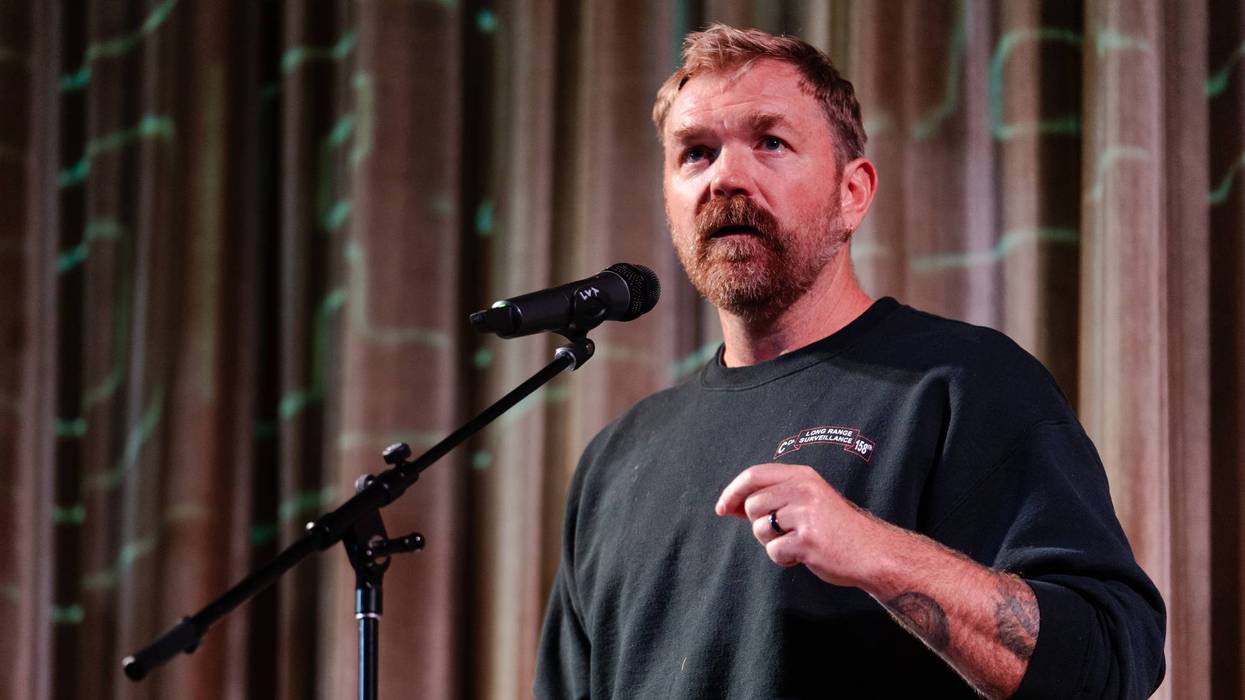
US Senate hopeful Graham Platner wants Democrats to "deal with" the Supreme Court if they retake power in November and launch oversight and possible impeachments to remove justices from office.
Amid President Donald Trump's historic unpopularity, Democrats are heavily favored to retake the House of Representatives and have gained momentum in the Senate, where Platner's bid to unseat five-term incumbent Sen. Susan Collins (R-Maine) could prove decisive.
But the Supreme Court's 6-3 conservative majority has the potential to effectively veto any significant actions a future Democratic Congress or president may seek to take, despite increasing doubts among the American public about its legitimacy and impartiality.
Its image as an independent arbiter of justice has come under further scrutiny as multiple justices have been embroiled in corruption scandals. This is where Platner believes Democrats could have options.
"There is structural power in the Senate to deal with the Supreme Court," the 41-year-old Marine-turned-oyster farmer told a crowd of supporters during an event this weekend.
He said that if Democrats get a majority, "at that point, I very much think that we need to be exercising ethics oversight over the court."
Unlike lower court judges, who must comply with a binding ethics code by avoiding partisan campaigning, disclosing conflicts of interest, and recusing themselves in cases where impartiality may be called into question, Supreme Court justices do not have to adhere to these rules.
Although the Supreme Court did adopt an ethics code for the first time in 2023, it is voluntary, and legal groups like the New York City Bar have described it as unenforceable and far short of what is necessary.
Platner said that "if we held Supreme Court justices to the same standards that we held federal judges, there is a compelling case for the impeachment and removal of at least two."
While he did not specify which two justices he believed could be impeached, it is highly likely that he was referring to Clarence Thomas and Samuel Alito, two of the furthest right justices, whom he has said have helped transform the court into a "political action wing... of conservatism."
In 2023, ProPublica published an investigation exposing that Thomas had, for years, accepted gifts from GOP megadonor Harlan Crow, including trips on his private jet and superyacht, as well as $6,000-per-month tuition for his grandnephew. None of these were reported on the justice's ethics disclosures.
It was also revealed that his wife, Ginni Thomas, was heavily involved with right-wing activist groups with business before the Supreme Court, including those that pushed discredited voter fraud claims to overturn Trump's loss in the 2020 election.
Alito, meanwhile, was revealed to have taken a luxury fishing trip to Alaska with the billionaire hedge fund tycoon Paul Singer, who was directly involved or had financial ties to several entities with business before the court, including a right-wing pro-business group that was pushing to have the court block then-President Joe Biden's student loan forgiveness policy.
The justice has also been accused of expressing support for Christian nationalism after a flag was seen flying outside his residence that appeared to express solidarity with the movement and with those who stormed the US Capitol on January 6, 2021. A documentarian has also published recordings of the justice speaking about how America must be returned to a "place of Godliness."
Some Democrats have also raised the possibility of impeaching Justice Brett Kavanaugh, who has been accused of lying during his confirmation hearings in 2018 when he was faced with allegations of sexual assault from a former classmate.
Right-wing control of the Supreme Court over the past decade has fundamentally altered the American political landscape by rolling back advancements to reproductive and LGBTQ+ rights, gutting the Voting Rights Act, and hindering environmental regulation.
And as Trump has expressed open contempt for constitutional limits on his power, the court has often indulged him, siding with his administration more than 80% of the time in emergency docket rulings during his second term while granting him broad "immunity" from prosecution for crimes committed while in office.
In addition to impeaching justices, Platner has called for Congress to expand the Supreme Court's size the next time a Democrat is in the White House, which can be done with a simple majority vote provided the filibuster is suspended.
"But to make that happen," Platner said, "we need to elect people to the Senate who want to wield power like that, who understand that power matters, that it's real and you can use it."

The Education Department has been at the center of Trump's push to "bring back religion in America" and promote “Judeo‑Christian principles.”
The union for US Department of Education workers has raised alarm about a top department official's display of a flag with Christian nationalist associations that was flown during the January 6, 2021, insurrection at the Capitol building.
The flag was spotted outside the Washington, DC, office of Murray Bessette, the principal deputy assistant secretary in the Office of Planning, Evaluation, and Policy Development, according to a report on Monday from USA Today. However, it's not clear how long it's been displayed there.
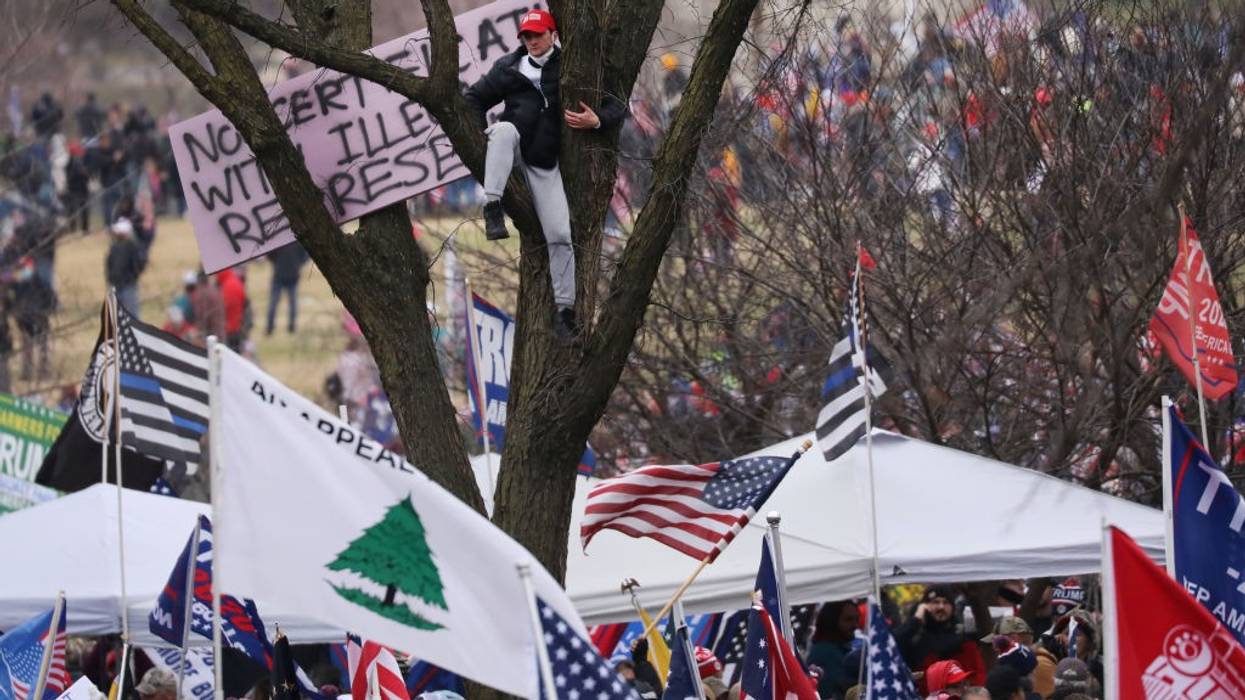
The stark white banner, emblazoned with a pine tree and the phrase "An Appeal to Heaven"—a reference to John Locke's “Second Treatise on Government”—was first used during the American Revolution and flown by six schooner privateers known as "Washington's Cruisers" for naval operations and supply capture missions.
The flag was flown sporadically throughout the 19th and 20th centuries, most prominently in New England. But it remained relatively obscure until recently.
As the Southern Poverty Law Center explained in November, it has undergone a revival among proponents of Christian nationalism over the past decade:
Its affiliation with Christian supremacist politicians largely began in 2013 after being reintroduced as a symbol of supremacy by Dutch Sheets, a highly influential leader in the New Apostolic Reformation, today’s most powerful Christian supremacist movement.
The NAR is an anti-democratic Christian supremacist movement that seeks to control all areas of national life, from the halls of Congress to one’s living room, compelling all Americans to align their lives with NAR’s worldview. According to NAR leaders, those who oppose them are not just wrong but under the control of the demonic, and are even possibly demonic entities themselves.
Sheets, a prominent supporter of President Donald Trump, helped to mobilize thousands of Christian followers to the Capitol leading up to the January 6 riot, where supporters of the president sought to violently overturn the electoral victory of his opponent, former President Joe Biden. The pastor referred to the recognition of Biden's election as "an evil attempt to overthrow the government of the United States of America."
The "Appeal to Heaven" flag was spotted on multiple occasions at the Capitol on that day and at other "Stop the Steal" events protesting Trump's 2020 election loss. It has continued to cause controversy in the years since.
In 2023, the right-wing Supreme Court Justice Samuel Alito was seen flying the flag outside his New Jersey beach house. Alito blamed his wife for the flag flying outside their property just weeks before a documentarian published a secret recording of him expressing his desire to return the country to “a place of godliness,” and agreeing with radical right-wing groups who he said refuse to “negotiate with the left.”
The flag has also been displayed by several Republicans in Congress, including House Speaker Mike Johnson (R-La.), who has expressed many Christian nationalist viewpoints, including a distaste for the idea that the Constitution requires the separation of church and state.
Its appearance outside Bessette's office is not the first time a government agency has displayed the flag during the second Trump presidency. In June, the Small Business Administration also displayed it during a ceremony, though only for about a day, according to Wired.
Rachel Gittleman, the president of the union for Education Department workers nationwide, said in a statement that the agency "has no place for symbols that were carried by insurrectionists."
“Since January, hardworking public servants at the US Department of Education have been subjected to threats, harassment, and sustained demoralization," she added. "Now, they are being asked to work in an environment where a senior leader is prominently displaying an offensive flag—one that, regardless of its origins in the American Revolution, has come to represent intolerance, hatred, and extremism."
The use of a flag with Christian nationalist affiliations is especially noteworthy at the Education Department, which has been at the center of Trump's push to "bring back religion in America" and promote “Judeo‑Christian principles.”
Trump has endorsed state-level policies requiring the Ten Commandments to be posted in classrooms, which he called a "major step in the revival of religion." In September, he also said that he would soon roll out a policy to provide "total protection" for prayer in public schools, which has long been considered unconstitutional when sponsored by school or state officials.
Alito's order came in response to a ruling from a federal court in Texas on Tuesday, which blocked the new congressional maps on the basis that they were "racially gerrymandered."
Supreme Court Justice Samuel Alito on Friday temporarily restored a controversial Trump-backed Texas redistricting plan that could grant Republicans an extra five seats in the House of Representatives.
Alito's order came in response to a ruling from a federal court in Texas on Tuesday, which blocked the redrawn congressional maps on the basis that they were "racially gerrymandered."
"It is ordered that the November 18, 2025 order of the United States District Court for the Western District of Texas, case No. 3:21-cv-259 is hereby administratively stayed pending further order of the undersigned or of the Court," Alito wrote around one hour after Texas appealed the district court's ruling.
Alito was the justice to issue the stay because he handles emergency requests from the Fifth Circuit, which includes Texas.
"Well, the Supreme Court fucked us yet again."
Friday's ruling is not the final say on the fate of Texas' new maps, but allows the state to continue preparations for the 2026 midterm elections under the redistricting while the full Supreme Court considers the case. Texas has asked for a ruling by December 1, one week before the December 8 filling deadline for congressional races. The state is set to hold primary elections in March.
Alito has asked the civil rights organizations fighting to block the maps for more materials by Monday, November 24—a sign, according to Politico, that he planned to put the case "on a fast-track."
Texas was the first state to heed President Donald Trump's request to redraw its maps in order to give Republicans an advantage in the 2026 midterm elections and attempt to prevent the Democrats from retaking the House. In response, Missouri and North Carolina also redrew their maps to give the GOP one extra seat each. However, California voters then retaliated by approving a proposition to redistrict in a way that would see an additional five Democrats elected. All of these plans now face legal challenges.
As the fight for control of the House continues through maps and courts, Texas Democratic activists haven't given up on voters.
"Well, the Supreme Court fucked us yet again," said Allison Campolo, who chairs the Democratic Party of Tarrant County, Texas, on social media Friday, "but—We in Texas know the cavalry doesn't come for us. We save ourselves."
"100 people came out to our party headquarters tonight and we were absolutely PACKED with candidates running for every seat and bench from the top to the bottom of the ticket," Campolo continued. "Texas Democrats are here to save our county, our state, and our country. We'll be seeing you at the polls."
It’s safe to say that Vance Boelter’s actions were at least partially motivated by sycophants and political figures who twisted the Gospel and scripture for their benefit.
It’s easy to look at Vance Boelter, who pleaded not guilty to federal charges for murdering a Minnesota state representative and her husband, and think of him as a deeply unwell individual who took out his personal anger and frustration on civil servants. But there’s more at play here.
The ideology reported to have likely contributed to Boelter’s violence is the same set of beliefs espoused by elected officials across the country, including US House Speaker Mike Johnson (R-La.), who flies a flag symbolic of those beliefs outside his office.
Boelter graduated from Christ for the Nations Institute, a nonaccredited Bible college in Texas, that is reported to be a “stronghold of the New Apostolic Reformation (NAR), the charismatic movement that teaches that Christians are called to take over the US government.” Adherents are taught “to see themselves as agents of the supernatural”—a belief Boelter seems to hold about himself based on correspondence with the New York Times. Notable alumni of the Institute include Lance Wallnau and Dutch Sheets. In addition to their roles as self-appointed NAR prophets, both are influential within MAGA circles and were big proponents of the Big Lie, preaching violence to win power.
The NAR, and the related Seven Mountain Mandate theology championed by Wallnau in particular, is a push for total control of society through any means necessary. The Appeal to Heaven flag, propped up by Sheets and associated with the movement, was proudly flown on January 6, 2021 by insurrectionists storming the Capitol building and infamously outside the home of US Supreme Court Justice Samuel Alito. Its presence outside the speaker’s office makes a clear declaration about Christian nationalism and the dangerous NAR as ever-present forces in the highest offices of power, shaping policies that impact the lives of millions of Americans.
Always painting political opponents as enemies of God and your work as God’s will, and calling on adherents to take up arms—even if the intent is metaphorical—leads adherents to being more open to violence.
Wallnau regularly appeared on Christian media outlets and platforms to prop US President Donald Trump up as a holy savior and has called for “spiritual warfare” and expressed support for political violence in support of Trump. Meanwhile, Sheets’ daily YouTube broadcasts reached more than 200,000 views a day to spread the Big Lie. In fact, Matthew D. Taylor, religious studies scholar and Christian nationalism expert, writes, “No Christian leader did more to mobilize Christians to be in DC on January 6 than Dutch Sheets.”
Though we don’t know how closely Boelter followed Wallnau and Sheets, it’s safe to say that his actions were at least partially motivated by sycophants and political figures who twisted the Gospel and scripture for their benefit.
Certainly, neither of these men told Boelter or anyone else to assassinate anyone or take violent action. However, always painting political opponents as enemies of God and your work as God’s will, and calling on adherents to take up arms—even if the intent is metaphorical—leads adherents to being more open to violence. Nonpartisan research organization PRRI, finds that support for Christian nationalism and adherence to right-wing authoritarian views correlate with acceptance of political violence.
For years, men like Wallnau and Sheets have joined the likes of Michael Flynn, David Barton, Sean Feucht, Charlie Kirk, Lara Locke, Alex Jones, Mike Lindell, Jackson Lahmeyer, current Federal Bureau of Investigations Director Kash Patel, and sitting elected officials, including Rep. Marjorie Taylor Greene (R-Ga.), touring the country through events like ReAwaken America and the Courage Tour. At each stop, they’ve framed their work as a “holy war,” offering speeches steeped in hateful, harmful rhetoric that created a permission structure for violence.
In the immediate aftermath of a tragedy, as happened in Minnesota, when we rush to characterize the perpetrator as a lone wolf, as crazy, we miss the forest for the trees. We begin to normalize the ideologies and conditions that contributed to the violence, risking more harm as they seep more deeply into our culture.
For example, proud evangelical and self-proclaimed “amateur historian” David Barton once called “the most influential evangelist you’ve never heard of,” has secured the ear of lawmakers, both local and national, and has had his fingerprints on “28 bills that have cropped up before 18 states this year,” including my home state of Oklahoma. He’s also one of the leading voices behind the movement to dismantle the US Department of Education—an initiative straight from the pages of Project 2025, which has become the Trump administration’s policy roadmap.
I’ve watched first hand as Oklahoma became a testing ground for Project 2025 and our schools dropped to among the worst in the nation. State Superintendent Ryan Walters has pushed for legislation requiring the Ten Commandments to be displayed in every classroom. Walters even went so far as to buy Bibles branded with Trump’s name, which he intended to place in every classroom in the state, while seeking to force teachers to teach liturgy instead of literacy.
We cannot, therefore, divorce what happened in Minnesota from the actions on Capitol Hill, in state legislatures, or at school board meetings across the country, for they are bound by an ideology that preaches power by any means necessary.