SUBSCRIBE TO OUR FREE NEWSLETTER
Daily news & progressive opinion—funded by the people, not the corporations—delivered straight to your inbox.
5
#000000
#FFFFFF
To donate by check, phone, or other method, see our More Ways to Give page.
Daily news & progressive opinion—funded by the people, not the corporations—delivered straight to your inbox.
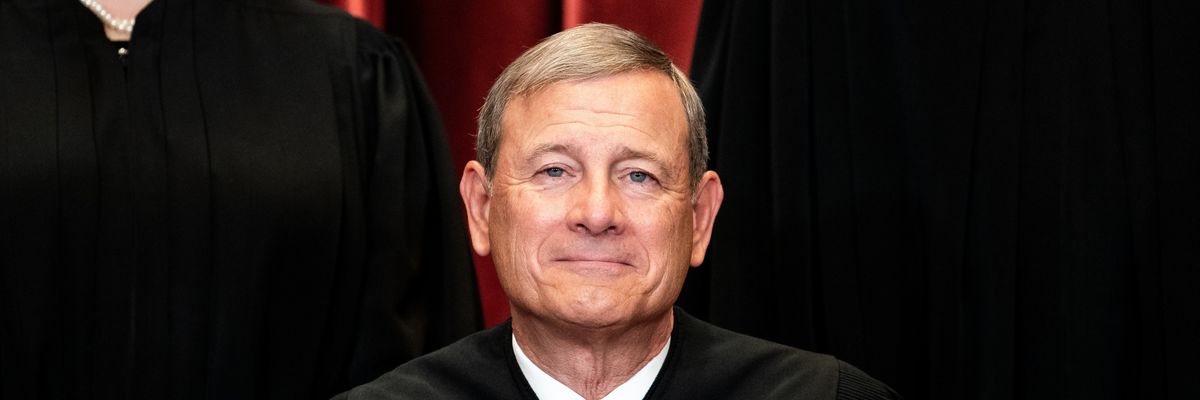
Chief U.S. Supreme Court Justice John Roberts sits during a group photo in Washington, D.C. on April 23, 2021.
"Make no mistake—more people will get sick, injured, or die as a result of today's decision," said one advocate.
The U.S. Supreme Court's conservative supermajority delivered corporate polluters, anti-abortion campaigners, and other right-wing interests a major victory Friday by overturning the so-called Chevron doctrine, a deeply engrained legal precedent whose demise could spell disaster for public health and the climate.
The high court's 6-3 ruling along ideological lines in Loper Bright Enterprises v. Raimondo and Relentless, Inc. v. Department of Commerce significantly constrains the regulatory authority of federal agencies tasked with crafting rules on a range of critical matters, from worker protection to the climate to drug safety.
The majority's decision was written by Chief Justice John Roberts.
"The weight of human suffering likely to arise from this decision should keep the justices up at night," said Emily Peterson-Cassin of Demand Progress, a watchdog group that called the decision "a gift to corporate greed."
"The Supreme Court is threatening safeguards that protect hundreds of millions of people from unsafe products, bad medicines, dangerous chemicals, illegal scams, and more," Peterson-Cassin added. "By handing policy decisions usually deliberated over by experts to lower level judges, the Supreme Court has set off a seismic political shift that primarily serves only the most powerful corporate interests."
Stand Up America executive director Christina Harvey issued a similarly stark warning: "Make no mistake—more people will get sick, injured, or die as a result of today's decision. Some ramifications of this decision won't be felt for decades, but they will be felt."
The Chevron doctrine, which stemmed from the high court's 1984 ruling in Chevron v. Natural Resources Defense Council, held that judges should defer to federal agencies' reasonable interpretation of a law if Congress has not specifically addressed the issue.
In her dissent, liberal Justice Elena Kagan wrote that the consequences of upending Chevron could be vast given that it underpinned "thousands of judicial decisions" and has "become part of the warp and woof of modern government, supporting regulatory efforts of all kinds—to name a few, keeping air and water clean, food and drugs safe, and financial markets honest."
Kagan noted that unlike the Supreme Court, federal agencies are staffed with experts that should be granted deference to interpret ambiguities in laws written by Congress, which "knows that it does not—in fact cannot—write perfectly complete regulatory statutes."
"When does an alpha amino acid polymer qualify as a 'protein'?" Kagan asked. "I don't know many judges who would feel confident resolving that issue... But the [Food and Drug Administration] likely has scores of scientists on staff who can think intelligently about it, maybe collaborate with each other on its finer points, and arrive at a sensible answer."
By overturning the Chevron doctrine, the liberal justice wrote, the Supreme Court's majority demonstrated that it "disdains restraint, and grasps for power."
"This is the outcome of a multidecade crusade by big business and right-wing extremists to gut federal agencies tasked with protecting Americans’ health and safety."
An array of right-wing and industry organizations—including groups with ties to the Koch network and Federalist Society co-chairman Leonard Leo—pushed the Supreme Court to scrap the Chevron doctrine, and Friday's decision could embolden separate legal challenges.
"Anti-abortion activists are celebrating the ruling as a big win for their plans to further restrict medication abortion," The New York Times reported Friday, citing a strategist for Students for Life who said that "getting rid of Chevron is the first domino to fall."
"They see the decision as a new precedent that can work in their favor as they seek to bring another case against the Food and Drug Administration to the Supreme Court, which rejected their bid to undo the FDA's approval of the drug earlier in June," the Times added.
Climate advocates warned the ruling could also be devastating for the planet, potentially hamstringing the Environmental Protection Agency and other departments as they attempt to rein in planet-warming pollution using existing law. The American Petroleum Institute, the U.S. oil and gas industry's largest lobbying group, celebrated Friday's ruling as environmentalists voiced dismay.
"Today's reckless but unsurprising decision from this far-right court is a triumph for corporate polluters that seek to dismantle commonsense regulations protecting clean air, clean water, and a livable climate future," said Food and Water Watch executive director Wenonah Hauter. "This decision brings into sharp relief the critical importance of electing presidents who will appoint Supreme Court justices guided by science and sound legal precedent."
Rep. Pramila Jayapal (D-Wash.), chair of the Congressional Progressive Caucus, said that Friday's ruling "by an extremist Supreme Court eviscerates four decades of legal precedent that protects Americans' rights to clean air and water, safe workplaces, and healthcare by preventing the dedicated civil-servant experts who staff our federal agencies from implementing the laws enacted by Congress."
"That is why Congress must immediately pass my Stop Corporate Capture Act, the only bill that codifies Chevron deference, strengthens the federal-agency rulemaking process, and ensures that rulemaking is guided by the public interest—not what's good for wealthy corporations," said Jayapal. "Make no mistake: This is the outcome of a multidecade crusade by big business and right-wing extremists to gut federal agencies tasked with protecting Americans' health and safety to instead benefit corporations aiming to dismantle regulations and boost their profits."
Dear Common Dreams reader, It’s been nearly 30 years since I co-founded Common Dreams with my late wife, Lina Newhouser. We had the radical notion that journalism should serve the public good, not corporate profits. It was clear to us from the outset what it would take to build such a project. No paid advertisements. No corporate sponsors. No millionaire publisher telling us what to think or do. Many people said we wouldn't last a year, but we proved those doubters wrong. Together with a tremendous team of journalists and dedicated staff, we built an independent media outlet free from the constraints of profits and corporate control. Our mission has always been simple: To inform. To inspire. To ignite change for the common good. Building Common Dreams was not easy. Our survival was never guaranteed. When you take on the most powerful forces—Wall Street greed, fossil fuel industry destruction, Big Tech lobbyists, and uber-rich oligarchs who have spent billions upon billions rigging the economy and democracy in their favor—the only bulwark you have is supporters who believe in your work. But here’s the urgent message from me today. It's never been this bad out there. And it's never been this hard to keep us going. At the very moment Common Dreams is most needed, the threats we face are intensifying. We need your support now more than ever. We don't accept corporate advertising and never will. We don't have a paywall because we don't think people should be blocked from critical news based on their ability to pay. Everything we do is funded by the donations of readers like you. When everyone does the little they can afford, we are strong. But if that support retreats or dries up, so do we. Will you donate now to make sure Common Dreams not only survives but thrives? —Craig Brown, Co-founder |
The U.S. Supreme Court's conservative supermajority delivered corporate polluters, anti-abortion campaigners, and other right-wing interests a major victory Friday by overturning the so-called Chevron doctrine, a deeply engrained legal precedent whose demise could spell disaster for public health and the climate.
The high court's 6-3 ruling along ideological lines in Loper Bright Enterprises v. Raimondo and Relentless, Inc. v. Department of Commerce significantly constrains the regulatory authority of federal agencies tasked with crafting rules on a range of critical matters, from worker protection to the climate to drug safety.
The majority's decision was written by Chief Justice John Roberts.
"The weight of human suffering likely to arise from this decision should keep the justices up at night," said Emily Peterson-Cassin of Demand Progress, a watchdog group that called the decision "a gift to corporate greed."
"The Supreme Court is threatening safeguards that protect hundreds of millions of people from unsafe products, bad medicines, dangerous chemicals, illegal scams, and more," Peterson-Cassin added. "By handing policy decisions usually deliberated over by experts to lower level judges, the Supreme Court has set off a seismic political shift that primarily serves only the most powerful corporate interests."
Stand Up America executive director Christina Harvey issued a similarly stark warning: "Make no mistake—more people will get sick, injured, or die as a result of today's decision. Some ramifications of this decision won't be felt for decades, but they will be felt."
The Chevron doctrine, which stemmed from the high court's 1984 ruling in Chevron v. Natural Resources Defense Council, held that judges should defer to federal agencies' reasonable interpretation of a law if Congress has not specifically addressed the issue.
In her dissent, liberal Justice Elena Kagan wrote that the consequences of upending Chevron could be vast given that it underpinned "thousands of judicial decisions" and has "become part of the warp and woof of modern government, supporting regulatory efforts of all kinds—to name a few, keeping air and water clean, food and drugs safe, and financial markets honest."
Kagan noted that unlike the Supreme Court, federal agencies are staffed with experts that should be granted deference to interpret ambiguities in laws written by Congress, which "knows that it does not—in fact cannot—write perfectly complete regulatory statutes."
"When does an alpha amino acid polymer qualify as a 'protein'?" Kagan asked. "I don't know many judges who would feel confident resolving that issue... But the [Food and Drug Administration] likely has scores of scientists on staff who can think intelligently about it, maybe collaborate with each other on its finer points, and arrive at a sensible answer."
By overturning the Chevron doctrine, the liberal justice wrote, the Supreme Court's majority demonstrated that it "disdains restraint, and grasps for power."
"This is the outcome of a multidecade crusade by big business and right-wing extremists to gut federal agencies tasked with protecting Americans’ health and safety."
An array of right-wing and industry organizations—including groups with ties to the Koch network and Federalist Society co-chairman Leonard Leo—pushed the Supreme Court to scrap the Chevron doctrine, and Friday's decision could embolden separate legal challenges.
"Anti-abortion activists are celebrating the ruling as a big win for their plans to further restrict medication abortion," The New York Times reported Friday, citing a strategist for Students for Life who said that "getting rid of Chevron is the first domino to fall."
"They see the decision as a new precedent that can work in their favor as they seek to bring another case against the Food and Drug Administration to the Supreme Court, which rejected their bid to undo the FDA's approval of the drug earlier in June," the Times added.
Climate advocates warned the ruling could also be devastating for the planet, potentially hamstringing the Environmental Protection Agency and other departments as they attempt to rein in planet-warming pollution using existing law. The American Petroleum Institute, the U.S. oil and gas industry's largest lobbying group, celebrated Friday's ruling as environmentalists voiced dismay.
"Today's reckless but unsurprising decision from this far-right court is a triumph for corporate polluters that seek to dismantle commonsense regulations protecting clean air, clean water, and a livable climate future," said Food and Water Watch executive director Wenonah Hauter. "This decision brings into sharp relief the critical importance of electing presidents who will appoint Supreme Court justices guided by science and sound legal precedent."
Rep. Pramila Jayapal (D-Wash.), chair of the Congressional Progressive Caucus, said that Friday's ruling "by an extremist Supreme Court eviscerates four decades of legal precedent that protects Americans' rights to clean air and water, safe workplaces, and healthcare by preventing the dedicated civil-servant experts who staff our federal agencies from implementing the laws enacted by Congress."
"That is why Congress must immediately pass my Stop Corporate Capture Act, the only bill that codifies Chevron deference, strengthens the federal-agency rulemaking process, and ensures that rulemaking is guided by the public interest—not what's good for wealthy corporations," said Jayapal. "Make no mistake: This is the outcome of a multidecade crusade by big business and right-wing extremists to gut federal agencies tasked with protecting Americans' health and safety to instead benefit corporations aiming to dismantle regulations and boost their profits."
The U.S. Supreme Court's conservative supermajority delivered corporate polluters, anti-abortion campaigners, and other right-wing interests a major victory Friday by overturning the so-called Chevron doctrine, a deeply engrained legal precedent whose demise could spell disaster for public health and the climate.
The high court's 6-3 ruling along ideological lines in Loper Bright Enterprises v. Raimondo and Relentless, Inc. v. Department of Commerce significantly constrains the regulatory authority of federal agencies tasked with crafting rules on a range of critical matters, from worker protection to the climate to drug safety.
The majority's decision was written by Chief Justice John Roberts.
"The weight of human suffering likely to arise from this decision should keep the justices up at night," said Emily Peterson-Cassin of Demand Progress, a watchdog group that called the decision "a gift to corporate greed."
"The Supreme Court is threatening safeguards that protect hundreds of millions of people from unsafe products, bad medicines, dangerous chemicals, illegal scams, and more," Peterson-Cassin added. "By handing policy decisions usually deliberated over by experts to lower level judges, the Supreme Court has set off a seismic political shift that primarily serves only the most powerful corporate interests."
Stand Up America executive director Christina Harvey issued a similarly stark warning: "Make no mistake—more people will get sick, injured, or die as a result of today's decision. Some ramifications of this decision won't be felt for decades, but they will be felt."
The Chevron doctrine, which stemmed from the high court's 1984 ruling in Chevron v. Natural Resources Defense Council, held that judges should defer to federal agencies' reasonable interpretation of a law if Congress has not specifically addressed the issue.
In her dissent, liberal Justice Elena Kagan wrote that the consequences of upending Chevron could be vast given that it underpinned "thousands of judicial decisions" and has "become part of the warp and woof of modern government, supporting regulatory efforts of all kinds—to name a few, keeping air and water clean, food and drugs safe, and financial markets honest."
Kagan noted that unlike the Supreme Court, federal agencies are staffed with experts that should be granted deference to interpret ambiguities in laws written by Congress, which "knows that it does not—in fact cannot—write perfectly complete regulatory statutes."
"When does an alpha amino acid polymer qualify as a 'protein'?" Kagan asked. "I don't know many judges who would feel confident resolving that issue... But the [Food and Drug Administration] likely has scores of scientists on staff who can think intelligently about it, maybe collaborate with each other on its finer points, and arrive at a sensible answer."
By overturning the Chevron doctrine, the liberal justice wrote, the Supreme Court's majority demonstrated that it "disdains restraint, and grasps for power."
"This is the outcome of a multidecade crusade by big business and right-wing extremists to gut federal agencies tasked with protecting Americans’ health and safety."
An array of right-wing and industry organizations—including groups with ties to the Koch network and Federalist Society co-chairman Leonard Leo—pushed the Supreme Court to scrap the Chevron doctrine, and Friday's decision could embolden separate legal challenges.
"Anti-abortion activists are celebrating the ruling as a big win for their plans to further restrict medication abortion," The New York Times reported Friday, citing a strategist for Students for Life who said that "getting rid of Chevron is the first domino to fall."
"They see the decision as a new precedent that can work in their favor as they seek to bring another case against the Food and Drug Administration to the Supreme Court, which rejected their bid to undo the FDA's approval of the drug earlier in June," the Times added.
Climate advocates warned the ruling could also be devastating for the planet, potentially hamstringing the Environmental Protection Agency and other departments as they attempt to rein in planet-warming pollution using existing law. The American Petroleum Institute, the U.S. oil and gas industry's largest lobbying group, celebrated Friday's ruling as environmentalists voiced dismay.
"Today's reckless but unsurprising decision from this far-right court is a triumph for corporate polluters that seek to dismantle commonsense regulations protecting clean air, clean water, and a livable climate future," said Food and Water Watch executive director Wenonah Hauter. "This decision brings into sharp relief the critical importance of electing presidents who will appoint Supreme Court justices guided by science and sound legal precedent."
Rep. Pramila Jayapal (D-Wash.), chair of the Congressional Progressive Caucus, said that Friday's ruling "by an extremist Supreme Court eviscerates four decades of legal precedent that protects Americans' rights to clean air and water, safe workplaces, and healthcare by preventing the dedicated civil-servant experts who staff our federal agencies from implementing the laws enacted by Congress."
"That is why Congress must immediately pass my Stop Corporate Capture Act, the only bill that codifies Chevron deference, strengthens the federal-agency rulemaking process, and ensures that rulemaking is guided by the public interest—not what's good for wealthy corporations," said Jayapal. "Make no mistake: This is the outcome of a multidecade crusade by big business and right-wing extremists to gut federal agencies tasked with protecting Americans' health and safety to instead benefit corporations aiming to dismantle regulations and boost their profits."