SUBSCRIBE TO OUR FREE NEWSLETTER
Daily news & progressive opinion—funded by the people, not the corporations—delivered straight to your inbox.
5
#000000
#FFFFFF
To donate by check, phone, or other method, see our More Ways to Give page.
Daily news & progressive opinion—funded by the people, not the corporations—delivered straight to your inbox.
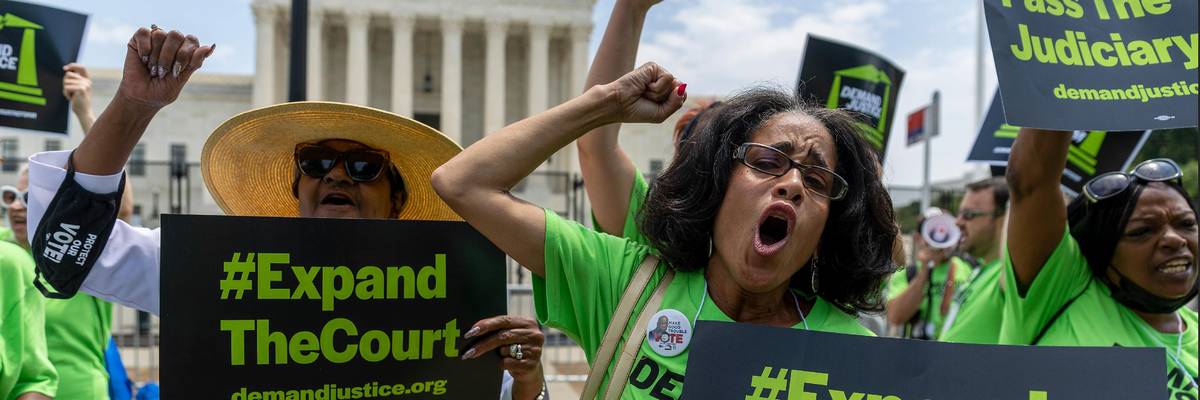
Activists for expanding the U.S. Supreme Court rally outside the nation's highest court in Washington, D.C. on June 22, 2022. (Photo: Tasos Katopodis/Getty Images for Demand Justice)
Friends,
On June 30, the Supreme Court agreed to hear a case called Moore v. Harper. With all the controversial decisions handed down by the Court this term, its decision to take up this case slid under most radar detectors. But it could be the most dangerous case on the Court's upcoming docket. You need to know about it.
As this Supreme Court shows, the future of our democracy is not guaranteed.
Here's the background: Last February, the North Carolina Supreme Court blocked the state's Republican controlled general assembly from instituting a newly drawn congressional district map, holding that the map violated the state constitutional ban on partisan gerrymandering. The Republican Speaker of the North Carolina House appealed the decision to the U.S. Supreme Court, advancing what's called the "independent state legislature" theory. It's a theory that's been circulating for years in right-wing circles. It holds that the U.S. Constitution gives state legislatures alone the power to regulate federal elections in their states.
We've already had a preview of what this theory could mean. It underpins a major legal strategy in Trump's attempted coup: the argument that state legislatures can substitute their own judgment of who should be president in place of the person chosen by a majority of voters. This was the core of the so-called "Eastman memo" that Trump relied on (and continues to rely on) in seeking to decertify Biden's election.
The U.S. Constitution does grant state legislatures the authority to prescribe "the Times, Places and Manner of holding Elections." But it does not give state legislatures total power over our democracy. In fact, for the last century, the Supreme Court has repeatedly rejected the independent state legislature theory.
Yet if we know anything about the conservative majority now controlling the Supreme Court, it's that they will rule on just about anything that suits the far-right's agenda.
Conservatives on the Court have already paved the way for this bonkers idea. Then-Chief Justice William Rehnquist was an early proponent. In his concurring opinion in Bush v. Gore, the 2000 case that halted the recount in Florida in the presidential election, Rehnquist (in an opinion joined by Justices Antonin Scalia and Clarence Thomas) asserted that because the state court's recount conflicted with deadlines set by the state legislature for the election, the court's recount could not stand.
The issue returned to the Supreme Court in 2020, when the justices turned down a request by Pennsylvania Republicans to fast-track their challenge to a Pennsylvania Supreme Court ruling that required state election officials to count mail-in ballots received within three days of Election Day. In an opinion that accompanied the court's order, Justice Alito (joined by Justices Clarence Thomas and Neil Gorsuch) suggested that the state supreme court's decision to extend the deadline for counting ballots likely violated the U.S. Constitution because it intruded on the state legislature's decision making.
Make no mistake. The independent state legislature theory would make it easier for state legislatures to pull all sorts of additional election chicanery, without any oversight from state courts: ever more voter suppression laws, gerrymandered maps, and laws eliminating the power of election commissions and secretaries of state to protect elections.
If the Supreme Court adopts the independent state legislature theory, it wouldn't just be throwing out a century of its own precedent. It would be rejecting the lessons that inspired the Framers to write the Constitution in the first place: that it's dangerous to give state legislatures unchecked power, as they had under the Articles of Confederation.
The Republican Party and the conservative majority on the Supreme Court call themselves "originalists" who find the meaning of the Constitution in the intent of the Farmers. But they really don't give a damn what the Framers thought. They care only about imposing their own retrograde and anti-democracy ideology on the United States.
But we can fight back.
First, Congress must expand the Supreme Court to add balance to a branch of government that has been stolen by radicalized Republicans. This is not a far-fetched idea. The Constitution doesn't specify how many justices there should be - and we've already changed the size of the Court seven times in American history.
Second, Congress must impose term limits on Supreme Court justices, and have them rotate with judges on the U.S. courts of appeals.
Third, Congress must restore federal voting rights protections and expand access to the ballot box. We need national minimum standards for voting in our democracy.
Obviously, these reforms can happen only if Democrats retain control of the House in the midterm elections and add at least two more Democratic senators--willing to reform or abolish the filibuster.
So your vote is critical, and not just in federal elections. Make sure you also vote for state legislators who understand what's at stake to preserve our democracy. Because, as this Supreme Court shows, the future of our democracy is not guaranteed.
Dear Common Dreams reader, It’s been nearly 30 years since I co-founded Common Dreams with my late wife, Lina Newhouser. We had the radical notion that journalism should serve the public good, not corporate profits. It was clear to us from the outset what it would take to build such a project. No paid advertisements. No corporate sponsors. No millionaire publisher telling us what to think or do. Many people said we wouldn't last a year, but we proved those doubters wrong. Together with a tremendous team of journalists and dedicated staff, we built an independent media outlet free from the constraints of profits and corporate control. Our mission has always been simple: To inform. To inspire. To ignite change for the common good. Building Common Dreams was not easy. Our survival was never guaranteed. When you take on the most powerful forces—Wall Street greed, fossil fuel industry destruction, Big Tech lobbyists, and uber-rich oligarchs who have spent billions upon billions rigging the economy and democracy in their favor—the only bulwark you have is supporters who believe in your work. But here’s the urgent message from me today. It's never been this bad out there. And it's never been this hard to keep us going. At the very moment Common Dreams is most needed, the threats we face are intensifying. We need your support now more than ever. We don't accept corporate advertising and never will. We don't have a paywall because we don't think people should be blocked from critical news based on their ability to pay. Everything we do is funded by the donations of readers like you. When everyone does the little they can afford, we are strong. But if that support retreats or dries up, so do we. Will you donate now to make sure Common Dreams not only survives but thrives? —Craig Brown, Co-founder |
Friends,
On June 30, the Supreme Court agreed to hear a case called Moore v. Harper. With all the controversial decisions handed down by the Court this term, its decision to take up this case slid under most radar detectors. But it could be the most dangerous case on the Court's upcoming docket. You need to know about it.
As this Supreme Court shows, the future of our democracy is not guaranteed.
Here's the background: Last February, the North Carolina Supreme Court blocked the state's Republican controlled general assembly from instituting a newly drawn congressional district map, holding that the map violated the state constitutional ban on partisan gerrymandering. The Republican Speaker of the North Carolina House appealed the decision to the U.S. Supreme Court, advancing what's called the "independent state legislature" theory. It's a theory that's been circulating for years in right-wing circles. It holds that the U.S. Constitution gives state legislatures alone the power to regulate federal elections in their states.
We've already had a preview of what this theory could mean. It underpins a major legal strategy in Trump's attempted coup: the argument that state legislatures can substitute their own judgment of who should be president in place of the person chosen by a majority of voters. This was the core of the so-called "Eastman memo" that Trump relied on (and continues to rely on) in seeking to decertify Biden's election.
The U.S. Constitution does grant state legislatures the authority to prescribe "the Times, Places and Manner of holding Elections." But it does not give state legislatures total power over our democracy. In fact, for the last century, the Supreme Court has repeatedly rejected the independent state legislature theory.
Yet if we know anything about the conservative majority now controlling the Supreme Court, it's that they will rule on just about anything that suits the far-right's agenda.
Conservatives on the Court have already paved the way for this bonkers idea. Then-Chief Justice William Rehnquist was an early proponent. In his concurring opinion in Bush v. Gore, the 2000 case that halted the recount in Florida in the presidential election, Rehnquist (in an opinion joined by Justices Antonin Scalia and Clarence Thomas) asserted that because the state court's recount conflicted with deadlines set by the state legislature for the election, the court's recount could not stand.
The issue returned to the Supreme Court in 2020, when the justices turned down a request by Pennsylvania Republicans to fast-track their challenge to a Pennsylvania Supreme Court ruling that required state election officials to count mail-in ballots received within three days of Election Day. In an opinion that accompanied the court's order, Justice Alito (joined by Justices Clarence Thomas and Neil Gorsuch) suggested that the state supreme court's decision to extend the deadline for counting ballots likely violated the U.S. Constitution because it intruded on the state legislature's decision making.
Make no mistake. The independent state legislature theory would make it easier for state legislatures to pull all sorts of additional election chicanery, without any oversight from state courts: ever more voter suppression laws, gerrymandered maps, and laws eliminating the power of election commissions and secretaries of state to protect elections.
If the Supreme Court adopts the independent state legislature theory, it wouldn't just be throwing out a century of its own precedent. It would be rejecting the lessons that inspired the Framers to write the Constitution in the first place: that it's dangerous to give state legislatures unchecked power, as they had under the Articles of Confederation.
The Republican Party and the conservative majority on the Supreme Court call themselves "originalists" who find the meaning of the Constitution in the intent of the Farmers. But they really don't give a damn what the Framers thought. They care only about imposing their own retrograde and anti-democracy ideology on the United States.
But we can fight back.
First, Congress must expand the Supreme Court to add balance to a branch of government that has been stolen by radicalized Republicans. This is not a far-fetched idea. The Constitution doesn't specify how many justices there should be - and we've already changed the size of the Court seven times in American history.
Second, Congress must impose term limits on Supreme Court justices, and have them rotate with judges on the U.S. courts of appeals.
Third, Congress must restore federal voting rights protections and expand access to the ballot box. We need national minimum standards for voting in our democracy.
Obviously, these reforms can happen only if Democrats retain control of the House in the midterm elections and add at least two more Democratic senators--willing to reform or abolish the filibuster.
So your vote is critical, and not just in federal elections. Make sure you also vote for state legislators who understand what's at stake to preserve our democracy. Because, as this Supreme Court shows, the future of our democracy is not guaranteed.
Friends,
On June 30, the Supreme Court agreed to hear a case called Moore v. Harper. With all the controversial decisions handed down by the Court this term, its decision to take up this case slid under most radar detectors. But it could be the most dangerous case on the Court's upcoming docket. You need to know about it.
As this Supreme Court shows, the future of our democracy is not guaranteed.
Here's the background: Last February, the North Carolina Supreme Court blocked the state's Republican controlled general assembly from instituting a newly drawn congressional district map, holding that the map violated the state constitutional ban on partisan gerrymandering. The Republican Speaker of the North Carolina House appealed the decision to the U.S. Supreme Court, advancing what's called the "independent state legislature" theory. It's a theory that's been circulating for years in right-wing circles. It holds that the U.S. Constitution gives state legislatures alone the power to regulate federal elections in their states.
We've already had a preview of what this theory could mean. It underpins a major legal strategy in Trump's attempted coup: the argument that state legislatures can substitute their own judgment of who should be president in place of the person chosen by a majority of voters. This was the core of the so-called "Eastman memo" that Trump relied on (and continues to rely on) in seeking to decertify Biden's election.
The U.S. Constitution does grant state legislatures the authority to prescribe "the Times, Places and Manner of holding Elections." But it does not give state legislatures total power over our democracy. In fact, for the last century, the Supreme Court has repeatedly rejected the independent state legislature theory.
Yet if we know anything about the conservative majority now controlling the Supreme Court, it's that they will rule on just about anything that suits the far-right's agenda.
Conservatives on the Court have already paved the way for this bonkers idea. Then-Chief Justice William Rehnquist was an early proponent. In his concurring opinion in Bush v. Gore, the 2000 case that halted the recount in Florida in the presidential election, Rehnquist (in an opinion joined by Justices Antonin Scalia and Clarence Thomas) asserted that because the state court's recount conflicted with deadlines set by the state legislature for the election, the court's recount could not stand.
The issue returned to the Supreme Court in 2020, when the justices turned down a request by Pennsylvania Republicans to fast-track their challenge to a Pennsylvania Supreme Court ruling that required state election officials to count mail-in ballots received within three days of Election Day. In an opinion that accompanied the court's order, Justice Alito (joined by Justices Clarence Thomas and Neil Gorsuch) suggested that the state supreme court's decision to extend the deadline for counting ballots likely violated the U.S. Constitution because it intruded on the state legislature's decision making.
Make no mistake. The independent state legislature theory would make it easier for state legislatures to pull all sorts of additional election chicanery, without any oversight from state courts: ever more voter suppression laws, gerrymandered maps, and laws eliminating the power of election commissions and secretaries of state to protect elections.
If the Supreme Court adopts the independent state legislature theory, it wouldn't just be throwing out a century of its own precedent. It would be rejecting the lessons that inspired the Framers to write the Constitution in the first place: that it's dangerous to give state legislatures unchecked power, as they had under the Articles of Confederation.
The Republican Party and the conservative majority on the Supreme Court call themselves "originalists" who find the meaning of the Constitution in the intent of the Farmers. But they really don't give a damn what the Framers thought. They care only about imposing their own retrograde and anti-democracy ideology on the United States.
But we can fight back.
First, Congress must expand the Supreme Court to add balance to a branch of government that has been stolen by radicalized Republicans. This is not a far-fetched idea. The Constitution doesn't specify how many justices there should be - and we've already changed the size of the Court seven times in American history.
Second, Congress must impose term limits on Supreme Court justices, and have them rotate with judges on the U.S. courts of appeals.
Third, Congress must restore federal voting rights protections and expand access to the ballot box. We need national minimum standards for voting in our democracy.
Obviously, these reforms can happen only if Democrats retain control of the House in the midterm elections and add at least two more Democratic senators--willing to reform or abolish the filibuster.
So your vote is critical, and not just in federal elections. Make sure you also vote for state legislators who understand what's at stake to preserve our democracy. Because, as this Supreme Court shows, the future of our democracy is not guaranteed.