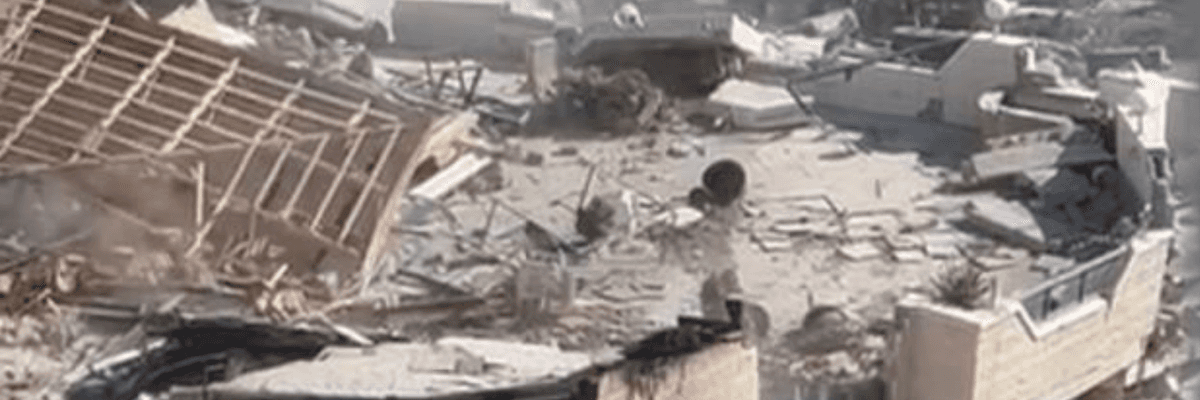
A photo shared by Belgium's foreign affairs minister shows the destroyed office building that housed the Belgian Agency for Development Cooperation in the Gaza Strip on February 1, 2024.
Israel Bombed Belgian Aid Office in Gaza After Nation Refused to Halt UNRWA Funding
"This is a direct result of the impunity Washington has provided Israel," said one analyst.
Belgian officials expressed outrage Thursday after Israeli forces reportedly bombed the office building of the Belgian Agency for Development Cooperation in the Gaza Strip, an attack that came after Belgium declined to join the U.S. and more than a dozen other countries in cutting off funding to the United Nations' Palestinian refugee agency.
"The offices of Enabel, the Belgian development agency in Gaza, were bombed and destroyed," Hadja Lahbib, Belgium's foreign affairs minister, wrote on social media. "Targeting civilian buildings is unacceptable."
Lahbib and Caroline Gennez, Belgium's minister of development cooperation and urban policy, posted photos of the destroyed building and demanded a meeting with Israel's ambassador envoy to the country to discuss the attack, which took place on Wednesday.
Jean Van Wetter, the CEO of Enabel, said Thursday that "we are all shocked."
"As a government agency working for the common good in a framework of international humanitarian law," he added, "we cannot accept this."
None of the agency's staffers were believed to be present when Israeli forces struck the building, as Belgium withdrew Enabel employees and their families from the territory two weeks ago.
A satellite data analysis released earlier this week shows that more than half of Gaza's buildings have been damaged or destroyed by Israel's U.S.-backed bombardment of the Palestinian enclave—one of the most devastating bombing campaigns in modern history.
The timing of the attack on the Belgian office building raised eyebrows, with observers pointing to the nation's status as one of the handful of Western countries not suspending aid to the U.N. Relief and Works Agency for Palestine Refugees in the Near East (UNRWA) in response to Israel's allegation that a dozen of the agency's employees took part in the October 7 attacks.
"Belgium is one of the Western countries that has refused to cut funding to UNRWA. So Israel just bombed the office of the Belgian Agency for Development Cooperation in Gaza," Trita Parsi, executive vice president of the Quincy Institute for Responsible Statecraft, wrote on social media. "This is a direct result of the impunity Washington has provided Israel."
Sixteen countries have halted their financial support to UNRWA, compromising the aid agency's ability to deliver humanitarian assistance to Gazans increasingly at risk of starvation and disease. Philippe Lazzarini, the UNRWA's commissioner-general, said Thursday that the agency "will most likely be forced to shut down" its operations in Gaza and across the region by the end of this month if funding isn't restored.
The U.S. State Department announced its decision to suspend funding for UNRWA last Friday, just hours after the International Court of Justice ruled that South Africa's genocide case against Israel was plausible and ordered the Israeli government to ensure the flow of humanitarian assistance to Gaza.
Questioned about the timing of the U.S. decision to suspend UNRWA funding, State Department spokesman Matthew Miller said during a press briefing Thursday that "there was no concern" internally that the announcement would be seen as a rebuke of the ICJ's interim ruling.
Press corps teams up to question the State Department on the timing of its UNRWA announcement coinciding perfectly with the ICJ ruling pic.twitter.com/jpO2mnBNSY
— HalalFlow (@halalflow) February 1, 2024
Norwegian Foreign Minister Espen Barth Eide, whose country is among those that have declined to suspend aid to UNRWA, said Thursday that he is "reasonably optimistic" that at least some of the countries that have cut off funding will reverse course in the near future.
Eide said earlier this week that he has been "discussing the question of funding with other donors" and urged "fellow donor countries to reflect on the wider consequences of cutting their funding to UNRWA"
"UNWRA is a vital lifeline for 1.5 million refugees in Gaza," he added. "Now more than ever, the agency needs international support."
We are at a crossroads
This country and this world are at a monumental crossroads. In a few short weeks, US voters will have an opportunity to beat back the forces of fascism and confront the billionaires who are rigging the economy, our media system, and our democracy, making it increasingly impossible for ordinary people to get by. We’re not just talking about the election. We’re talking about what must be done once these fascist elements are vanquished from power. We need a bolder set of solutions than what either major party has so far been willing to offer and a working-class movement ready to fight like hell for it. Trump didn't emerge from nowhere. The conditions that fueled MAGA authoritarianism were created by decades of radical neoliberal economic policies and a corrupt political system dominated by corporate interests. They slashed taxes on the super-rich, promising that the benefits would trickle down. They said giveaways to the corporate titans would make life more affordable for the rest of us. It was all bullshit. And when a bitter, betrayed populace searches for someone to blame, right-wing demagogues have little trouble finding scapegoats. People know when they're being lied to, but you won't hear any of this from the corporate media. Only independent journalism—powered and funded by people who believe in building a better world—can deliver truly trustworthy daily news. Our Fall Campaign is underway, and we need your help. To power our newsroom through the rest of the year, we need to raise $125,000 by midnight on October 31. So if you share our vision, please contribute whatever you can to sustain our work. |
Belgian officials expressed outrage Thursday after Israeli forces reportedly bombed the office building of the Belgian Agency for Development Cooperation in the Gaza Strip, an attack that came after Belgium declined to join the U.S. and more than a dozen other countries in cutting off funding to the United Nations' Palestinian refugee agency.
"The offices of Enabel, the Belgian development agency in Gaza, were bombed and destroyed," Hadja Lahbib, Belgium's foreign affairs minister, wrote on social media. "Targeting civilian buildings is unacceptable."
Lahbib and Caroline Gennez, Belgium's minister of development cooperation and urban policy, posted photos of the destroyed building and demanded a meeting with Israel's ambassador envoy to the country to discuss the attack, which took place on Wednesday.
Jean Van Wetter, the CEO of Enabel, said Thursday that "we are all shocked."
"As a government agency working for the common good in a framework of international humanitarian law," he added, "we cannot accept this."
None of the agency's staffers were believed to be present when Israeli forces struck the building, as Belgium withdrew Enabel employees and their families from the territory two weeks ago.
A satellite data analysis released earlier this week shows that more than half of Gaza's buildings have been damaged or destroyed by Israel's U.S.-backed bombardment of the Palestinian enclave—one of the most devastating bombing campaigns in modern history.
The timing of the attack on the Belgian office building raised eyebrows, with observers pointing to the nation's status as one of the handful of Western countries not suspending aid to the U.N. Relief and Works Agency for Palestine Refugees in the Near East (UNRWA) in response to Israel's allegation that a dozen of the agency's employees took part in the October 7 attacks.
"Belgium is one of the Western countries that has refused to cut funding to UNRWA. So Israel just bombed the office of the Belgian Agency for Development Cooperation in Gaza," Trita Parsi, executive vice president of the Quincy Institute for Responsible Statecraft, wrote on social media. "This is a direct result of the impunity Washington has provided Israel."
Sixteen countries have halted their financial support to UNRWA, compromising the aid agency's ability to deliver humanitarian assistance to Gazans increasingly at risk of starvation and disease. Philippe Lazzarini, the UNRWA's commissioner-general, said Thursday that the agency "will most likely be forced to shut down" its operations in Gaza and across the region by the end of this month if funding isn't restored.
The U.S. State Department announced its decision to suspend funding for UNRWA last Friday, just hours after the International Court of Justice ruled that South Africa's genocide case against Israel was plausible and ordered the Israeli government to ensure the flow of humanitarian assistance to Gaza.
Questioned about the timing of the U.S. decision to suspend UNRWA funding, State Department spokesman Matthew Miller said during a press briefing Thursday that "there was no concern" internally that the announcement would be seen as a rebuke of the ICJ's interim ruling.
Press corps teams up to question the State Department on the timing of its UNRWA announcement coinciding perfectly with the ICJ ruling pic.twitter.com/jpO2mnBNSY
— HalalFlow (@halalflow) February 1, 2024
Norwegian Foreign Minister Espen Barth Eide, whose country is among those that have declined to suspend aid to UNRWA, said Thursday that he is "reasonably optimistic" that at least some of the countries that have cut off funding will reverse course in the near future.
Eide said earlier this week that he has been "discussing the question of funding with other donors" and urged "fellow donor countries to reflect on the wider consequences of cutting their funding to UNRWA"
"UNWRA is a vital lifeline for 1.5 million refugees in Gaza," he added. "Now more than ever, the agency needs international support."
Belgian officials expressed outrage Thursday after Israeli forces reportedly bombed the office building of the Belgian Agency for Development Cooperation in the Gaza Strip, an attack that came after Belgium declined to join the U.S. and more than a dozen other countries in cutting off funding to the United Nations' Palestinian refugee agency.
"The offices of Enabel, the Belgian development agency in Gaza, were bombed and destroyed," Hadja Lahbib, Belgium's foreign affairs minister, wrote on social media. "Targeting civilian buildings is unacceptable."
Lahbib and Caroline Gennez, Belgium's minister of development cooperation and urban policy, posted photos of the destroyed building and demanded a meeting with Israel's ambassador envoy to the country to discuss the attack, which took place on Wednesday.
Jean Van Wetter, the CEO of Enabel, said Thursday that "we are all shocked."
"As a government agency working for the common good in a framework of international humanitarian law," he added, "we cannot accept this."
None of the agency's staffers were believed to be present when Israeli forces struck the building, as Belgium withdrew Enabel employees and their families from the territory two weeks ago.
A satellite data analysis released earlier this week shows that more than half of Gaza's buildings have been damaged or destroyed by Israel's U.S.-backed bombardment of the Palestinian enclave—one of the most devastating bombing campaigns in modern history.
The timing of the attack on the Belgian office building raised eyebrows, with observers pointing to the nation's status as one of the handful of Western countries not suspending aid to the U.N. Relief and Works Agency for Palestine Refugees in the Near East (UNRWA) in response to Israel's allegation that a dozen of the agency's employees took part in the October 7 attacks.
"Belgium is one of the Western countries that has refused to cut funding to UNRWA. So Israel just bombed the office of the Belgian Agency for Development Cooperation in Gaza," Trita Parsi, executive vice president of the Quincy Institute for Responsible Statecraft, wrote on social media. "This is a direct result of the impunity Washington has provided Israel."
Sixteen countries have halted their financial support to UNRWA, compromising the aid agency's ability to deliver humanitarian assistance to Gazans increasingly at risk of starvation and disease. Philippe Lazzarini, the UNRWA's commissioner-general, said Thursday that the agency "will most likely be forced to shut down" its operations in Gaza and across the region by the end of this month if funding isn't restored.
The U.S. State Department announced its decision to suspend funding for UNRWA last Friday, just hours after the International Court of Justice ruled that South Africa's genocide case against Israel was plausible and ordered the Israeli government to ensure the flow of humanitarian assistance to Gaza.
Questioned about the timing of the U.S. decision to suspend UNRWA funding, State Department spokesman Matthew Miller said during a press briefing Thursday that "there was no concern" internally that the announcement would be seen as a rebuke of the ICJ's interim ruling.
Press corps teams up to question the State Department on the timing of its UNRWA announcement coinciding perfectly with the ICJ ruling pic.twitter.com/jpO2mnBNSY
— HalalFlow (@halalflow) February 1, 2024
Norwegian Foreign Minister Espen Barth Eide, whose country is among those that have declined to suspend aid to UNRWA, said Thursday that he is "reasonably optimistic" that at least some of the countries that have cut off funding will reverse course in the near future.
Eide said earlier this week that he has been "discussing the question of funding with other donors" and urged "fellow donor countries to reflect on the wider consequences of cutting their funding to UNRWA"
"UNWRA is a vital lifeline for 1.5 million refugees in Gaza," he added. "Now more than ever, the agency needs international support."