SUBSCRIBE TO OUR FREE NEWSLETTER
Daily news & progressive opinion—funded by the people, not the corporations—delivered straight to your inbox.
5
#000000
#FFFFFF
To donate by check, phone, or other method, see our More Ways to Give page.
Daily news & progressive opinion—funded by the people, not the corporations—delivered straight to your inbox.
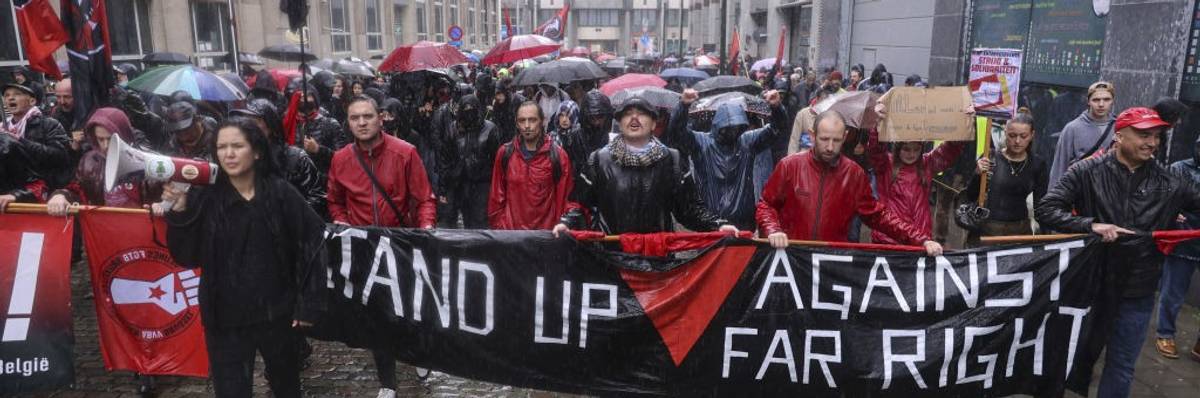
Thousands of people marched to denounce fascism after the European Union elections in Brussels, Belgium on June 16, 2024.
"It's important to show that we're in solidarity with everyone, whatever their nationality, whatever they earn, whatever they do," said a member of the Anti-Fascist Coordination of Belgium.
Thousands of people came together in Brussels on Sunday to march against the far-right parties' recent gains in the European Union elections—the second such protest in the Belgian capital since the results were announced earlier this month.
Sunday's march was organized by the Anti-Fascist Coordination of Belgium. The Brussels Times reported that "some 20 social movements and organizations are part of the CAB, including Young FGTB, Ades network, the Anti-Fascist Front of Liège, MOC Brussels, ASBL Garance, Ecolo J, and Mrax."
The organizers aimed to offer a "popular response and a contrasting social agenda" to the E.U.'s far-right movement, which they said "exacerbates social degradation" and promotes "absolutely disastrous policies" targeting democratic rights, the LGTBQ+ community, migrants, women, and workers.
"It will never be the far right that calls for taxing the richest, increasing the number of social housing, or implementing an ecological transition rooted in a logic of social justice, which is necessary for our common future."
"The far right will never demand higher wages for all," the organizers said. "It will never be the far right that calls for taxing the richest, increasing the number of social housing, or implementing an ecological transition rooted in a logic of social justice, which is necessary for our common future."
CAB member Sixtine Van Outryve told Euronews that "this march is important today to show a message of hope in the face of the messages of despair that the far right wants to bring us."
"It's important to show that we're in solidarity with everyone, whatever their nationality, whatever they earn, whatever they do," she said. "We stand together and we want a society that doesn't divide us. A society that doesn't exclude, a society that isn't racist or sexist."
"Many of us were shocked by the election results, showing far-right breakthroughs at the European level," Van Outryve added, expressing concern about the "alarming" normalization of far-right discourse.
The right-wing surge in the 27-member bloc's elections was widely anticipated, as key figures from across the continent and beyond collectively campaigned against migrants, feminism, socialism, LGBTQ+ rights, and the United Nations.
Parties that did well in the E.U. contests included Italian Prime Minister Giorgia Meloni's Brothers of Italy, Germany's Alternative für Deutschland, and Marine le Pen's National Rally in France, where President Emmanuel Macron responded to the results by calling snap national elections scheduled for June 30 and July 7.
As The Guardian reported earlier this month, "A surge in support for far-right parties in France, Germany, and Austria was tempered by strong support for centrist and left-wing groups in other countries."
The mixed results mean Ursula von der Leyen—who is tied to Germany's center-right Christian Democratic Union and the European People's Party—is expected to secure a second five-year term as president of the European Commission.
The Sunday march preceded a Monday evening meeting for heads of state and government to begin discussing who will fill that role and other top E.U. posts. In addition to the commission spot, The Guardian noted, "leaders will also decide on successors to Charles Michel, the president of the European Council, and Josep Borrell, the E.U.'s top diplomat."
"Consensus is also firming around Portugal's Socialist former Prime Minister António Costa to take over from Michel in chairing E.U. Council meetings," according to the British newspaper. "Estonia's prime minister, Kaja Kallas, is a favorite to take over from Borrell."
Dear Common Dreams reader, It’s been nearly 30 years since I co-founded Common Dreams with my late wife, Lina Newhouser. We had the radical notion that journalism should serve the public good, not corporate profits. It was clear to us from the outset what it would take to build such a project. No paid advertisements. No corporate sponsors. No millionaire publisher telling us what to think or do. Many people said we wouldn't last a year, but we proved those doubters wrong. Together with a tremendous team of journalists and dedicated staff, we built an independent media outlet free from the constraints of profits and corporate control. Our mission has always been simple: To inform. To inspire. To ignite change for the common good. Building Common Dreams was not easy. Our survival was never guaranteed. When you take on the most powerful forces—Wall Street greed, fossil fuel industry destruction, Big Tech lobbyists, and uber-rich oligarchs who have spent billions upon billions rigging the economy and democracy in their favor—the only bulwark you have is supporters who believe in your work. But here’s the urgent message from me today. It's never been this bad out there. And it's never been this hard to keep us going. At the very moment Common Dreams is most needed, the threats we face are intensifying. We need your support now more than ever. We don't accept corporate advertising and never will. We don't have a paywall because we don't think people should be blocked from critical news based on their ability to pay. Everything we do is funded by the donations of readers like you. When everyone does the little they can afford, we are strong. But if that support retreats or dries up, so do we. Will you donate now to make sure Common Dreams not only survives but thrives? —Craig Brown, Co-founder |
Thousands of people came together in Brussels on Sunday to march against the far-right parties' recent gains in the European Union elections—the second such protest in the Belgian capital since the results were announced earlier this month.
Sunday's march was organized by the Anti-Fascist Coordination of Belgium. The Brussels Times reported that "some 20 social movements and organizations are part of the CAB, including Young FGTB, Ades network, the Anti-Fascist Front of Liège, MOC Brussels, ASBL Garance, Ecolo J, and Mrax."
The organizers aimed to offer a "popular response and a contrasting social agenda" to the E.U.'s far-right movement, which they said "exacerbates social degradation" and promotes "absolutely disastrous policies" targeting democratic rights, the LGTBQ+ community, migrants, women, and workers.
"It will never be the far right that calls for taxing the richest, increasing the number of social housing, or implementing an ecological transition rooted in a logic of social justice, which is necessary for our common future."
"The far right will never demand higher wages for all," the organizers said. "It will never be the far right that calls for taxing the richest, increasing the number of social housing, or implementing an ecological transition rooted in a logic of social justice, which is necessary for our common future."
CAB member Sixtine Van Outryve told Euronews that "this march is important today to show a message of hope in the face of the messages of despair that the far right wants to bring us."
"It's important to show that we're in solidarity with everyone, whatever their nationality, whatever they earn, whatever they do," she said. "We stand together and we want a society that doesn't divide us. A society that doesn't exclude, a society that isn't racist or sexist."
"Many of us were shocked by the election results, showing far-right breakthroughs at the European level," Van Outryve added, expressing concern about the "alarming" normalization of far-right discourse.
The right-wing surge in the 27-member bloc's elections was widely anticipated, as key figures from across the continent and beyond collectively campaigned against migrants, feminism, socialism, LGBTQ+ rights, and the United Nations.
Parties that did well in the E.U. contests included Italian Prime Minister Giorgia Meloni's Brothers of Italy, Germany's Alternative für Deutschland, and Marine le Pen's National Rally in France, where President Emmanuel Macron responded to the results by calling snap national elections scheduled for June 30 and July 7.
As The Guardian reported earlier this month, "A surge in support for far-right parties in France, Germany, and Austria was tempered by strong support for centrist and left-wing groups in other countries."
The mixed results mean Ursula von der Leyen—who is tied to Germany's center-right Christian Democratic Union and the European People's Party—is expected to secure a second five-year term as president of the European Commission.
The Sunday march preceded a Monday evening meeting for heads of state and government to begin discussing who will fill that role and other top E.U. posts. In addition to the commission spot, The Guardian noted, "leaders will also decide on successors to Charles Michel, the president of the European Council, and Josep Borrell, the E.U.'s top diplomat."
"Consensus is also firming around Portugal's Socialist former Prime Minister António Costa to take over from Michel in chairing E.U. Council meetings," according to the British newspaper. "Estonia's prime minister, Kaja Kallas, is a favorite to take over from Borrell."
Thousands of people came together in Brussels on Sunday to march against the far-right parties' recent gains in the European Union elections—the second such protest in the Belgian capital since the results were announced earlier this month.
Sunday's march was organized by the Anti-Fascist Coordination of Belgium. The Brussels Times reported that "some 20 social movements and organizations are part of the CAB, including Young FGTB, Ades network, the Anti-Fascist Front of Liège, MOC Brussels, ASBL Garance, Ecolo J, and Mrax."
The organizers aimed to offer a "popular response and a contrasting social agenda" to the E.U.'s far-right movement, which they said "exacerbates social degradation" and promotes "absolutely disastrous policies" targeting democratic rights, the LGTBQ+ community, migrants, women, and workers.
"It will never be the far right that calls for taxing the richest, increasing the number of social housing, or implementing an ecological transition rooted in a logic of social justice, which is necessary for our common future."
"The far right will never demand higher wages for all," the organizers said. "It will never be the far right that calls for taxing the richest, increasing the number of social housing, or implementing an ecological transition rooted in a logic of social justice, which is necessary for our common future."
CAB member Sixtine Van Outryve told Euronews that "this march is important today to show a message of hope in the face of the messages of despair that the far right wants to bring us."
"It's important to show that we're in solidarity with everyone, whatever their nationality, whatever they earn, whatever they do," she said. "We stand together and we want a society that doesn't divide us. A society that doesn't exclude, a society that isn't racist or sexist."
"Many of us were shocked by the election results, showing far-right breakthroughs at the European level," Van Outryve added, expressing concern about the "alarming" normalization of far-right discourse.
The right-wing surge in the 27-member bloc's elections was widely anticipated, as key figures from across the continent and beyond collectively campaigned against migrants, feminism, socialism, LGBTQ+ rights, and the United Nations.
Parties that did well in the E.U. contests included Italian Prime Minister Giorgia Meloni's Brothers of Italy, Germany's Alternative für Deutschland, and Marine le Pen's National Rally in France, where President Emmanuel Macron responded to the results by calling snap national elections scheduled for June 30 and July 7.
As The Guardian reported earlier this month, "A surge in support for far-right parties in France, Germany, and Austria was tempered by strong support for centrist and left-wing groups in other countries."
The mixed results mean Ursula von der Leyen—who is tied to Germany's center-right Christian Democratic Union and the European People's Party—is expected to secure a second five-year term as president of the European Commission.
The Sunday march preceded a Monday evening meeting for heads of state and government to begin discussing who will fill that role and other top E.U. posts. In addition to the commission spot, The Guardian noted, "leaders will also decide on successors to Charles Michel, the president of the European Council, and Josep Borrell, the E.U.'s top diplomat."
"Consensus is also firming around Portugal's Socialist former Prime Minister António Costa to take over from Michel in chairing E.U. Council meetings," according to the British newspaper. "Estonia's prime minister, Kaja Kallas, is a favorite to take over from Borrell."