SUBSCRIBE TO OUR FREE NEWSLETTER
Daily news & progressive opinion—funded by the people, not the corporations—delivered straight to your inbox.
5
#000000
#FFFFFF
To donate by check, phone, or other method, see our More Ways to Give page.
Daily news & progressive opinion—funded by the people, not the corporations—delivered straight to your inbox.
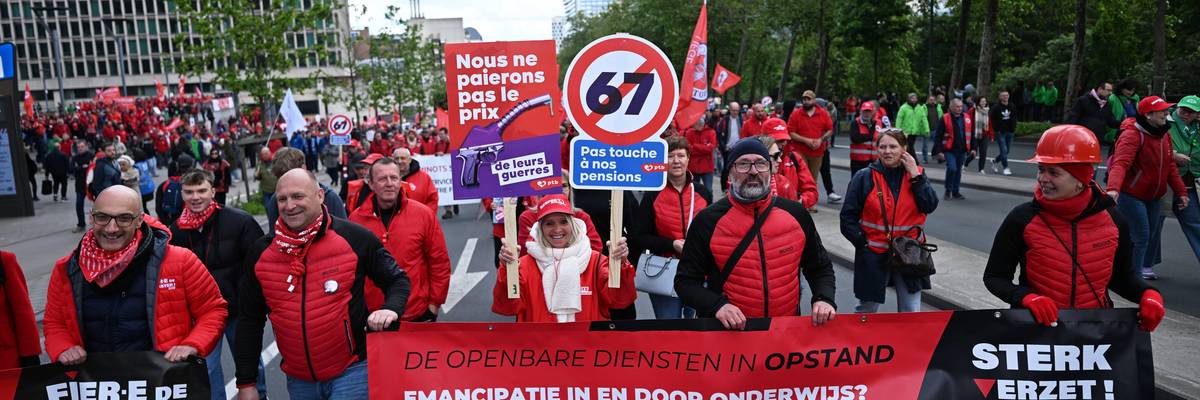
People take part in a national demonstration against rising energy prices and social reforms by the government, organized by the three national trade unions, in front of the North Train Station in Brussels, Belgium on May 12, 2026.
It's the latest of several national strikes over the past year and a half against policies that one union leader said will heighten "inequality" and "poverty."
Much of Belgium ground to a halt on Tuesday as tens of thousands of workers flooded the streets of Brussels as part of a general strike against government austerity measures.
Schools closed, public transit operated with reduced service, and flights out of major airports were grounded as workers walked off the job. Instead, they marched through the capital clad in red and green, the colors of Belgium's major labor unions, with some carrying signs that read, "Hands off our pensions" and "We will not pay the price of their wars."
According to Morning Star, as many as 100,000 people took part in the strike, which was called by the nation's three biggest trade unions in protest of measures by Prime Minister Bart De Wever's government that the unions say slash pensions, reduce wages, and attack collective bargaining.
The marchers called on the government to roll back plans to raise Belgium's retirement age to 67 and have called for an end to what the unions have dubbed a “pension penalty” that would cut benefits for those who retire early.
Amid rising costs caused by the US-Israeli war against Iran, the unions are also outraged by a proposed temporary cap on wage indexation, which requires wages to rise in tandem with inflation.
It's part of a broader trend of the government loosening labor rules for employers, which unions say has led to longer, more irregular hours and diminished employees' work-life balance.
"People will have less money left over and will still have to work more flexibly and longer," said Ann Vermorgen, the chair of the Confederation of Christian Trade Unions. "Even the Planning Bureau says that the reform will promote inequality and that poverty will emerge.”
Tuesday's general strike was just the latest over the past year and a half, as the unions have refused to let up on their push to reverse De Wever's agenda.
Gert Truyens, the chair of the General Confederation of Liberal Trade Unions of Belgium (ACLVB), said that with the pension penalty and the other labor proposals, the government was displaying “total disregard” for social dialogue by “unilaterally imposing things without discussing them with the trade unions and employers.”
Dear Common Dreams reader, It’s been nearly 30 years since I co-founded Common Dreams with my late wife, Lina Newhouser. We had the radical notion that journalism should serve the public good, not corporate profits. It was clear to us from the outset what it would take to build such a project. No paid advertisements. No corporate sponsors. No millionaire publisher telling us what to think or do. Many people said we wouldn't last a year, but we proved those doubters wrong. Together with a tremendous team of journalists and dedicated staff, we built an independent media outlet free from the constraints of profits and corporate control. Our mission has always been simple: To inform. To inspire. To ignite change for the common good. Building Common Dreams was not easy. Our survival was never guaranteed. When you take on the most powerful forces—Wall Street greed, fossil fuel industry destruction, Big Tech lobbyists, and uber-rich oligarchs who have spent billions upon billions rigging the economy and democracy in their favor—the only bulwark you have is supporters who believe in your work. But here’s the urgent message from me today. It's never been this bad out there. And it's never been this hard to keep us going. At the very moment Common Dreams is most needed, the threats we face are intensifying. We need your support now more than ever. We don't accept corporate advertising and never will. We don't have a paywall because we don't think people should be blocked from critical news based on their ability to pay. Everything we do is funded by the donations of readers like you. When everyone does the little they can afford, we are strong. But if that support retreats or dries up, so do we. Will you donate now to make sure Common Dreams not only survives but thrives? —Craig Brown, Co-founder |
Much of Belgium ground to a halt on Tuesday as tens of thousands of workers flooded the streets of Brussels as part of a general strike against government austerity measures.
Schools closed, public transit operated with reduced service, and flights out of major airports were grounded as workers walked off the job. Instead, they marched through the capital clad in red and green, the colors of Belgium's major labor unions, with some carrying signs that read, "Hands off our pensions" and "We will not pay the price of their wars."
According to Morning Star, as many as 100,000 people took part in the strike, which was called by the nation's three biggest trade unions in protest of measures by Prime Minister Bart De Wever's government that the unions say slash pensions, reduce wages, and attack collective bargaining.
The marchers called on the government to roll back plans to raise Belgium's retirement age to 67 and have called for an end to what the unions have dubbed a “pension penalty” that would cut benefits for those who retire early.
Amid rising costs caused by the US-Israeli war against Iran, the unions are also outraged by a proposed temporary cap on wage indexation, which requires wages to rise in tandem with inflation.
It's part of a broader trend of the government loosening labor rules for employers, which unions say has led to longer, more irregular hours and diminished employees' work-life balance.
"People will have less money left over and will still have to work more flexibly and longer," said Ann Vermorgen, the chair of the Confederation of Christian Trade Unions. "Even the Planning Bureau says that the reform will promote inequality and that poverty will emerge.”
Tuesday's general strike was just the latest over the past year and a half, as the unions have refused to let up on their push to reverse De Wever's agenda.
Gert Truyens, the chair of the General Confederation of Liberal Trade Unions of Belgium (ACLVB), said that with the pension penalty and the other labor proposals, the government was displaying “total disregard” for social dialogue by “unilaterally imposing things without discussing them with the trade unions and employers.”
Much of Belgium ground to a halt on Tuesday as tens of thousands of workers flooded the streets of Brussels as part of a general strike against government austerity measures.
Schools closed, public transit operated with reduced service, and flights out of major airports were grounded as workers walked off the job. Instead, they marched through the capital clad in red and green, the colors of Belgium's major labor unions, with some carrying signs that read, "Hands off our pensions" and "We will not pay the price of their wars."
According to Morning Star, as many as 100,000 people took part in the strike, which was called by the nation's three biggest trade unions in protest of measures by Prime Minister Bart De Wever's government that the unions say slash pensions, reduce wages, and attack collective bargaining.
The marchers called on the government to roll back plans to raise Belgium's retirement age to 67 and have called for an end to what the unions have dubbed a “pension penalty” that would cut benefits for those who retire early.
Amid rising costs caused by the US-Israeli war against Iran, the unions are also outraged by a proposed temporary cap on wage indexation, which requires wages to rise in tandem with inflation.
It's part of a broader trend of the government loosening labor rules for employers, which unions say has led to longer, more irregular hours and diminished employees' work-life balance.
"People will have less money left over and will still have to work more flexibly and longer," said Ann Vermorgen, the chair of the Confederation of Christian Trade Unions. "Even the Planning Bureau says that the reform will promote inequality and that poverty will emerge.”
Tuesday's general strike was just the latest over the past year and a half, as the unions have refused to let up on their push to reverse De Wever's agenda.
Gert Truyens, the chair of the General Confederation of Liberal Trade Unions of Belgium (ACLVB), said that with the pension penalty and the other labor proposals, the government was displaying “total disregard” for social dialogue by “unilaterally imposing things without discussing them with the trade unions and employers.”