

SUBSCRIBE TO OUR FREE NEWSLETTER
Daily news & progressive opinion—funded by the people, not the corporations—delivered straight to your inbox.
5
#000000
#FFFFFF
To donate by check, phone, or other method, see our More Ways to Give page.
Daily news & progressive opinion—funded by the people, not the corporations—delivered straight to your inbox.
"If this polluter handout is snuck into the GOP tax bill, then cuts to Medicaid and food stamps could well pay for another giveaway to Big Oil," said the co-author of a new report. "That's obscene."
Having helped install the most fossil fuel-friendly administration of the climate awareness era, Big Oil and their Republican boosters in Congress are now setting their sights on undermining a tax enacted by during the tenure of former President Joe Biden as part of the landmark Inflation Reduction Act.
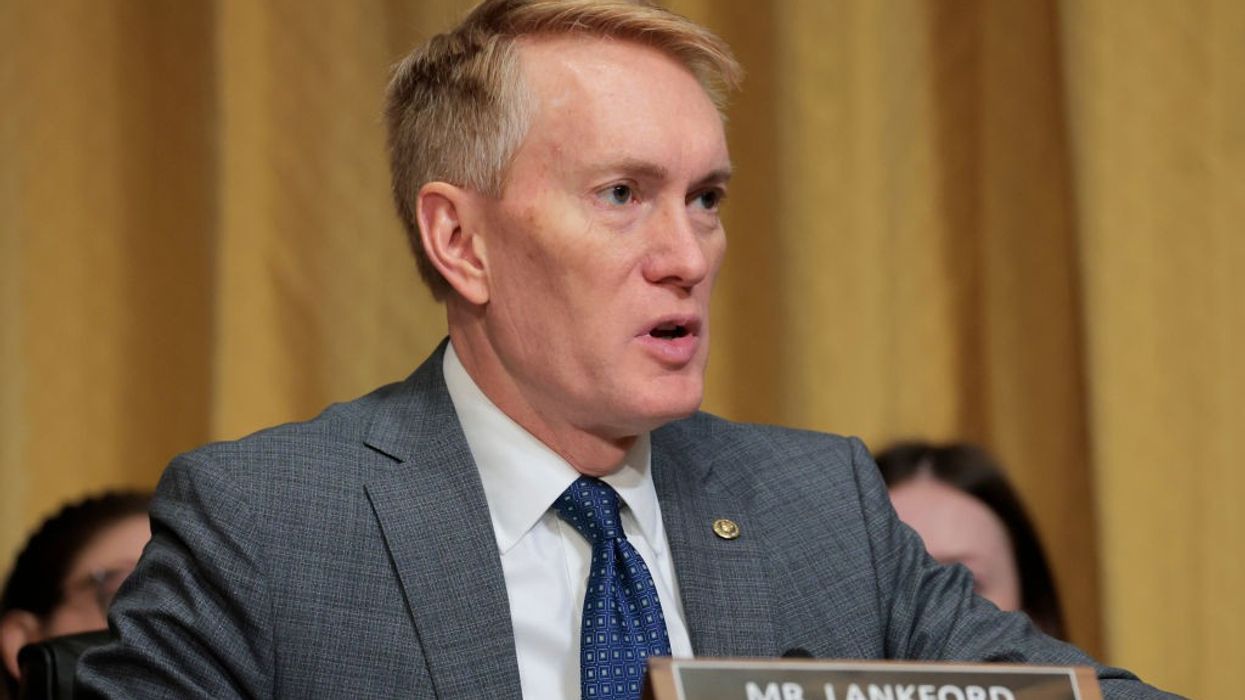
Alan Zibel, research director at the consumer advocacy watchdog Public Citizen, and Lukas Shankar-Ross, deputy director of Friends of the Earth's Climate and Energy Justice Program, noted in a report published Monday that Sen. James Lankford (R-Okla.), who chairs the Senate Ethics Committee, earlier this year introduced industry-backed legislation, the Promoting Domestic Energy Production Act, for possible inclusion in Republicans' proposed $4.5 trillion tax giveaway to corporations and the ultrawealthy.
As Common Dreams reported in January, the fossil fuel industry spent an estimated $445 million during the 2024 election cycle to elect President Donald Trump and other GOP candidates who serve their climate-wrecking interests, and it expects much in return.
"Domestic oil and gas companies, including from Lankford's home state of Oklahoma, have warned their investors about the corporate alternative minimum tax," Zibel and Shankar-Ross wrote. "The industry could soon be rewarded with specially tailored tax relief courtesy of their Republican political allies."
As the report explains:
Here's how the tax scheme works: In August 2022, President Joe Biden signed the Inflation Reduction Act, which made historic climate investments. To help pay for new spending, the bill included a set of corporate tax increases, the largest of which was the $222 billion corporate alternative minimum tax. This tax is meant to prevent corporations that deliver massive profits to investors from paying nothing or nearly nothing in taxes because of corporate-friendly tax loopholes. Under the corporate minimum tax, if a company reports an average of at least $1 billion in annual income over three years, then it must pay 15% of that reported income in taxes, minus certain deductions.
The report highlights Republican efforts to eliminate the minimum tax, including via legislation introduced by Sen. John Barrasso (R-Wyo.) and endorsed by the American Petroleum Institute, U.S. Chamber of Commerce, National Association of Manufacturers, National Mining Association, Western Energy Alliance, and industry lobbyists.
The bill introduced by Lankford would enable fossil fuel companies to skirt the minimum tax by allowing them to deduct "intangible" drilling costs, a tactic used as an effective subsidy for more than 120 years. Zibel and Shankar-Ross described the tax dodge as "the oldest and the largest fossil fuel subsidy on the books," and one which "allows all of the costs for drilling an oil or gas well to be deducted immediately in the year they are incurred."
"If individual taxpayers understood the magnitude of the extreme subsidies for Big Oil, they would be shocked."
"It is simply outrageous that the GOP is using its trifecta to create yet another fossil fuel subsidy," Shankar-Ross said in a statement, referring to Republicans' control of the White House and both chambers of Congress. "If this polluter handout is snuck into the GOP tax bill, then cuts to Medicaid and food stamps could well pay for another giveaway to Big Oil. That's obscene."
Zibel asserted that "oil and gas companies are using the political influence they purchased to dodge paying even a minimal part of their fair share."
"If individual taxpayers understood the magnitude of the extreme subsidies for Big Oil, they would be shocked," he added. "The newest effort to bypass even the most modest of tax bills by the industry is shocking, but sadly not surprising."
Their fortunes are the result of poisoning you, me, our children and grandchildren, every other living thing on Earth, and destroying the temperature stability of our atmosphere. This week it's horrifying to look out and see the world they are creating for the rest of us.
Public Citizen would like you to know that there are killers among us.
They wear $2,000 suits and travel in private jets, unbothered by the TSA or the teeming masses. Their children attend the finest universities in the world, and they vacation on private islands and yachts. Many “earn” more in a day than most Americans take home in a year; their positions ensure their heirs will never have to work a day in their lives.
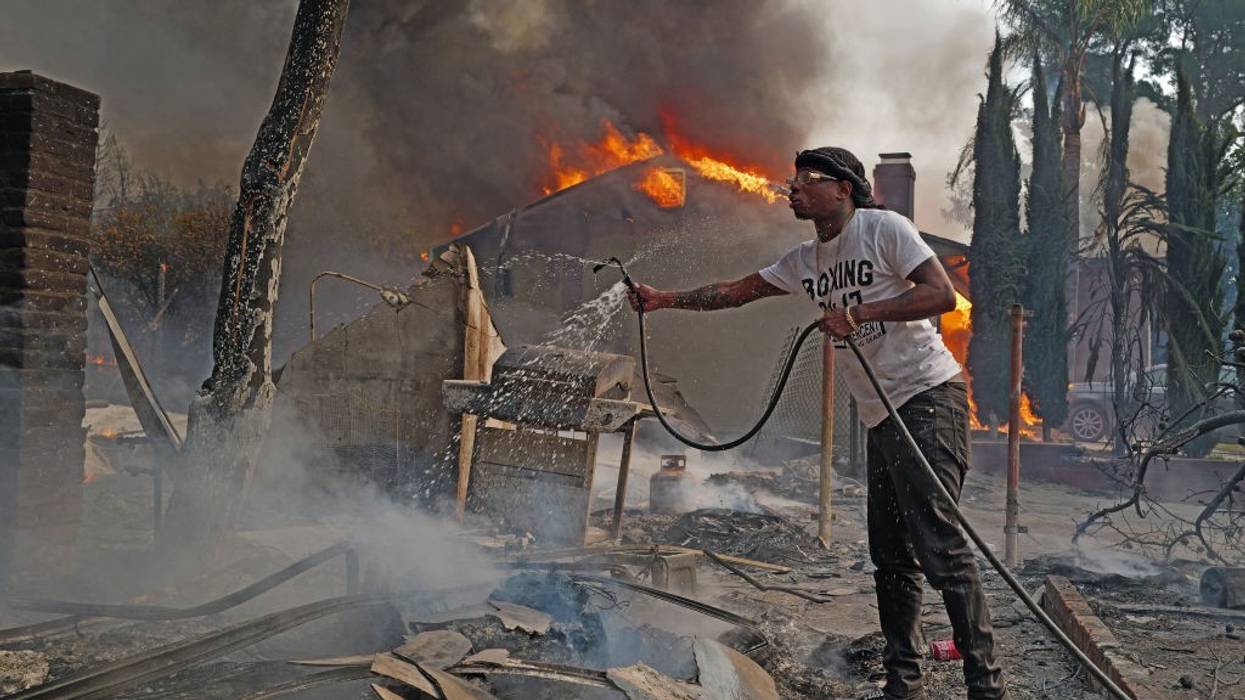
Their fortunes are the result of poisoning you, me, our children and grandchildren, every other living thing on Earth, and destroying the temperature stability of our atmosphere. This week they’re arguably responsible, in part, for billions of dollars in losses, numerous deaths, and thousands of shattered lives in Southern California.
Illegitimate president-elect Trump is trying his best to cover for them, claiming that the fires ripping through the Los Angeles area are the fault of California’s Democratic governor, calling Gavin Newsome by a childish name to draw more attention to Trump’s efforts on behalf of the Republican Party’s most generous donors.
Oil industry executives and fossil fuel billionaires are the hands holding the smoking gun of climate change that have directly or indirectly caused tens of thousands of deaths and millions of people displaced worldwide over the past two decades. And now the fires in southern California.
Mainstream media is largely going along with Trump’s charade, choosing not to even mention — in the vast majority of their reports on the crisis — the role of climate change in the fires. And never, G-d forbid, mentioning the role of the fossil fuel industry in the climate change that has turned these fires from an annual nuisance into a hellscape.
It’s as frankly absurd as a TV news person reporting on a plane crash and, instead of asking aviation experts what caused it, simply lifting their collective shoulders with a helpless “shit happens” shrug.
But these fires — and the droughts and changing weather patterns that made them so severe — aren’t something that just happens by random happenstance, any more than an airliner crash.
And the oil industry has known for decades this day was coming.
In November, 1959, the famous scientist Edward Teller — the “Father of the H-Bomb” — was the keynote speaker at a conference on “The Energy of the Future” in New York, organized by the American Petroleum Institute and the Columbia Graduate School of Business. The news he conveyed to the assembled oil industry executives was stark:
“Whenever you burn conventional fuel, you create carbon dioxide. ... The carbon dioxide is invisible, it is transparent, you can’t smell it, it is not dangerous to health, so why should one worry about it? Carbon dioxide has a strange property. It transmits visible light but it absorbs the infrared radiation which is emitted from the earth. Its presence in the atmosphere causes a greenhouse effect ...
“It has been calculated that a temperature rise corresponding to a 10 per cent increase in carbon dioxide will be sufficient to melt the icecap and submerge New York. All the coastal cities would be covered, and since a considerable percentage of the human race lives in coastal regions, I think that this chemical contamination is more serious than most people tend to believe.”
This shocking news apparently provoked a scramble in the oil industry, probably similar to when the asbestos industry learned in the 1930s that their product caused lung cancer (the mesothelioma that killed my father), or in 1939 when the tobacco industry learned that smoking also killed people.
They set out to determine if Teller’s prediction was true. He’d predicted that CO2 levels would reach the point where they’d begin to seriously melt the polar and Greenland ice caps and alter weather patterns within a few decades, telling the oil executives at that 1959 meeting:
“At present the carbon dioxide in the atmosphere has risen by 2 per cent over normal. By 1970, it will be perhaps 4 per cent, by 1980, 8 per cent, by 1990, 16 per cent [about 360 parts per million, by Teller’s accounting], if we keep on with our exponential rise in the use of purely conventional fuels. By that time, there will be a serious additional impediment for the [heat] radiation leaving the earth.”
For the next decade, industry scientists went to work along with studies commissioned by major universities. One of the most well-known was a 1968 report the American Petroleum Institute hired the Stanford Research Institute to conduct. Its findings corroborated Teller’s prediction:
“Significant temperature changes are almost certain to occur by the year 2000, and these could bring about climatic changes. ... there seems to be no doubt that the potential damage to our environment could be severe. ... pollutants which we generally ignore because they have little local effect, CO2 and submicron particles, may be the cause of serious world-wide environmental changes.”
It was the first of dozens of studies the industry paid for or knew about, all predicting pretty much exactly what’s happening right now in Los Angeles, including major reports in 1979, 1982, and 1991.
And then the “climate denial” began.
Fossil fuel billionaires and their oil companies funded think tanks to promote skepticism, pushed frontmen onto radio and TV to claim that climate scientists and people like Al Gore were “in it for the money,” and began funding the campaigns of politicians willing to exchange the future habitability of the planet for a few decades of power and wealth.
In 2015, the Union of Concerned Scientists documented decades of internal industry memos and strategy sessions that were organizing, funding, and detailing roughly three decades of lies foisted on the American Public. The industry and its executives’ efforts were all, apparently, in the service of preserving their income stream and avoiding any liability for the deaths they knew would one day come as a result of their product poisoning our atmosphere.
And now that day is here. Oil industry executives and fossil fuel billionaires are the hands holding the smoking gun of climate change that have directly or indirectly caused tens of thousands of deaths and millions of people displaced worldwide over the past two decades. And now the fires in southern California.
Two-thirds of voters, according to a 2024 poll, believe the fossil fuel industry and its pampered executives should be held civilly responsible for the damage climate change is causing, and a plurality want them to face criminal charges.
Public Citizen published a 2023 report titled “Charging Big Oil with Climate Homicide,” including legal rationales and possible strategies for holding the killers in suits accountable by state and local prosecutors.
Will Los Angeles District Attorney Nathan Hochman or California Attorney General Rob Bonta have the courage to hold these companies and/or their executives accountable for the lies and deceptions they’ve funded that this week are killing Angelinos?
Will enough people call their members of Congress at 202-224-3121 to provoke investigations that could lead to congressional action?
Will our media ever begin to call out Trump and the alleged climate lies and deceptions of the industry that owns him?
'For too long, giant fossil fuel companies have knowingly lit the match of climate disruption'
The US Chamber of Commerce and the American Petroleum Institute - representing the biggest fossil fuel companies in the world - are suing the State of Vermont over its new law requiring fossil fuel companies to pay a share of the state's damage caused by climate change.
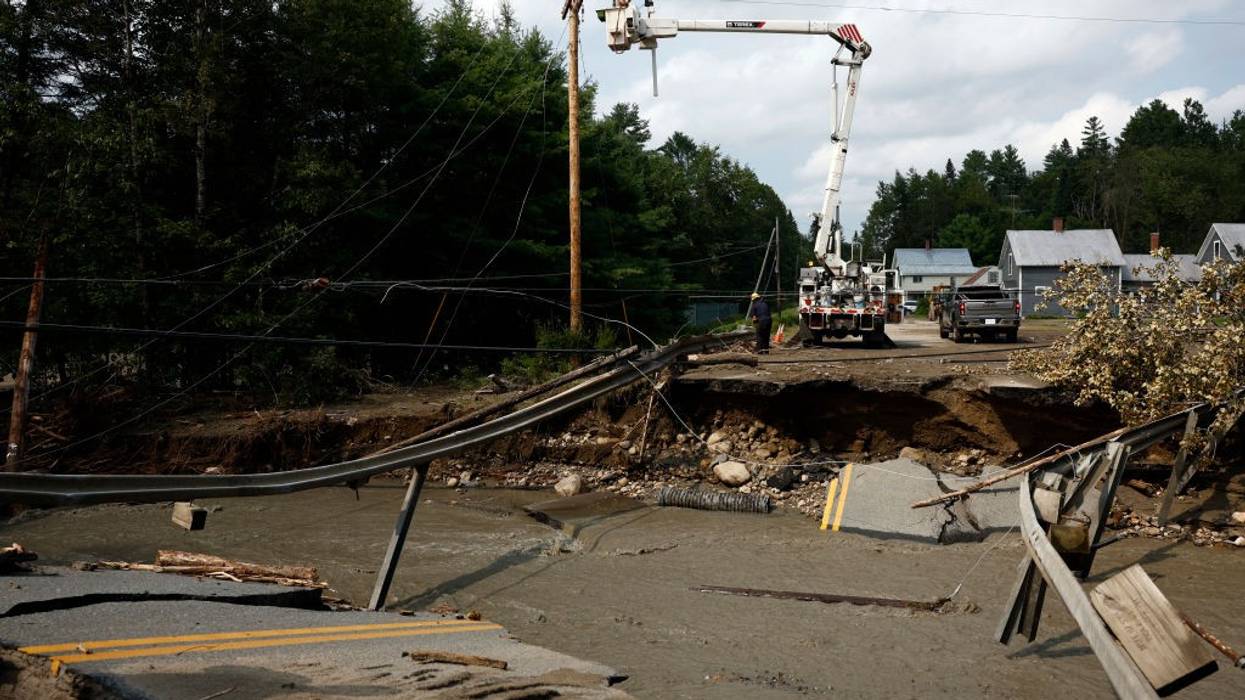
The lawsuit, filed last Monday in the US District Court for the District of Vermont, asks a state court to prevent Vermont from enforcing the law passed last year. Vermont became the first state in the country to enact the law after it suffered over $1 billion in damages from catastrophic summer flooding and other extreme weather.
Vermont’s Attorney General’s Office said as of Friday, Jan. 3, they had not been served with the lawsuit.
The lawsuit argues that the U.S. Constitution precludes the act and that the federal Clean Air Act preempts state law. It also claims that the law violates domestic and foreign commerce clauses by discriminating “against the important interest of other states by targeting large energy companies located outside of Vermont.”
The Chamber and the American Petroleum Institute argue that the federal government is already addressing climate change. Because greenhouse gases come from billions of individual sources, they claim it has been impossible to measure “accurately and fairly” the impact of emissions from a particular entity in a specific location over decades.
“For too long, giant fossil fuel companies have knowingly lit the match of climate disruption without being required to do a thing to put out the fire,” Paul Burns, executive director of the Vermont Public Interest Research Group, said in a statement. “Finally, maybe for the first time anywhere, Vermont is going to hold the companies most responsible for climate-driven floods, fires and heat waves financially accountable for a fair share of the damages they’ve caused.”
The complaint is an essential legal test as more states consider holding fossil fuels liable for expensive global warming-intensified events like floods, fires, and more. Maryland and Massachusetts are among the states expected to pursue similar legislation, modeled after the federal law known as Superfund, in 2025.
New York Gov. Kathy Hochul (D) signed a similar climate bill into law - the Climate Change Superfund Act- on Dec. 26, pointing to the need to fund climate adaptation projects.
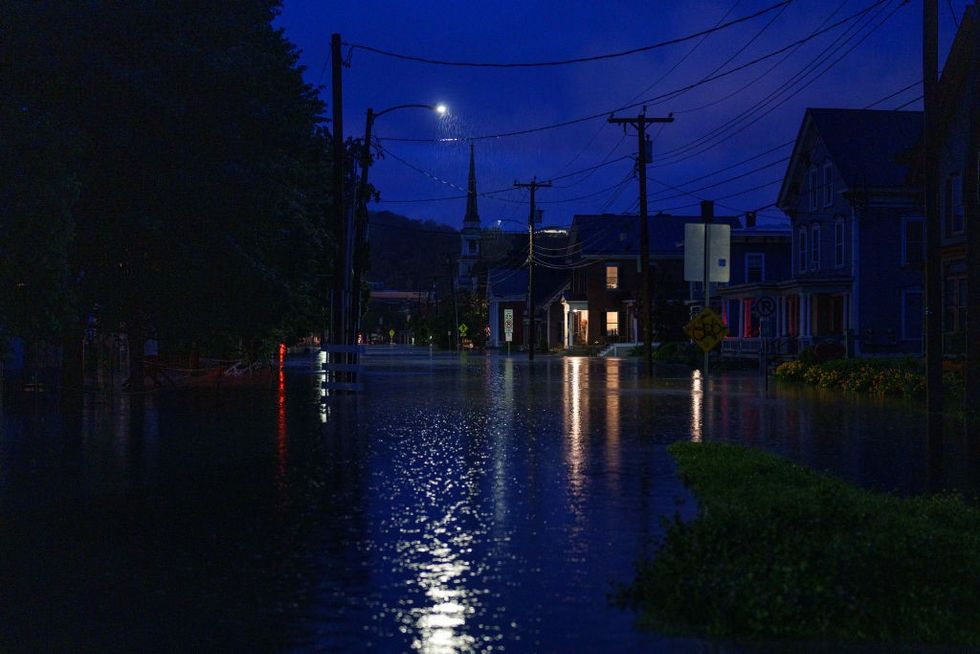 Downtown Montpelier, Vermont was under water on Monday, July 10, 2023 caused by the flooding of the Winooski River.
(Photo: John Tully for The Washington Post via Getty Images)
Downtown Montpelier, Vermont was under water on Monday, July 10, 2023 caused by the flooding of the Winooski River.
(Photo: John Tully for The Washington Post via Getty Images)
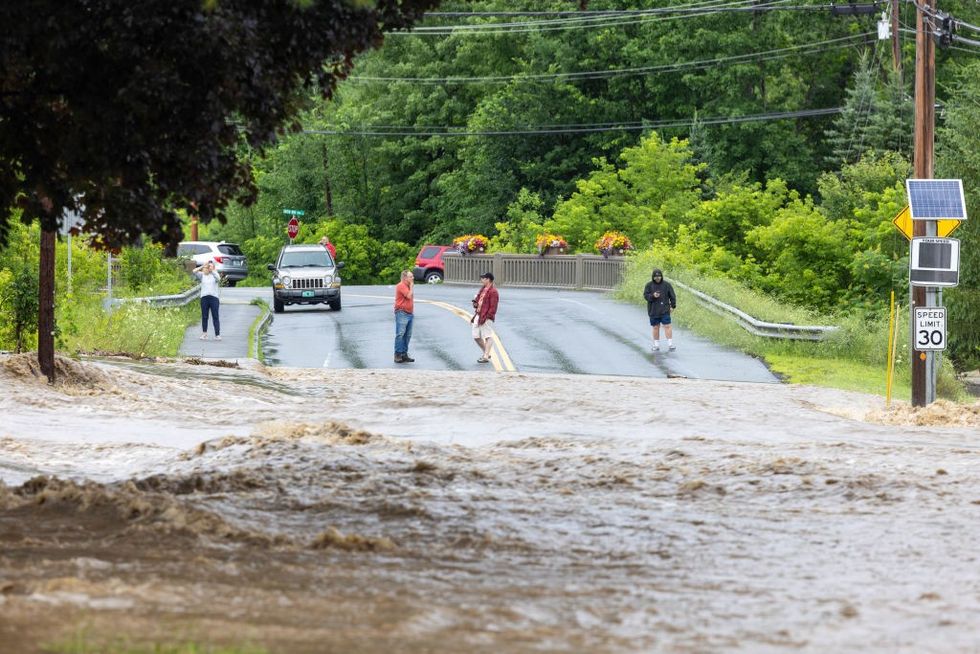 Heavy Rains Cause Catastrophic Flooding In Southern Vermont
(Photo by Scott Eisen/Getty Images)
Heavy Rains Cause Catastrophic Flooding In Southern Vermont
(Photo by Scott Eisen/Getty Images)
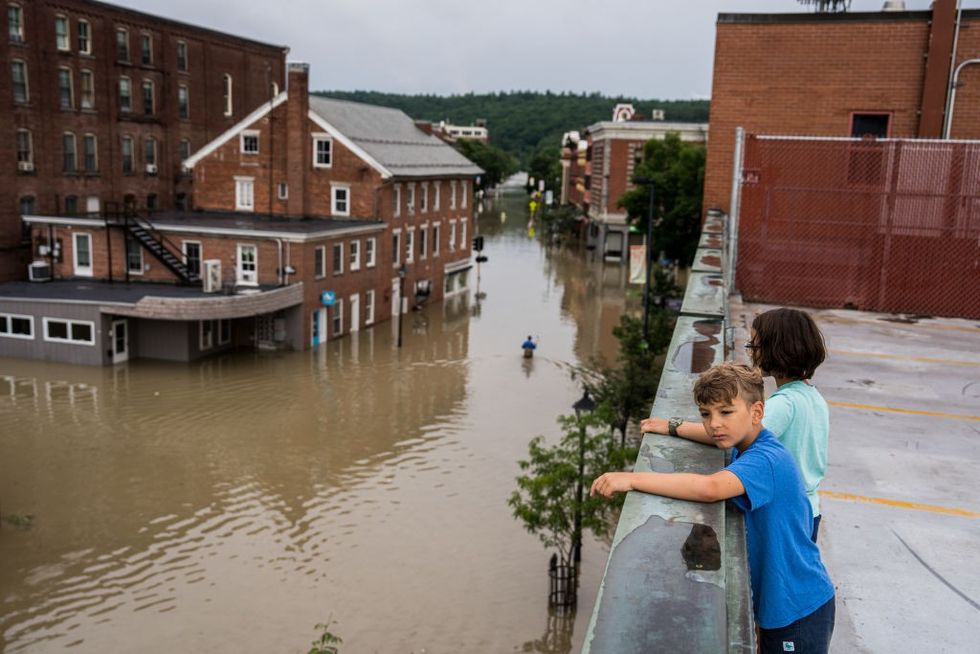 Flooding is seen in downtown Montpelier, Vermont
(Photo: John Tully for The Washington Post via Getty Images)
Flooding is seen in downtown Montpelier, Vermont
(Photo: John Tully for The Washington Post via Getty Images)
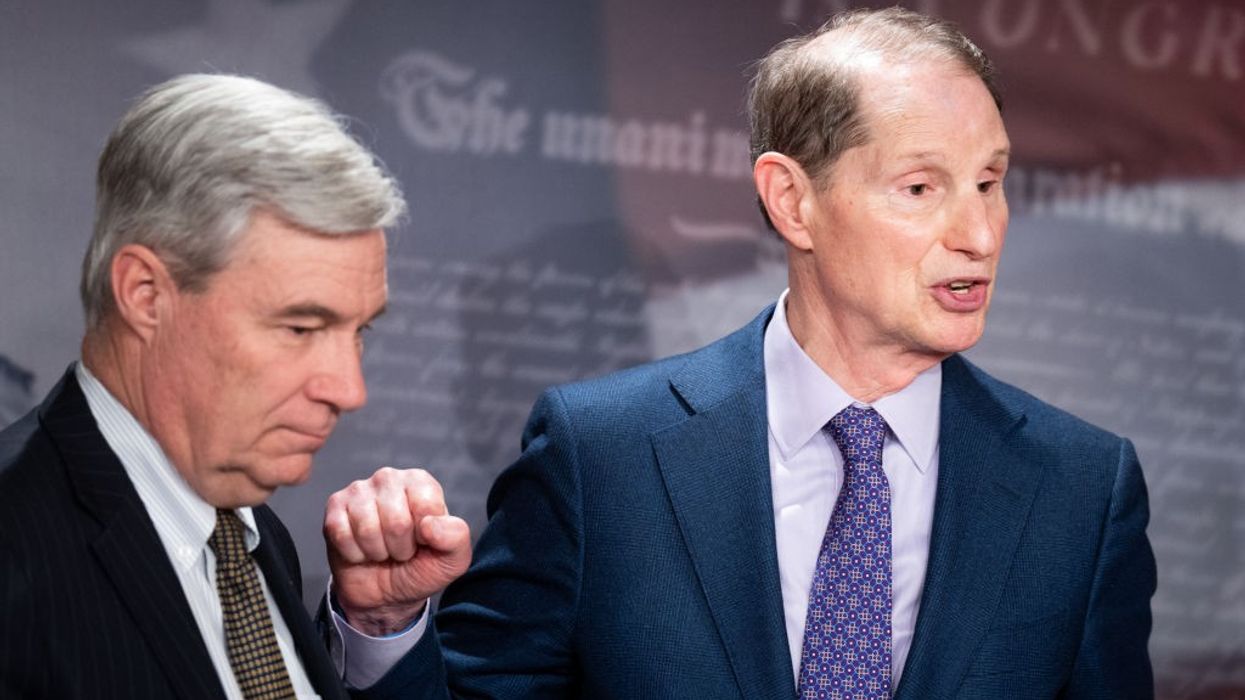
"The behavior of Donald Trump and the oil and gas industry has added to evidence of possible misconduct," said three U.S. lawmakers.
A trio of senior congressional Democrats on Tuesday admonished fossil fuel executives to comply with a request for "information regarding quid pro quo solicitations" from former U.S. President Donald Trump, who earlier this year promised to gut climate regulations if they donated $1 billion to his Republican presidential campaign.
In May, Trump reportedly told Big Oil executives at his Mar-a-Lago resort in Palm Beach, Florida that he would sign executive orders and take other action to boost the fossil fuel industry if they raised nine figures for his campaign. Executives from ExxonMobil, Chevron, Occidental Petroleum, and other corporations reportedly attended the dinner.
A May analysis by the green group Friends of the Earth Action found that the fossil fuel industry would reap an estimated $110 billion windfall from tax breaks alone under Trump's proposed policies—an 11,000% return on Big Oil's billion-dollar investment.
Following the revelation of Trump's quid pro quo offer, House Oversight and Accountability Ranking Member Jamie Raskin (D-Md.), Senate Budget Committee Chair Sheldon Whitehouse (D-R.I.), and Senate Finance Committee Chair Ron Wyden (D-Ore.) wrote to the head of the American Petroleum Institute—the leading Big Oil lobby—and the CEOs of eight companies seeking answers about whether they accepted what Raskin called "Trump's explicit corrupt bargain."
Nearly four months later, the lawmakers are still awaiting satisfactory answers.
"Not only was your response to our inquiries insufficient; tellingly, none of the responses we have received to date refute the accuracy of the reporting, renewing our concern that Donald Trump is actively seeking to sell out American energy policy to the highest bidder," the trio wrote on Tuesday.
"In the weeks since our initial letters, the behavior of Donald Trump and the oil and gas industry has added to evidence of possible misconduct," the lawmakers continued. "Campaign finance records show that following Trump's quid pro quo solicitation at least one company made a significant contribution in support of Trump's presidential run."
"Specifically, on April 29, 2024, Continental Resources Inc. contributed $1 million to Make America Great Again, Inc.—a super PAC dedicated to Trump's reelection," they added. "Continental's CEO, Harold Hamm, who is also an informal adviser to Trump, has reportedly given $1.6 million to aid Trump's reelection so far this year, and he has raised millions more from independent oil producers operating in Texas and Alaska."
According to a Washington Post article published last month, Hamm's top priorities are "opening up more federal lands to drilling, easing the Endangered Species Act, and curbing numerous regulations at the Environmental Protection Agency."
During his first White House term, Trump rolled back regulations protecting the climate, environment, and biodiversity, resulting in increased pollution and premature deaths and fueling catastrophic planetary heating.
In addition to sounding the alarm over Trump's climate-wrecking policies, campaigners have expressed concerns about the GOP nominee's selection of Sen. JD Vance of Ohio as his running mate. Like Trump, Vance is a climate denier. He also has strong ties to the fossil fuel industry, his top donor.

Climate campaigners said the "brilliant and disturbing" publication "shows the crucial need for increased awareness of the delaying tactics of fossil fuel companies."
Echoing years of academic, congressional, and journalistic research, a U.K.-based think tank on Thursday released a report detailing how top fossil fuel industry trade groups have "used a playbook of narratives and arguments to systematically oppose, weaken, and delay the transition to renewables and electric vehicles (EVs) since at least 1967."
The new InfluenceMap analysis focuses on the American Petroleum Institute (API), FuelsEurope, and Fuels Industry U.K.—whose spokespeople responded to the report by insisting to SustainableViews that the oil and gas industry is playing an "essential" role in the transition and it is necessary to harness "vast energy resources, from oil and natural gas to renewables."
Meanwhile, InfluenceMap's report calls out the organizations for their use of three narratives over the past five decades that "has likely contributed to delaying the energy transition and continues to pose a serious threat to policy progress on climate change."
"Between 1950 and 2022, the members of these associations have a combined contribution of approximately 350 billion tons of greenhouse gas emissions, accounting for approximately 18% of the world's total cumulative CO2 emissions from fossil fuels and industry," the report notes.
InfluenceMap traced the narratives "across 51 separate instances of the associations' advocacy against fossil fuel alternatives between 1967 and 2023," the publication explains. "These narratives include 'Solution Skepticism,' which has been in use for 56 years, 'Policy Neutrality' for 34 years, and 'Affordability and Energy Security' for 51 years."
The group defined the narratives as follows:
"Despite advancements in understanding the threats posed by the climate crisis, these narratives persist as of 2023," the report says. It also emphasizes that the narratives contradict science-based policy recommendations from the United Nations' Intergovernmental Panel on Climate Change (IPCC) and the International Energy Association (IEA).
Some examples identified by InfluenceMap include API comments on the Clean Air Act and amendments in 1967, 1970, and 1989 as well as the association's remarks on the Inflation Reduction Act of 2022 and pollution standards for heavy-duty vehicles last year. The publication also points to FuelsEurope's 2021 comments on European Union Performance Standards and the group's participation in a 2022 letter about the Energy Performance of Buildings Directive.
InfluenceMap produced graphics to display its findings, including one that shows key members of each association as of March. Members of all three include BP, ExxonMobil, Shell, and Phillips 66.
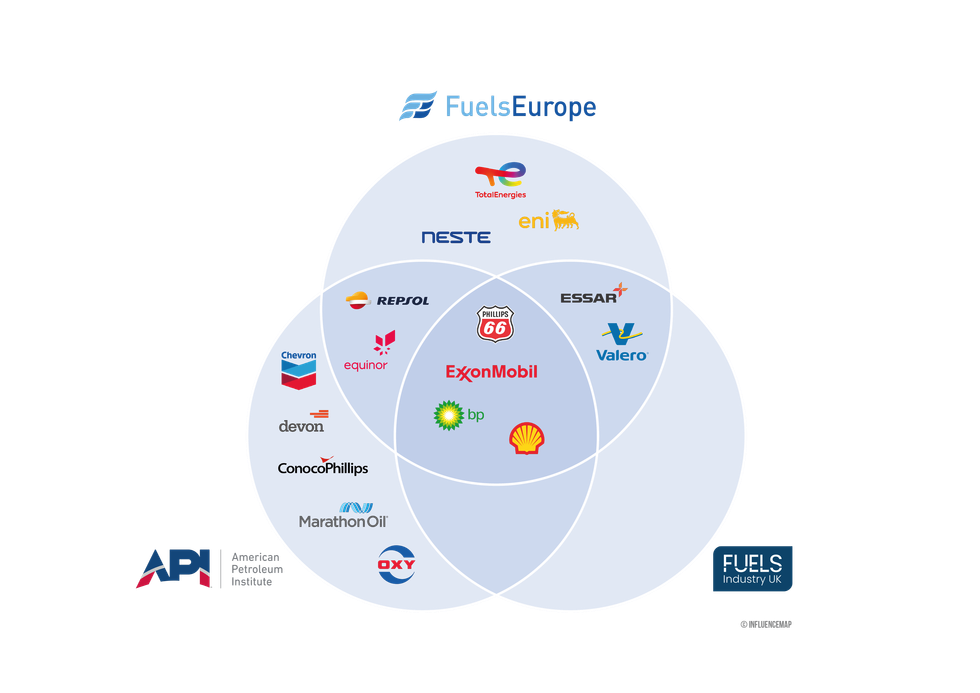
"Some of the world's largest oil and gas companies are still paying a high premium to participate in industry associations that may no longer represent them on climate policy," the report states, pointing to how associations' actions contrast with public positions taken by some major fossil fuel corporations. "Meanwhile, Shell, Chevron, and Exxon have disclosed that they pay between $5 million and $12.5 million per year to hold a membership with the API."
The think tank also made a pair of graphics showing how the trade associations' documented use of the three narratives aligns with fossil fuel and renewables consumption, association members' cumulative emissions, and the number of EVs compared with the total number of registered passenger vehicles since the 1950s.
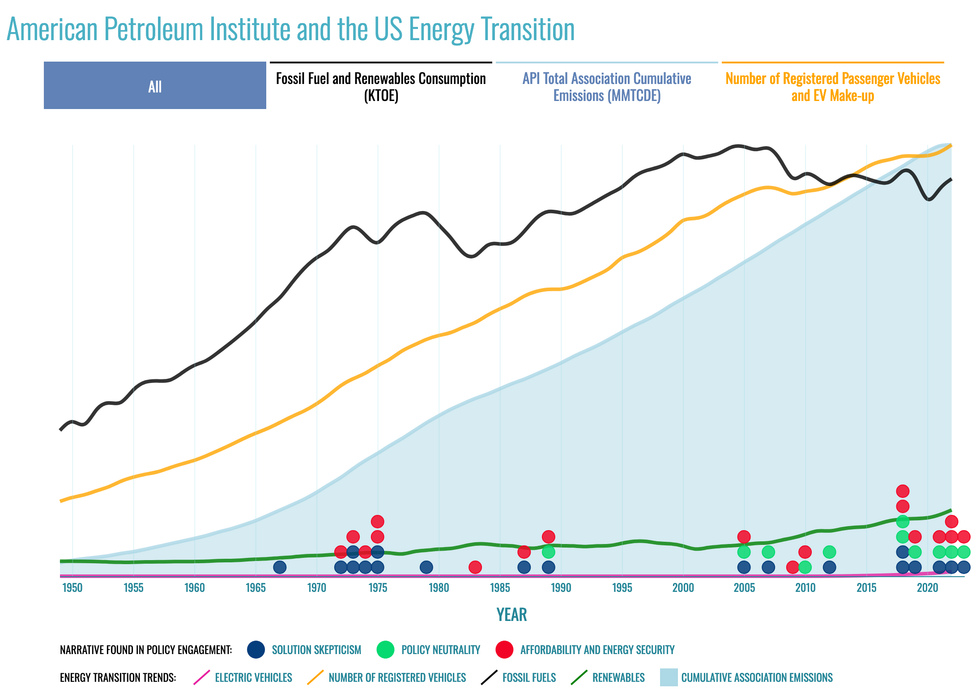
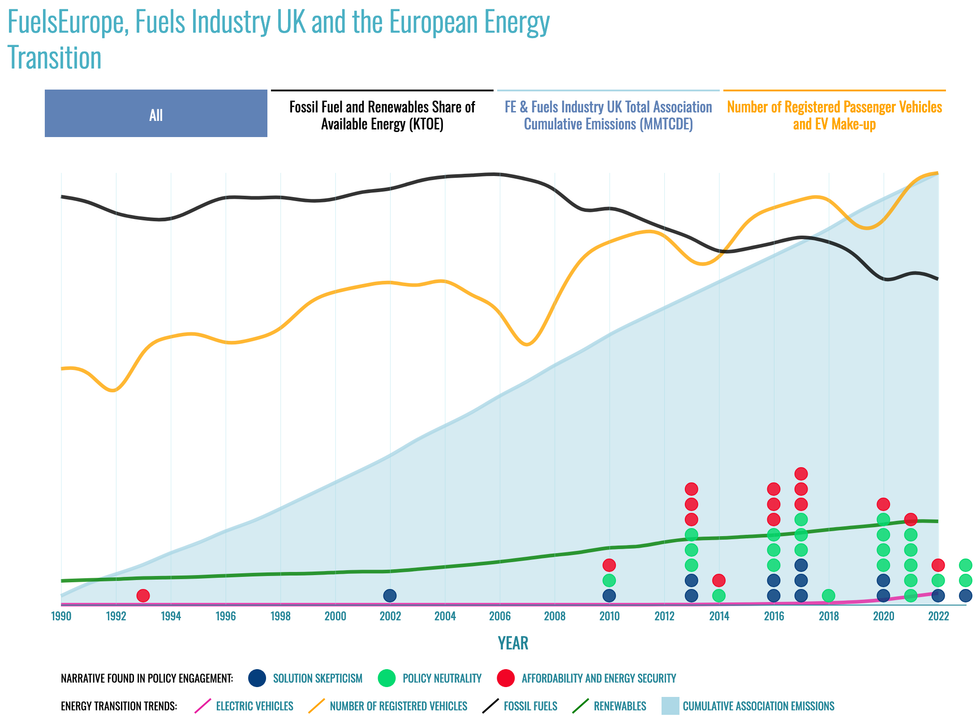
"This report shows that even faced with mounting scientific evidence over decades, the oil and gas industry have pushed ahead with a damaging messaging strategy they developed as early as the 1960s," said Tessa Khan, founder and executive director of Uplift, which supports a rapid and fair transition away from fossil fuel production in the U.K.
"It shows the crucial need for increased awareness of the delaying tactics of fossil fuel companies from policymakers if they are to successfully drive the energy transition forward at the pace we need," Khan added.
Calling the report "brilliant and disturbing," the U.K.-based Fossil Free Parliament said that "this is exactly why we need to remove the industry's seat at the table in Westminster."
In the United States, Democratic federal lawmakers recently concluded a probe into BP, Chevron, ExxonMobil, Shell, API, and the U.S. Chamber of Commerce for decades of spreading climate disinformation, after which they urged the U.S. Department of Justice to investigate all six.

"Emboldened by impunity, Mr. Trump and Big Oil are flaunting their indifference to U.S. citizens' economic well-being for all to see, conferring on how to trade campaign cash for policy changes."
In the wake of Donald Trump attending a Big Oil-hosted fundraiser in Texas, two Democratic Senate chairs on Thursday initiated an investigation into the recent quid pro quo offer to fossil fuel industry executives by the presumptive Republican presidential nominee.
After The Washington Post reported that during an April event, Trump pledged to gut climate policies implemented under Democratic President Joe Biden if the fossil fuel industry raised $1 billion for his 2024 presidential campaign, House Committee on Oversight and Accountability Ranking Member Jamie Raskin (D-Md.) launched a probe last week, sending letters to the leaders of a trade group and companies whose executives appear to have attended that Mar-a-Lago gathering.
Senate Budget Committee Chair Sheldon Whitehouse (D-R.I.) and Senate Finance Committee Chair Ron Wyden (D-Ore.) followed suit on Thursday, sending letters to the American Petroleum Institute (API) and the same eight companies: Cheniere Energy, Chesapeake Energy, Chevron, Continental Resources, EQT Corporation, ExxonMobil, Occidental Petroleum, and Venture Global LNG.
"Such an obvious policies-for-money transaction reeks of cronyism and corruption," Whitehouse and Wyden wrote. "This solicitation, coupled with troubling reports that fossil fuel interests and other companies have been drafting language for use in executive orders favorable to their businesses during a possible second Trump administration, demand immediate additional inquiry."
"Such an obvious policies-for-money transaction reeks of cronyism and corruption."
"According to reports, Mr. Trump made specific policy commitments, including promises to auction off more oil and gas leases on federal lands and in federal waters, reverse pollution standards for new cars, and end drilling restrictions in the Alaskan Arctic," they detailed. "He also vowed to terminate the pause on new permits for liquefied natural gas (LNG) exports, allegedly pledging to do so 'on the first day.' Notably, Mr. Trump called the proposed arrangement a 'deal' for the executives given the tax and regulatory benefits that he would deliver for Big Oil companies and executives."
As Common Dreams reported last week, one analysis found that if the industry executives took Trump up on his $1 billion offer—that has been undercovered by cable news—there would be a major return on investment for the companies, which would enjoy an estimated $110 billion from the tax breaks alone.
"Mr. Trump's blatant quid pro quo offer is particularly concerning in light of concurrent reporting by Politico that the oil and gas industry is drafting 'ready-to-sign' executive orders," Whitehouse and Wyden noted. "The fossil fuel industry's active attempts to write policy for its preferred presidential candidate are simply the latest installment in Big Oil's decadeslong pattern and practice of lobbying for anti-climate policies even while trying to greenwash its public image."
The pair of senators pointed to documents released last month by Raskin and Whitehouse's panels as part of a three-year probe that on Wednesday culminated in them urging U.S. Attorney General Merrick Garland to investigate the fossil fuel industry for decades of spreading disinformation about their products and the climate emergency.
Speaking with The New Republic's Greg Sargent about Trump's reported comments to Big Oil executives, Whitehouse said last week that "this is practically an invitation to ask more questions," and a "natural extension of the investigation already underway."
As the senators highlighted Thursday: "Of particular relevance here, documents released in the joint investigation detail the industry's outsized influence on energy policy during Mr. Trump's first administration... In turn, the Trump administration appeared to rely on the oil and gas industry to support and defend its anti-climate energy agenda."
"Time and time again, both Mr. Trump and the U.S. oil and gas industry have proved they are willing to sell out Americans to pad their own pockets," they continued. "And now, emboldened by impunity, Mr. Trump and Big Oil are flaunting their indifference to U.S. citizens' economic well-being for all to see, conferring on how to trade campaign cash for policy changes. Such potential abuses must be scrutinized."
Whitehouse and Wyden are demanding answers and documents from API and the executives by June 6. Raskin, in his letters, called for responses and records by next Monday.

Rep. Jamie Raskin expressed concern that some firms, "which have a track record of using deceitful tactics to undermine effective climate policy, may have already accepted or facilitated Mr. Trump's explicit corrupt bargain."
A top U.S. House Democrat announced Tuesday that he is demanding answers from fossil fuel executives after Washington Post reporting revealed last week that former Republican President Donald Trump recently told industry leaders he would gut climate regulations if they raised $1 billion for his 2024 presidential campaign.
Maryland Congressman Jamie Raskin, ranking member of the Committee on Oversight and Accountability, on Monday wrote to the heads of the American Petroleum Institute (API) and eight companies: Cheniere Energy, Chesapeake Energy, Chevron, Continental Resources, EQT Corporation, ExxonMobil, Occidental Petroleum, and Venture Global LNG.
Raskin's letters note that the executives "appear to have attended" Trump's fundraising dinner at Mar-a-Lago in Florida last month and "media reports raise significant potential ethical, campaign finance, and legal issues that would flow from the effective sale of American energy and regulatory policy to commercial interests in return for large campaign contributions."
"Mr. Trump's unvarnished quid pro quo offer is especially troubling evidence in light of recent accounts that the 'U.S. oil industry is drawing up ready-to-sign executive orders for Donald Trump aimed at pushing natural gas exports, cutting drilling costs, and increasing offshore oil leases in case he wins a second term,'" he wrote, citing Politico. "These preparatory actions suggest that certain oil and gas companies, which have a track record of using deceitful tactics to undermine effective climate policy, may have already accepted or facilitated Mr. Trump's explicit corrupt bargain."
Raskin also highlighted findings from a January Oversight Committee Democrats staff report, which shows that "when Mr. Trump was in office, he accepted at least $7.8 million from kings, princes, and foreign states, including the People's Republic of China and Saudi Arabia, in blatant violation of the Constitution's foreign emoluments clause, and rendered a sequence of foreign policy favors to his patrons."
The congressman—and constitutional scholar—asked the executives to respond to questions and document requests by May 27. He is seeking the names of employees who attended the April 11 fundraiser, copies of materials distributed during the event, descriptions of all policy proposals and related campaign contributions discussed, and draft executive orders or policy paperwork prepared by members of the companies.
"The Committee on Oversight and Accountability is the principal oversight committee of the House of Representatives and has broad authority to investigate 'any matter' at 'any time,'" Raskin explained. "The requested information is needed to investigate and legislate on matters related to presidential and presidential-candidate ethics and to continue to address the major ethics crisis created by Donald Trump's efforts to profit off the presidency."
As Raskin released the letters on Tuesday, Media Matters for America's Allison Fisher pointed out that "unfortunately, over a four-day period, TV news broadcast and cable networks—with the exception of MSNBC—did not cover Trump's proposition to oil executives."
However, Trump has made his policy plans clear. Even before the fundraiser, he publicly pledged to "drill, baby, drill" if he beats Democratic President Joe Biden in November. One March analysis found that a second Trump term would lead to the release of 4 billion more tons of planet-heating carbon dioxide—the combined annual emissions of the European Union and Japan—by 2030 than if Biden were reelected.
The letters aren't the first time Raskin has taken aim at the fossil fuel industry this month. At the beginning of May, he testified before the U.S. Senate Budget Committee about a nearly three-year investigation into "Big Oil's campaign of deception and distraction," which he said "undermines the efforts we need to mobilize our people and government to save our climate, our habitat, and our species."
"Unless the deception ends, and until the industry is held accountable," the congressman warned, "we are unlikely ever to be able to muster the national political will to effectively tackle climate change."
"If you contributed to a mess, you should play a role in cleaning it up," said one supporter of a bill that could be a model for other states to follow.
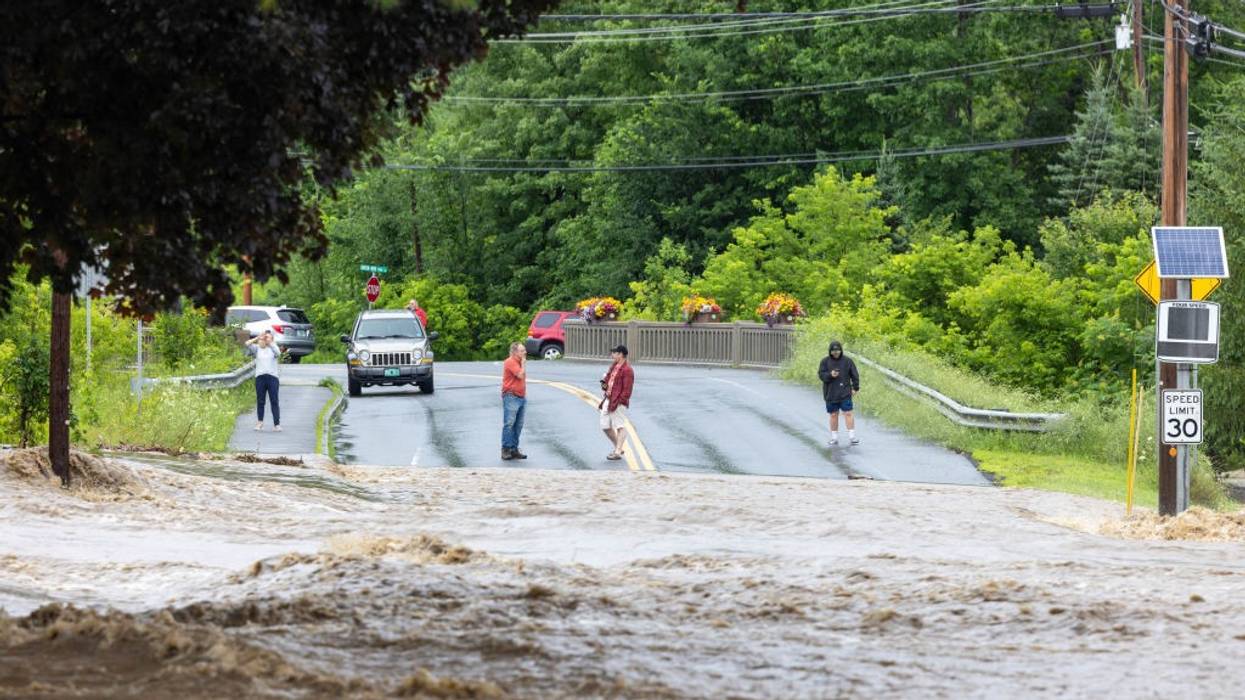
This week, Vermont became the nation's first state to pass legislation requiring fossil fuel giants to pay for the damage and disruption caused by their planet-warming products, offering a model for others to follow.
While it remains likely Republican Gov. Phil Scott will veto the bill passed by the state Senate in March and the House on Monday, the legislation—now heading for his desk—was celebrated as a blueprint for others to imitate.
As Vermont Public reported:
Modeled after the federal Superfund program, the policy would require companies like ExxonMobil Corporation and Shell to pay Vermont a share of what climate change has cost the state in recent decades. Vermont would use those payments to establish a program to fund recovery from climate-fueled disasters and work to adapt to the state’s already-changed climate.
Vermont could become the first state in the country to enact such legislation. New York, California, Massachusetts and Maryland are all considering similar bills, as is Congress.
The fossil fuel industry has opposed the measure and vowed legal action if it becomes law. In March, the American Petroleum Institute (API), which represents oil and gas companies, called the legislation "bad policy" and argued that it "may be unconstitutional" for holding corporations responsible for what society at large has done.
Evidence has shown, however, that the fossil fuel industry knew about the climate impacts of burning coal, oil, and gas for decades but hid those understandings from the public as it fought efforts to curb emissions or mitigate the damage being done.
"If you contributed to a mess, you should play a role in cleaning it up," Elena Mihaly, vice-president of the Conservation Law Foundation's Vermont chapter and a supporter of the bill, told The Guardian.
Like many other states, Vermont has suffered expensive damage from climate-related weather events in recent years—costs that proponents of the bill say should not be shouldered by the state alone when it's so clear the fossil fuel industry's role in creating the current crisis.
"You see towns across the state underwater, and communities and businesses financially devastated. The reality of the climate crisis just really comes crashing home," Ben Edgerly Walsh, climate and energy program director for the Vermont Public Interest Research Group, told NBC News following passage in the House. "These are facts that we are dealing with in real-time that we need the financial resources to deal with."
If Scott vetoes the bill, the state House and Senate lawmakers would have to muster a two-thirds majority to override his rejection.
The report details a "campaign of deception, disinformation, and doublespeak waged using dark money, phony front groups, false economics, and relentless exertion of political influence."
Two U.S. congressional committees on Tuesday released a report that "provides a rare glimpse into the extensive efforts undertaken by fossil fuel companies to deceive the public and investors about their knowledge of the effects of their products on climate change and to undermine efforts to curb greenhouse gas emissions."
The report—titled Denial, Disinformation, and Doublespeak: Big Oil's Evolving Efforts to Avoid Accountability for Climate Change—was released after nearly three years of investigation by the Democratic staffs of the House Committee on Oversight and Accountability and the Senate Budget Committee.
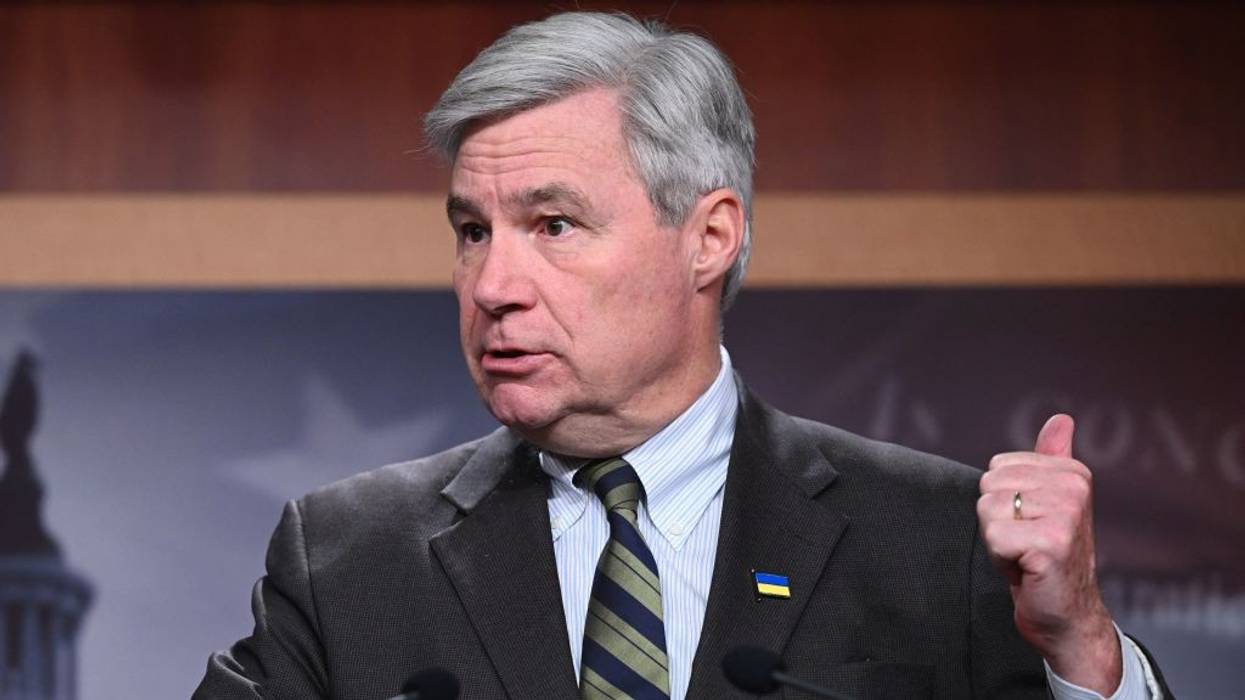
"For decades, the fossil fuel industry has known about the economic and climate harms of its products but has deceived the American public to keep collecting more than $600 billion each year in subsidies while raking in record-breaking profits," said Senate Budget Committee Chair Sheldon Whitehouse (D-R.I.).
"As this joint report makes clear, the industry's outright denial of climate change has evolved into a green-seeming cover for its ongoing covert operation—a campaign of deception, disinformation, and doublespeak waged using dark money, phony front groups, false economics, and relentless exertion of political influence—to block climate progress," the senator added.
Big Oil’s 4 phases on climate change:
1.Learn of the danger posed by climate change from their own scientists
2.Form an armada of front groups to cover it up
3.Deny a problem exists
4.Engage in doublespeak by pretending to care for a solution
Now we're holding them accountable. pic.twitter.com/YlqztAZgo1
— Senate Budget Committee (@SenateBudget) April 30, 2024
In a statement welcoming the report, Richard Wiles, president of the Center for Climate Integrity, said that "this new evidence of Big Oil's climate lies will likely be used to hold these companies accountable in court—and it should generate renewed calls for the U.S. Department of Justice to finally open its own investigation into the fossil fuel industry."
The congressional probe targeted four companies and two industry allies: BP America, Chevron, ExxonMobil, and Shell USA as well as the American Petroleum Institute (API) and the Chamber of Commerce. As the report details, the committee staffers found:
The report was released on the eve of a Wednesday morning Senate hearing hosted by Whitehouse. The House panel's ranking member, Rep. Jamie Raskin (D-Md.)—who participated in a related October 2021 event in the lower chamber—is expected to join multiple experts in testifying.
"We applaud Sen. Whitehouse, Rep. Raskin, and their committees for helping to shine further light on Big Oil's ongoing climate deception," said Wiles. "Communities across the country are already taking these polluters to court to make them pay for their deceit, and many of their lawsuits have cited documents unearthed by Congress as evidence."
"Big Oil's concerted efforts to mislead the public about their destructive industry are the most consequential corporate fraud in history," he continued. "Tomorrow's hearing should make clear that it's time for the U.S. Justice Department to get off the sidelines and take action to hold Big Oil accountable for lying to the American people for decades."
Wiles was far from alone in demanding action from the Biden administration based on the committees' findings.
"This report is a scathing indictment of the fossil fuel industry's lies and corruption," declared Cassidy DiPaola, a spokesperson for the Make Polluters Pay campaign. "As the impacts of the climate crisis worsen, from deadly heatwaves to devastating floods and wildfires, it's never been more important to hold polluters accountable for the damage they've knowingly caused. The Senate Budget Committee's investigation is a critical step towards justice, and it's time the Biden administration follows suit."
Sunrise Movement executive director Aru Shiney-Ajay urged President Joe Biden—who is seeking reelection in November—to "fight for young people by holding companies like Exxon accountable for their climate lies."
"President Biden must hold Big Oil responsible by declaring a climate emergency and suing fossil fuel companies for creating the climate crisis and lying to the public about it," Shiney-Ajay said. "For too long we've seen fossil fuel companies like Exxon and Chevron deny the cause of the climate crisis and pretend to fight for climate action, all the while lining their pockets with bigger and bigger returns. This must stop and the president can do something about it."
"Biden must direct the Department of Justice to investigate and prosecute fossil fuel companies like Exxon for their disinformation," she argued. "Until the administration starts treating Big Oil like Big Tobacco, everyday Americans will continue to pay for their lies with flooded homes, hotter summers, and more extreme weather."
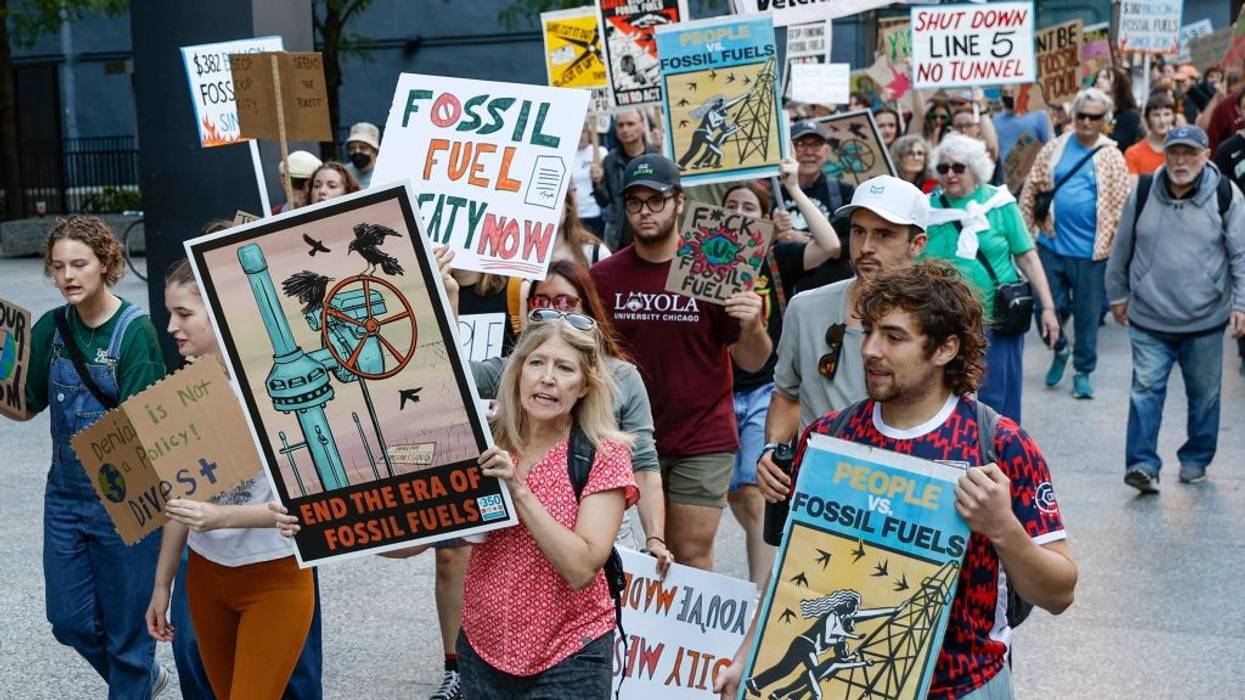
The city alleges the industry "funded, conceived, planned, and carried out a sustained and widespread campaign of denial and disinformation about the existence of climate change and their products' contribution to it."
Chicago on Tuesday joined the growing list of U.S. cities and states suing Big Oil for lying to the public about how burning fossil fuels causes and exacerbates the climate emergency.
The administration of Chicago Mayor Brandon Johnson, a progressive Democrat, filed a lawsuit in Cook County Circuit Court against ExxonMobil, Chevron, BP, Shell, ConocoPhillips, Phillips 66, and the industry lobby American Petroleum Institute, which "funded, conceived, planned, and carried out a sustained and widespread campaign of denial and disinformation about the existence of climate change and their products' contribution to it."
"The climate change impacts that Chicago has faced and will continue to face—including more frequent and intense storms, flooding, droughts, extreme heat events, and shoreline erosion—are felt throughout every part of the city and disproportionately in low-income communities," the suit contends.
In a statement, Johnson said that "there is no justice without accountability."
"From the unprecedented poor air quality that we experienced last summer to the basement floodings that our residents on the West Side experienced, the consequences of this crisis are severe, as are the costs of surviving them," he added. "That is why we are seeking to hold these defendants accountable."
Climate campaigners welcomed the lawsuit.
"Big Oil has lied to the American people for decades about the catastrophic climate risks of their products, and now Chicago and communities across the country are rightfully insisting they pay for the damage they've caused," Center for Climate Integrity president Richard Wiles said in a statement.
"With Chicago, the nation's third largest city, joining the fray, there is no doubt that we are witnessing a historic wave of lawsuits that could finally hold Big Oil accountable for the climate crisis they knowingly caused," he added.
Chicago joins eight U.S. states plus the District of Columbia and numerous municipalities across the country that have sued to hold Big Oil accountable for deceiving the public about its role in the climate emergency.
"To date, eight federal appeals courts and dozens of federal district courts have unanimously ruled against the fossil fuel industry's arguments to prevent these lawsuits from moving forward in state courts," noted the Center for Climate Integrity. "In 2023, the U.S. Justice Department added its support for the communities. The U.S. Supreme Court has denied Big Oil petitions to consider the industry's appeals of those lower court rulings three separate times, most recently in January."
Angela Tovar, Chicago's chief sustainability officer, told the Chicago Sun-Times that "the fossil fuel industry should be able to pay for the damage they've caused."
"We have to see accountability for the climate crisis," she added.