SUBSCRIBE TO OUR FREE NEWSLETTER
Daily news & progressive opinion—funded by the people, not the corporations—delivered straight to your inbox.
5
#000000
#FFFFFF
To donate by check, phone, or other method, see our More Ways to Give page.
Daily news & progressive opinion—funded by the people, not the corporations—delivered straight to your inbox.
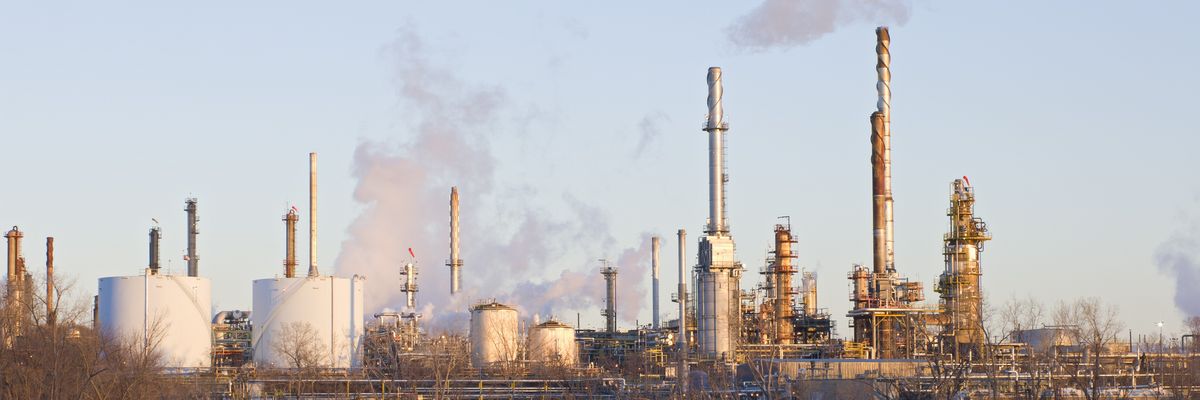
An oil and petroleum refinery is shown in St. Paul Park, Minnesota.
"Big Oil companies will continue fighting to escape justice, but for the third time in a year, the U.S. Supreme Court has denied their desperate pleas," said one campaigner.
For the third time in less than a year, the U.S. Supreme Court on Monday allowed a key case against the fossil fuel industry to proceed in state court, delivering a win for the movement to make polluters pay for driving the climate emergency.
"This decision is another step forward for Minnesota's efforts to hold fossil fuel giants accountable for their climate lies and the harm they've caused," said Center for Climate Integrity president Richard Wiles, pointing to the previous denials of other cases last April and May.
" Big Oil companies will continue fighting to escape justice, but for the third time in a year, the U.S. Supreme Court has denied their desperate pleas to overturn the unanimous rulings of every single court to consider this issue," he continued.
"It's time for these polluters to give up their failed arguments to escape state courts."
As legal leaders of dozens of U.S. states and municipalities have launched climate lawsuits in recent years, the fossil fuel industry has attempted to evade accountability by shifting the cases to federal court—a strategy that's proven unsuccessful.
Wiles argued that "after three strikes, it's time for these polluters to give up their failed arguments to escape state courts and prepare to face the evidence of their climate deception at trial."
The U.S. Supreme Court's Monday decision came in a case filed in 2020 by Democratic Minnesota Attorney General Keith Ellison against ExxonMobil, Koch Industries, and the American Petroleum Institute (API), based on the state's consumer protection laws.
"The fraud, deceptive advertising, and other violations of Minnesota state law and common law that the lawsuit shows they perpetrated have harmed Minnesotans' health and our state's environment, infrastructure, and economy," Ellison said at the time.
The justices declined Big Oil's request to review the 8th U.S. Circuit Court of Appeals' March decision that the case belongs in state court. Justice Brett Kavanaugh, an appointee of former GOP President Donald Trump, would have taken the case, in line with his position last year.
"I appreciate the court's consideration and decision," Ellison said in a statement Monday. "It aligns with 25 federal court decisions across the country, all of which have found that cases like ours rest on these defendants' failures to warn and their campaigns of deception around their products' contributions to the climate crisis. The court's decision confirms these cases are properly filed in state courts."
"Taken together, the defendants' behavior has delayed the transition to alternative energy sources and a lower-carbon economy, resulting in dire impacts on Minnesota's environment and enormous costs to Minnesotans and the world," he stressed. "Now, the case can move forward in state court, where it was properly filed, and we can begin to hold these companies accountable for their wrongful conduct."
Cassidy DiPaola, communications director for Fossil Free Media and the Make Polluters Pay campaign, declared Monday that "today's decision is an important step forward for accountability and justice."
"The Supreme Court has now laid out an unmistakable path forward," she added, "for not only Minnesota's consumer protection case against ExxonMobil, Koch Industries, and API, but the dozens of cases against the fossil fuel industry popping up across the county."
This post has been updated with comment from Keith Ellison.
Dear Common Dreams reader, It’s been nearly 30 years since I co-founded Common Dreams with my late wife, Lina Newhouser. We had the radical notion that journalism should serve the public good, not corporate profits. It was clear to us from the outset what it would take to build such a project. No paid advertisements. No corporate sponsors. No millionaire publisher telling us what to think or do. Many people said we wouldn't last a year, but we proved those doubters wrong. Together with a tremendous team of journalists and dedicated staff, we built an independent media outlet free from the constraints of profits and corporate control. Our mission has always been simple: To inform. To inspire. To ignite change for the common good. Building Common Dreams was not easy. Our survival was never guaranteed. When you take on the most powerful forces—Wall Street greed, fossil fuel industry destruction, Big Tech lobbyists, and uber-rich oligarchs who have spent billions upon billions rigging the economy and democracy in their favor—the only bulwark you have is supporters who believe in your work. But here’s the urgent message from me today. It's never been this bad out there. And it's never been this hard to keep us going. At the very moment Common Dreams is most needed, the threats we face are intensifying. We need your support now more than ever. We don't accept corporate advertising and never will. We don't have a paywall because we don't think people should be blocked from critical news based on their ability to pay. Everything we do is funded by the donations of readers like you. When everyone does the little they can afford, we are strong. But if that support retreats or dries up, so do we. Will you donate now to make sure Common Dreams not only survives but thrives? —Craig Brown, Co-founder |
For the third time in less than a year, the U.S. Supreme Court on Monday allowed a key case against the fossil fuel industry to proceed in state court, delivering a win for the movement to make polluters pay for driving the climate emergency.
"This decision is another step forward for Minnesota's efforts to hold fossil fuel giants accountable for their climate lies and the harm they've caused," said Center for Climate Integrity president Richard Wiles, pointing to the previous denials of other cases last April and May.
" Big Oil companies will continue fighting to escape justice, but for the third time in a year, the U.S. Supreme Court has denied their desperate pleas to overturn the unanimous rulings of every single court to consider this issue," he continued.
"It's time for these polluters to give up their failed arguments to escape state courts."
As legal leaders of dozens of U.S. states and municipalities have launched climate lawsuits in recent years, the fossil fuel industry has attempted to evade accountability by shifting the cases to federal court—a strategy that's proven unsuccessful.
Wiles argued that "after three strikes, it's time for these polluters to give up their failed arguments to escape state courts and prepare to face the evidence of their climate deception at trial."
The U.S. Supreme Court's Monday decision came in a case filed in 2020 by Democratic Minnesota Attorney General Keith Ellison against ExxonMobil, Koch Industries, and the American Petroleum Institute (API), based on the state's consumer protection laws.
"The fraud, deceptive advertising, and other violations of Minnesota state law and common law that the lawsuit shows they perpetrated have harmed Minnesotans' health and our state's environment, infrastructure, and economy," Ellison said at the time.
The justices declined Big Oil's request to review the 8th U.S. Circuit Court of Appeals' March decision that the case belongs in state court. Justice Brett Kavanaugh, an appointee of former GOP President Donald Trump, would have taken the case, in line with his position last year.
"I appreciate the court's consideration and decision," Ellison said in a statement Monday. "It aligns with 25 federal court decisions across the country, all of which have found that cases like ours rest on these defendants' failures to warn and their campaigns of deception around their products' contributions to the climate crisis. The court's decision confirms these cases are properly filed in state courts."
"Taken together, the defendants' behavior has delayed the transition to alternative energy sources and a lower-carbon economy, resulting in dire impacts on Minnesota's environment and enormous costs to Minnesotans and the world," he stressed. "Now, the case can move forward in state court, where it was properly filed, and we can begin to hold these companies accountable for their wrongful conduct."
Cassidy DiPaola, communications director for Fossil Free Media and the Make Polluters Pay campaign, declared Monday that "today's decision is an important step forward for accountability and justice."
"The Supreme Court has now laid out an unmistakable path forward," she added, "for not only Minnesota's consumer protection case against ExxonMobil, Koch Industries, and API, but the dozens of cases against the fossil fuel industry popping up across the county."
This post has been updated with comment from Keith Ellison.
For the third time in less than a year, the U.S. Supreme Court on Monday allowed a key case against the fossil fuel industry to proceed in state court, delivering a win for the movement to make polluters pay for driving the climate emergency.
"This decision is another step forward for Minnesota's efforts to hold fossil fuel giants accountable for their climate lies and the harm they've caused," said Center for Climate Integrity president Richard Wiles, pointing to the previous denials of other cases last April and May.
" Big Oil companies will continue fighting to escape justice, but for the third time in a year, the U.S. Supreme Court has denied their desperate pleas to overturn the unanimous rulings of every single court to consider this issue," he continued.
"It's time for these polluters to give up their failed arguments to escape state courts."
As legal leaders of dozens of U.S. states and municipalities have launched climate lawsuits in recent years, the fossil fuel industry has attempted to evade accountability by shifting the cases to federal court—a strategy that's proven unsuccessful.
Wiles argued that "after three strikes, it's time for these polluters to give up their failed arguments to escape state courts and prepare to face the evidence of their climate deception at trial."
The U.S. Supreme Court's Monday decision came in a case filed in 2020 by Democratic Minnesota Attorney General Keith Ellison against ExxonMobil, Koch Industries, and the American Petroleum Institute (API), based on the state's consumer protection laws.
"The fraud, deceptive advertising, and other violations of Minnesota state law and common law that the lawsuit shows they perpetrated have harmed Minnesotans' health and our state's environment, infrastructure, and economy," Ellison said at the time.
The justices declined Big Oil's request to review the 8th U.S. Circuit Court of Appeals' March decision that the case belongs in state court. Justice Brett Kavanaugh, an appointee of former GOP President Donald Trump, would have taken the case, in line with his position last year.
"I appreciate the court's consideration and decision," Ellison said in a statement Monday. "It aligns with 25 federal court decisions across the country, all of which have found that cases like ours rest on these defendants' failures to warn and their campaigns of deception around their products' contributions to the climate crisis. The court's decision confirms these cases are properly filed in state courts."
"Taken together, the defendants' behavior has delayed the transition to alternative energy sources and a lower-carbon economy, resulting in dire impacts on Minnesota's environment and enormous costs to Minnesotans and the world," he stressed. "Now, the case can move forward in state court, where it was properly filed, and we can begin to hold these companies accountable for their wrongful conduct."
Cassidy DiPaola, communications director for Fossil Free Media and the Make Polluters Pay campaign, declared Monday that "today's decision is an important step forward for accountability and justice."
"The Supreme Court has now laid out an unmistakable path forward," she added, "for not only Minnesota's consumer protection case against ExxonMobil, Koch Industries, and API, but the dozens of cases against the fossil fuel industry popping up across the county."
This post has been updated with comment from Keith Ellison.