SUBSCRIBE TO OUR FREE NEWSLETTER
Daily news & progressive opinion—funded by the people, not the corporations—delivered straight to your inbox.
5
#000000
#FFFFFF
To donate by check, phone, or other method, see our More Ways to Give page.
Daily news & progressive opinion—funded by the people, not the corporations—delivered straight to your inbox.
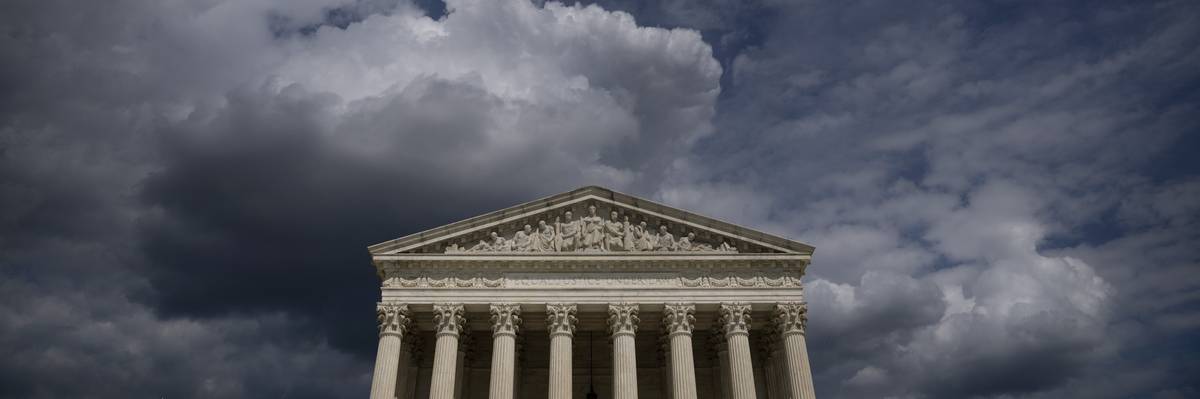
Clouds are seen above The US Supreme Court building on May 17, 2021 in Washington, DC.
Standing alone, neither the expanded SAVE program nor the citizenship lists may be capable of changing the outcome of the midterms. But they do not stand alone.
Just when it seemed the Supreme Court might be prepared to stop Donald Trump from sabotaging the midterm elections, the six Republican justices who dominate the court handed the president a potentially far-reaching victory on September 25 with another ruling on its emergency “shadow” docket. The ruling in Department of Homeland Security v. League of Women Voters permits the administration and Republican-led states to use a newly expanded federal database to review state voter lists, overturning a lower-court decision that had concluded the database could not be used for the midterms because it violates federal privacy laws and the Administrative Procedure Act.
The Systematic Alien Verification for Entitlements program was created in 1986 to allow federal, state, and local government agencies to verify the citizenship and immigration status of noncitizens applying for public benefits, relying on records maintained by the Department of Homeland Security (DHS), the Department of Justice (DOJ), and the Department of State. However, in March 2025, Trump promulgated Executive Order 14248 (titled “Preserving and Protecting the Integrity of American Elections”), that revamped the program to permit state and local authorities to verify the citizenship status of registered voters so they could purge noncitizens from the rolls—a purpose the SAVE program was never intended to serve. The executive order also directed the Social Security Administration (SSA) to make its records available to the DHS for that purpose. Two months later, the DHS, acting on its own, launched a modified SAVE program that allows state and local authorities to conduct unlimited bulk searches of multiple individuals at once.
In September 2025, the League of Women Voters, together with its affiliates in Texas, Louisiana, and Virginia, and the Electronic Privacy Information Center sued the federal government, claiming that the expanded SAVE program violated the Social Security Act, the federal Privacy Act, and the Administrative Procedure Act. On June 22 of this year, District Court Judge Sparkle L. Sooknanan, who sits in Washington, DC, blocked the revamped SAVE program from being used for the midterm elections. The Justice Department, led by Solicitor General D. John Sauer, took its case to the US Court of Appeals for the DC Circuit, and, after failing to secure relief there, turned to the Supreme Court’s shadow docket, where the administration has enjoyed great success.
In one Texas county alone, searches conducted under the database returned an astounding error rate of 21%. There is no reason to believe the master citizenship lists will be any more reliable.
The high court granted Sauer’s request with a seven-page unsigned “per curiam” ruling, holding that the plaintiffs’ claims about the expanded database lacked merit, and that “the Federal Government has an obligation to respond to requests from state and local election officials seeking to verify the citizenship of voters.” In their dissent, the court’s three Democrats argued that the use of the database will result in voter disenfranchisement.
On its face, as some commentators have noted, the court’s ruling appears limited in scope because the National Voter Registration Act (NRVA) of 1993 prohibits states from conducting “systematic” purges of registered voters in the 90-day “quiet period” prior to elections. If the terms of the NRVA are faithfully and literally applied, this means that states can utilize the expanded SAVE program to conduct only “individualized” (one at a time) citizenship checks of prospective voters in the weeks remaining before the midterms. Use of the SAVE program is also voluntary, as states are not compelled but only urged to use the system.
The problem is that neither the NRVA nor the Supreme Court’s shadow docket ruling defines what is meant by “systematic” purges, and that individual purges can easily be aggregated to have a mass impact. In a post for Democracy Docket, reporter Yunior Rivas explained the problem this way:
Now, a crucial voter protection [under the NRVA] could hinge on whether the Supreme Court [in subsequent cases that will surely come its way before the midterms] wants to narrow the definition of “systematic” as applied to purges. And there’s reason to fear that it does [ … by allowing states to] run thousands of voters through SAVE and then evade the NVRA’s quiet period by treating each resulting citizenship challenge as an “individualized” inquiry.
Rivas also observed that the Supreme Court’s shadow docket decision does not prevent the Trump administration from preparing master citizenship lists for each state, which GOP-led states could use to purge unlimited numbers of individual voters without even using the SAVE program.
In fact, those citizenship lists are being compiled pursuant to Executive Order 14399, which directs the DHS, SSA, and State Department to create lists of all “confirmed” citizens residing in every state who are entitled to vote. Once again, states are not required by the order to use the lists to purge their voting rolls, but the order stipulates that election officials in states that permit noncitizens to vote will be referred to the DOJ for possible criminal prosecution.
On September 14, the Supreme Court handed Trump a rare shadow-docket defeat, preventing the US Postal Service from interfering with mail-in balloting. But that decision did not address the legality of the citizenship lists. The legality of the lists is currently pending in litigation brought by the Electronic Privacy Information Center and the public-interest groups Protect Democracy and Citizens for Responsibility and Ethics in Washington, but no decision has been rendered.
Meanwhile, the clock is ticking.
According to the DOJ, 27 states, including Texas, Florida, Georgia, Ohio, and Indiana, have agreed to use the expanded SAVE database, which in practice has proven to be plagued by serious mistakes. In one Texas county alone, searches conducted under the database returned an astounding error rate of 21%. There is no reason to believe the master citizenship lists will be any more reliable.
Standing alone, neither the expanded SAVE program nor the citizenship lists may be capable of changing the outcome of the midterms. But they do not stand alone. They are part and parcel of a multifaceted plan to sabotage the elections, engineered by a president with dictatorial aspirations and a core of committed quislings determined to keep him and the MAGA movement in power through the midterms and beyond.
Dear Common Dreams reader, It’s been nearly 30 years since I co-founded Common Dreams with my late wife, Lina Newhouser. We had the radical notion that journalism should serve the public good, not corporate profits. It was clear to us from the outset what it would take to build such a project. No paid advertisements. No corporate sponsors. No millionaire publisher telling us what to think or do. Many people said we wouldn't last a year, but we proved those doubters wrong. Together with a tremendous team of journalists and dedicated staff, we built an independent media outlet free from the constraints of profits and corporate control. Our mission has always been simple: To inform. To inspire. To ignite change for the common good. Building Common Dreams was not easy. Our survival was never guaranteed. When you take on the most powerful forces—Wall Street greed, fossil fuel industry destruction, Big Tech lobbyists, and uber-rich oligarchs who have spent billions upon billions rigging the economy and democracy in their favor—the only bulwark you have is supporters who believe in your work. But here’s the urgent message from me today. It's never been this bad out there. And it's never been this hard to keep us going. At the very moment Common Dreams is most needed, the threats we face are intensifying. We need your support now more than ever. We don't accept corporate advertising and never will. We don't have a paywall because we don't think people should be blocked from critical news based on their ability to pay. Everything we do is funded by the donations of readers like you. When everyone does the little they can afford, we are strong. But if that support retreats or dries up, so do we. Will you donate now to make sure Common Dreams not only survives but thrives? —Craig Brown, Co-founder |
Just when it seemed the Supreme Court might be prepared to stop Donald Trump from sabotaging the midterm elections, the six Republican justices who dominate the court handed the president a potentially far-reaching victory on September 25 with another ruling on its emergency “shadow” docket. The ruling in Department of Homeland Security v. League of Women Voters permits the administration and Republican-led states to use a newly expanded federal database to review state voter lists, overturning a lower-court decision that had concluded the database could not be used for the midterms because it violates federal privacy laws and the Administrative Procedure Act.
The Systematic Alien Verification for Entitlements program was created in 1986 to allow federal, state, and local government agencies to verify the citizenship and immigration status of noncitizens applying for public benefits, relying on records maintained by the Department of Homeland Security (DHS), the Department of Justice (DOJ), and the Department of State. However, in March 2025, Trump promulgated Executive Order 14248 (titled “Preserving and Protecting the Integrity of American Elections”), that revamped the program to permit state and local authorities to verify the citizenship status of registered voters so they could purge noncitizens from the rolls—a purpose the SAVE program was never intended to serve. The executive order also directed the Social Security Administration (SSA) to make its records available to the DHS for that purpose. Two months later, the DHS, acting on its own, launched a modified SAVE program that allows state and local authorities to conduct unlimited bulk searches of multiple individuals at once.
In September 2025, the League of Women Voters, together with its affiliates in Texas, Louisiana, and Virginia, and the Electronic Privacy Information Center sued the federal government, claiming that the expanded SAVE program violated the Social Security Act, the federal Privacy Act, and the Administrative Procedure Act. On June 22 of this year, District Court Judge Sparkle L. Sooknanan, who sits in Washington, DC, blocked the revamped SAVE program from being used for the midterm elections. The Justice Department, led by Solicitor General D. John Sauer, took its case to the US Court of Appeals for the DC Circuit, and, after failing to secure relief there, turned to the Supreme Court’s shadow docket, where the administration has enjoyed great success.
In one Texas county alone, searches conducted under the database returned an astounding error rate of 21%. There is no reason to believe the master citizenship lists will be any more reliable.
The high court granted Sauer’s request with a seven-page unsigned “per curiam” ruling, holding that the plaintiffs’ claims about the expanded database lacked merit, and that “the Federal Government has an obligation to respond to requests from state and local election officials seeking to verify the citizenship of voters.” In their dissent, the court’s three Democrats argued that the use of the database will result in voter disenfranchisement.
On its face, as some commentators have noted, the court’s ruling appears limited in scope because the National Voter Registration Act (NRVA) of 1993 prohibits states from conducting “systematic” purges of registered voters in the 90-day “quiet period” prior to elections. If the terms of the NRVA are faithfully and literally applied, this means that states can utilize the expanded SAVE program to conduct only “individualized” (one at a time) citizenship checks of prospective voters in the weeks remaining before the midterms. Use of the SAVE program is also voluntary, as states are not compelled but only urged to use the system.
The problem is that neither the NRVA nor the Supreme Court’s shadow docket ruling defines what is meant by “systematic” purges, and that individual purges can easily be aggregated to have a mass impact. In a post for Democracy Docket, reporter Yunior Rivas explained the problem this way:
Now, a crucial voter protection [under the NRVA] could hinge on whether the Supreme Court [in subsequent cases that will surely come its way before the midterms] wants to narrow the definition of “systematic” as applied to purges. And there’s reason to fear that it does [ … by allowing states to] run thousands of voters through SAVE and then evade the NVRA’s quiet period by treating each resulting citizenship challenge as an “individualized” inquiry.
Rivas also observed that the Supreme Court’s shadow docket decision does not prevent the Trump administration from preparing master citizenship lists for each state, which GOP-led states could use to purge unlimited numbers of individual voters without even using the SAVE program.
In fact, those citizenship lists are being compiled pursuant to Executive Order 14399, which directs the DHS, SSA, and State Department to create lists of all “confirmed” citizens residing in every state who are entitled to vote. Once again, states are not required by the order to use the lists to purge their voting rolls, but the order stipulates that election officials in states that permit noncitizens to vote will be referred to the DOJ for possible criminal prosecution.
On September 14, the Supreme Court handed Trump a rare shadow-docket defeat, preventing the US Postal Service from interfering with mail-in balloting. But that decision did not address the legality of the citizenship lists. The legality of the lists is currently pending in litigation brought by the Electronic Privacy Information Center and the public-interest groups Protect Democracy and Citizens for Responsibility and Ethics in Washington, but no decision has been rendered.
Meanwhile, the clock is ticking.
According to the DOJ, 27 states, including Texas, Florida, Georgia, Ohio, and Indiana, have agreed to use the expanded SAVE database, which in practice has proven to be plagued by serious mistakes. In one Texas county alone, searches conducted under the database returned an astounding error rate of 21%. There is no reason to believe the master citizenship lists will be any more reliable.
Standing alone, neither the expanded SAVE program nor the citizenship lists may be capable of changing the outcome of the midterms. But they do not stand alone. They are part and parcel of a multifaceted plan to sabotage the elections, engineered by a president with dictatorial aspirations and a core of committed quislings determined to keep him and the MAGA movement in power through the midterms and beyond.
Just when it seemed the Supreme Court might be prepared to stop Donald Trump from sabotaging the midterm elections, the six Republican justices who dominate the court handed the president a potentially far-reaching victory on September 25 with another ruling on its emergency “shadow” docket. The ruling in Department of Homeland Security v. League of Women Voters permits the administration and Republican-led states to use a newly expanded federal database to review state voter lists, overturning a lower-court decision that had concluded the database could not be used for the midterms because it violates federal privacy laws and the Administrative Procedure Act.
The Systematic Alien Verification for Entitlements program was created in 1986 to allow federal, state, and local government agencies to verify the citizenship and immigration status of noncitizens applying for public benefits, relying on records maintained by the Department of Homeland Security (DHS), the Department of Justice (DOJ), and the Department of State. However, in March 2025, Trump promulgated Executive Order 14248 (titled “Preserving and Protecting the Integrity of American Elections”), that revamped the program to permit state and local authorities to verify the citizenship status of registered voters so they could purge noncitizens from the rolls—a purpose the SAVE program was never intended to serve. The executive order also directed the Social Security Administration (SSA) to make its records available to the DHS for that purpose. Two months later, the DHS, acting on its own, launched a modified SAVE program that allows state and local authorities to conduct unlimited bulk searches of multiple individuals at once.
In September 2025, the League of Women Voters, together with its affiliates in Texas, Louisiana, and Virginia, and the Electronic Privacy Information Center sued the federal government, claiming that the expanded SAVE program violated the Social Security Act, the federal Privacy Act, and the Administrative Procedure Act. On June 22 of this year, District Court Judge Sparkle L. Sooknanan, who sits in Washington, DC, blocked the revamped SAVE program from being used for the midterm elections. The Justice Department, led by Solicitor General D. John Sauer, took its case to the US Court of Appeals for the DC Circuit, and, after failing to secure relief there, turned to the Supreme Court’s shadow docket, where the administration has enjoyed great success.
In one Texas county alone, searches conducted under the database returned an astounding error rate of 21%. There is no reason to believe the master citizenship lists will be any more reliable.
The high court granted Sauer’s request with a seven-page unsigned “per curiam” ruling, holding that the plaintiffs’ claims about the expanded database lacked merit, and that “the Federal Government has an obligation to respond to requests from state and local election officials seeking to verify the citizenship of voters.” In their dissent, the court’s three Democrats argued that the use of the database will result in voter disenfranchisement.
On its face, as some commentators have noted, the court’s ruling appears limited in scope because the National Voter Registration Act (NRVA) of 1993 prohibits states from conducting “systematic” purges of registered voters in the 90-day “quiet period” prior to elections. If the terms of the NRVA are faithfully and literally applied, this means that states can utilize the expanded SAVE program to conduct only “individualized” (one at a time) citizenship checks of prospective voters in the weeks remaining before the midterms. Use of the SAVE program is also voluntary, as states are not compelled but only urged to use the system.
The problem is that neither the NRVA nor the Supreme Court’s shadow docket ruling defines what is meant by “systematic” purges, and that individual purges can easily be aggregated to have a mass impact. In a post for Democracy Docket, reporter Yunior Rivas explained the problem this way:
Now, a crucial voter protection [under the NRVA] could hinge on whether the Supreme Court [in subsequent cases that will surely come its way before the midterms] wants to narrow the definition of “systematic” as applied to purges. And there’s reason to fear that it does [ … by allowing states to] run thousands of voters through SAVE and then evade the NVRA’s quiet period by treating each resulting citizenship challenge as an “individualized” inquiry.
Rivas also observed that the Supreme Court’s shadow docket decision does not prevent the Trump administration from preparing master citizenship lists for each state, which GOP-led states could use to purge unlimited numbers of individual voters without even using the SAVE program.
In fact, those citizenship lists are being compiled pursuant to Executive Order 14399, which directs the DHS, SSA, and State Department to create lists of all “confirmed” citizens residing in every state who are entitled to vote. Once again, states are not required by the order to use the lists to purge their voting rolls, but the order stipulates that election officials in states that permit noncitizens to vote will be referred to the DOJ for possible criminal prosecution.
On September 14, the Supreme Court handed Trump a rare shadow-docket defeat, preventing the US Postal Service from interfering with mail-in balloting. But that decision did not address the legality of the citizenship lists. The legality of the lists is currently pending in litigation brought by the Electronic Privacy Information Center and the public-interest groups Protect Democracy and Citizens for Responsibility and Ethics in Washington, but no decision has been rendered.
Meanwhile, the clock is ticking.
According to the DOJ, 27 states, including Texas, Florida, Georgia, Ohio, and Indiana, have agreed to use the expanded SAVE database, which in practice has proven to be plagued by serious mistakes. In one Texas county alone, searches conducted under the database returned an astounding error rate of 21%. There is no reason to believe the master citizenship lists will be any more reliable.
Standing alone, neither the expanded SAVE program nor the citizenship lists may be capable of changing the outcome of the midterms. But they do not stand alone. They are part and parcel of a multifaceted plan to sabotage the elections, engineered by a president with dictatorial aspirations and a core of committed quislings determined to keep him and the MAGA movement in power through the midterms and beyond.