

SUBSCRIBE TO OUR FREE NEWSLETTER
Daily news & progressive opinion—funded by the people, not the corporations—delivered straight to your inbox.
5
#000000
#FFFFFF
To donate by check, phone, or other method, see our More Ways to Give page.
Daily news & progressive opinion—funded by the people, not the corporations—delivered straight to your inbox.

The nation's workplace safety laws and penalties are
too weak to effectively protect workers, according to the new AFL-CIO
annual report released today: Death on the Job: The Toll of Neglect.
As the country reels from the loss of the 29 miners at the Massey Upper
Big Branch coal mine in West Virginia, the report shows that there were
a total of 5,214 fatal workplace injuries in 2008. Because
underreporting of workplace-related injuries and illness remains a
persistent problem, the true toll is estimated to be as many as three
times the 4.6 million reported incidents.
The nation's workplace safety laws and penalties are
too weak to effectively protect workers, according to the new AFL-CIO
annual report released today: Death on the Job: The Toll of Neglect.
As the country reels from the loss of the 29 miners at the Massey Upper
Big Branch coal mine in West Virginia, the report shows that there were
a total of 5,214 fatal workplace injuries in 2008. Because
underreporting of workplace-related injuries and illness remains a
persistent problem, the true toll is estimated to be as many as three
times the 4.6 million reported incidents.
On average, 14 workers were fatally injured each day in 2008. This
statistic does not include death from occupational diseases, which
claims the lives of an estimated 50,000 - 60,000 more workers each
year. The report shows that Latino and Hispanic workers continue to
face much higher risks of death on the job. In 2008, the fatality rate
among these workers was 4.2 per 100,000 workers, 13.5 percent higher
than the fatal injury rate for all U.S. workers.
This year's report also examined job safety enforcement in cases of
worker deaths, finding that the median penalty in fatalities
investigated by federal OSHA and the OSHA state plans was just
$5,000. Utah had the lowest median penalty in fatality cases with a
paltry $1,250 in penalties assessed, followed by Washington with a
median penalty of $1,600 and Kentucky with a median penalty of $2,000.
Both OSHA and MSHA are moving to step up enforcement against
employers with repeated violations, and the Administration has increased
the job safety budget and is hiring hundreds of new inspectors.
However, as the Death on the Job report reveals, there are only
2,218 OSHA inspectors (885 federal and 1,333 state inspectors) for the
approximately 130 million workers in the United States today. At this
rate, federal OSHA inspectors are only able to inspect workplaces, on
average, once every 137 years, and state OSHA inspectors on average once
every 63 years. And, as the recent wave of workplace tragedies makes
clear, the Occupational Safety and Health Act and Mine Safety and Health
Act are still too weak to deter future violations.
"In less than 3 months time, 42 workers have been killed in 3 major
industrial.disasters - at Massey's Upper Big Branch Mine, the Tesoro
Refinery in Washington State and the Kleen Energy plant in Connecticut.
And eleven workers are missing and likely dead following last week's
catastrophic explosion at the Transocean oil rig off Louisiana," said
AFL-CIO President Richard Trumka. "There's no question that eight years
of neglect and inaction by the Bush Administration seriously eroded
safety and health protections, and put workers' lives in danger. Wall
Street was allowed to do as it pleased with little oversight or
accountability. And now, with 11 million jobs and thousands of lives
lost, we're fighting to create the jobs--good jobs, safe jobs--that
America's working families so desperately need."
Also in conjunction with Workers Memorial Day, on Tuesday, April 27,
the Senate Health, Education, Labor and Pensions (HELP) Committee is
holding a full committee hearing examining safety and health conditions
and protections under MSHA and OSHA. Peg Seminario, Director of Safety
and Health at the AFL-CIO, will testify before the committee, arguing
that the OSHAct is too weak to protect workers and to deter employers
from violating the law. The hearing will take place in Room 430 at the
Dirksen Senate Office Building at 2:00pm.
On April 28, the House Workforce Protections Subcommittee of the
Education and Labor Committee will hold a hearing on legislation to
strengthen the anti-discrimination protections and victims rights under
the OSHAct. AFL-CIO General Counsel Lynn Rhinehart will testify at the
hearing, which will take place in Room 2175 of the Rayburn House Office
Building at 10:00am.
AFL-CIO Secretary Treasurer Liz Shuler will speak at the dedication
of the National Labor College's recently completed Workers Memorial on
April 28 at 2:00pm. She will be joined by David Michaels, Assistant
Secretary for Labor for Occupational Safety and Health at OSHA, and
United Mine Workers President Cecil Roberts Jr.
For a copy of the AFL-CIO Death on the Job report, go to https://www.aflcio.org/issues/safety/memorial/doj_2010.cfm
The American Federation of Labor and Congress of Industrial Organizations (AFL-CIO) works tirelessly to improve the lives of working people. We are the democratic, voluntary federation of 56 national and international labor unions that represent 12.5 million working men and women.

Labor rights and voting rights groups were among those who gathered in Selma and Montgomery, Alabama for the All Roads Lead to the South Day of Action.
This is a developing story... Please check back for possible updates...
In a show of resistance to the US Supreme Court's dismantling of the Voting Rights Act and Republicans' efforts to redraw congressional districts across southern states in a bid to retain power despite their party's unpopular agenda, labor and voting rights groups were among those that arrived in Montgomery, Alabama Saturday for "Day One" of a mass mobilization against GOP lawmakers who they said are intent on "resurrecting Jim Crow."
While groups including the Movement for Black Lives and National Jobs With Justice boarded buses in Atlanta Saturday morning to join more than 250 organizations at a rally at the Alabama State Capitol, other organizers began the "All Roads Lead to the South" National Day of Action with a march across the Edmund Pettus Bridge in Selma, Alabama—the same site of the historic 1965 voting rights march that became known as Bloody Sunday.
"We started here because we wanted to stand on sacred ground and consecrate ourselves," said organizer LaTosha Brown, co-founder of the group Black Voters Matter. "You cannot fight hate with hate, you have to stand in the spirit of love, and so look around—this is what love looks like."We’re joining the All Roads Lead to the South coalition in Alabama today to show that We the People will not allow a Jim Crow 2.0.
Today’s march is a powerful reminder: courage and community are how we will get through this.
WATCH: https://t.co/9Z5DOblam1
— Democracy Forward (@DemocracyFwd) May 16, 2026
The march and rally were organized in response to a ramp-up of efforts by the Republican Party and right-wing courts, including the far-right majority on the US Supreme Court, to redraw electoral maps in states including Louisiana, Alabama, and Tennessee.
The mass mobilization was organized after the Supreme Court handed down its ruling in Louisiana v. Callais last month, effectively eviscerating Section 2 of the Voting Rights Act, which has held that voters of color have the right to legally challenge racially discriminatory congressional maps.
The Supreme Court this week allowed Alabama to revert back to an electoral map with just one majority-Black district out of seven, despite that fact that 26% of Alabama residents are Black.
Tennessee Republicans also adopted a new electoral map that splits up the state's only majority-Black district, and the Missouri Supreme Court approved a congressional map that targets the state's 5th District, represented by Rep. Emanuel Cleaver.
Arriving in Montgomery, Tennessee state Rep. Justin Jones (D-52) said voters across the South need "a united front... to take on this new Confederacy... We know what the intent of these governors and state lawmakers are, to dismantle every gain made during the civil rights movement and dismantle the crown jewel of the civil rights movement, which was the Voting Rights Act."
Rep. @brotherjones_ in Montgomery: “We’re here united to take on this new confederacy, 60 years after the Selma March… because we know their intent is to dismantle everything gained during the civil rights movement.” pic.twitter.com/op87I4g8hT
— The Tennessee Holler (@TheTNHoller) May 16, 2026
"Our parents and grandparents marched, organized, bled, and won," said organizers ahead of the rally. "The Voting Rights Act was theirs. The fight to keep it is ours. Right now, state by state, that law is being dismantled. We know that we cannot fight the same battles the same way. New times demand new tactics—economic pressure, political organizing, community action, culture, and faith. But we know what we know: Organizing works. And we have unfinished business."
Erica Smiley, executive director of Jobs With Justice, said labor groups joined the mass mobilization because "the bridges we have to cross are not only in Selma."
"Jim Crow didn't just come for the ballot. It came for anyone who tried to organize and have a voice," said Smiley. "Efforts to rollback equality and democracy are happening in the occupied cities, shop floors, and now the halls of the Capitol across the country."
US Rep. Alexandria Ocasio-Cortez (D-NY) spoke briefly at the State Capitol ahead of the rally, saying that although she represents a district far from the Deep South, where many of the GOP's gerrymandering efforts are currently centered, "our destinies are tied."
"This country was built on solidarity, and all of us here are inheritors of the legacy of the civil rights movement," said Ocasio-Cortez. "We stand in that legacy and we're here to stand with you. You are not alone, and our destinies are tied."
LIVE NOW: I'm in Montgomery with more than 20 of my colleagues to participate in the "All Roads Lead to the South" Mass Rally! We won't let extremists drag us backward. Tune in! https://t.co/lPv9kvVoDe
— Rep. Terri A. Sewell (@RepTerriSewell) May 16, 2026
Rep. Terri Sewell (D-Ala.) called for the rally to mark the beginning of a "Freedom Summer," with rallies at "every State House" in the country to pressure state legislators to end the GOP gerrymandering efforts, which President Donald Trump has explicitly called for.
"Let's declare a Freedom Summer and go to every courthouse this summer, to tell those legislators, 'We will not go back,'" said Sewell.
Dozens of satellite events were also taking place across the US on Saturday.
"Donald Trump, Republican state legislatures, and conservative courts are systematically and unabashedly tilting power away from the people for Trump’s political gain," said state Attorney General Jay Jones.
Virginia's Democratic attorney general, Jay Jones, said Friday night that he would redouble efforts to campaign on behalf of Democrats in the upcoming midterm elections following the US Supreme Court's rejection of a request to restore a voter-approved congressional map.
Following the high court's one-sentence denial of Democratic state officials' petition for emergency relief, which they had filed to block the state Supreme Court's ruling against a congressional map that passed via ballot measure last month, Jones said he would be "working tirelessly to support our Democratic candidates so we can win control of the House in spite of Republicans putting their thumbs on the scale."
With no dissents noted, the Supreme Court said Friday evening that it was denying the request to block the Virginia high court's ruling that had tossed out last month's redistricting referendum.
BREAKING: SCOTUS denies Virginia Democrats' request to block the Virginia Supreme Court ruling tossing out the redistricting referendum. There are no noted dissents and no opinion.
[image or embed]
— Chris Geidner (@chrisgeidner.bsky.social) May 15, 2026 at 6:35 PM
The decision "leaves in place the deeply flawed ruling from the Supreme Court of Virginia, which overturned the results of a lawful election and erased the will of millions of Virginia voters," said Jones.
It also served as "yet another profoundly troubling example of the continued national attack on voting rights and the rule of law by [President] Donald Trump, Republican state legislatures, and conservative courts," said the attorney general.
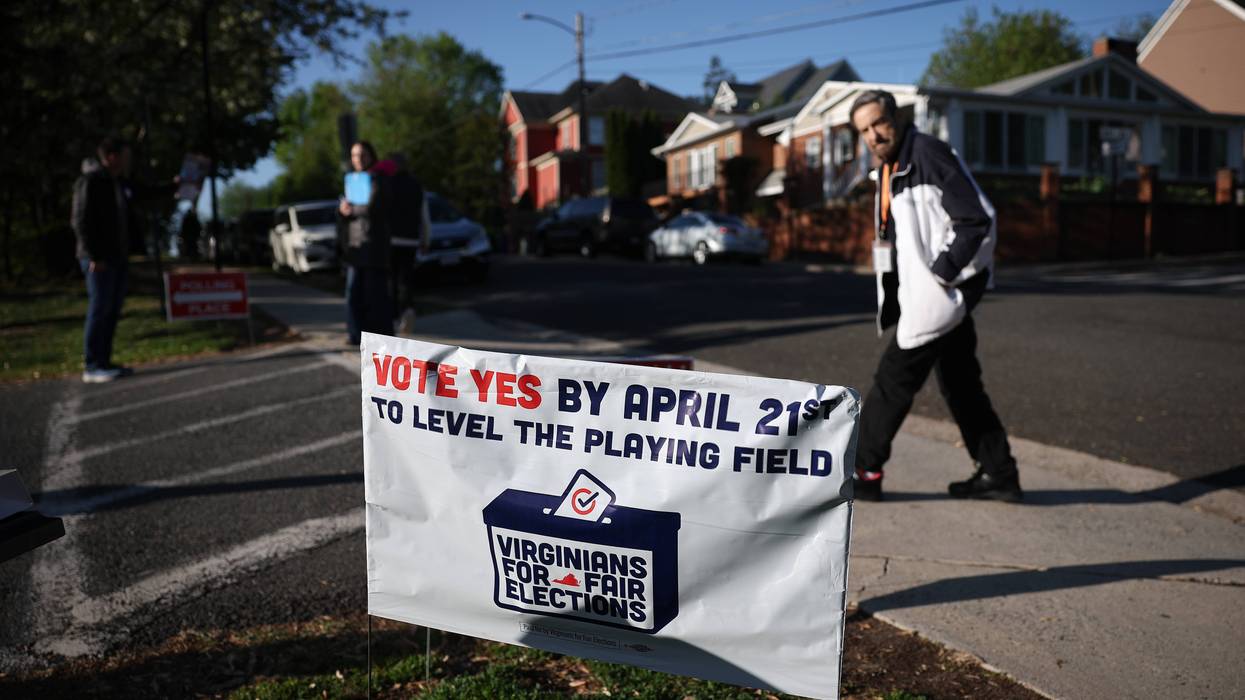
The map that was narrowly approved by voters last month included four new Democratic-leaning US House districts in Virginia, putting the party on equal footing with Republicans nationally or potentially giving it an edge in a mid-decade redistricting battle that was kicked off last year. Trump has urged Republican state legislatures to redraw congressional districts to give the GOP more winnable seats in the US House—as the president's economic policies and his deeply unpopular war on Iran as well as other military actions have pushed his approval rating to a low point for his second term ahead of the November midterms.
The redistricting fight was intensified late last month with the Supreme Court's ruling in Louisiana v. Callais, which held that Louisiana must redraw its 2024 congressional map. The map had created a second majority-minority district in the state, whose population is one-third Black. The ruling effectively gutted Section 2 of the Voting Rights Act, which allowed voters of color to challenge racially discriminatory electoral maps in court.
After the ruling, Louisiana's Republican governor, Jeff Landry, suspended the state's primary elections to allow the Republican-controlled legislature to redraw the congressional map, throwing out roughly 45,000 votes that had already been cast.
In the Virginia case, the US Supreme Court sided with the state's high court, which had found earlier this month that Virginia's Democratic legislature improperly began the process of placing an amendment to the state constitution after early voting in last fall's election was underway. The amendment cleared the way for Democrats to redraw the map, and the General Assembly approved the amendment days before the election.
Virginia voters then approved the redrawn map in April, only to have the state Supreme Court strike it down.
In filing their emergency petition with the US Supreme Court, Virginia Democrats argued the ruling had undermined the will of the residents who had voted for the referendum in April.
On Friday evening, Democratic Gov. Abigail Spanberger said the court had chosen "to nullify an election and the votes of more than three million Virginians."
Jones added in his statement that "Donald Trump, Republican state legislatures, and conservative courts are systematically and unabashedly tilting power away from the people for Trump’s political gain. Just this past month in Louisiana, Tennessee, and South Carolina, they have redrawn their maps and diluted Black political representation because it threatens their hold on power."
"This attack is not subtle," said the attorney general. "It is a coordinated effort to stack the deck in the Republicans' favor before the midterms, lock in political advantage, and make it harder for voters, especially Black voters and communities of color, to hold Trump and his allies accountable. There can be no doubt: Trump and his allies want only their most politically extreme supporters to have their voices heard in Washington. The Supreme Court of Virginia’s previous decision and today’s refusal by the United States Supreme Court to act are only bolstering these extreme MAGA voices."
Addressing Virginia voters, Jones added, "This fight is far from over, and I am committed to fighting alongside you."

Cuban Chargé d'Affaires Lianys Torres Rivera said her government is willing to negotiate with the US, but "the only exception is our sovereignty, independence, and right to self-determination."
Cuba's top diplomat in the United States on Friday underscored the inviolability of her country's sovereignty amid tenuous negotiations with the Trump administration and mounting fears that the US is planning to criminally indict a former Cuban president and possibly invade the island to abduct him.
Cuban Chargé d'Affaires Lianys Torres Rivera told The Hill that her country's socialist government is open to negotiating with the US, but that "the only exception is our sovereignty, independence, and right to self-determination," adding that "those are the red lines."
Torres Rivera acknowledged that ramped-up US pressure—including President Donald Trump's invasion threats and tightening of the internationally condemned 65-year economic embargo—is inflicting tremendous suffering on the Cuban people.
“It’s difficult. What the Cuban people are enduring these days is difficult," she said. "They are under a collective punishment from the US."
The Cuban government said Thursday that Trump's oil blockade has left the island and its 11 million people without fuel—a situation United Nations experts last week described as illegal "energy starvation."
“We have reorganized the whole country, the healthcare system, the education system, the transportation system, to keep the basic services running," Torres Rivera told The Hill. "But it doesn’t mean that they are running normally. They are running under huge stress.”
Still, "a serious country that respects yourself... won’t put on the table your political system or your internal order that the people of our country decide in a sovereign way," she stressed.
The delicate balancing act Cuba is being forced to perform was on stark display on Thursday as Central Intelligence Agency Director John Ratcliffe traveled to Havana for talks aimed at pressuring Cuban officials into complying with demands that critics say would inrfinge upon the nation's sovereignty. These likely include political and economic reforms, releasing political prisoners, and ending or weakening Cuba's alliances with US adversaries including China, Iran, Russia, and Venezuela.
It was a bitter pill to swallow for Cubans, as the CIA was behind myriad efforts to topple their government, from assassination attempts against revolutionary leader Fidel Castro to the failed Bay of Pigs invasion to supporting Cuban exile terrorists who carried out deadly attacks that Havana says killed thousands of people.
Further stoking fears of aggression from the Trump administration,r unidentified US officials told CBS News that the Department of Justice is preparing to criminally indict 94-year-old former Cuban President Raúl Castro for the 1996 shoot-down of planes belonging to the subversive US-based group Brothers to the Rescue after they violated Cuban airspace.
Some observers noted the 1976 midair bombing by US-based anti-Castro militants of Cubana de Aviacion Flight 455, a commercial airliner carrying 73 passengers and crew. The CIA, under then-Director George H.W. Bush, knew that Cuban exiles were plotting to blow up a Cubana plane, but did not warn Havana. The perpetrators of the bombing eventually made their way back to Florida, where they were welcomed as heroes.
Others surmised that the reported planned indictment is a pretext for a US invasion and arrest of Castro similar to January's abduction of Venezuelan President Nicolás Maduro on dubious—and partially retracted—narco-terrorism allegations.Thirty-two Cubans, including military and police officers providing security for Maduro, were killed by US forces during the abduction operation.
"To me, this signals that the Pirate State could be planning another kidnapping operation against Cuba like they did in Venezuela," British journalist Richard Medhurst said in response to the reporting, referring to the US. "This is the lawless behavior they want to normalize around the world."
ACLU head of digital engagement Stefan Smith said on social media: "Remember Maduro and Venezuela? If you’re a foreign leader indicted in American courts, we claim the right to send the military to kidnap you. Indictment is permission to invade."
Following his visit to Cuba, Ratcliffe said that negotiations "will not stay open indefinitely," remarks that followed numerous threats by Trump to "take" Cuba.
"Whether I free it, take it—I think I can do anything I want," the president said in March as his fuel embargo caused blackouts that brought deadly suffering to the most vulnerable Cubans, including sick people and children.
Torres Rivera insisted that protests over the blackouts don't mean Cubans won't rally in defense of their homeland.
“When they are enduring 20 hours of blackouts, they have grievances, and they express it,” she told The Hill, cautioning US officials against a "wrong reading" of the demonstrations.
"We are preparing to defend ourselves," Torres Rivera said, adding that a US invasion "could be a big mistake. It could be a bloodbath."
"We don’t want Cubans dying in Cuba,” she stressed, nor “any American soldier.”