

SUBSCRIBE TO OUR FREE NEWSLETTER
Daily news & progressive opinion—funded by the people, not the corporations—delivered straight to your inbox.
5
#000000
#FFFFFF
To donate by check, phone, or other method, see our More Ways to Give page.
Daily news & progressive opinion—funded by the people, not the corporations—delivered straight to your inbox.
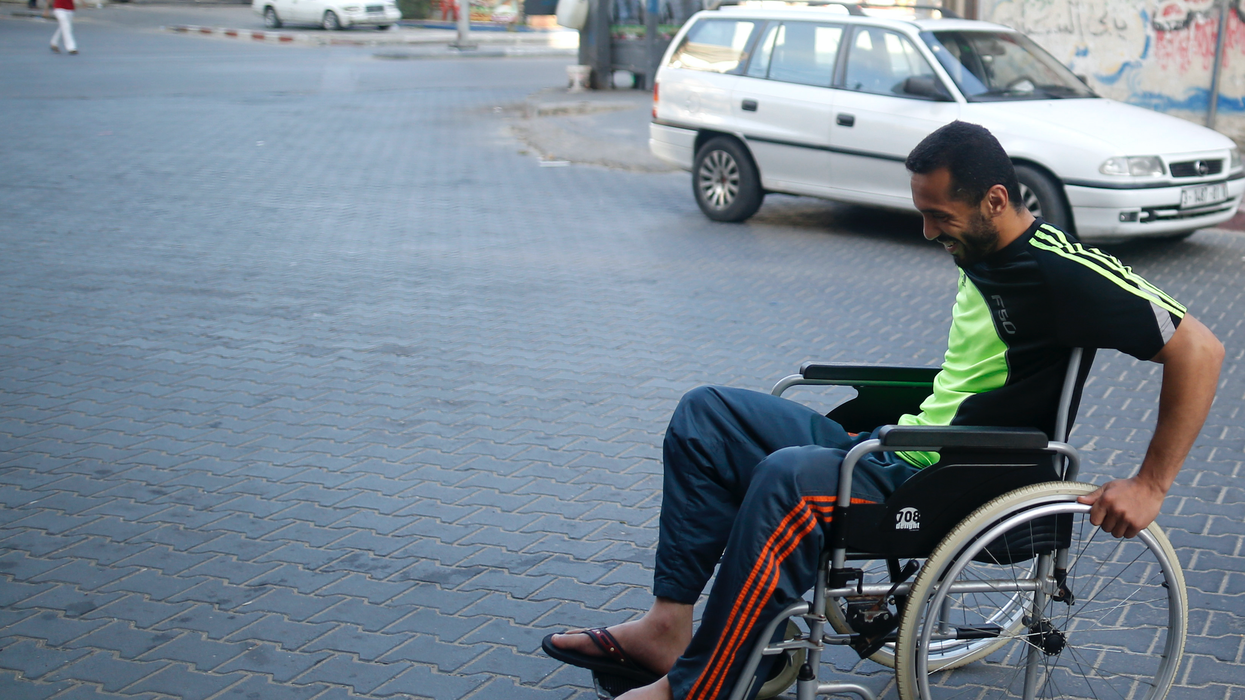
"I want to raise my country flag here in Paris and to show the people we are still here," said Fadi Deeb. "We're still alive—we have hopes, we have dreams, we have goals."
Following an Olympic Games that activists said was tainted by the participation Israeli athletes including a flag-bearer who signed bombs bound for Gaza, a shot putter who was disabled by an Israeli sniper and who lost at least 17 relatives to Israel's onslaught is set to be the sole Palestinian competitor at the upcoming Paralympics in Paris.
"I want to raise my country flag here in Paris and to show the people we are still here," 39-year-old Fadi Deeb said during a Monday interview with Democracy Now! ahead of the August 28 Paralympic Opening Ceremony. "We're still alive—we have hopes, we have dreams, we have goals."
"There is no safe place in Gaza... everyone is like a target for the killing machine."
Deeb, who is from Gaza City, was shot in the spine by an Israeli sniper in 2001 during the Second Intifada, or general Palestinian uprising.
"It's a very hard situation to... balance between my sport as an international player and one who is going to compete in the Paralympic Games, and... my family, all of my sisters, my brothers still in Gaza Strip," he explained.
"There is no safe place in Gaza... everyone is like a target for the killing machine," Deeb continued. "So, what is happening now... it's a genocide. It's not a war... I lost my brother on December 7, 2023 and two of my nephews... And for whole of my family members, I lost like more than, like, 17 persons. So, the situation is very hard."
The Palestinian death toll from Israel's 311-day bombardment, invasion, and siege of Gaza surged toward 40,000 on Monday, according to local and international officials, with at least an additional 103,000 people wounded or missing. Most of those killed have been women and children.
Almost all of Gaza's 2.3 million people have been forcibly displaced, while Israel's total blockade of the coastal enclave has forced the starvation of at least hundreds of thousands of Palestinians. Dozens of Gazans—almost all of them children—have died from malnutrition, dehydration, and lack of medical care.
Asked by Democracy Now! host Amy Goodman about the "amputation crisis" in Gaza—the charity Save the Children says an average of 10 children a day have lost one or more limbs during the war—Deeb said that it's "a very hard situation, because, as I told before, there's no difference... if you are children or women... everyone is a target."
According to the Palestine Olympic Committee and Palestine Football Association (PFA), at least 400 Palestinian athletes, including nearly 70 children, have been killed by Israeli forces since October as of July 26. Among the dead are Hany Al-Masry, a former player and general manager of the Palestinian Olympic soccer team.
Still, eight Palestinians managed to compete in the Paris Olympics, although they did not win any medals.
The International Olympic Committee has been accused of double standards for banning Russian athletes over their country's invasion of Ukraine but allowing Israeli athletes—including Israel Defense Forces veterans and an Olympic flag-bearer who recently signed bombs to be dropped on Gaza—to compete.
Last week, PFA president Jibril Rajub
called Israel's alleged deliberate targeting of Palestinian athletes a blatant violation of the Olympic Charter.
Despite all this, Deeb said he is hopeful.
"To be a player and to compete in this competition for the Paris 2024... gives me, like, too much responsibility to talk about my country, to show the people about Palestine," he said. "It's not just war. It's not just blood. There is life. There is hopes. There is goals. There is dreams."

Providing world-class athletes dispossessed from their homes a chance to compete in the Olympic games is a gift—to them and their communities, and to the rest of us watching and cheering them on. But at the end of the day, the need for such a team speaks to our failure.
It was a spectacular parade of lighted boats filled with some of the best athletes in the world that sailed up the Seine to open the 2024 Olympics. Among them, second in line following the Greek team, traditionally the first to enter the Olympic stadium, was a small craft filled with 37 competitors in white uniforms, grinning and waving to the thousands of spectators. Their flag carrier was boxer Cindy Ngamba. A few days later she would win the first Olympic medal for her team.
But Ngamba, from Cameroon, did not win that bronze medal for her home country. And the flag that Ngamba, from Cameroon, and her co-flag-bearer Yahya al Ghotany, from Syria, waved proudly above their heads was not that of either their countries. Ngamba and al Ghotany are members of the Refugee Olympic Team, carrying the Olympic flag and wearing the five interlocked circles on their jackets. Their flag is raised to the notes of the Olympic hymn, not their national anthems.
The idea of a refugee team first emerged in 2016—and unfortunately not much has changed. Like before, all of the athletes on the team have been forced from their homes by some combination of war, exploding climate change, massive human rights violations, and economic crisis. This year the 37 members of the Refugee Olympic Team have something else in common: all of their home countries are facing often crippling U.S. economic sanctions.
This year the 37 members of the Refugee Olympic Team have something else in common: all of their home countries are facing often crippling U.S. economic sanctions.
The Rio Olympics in 2016 took place in the midst of the mass displacement crisis resulting from the civil war in Syria. At that time, there were 67 million people in the world forcibly displaced, a population comparable to that of France and bigger than those of Italy or South Africa. If it were a country, Refugee Nation would have been the 23rd largest population in the world.
By the time of the Tokyo games in 2021, Refugee Nation had grown to 82 million and was then the 20th largest in the world, situated just between Thailand and Germany.
And this year, as the 2024 Olympic torch was lit in Paris, the number of forcibly displaced people has soared to 107 million, and Refugee Nation has risen through the ranks to become the 15th largest population in the world—just behind Egypt.
Forced displacement has been on the rise for a very long time. And the conditions driving people from their homes—war, repression, economic and climate crises—are on the rise as well. In 2016 war was the biggest reason people were forced to leave their homes. By 2021 wars were still raging, but climate crises and especially the Covid-19 pandemic were creating refugees by the millions.
And all those crises—and the resulting escalation in forced migration—were and continue to be made significantly worse by U.S. economic sanctions. Two years before the Rio Olympics, the UN Human Rights Council expressed alarm at “the disproportionate and indiscriminate human costs of unilateral sanctions and their negative effects on the civilian population.”
In Iran, for example, the U.S. imposed extreme sanctions in 2018 when then-President Donald Trump pulled out of the Iran nuclear deal despite recognition by the UN’s nuclear watchdog agency that Tehran was in compliance with the deal’s requirements. The sanctions’ impact on civilians was dire. According to Human Rights Watch, the sanctions “pose a serious threat to Iranians’ right to health and access to essential medicines,” something especially dangerous during the Covid-19 pandemic that was about to hit. While the Biden administration lifted some of those Trump-era sanctions, many remain in place and were significantly tightened in April 2024. Fourteen members of the Olympic Refugee Team are from Iran.
Whatever the specific conditions that forced each of them to leave their homes, U.S. policy is one of the factors that made things worse in their countries.
In Afghanistan, sanctions cause famine. In 2022, head of the International Rescue Committee and former UK foreign minister David Miliband told the U.S. Senate that the policy of cutting Afghanistan off from financial flows—aka sanctions—was “the proximate cause of this starvation crisis.” Five of the Refugee Team come from Afghanistan.
The 37 athletes brought audiences to their feet, on the banks of the Seine and on screens around the world. But the triumph and beauty of the Refugee Team, and all that these young people have accomplished despite having been forced to leave their homes, cannot hide the stark reality that mass displacement on a global scale has become the new normal. And whatever the specific conditions that forced each of them to leave their homes, U.S. policy is one of the factors that made things worse in their countries.
Providing world-class athletes dispossessed from their homes a chance to compete in the Olympic games is a gift—to them and their communities, and to the rest of us watching and cheering them on. But at the end of the day, the need for such a team speaks to our failure—to stop the normalization of forced displacement, and to reverse the conditions that create it in the first place. Including ending U.S. economic sanctions. The chance to win a medal in Paris is great—but wouldn’t it be better if these amazing athletes could instead win the right to return safely home instead?
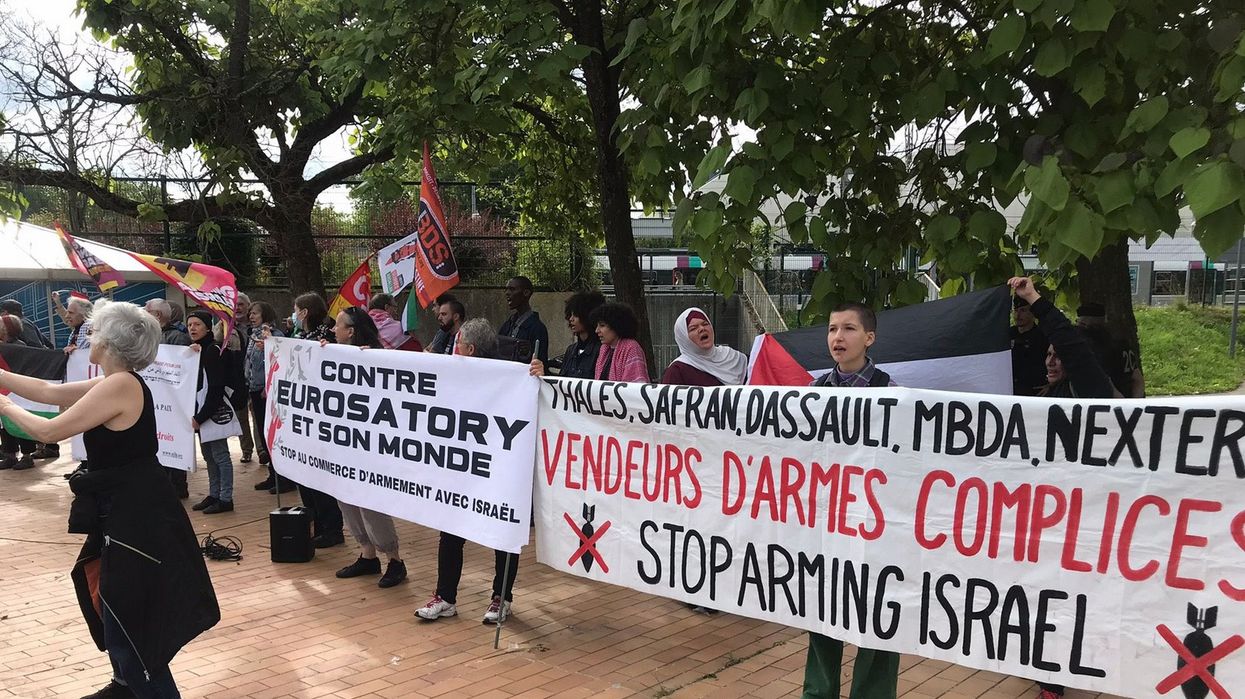
The Paris Commercial Court ruled that the French Defense Ministry's prohibition on Israeli entry to the Eurosatory exhibition amounts to illegal discrimination.
A French court on Tuesday overruled what it determined was a discriminatory ban on Israeli weapons companies' participation in one of the world's premier arms expositions.
The Paris Commercial Court reversed the French Ministry of Defense's May 31 prohibition of Israeli entry to the Eurosatory exhibition, held biennially at the Paris Nord Villepinte Exhibition Center. The ministry decided to ban Israel from the event—which runs from June 17-21—following the Israel Defense Forces' (IDF) May 26 attack on a refugee encampment in Rafah that killed or wounded hundreds of Palestinians, including many women and children.
However, the commercial court concurred with the France-Israel Chamber of Commerce's assertion that COGES Events, the company that organizes the expo, unfairly discriminated against Israeli exhibitors.
A separate decision by the Bobigny District Court directing COGES Events to ban any employees or representatives of Israeli companies from participating in expo was not directly addressed by Tuesday's ruling.
The Representative Council of French Jewish Institutions hailed Tuesday's ruling as a "victory against the exclusion of Israel."
As the European Union weighed sanctioning Israel over the massacre, tens of thousands of people took to the streets of Paris to condemn the Rafah tent massacre. French President Emmanuel Macron said he was "outraged" over the attack and asserted that Israel's killing and maiming of civilians "must stop."
"There are no safe areas in Rafah for Palestinian civilians," he said. "I call for full respect for international law and an immediate cease-fire."
The French Ministry of Defense subsequently said that "the conditions are no longer right to host Israeli companies at the Paris show, given that the French president is calling for the cessation of IDF operations in Rafah."
Israel's conduct in the Gaza onslaught—which according to Palestinian and international agencies has left more than 133,000 Gazans dead, injured, or missing since the Hamas-led October 7 attack on Israel—is the subject of an International Court of Justice genocide case brought by South Africa and backed by over 30 countries and regional blocs.
Since Israel began its devastating retaliation for the October 7 attack, people worldwide have called for countries to cut off diplomatic and weapons support for Israeli forces. Over the past eight months there have also been protests in Paris and throughout France calling for a Gaza cease-fire.
Exports by Israeli arms firms soared to a record $13.1 billion last year, up from $12.5 billion in 2022,
according to Israel's Ministry of Defense.

"When the history of this is written, it will document how some stood against these war crimes," said one critic. "And how others supported, protected, and abetted them."
Tens of thousands of people took to the streets in Paris late Monday to condemn Israel's bombing of a tent encampment in Rafah overnight Sunday that killed at least 45 people and wounded hundreds of others in what has been alternately described as a "mass atrocity," "horrific massacre," and "war crime."
Demanding French leaders and other European nations decisively end their military and political support for the Israeli assault on Gaza, the demonstrators gathered near the Israeli embassy, chanting slogans that included: "Free Gaza!"; "Gaza, Paris is with you!"; and "We are all Gaza children!"
Gaza health officials reported Monday that a majority of those killed in the encampment in Rafah's Tal al-Sultan were women and children.
Footage that emerged of the attack showed charred corpses and, in one clip, what appeared to be a man carrying the body of a small child who had been beheaded.
The Paris demonstration was organized by the Association France-Palestine Solidarity group, with protesters calling on the French government to demand accountability for the Rafah assault.
French President Emmanuel Macron said Monday he was "outraged" by the attack and called for "full respect for international law and an immediate cease-fire," but organizer François Rippe told The Times of Israel that greater action is needed from the French government.
"They start a fire in a camp for displaced, they burn people and we don't even summon the Israeli ambassador to ask for an account. It is just not acceptable," said Rippe.
Paris has supplied Israel with intelligence and military aid since it began its assault on Gaza in October, which has killed more than 36,000 Palestinians—the majority of whom have been civilian men, women, and children. The carnage of innocent people has continued despite repeated Israeli claims that the Israel Defense Forces (IDF) only targets Hamas fighters and is taking all necessary steps to protect civilians.
Anadolu Agency reported Tuesday that Paris police fired tear gas shells at protesters who attempted to proceed toward the Israeli embassy.
"We participate in this march, which is scheduled to reach the Israeli embassy to confirm and loudly say that we are all against what happened in Rafah," Carlos Martens Bilongo, a member of the French National Assembly, told Anadolu. "Burning the tents of the displaced Palestinians is unacceptable, and France must move more politically to cease-fire in Gaza."
As protesters marched in Paris as well as in other European cities including Madrid and Barcelona, Irish Foreign Minister Micheál Martin told reporters after attending a European Union Foreign Affairs Council meeting that there "was a very clear consensus about the need to uphold the international humanitarian legal institutions" and that officials had for the first time engaged in "significant" discussions about possible sanctions on Israel.
Martin noted that the foreign ministers had discussed sanctions if Israel does not comply with the International Court of Justice's latest ruling, in which the court ordered Israel to halt its military operation in Rafah.
"There was a strong discussion on the provisional orders of the International Court of Justice," Martin told reporters, adding that offiicals had "very clear views that Israel should adhere to those provisional orders to open the border crossing with Rafah and cease its military operations in Rafah."
"International humanitarian law, adherence to human rights, is the raison d’etre of the European Union and events now are really putting that issue into sharp focus, particularly given the attack last night when so many innocent people were killed," said Martin.
In the U.S., the Biden administration—the largest international funder of the IDF—said Monday that it was "assessing" whether Israel had crossed a "red line" by killing 45 displaced people. Biden has been the target of national and international outrage for continuing to support Israel despite mounting proof that the IDF is not protecting civilians and is operating with genocidal intent.
"When the history of this is written, it will document how some stood against these war crimes," said Trita Parsi, executive vice president of the Quincy Institute for Responsible Statecraft, as French protesters stood against the Rafah attack. "And how others supported, protected and abetted them. I am talking about you, Joe Biden."

"We live in a country of civil law, a country where we have the right to take a stand and to demonstrate," said one Parisian who demonstrated.
Hundreds of French citizens on Thursday defied the government's newly announced ban on pro-Palestinian rights protests, gathering in central Paris to demand an end to the violence in Gaza.
French Interior Minister Gérald Darmanin announced the ban after reports of antisemitic incidents in France—including graffiti showing swastikas and anti-Jewish messages—which followed Hamas' brutal attack on Israeli civilians last weekend and the Israel Defense Forces' (IDF) retaliation on Gaza.
At least 1,537 Palestinians, including 500 children, have been killed so far in the blockaded enclave, prompting calls for a cease-fire from the United Nations and progressive lawmakers in the United States.
But Darmanin claimed that gatherings of people with similar demands were "likely to generate disturbances to public order."
"The organization of these prohibited demonstrations should lead to arrests," he said Thursday.
When Parisians gathered in defiance of the ban, police responded by firing tear gas and water cannons at the crowd.
" France banned Palestinian solidarity protests, but people still showed up," said Sana Saeed of Al Jazeera. "That's how it's done."
Charlotte Vautier, a nonprofit employee who attended the rally on Thursday, told Reuters it was unfair of the government "to forbid [protesting] for one side and to authorize for the other."
"We live in a country of civil law, a country where we have the right to take a stand and to demonstrate," she said.
The ban was announced days after France joined the United States, Germany, the United Kingdom, and Italy in making a joint statement in support of Israel's right "to defend itself"—without calling for the protection of civilians' lives—as Israel unleashed an air assault on Gaza.
As U.S. journalist Paul Blest noted, police in Berlin also banned Palestinian solidarity protests this week, while U.K. Labour Party Leader Keir Starmer claimed Israel has the "right" to cut off Gaza residents' access to food, water, and electricity—a violation of the Geneva Conventions.
"The response to this from so-called liberal democracies has been nothing short of fucking insane," said Blest. "Incredibly grim times."

"It is clear from this week's negotiations that oil-producing countries and the fossil fuel industry will do everything in their power to weaken the treaty and delay the process," said one Greenpeace USA campaigner.
As the second session of the Intergovernmental Negotiating Committee wrapped up in Paris with an agreement to develop the first draft of a Global Plastics Treaty by November, climate, environmental, and other advocacy groups on Friday urged governments not to allow fossil fuel and other corporate interests to water down the landmark accord.
"Time is running out and it is clear from this week's negotiations that oil-producing countries and the fossil fuel industry will do everything in their power to weaken the treaty and delay the process," Graham Forbes, Greenpeace USA's global plastics campaign lead, said in a statement. "While some substantive discussions have taken place, there is still a huge amount of work ahead of us."
"Plastic pollution and the climate crisis are two sides of the same coin," Forbes added. "The Global Plastics Treaty must tackle plastic production head-on. This will align with the need to stay within 1.5℃ and move the world away from its plastic addiction. Anything else less than that, and the treaty will fail."
Governments from around 170 nations, NGOs, and plastics industry lobbyists spent the week at the United Nations Educational, Scientific, and Cultural Organization (UNESCO) headquarters in the French capital hammering out the framework for the world's first treaty aimed at reducing plastic pollution.
As Reuters reports:
Though the first half of the five-day negotiations was spent arguing over procedural issues, delegations split into two groups to discuss the range of control measures that can be taken to stop plastic pollution as well as whether countries should develop national plans or set global targets to tackle the problem.
By the session's close on Friday, countries agreed to prepare a "zero draft" text of what would become a legally binding plastics treaty and to work between negotiation sessions on key questions such as the scope and principles of the future treaty.
The "zero draft" text would reflect options from the wide-ranging positions of different countries by the start of the next round of talks to be held in Nairobi, Kenya, in November.
Ana Rocha, who directs the Global Plastics Program at GAIA, lamented that the conference "hosted at least 190 industry lobbyists, who used their access and infinite resources to promote tech-fixes like chemical 'recycling,' and plastic credits, while fenceline communities, waste pickers, Indigenous peoples, youth, and other members of civil society most impacted by plastic pollution had very limited opportunity to hold the mic."
"If we are to achieve a strong plastics treaty, member states must listen to and represent their people, not the very industry that is profiting from this crisis," Rocha added.
Julie Teel Simmonds, a senior attorney at the Center for Biological Diversity, praised the United States for helping to "jumpstart substantive talks in Paris," however, she added that the U.S. "must come to the next session with a bold commitment to cut plastic production."
"The U.S. hasn't yet been willing to put the reduction of plastic production front and center in this treaty, and we can't curb pollution without drastically scaling back its creation," she asserted. "At the next negotiations, the United States should take direct aim at the pervasive plastic that's infiltrating every corner of our planet by hitting hard on production."

"Total's record-breaking profits come at a steep cost: environmental devastation, human rights abuses, and climate chaos," said one advocacy group. "It's time to hold them accountable for their insatiable pursuit of wealth!"
Climate campaigners marched through central Paris Friday in the latest attempt to disrupt a shareholder meeting held by a major fossil fuel company, demanding that oil giant TotalEnergies adopt a resolution to sharply increase the pace of its greenhouse gas emissions reductions.
Advocacy groups including 350.org, Greenpeace, Scientist Rebellion, and Friends of the Earth France joined a reported 700 demonstrators outside the Salle Pleyel, the venue of Total's annual general meeting, with campaigners chanting, "All we want is to knock down Total" and "One, two, three degrees, we have Total to thank"—a reference to planetary heating and scientists' warnings that fossil fuel extraction must be drastically reduced in order to keep warming to less than 2°C above pre-industrial levels.
Banners carried by the protesters read, "The science is clear but Total is ignoring it" and "Floods, heatwaves, drought, pandemics: The world according to Total."
Police targeted the demonstrators with tear gas and pepper spray, with some people being dragged away from the Salle Pleyel—moves that were condemned as "outrageous" by the campaign group Stop East African Crude Oil Pipeline (EACOP), of which Total is the lead shareholder.
"Police resorted to extreme measures, dropping a tear gas grenade amidst a group of peaceful, seated, handcuffed activists at Total's AGM blockade," said the group. "This excessive force against non-violent individuals is utterly unacceptable!"
Inside the meeting, the Dutch activist shareholder group Follow This pushed investors in Total to adopt a resolution committing the company to include Scope 3 emissions—those caused by the burning of Total's products by customers, such as airlines, or drivers—in its 2030 emissions targets and steeper absolute emissions cuts.
The resolution garnered the support of about 30% of shareholders, nearly doubling its support in 2020, the last time such a proposal was put forward. Seventeen investors who control a total of $1.2 million in the company voted in support of the resolution.
Follow This CEO Mark van Baal, whose group's motto is "Change from the inside," called the vote "a great outcome" and evidence of a growing "shareholder rebellion."
"One-third of investors say Total needs to decrease emissions by 2030 and that they can't hide behind their customers by saying Scope 3 emissions are not the company's responsibility," he told France24.
The final vote on Total's climate pledge, however, approved emissions cuts only at the company's directly-owned facilities and garnered more than 88% of shareholder votes.
Greenpeace France on Friday acknowledged that Energy Minister Agnes Pannier-Runacher told France Info radio as the meeting convened that fossil fuel companies will have no future unless they shift to renewable energy and urged companies including Total to "re-invent themselves."
"But you know that these companies won't do anything without legal constraint," said the group. "We therefore expect strong political acts."
In the United Nations' Intergovernmental Panel on Climate Change's 2022 report, scientists said the world needs to reduce fossil fuel emissions by 43% from 2019 levels by 2030 in order to meet the Paris climate agreement's target of limiting planetary heating to less than 2°C.
As scientists and advocates have demanded companies including Total reduce their emissions, the company reported a net profit of $36.2 billion in 2022, doubling its earnings in the previous year.
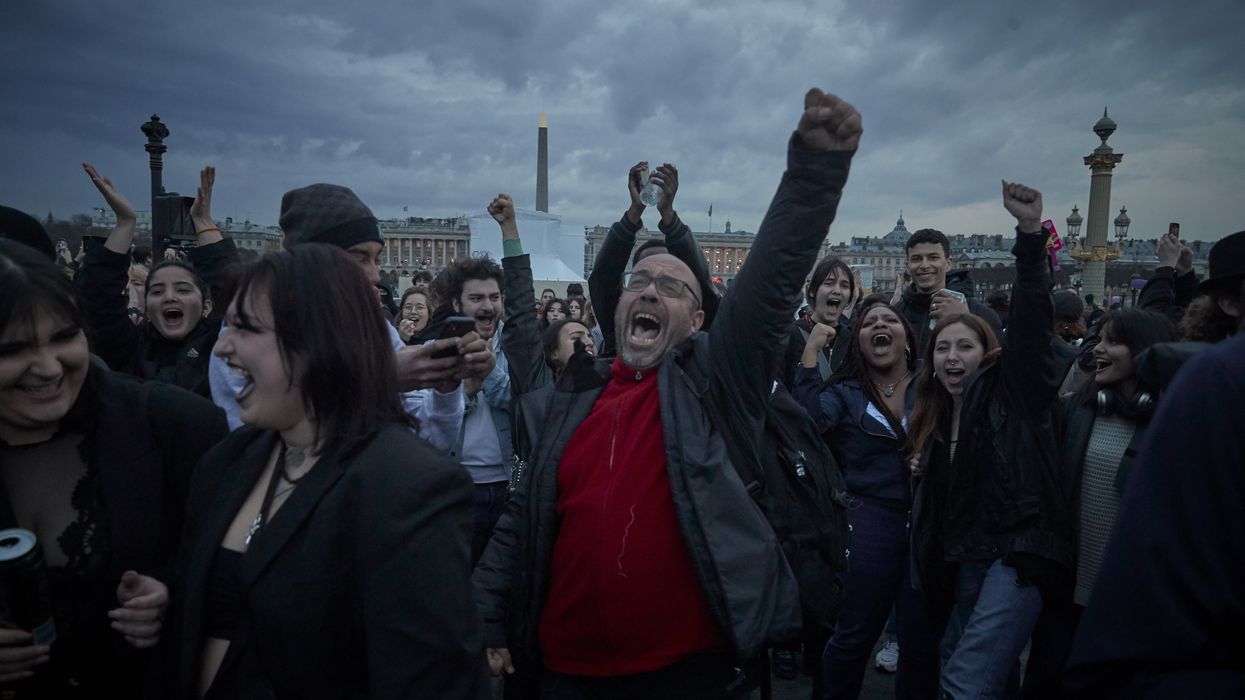
"This forced passage with the use of Article 49.3 must be met with a response in line with this show of contempt toward the people," declared one union leader as MPs introduced no-confidence motions.
Protests in Paris and across France have ramped up since President Emmanuel Macron's government on Thursday used a controversial constitutional measure to force through a pension reform plan without a National Assembly vote.
Fears that the Senate-approved measure—which would raise the retirement age from 62 to 64—did not have enough support to pass the lower house of Parliament led to a Council of Ministers meeting, during which Macron reportedly said that "my political interest would have been to submit to a vote… But I consider that the financial, economic risks are too great at this stage."
"This reform is outrageous, punishing women and the working class, and denying the hardship of those who have the toughest jobs."
After the meeting, French Prime Minister Élisabeth Borne announced the decision to go with the "nuclear option," invoking Article 49.3 of the French Constitution—a calculated risk considering the potential for a resulting motion of no-confidence.
Members of Parliament opposed to the overhaul filed a pair of no-confidence motions on Friday, and votes are expected on Monday. Although unlikely, given the current makeup of the legislature, passing such a motion would not only reject the looming pension law but also oust Macron's prime minister and Cabinet, and likely lead to early elections in France.
As Deutsche Welle reported:
"The vote on this motion will allow us to get out on top of a deep political crisis," said the head of the so-called LIOT group Bertrand Pancher, whose motion was co-signed by members of the broad left-wing NUPES coalition.
The far-right National Rally (RN) filed a second motion, but that was expected to get less backing. RN lawmaker Laure Lavalette however said her party would vote for "all" no-confidence motions filed. "What counts is scuppering this unfair reform bill," she said.
Leaders of the Les Republicains (LR) are not sponsoring any such motions. Reuters explained that individuals in the conservative party "have said they could break ranks, but the no-confidence bill would require all of the other opposition lawmakers and half of LR's 61 lawmakers to go through, which is a tall order."
Still, Green MP Julien Bayou said, "it's maybe the first time that a motion of no-confidence may overthrow the government."
Meanwhile, protests against the pension proposal—which have been happening throughout the year—continue in the streets, with some drawing comparisons to France's "Yellow Vests" movement sparked by fuel prices and economic conditions in 2018.
Not long after Borne's Article 49.3 announcement on Thursday, "protesters began to converge on the sprawling Place de la Concorde in central Paris, a mere bridge away from the heavily guarded National Assembly," according to France 24.
As the news outlet detailed:
There were the usual suspects, like leftist firebrand Jean-Luc Mélenchon, thundering against a reform he said had "no legitimacy—neither in Parliament, nor in the street." Unionists were also out in strength, hailing a moral victory even as they denounced Macron's "violation of democracy."
Many more were ordinary protesters who had flocked to the Concorde after class or work. One brandished a giant fork made of cardboard as the crowd chanted "Macron démission" (Macron resign). Another spray-painted an ominous message on a metal barrier—"The shadow of the guillotine is nearing"—in the exact spot where Louis XVI was executed 230 years ago.
Police used tear gas to disperse the Concorde crowd. Interior Minister Gérald Darmanin told RTL radio 310 people were arrested nationwide—258 of them in Paris. He said, "The opposition is legitimate, the protests are legitimate, but wreaking havoc is not."
Anna Neiva Cardante is a 23-year-old student whose parents, a bricklayer and a cleaner, "are among those who stand to lose most."
"A vote in the National Assembly was the government’s only chance of securing a measure of legitimacy for its reform," Neiva Cardante told France 24 as police cleared the crowd Thursday. "Now it has a full-blown crisis on its hands."
"This reform is outrageous," she added, "punishing women and the working class, and denying the hardship of those who have the toughest jobs."
Across the French capital early Friday, "traffic, garbage collection, and university campuses in the city were disrupted, as unions threatened open-ended strikes," DW noted. "Elsewhere in the country, striking sanitation workers blocked a waste collection plant that is home to Europe's largest incinerator to underline their determination."
"Article 49.3 constitutes a triple defeat for the executive: popular, political, and moral," declared Laurent Escure, secretary general of the labor union UNSA. "It opens up a new stage for the protests."
Philippe Martinez of the CGT union asserted that "this forced passage with the use of Article 49.3 must be met with a response in line with this show of contempt toward the people."
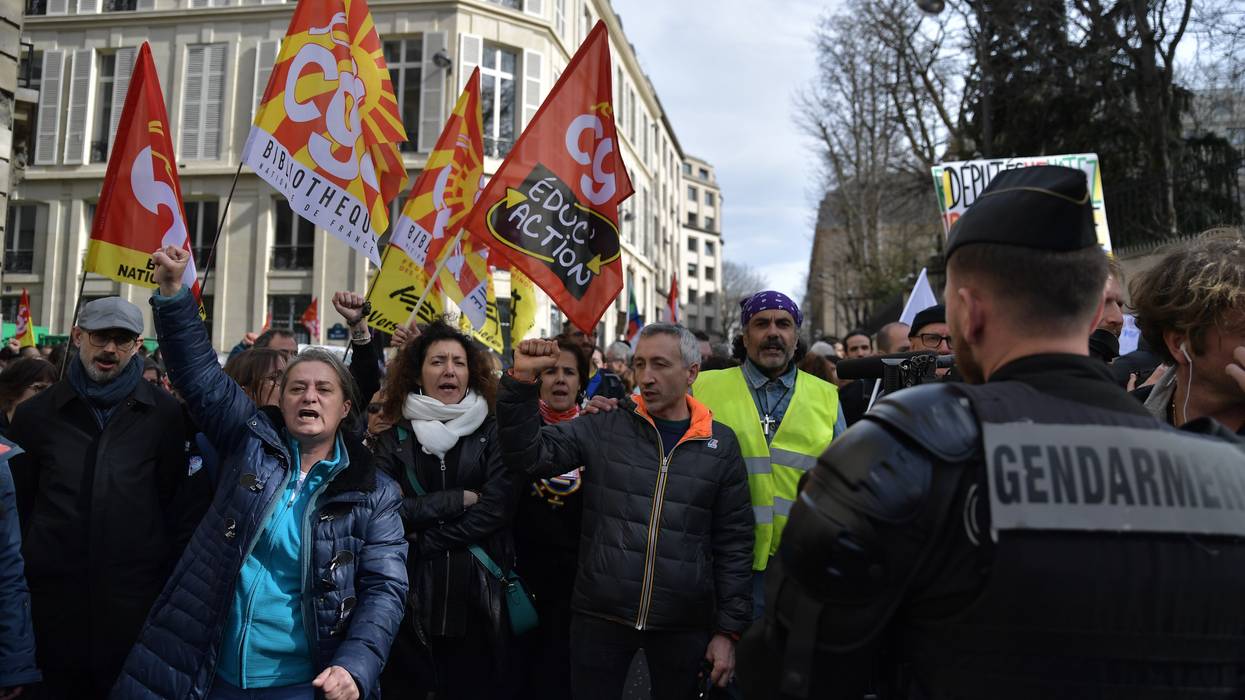
"What the government is doing makes people sick of politics. It should improve people's lives, not destroy them," said Rachel Keke, a leftist in France's National Assembly.
Amid protests against French President Emmanuel Macron's unpopular plan to overhaul the country's pension system, his government on Thursday chose the "nuclear option," opting to use a constitutional procedure to force through reforms, including raising the retirement age from 62 to 64, without a vote in the lower house of Parliament.
While the proposal passed the Senate, the upper chamber of Parliament, 193-114 Thursday morning, "reports indicated that the ruling party, which lost its overall majority in elections last year, was a handful of votes short" in the National Assembly, which led to an emergency Council of Ministers meeting about triggering Article 49.3,
Le Monde explained.
After announcing the government was invoking executive privilege, French Prime Minister Élisabeth Borne "faced scenes of anger and unrest in the National Assembly," reported Politico. "Far-left lawmakers belonging to the France Unbowed party booed and chanted the national hymn the Marseillaise as far-right National Rally MPs shouted 'Resign! Resign!'"
Using the controversial procedure to push through the plan is risky for Macron—founder of the Renaissance party—because it allows members of Parliament "to submit motions of no-confidence within 24 hours," Politico added. "While the government has survived motions of no-confidence in recent months, the stakes are much higher this time around. If a majority of MPs vote in favor of a motion, Borne's government would be forced to resign."
While multiple opposition groups in Parliament may respond with no-confidence motions, Marine Le Pen's far-right National Rally party has already pledged to do so.
"It's a total failure for the government," Le Pen told reporters of the Article 49.3 decision, calling for Borne's resignation. "From the beginning, the government fooled itself into thinking it had a majority."
Socialist Party chief Olivier Faure also criticized the approach, saying that "when a president has no majority in the country, no majority in the National Assembly, he must withdraw his bill."
Fabien Roussel, head of the French Communist Party, declared that "this government is not worthy of our Fifth Republic, of French democracy. Until the very end, Parliament has been ridiculed, humiliated."
MP Rachel Keke of the leftist party La France Insoumise stressed that "what the government is doing makes people sick of politics. It should improve people's lives, not destroy them."
Former French presidential candidate and MP Jean-Luc Mélenchon, who launched La France Insoumise, tweeted: "It is a spectacular failure and a collapse of the presidential minority. United unions call for continued action. This is what we are going to focus on."
French trade unions have led national demonstrations and strikes against the overhaul since January. While protesters were oscillating "between rage and resignation" earlier this week, they filled the streets of Paris on Thursday, and "the leader of the CFDT labor union, Laurent Berger, announced there would be new protest dates," according to Le Monde.
The General Confederation of Labor (CGT) said in a statement that "this reform is unfair, unjustified, and unjustifiable, this is what millions of people have been asserting forcefully for weeks in the demonstrations, with the strike, and in all the initiatives. These massive mobilizations are supported by a very large majority of the population and almost all workers."
"The only response from the government and employers is repression: requisitions, police interventions on workplace occupations, arrests, intimidation, questioning of the right to strike," the confederation added. "We won't let it happen! What the CGT denounced as unfair yesterday is even more so today! This can only encourage us to step up mobilizations and strikes, the fight continues!"

"I don't want my parents to die at work," one Paris protester's placard pleaded.
Nearly a million people took to the streets of cities across France on Saturday during the fourth round of nationwide protests against President Emmanuel Macron's plan to raise the country's pension eligibility age from 62 to 64.
The French Interior Ministry said an estimated 963,000 protesters rallied in Paris, Marseilles, Nantes, Nice, Toulouse, and other cities and towns large and small for the fourth straight day of demonstrations, Agence France-Presse reports.
Authorities in Paris said nearly 100,000 people turned out to Saturday's demonstrations, which included many young people who could not make it to the previous three days' protests. Union leaders said the number of Paris protesters was five times as high.
One teen protesting in the capital's Place de la République carried a placard reading, "I don't want my parents to die at work."
Others held banners declaring, "No to working longer," Not one year more, not one euro less", and other slogans.
There were reports of police brutality in cities including Rennes, where water cannons and other "less-lethal" weapons were used against protesters, the overwhelming majority of whom marched peacefully.
The massive demonstrations are a critical test for Macron's government, and for the opposition. Macron's centrist Renaissance party faces an uphill battle to get the pension plan passed in a parliament where it no longer enjoys majority control. Renaissance needs the support of right-wing opposition lawmakers in order to avert a highly controversial constitutional measure that would allow the pension reform to be forced through without a vote.
Macron steadfastly insists he's delivering upon a campaign promise to reform France's pension system, one of the world's most generous. The president asserts raising the retirement age is an "indispensable" move to guarantee the future survival of the pension system, while pointing to higher retirement ages in other European Union countries.
An inter-union coalition of 13 labor groups said in a joint statement on Saturday that "since January 19, the population has continued to demonstrate its very strong determination to refuse the government's pension reform project through strikes, demonstrations, and also the online petition, which has reached one million signatures."
"Over the weeks, the polls also show an increase in this massive rejection since now, more than 7 out of 10 French people and 9 out of 10 workers say they are opposed to the reform project," the coalition continued. "This social movement, unprecedented in its scope, is therefore now anchored in the social landscape. The government, like parliamentarians, cannot remain deaf to it."
"If, despite everything, the government and the parliamentarians remained deaf to popular protest, the inter-union would call on workers, young people, and retirees to harden the movement by bringing France to a halt in all sectors on March 7."
The inter-union coalition said it would meet Thursday evening and that "in the meantime, we call on the government to withdraw its bill and on parliamentarians to take their responsibilities in the face of the massive rejection of the population [of this] unjust and brutal project."
"If, despite everything, the government and the parliamentarians remained deaf to popular protest, the inter-union would call on workers, young people, and retirees to harden the movement by bringing France to a halt in all sectors on March 7," the unions vowed, adding that the coalition "will take advantage of March 8, the international day of struggle for women's rights, to highlight the major social injustice of this reform against women."