SUBSCRIBE TO OUR FREE NEWSLETTER
Daily news & progressive opinion—funded by the people, not the corporations—delivered straight to your inbox.
5
#000000
#FFFFFF
To donate by check, phone, or other method, see our More Ways to Give page.
Daily news & progressive opinion—funded by the people, not the corporations—delivered straight to your inbox.
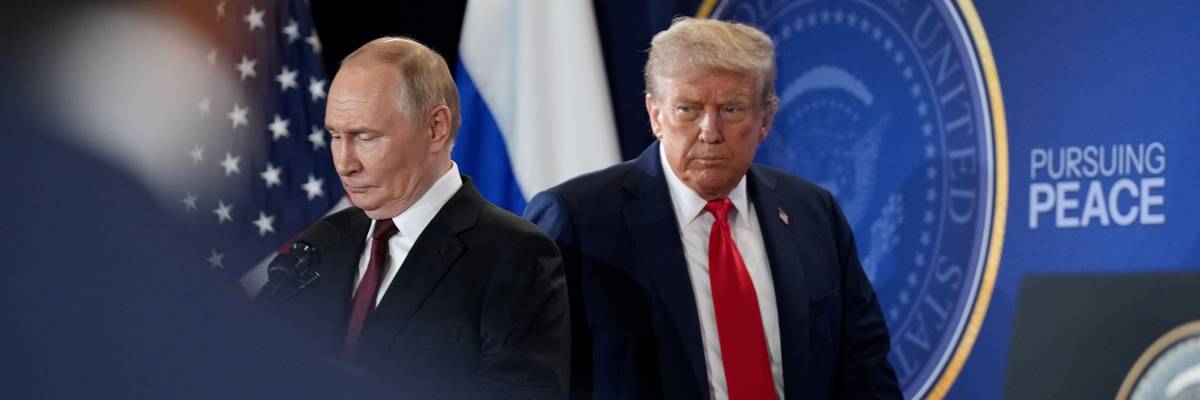
US President Donald Trump and Russian President Vladimir Putin arrive for a press conference at Joint Base Elmendorf-Richardson on August 15, 2025 in Anchorage, Alaska.
“To limit new weapons development in China or Russia, one of the best things the US can do is maintain the taboo on testing and ratify the Comprehensive Test Ban Treaty," said one expert.
More than a dozen US senators on Wednesday urged President Donald Trump to abort plans for a resumption of nuclear weapons testing, a call that came as Russian President Vladimir Putin directed his senior officials to draft proposals for possible new nuke tests in response.
“We write to you today to express grave reservation about any action to resume nuclear weapons testing," 14 Democratic senators led by Sens. Jacky Rosen (D-Nev.) and Martin Heinrich (D-NM), ranking member of the Senate Select Committee on Intelligence, said in a letter to Trump.
"We request that you personally provide clarification," the lawmakers added. "The decision to resume nuclear weapons testing would be geopolitically dangerous, fiscally irresponsible, and simply unnecessary to ensure the ability of the United States to defend itself."
Sen. Ed Markey (D-Mass.)—who signed the letter—also introduced emergency legislation last week aimed at preventing Trump from resuming nuclear weapons tests.
Although no country is known to have tested a nuclear weapon since North Korea last did so in 2017, Trump last month ordered the Pentagon to prepare for a resumption of reciprocal testing.
“The United States has more Nuclear Weapons than any other country,” Trump falsely wrote on social media. “Because of other countries testing programs, I have instructed the Department of War to start testing our Nuclear Weapons on an equal basis.”
TASS reported Wednesday that Putin instructed the Russian Foreign Ministry, Defense Ministry, intelligence agencies, and civilian bureaus to submit proposals "on the possibility of preparing for nuclear weapons tests" in the event that other countries resume testing.
Russia has not tested a nuclear weapon in its modern history. The former Soviet Union's final nuclear test took place in 1990 and the successor Russian state has adhered to a moratorium ever since.
Last week, Congresswoman Dina Titus (D-Nev.) introduced a bill to prohibit new US nuclear weapons testing. Titus accused Trump of putting "his own ego and authoritarian ambitions above the health and safety of Nevadans."
Supporting Titus' bill, Tara Drozdenko, director of the Global Security Program at the Union of Concerned Scientists, said in a statement Wednesday that “there is no good reason for the United States to resume explosive nuclear testing and it would actually make everyone in this country less safe."
"We have so much to lose and so little to gain from resuming testing," she continued. "New explosive testing by the United States would be to make a political statement, with major consequences: It would shatter the global freeze on nuclear testing observed by all but North Korea and give Russia, China, and other nuclear powers the green light to restart their own nuclear testing programs."
“The United States has not conducted a nuclear detonation test since 1992," Drozdenko noted. "Even those advocating for testing acknowledge there is no scientific need to test to maintain the US nuclear arsenal. In fact, Energy Secretary Chris Wright recently said that the updated systems can be tested without conducting full nuclear detonations."
“To limit new weapons development in China or Russia, one of the best things the US can do is maintain the taboo on testing and ratify the Comprehensive Test Ban Treaty," she added. "This treaty with on-site verification measures would be the best way to ensure that countries are not clandestinely testing nuclear weapons.”
The United States and Soviet Union came dangerously close to nuclear war on multiple occasions during the Cold War, most notably amid the 1962 Cuban Missile Crisis and, later, during then-President Ronald Reagan's first administration in the early 1980s.
Weeks after becoming the first country to develop nuclear weapons in 1945, the United States waged the world's only nuclear war, dropping atomic bombs on the defenseless Japanese cities of Hiroshima and Nagasaki and killing hundreds of thousands of people, mostly civilians.
According to the International Campaign for the Abolition of Nuclear Weapons, Russia leads the world with 5,449 nuclear warheads in its arsenal, followed by the US with 5,277 warheads, China with around 600, France with 290, and the United Kingdom with 225. Four other nations—India, Pakistan, Israel, and North Korea—also have nuclear arsenals of between 50-180 warheads each.
Dear Common Dreams reader, It’s been nearly 30 years since I co-founded Common Dreams with my late wife, Lina Newhouser. We had the radical notion that journalism should serve the public good, not corporate profits. It was clear to us from the outset what it would take to build such a project. No paid advertisements. No corporate sponsors. No millionaire publisher telling us what to think or do. Many people said we wouldn't last a year, but we proved those doubters wrong. Together with a tremendous team of journalists and dedicated staff, we built an independent media outlet free from the constraints of profits and corporate control. Our mission has always been simple: To inform. To inspire. To ignite change for the common good. Building Common Dreams was not easy. Our survival was never guaranteed. When you take on the most powerful forces—Wall Street greed, fossil fuel industry destruction, Big Tech lobbyists, and uber-rich oligarchs who have spent billions upon billions rigging the economy and democracy in their favor—the only bulwark you have is supporters who believe in your work. But here’s the urgent message from me today. It's never been this bad out there. And it's never been this hard to keep us going. At the very moment Common Dreams is most needed, the threats we face are intensifying. We need your support now more than ever. We don't accept corporate advertising and never will. We don't have a paywall because we don't think people should be blocked from critical news based on their ability to pay. Everything we do is funded by the donations of readers like you. When everyone does the little they can afford, we are strong. But if that support retreats or dries up, so do we. Will you donate now to make sure Common Dreams not only survives but thrives? —Craig Brown, Co-founder |
More than a dozen US senators on Wednesday urged President Donald Trump to abort plans for a resumption of nuclear weapons testing, a call that came as Russian President Vladimir Putin directed his senior officials to draft proposals for possible new nuke tests in response.
“We write to you today to express grave reservation about any action to resume nuclear weapons testing," 14 Democratic senators led by Sens. Jacky Rosen (D-Nev.) and Martin Heinrich (D-NM), ranking member of the Senate Select Committee on Intelligence, said in a letter to Trump.
"We request that you personally provide clarification," the lawmakers added. "The decision to resume nuclear weapons testing would be geopolitically dangerous, fiscally irresponsible, and simply unnecessary to ensure the ability of the United States to defend itself."
Sen. Ed Markey (D-Mass.)—who signed the letter—also introduced emergency legislation last week aimed at preventing Trump from resuming nuclear weapons tests.
Although no country is known to have tested a nuclear weapon since North Korea last did so in 2017, Trump last month ordered the Pentagon to prepare for a resumption of reciprocal testing.
“The United States has more Nuclear Weapons than any other country,” Trump falsely wrote on social media. “Because of other countries testing programs, I have instructed the Department of War to start testing our Nuclear Weapons on an equal basis.”
TASS reported Wednesday that Putin instructed the Russian Foreign Ministry, Defense Ministry, intelligence agencies, and civilian bureaus to submit proposals "on the possibility of preparing for nuclear weapons tests" in the event that other countries resume testing.
Russia has not tested a nuclear weapon in its modern history. The former Soviet Union's final nuclear test took place in 1990 and the successor Russian state has adhered to a moratorium ever since.
Last week, Congresswoman Dina Titus (D-Nev.) introduced a bill to prohibit new US nuclear weapons testing. Titus accused Trump of putting "his own ego and authoritarian ambitions above the health and safety of Nevadans."
Supporting Titus' bill, Tara Drozdenko, director of the Global Security Program at the Union of Concerned Scientists, said in a statement Wednesday that “there is no good reason for the United States to resume explosive nuclear testing and it would actually make everyone in this country less safe."
"We have so much to lose and so little to gain from resuming testing," she continued. "New explosive testing by the United States would be to make a political statement, with major consequences: It would shatter the global freeze on nuclear testing observed by all but North Korea and give Russia, China, and other nuclear powers the green light to restart their own nuclear testing programs."
“The United States has not conducted a nuclear detonation test since 1992," Drozdenko noted. "Even those advocating for testing acknowledge there is no scientific need to test to maintain the US nuclear arsenal. In fact, Energy Secretary Chris Wright recently said that the updated systems can be tested without conducting full nuclear detonations."
“To limit new weapons development in China or Russia, one of the best things the US can do is maintain the taboo on testing and ratify the Comprehensive Test Ban Treaty," she added. "This treaty with on-site verification measures would be the best way to ensure that countries are not clandestinely testing nuclear weapons.”
The United States and Soviet Union came dangerously close to nuclear war on multiple occasions during the Cold War, most notably amid the 1962 Cuban Missile Crisis and, later, during then-President Ronald Reagan's first administration in the early 1980s.
Weeks after becoming the first country to develop nuclear weapons in 1945, the United States waged the world's only nuclear war, dropping atomic bombs on the defenseless Japanese cities of Hiroshima and Nagasaki and killing hundreds of thousands of people, mostly civilians.
According to the International Campaign for the Abolition of Nuclear Weapons, Russia leads the world with 5,449 nuclear warheads in its arsenal, followed by the US with 5,277 warheads, China with around 600, France with 290, and the United Kingdom with 225. Four other nations—India, Pakistan, Israel, and North Korea—also have nuclear arsenals of between 50-180 warheads each.
More than a dozen US senators on Wednesday urged President Donald Trump to abort plans for a resumption of nuclear weapons testing, a call that came as Russian President Vladimir Putin directed his senior officials to draft proposals for possible new nuke tests in response.
“We write to you today to express grave reservation about any action to resume nuclear weapons testing," 14 Democratic senators led by Sens. Jacky Rosen (D-Nev.) and Martin Heinrich (D-NM), ranking member of the Senate Select Committee on Intelligence, said in a letter to Trump.
"We request that you personally provide clarification," the lawmakers added. "The decision to resume nuclear weapons testing would be geopolitically dangerous, fiscally irresponsible, and simply unnecessary to ensure the ability of the United States to defend itself."
Sen. Ed Markey (D-Mass.)—who signed the letter—also introduced emergency legislation last week aimed at preventing Trump from resuming nuclear weapons tests.
Although no country is known to have tested a nuclear weapon since North Korea last did so in 2017, Trump last month ordered the Pentagon to prepare for a resumption of reciprocal testing.
“The United States has more Nuclear Weapons than any other country,” Trump falsely wrote on social media. “Because of other countries testing programs, I have instructed the Department of War to start testing our Nuclear Weapons on an equal basis.”
TASS reported Wednesday that Putin instructed the Russian Foreign Ministry, Defense Ministry, intelligence agencies, and civilian bureaus to submit proposals "on the possibility of preparing for nuclear weapons tests" in the event that other countries resume testing.
Russia has not tested a nuclear weapon in its modern history. The former Soviet Union's final nuclear test took place in 1990 and the successor Russian state has adhered to a moratorium ever since.
Last week, Congresswoman Dina Titus (D-Nev.) introduced a bill to prohibit new US nuclear weapons testing. Titus accused Trump of putting "his own ego and authoritarian ambitions above the health and safety of Nevadans."
Supporting Titus' bill, Tara Drozdenko, director of the Global Security Program at the Union of Concerned Scientists, said in a statement Wednesday that “there is no good reason for the United States to resume explosive nuclear testing and it would actually make everyone in this country less safe."
"We have so much to lose and so little to gain from resuming testing," she continued. "New explosive testing by the United States would be to make a political statement, with major consequences: It would shatter the global freeze on nuclear testing observed by all but North Korea and give Russia, China, and other nuclear powers the green light to restart their own nuclear testing programs."
“The United States has not conducted a nuclear detonation test since 1992," Drozdenko noted. "Even those advocating for testing acknowledge there is no scientific need to test to maintain the US nuclear arsenal. In fact, Energy Secretary Chris Wright recently said that the updated systems can be tested without conducting full nuclear detonations."
“To limit new weapons development in China or Russia, one of the best things the US can do is maintain the taboo on testing and ratify the Comprehensive Test Ban Treaty," she added. "This treaty with on-site verification measures would be the best way to ensure that countries are not clandestinely testing nuclear weapons.”
The United States and Soviet Union came dangerously close to nuclear war on multiple occasions during the Cold War, most notably amid the 1962 Cuban Missile Crisis and, later, during then-President Ronald Reagan's first administration in the early 1980s.
Weeks after becoming the first country to develop nuclear weapons in 1945, the United States waged the world's only nuclear war, dropping atomic bombs on the defenseless Japanese cities of Hiroshima and Nagasaki and killing hundreds of thousands of people, mostly civilians.
According to the International Campaign for the Abolition of Nuclear Weapons, Russia leads the world with 5,449 nuclear warheads in its arsenal, followed by the US with 5,277 warheads, China with around 600, France with 290, and the United Kingdom with 225. Four other nations—India, Pakistan, Israel, and North Korea—also have nuclear arsenals of between 50-180 warheads each.