

SUBSCRIBE TO OUR FREE NEWSLETTER
Daily news & progressive opinion—funded by the people, not the corporations—delivered straight to your inbox.
5
#000000
#FFFFFF
To donate by check, phone, or other method, see our More Ways to Give page.
Daily news & progressive opinion—funded by the people, not the corporations—delivered straight to your inbox.
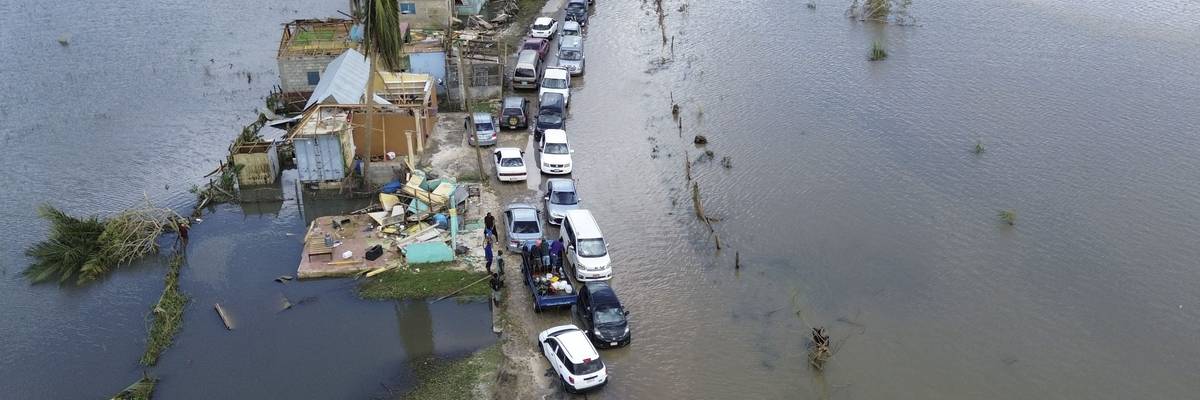
An aerial view shows cars and damaged property in a flooded section of road from Holland Bamboo to Middle Quarters in St. Elizabeth, Jamaica, on October 31, 2025, in the aftermath of Hurricane Melissa.
"Years of grossly insufficient action from richer nations and continued climate deception and obstruction by fossil fuel interests are directly responsible for bringing us here," one expert said.
A United Nations assessment released Tuesday—less than a week before the UN Climate Change Conference summit in Brazil—warns that countries' latest pledges to cut greenhouse gas emissions under the Paris Agreement could push global temperatures to 2.3-2.5°C above preindustrial levels, up to a full degree beyond the treaty's primary goal.
A decade after that agreement was finalized, only about a third of state parties submitted new plans, officially called Nationally Determined Contributions (NDCs), for the United Nations Environment Programme's (UNEP) Emissions Gap Report 2025: Off Target.
While the updated NDCs—if fully implemented—would be a slight improvement on the 2.6-2.8°C projection in last year's report, the more ambitious Paris target is to limit global temperature rise this century to 1.5°C. Already, the world is beginning to experience what that looks like: Last year was the hottest on record and the first in which the global average temperature exceeded 1.5°C, relative to preindustrial times.
As with those findings, UNEP's report sparked calls for bold action at COP30 in Belém next week, including from UN Secretary-General António Guterres. He noted that "scientists tell us that a temporary overshoot above 1.5°C is now inevitable—starting, at the latest, in the early 2030s. And the path to a livable future gets steeper by the day."
"1.5°C by the end of the century remains our North Star. And the science is clear: This goal is still within reach."
"But this is no reason to surrender," Guterres argued. "It's a reason to step up and speed up. 1.5°C by the end of the century remains our North Star. And the science is clear: This goal is still within reach. But only if we meaningfully increase our ambition."
UNEP Executive Director Inger Andersen also stressed that while inadequate climate policies have created the conditions in which now "we still need unprecedented emissions cuts in an increasingly tight window, with an increasingly challenging geopolitical backdrop," reaching the Paris goal "is still possible—just."
"Proven solutions already exist. From the rapid growth in cheap renewable energy to tackling methane emissions, we know what needs to be done," she said. "Now is the time for countries to go all in and invest in their future with ambitious climate action—action that delivers faster economic growth, better human health, more jobs, energy security, and resilience."
NEW – UNEP: New country climate plans ‘barely move needle’ on expected warming | @ayeshatandon.carbonbrief.org @ceciliakeating.carbonbrief.org @unep.org Read here: buff.ly/U0XaME9
[image or embed]
— Carbon Brief (@carbonbrief.org) November 4, 2025 at 9:03 AM
Climate campaigners responded with similar statements. Savio Carvalho, head of regions at the global advocacy group 350.org, said that "this report confirms what millions already feel in their daily lives: Governments are still failing to deliver on their promises. The window to keep 1.5°C within reach is closing fast, but it is not yet gone."
"All eyes are now on Belém," Carvalho declared. "COP30 must be a turning point, where leaders stop making excuses, phase out fossil fuels, and scale up renewable energy in a way that is fast, fair, and equitable."
Rachel Cleetus, senior policy director for the Climate and Energy Program at the US-based Union of Concerned Scientists, said that "this report's findings, confirming that a crucial science-based benchmark for limiting dangerous climate change is about to be breached, are alarming, enraging, and heartbreaking."
"Years of grossly insufficient action from richer nations and continued climate deception and obstruction by fossil fuel interests are directly responsible for bringing us here," she highlighted. "World leaders still have the power to act decisively to sharply rein in heat-trapping emissions and any other choice would be an unconscionable dereliction of their responsibility to humanity."
Cleetus—a regular attendee of the annual UN climate talks who will be at COP30, unlike President Donald Trump's administration—continued:
Costly and deadly climate impacts are already widespread and will worsen with every fraction of a degree, harming people's health and well-being, as well as the economy. Policymakers must seize the opportunity now to accelerate deployment of renewable energy and energy efficiency—solutions that are plentiful, clean, and affordable—and transition away from polluting fossil fuels. Protecting people, livelihoods, and ecosystems by helping them adapt to climate hazards is also critical as higher temperatures unleash rapidly worsening heat, floods, storms, wildfires, drought, and sea-level rise.
Ambitious climate action can cut energy costs, improve public health, and create a myriad of economic opportunities. Richer, high-emitting countries' continued failure to tackle the challenge head-on is undermining the well-being of their own people and is a monumental injustice toward lower-income countries that have contributed the least to this problem yet bear the most acute harms. It’s past time for wealthy countries to heed the latest science and pay up for their role in fueling the climate crisis. With alarms blaring, the upcoming UN climate talks must be a turning point in global climate action. Powerful politicians and billionaires who willfully ignore urgent realities and continue to delay, distract, or lie about climate change will have to answer to our children and grandchildren.
Jean Su, director of the Center for Biological Diversity's Energy Justice Program, also plans to attend COP30.
"This report shows Earth's livable future hanging in the balance while Trump tells climate diplomacy to go to hell," she said. "The US exit from Paris threatens to cancel out any climate gains from other countries. The rise of petro-authoritarianism in the US shouldn't be an excuse for other countries to backpedal on their own commitments. This report sends alarm bells to rich countries with a conscience to exercise real leadership and lead a fossil fuel phaseout to protect us all."
The UNEP report was released on the same day that the German environmental rights group Urgewald published its Global Oil and Gas Exit List, which shows that a green transition is being undercut by fossil fuel extraction and production.
Other publications put out in the lead-up to COP30 include an Oxfam International report showing that the wealthiest people on the planet are disproportionately fueling the climate emergency, as well as a UN Food and Agriculture Organization analysis warning that human-induced land degradation "is undermining agricultural productivity and threatening ecosystem health worldwide."
There have also been mounting demands for specific action, such as Greenpeace and 350.org urging governments to pay for climate action in part by taxing the ultrarich, and an open letter signed by advocacy organizations, activists, policymakers, artists, and experts urging world leaders to prioritize health during discussions in Brazil next week.
As Common Dreams reported earlier Tuesday, COP30 Special Envoy for Health Ethel Maciel said that "this letter sends an unequivocal message that health is an essential component of climate action."
Dear Common Dreams reader, It’s been nearly 30 years since I co-founded Common Dreams with my late wife, Lina Newhouser. We had the radical notion that journalism should serve the public good, not corporate profits. It was clear to us from the outset what it would take to build such a project. No paid advertisements. No corporate sponsors. No millionaire publisher telling us what to think or do. Many people said we wouldn't last a year, but we proved those doubters wrong. Together with a tremendous team of journalists and dedicated staff, we built an independent media outlet free from the constraints of profits and corporate control. Our mission has always been simple: To inform. To inspire. To ignite change for the common good. Building Common Dreams was not easy. Our survival was never guaranteed. When you take on the most powerful forces—Wall Street greed, fossil fuel industry destruction, Big Tech lobbyists, and uber-rich oligarchs who have spent billions upon billions rigging the economy and democracy in their favor—the only bulwark you have is supporters who believe in your work. But here’s the urgent message from me today. It's never been this bad out there. And it's never been this hard to keep us going. At the very moment Common Dreams is most needed, the threats we face are intensifying. We need your support now more than ever. We don't accept corporate advertising and never will. We don't have a paywall because we don't think people should be blocked from critical news based on their ability to pay. Everything we do is funded by the donations of readers like you. When everyone does the little they can afford, we are strong. But if that support retreats or dries up, so do we. Will you donate now to make sure Common Dreams not only survives but thrives? —Craig Brown, Co-founder |
A United Nations assessment released Tuesday—less than a week before the UN Climate Change Conference summit in Brazil—warns that countries' latest pledges to cut greenhouse gas emissions under the Paris Agreement could push global temperatures to 2.3-2.5°C above preindustrial levels, up to a full degree beyond the treaty's primary goal.
A decade after that agreement was finalized, only about a third of state parties submitted new plans, officially called Nationally Determined Contributions (NDCs), for the United Nations Environment Programme's (UNEP) Emissions Gap Report 2025: Off Target.
While the updated NDCs—if fully implemented—would be a slight improvement on the 2.6-2.8°C projection in last year's report, the more ambitious Paris target is to limit global temperature rise this century to 1.5°C. Already, the world is beginning to experience what that looks like: Last year was the hottest on record and the first in which the global average temperature exceeded 1.5°C, relative to preindustrial times.
As with those findings, UNEP's report sparked calls for bold action at COP30 in Belém next week, including from UN Secretary-General António Guterres. He noted that "scientists tell us that a temporary overshoot above 1.5°C is now inevitable—starting, at the latest, in the early 2030s. And the path to a livable future gets steeper by the day."
"1.5°C by the end of the century remains our North Star. And the science is clear: This goal is still within reach."
"But this is no reason to surrender," Guterres argued. "It's a reason to step up and speed up. 1.5°C by the end of the century remains our North Star. And the science is clear: This goal is still within reach. But only if we meaningfully increase our ambition."
UNEP Executive Director Inger Andersen also stressed that while inadequate climate policies have created the conditions in which now "we still need unprecedented emissions cuts in an increasingly tight window, with an increasingly challenging geopolitical backdrop," reaching the Paris goal "is still possible—just."
"Proven solutions already exist. From the rapid growth in cheap renewable energy to tackling methane emissions, we know what needs to be done," she said. "Now is the time for countries to go all in and invest in their future with ambitious climate action—action that delivers faster economic growth, better human health, more jobs, energy security, and resilience."
NEW – UNEP: New country climate plans ‘barely move needle’ on expected warming | @ayeshatandon.carbonbrief.org @ceciliakeating.carbonbrief.org @unep.org Read here: buff.ly/U0XaME9
[image or embed]
— Carbon Brief (@carbonbrief.org) November 4, 2025 at 9:03 AM
Climate campaigners responded with similar statements. Savio Carvalho, head of regions at the global advocacy group 350.org, said that "this report confirms what millions already feel in their daily lives: Governments are still failing to deliver on their promises. The window to keep 1.5°C within reach is closing fast, but it is not yet gone."
"All eyes are now on Belém," Carvalho declared. "COP30 must be a turning point, where leaders stop making excuses, phase out fossil fuels, and scale up renewable energy in a way that is fast, fair, and equitable."
Rachel Cleetus, senior policy director for the Climate and Energy Program at the US-based Union of Concerned Scientists, said that "this report's findings, confirming that a crucial science-based benchmark for limiting dangerous climate change is about to be breached, are alarming, enraging, and heartbreaking."
"Years of grossly insufficient action from richer nations and continued climate deception and obstruction by fossil fuel interests are directly responsible for bringing us here," she highlighted. "World leaders still have the power to act decisively to sharply rein in heat-trapping emissions and any other choice would be an unconscionable dereliction of their responsibility to humanity."
Cleetus—a regular attendee of the annual UN climate talks who will be at COP30, unlike President Donald Trump's administration—continued:
Costly and deadly climate impacts are already widespread and will worsen with every fraction of a degree, harming people's health and well-being, as well as the economy. Policymakers must seize the opportunity now to accelerate deployment of renewable energy and energy efficiency—solutions that are plentiful, clean, and affordable—and transition away from polluting fossil fuels. Protecting people, livelihoods, and ecosystems by helping them adapt to climate hazards is also critical as higher temperatures unleash rapidly worsening heat, floods, storms, wildfires, drought, and sea-level rise.
Ambitious climate action can cut energy costs, improve public health, and create a myriad of economic opportunities. Richer, high-emitting countries' continued failure to tackle the challenge head-on is undermining the well-being of their own people and is a monumental injustice toward lower-income countries that have contributed the least to this problem yet bear the most acute harms. It’s past time for wealthy countries to heed the latest science and pay up for their role in fueling the climate crisis. With alarms blaring, the upcoming UN climate talks must be a turning point in global climate action. Powerful politicians and billionaires who willfully ignore urgent realities and continue to delay, distract, or lie about climate change will have to answer to our children and grandchildren.
Jean Su, director of the Center for Biological Diversity's Energy Justice Program, also plans to attend COP30.
"This report shows Earth's livable future hanging in the balance while Trump tells climate diplomacy to go to hell," she said. "The US exit from Paris threatens to cancel out any climate gains from other countries. The rise of petro-authoritarianism in the US shouldn't be an excuse for other countries to backpedal on their own commitments. This report sends alarm bells to rich countries with a conscience to exercise real leadership and lead a fossil fuel phaseout to protect us all."
The UNEP report was released on the same day that the German environmental rights group Urgewald published its Global Oil and Gas Exit List, which shows that a green transition is being undercut by fossil fuel extraction and production.
Other publications put out in the lead-up to COP30 include an Oxfam International report showing that the wealthiest people on the planet are disproportionately fueling the climate emergency, as well as a UN Food and Agriculture Organization analysis warning that human-induced land degradation "is undermining agricultural productivity and threatening ecosystem health worldwide."
There have also been mounting demands for specific action, such as Greenpeace and 350.org urging governments to pay for climate action in part by taxing the ultrarich, and an open letter signed by advocacy organizations, activists, policymakers, artists, and experts urging world leaders to prioritize health during discussions in Brazil next week.
As Common Dreams reported earlier Tuesday, COP30 Special Envoy for Health Ethel Maciel said that "this letter sends an unequivocal message that health is an essential component of climate action."
A United Nations assessment released Tuesday—less than a week before the UN Climate Change Conference summit in Brazil—warns that countries' latest pledges to cut greenhouse gas emissions under the Paris Agreement could push global temperatures to 2.3-2.5°C above preindustrial levels, up to a full degree beyond the treaty's primary goal.
A decade after that agreement was finalized, only about a third of state parties submitted new plans, officially called Nationally Determined Contributions (NDCs), for the United Nations Environment Programme's (UNEP) Emissions Gap Report 2025: Off Target.
While the updated NDCs—if fully implemented—would be a slight improvement on the 2.6-2.8°C projection in last year's report, the more ambitious Paris target is to limit global temperature rise this century to 1.5°C. Already, the world is beginning to experience what that looks like: Last year was the hottest on record and the first in which the global average temperature exceeded 1.5°C, relative to preindustrial times.
As with those findings, UNEP's report sparked calls for bold action at COP30 in Belém next week, including from UN Secretary-General António Guterres. He noted that "scientists tell us that a temporary overshoot above 1.5°C is now inevitable—starting, at the latest, in the early 2030s. And the path to a livable future gets steeper by the day."
"1.5°C by the end of the century remains our North Star. And the science is clear: This goal is still within reach."
"But this is no reason to surrender," Guterres argued. "It's a reason to step up and speed up. 1.5°C by the end of the century remains our North Star. And the science is clear: This goal is still within reach. But only if we meaningfully increase our ambition."
UNEP Executive Director Inger Andersen also stressed that while inadequate climate policies have created the conditions in which now "we still need unprecedented emissions cuts in an increasingly tight window, with an increasingly challenging geopolitical backdrop," reaching the Paris goal "is still possible—just."
"Proven solutions already exist. From the rapid growth in cheap renewable energy to tackling methane emissions, we know what needs to be done," she said. "Now is the time for countries to go all in and invest in their future with ambitious climate action—action that delivers faster economic growth, better human health, more jobs, energy security, and resilience."
NEW – UNEP: New country climate plans ‘barely move needle’ on expected warming | @ayeshatandon.carbonbrief.org @ceciliakeating.carbonbrief.org @unep.org Read here: buff.ly/U0XaME9
[image or embed]
— Carbon Brief (@carbonbrief.org) November 4, 2025 at 9:03 AM
Climate campaigners responded with similar statements. Savio Carvalho, head of regions at the global advocacy group 350.org, said that "this report confirms what millions already feel in their daily lives: Governments are still failing to deliver on their promises. The window to keep 1.5°C within reach is closing fast, but it is not yet gone."
"All eyes are now on Belém," Carvalho declared. "COP30 must be a turning point, where leaders stop making excuses, phase out fossil fuels, and scale up renewable energy in a way that is fast, fair, and equitable."
Rachel Cleetus, senior policy director for the Climate and Energy Program at the US-based Union of Concerned Scientists, said that "this report's findings, confirming that a crucial science-based benchmark for limiting dangerous climate change is about to be breached, are alarming, enraging, and heartbreaking."
"Years of grossly insufficient action from richer nations and continued climate deception and obstruction by fossil fuel interests are directly responsible for bringing us here," she highlighted. "World leaders still have the power to act decisively to sharply rein in heat-trapping emissions and any other choice would be an unconscionable dereliction of their responsibility to humanity."
Cleetus—a regular attendee of the annual UN climate talks who will be at COP30, unlike President Donald Trump's administration—continued:
Costly and deadly climate impacts are already widespread and will worsen with every fraction of a degree, harming people's health and well-being, as well as the economy. Policymakers must seize the opportunity now to accelerate deployment of renewable energy and energy efficiency—solutions that are plentiful, clean, and affordable—and transition away from polluting fossil fuels. Protecting people, livelihoods, and ecosystems by helping them adapt to climate hazards is also critical as higher temperatures unleash rapidly worsening heat, floods, storms, wildfires, drought, and sea-level rise.
Ambitious climate action can cut energy costs, improve public health, and create a myriad of economic opportunities. Richer, high-emitting countries' continued failure to tackle the challenge head-on is undermining the well-being of their own people and is a monumental injustice toward lower-income countries that have contributed the least to this problem yet bear the most acute harms. It’s past time for wealthy countries to heed the latest science and pay up for their role in fueling the climate crisis. With alarms blaring, the upcoming UN climate talks must be a turning point in global climate action. Powerful politicians and billionaires who willfully ignore urgent realities and continue to delay, distract, or lie about climate change will have to answer to our children and grandchildren.
Jean Su, director of the Center for Biological Diversity's Energy Justice Program, also plans to attend COP30.
"This report shows Earth's livable future hanging in the balance while Trump tells climate diplomacy to go to hell," she said. "The US exit from Paris threatens to cancel out any climate gains from other countries. The rise of petro-authoritarianism in the US shouldn't be an excuse for other countries to backpedal on their own commitments. This report sends alarm bells to rich countries with a conscience to exercise real leadership and lead a fossil fuel phaseout to protect us all."
The UNEP report was released on the same day that the German environmental rights group Urgewald published its Global Oil and Gas Exit List, which shows that a green transition is being undercut by fossil fuel extraction and production.
Other publications put out in the lead-up to COP30 include an Oxfam International report showing that the wealthiest people on the planet are disproportionately fueling the climate emergency, as well as a UN Food and Agriculture Organization analysis warning that human-induced land degradation "is undermining agricultural productivity and threatening ecosystem health worldwide."
There have also been mounting demands for specific action, such as Greenpeace and 350.org urging governments to pay for climate action in part by taxing the ultrarich, and an open letter signed by advocacy organizations, activists, policymakers, artists, and experts urging world leaders to prioritize health during discussions in Brazil next week.
As Common Dreams reported earlier Tuesday, COP30 Special Envoy for Health Ethel Maciel said that "this letter sends an unequivocal message that health is an essential component of climate action."

