SUBSCRIBE TO OUR FREE NEWSLETTER
Daily news & progressive opinion—funded by the people, not the corporations—delivered straight to your inbox.
5
#000000
#FFFFFF
To donate by check, phone, or other method, see our More Ways to Give page.
Daily news & progressive opinion—funded by the people, not the corporations—delivered straight to your inbox.
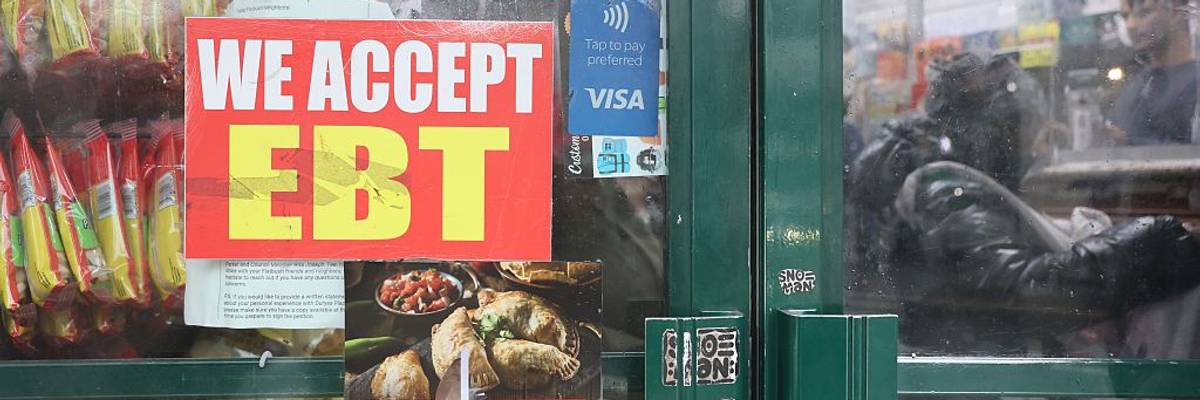
An EBT sign is displayed on the window of a grocery store on October 30, 2025 in the Flatbush neighborhood of the Brooklyn borough in New York City.
"If I have money left over, then I will eat."
Beneficiaries of federal food aid are expressing anger and bewilderment at the Trump administration's efforts to use the program as a hostage to end the current shutdown of the federal government.
On Monday, the Trump administration said that it would partially restart funding for the Supplemental Nutrition Assistance Program (SNAP) in the wake of two district court rulings mandating that the administration use emergency funds set up by Congress to continue the program.
The administration said that it would only fund around 50% of the $8 billion in total monthly benefits, while also warning that there could be delays before SNAP beneficiaries are able to access the funds.
In interviews with The Guardian, several SNAP beneficiaries fumed that their ability to access food for themselves and their families is being used as a political football by the administration.
Wisconsin resident Betty Standridge, who had been relying on SNAP to afford food after being hospitalized, told The Guardian that, without the funds, "I will not be able to replenish my food for the month, therefore I will do without things like fresh produce, milk, eggs."
Donna Lynn, a disabled veteran who lives in Missouri, also said that she would have to make significant cuts to her budget if SNAP benefits were not replenished.
"It comes down to paying for my medications and my bills or buying food for myself and for my animals," she said. "So I pay for my medications and bills and get what food I can for my animals, and if I have money left over, then I will eat."
A Wisconsin retiree named Sandra, meanwhile, told The Guardian she feared that the administration was angling to permanently end SNAP even after the end of the government shutdown.
"I'm dumbfounded by the cruelty," she said.
Before the administration allowed more than 40 million people—nearly 40% of whom are children—to go without food assistance on November 1 and refused to use a contingency fund to keep SNAP running, the Republican Party passed roughly $186 billion in cuts to the program in the One Big Beautiful Bill Act this summer.
The bill expanded work requirements, shifted some of the cost of SNAP to the states, and restricted benefit increases, leaving millions of people vulnerable to losing their benefits.
Betty Szretter, a New York retiree whose daughter depends on SNAP benefits, told NBC News that she regrets voting for President Donald Trump in 2024, and said she's worried that his focus appears to be elsewhere—like the corporate-funded construction of a ballroom at the White House—rather than on helping people like her family.
“I think deep down he wants to help the country with things like food insecurity,” she said. “But now he is busy out of the country and demolishing the White House. I know that is being paid for with private funds, but those could be used to help people... It all seems very selfish."
CBS News on Tuesday interviewed a Baltimore resident named Kelly Lennox, who has been relying on SNAP for the last year-and-a-half after a car accident that required multiple surgeries left her unable to work. She said the halt of SNAP payments was a particularly harsh blow given that she's deep in medical debt in the wake of the accident.
Now, she says she'll have to rely on local food pantries to keep from going hungry.
"I'm going to have to make use of the pantries and work with their schedule, because if I use actual money for food, it takes away money I need to pay for my residential parking permit, gas, and union dues," she said.
Roughly 42 million people living in the US currently receive SNAP benefits, and The Washington Post estimates that SNAP payments account for 9% of all grocery sales in the US.
Dear Common Dreams reader, It’s been nearly 30 years since I co-founded Common Dreams with my late wife, Lina Newhouser. We had the radical notion that journalism should serve the public good, not corporate profits. It was clear to us from the outset what it would take to build such a project. No paid advertisements. No corporate sponsors. No millionaire publisher telling us what to think or do. Many people said we wouldn't last a year, but we proved those doubters wrong. Together with a tremendous team of journalists and dedicated staff, we built an independent media outlet free from the constraints of profits and corporate control. Our mission has always been simple: To inform. To inspire. To ignite change for the common good. Building Common Dreams was not easy. Our survival was never guaranteed. When you take on the most powerful forces—Wall Street greed, fossil fuel industry destruction, Big Tech lobbyists, and uber-rich oligarchs who have spent billions upon billions rigging the economy and democracy in their favor—the only bulwark you have is supporters who believe in your work. But here’s the urgent message from me today. It's never been this bad out there. And it's never been this hard to keep us going. At the very moment Common Dreams is most needed, the threats we face are intensifying. We need your support now more than ever. We don't accept corporate advertising and never will. We don't have a paywall because we don't think people should be blocked from critical news based on their ability to pay. Everything we do is funded by the donations of readers like you. When everyone does the little they can afford, we are strong. But if that support retreats or dries up, so do we. Will you donate now to make sure Common Dreams not only survives but thrives? —Craig Brown, Co-founder |
Beneficiaries of federal food aid are expressing anger and bewilderment at the Trump administration's efforts to use the program as a hostage to end the current shutdown of the federal government.
On Monday, the Trump administration said that it would partially restart funding for the Supplemental Nutrition Assistance Program (SNAP) in the wake of two district court rulings mandating that the administration use emergency funds set up by Congress to continue the program.
The administration said that it would only fund around 50% of the $8 billion in total monthly benefits, while also warning that there could be delays before SNAP beneficiaries are able to access the funds.
In interviews with The Guardian, several SNAP beneficiaries fumed that their ability to access food for themselves and their families is being used as a political football by the administration.
Wisconsin resident Betty Standridge, who had been relying on SNAP to afford food after being hospitalized, told The Guardian that, without the funds, "I will not be able to replenish my food for the month, therefore I will do without things like fresh produce, milk, eggs."
Donna Lynn, a disabled veteran who lives in Missouri, also said that she would have to make significant cuts to her budget if SNAP benefits were not replenished.
"It comes down to paying for my medications and my bills or buying food for myself and for my animals," she said. "So I pay for my medications and bills and get what food I can for my animals, and if I have money left over, then I will eat."
A Wisconsin retiree named Sandra, meanwhile, told The Guardian she feared that the administration was angling to permanently end SNAP even after the end of the government shutdown.
"I'm dumbfounded by the cruelty," she said.
Before the administration allowed more than 40 million people—nearly 40% of whom are children—to go without food assistance on November 1 and refused to use a contingency fund to keep SNAP running, the Republican Party passed roughly $186 billion in cuts to the program in the One Big Beautiful Bill Act this summer.
The bill expanded work requirements, shifted some of the cost of SNAP to the states, and restricted benefit increases, leaving millions of people vulnerable to losing their benefits.
Betty Szretter, a New York retiree whose daughter depends on SNAP benefits, told NBC News that she regrets voting for President Donald Trump in 2024, and said she's worried that his focus appears to be elsewhere—like the corporate-funded construction of a ballroom at the White House—rather than on helping people like her family.
“I think deep down he wants to help the country with things like food insecurity,” she said. “But now he is busy out of the country and demolishing the White House. I know that is being paid for with private funds, but those could be used to help people... It all seems very selfish."
CBS News on Tuesday interviewed a Baltimore resident named Kelly Lennox, who has been relying on SNAP for the last year-and-a-half after a car accident that required multiple surgeries left her unable to work. She said the halt of SNAP payments was a particularly harsh blow given that she's deep in medical debt in the wake of the accident.
Now, she says she'll have to rely on local food pantries to keep from going hungry.
"I'm going to have to make use of the pantries and work with their schedule, because if I use actual money for food, it takes away money I need to pay for my residential parking permit, gas, and union dues," she said.
Roughly 42 million people living in the US currently receive SNAP benefits, and The Washington Post estimates that SNAP payments account for 9% of all grocery sales in the US.
Beneficiaries of federal food aid are expressing anger and bewilderment at the Trump administration's efforts to use the program as a hostage to end the current shutdown of the federal government.
On Monday, the Trump administration said that it would partially restart funding for the Supplemental Nutrition Assistance Program (SNAP) in the wake of two district court rulings mandating that the administration use emergency funds set up by Congress to continue the program.
The administration said that it would only fund around 50% of the $8 billion in total monthly benefits, while also warning that there could be delays before SNAP beneficiaries are able to access the funds.
In interviews with The Guardian, several SNAP beneficiaries fumed that their ability to access food for themselves and their families is being used as a political football by the administration.
Wisconsin resident Betty Standridge, who had been relying on SNAP to afford food after being hospitalized, told The Guardian that, without the funds, "I will not be able to replenish my food for the month, therefore I will do without things like fresh produce, milk, eggs."
Donna Lynn, a disabled veteran who lives in Missouri, also said that she would have to make significant cuts to her budget if SNAP benefits were not replenished.
"It comes down to paying for my medications and my bills or buying food for myself and for my animals," she said. "So I pay for my medications and bills and get what food I can for my animals, and if I have money left over, then I will eat."
A Wisconsin retiree named Sandra, meanwhile, told The Guardian she feared that the administration was angling to permanently end SNAP even after the end of the government shutdown.
"I'm dumbfounded by the cruelty," she said.
Before the administration allowed more than 40 million people—nearly 40% of whom are children—to go without food assistance on November 1 and refused to use a contingency fund to keep SNAP running, the Republican Party passed roughly $186 billion in cuts to the program in the One Big Beautiful Bill Act this summer.
The bill expanded work requirements, shifted some of the cost of SNAP to the states, and restricted benefit increases, leaving millions of people vulnerable to losing their benefits.
Betty Szretter, a New York retiree whose daughter depends on SNAP benefits, told NBC News that she regrets voting for President Donald Trump in 2024, and said she's worried that his focus appears to be elsewhere—like the corporate-funded construction of a ballroom at the White House—rather than on helping people like her family.
“I think deep down he wants to help the country with things like food insecurity,” she said. “But now he is busy out of the country and demolishing the White House. I know that is being paid for with private funds, but those could be used to help people... It all seems very selfish."
CBS News on Tuesday interviewed a Baltimore resident named Kelly Lennox, who has been relying on SNAP for the last year-and-a-half after a car accident that required multiple surgeries left her unable to work. She said the halt of SNAP payments was a particularly harsh blow given that she's deep in medical debt in the wake of the accident.
Now, she says she'll have to rely on local food pantries to keep from going hungry.
"I'm going to have to make use of the pantries and work with their schedule, because if I use actual money for food, it takes away money I need to pay for my residential parking permit, gas, and union dues," she said.
Roughly 42 million people living in the US currently receive SNAP benefits, and The Washington Post estimates that SNAP payments account for 9% of all grocery sales in the US.