

SUBSCRIBE TO OUR FREE NEWSLETTER
Daily news & progressive opinion—funded by the people, not the corporations—delivered straight to your inbox.
5
#000000
#FFFFFF
To donate by check, phone, or other method, see our More Ways to Give page.
Daily news & progressive opinion—funded by the people, not the corporations—delivered straight to your inbox.

"Israel’s wanton killing of rescue workers and targeting of medical infrastructure in Lebanon has been one of this war’s most brazen features," Drop Site News noted.
Israeli attacks killed at least seven rescue workers in southern Lebanon on Thursday and Friday in violation of a US-brokered ceasefire, part of what critics say is a pattern of deliberate targeted murders of first responders that mirror the genocidal massacres committed in Gaza.
On Friday, paramedics from the al-Risala Association rushed to the site of an Israeli strike in Deir Qanun al-Nah, Tyre district, that reportedly killed a young girl and the village barber, identified by L'Orient Today as Ali Allameh. As they arrived on the scene, the paramedics were hit by a so-called "double-tap" strike—a follow-up bombing meant to eliminate survivors and first responders—that killed would-be rescuers Ali Abboud, Hussein Kassir, and Ahmad Hariri.
Hariri was also a well-known photojournalist who earlier this week documented an Israeli massacre of 14 people—including four children and 11 members of one family—in Deir Qanun al-Nah.
L'Orient Today reported that Israeli forces bombed two Islamic Health Committee centers in Hanouiyeh overnight Thursday, killing four rescue workers and wounding two others. Earlier on Thursday, an Israeli airstrike near the Tebnine Hospital reportedly killed two people and injured another while damaging all three floors of the facility.
Lebanon's Ministry of Public Health said more than 3,100 people have been killed by Israeli attacks since March 2, in addition to the more than 4,000 people, including nearly 800 women and over 300 children, slain in Israel’s 2023-25 attacks on its northern neighbor, where the militant resistance group Hezbollah is based. The dead from the current round of Israeli attacks include nearly 300 women, more than 210 children, and 123 medical and healthcare workers.
The Committee to Protect Journalists says 15 media professionals have also been killed in Lebanon since October 2023. One of them, Al-Akhbar correspondent Amal Khalil, was wounded last month by an Israeli strike while reporting on a previous bombing. Khalil was trapped under rubble, and as Red Cross workers attempted to extricate her, Israeli forces dropped a stun grenade on them as a warning to disperse. They were unable to rescue Khalil, who later died.
As in Gaza—where Israeli forces have killed or wounded more than 250,000 Palestinians since the Hamas-led attack of October 7, 2023—attacks by Israel have devastated Lebanon's healthcare infrastructure.
Israel's continued slaughter of Lebanese first responders comes as World Health Organization (WHO) member states gathered this week in Geneva, where they overwhelmingly backed a declaration of alarm over “the impact of the ongoing war on the Lebanese health systems, including attacks on health facilities and health workers, and the closure of dozens of primary healthcare centers and hospitals."
The measure, which also called on the WHO to "scale up" support for Lebanon's health system, passed by a vote of 95-2—with Israel and Honduras against—and 18 abstentions.
"Israeli military action has had unacceptable impacts on civilians and medical care," the United Kingdom said in an explanation of its vote in favor of the declaration. "The conflict has led to the displacement of over 1 million people and the closure of several hospitals and health facilities. The WHO has reported over 150 verified attacks against healthcare, with over 100 healthcare workers killed."
As Drop Site News reported Friday:
Israel’s wanton killing of rescue workers and targeting of medical infrastructure in Lebanon has been one of this war’s most brazen features. For the past five weeks, the relentless Israeli aerial and ground assault has continued despite a nominal ceasefire being announced by President Donald Trump on April 16. Last week, Israel and Lebanon agreed to a 45-day extension of the “ceasefire” after holding their third round of direct talks in Washington, of which Hezbollah is not a part. The declaration of a ceasefire has not stopped the Israeli military from continuing its bombardment of Lebanon, mostly in the south and the eastern Bekka Valley.
Rescue teams describe a pattern of repeated Israeli attacks directly targeting their members, often in double—or triple-tap strikes—where after a site is struck, it is struck a second or even third time as emergency crews arrive on the scene.
“We try to be careful and take safety precautions before interventions, like waiting 10 minutes to avoid the double taps,” Abdullah Halal, who leads a Civil Defense rescue team in Nabatiyeh, told Drop Site News.
"But," the outlet noted, "even those precautions have not always been enough. Last week, Halal lost two of his two colleagues in a double-tap strike."
Ali Saad, who is with the Lebanese Red Cross, told UN News on Wednesday that his colleagues share coordinates with Israeli forces and other belligerents, but rescue workers are still being targeted.
“This is why the Red Cross volunteers hug each other and say goodbye before every mission,” he said.
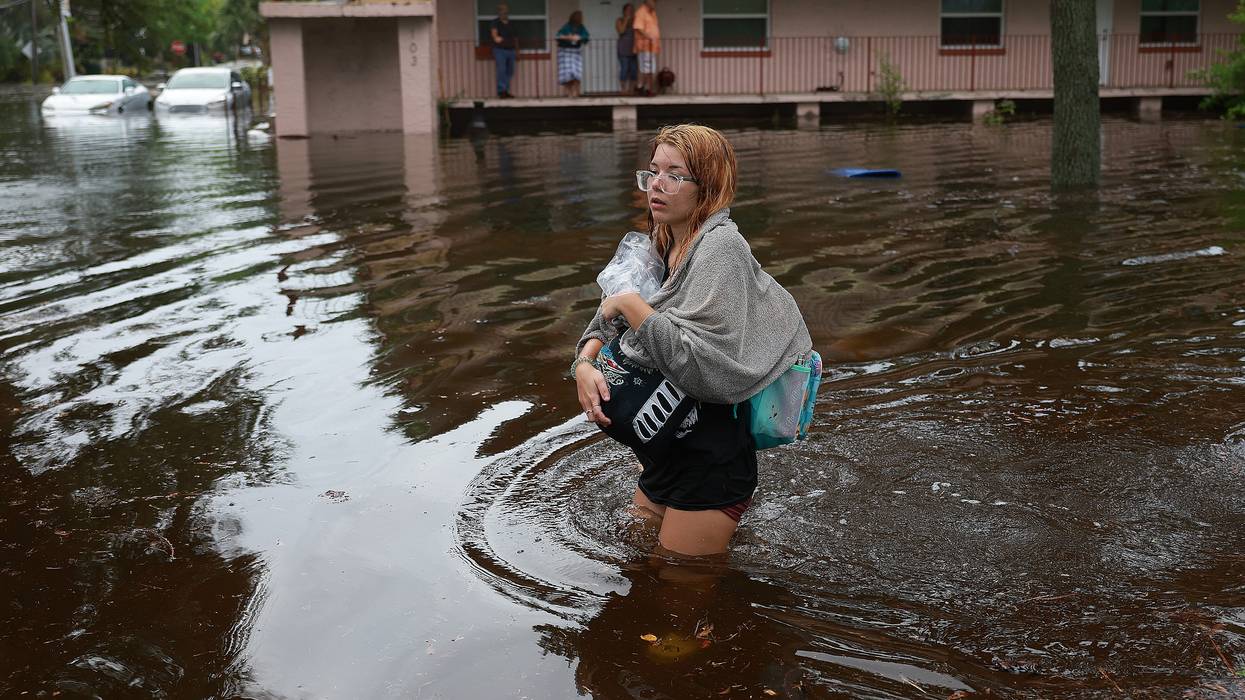
"This is unfathomable discrimination against immigrants that will cost our country lives," said Rep. Pramila Jayapal.
The Trump administration is reportedly putting new restrictions on nonprofit organizations that would bar them from helping undocumented immigrants affected by natural disasters.
The Washington Post reported on Wednesday that the Department of Homeland Security (DHS) is "now barring states and volunteer groups that receive government funds from helping undocumented immigrants" while also requiring these groups "to cooperate with immigration officials and enforcement operations."
Documents obtained by the paper reveal that all volunteer groups that receive government money to help in the wake of disasters must not "operate any program that benefits illegal immigrants or incentivizes illegal immigration." What's more, the groups are prohibited from "harboring, concealing, or shielding from detection illegal aliens" and must "provide access to detainees, such as when an immigration officer seeks to interview a person who might be a removable alien."
The order pertains to faith-based aid groups such as the Salvation Army and Red Cross that are normally on the front lines building shelters and providing assistance during disasters.
Scott Robinson, an emergency management expert who teaches at Arizona State University, told The Washington Post that there is no historical precedent for requiring disaster victims to prove proof of their legal status before receiving assistance.
"The notion that the federal government would use these operations for surveillance is entirely new territory," he said.
Many critics were quick to attack the administration for threatening to punish nonprofit groups that help undocumented immigrants during natural disasters.
Rep. Pramila Jayapal (D-Wash.) lashed out at the decision to bar certain people from receiving assistance during humanitarian emergencies.
"When disaster hits, we cannot only help those with certain legal status," she wrote in a social media post. "We have an obligation to help every single person in need. This is unfathomable discrimination against immigrants that will cost our country lives."
Aaron Reichlin-Melnick, senior fellow at the American Immigration Council, said that restrictions on faith-based groups such as the Salvation Army amounted to a violation of their First Amendment rights.
"Arguably the most anti-religious administration in history," he wrote. "Just nakedly hostile to those who wish to practice their faith."
Bloomberg columnist Erika Smith labeled the new DHS policy "truly cruel and crazy—even for this administration."
Author Charles Fishman also labeled the new policy "crazy" and said it looks like the Trump administration is "trying to crush even charity."
Catherine Rampell, a former columnist at The Washington Post, simply described the new DHS policy as "evil."
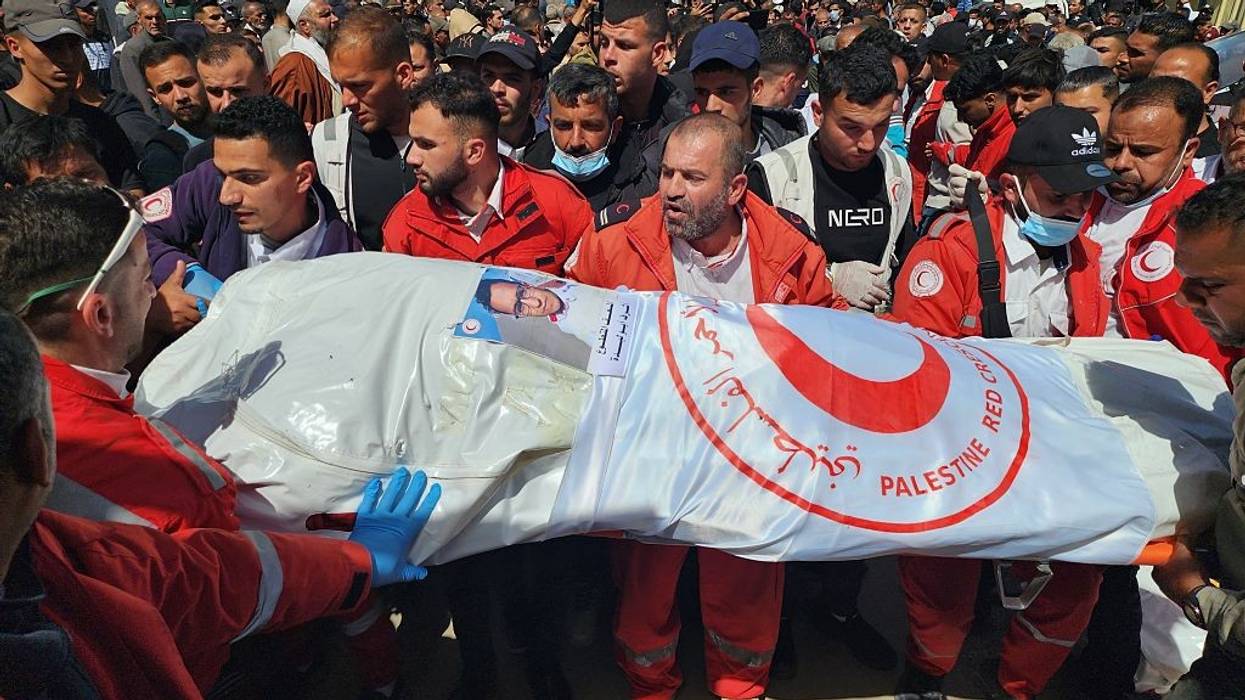
"Genocide, ecocide, mass infanticide, rape, sexual assault, torture, slavery, sniping children, bombing hospitals, executing aid workers," said one critic. "We are funding an endless nightmare and it should haunt us forever."
As Israel Defense Forces bombing continued to kill and maim large numbers of Palestinians across the Gaza Strip over the weekend and into Monday, the discovery of the bodies of medical workers who were apparently executed by their captors and the publication of several reports in which Israeli soldiers admit to torturing prisoners and using civilians as human shields have drawn renewed war crimes accusations and calls for accountability.
On Sunday, the Palestine Red Crescent Society (PRCS) said it had recovered the bodies of 15 Palestinian first responders from a mass grave, including eight Red Crescent workers and six Civil Defense personnel, who were killed by Israeli forces on March 23 while traveling "on duty" in five ambulances, a fire truck, and a United Nations vehicle in the al-Hashashin area of southern Gaza.
Jonathan Whittall, head of the United Nations Office for the Coordination of Humanitarian Affairs (OCHA) in Gaza, said Sunday that the first responders were picked off "one by one."
"Their bodies were gathered and buried in this mass grave," Whittall added. "We're digging them out with uniforms, with their gloves on. They were here to save lives. Instead, they ended up in a mass grave."
The IFRC condemns the killing of eight Palestine Red Crescent Society medics in Gaza.We are heartbroken. These dedicated humanitarians, killed while responding to the wounded, should have been protected. We mourn their loss and stand with the Palestine Red Crescent.Full statement: bit.ly/427LXxp
[image or embed]
— IFRC (@ifrc.org) March 30, 2025 at 11:47 AM
The Gaza Health Ministry said that "some of these bodies were bound and shot in the chest" before being "buried in a deep hole to prevent their identification."
Accusing Israel of a "heinous crime," the ministry called on U.N. agencies "and relevant international bodies to conduct an urgent investigation into these crimes and hold the occupation accountable for committing them."
An Israel Defense Forces (IDF) spokesperson said troops opened fire on the convoy because it was "advancing suspiciously" toward their position.
"Following an initial assessment, it was determined that the forces had eliminated a Hamas military operative, Mohammad Amin Ibrahim Shubaki, who took part in the October 7 massacre, along with eight other terrorists from Hamas and the Islamic Jihad," the spokesperson claimed.
Israeli officials routinely claim—often with little or no evidence—that Palestinian first responders, United Nations workers, journalists, and other civilians that it kills are members of Hamas or other militant resistance groups.
The International Federation of Red Cross and Red Crescent Societies (IFRC) said in a statement Sunday that it is "outraged" by the killings, which it called "the single most deadly attack on Red Cross Red Crescent workers anywhere in the world since 2017."
"After seven days of silence and having access denied to the area of Rafah where they were last seen, the bodies of ambulance officers Mostafa Khufaga, Saleh Muamer, and Ezzedine Shaath and first responder volunteers Mohammad Bahloul, Mohammed Al-Heila, Ashraf Abu Labda, Raed Al Sharif, and Rifatt Radwan were retrieved today," the statement noted. "Ambulance officer Assad Al-Nassasra is still missing."
Noting that at least 30 Red Crescent workers and volunteers have been killed by Israeli forces during the war, IFRC secretary general Jagan Chapagain said: "I am heartbroken. These dedicated ambulance workers were responding to wounded people. They were humanitarians. They wore emblems that should have protected them; their ambulances were clearly marked. They should have returned to their families; they did not."
"Even in the most complex conflict zones, there are rules," Chapagain stressed. "These rules of international humanitarian law could not be clearer—civilians must be protected; humanitarians must be protected. Health services must be protected."
"Our network is in mourning, but this is not enough," he added. "Instead of another call on all parties to protect and respect humanitarians and civilians, I pose a question: When will this stop? All parties must stop the killing, and all humanitarians must be protected."
Journalist Mohammad Alsaafin compared the killings to last year's IDF massacre of 6-year-old Hind Rajab, five of her relatives, and two PRCS medics who rushed to the site of the attack in a doomed bid to rescue the wounded child after she called for help.
On Sunday, the British newspaper The Independent published an investigation into alleged Israeli torture of Palestinians detained at facilities including Ofer Prison in the illegally occupied West Bank and the notorious Sde Teiman base in the Negev Desert.
The report begins:
Handcuffed and cowering on the floor of a cell in a military base in southern Israel, the Palestinian found himself surrounded by five soldiers. Armed with dogs, the five reservists allegedly kicked, punched, and stamped on the man as he lay on the ground. Continuing their assault, they are accused of attacking him with Taser guns and sharp objects, sexually abusing him with these instruments. At one point, the soldiers allegedly stabbed him so hard that they pierced his buttocks and anus. The brutal alleged assault left the man hospitalized with a punctured lung, cracked ribs, and a tear in his rectum needing surgery for a stoma. He had not been charged with any crime.
The Independent noted details regarding some of the dozens of Palestinian detainees who have died in Israeli custody. The IDF is currently conducting its own probe into the deaths of at least 36 Sde Teiman prisoners, including one who died after allegedly being sodomized with an electric baton.
"The fact that we see some signs of abuse means that this is probably the tip of the iceberg," said one Israeli physician who has overseen multiple autopsies on dead detainees.
In an anonymous testimony leaked to The Independent, one Sde Teiman guard described a prevailing attitude of "Yes, they need to be beaten, it must be done."
"We began looking for opportunities to do so," the soldier said, adding that when he spoke out against the beating of one detainee, he was told, "Shut up, you leftist, these are Gazans, these are terrorists, what's wrong with you?"
One former Sde Teiman detainee said that "every meter you moved, they beat you, they hit you, they insulted you; they used dogs, tear gas, and electric shock."
IDF troops and veterans who were posted at Sde Teiman have provided similar details about "Israel's Abu Ghraib," a reference to the U.S. torture prison outside Baghdad during the Iraq War. Israeli doctors and medics have described forced starvation and 24-hour shackling so severe that prisoners have had limbs amputated.
A number of Sde Teiman guards were arrested last year following the leak of a video allegedly showing them raping a Palestinian detainee. The arrests outraged far-right Israelis, a mob of whom stormed Sde Teiman in a failed bid to free the accused guards.
As The Independent noted, "Among those held in [Israeli] detention are many of Gaza's healthcare workers, including doctors, nurses, and paramedics." Some of these prisoners have died in custody, including the renowned surgeon Dr. Adnan al-Bursh, who may have been raped to death, according to Francesca Albanese, the U.N. special rapporteur on the situation of human rights in the Palestinian territory occupied since 1967.
Earlier this month, an independent U.N. panel found that Israel has "systematically" used reproductive, sexual, and other forms of gender-based violence against Palestinian men, women, and children during the war.
The IDF has responded to these and other allegations by claiming it "operates in accordance with international law."
However, the International Criminal Court last year issued arrest warrants for Israeli Prime Minister Benjamin Netanyahu and former Israeli Defense Minister Yoav Gallant—who ordered a "complete siege" of Gaza blamed for deadly starvation and disease there—for alleged war crimes and crimes against humanity. Israel is also the subject of an ongoing International Court of Justice genocide case brought by South Africa.
Also on Sunday, Haaretz, Israel's oldest newspaper, published a piece by an anonymous Israel soldier who said that "in Gaza, almost every IDF platoon keeps a human shield."
"We operate a sub-army of slaves," the soldier said, describing how innocent Palestinians are used to check buildings for Hamas fighters or booby traps before IDF troops enter.
"I recently saw that the IDF's Military Police Criminal Investigation Division opened six investigations into the use of Palestinian civilians as human shields, and my jaw dropped," he wrote. "I've seen cover-ups before, but this is a new low."
Previous reporting has detailed the IDF's widespread use of Palestinian civilians—including children—as human shields in Gaza. The IDF even has a name for the practice—the "mosquito protocol." In one case, an 80-year-old man was used as a human shield before being shot dead by Israeli troops.
The IDF's thoroughly documented use of noncombatants as human shields stands in start contrast with mostly baseless claims of Hamas using Palestinian civilians in such a manner.
The new reports come as Israeli forces continued their assault on Gaza. Health and medical officials in Gaza said at least 41 Palestinians were killed in airstrikes throughout the strip on Monday, the second day of the Muslim holiday Eid al-Fitr. This followed the killing of at least 64 Palestinians across Gaza on Sunday.
Approximately 1,000 Palestinians have been killed in Gaza since Israel resumed its assault on the embattled coastal enclave on March 18, including hundreds of children. Israel's 542-day annihilation of Gaza has left more than 175,000 Palestinians dead, wounded, or missing since October 7, 2023, when Hamas led the deadliest-ever attack on Israel.

"This devastating disaster shows how climate change-fueled extreme weather events are combining with human factors to create even bigger impacts," said the head of the Red Cross Red Crescent Climate Center.
International scientists announced Tuesday that an event like the extreme rain that led to deadly flooding in Libya earlier this month "has become up to 50 times more likely and up to 50% more intense compared to a 1.2°C cooler climate," or the preindustrial world.
Those were among the findings of a World Weather Attribution (WWA) analysis of torrential rainfall in several countries across the Mediterranean during the first two weeks of September, conducted by researchers from Germany, Greece, the Netherlands, the United Kingdom, and the United States.
"The research is top notch and follows established... rapid attribution principles, grounded in peer-reviewed methods and data that pass highest quality standards," said Karsten Haustein, a climate scientist at the Leipzig University in Germany not involved with the analysis.
While the storm dubbed Daniel by Greek meteorologists impacted various countries, the African nation of Libya—which has been in chaos since 2011—was by far the worst affected, largely due to a pair of dams that failed and let floodwaters kill thousands in the city of Derna.
The United Nations Office for the Coordination of Humanitarian Affairs said Saturday that at least 3,958 people were killed and over 9,000 more were still missing. Some groups have reported higher figures, such as the Libyan Red Crescent, which previously put the death toll at 11,300.
Haustein noted that in terms of the death and destruction in Libya, the WWA researchers "discuss a host of confounding factors (long-lasting armed conflict, political instability, potential design flaws and poor maintenance of dams) that have led to an extreme level of vulnerability and exposure. All independent of climate change."
"Accordingly, they do not speculate about the role of climate change regarding damage and fatalities," the scientist explained. "Rather they highlight that the lack of early warning action and disaster relief has played a critical role in worsening the destructive outcome. The implications as far as adaptation is concerned are crucially important nonetheless, especially in light of the drastically increased risk for an event like this to happen again within the coming decades (rather than twice a millennium)."
Julie Arrighi, interim director at the Red Cross Red Crescent Climate Center, which had researchers working on the WWA report, said that
"this devastating disaster shows how climate change-fueled extreme weather events are combining with human factors to create even bigger impacts, as more people, assets, and infrastructure are exposed and vulnerable to flood risks."
"However, there are practical solutions that can help us prevent these disasters from becoming routine," Arrighi stressed, "such as strengthened emergency management, improved impact-based forecasts and warning systems, and infrastructure that is designed for the future climate."
The WWA team also found that for the region including Greece and parts of Bulgaria and Turkey, human-induced climate change made an extreme event up to 10 times more likely and up to 40% more intense. As the WWA report notes, the flooding led to at least 17 deaths in Greece, seven in Turkey, six in Spain, and four in Bulgaria.
"The worst-affected region in Greece, the Thessaly plain, accounts for over one-quarter of the country's agricultural production, the report says. "After more than 75,000 hectares were inundated, it is estimated that the agricultural sector in Thessaly will need five years to recover from the damages and for the lands to become fertile again."
Friederike Otto, a climatologist at the U.K.'s Imperial College London who worked on the WWA analysis, said Tuesday that "the Mediterranean is a hotspot of climate change-fueled hazards."
"After a summer of devastating heatwaves and wildfires with a very clear climate change fingerprint, quantifying the contribution of global warming to these floods proved more challenging," Otto added. "But there is absolutely no doubt that reducing vulnerability and increasing resilience to all types of extreme weather is paramount for saving lives in the future."
The analysis was released on the eve of the United Nations Climate Ambition Summit in New York City—which some world leaders, including U.S. President Joe Biden, have decided to skip despite demands for bold action, particularly from rich nations that are largely responsible for the planetary emergency.
Jagan Chapagain, secretary general of the International Federation of Red Cross and Red Crescent Societies, said Tuesday that "the disaster in Derna is yet another example of what climate change is already doing to our weather."
"Obviously multiple factors in Libya turned Storm Daniel into a human catastrophe; it wasn't climate change alone. But climate change did make the storm much more extreme and much more intense and that resulted in the loss of thousands of lives," Chapagain continued. "That should be a wake-up call for the world to fulfill the commitment on reducing emissions, to ensure climate adaptation funding, and tackle the issues of loss and damage."
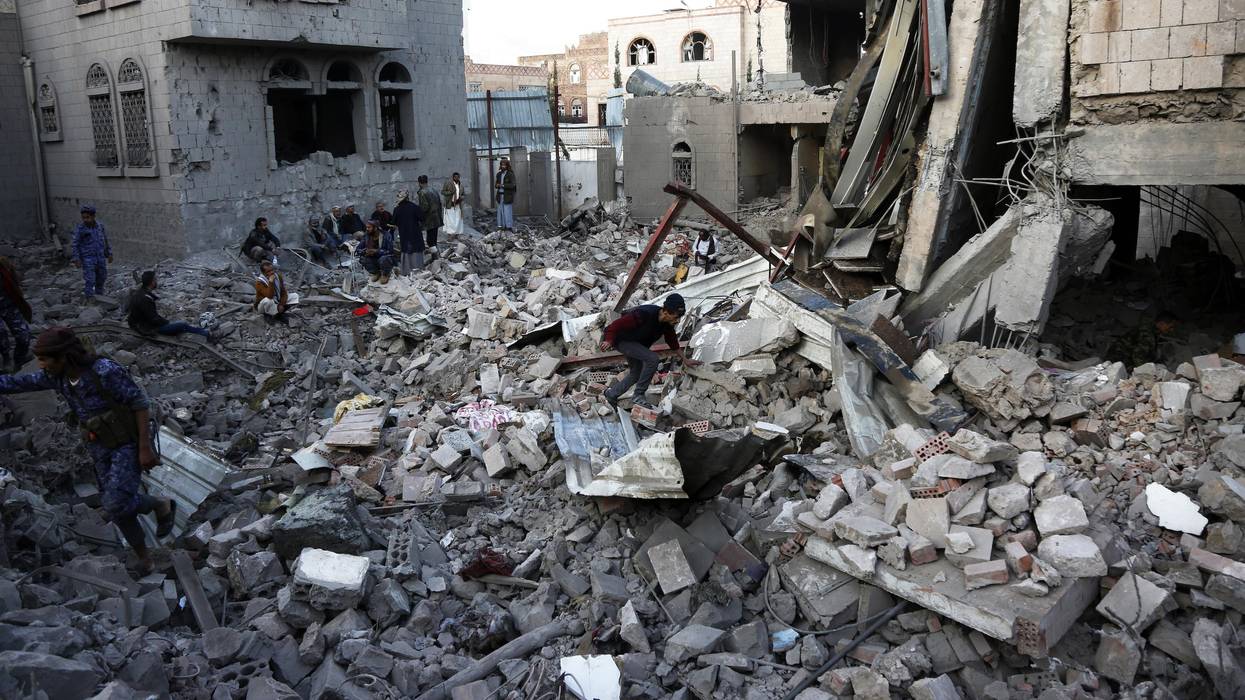
A series of Saudi-led airstrikes were blamed Friday for killing scores of people in Yemen as civilians, including children, continue to suffer deadly consequences of the U.S.-backed conflict that has lasted for years.
"It seems to have been a horrific act of violence."
Overnight bombings included one that targeted a prison holding mostly migrants in the northern city of Sa'ada, an area described as being under the control of Houthi forces.
"It is impossible to know how many people have been killed. It seems to have been a horrific act of violence," said Ahmed Mahat, MSF's (Doctors Without Borders) head of mission in Yemen.
A hospital in the city "has received 138 wounded and 70 dead" and is "so overwhelmed that they can't take any more patients," MSF said.
Strikes also hit further south in the port city of Hodeida. According to Agence France-Presse: "Video footage showed bodies in the rubble and dazed survivors after an air attack from the Saudi Arabia-led pro-government coalition took out a telecommunications hub. Yemen suffered a nationwide internet blackout, a web monitor said."
The humanitarian group Save the Children said that at least three children, as well as more than 60 adults, were reported killed by the series of strikes, though the number of confirmed casualties would likely rise.
The children killed as a result of the Hodeidah strike had been playing on a nearby football field, the group said.
"Children are bearing the brunt of this crisis," said Gillian Moyes, the group's country director in Yemen.
"The human toll that we witness in Yemen is unacceptable."
"They are being killed and maimed, watching as their schools and hospitals are being destroyed, and denied access to basic lifesaving services," she said. "They are asking us: Does it matter if I die?"
"The initial casualties report from Sa'ada is horrifying," Moyes added. "Migrants seeking better lives for themselves and their families, Yemeni civilians injured by the dozens, is a picture we never hoped to wake up to in Yemen."
In the U.S., the Biden administration--like previous administrations--has faced calls to stop supplying Saudi Arabia with weapons and other support being used to wage the bombing campaign on Yemen that's estimated to have killed over 300,000 Yemenis since 2015 and unleashed what the United Nations called the world's worst humanitarian crisis.
In The New Republic earlier this month, the Quincy Institute's Trita Parsi and Annelle Sheline wrote:
Despite Biden's promise to end the war in Yemen and his pledge to make the Saudis "pay the price, and make them in fact the pariah that they are," he has fallen back into America's hegemonic role in the Middle East: taking sides, making America a party to conflicts, and selling more weapons--U.S. interest, peace, stability, and human rights be damned.
Responding to news of the overnight airstrikes, journalist Spencer Ackerman tweeted: "America is complicit in this, as it has been complicit in every Saudi or UAE airstrike of this horrific war that Biden and his senior officials once promised to end. I hope they see these children when they sleep at night."
The International Committee of the Red Cross sounded alarm about the recent intensification of violence in Yemen.
"It is essential that we protect the lives of people in armed conflict. The human toll that we witness in Yemen is unacceptable," Fabrizio Carboni, ICRC's regional director for the Near and Middle East, said in a statement Thursday.
"Civilians living in densely populated areas have been exposed to increased attacks," he continued, "causing death and injury and deepening the psychological trauma among the affected communities after seven years of war."
The deadly strikes came after a Tuesday statement from the United Nations High Commissioner for Human Rights also expessing concern about the uptick in violence in Yemen.
"In recent days," said spokesperson Ravina Shamdasani, "there have been dozens of airstrikes and artillery strikes launched by the parties with seemingly little regard for civilians."
"The fighting has damaged civilian objects and critical infrastructure, including telecommunication towers and water reservoirs, as well as hospitals in Sana'a and Taizz. With frontlines shifting rapidly over large areas, civilians are also exposed to the constant threat of landmines," she said.
"As has been shown time and time again," added Shamdasani, "there is no military solution to the conflict in Yemen."
Doctors Without Borders said Thursday that a hospital it supported in the Syrian city of Aleppo was bombed, destroying the key pediatric facility and killing at least 14 people.
The medical humanitarian aid group, also known by its French acronym, MSF, said in a statement that two doctors were among the casualties, including one of the last pediatricians in Aleppo, and that other medical structures in the city had also been attacked this week.
Witnesses said the Al Quds hospital was hit by a missile from a fighter jet Wednesday, according to CNN.
"MSF categorically condemns this outrageous targeting of yet another medical facility in Syria," said Muskilda Zancada, MSF head of mission for Syria. "This devastating attack has destroyed a vital hospital in Aleppo and the main referral center for pediatric care in the area. Where is the outrage among those with the power and obligation to stop this carnage?"
MSF, along with the International Committee of the Red Cross (ICRC), which also supported the Al Quds hospital, took to Twitter to express outrage over what appeared to be a deliberate targeting of the life-saving facility.
"The recent attack on the ICRC-supported Quds hospital is unacceptable and sadly this is not the first time the lifesaving medical services have been hit," said Marianne Gasser, head of the ICRC mission in Syria, in a press statement. "We urge all the parties to spare the civilians. Don't attack hospitals, don't use weapons that cause widespread damage. Otherwise, Aleppo will be pushed further to the brink of humanitarian disaster."
The organizations didn't lay blame on any particular party, the Guardian notes, "but the Syrian and Russian air forces have carried out almost all the aerial strikes on the opposition-controlled east of the city."
Speaking at a press conference Wednesday, UN special envoy for Syria Staffan de Mistura described the "worrisome deterioration of the cessation of hostilities" as the country's five-year civil war continues and referenced the Aleppo hospital strike. He added, "In the last 48 hours, we have had an average of one Syrian killed every 25 minutes. One Syrian wounded every 13 minutes."
He said that for those inside of Syria, "The perception is that [the cessation of hostilities] could collapse at any time," adding that Russia and the U.S. are key, as they were in February, to make the truce "urgently revitalized."
Physicians for Human Rights (PHR) similarly described the nearly two-month truce as having "nearly disintegrated" while peace talks in Geneva have stalled. As Reuters explains,
The Geneva talks aim to end a war that has killed more than 250,000 people, created the world's worst refugee crisis, allowed for the rise of Islamic State and drawn in regional and major powers but the negotiations have all but failed and a truce to allow them to take place has collapsed."
"If Syria's leaders and the international community cannot reach a peace accord, there's no doubt attacks on health care will continue, and the consequences will be deadly for everyday Syrians. How many more doctors and patients have to die before the international community musters the will to end this bloodshed?" asked PHR Syria researcher Elise Baker.
And there's been no sign of an end to bloodshed over the past few days as fighting has intensified, with fresh airstrikes Thursday on the city killing dozens. According to reporting by the Associated Press, "About 200 civilians have been killed in the past week, nearly half of them around Aleppo."
"With the civilian death toll rising and hundreds of thousands of people fleeing the country, key powers need to be focused on protecting civilians in all parts of Syria," said Nadim Houry, Human Rights Watch's deputy Middle East director. "There are decisive measures that key powers, particularly those on the Security Council, can take to deter abusive parties and improve protection for civilians," he said.
Meanwhile, military officials told NBC News that the U.S. would release on Friday a redacted version of its investigation into U.S. airstrikes on MSF's trauma hospital in Kunduz, Afghanistan, that killed at least 30 people.
A human rights watchdog said Wednesday it has fresh evidence the Saudi-led coalition used U.S. cluster bombs, resulting in the deaths of dozens of civilians in Yemen.
Human Rights Watch said it identified United States-made ground-launched M26 cluster munition rockets that were likely used in seven attacks in the country's northwestern Hajja governorate between late April and mid-July. The group said it visited four of the seven sites and also spoke with witnesses of the attacks who said that three children were among the 13 civilians killed in the attacks. The group viewed photographic evidence of unexploded munition remnants at the other sites, it said.
HRW adds in a media statement: "Several of the attacks took place in or near areas with concentrations of civilians, indicating that the rocket attacks themselves may have been unlawfully indiscriminate in violation of the laws of war."
"The loss of civilian life in Hajja shows why most countries have committed never to use cluster munitions," said Ole Solvang, senior emergencies researcher with HRW. "These weapons not only kill or injure people at the time of the attack, but the unexploded submunitions go on killing long afterward."
Neither the U.S., Saudi Arabia, or Yemen have joined the Convention on Cluster Munitions, which bans their use.
HRW has previously warned that the coalition has used cluster munitions, and an anonymous Pentagon official told U.S. News this month that "the U.S. is aware that Saudi Arabia has used cluster munitions in Yemen."
Inter Press Service reported last week:
The United States is providing a thinly-veiled cover virtually legitimizing the use of cluster bombs - banned by an international convention - by Saudi Arabia and its allies in their heavy fighting against Houthi rebels in Yemen.
Asked if cluster bombs are legitimate weapons of war, "if used appropriately", U.S. State Department spokesman John Kirby told reporters: "If used appropriately, there are end-use regulations regarding the use of them. But yes, when used appropriately and according (to) those end-use rules, it's permissible."
Over 4,000 people have been killed in the conflict in Yemen since March. Though international aid groups continue to warn of the dire humanitarian situation gripping the impoverished country, it remains a largely ignored crisis.
Peter Maurer, President of the International Committee of the Red Cross, said this month, "The humanitarian situation is nothing short of catastrophic. Every family in Yemen has been affected by this conflict. The people are facing immense hardship. And it is getting worse by the day.
"The world needs to wake up to what is going on," said Maurer.
See more on HRW's new findings in the group's video below:
Haitian journalists grilled an American Red Cross official Wednesday about the group's Haiti program, but the official declined to provide any new details of how it spent nearly $500 million donated after the 2010 earthquake.
The Red Cross called a press conference, held at the Le Plaza Hotel in downtown Port-Au-Prince, in response to ProPublica and NPR's story published last week revealing a string of Red Cross failures in Haiti.
The American Red Cross official at the press conference was repeatedly interrupted by Haitian reporters frustrated that he would not give specifics on its spending:
The official, Walker Dauphin, criticized our story for making "misleading allegations" and said that "in total, more than a hundred projects were implemented."
But Haiti's most prominent newspaper, Le Nouvelliste, wrote that Dauphin was merely "retracing the broad strokes of the interventions and expenses ... while avoiding going into detail." The paper ran the story on its front page under the headline, "When the Red Cross drowns the fish," a reference to sidestepping a touchy subject.
Jean-Max Bellerive, who was prime minister of Haiti when the earthquake hit, also publicly criticized the American Red Cross, telling Le Nouvelliste that the Haitian government must "take legal actions to demand accountability."
In the United States, Rep. Rick Nolan, D-Minn., has called for the House oversight committee to hold hearings on the Red Cross' Haiti program. The story has also prompted anger and calls for investigation in a number of states. Watch this video where an activist and Georgia state senator interrupt a Red Cross spokesman: "They do not deny anything that's been said and just direct you to some website," said Sen. Vincent Fort.
Red Cross spokeswoman Jana Sweeney said in a statement: "The Red Cross is happy to talk with any member of Congress who has questions about our relief work in Haiti, or elsewhere."