

SUBSCRIBE TO OUR FREE NEWSLETTER
Daily news & progressive opinion—funded by the people, not the corporations—delivered straight to your inbox.
5
#000000
#FFFFFF
To donate by check, phone, or other method, see our More Ways to Give page.
Daily news & progressive opinion—funded by the people, not the corporations—delivered straight to your inbox.
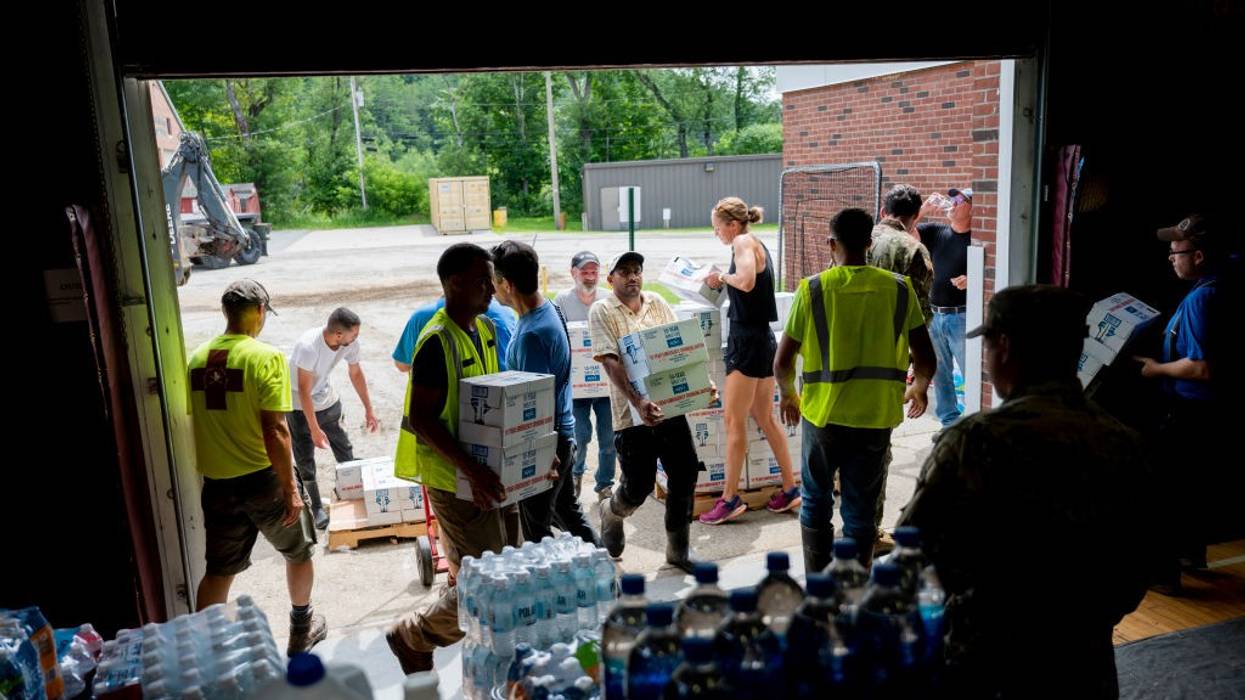
As global heating shrinks the size of the board on which we play the game of life, we’re going to need to return to the basic human experience of relying on the people around us.
I’ve given a lot of talks about climate change over the years—that’s part of what organizers do. And I can predict with great confidence the questions that people will raise their hands to ask. “Isn’t the real problem overpopulation?” (Not really; most population growth is coming in places that use incredibly small amounts of energy.) Or “what about nuclear?” (keep the plants we’ve got open if we safely can; new ones are incredibly slow and expensive to build, though someday a generation of yet newer ones could conceivably change that; in the meantime rely on the nuclear reactor hanging a safe 93 million miles up in the sky).
I can also predict the questions people will ask later, privately, as the crowd drifts out of the auditorium. One—“Is it OK for me to have a kid?”—is almost unbearably painful; no one should have to ask it. The other—“Where should I move?”—is a (little) less traumatizing. And I think it’s on a lot of minds, especially right now, as it becomes clear that many parts of our Earth won’t be habitable going forward. As I tried to explain in a recent book, global heating is systematically shrinking the size of the board on which humans can play the game of life.
On the one hand, the question implies a certain self-centered approach to the climate crisis—how do I avoid this huge communal disaster—as well as a certain quanta of privilege: Most people in this world, especially the ones who really need a new home, lack the resources or the legal ability to pick up and move. Still, we each get one life and we need to live it somewhere.
A recent study found that every time the temperature rises another tenth of a degree Celsius, another 140 million humans find themselves living outside what scientists call the “human climate niche,” the zone with temperatures where our species flourishes.
It’s easier, actually, to figure out where not to live. Phoenix may be the fastest-growing big city in the country, but anyone who moves there after this summer is not paying attention: 31 straight days over 110°F, and emergency rooms filled with people who burned themselves by… falling on the sidewalk. But it’s not just obvious places, like the middle of the desert. Last week, at 4,000 feet in the Andes, the temperature topped 95°F—in winter. (Weather historian Maximiliano Herrera described it as “one of the extreme events the world has ever seen.”) Or take Athens, one of those places we like to call a cradle of Western civilization, but two years ago the city’s “chief heat officer” was already warning it might be becoming uninhabitable; last month, during the longest heatwave in the city’s history, authorities closed the Acropolis to tourists in the afternoons.
Even in places used to dealing with extremes, life is getting harder; India’s monsoon, for instance, is ever more “violent and unpredictable.” In Himachal Pradesh, for instance, “the state has already received 1,200% more than its annual rainfall, according to data from the India Meteorological Department. Landslides and floods have claimed nearly 100 lives.”
I could muster these kinds of statistics for virtually any place you want to name: A recent study found that every time the temperature rises another tenth of a degree Celsius, another 140 million humans find themselves living outside what scientists call the “human climate niche,” the zone with temperatures where our species flourishes.
But as this summer—with the increase in global temperature at least temporarily topping the 1.5°C that the world swore to avoid in Paris—demonstrates, no place is really safe, even within those supposedly habitable zones. I live in Vermont, in the mountains of the American northeast, which has sometimes been seen as a “climate haven” because it’s at a high enough latitude to avoid the worst heatwaves, isolated from a stormy ocean coast, and historically wet. But this summer we’ve had too much water: some of the worst flooding in the country. We’re not that far from the overheated north Atlantic, and so wave after wave of unrelenting rain has descended on the state, drowning, among other things, the main street of our capital city (previously best known for being the only state capital without a McDonald’s). Another round of thunderstorms struck over the weekend; my county got six inches of rain, triggering landslides and closing the roads in and out of town. It turns out that steep mountain slopes and narrow mountain valleys combine with an overheated atmosphere (remember the 21st century’s most important physical fact: Warm air holds more water vapor; July set a new record for U.S. thunderstorms) to produce crazy flooding. I was away during this round of meteorological depravity, and it was hard to be seeing pictures of roads I travel every day wiped out.
There is no safe place.
And yet I remain glad I live where I do, not because it’s protected from climate change, but because it’s at least a little bit more equipped to deal with it. And that, in turn, is because it has high levels of social trust. Only 38% of Americans say they mostly or completely trust their neighbors, but a 2018 Vermont survey found that 78% of residents think that “people in my neighborhood trust each other to be good neighbors”; 69% of Vermonters said that they knew most of their neighbors, compared with 26% of Americans in general. Those levels of social trust help explain, I think, why the state had the lowest level of fatalities from Covid-19, much lower than its neighboring states and much lower than other small rural states with similarly homogeneous populations. Everyone wore masks, everyone got vaccinated. In the same way, when this summer’s floods hit, people came together, reenacting the surge of mutual aid that came after Hurricane Irene similarly drenched the state in 2011.
This is not an argument to move to Vermont. Among other things, the state had the lowest housing vacancy rate in the country before this summer’s flooding wiped out more of the state’s affordable housing stock. And Vermont has its share of problems, some of them rooted in an aging population resistant to progress of any kind—there are times when I think its de facto motto is “Change Anything You Want Once I’m Dead,” which explains among other things the de facto moratorium on building the wind turbines that could help provide us cleaner power.
We’ve come through 75 years where having neighbors was essentially optional: If you had a credit card, you could get everything you needed to survive dropped off at your front door. But the next 75 years aren’t going to be like that.
Instead it is an argument to get to work building that kind of social trust in as many places as possible, because we’re going to need it. We’ve come through 75 years where having neighbors was essentially optional: If you had a credit card, you could get everything you needed to survive dropped off at your front door. But the next 75 years aren’t going to be like that; we’re going to need to return to the basic human experience of relying on the people around you. We’re going to need to rediscover that we’re a social species, which for Americans will be hard—at least since Reagan we’ve been told to think of ourselves first and foremost (it was his pal Margaret Thatcher who insisted “there is no such thing as society, only individual men and women.”) And in the Musk/Trump age we’re constantly instructed to distrust everyone and everything, a corrosion that erodes the social fabric as surely as a rampaging river erodes a highway.
But it’s not impossible to change that. President Joe Biden has been frustratingly dunderheaded about approving new pipelines and oil wells, and hydrocarbon production has been soaring on his watch. He has been much better about trying to restore some sense of national unity—he has been trying to scale down national division by rebuilding left-behind economies, and also by appealing to our better angels. And those angels exist: The most hopeful book for our time remains Rebecca Solnit’s Paradise Built in Hell, which recounts how communities, whenever natural disaster strikes, pull together, just like Vermont this summer. It happens in cities as easily as in rural areas—maybe more easily, since cities are places where the gregarious gather.
An appeal to social trust is not an appeal to some airy idea of universal brotherhood. Vermont Digger, our local news service, had a reporter in a neighboring town yesterday, as it began to dig its way out of the flood. At a washed-out road crossing he encountered a pair of what I think you could only call hippies, trying to join a “Rainbow Family gathering” at a national forest campground nearby.
The two people—who went by the names Scooby Doo and Sparrow—said they had caught the first half of Dead & Company’s final tour before Sparrow’s school bus broke down in Alabama. This week they had traveled from Maine and spent the prior night camping elsewhere.
The duo had heard from two friends on Thursday night who were waiting for them at Texas Falls, estimating that dozens of people were there.
They were looking for dog food for their dog, Bhala, and thought they might have to try Killington or Middlebury.
No offense to Scooby, Sparrow, or certainly Bhala, but I’d rather have as a neighbor the next person the reporter encountered at the washed-out intersection..
Charlie Smith, an excavator, trucked loads of material to the washout in an effort to make the road passable.
“I’m trying to make it so people can get home, get groceries, go back to work,” he said. “It feels good to help people. That’s what we do.”
For Smith, the latest storm began with news that flood water had surrounded some of his equipment. He salvaged the gear Thursday night with minimal damage.
“This morning my dad called me at 5:30 and said ‘let’s get going,’” Smith recalled. He expected to go road by road throughout the day.
Neighborliness accompanied by skill in backhoe operation seems like a good combination for our moment in history. And I was even more reassured to get a mass email from the town clerk of my small burg. It outlined which roads were still closed but also reminded people that the evening’s nature talk was still on at the local school.
Please come join us for an evening of bugs after the sun goes down and stay as long as you’d like! We’ll attract the night-active insects to a white sheet in the woods, and you can learn about some of our local insects from Middlebury College Entomologist Greg Pask. Feel free to bring a flashlight or headlamp, and no bug spray please (we’re trying to attract the bugs!)
So make that neighborliness, backhoes, and a devotion to the world around us, which remains beautiful even this savage summer. We’re in a mess, but together we have some chance of working our way out of it.
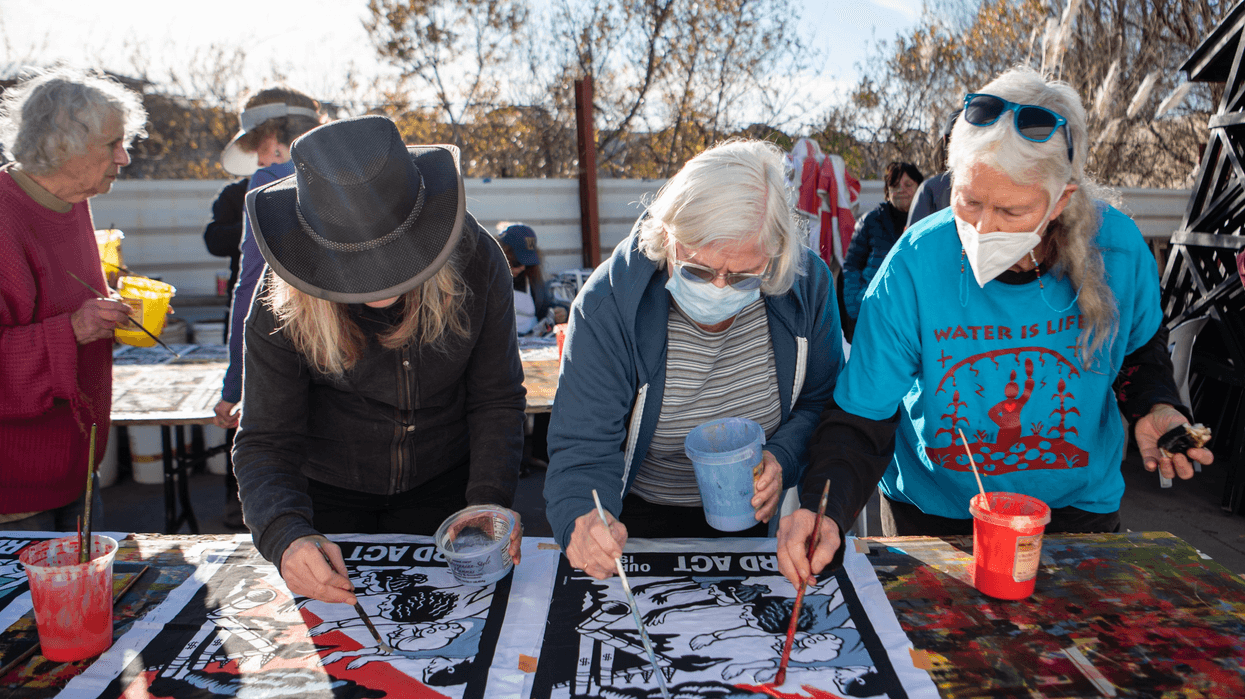
"We have to show young people we have their back," said veteran climate advocate Bill McKibben.
Determined not to leave all the responsibility for climate action with young campaigners like Greta Thunberg and the Sunrise Movement, older Americans are organizing a nationwide Day of Action planned for Tuesday, with the aim of wielding the relative political and economic power of people aged 60 and up to pressure big banks to stop funding fossil fuel projects.
Following actor and activist Jane Fonda's "Fire Drill Friday" protests that began in Washington, D.C. in 2019, longtime climate advocate Bill McKibben founded Third Act last year to mobilize older Americans who wanted to show solidarity with the Generation Z activists leading worldwide climate protests in recent years.
The grassroots effort quickly attracted 50,000 members, many of whom are taking part in the organization's Stop Dirty Banks action on Tuesday—a nationwide blockade of the branches of banks like Wells Fargo, Chase, Citibank, and Bank of America, which have collectively poured $1.1 trillion into fossil fuel projects since the 2015 Paris climate agreement was forged.
Nearly 100 public actions on Tuesday will include a literal "Rocking Chair Rebellion," as McKibben has called the movement, with advocates placing painted rocking chairs at the entrances of bank branches, slicing credit cards with giant pairs of scissors, and displaying papier mache orcas that will eat credit cards to demonstrate that older Americans will no longer support companies that back plant-heating oil and gas projects.
"We have everything we need to turn toward clean energy," said Akaya Windwood, a longtime social justice leader who leads Third Act's advisory council, in a video posted to social media ahead of the protest. "All we're lacking is the political and economic will, so we're calling out the big banks to disinvest in fossil fuels and invest in air that all of us can breathe."
Windwood filmed herself cutting up her credit card ahead of the Day of Action, as did writer Rebecca Solnit, mountain climber Kitty Calhoun, and ocean conservationist Wendy Benchley.
In an op-ed for Common Dreams last week, McKibben, who is 62, noted that his generation on the whole has amassed more "structural power" than the young people who have worked to pressure lawmakers to support the Green New Deal and organized school walkouts as part of the Fridays for Future movement.
"We all vote, so the political impact of the 70 million Americans over 60 is much magnified," wrote McKibben. "And we ended up—fairly or not—with something like 70% of the country's financial assets, so we can put some pressure on banks."
McKibben added that it is "ignoble and impractical" to leave climate action up to younger people.
"So far the kids have had to do all of the work and they've done an amazing job but it's not fair to ask 18-year-olds to solve this problem," the author and 350.org cofounder told The Guardian. "We have to show young people we have their back. I'm going to be dead before the climate crisis is at its absolute worst, but being nearer the exit than the entrance concentrates one's mind to notions of legacy and we are the first generation to leave the world in a worse place than we found it."
McKibben will join rally-goers on Tuesday in Washington, D.C., where activists will stage a "rocking chair rebellion" in an intersection outside two of the "big four" banks.
The nationwide Day of Action is being held a day after the Intergovernmental Panel on Climate Change (IPCC) issued its latest report on the climate crisis, showing, as United Nations Secretary-General António Guterres said, that all licensing and funding of new oil and gas extraction must be ceased and all public and private funding of coal must come to an end.
From California to New York, McKibben said Monday on social media, advocates have been alerting bank branches about the coming public actions—displaying all-night projections at Wells Fargo and Chase locations that warn, "Banks: Cut it out or we'll cut it up."
"Banks have particular reason to listen to older people, because so much of the money in the vault belongs to them," wrote McKibben last week. "And because we're hard to outwait. Youth climate organizers have only a decade or so before they're on to the next stage of their lives. Sixty year-old climate activists are likely to have twice that long or more—and we've often got lots of free time."
"Chase and Citi and Wells Fargo and Bank of America should be worried: we're not going anywhere any time soon," he added. "We'll just keep rocking on."
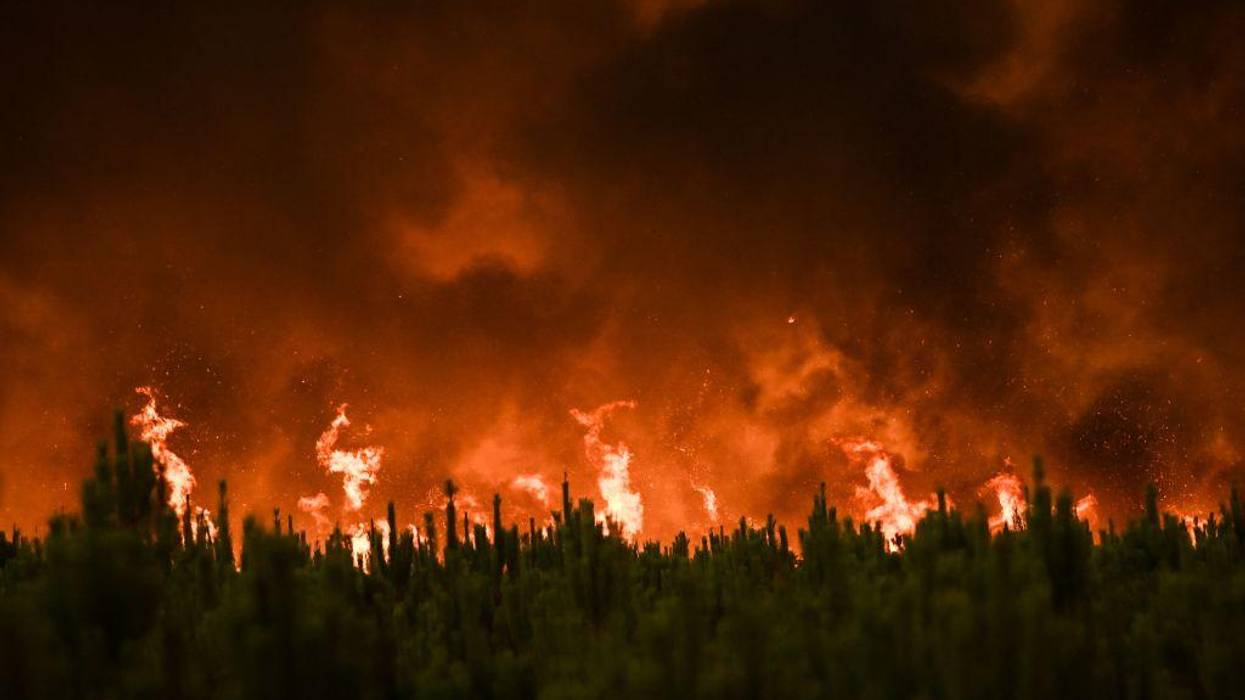
There is no longer time for thinking small. The only option is thinking big.
During the period from Christmas Eve to New Year's Eve, Wisconsinites saw powerful evidence of the instability of our devolving climate. A pre-Christmas snowstorm, fierce winds, record cold, temperatures in the 50s, rain, and melted-away snow—it was a cacophony that could only be attributed to climate change.
And, in many ways, Wisconsin's experience was better than that of other parts of the country, which in 2022 saw devastating hurricanes, fires, record heat, and a closing wave of apocalyptic snowstorms that left dozens dead.
The greatest danger to the planet is the surrender of hope, the loss of faith in the prospect that this Earth we call home can be saved from devastation.
The time to take climate change seriously arrived decades ago. Unfortunately, politicians in both parties were neglectful. Republicans chose to deny the crisis. Democrats chose to imagine that it could be met with half-steps.
Now reality is catching up with us, and there is so much bad news that it's easy to be overwhelmed. There is no longer time for thinking small. The only option is thinking big. Former Vice President Al Gore is not alone in suggesting, "We are running out of time, and we must have a planetary solution to a planetary crisis."
Unfortunately, world leaders missed several more deadlines to address the crisis last year. Frustrating negotiations associated with the United Nations Conference of the Parties of the UNFCCC (COP27) provided a reminder that the task at hand is an ever more challenging one.
Domestically, the new Republican-controlled U.S. House is going to do everything in its power to undermine the minimal progress that has been made since Joe Biden and the Democrats took charge in 2021. As Robinson Meyer of The Atlantic warns: "If history is any indication, a Republican Congress could spell doom for climate policy. Since the early 1990s, when the GOP took a turn toward climate-change denialism, the party has been one of the world's top enemies of climate policy."
So should we just give up? Not at all.
In fact, the greatest danger to the planet is the surrender of hope, the loss of faith in the prospect that this Earth we call home can be saved from devastation.
That's the message that Rebecca Solnit—the brilliant activist author of books such as Hope in the Dark and Men Explain Things to Me—has been preaching over the past several years.
"The world as we knew it is coming to an end, and it's up to us how it ends and what comes after," Solnit explains. "It's the end of the age of fossil fuel, but if the fossil fuel corporations have their way the ending will be delayed as long as possible, with as much carbon burned as possible. If the rest of us prevail, we will radically reduce our use of those fuels by 2030, and almost entirely by 2050. We will meet climate change with real change, and defeat the fossil fuel industry in the next nine years."
That's a daunting goal. But not an impossible one, argues Solnit.
As a co-founder of the Not Too Late project, Solnit is working with climate activist Thelma Young Lutunatabua and others to reject "sorrow and despair" and "invite newcomers to the climate movement, as well as provide climate facts and encouragement for people who are already engaged but weary."
There is nothing naïve about this project, which you can learn more about at nottoolateclimate.com. Solnit's not peddling optimism for the sake of optimism. Rather, she and her comrades rely on science to argue that there is still time to build a movement that is strong enough to force reluctant politicians to act on an agenda that breaks the grip of the fossil fuel giants.
Defeatism is a luxury we cannot afford. Instead of defeatism, Solnit says, "We must remake the world, and we can remake it better."
There have undoubtedly been stable periods in human history, but you and your parents, grandparents, and great-grandparents never lived through one, and neither will any children or grandchildren you may have or come to have. Everything has been changing continuously, profoundly -- from the role of women to the nature of agriculture. For the past couple of hundred years, change has been accelerating in both magnificent and nightmarish ways.
Yet when we argue for change, notably changing our ways in response to climate change, we're arguing against people who claim we're disrupting a stable system. They insist that we're rocking the boat unnecessarily.
I say: rock that boat. It's a lifeboat; maybe the people in it will wake up and start rowing. Those who think they're hanging onto a stable order are actually clinging to the wreckage of the old order, a ship already sinking, that we need to leave behind.
"If you want to know how potentially powerful you are, ask your enemies."
As you probably know, the actual oceans are rising -- almost eight inches since 1880, and that's only going to accelerate. They're also acidifying, because they're absorbing significant amounts of the carbon we continue to pump into the atmosphere at record levels. The ice that covers the polar seas is shrinking, while the ice shields that cover Antarctica and Greenland are melting. The water locked up in all the polar ice, as it's unlocked by heat, is going to raise sea levels staggeringly, possibly by as much as 200 feet at some point in the future, how distant we do not know. In the temperate latitudes, warming seas breed fiercer hurricanes.
The oceans are changing fast, and for the worse. Fish stocks are dying off, as are shellfish. In many acidified oceanic regions, their shells are actually dissolving or failing to form, which is one of the scariest, most nightmarish things I've ever heard. So don't tell me that we're rocking a stable boat on calm seas. The glorious 10,000-year period of stable climate in which humanity flourished and then exploded to overrun the Earth and all its ecosystems is over.
But responding to these current cataclysmic changes means taking on people who believe, or at least assert, that those of us who want to react and act are gratuitously disrupting a stable system that's working fine. It isn't stable. It is working fine -- in the short term and the most limited sense -- for oil companies and the people who profit from them and for some of us in the particularly cushy parts of the world who haven't been impacted yet by weather events like, say, the recent torrential floods in Japan or southern Nevada and Arizona, or the monsoon versions of the same that have devastated parts of India and Pakistan, or the drought that has mummified my beloved California, or the wildfires of Australia.
The problem, of course, is that the people who most benefit from the current arrangements have effectively purchased a lot of politicians, and that a great many of the rest of them are either hopelessly dim or amazingly timid. Most of the Democrats recognize the reality of climate change but not the urgency of doing something about it. Many of the Republicans used to -- John McCain has done an amazing about-face from being a sane voice on climate to a shrill denier -- and they present a horrific obstacle to any international treaties.
Put it this way: in one country, one party holding 45 out of 100 seats in one legislative house, while serving a minority of the very rich, can basically block what quite a lot of the other seven billion people on Earth want and need, because a two-thirds majority in the Senate must consent to any international treaty the U.S. signs. Which is not to say much for the president, whose drill-baby-drill administration only looks good compared to the petroleum servants he faces, when he bothers to face them and isn't just one of them. History will despise them all and much of the world does now, but as my mother would have said, they know which side their bread is buttered on.
As it happens, the butter is melting and the bread is getting more expensive. Global grain production is already down several percent thanks to climate change, says a terrifying new United Nations report. Declining crops cause food shortages and rising food prices, creating hunger and even famine for the poorest on Earth, and also sometimes cause massive unrest. Rising bread prices were one factor that helped spark the Arab Spring in 2011. Anyone who argues that doing something about global warming will be too expensive is dodging just how expensive unmitigated climate change is already proving to be.
It's only a question of whether the very wealthy or the very poor will pay. Putting it that way, however, devalues all the nonmonetary things at stake, from the survival of myriad species to our confidence in the future. And yeah, climate change is here, now. We've already lost a lot and we're going to lose more, but there's a difference between terrible and apocalyptic. We still have some control over how extreme it gets. That's not a great choice, but it's the choice we have. There's still a window open for action, but it's closing. As the Secretary-General of the World Meteorological Society, Michel Jarraud, bluntly put it recently, "We are running out of time."
New and Renewable Energies
The future is not yet written. Look at the world we're in at this very moment. The Keystone XL tar sands pipeline was supposed to be built years ago, but activists catalyzed by the rural and indigenous communities across whose land it would go have stopped it so far, and made what was supposed to be a done deal a contentious issue. Activists changed the outcome.
Fracking has been challenged on the state level, and banned in townships and counties from upstate New York to central California. (It has also been banned in two Canadian provinces, France, and Bulgaria.) The fossil-fuel divestment movement has achieved a number of remarkable victories in its few bare years of existence and more are on the way. The actual divestments and commitments to divest fossil fuel stocks by various institutions ranging from the city of Seattle to the British Medical Association are striking. But the real power of the movement lies in the way it has called into question the wisdom of investing in fossil fuel corporations. Even mainstream voices like the British Parliament's Environmental Audit Committee and publications like Forbes are now beginning to question whether they are safe places to put money. That's a sea change.
Renewable energy has become more efficient, technologically sophisticated, and cheaper -- the price of solar power in relation to the energy it generates has plummeted astonishingly over the past three decades and wind technology keeps getting better. While Americans overall are not yet curtailing their fossil-fuel habits, many individuals and communities are choosing other options, and those options are becoming increasingly viable. A Stanford University scientist has proposed a plan to allow each of the 50 states to run on 100% renewable energy by 2050.
Since, according to the latest report of the U.N.'s Intergovernmental Panel on Climate Change, fossil fuel reserves still in the ground are "at least four times larger than could safely be burned if global warming is to be kept to a tolerable level," it couldn't be more important to reach global agreements to do things differently on a planetary scale. Notably, most of those carbon reserves must be left untapped and the modest steps already taken locally and ad hoc show that such changes are indeed possible and that an encouraging number of us want to pursue them.
We can do it. And we is the key word here. The world is not going to be saved by individual acts of virtue; it's going to be saved, if it is to be saved, by collective acts of social and political change. That's why I'm marching this Sunday with tens or maybe hundreds of thousands of others in New York City -- to pressure the United Nations as it meets to address climate change. That's why people who care about the future state of our planet will also be marching and demonstrating in New Delhi, Rio de Janeiro, Paris, Berlin, Melbourne, Kathmandu, Dublin, Manila, Seoul, Mumbai, Istanbul, and so many smaller places.
Mass movements work. Unarmed citizens have changed the course of history countless times in the modern era. When we come together as civil society, we have the capacity to transform policies, change old ways of doing things, and sometimes even topple regimes. And it is about governments. Like it or not, the global treaties, compacts, and agreements we need can only be made by governments, and governments will make those agreements when the pressure to do so is greater than the pressure not to. We can and must be that pressure.
The Long View from One Window
I lived in the same apartment for 25 years, moving into a poor but thriving black community in 1981 and out of the far more affluent, paler, and less neighborly place it had become in 2006. A lot of people moved in and out in that period, many of them staying only a year or two. Those transients always seemed to believe that the neighborhood they were passing through was a stable one. You had to be slower than change and stick around to see it. I saw it and it helped me learn how to take a historical view of things.
It's crazy that anyone speaks as if our world is not undergoing rapid change, when the view from the window called history shows nothing but transformation, both incremental and dramatic. Exactly 25 years ago this month, Eastern Europe was astir. Remember that back then there was still a Soviet bloc, and a Soviet Union, and an Iron Curtain, and a Berlin Wall, and a Cold War. Most people thought those were permanent fixtures, but in the summer of 1989, Hungary decided to let East Germans (who were permitted to travel freely to that communist country) stream over to the West.
Thousands of people, tired of life in the totalitarian east, fled. Poland, Czechoslovakia, and Hungary, as well as East Germany, were already electrified by a resurgent civil society and activist communities that had dared to organize in the face of repression. At the time, politicians and pundits in the West were making careers out of explaining, among so many other things, why German reunification wasn't going to happen in anyone's lifetime. And they probably would have been proven right if people had stayed home and done nothing, if they hadn't begun to hope and acted on that hope.
The bureaucrats on both sides of the Berlin Wall were still talking about the possibility of demilitarizing it when citizens showed up en masse and the guards began abandoning their posts. On that epochal night of November 9, 1989, the people made whole what had been broken. The lesson: showing up is half the battle.
British Prime Minister Margaret Thatcher had been so unnerved by developments in the Soviet Union's Eastern European holdings that she went to Moscow, two months before the fall of the wall, to implore Soviet leader Mikhail Gorbachev to prevent any such thing. That was early September 1989. "No dramatic change in the situation in Czechoslovakia can be expected," predicted a Czech official two months before a glorious popular uprising, remembered as the Velvet Revolution, erupted and abolished the government in which he was an official.
There are three things to note about those changes in 1989. First, most people in power dismissed the possibility that such extraordinary change could happen or deplored what it might bring. They were comfortable enough with things as they were, even though the status quo was several kinds of scary and awful. In other words, the status quo likes the status quo and dislikes change. Second, everything changed despite them, thanks to grassroots organizing and civil society, forces that -- we are now regularly assured -- are pointless and irrelevant. Third, the world that existed then has been largely swept away: the Soviet Union, the global alignments of that time, the idea of a binary world of communism and capitalism, and the policies that had kept us on the brink of nuclear annihilation for decades. We live in a very different world now (though nuclear weapons are still a terrible problem). Things do change.
Maybe, in fact, there's a fourth point to note as well. That, important as they were, the front-page stories about the liberation of Eastern Europe weren't what mattered most all those years ago. After all, hidden away deep inside the New York Times that autumn, you can find a dozen or so articles about global warming, as the newly recognized phenomenon was then called. And small as they were, anyone reading them now can see that so long ago the essential problem and peril to our world was already clear.
The thought of what might have been accomplished, had a people's movement arisen then to face global warming, could break your heart. That, after all, was still a time when the Earth's atmosphere held just above 350 parts per million of carbon dioxide, the maximum safe level for a sustainable survivable planet, not the 400 parts per million of the present moment ("142% of the pre-industrial era" level of carbon, the World Meteorological Organization notes). In other words, we've been steadily filling the atmosphere with greenhouse gases and so imperiling the planet and humanity sincewe knew what we were doing.
The Great Smog and the Big Wind
In that fall a quarter of a century ago, the world changed profoundly right before our eyes. Then we settled back into the short-term, ahistorical view that things are really pretty stable, that ordinary people have no power, and that the world can't be changed. With that in mind, it's worth looking at Germany today. Maybe because Germans know better than us that things can change for the worse or the better fast, that the world is not a stable and settled place, and that we do shape it, they have been willing to change.
At one point last spring, cold, cloudy Germany managed to get almost 75% of its electricity from renewable sources. Scotland -- cold, gray, oil-rich Scotland! -- is on track to achieve 100% renewable electrical generation by 2020 and has already hit the 40% mark. Spain now generates about half its electricity through clean and renewable sources. Other European countries have similar accomplishments. In fact, many of the changes that we in the United States will be marching for this Sunday have already begun happening, sometimes on a significant scale, elsewhere.
To remember how radical this new Europe is, recall that most of these places were burning coal not just in power plants or factories but in homes, too, not so many decades ago. Everyone deplores the horrific air of Beijing and other Chinese cities now, but few remember that many European cities were similarly foul with smoke and smog from the industrial revolution into the postwar era. In December 1952, for instance, the "Great Smog" of London reduced daytime visibility to a few yards and killed about 4,000 people in three days.
A decade before that, in response to the war Germany started, North Americans radically reduced their use of private vehicles and gasoline and planted more than 20 million victory gardens, producing vast quantities of food by non-industrial means. We have done that; we could (and must) do it again.
At least, we don't burn coal in our homes any more, and in the U.S. we've retired 178 coal-fired power plants, phasing out many more, and prevented many new ones from being built. The renewable energy sources that were, people insisted, too minor or unreliable or expensive or new are now beginning to work well, and the price to produce energy in such a fashion is dropping rapidly. UBS, the European investment giant, recently counseled that power plants and centralized power generation are no longer good investments, since decentralized renewables are likely to replace them.
Of course, Germany and Britain are still burning coal, and Poland remains a giant coal mine. Europe is not a perfect renewable energy paradise, just a part of the world that demonstrates the viability of changing how we produce and consume energy. We are already changing, even if not fast enough, not by a long shot, at least not yet. The same goes for divesting from fossil-fuel investments, even though dozens of universities, cities, religious institutions, and foundations have already committed to doing so, and some have by now actually purged their portfolios. The excuse that change is impossible is no longer available, because many places and entities have already changed.
Last Glimmers
If you want to know how potentially powerful you are, ask your enemies. The misogynists who attack feminism and try to intimidate feminists into silence only demonstrate in a roundabout way that feminism really is changing the world; they are the furious backlash and so the proof that something meaningful is at stake. The climate movement is similarly upsetting a lot of powerful people and institutions; to grasp that, you just have to look at the tsunamis of money spent opposing specific measures and misinforming the public. The carbon barons are demonstrating that we could change the world and that they don't want us to.
We are powerful and need to become more so in the next year as a major conference in Paris approaches in December 2015 where the climate agreements we need could be hammered out. Or not. This is, after all, a sequel to the Copenhagen conference of 2009, where representatives of many smaller and more vulnerable nations, as well as citizens' groups, were eager for a treaty that took on climate change in significant ways, only to have their hopes crushed by the recalcitrant governments of the United States and China.
Right now, we are in a churning sea of change, of climate change, of subtle changes in everyday life, of powerful efforts by elites to serve themselves and damn the rest of us, and of increasingly powerful activist and social-movement campaigns to make a world that benefits more beings, human and otherwise, in the longer term. Every choice you make aligns you with one set of these forces or another. That includes doing nothing, which means aligning yourself with the worst of the status quo dragging us down in that ocean of carbon and consumption.
To make personal changes is to do too little. Only great movements, only collective action can save us now. Only is a scary word, but when the ship is sinking, it can be an encouraging one as well. It can hold out hope. The world has changed again and again in ways that, until they happened, would have been considered improbable by just about everyone on the planet. It is changing now and the direction is up to us.
There will be another story to be told about what we did a quarter century after civil society toppled the East Bloc regimes, what we did in the pivotal years of 2014 and 2015. All we know now is that it is not yet written, and that we who live at this very moment have the power to write it with our lives and acts.
It was a key match in the World Cup of Ideas. The teams vied furiously for the ball. The all-star feminist team tried repeatedly to kick it through the goalposts marked Widespread Social Problems, while the opposing team, staffed by the mainstream media and mainstream dudes, was intent on getting it into the usual net called Isolated Event. To keep the ball out of his net, the mainstream's goalie shouted "mental illness" again and again. That "ball," of course, was the meaning of the massacre of students in Isla Vista, California, by one of their peers.
All weekend the struggle to define his acts raged. Voices in the mainstream insisted he was mentally ill, as though that settled it, as though the world were divided into two countries called Sane and Crazy that share neither border crossings nor a culture. Mental illness is, however, more often a matter of degree, not kind, and a great many people who suffer it are gentle and compassionate. And by many measures, including injustice, insatiable greed, and ecological destruction, madness, like meanness, is central to our society, not simply at its edges.
In a fascinating op-ed piece last year, T.M. Luhrmann noted that when schizophrenics hear voices in India, they're more likely to be told to clean the house, while Americans are more likely to be told to become violent. Culture matters. Or as my friend, the criminal-defense investigator who knows insanity and violence intimately, put it, "When one begins to lose touch with reality, the ill brain latches obsessively and delusionally onto whatever it's immersed in -- the surrounding culture's illness."
The murderer at Isla Vista was also repeatedly called "aberrant," as if to emphasize that he was nothing like the rest of us. But other versions of such violence are all around us, most notably in the pandemic of hate toward and violence against women.
In the end, this struggle over the meaning of one man's killing spree may prove to be a watershed moment in the history of feminism, which always has been and still is in a struggle to name and define, to speak and be heard. "The battle of the story" the Center for Story-Based Strategy calls it, because you win or lose your struggle in large part through the language and narrative you use.
As media critic Jennifer Pozner put it in 2010 about another massacre by a woman-hating man,
"I am sick to death that I have to keep writing some version of this same article or blog post on loop. But I have to, because in all of these cases, gender-based violence lies at the heart of these crimes -- and leaving this motivating factor uninvestigated not only deprives the public of the full, accurate picture of the events at hand, but leaves us without the analysis and context needed to understand the violence, recognize warning signs, and take steps to prevent similar massacres in the future."
The Isla Vista murderer took out men as well as women, but blowing away members of a sorority seems to have been the goal of his rampage. He evidently interpreted his lack of sexual access to women as offensive behavior by women who, he imagined in a sad mix of entitlement and self-pity, owed him fulfillment.
#YesAllWomen
Richard Martinez, the father of one of the young victims, spoke powerfully on national TV about gun control and the spinelessness of the politicians who have caved to the gun lobby, as well as about the broader causes of such devastation. A public defender in Santa Barbara County, he has for decades dealt with violence against women, gun users, and mental illness, as does everyone in his field. He and Christopher Michaels-Martinez's mother, a deputy district attorney, knew the territory intimately before they lost their only child. The bloodbath was indeed about guns and toxic versions of masculinity and entitlement, and also about misery, cliche, and action-movie solutions to emotional problems. It was, above all, about the hatred of women.
\According to one account of the feminist conversation that followed, a young woman with the online name Kaye (who has since been harassed or intimidated into withdrawing from the public conversation) decided to start tweeting with the hashtag #YesAllWomen at some point that Saturday after the massacre. By Sunday night, half a million #yesallwomen tweets had appeared around the world, as though a dam had burst. And perhaps it had. The phrase described the hells and terrors women face and specifically critiqued a stock male response when women talked about their oppression: "Not all men."
It's the way some men say, "I'm not the problem" or that they shifted the conversation from actual corpses and victims as well as perpetrators to protecting the comfort level of bystander males. An exasperated woman remarked to me, "What do they want -- a cookie for not hitting, raping, or threatening women?" Women are afraid of being raped and murdered all the time and sometimes that's more important to talk about than protecting male comfort levels. Or as someone named Jenny Chiu tweeted, "Sure #NotAllMen are misogynists and rapists. That's not the point. The point is that #YesAllWomen live in fear of the ones that are."
Women -- and men (but mostly women) -- said scathing things brilliantly.
-- #YesAllWomen because I can't tweet about feminism without getting threats and perverted replies. Speaking out shouldn't scare me.
-- #YesAllWomen because I've seen more men angry at the hashtag rather than angry at the things happening to women.
-- #YesAllWomen because if you're too nice to them you're "leading them on" & if you're too rude you risk violence. Either way you're a bitch.
It was a shining media moment, a vast conversation across all media, including millions of participants on Facebook and Twitter -- which is significant since Twitter has been a favorite means of delivering rape and death threats to outspoken women. As Astra Taylor has pointed out in her new book, The People's Platform, the language of free speech is used to protect hate speech, itself an attempt to deprive others of their freedom of speech, to scare them into shutting up.
Laurie Penny, one of the important feminist voices of our times, wrote,
"When news of the murders broke, when the digital world began to absorb and discuss its meaning, I had been about to email my editor to request a few days off, because the impact of some particularly horrendous rape threats had left me shaken, and I needed time to collect my thoughts. Instead of taking that time, I am writing this blog, and I am doing so in rage and in grief -- not just for the victims of the Isla Vista massacre, but for what is being lost everywhere as the language and ideology of the new misogyny continues to be excused... I am sick of being told to empathize with the perpetrators of violence any time I try to talk about the victims and survivors."
Our Words Are Our Weapons
In 1963, Betty Friedan published a landmark book, The Feminine Mystique, in which she wrote, "The problem that has no name -- which is simply the fact that American women are kept from growing to their full human capacities -- is taking a far greater toll on the physical and mental health of our country than any known disease." In the years that followed, that problem gained several names: male chauvinism, then sexism, misogyny, inequality, and oppression. The cure was to be "women's liberation," or "women's lib," or "feminism." These words, which might seem worn out from use now, were fresh then.
Since Friedan's manifesto, feminism has proceeded in part by naming things. The term "sexual harassment," for example, was coined in the 1970s, first used in the legal system in the 1980s, given legal status by the Supreme Court in 1986, and given widespread coverage in the upheaval after Anita Hill's testimony against her former boss, Clarence Thomas, in the 1991 Senate hearings on his Supreme Court nomination. The all-male interrogation team patronized and bullied Hill, while many men in the Senate and elsewhere failed to grasp why it mattered if your boss said lecherous things and demanded sexual services. Or they just denied that such things happen.
Many women were outraged. It was, like the post-Isla Vista weekend, a watershed moment in which the conversation changed, in which those who got it pushed hard on those who didn't, opening some minds and updating some ideas. The bumper sticker "I Believe You Anita" was widespread for a while. Sexual harassment is now considerably less common in workplaces and schools, and its victims have far more recourse, thanks in part to Hill's brave testimony and the earthquake that followed.
So many of the words with which a woman's right to exist is adjudicated are of recent coinage: "domestic violence," for example, replaced "wife-beating" as the law began to take a (mild) interest in the subject. A woman is still beaten every nine seconds in this country, but thanks to the heroic feminist campaigns of the 1970s and 1980s, she now has access to legal remedies that occasionally work, occasionally protect her, and -- even more occasionally -- send her abuser to jail. In 1990, the Journal of the American Medical Association reported, "Studies of the Surgeon General's office reveal that domestic violence is the leading cause of injury to women between the ages of 15 and 44, more common than automobile accidents, muggings, and cancer deaths combined."
I go to check this fact and arrive at an Indiana Coalition Against Domestic Violence website that warns viewers their browsing history might be monitored at home and offers a domestic-violence hotline number. The site is informing women that their abusers may punish them for seeking information or naming their situation. It's like that out there.
One of the more shocking things I read recently was an essay in the Nation about the infamous slaying of Catherine "Kitty" Genovese in a neighborhood in Queens, New York, in 1964. The author, Peter Baker, reminds us that some of the neighbors who witnessed parts of her rape and murder from their windows likely mistook the savage assault by a stranger for a man exercising his rights over "his" woman. "Surely it matters that, at the time, violence inflicted by a man on his wife or romantic partner was widely considered a private affair. Surely it matters that, in the eyes of the law as it stood in 1964, it was impossible for a man to rape his wife."
Terms like acquaintance rape, date rape, and marital rape had yet to be invented.
Twenty-First Century Words
I apparently had something to do with the birth of the word "mansplaining," though I didn't coin it myself. My 2008 essay "Men Explain Things to Me" (now the title piece in my new book about gender and power) is often credited with inspiring the pseudonymous person who did coin it on a blog shortly thereafter. From there, it began to spread.
For a long time, I was squeamish about the term, because it seemed to imply that men in general were flawed rather than that particular specimens were prone to explain things they didn't understand to women who already did. Until this spring, that is, when a young PhD candidate at the University of California, Berkeley, told me that the word allowed women to identify another "problem with no name," something that often happened but was hard to talk about until the term arose.
Language is power. When you turn "torture" into "enhanced interrogation," or murdered children into "collateral damage," you break the power of language to convey meaning, to make us see, feel, and care. But it works both ways. You can use the power of words to bury meaning or to excavate it. If you lack words for a phenomenon, an emotion, a situation, you can't talk about it, which means that you can't come together to address it, let alone change it. Vernacular phrases -- Catch-22, monkeywrenching, cyberbullying, the 99% and the 1% -- have helped us to describe but also to reshape our world. This may be particularly true of feminism, a movement focused on giving voice to the voiceless and power to the powerless.
One of the compelling new phrases of our time is "rape culture." The term came into widespread circulation in late 2012 when sexual assaults in New Delhi, India, and Steubenville, Ohio, became major news stories. As a particularly strongly worded definition puts it:
"Rape culture is an environment in which rape is prevalent and in which sexual violence against women is normalized and excused in the media and popular culture. Rape culture is perpetuated through the use of misogynistic language, the objectification of women's bodies, and the glamorization of sexual violence, thereby creating a society that disregards women's rights and safety. Rape culture affects every woman. Most women and girls limit their behavior because of the existence of rape. Most women and girls live in fear of rape. Men, in general, do not. That's how rape functions as a powerful means by which the whole female population is held in a subordinate position to the whole male population, even though many men don't rape, and many women are never victims of rape."
Sometimes I've heard "rape culture" used to describe specifically what's called "lad culture" -- the jeering, leering subculture in which some young men are lodged. Other times it's used to indict the mainstream, which oozes with misogyny in its entertainment, its everyday inequalities, its legal loopholes. The term helped us stop pretending that rapes are anomalies, that they have nothing to do with the culture at large or are even antithetical to its values. If they were, a fifth of all American women (and one in 71 men) wouldn't be rape survivors; if they were, 19% of female college students wouldn't have to cope with sexual assault; if they were, the military wouldn't be stumbling through an epidemic of sexual violence. The term rape culture lets us begin to address the roots of the problem in the culture as a whole.
The term "sexual entitlement" was used in 2012 in reference to sexual assaults by Boston University's hockey team, though you can find earlier uses of the phrase. I first heard it in 2013 in a BBC report on a study of rape in Asia. The study concluded that in many cases the motive for rape was the idea that a man has the right to have sex with a woman regardless of her desires. In other words, his rights trump hers, or she has none. This sense of being owed sex is everywhere. Many women are told, as was I in my youth, that something we did or said or wore or just the way we looked or the fact that we were female had excited desires we were thereby contractually obliged to satisfy. We owed them. They had a right. To us.
Male fury at not having emotional and sexual needs met is far too common, as is the idea that you can rape or punish one woman to get even for what other women have done or not done. A teenager was stabbed to death for turning down a boy's invitation to go to the prom this spring; a 45-year-old mother of two was murdered May 14th for trying to "distance herself" from a man she was dating; the same night as the Isla Vista shootings, a California man shot at women who declined sex. After the killings in Isla Vista, the term "sexual entitlement" was suddenly everywhere, and blogs and commentary and conversations began to address it with brilliance and fury. I think that May 2014 marks the entry of the phrase into everyday speech. It will help people identify and discredit manifestations of this phenomenon. It will help change things. Words matter.
Crimes, Small and Large
The 22-year-old who, on May 23rd, murdered six of his peers and attempted to kill many more before taking his own life framed his unhappiness as due to others' failings rather than his own and vowed to punish the young women who, he believed, had rejected him. In fact, he already had done so, repeatedly, with minor acts of violence that foreshadowed his final outburst. In his long, sad autobiographical rant, he recounts that his first week in college,
"I saw two hot blonde girls waiting at the bus stop. I was dressed in one of my nice shirts, so I looked at them and smiled. They looked at me, but they didn't even deign to smile back. They just looked away as if I was a fool. In a rage, I made a U-turn, pulled up to their bus stop and splashed my Starbucks latte all over them. I felt a feeling [of] spiteful satisfaction as I saw it stain their jeans. How dare those girls snub me in such a fashion! How dare they insult me so! I raged to myself repeatedly. They deserved the punishment I gave them. It was such a pity that my latte wasn't hot enough to burn them. Those girls deserved to be dumped in boiling water for the crime of not giving me the attention and adoration I so rightfully deserve!"
Domestic violence, mansplaining, rape culture, and sexual entitlement are among the linguistic tools that redefine the world many women encounter daily and open the way to begin to change it.
The nineteenth-century geologist and survey director Clarence King and twentieth-century biologists have used the term "punctuated equilibrium" to describe a pattern of change that involves slow, quiet periods of relative stasis interrupted by turbulent intervals. The history of feminism is one of punctuated equilibriums in which our conversations about the nature of the world we live in, under the pressure of unexpected events, suddenly lurch forward. It's then that we change the story.
I think we are in such a crisis of opportunity now, as not one miserable, murderous young man but the whole construct in which we live is brought into question. On that Friday in Isla Vista, our equilibrium was disrupted, and like an earthquake releasing tension between tectonic plates, the realms of gender shifted a little. They shifted not because of the massacre, but because millions came together in a vast conversational network to share experiences, revisit meanings and definitions, and arrive at new understandings. At the memorials across California, people held up candles; in this conversation people held up ideas, words, and stories that also shone in the darkness. Maybe this change will grow, will last, will matter, and will be a lasting memorial to the victims.
Six years ago, when I sat down and wrote the essay "Men Explain Things to Me," here's what surprised me: though I began with a ridiculous example of being patronized by a man, I ended with rapes and murders. We tend to treat violence and the abuse of power as though they fit into airtight categories: harassment, intimidation, threat, battery, rape, murder. But I realize now that what I was saying is: it's a slippery slope. That's why we need to address that slope, rather than compartmentalizing the varieties of misogyny and dealing with each separately. Doing so has meant fragmenting the picture, seeing the parts, not the whole.
A man acts on the belief that you have no right to speak and that you don't get to define what's going on. That could just mean cutting you off at the dinner table or the conference. It could also mean telling you to shut up, or threatening you if you open your mouth, or beating you for speaking, or killing you to silence you forever. He could be your husband, your father, your boss or editor, or the stranger at some meeting or on the train, or the guy you've never seen who's mad at someone else but thinks "women" is a small enough category that you can stand in for "her." He's there to tell you that you have no rights.
Threats often precede acts, which is why the targets of online rape and death threats take them seriously, even though the sites that allow them and the law enforcement officials that generally ignore them apparently do not. Quite a lot of women are murdered after leaving a boyfriend or husband who believes he owns her and that she has no right to self-determination.
Despite this dismal subject matter, I'm impressed with the powers feminism has flexed of late. Watching Amanda Hess, Jessica Valenti, Soraya Chemaly, Laurie Penny, Amanda Marcotte, Jennifer Pozner, and other younger feminists swing into action the weekend after the Rodgers killing spree was thrilling, and the sudden explosion of #YesAllWomen tweets, astonishing. The many men who spoke up thoughtfully were heartening. More and more men are actively engaged instead of just being Not All Men bystanders.
You could see once-radical ideas blooming in the mainstream media. You could see our arguments and whole new ways of framing the world gaining ground and adherents. Maybe we had all just grown unbearably weary of the defense of unregulated guns after more than 40 school shootings since Sandy Hook Elementary School in December 2012, of the wages of macho fantasies of control and revenge, of the hatred of women.
If you look back to Betty Friedan's "problem that has no name," you see a world that was profoundly different from the one we now live in, one in which women had far fewer rights and far less voice. Back then, arguing that women should be equal was a marginal position; now arguing that we should not be is marginal in this part of the world and the law is mostly on our side. The struggle has been and will be long and harsh and sometimes ugly, and the backlash against feminism remains savage, strong, and omnipresent, but it is not winning. The world has changed profoundly, it needs to change far more -- and on that weekend of mourning and introspection and conversation just passed, you could see change happen.