SUBSCRIBE TO OUR FREE NEWSLETTER
Daily news & progressive opinion—funded by the people, not the corporations—delivered straight to your inbox.
5
#000000
#FFFFFF
To donate by check, phone, or other method, see our More Ways to Give page.
Daily news & progressive opinion—funded by the people, not the corporations—delivered straight to your inbox.
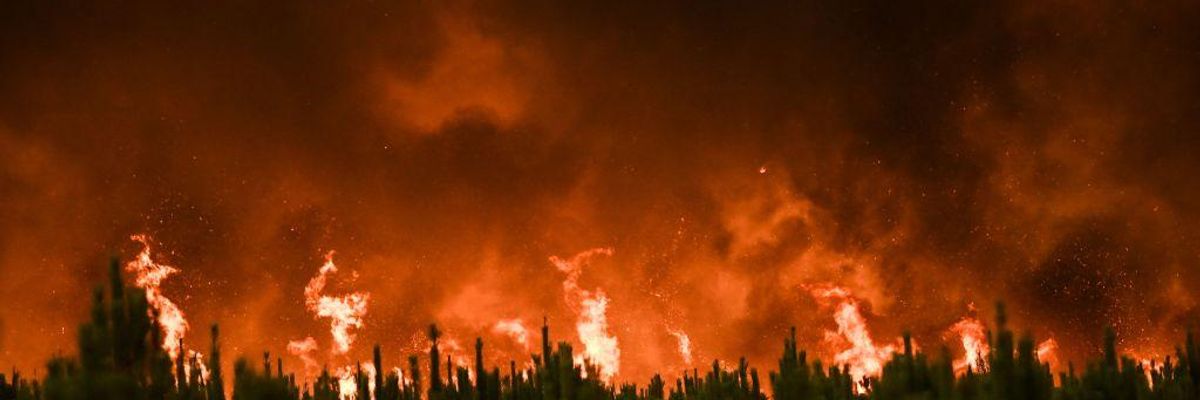
Flames burn trees during a forest fire near Belin-Beliet in Gironde, southwestern France, on August 10, 2022.
There is no longer time for thinking small. The only option is thinking big.
During the period from Christmas Eve to New Year's Eve, Wisconsinites saw powerful evidence of the instability of our devolving climate. A pre-Christmas snowstorm, fierce winds, record cold, temperatures in the 50s, rain, and melted-away snow—it was a cacophony that could only be attributed to climate change.
And, in many ways, Wisconsin's experience was better than that of other parts of the country, which in 2022 saw devastating hurricanes, fires, record heat, and a closing wave of apocalyptic snowstorms that left dozens dead.
The greatest danger to the planet is the surrender of hope, the loss of faith in the prospect that this Earth we call home can be saved from devastation.
The time to take climate change seriously arrived decades ago. Unfortunately, politicians in both parties were neglectful. Republicans chose to deny the crisis. Democrats chose to imagine that it could be met with half-steps.
Now reality is catching up with us, and there is so much bad news that it's easy to be overwhelmed. There is no longer time for thinking small. The only option is thinking big. Former Vice President Al Gore is not alone in suggesting, "We are running out of time, and we must have a planetary solution to a planetary crisis."
Unfortunately, world leaders missed several more deadlines to address the crisis last year. Frustrating negotiations associated with the United Nations Conference of the Parties of the UNFCCC (COP27) provided a reminder that the task at hand is an ever more challenging one.
Domestically, the new Republican-controlled U.S. House is going to do everything in its power to undermine the minimal progress that has been made since Joe Biden and the Democrats took charge in 2021. As Robinson Meyer of The Atlantic warns: "If history is any indication, a Republican Congress could spell doom for climate policy. Since the early 1990s, when the GOP took a turn toward climate-change denialism, the party has been one of the world's top enemies of climate policy."
So should we just give up? Not at all.
In fact, the greatest danger to the planet is the surrender of hope, the loss of faith in the prospect that this Earth we call home can be saved from devastation.
That's the message that Rebecca Solnit—the brilliant activist author of books such as Hope in the Dark and Men Explain Things to Me—has been preaching over the past several years.
"The world as we knew it is coming to an end, and it's up to us how it ends and what comes after," Solnit explains. "It's the end of the age of fossil fuel, but if the fossil fuel corporations have their way the ending will be delayed as long as possible, with as much carbon burned as possible. If the rest of us prevail, we will radically reduce our use of those fuels by 2030, and almost entirely by 2050. We will meet climate change with real change, and defeat the fossil fuel industry in the next nine years."
That's a daunting goal. But not an impossible one, argues Solnit.
As a co-founder of the Not Too Late project, Solnit is working with climate activist Thelma Young Lutunatabua and others to reject "sorrow and despair" and "invite newcomers to the climate movement, as well as provide climate facts and encouragement for people who are already engaged but weary."
There is nothing naïve about this project, which you can learn more about at nottoolateclimate.com. Solnit's not peddling optimism for the sake of optimism. Rather, she and her comrades rely on science to argue that there is still time to build a movement that is strong enough to force reluctant politicians to act on an agenda that breaks the grip of the fossil fuel giants.
Defeatism is a luxury we cannot afford. Instead of defeatism, Solnit says, "We must remake the world, and we can remake it better."
Dear Common Dreams reader, It’s been nearly 30 years since I co-founded Common Dreams with my late wife, Lina Newhouser. We had the radical notion that journalism should serve the public good, not corporate profits. It was clear to us from the outset what it would take to build such a project. No paid advertisements. No corporate sponsors. No millionaire publisher telling us what to think or do. Many people said we wouldn't last a year, but we proved those doubters wrong. Together with a tremendous team of journalists and dedicated staff, we built an independent media outlet free from the constraints of profits and corporate control. Our mission has always been simple: To inform. To inspire. To ignite change for the common good. Building Common Dreams was not easy. Our survival was never guaranteed. When you take on the most powerful forces—Wall Street greed, fossil fuel industry destruction, Big Tech lobbyists, and uber-rich oligarchs who have spent billions upon billions rigging the economy and democracy in their favor—the only bulwark you have is supporters who believe in your work. But here’s the urgent message from me today. It's never been this bad out there. And it's never been this hard to keep us going. At the very moment Common Dreams is most needed, the threats we face are intensifying. We need your support now more than ever. We don't accept corporate advertising and never will. We don't have a paywall because we don't think people should be blocked from critical news based on their ability to pay. Everything we do is funded by the donations of readers like you. When everyone does the little they can afford, we are strong. But if that support retreats or dries up, so do we. Will you donate now to make sure Common Dreams not only survives but thrives? —Craig Brown, Co-founder |
During the period from Christmas Eve to New Year's Eve, Wisconsinites saw powerful evidence of the instability of our devolving climate. A pre-Christmas snowstorm, fierce winds, record cold, temperatures in the 50s, rain, and melted-away snow—it was a cacophony that could only be attributed to climate change.
And, in many ways, Wisconsin's experience was better than that of other parts of the country, which in 2022 saw devastating hurricanes, fires, record heat, and a closing wave of apocalyptic snowstorms that left dozens dead.
The greatest danger to the planet is the surrender of hope, the loss of faith in the prospect that this Earth we call home can be saved from devastation.
The time to take climate change seriously arrived decades ago. Unfortunately, politicians in both parties were neglectful. Republicans chose to deny the crisis. Democrats chose to imagine that it could be met with half-steps.
Now reality is catching up with us, and there is so much bad news that it's easy to be overwhelmed. There is no longer time for thinking small. The only option is thinking big. Former Vice President Al Gore is not alone in suggesting, "We are running out of time, and we must have a planetary solution to a planetary crisis."
Unfortunately, world leaders missed several more deadlines to address the crisis last year. Frustrating negotiations associated with the United Nations Conference of the Parties of the UNFCCC (COP27) provided a reminder that the task at hand is an ever more challenging one.
Domestically, the new Republican-controlled U.S. House is going to do everything in its power to undermine the minimal progress that has been made since Joe Biden and the Democrats took charge in 2021. As Robinson Meyer of The Atlantic warns: "If history is any indication, a Republican Congress could spell doom for climate policy. Since the early 1990s, when the GOP took a turn toward climate-change denialism, the party has been one of the world's top enemies of climate policy."
So should we just give up? Not at all.
In fact, the greatest danger to the planet is the surrender of hope, the loss of faith in the prospect that this Earth we call home can be saved from devastation.
That's the message that Rebecca Solnit—the brilliant activist author of books such as Hope in the Dark and Men Explain Things to Me—has been preaching over the past several years.
"The world as we knew it is coming to an end, and it's up to us how it ends and what comes after," Solnit explains. "It's the end of the age of fossil fuel, but if the fossil fuel corporations have their way the ending will be delayed as long as possible, with as much carbon burned as possible. If the rest of us prevail, we will radically reduce our use of those fuels by 2030, and almost entirely by 2050. We will meet climate change with real change, and defeat the fossil fuel industry in the next nine years."
That's a daunting goal. But not an impossible one, argues Solnit.
As a co-founder of the Not Too Late project, Solnit is working with climate activist Thelma Young Lutunatabua and others to reject "sorrow and despair" and "invite newcomers to the climate movement, as well as provide climate facts and encouragement for people who are already engaged but weary."
There is nothing naïve about this project, which you can learn more about at nottoolateclimate.com. Solnit's not peddling optimism for the sake of optimism. Rather, she and her comrades rely on science to argue that there is still time to build a movement that is strong enough to force reluctant politicians to act on an agenda that breaks the grip of the fossil fuel giants.
Defeatism is a luxury we cannot afford. Instead of defeatism, Solnit says, "We must remake the world, and we can remake it better."
During the period from Christmas Eve to New Year's Eve, Wisconsinites saw powerful evidence of the instability of our devolving climate. A pre-Christmas snowstorm, fierce winds, record cold, temperatures in the 50s, rain, and melted-away snow—it was a cacophony that could only be attributed to climate change.
And, in many ways, Wisconsin's experience was better than that of other parts of the country, which in 2022 saw devastating hurricanes, fires, record heat, and a closing wave of apocalyptic snowstorms that left dozens dead.
The greatest danger to the planet is the surrender of hope, the loss of faith in the prospect that this Earth we call home can be saved from devastation.
The time to take climate change seriously arrived decades ago. Unfortunately, politicians in both parties were neglectful. Republicans chose to deny the crisis. Democrats chose to imagine that it could be met with half-steps.
Now reality is catching up with us, and there is so much bad news that it's easy to be overwhelmed. There is no longer time for thinking small. The only option is thinking big. Former Vice President Al Gore is not alone in suggesting, "We are running out of time, and we must have a planetary solution to a planetary crisis."
Unfortunately, world leaders missed several more deadlines to address the crisis last year. Frustrating negotiations associated with the United Nations Conference of the Parties of the UNFCCC (COP27) provided a reminder that the task at hand is an ever more challenging one.
Domestically, the new Republican-controlled U.S. House is going to do everything in its power to undermine the minimal progress that has been made since Joe Biden and the Democrats took charge in 2021. As Robinson Meyer of The Atlantic warns: "If history is any indication, a Republican Congress could spell doom for climate policy. Since the early 1990s, when the GOP took a turn toward climate-change denialism, the party has been one of the world's top enemies of climate policy."
So should we just give up? Not at all.
In fact, the greatest danger to the planet is the surrender of hope, the loss of faith in the prospect that this Earth we call home can be saved from devastation.
That's the message that Rebecca Solnit—the brilliant activist author of books such as Hope in the Dark and Men Explain Things to Me—has been preaching over the past several years.
"The world as we knew it is coming to an end, and it's up to us how it ends and what comes after," Solnit explains. "It's the end of the age of fossil fuel, but if the fossil fuel corporations have their way the ending will be delayed as long as possible, with as much carbon burned as possible. If the rest of us prevail, we will radically reduce our use of those fuels by 2030, and almost entirely by 2050. We will meet climate change with real change, and defeat the fossil fuel industry in the next nine years."
That's a daunting goal. But not an impossible one, argues Solnit.
As a co-founder of the Not Too Late project, Solnit is working with climate activist Thelma Young Lutunatabua and others to reject "sorrow and despair" and "invite newcomers to the climate movement, as well as provide climate facts and encouragement for people who are already engaged but weary."
There is nothing naïve about this project, which you can learn more about at nottoolateclimate.com. Solnit's not peddling optimism for the sake of optimism. Rather, she and her comrades rely on science to argue that there is still time to build a movement that is strong enough to force reluctant politicians to act on an agenda that breaks the grip of the fossil fuel giants.
Defeatism is a luxury we cannot afford. Instead of defeatism, Solnit says, "We must remake the world, and we can remake it better."