SUBSCRIBE TO OUR FREE NEWSLETTER
Daily news & progressive opinion—funded by the people, not the corporations—delivered straight to your inbox.
5
#000000
#FFFFFF
To donate by check, phone, or other method, see our More Ways to Give page.
Daily news & progressive opinion—funded by the people, not the corporations—delivered straight to your inbox.
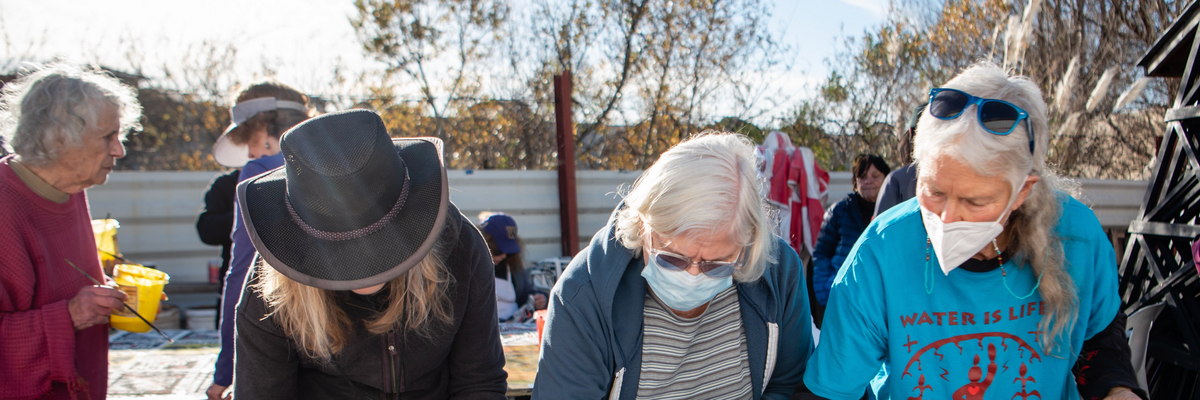
Advocates prepare for a national day of action organized by the grassroots group Third Act, planned for March 21, 2023.
"We have to show young people we have their back," said veteran climate advocate Bill McKibben.
Determined not to leave all the responsibility for climate action with young campaigners like Greta Thunberg and the Sunrise Movement, older Americans are organizing a nationwide Day of Action planned for Tuesday, with the aim of wielding the relative political and economic power of people aged 60 and up to pressure big banks to stop funding fossil fuel projects.
Following actor and activist Jane Fonda's "Fire Drill Friday" protests that began in Washington, D.C. in 2019, longtime climate advocate Bill McKibben founded Third Act last year to mobilize older Americans who wanted to show solidarity with the Generation Z activists leading worldwide climate protests in recent years.
The grassroots effort quickly attracted 50,000 members, many of whom are taking part in the organization's Stop Dirty Banks action on Tuesday—a nationwide blockade of the branches of banks like Wells Fargo, Chase, Citibank, and Bank of America, which have collectively poured $1.1 trillion into fossil fuel projects since the 2015 Paris climate agreement was forged.
Nearly 100 public actions on Tuesday will include a literal "Rocking Chair Rebellion," as McKibben has called the movement, with advocates placing painted rocking chairs at the entrances of bank branches, slicing credit cards with giant pairs of scissors, and displaying papier mache orcas that will eat credit cards to demonstrate that older Americans will no longer support companies that back plant-heating oil and gas projects.
"We have everything we need to turn toward clean energy," said Akaya Windwood, a longtime social justice leader who leads Third Act's advisory council, in a video posted to social media ahead of the protest. "All we're lacking is the political and economic will, so we're calling out the big banks to disinvest in fossil fuels and invest in air that all of us can breathe."
Windwood filmed herself cutting up her credit card ahead of the Day of Action, as did writer Rebecca Solnit, mountain climber Kitty Calhoun, and ocean conservationist Wendy Benchley.
In an op-ed for Common Dreams last week, McKibben, who is 62, noted that his generation on the whole has amassed more "structural power" than the young people who have worked to pressure lawmakers to support the Green New Deal and organized school walkouts as part of the Fridays for Future movement.
"We all vote, so the political impact of the 70 million Americans over 60 is much magnified," wrote McKibben. "And we ended up—fairly or not—with something like 70% of the country's financial assets, so we can put some pressure on banks."
McKibben added that it is "ignoble and impractical" to leave climate action up to younger people.
"So far the kids have had to do all of the work and they've done an amazing job but it's not fair to ask 18-year-olds to solve this problem," the author and 350.org cofounder told The Guardian. "We have to show young people we have their back. I'm going to be dead before the climate crisis is at its absolute worst, but being nearer the exit than the entrance concentrates one's mind to notions of legacy and we are the first generation to leave the world in a worse place than we found it."
McKibben will join rally-goers on Tuesday in Washington, D.C., where activists will stage a "rocking chair rebellion" in an intersection outside two of the "big four" banks.
The nationwide Day of Action is being held a day after the Intergovernmental Panel on Climate Change (IPCC) issued its latest report on the climate crisis, showing, as United Nations Secretary-General António Guterres said, that all licensing and funding of new oil and gas extraction must be ceased and all public and private funding of coal must come to an end.
From California to New York, McKibben said Monday on social media, advocates have been alerting bank branches about the coming public actions—displaying all-night projections at Wells Fargo and Chase locations that warn, "Banks: Cut it out or we'll cut it up."
"Banks have particular reason to listen to older people, because so much of the money in the vault belongs to them," wrote McKibben last week. "And because we're hard to outwait. Youth climate organizers have only a decade or so before they're on to the next stage of their lives. Sixty year-old climate activists are likely to have twice that long or more—and we've often got lots of free time."
"Chase and Citi and Wells Fargo and Bank of America should be worried: we're not going anywhere any time soon," he added. "We'll just keep rocking on."
Dear Common Dreams reader, It’s been nearly 30 years since I co-founded Common Dreams with my late wife, Lina Newhouser. We had the radical notion that journalism should serve the public good, not corporate profits. It was clear to us from the outset what it would take to build such a project. No paid advertisements. No corporate sponsors. No millionaire publisher telling us what to think or do. Many people said we wouldn't last a year, but we proved those doubters wrong. Together with a tremendous team of journalists and dedicated staff, we built an independent media outlet free from the constraints of profits and corporate control. Our mission has always been simple: To inform. To inspire. To ignite change for the common good. Building Common Dreams was not easy. Our survival was never guaranteed. When you take on the most powerful forces—Wall Street greed, fossil fuel industry destruction, Big Tech lobbyists, and uber-rich oligarchs who have spent billions upon billions rigging the economy and democracy in their favor—the only bulwark you have is supporters who believe in your work. But here’s the urgent message from me today. It's never been this bad out there. And it's never been this hard to keep us going. At the very moment Common Dreams is most needed, the threats we face are intensifying. We need your support now more than ever. We don't accept corporate advertising and never will. We don't have a paywall because we don't think people should be blocked from critical news based on their ability to pay. Everything we do is funded by the donations of readers like you. When everyone does the little they can afford, we are strong. But if that support retreats or dries up, so do we. Will you donate now to make sure Common Dreams not only survives but thrives? —Craig Brown, Co-founder |
Determined not to leave all the responsibility for climate action with young campaigners like Greta Thunberg and the Sunrise Movement, older Americans are organizing a nationwide Day of Action planned for Tuesday, with the aim of wielding the relative political and economic power of people aged 60 and up to pressure big banks to stop funding fossil fuel projects.
Following actor and activist Jane Fonda's "Fire Drill Friday" protests that began in Washington, D.C. in 2019, longtime climate advocate Bill McKibben founded Third Act last year to mobilize older Americans who wanted to show solidarity with the Generation Z activists leading worldwide climate protests in recent years.
The grassroots effort quickly attracted 50,000 members, many of whom are taking part in the organization's Stop Dirty Banks action on Tuesday—a nationwide blockade of the branches of banks like Wells Fargo, Chase, Citibank, and Bank of America, which have collectively poured $1.1 trillion into fossil fuel projects since the 2015 Paris climate agreement was forged.
Nearly 100 public actions on Tuesday will include a literal "Rocking Chair Rebellion," as McKibben has called the movement, with advocates placing painted rocking chairs at the entrances of bank branches, slicing credit cards with giant pairs of scissors, and displaying papier mache orcas that will eat credit cards to demonstrate that older Americans will no longer support companies that back plant-heating oil and gas projects.
"We have everything we need to turn toward clean energy," said Akaya Windwood, a longtime social justice leader who leads Third Act's advisory council, in a video posted to social media ahead of the protest. "All we're lacking is the political and economic will, so we're calling out the big banks to disinvest in fossil fuels and invest in air that all of us can breathe."
Windwood filmed herself cutting up her credit card ahead of the Day of Action, as did writer Rebecca Solnit, mountain climber Kitty Calhoun, and ocean conservationist Wendy Benchley.
In an op-ed for Common Dreams last week, McKibben, who is 62, noted that his generation on the whole has amassed more "structural power" than the young people who have worked to pressure lawmakers to support the Green New Deal and organized school walkouts as part of the Fridays for Future movement.
"We all vote, so the political impact of the 70 million Americans over 60 is much magnified," wrote McKibben. "And we ended up—fairly or not—with something like 70% of the country's financial assets, so we can put some pressure on banks."
McKibben added that it is "ignoble and impractical" to leave climate action up to younger people.
"So far the kids have had to do all of the work and they've done an amazing job but it's not fair to ask 18-year-olds to solve this problem," the author and 350.org cofounder told The Guardian. "We have to show young people we have their back. I'm going to be dead before the climate crisis is at its absolute worst, but being nearer the exit than the entrance concentrates one's mind to notions of legacy and we are the first generation to leave the world in a worse place than we found it."
McKibben will join rally-goers on Tuesday in Washington, D.C., where activists will stage a "rocking chair rebellion" in an intersection outside two of the "big four" banks.
The nationwide Day of Action is being held a day after the Intergovernmental Panel on Climate Change (IPCC) issued its latest report on the climate crisis, showing, as United Nations Secretary-General António Guterres said, that all licensing and funding of new oil and gas extraction must be ceased and all public and private funding of coal must come to an end.
From California to New York, McKibben said Monday on social media, advocates have been alerting bank branches about the coming public actions—displaying all-night projections at Wells Fargo and Chase locations that warn, "Banks: Cut it out or we'll cut it up."
"Banks have particular reason to listen to older people, because so much of the money in the vault belongs to them," wrote McKibben last week. "And because we're hard to outwait. Youth climate organizers have only a decade or so before they're on to the next stage of their lives. Sixty year-old climate activists are likely to have twice that long or more—and we've often got lots of free time."
"Chase and Citi and Wells Fargo and Bank of America should be worried: we're not going anywhere any time soon," he added. "We'll just keep rocking on."
Determined not to leave all the responsibility for climate action with young campaigners like Greta Thunberg and the Sunrise Movement, older Americans are organizing a nationwide Day of Action planned for Tuesday, with the aim of wielding the relative political and economic power of people aged 60 and up to pressure big banks to stop funding fossil fuel projects.
Following actor and activist Jane Fonda's "Fire Drill Friday" protests that began in Washington, D.C. in 2019, longtime climate advocate Bill McKibben founded Third Act last year to mobilize older Americans who wanted to show solidarity with the Generation Z activists leading worldwide climate protests in recent years.
The grassroots effort quickly attracted 50,000 members, many of whom are taking part in the organization's Stop Dirty Banks action on Tuesday—a nationwide blockade of the branches of banks like Wells Fargo, Chase, Citibank, and Bank of America, which have collectively poured $1.1 trillion into fossil fuel projects since the 2015 Paris climate agreement was forged.
Nearly 100 public actions on Tuesday will include a literal "Rocking Chair Rebellion," as McKibben has called the movement, with advocates placing painted rocking chairs at the entrances of bank branches, slicing credit cards with giant pairs of scissors, and displaying papier mache orcas that will eat credit cards to demonstrate that older Americans will no longer support companies that back plant-heating oil and gas projects.
"We have everything we need to turn toward clean energy," said Akaya Windwood, a longtime social justice leader who leads Third Act's advisory council, in a video posted to social media ahead of the protest. "All we're lacking is the political and economic will, so we're calling out the big banks to disinvest in fossil fuels and invest in air that all of us can breathe."
Windwood filmed herself cutting up her credit card ahead of the Day of Action, as did writer Rebecca Solnit, mountain climber Kitty Calhoun, and ocean conservationist Wendy Benchley.
In an op-ed for Common Dreams last week, McKibben, who is 62, noted that his generation on the whole has amassed more "structural power" than the young people who have worked to pressure lawmakers to support the Green New Deal and organized school walkouts as part of the Fridays for Future movement.
"We all vote, so the political impact of the 70 million Americans over 60 is much magnified," wrote McKibben. "And we ended up—fairly or not—with something like 70% of the country's financial assets, so we can put some pressure on banks."
McKibben added that it is "ignoble and impractical" to leave climate action up to younger people.
"So far the kids have had to do all of the work and they've done an amazing job but it's not fair to ask 18-year-olds to solve this problem," the author and 350.org cofounder told The Guardian. "We have to show young people we have their back. I'm going to be dead before the climate crisis is at its absolute worst, but being nearer the exit than the entrance concentrates one's mind to notions of legacy and we are the first generation to leave the world in a worse place than we found it."
McKibben will join rally-goers on Tuesday in Washington, D.C., where activists will stage a "rocking chair rebellion" in an intersection outside two of the "big four" banks.
The nationwide Day of Action is being held a day after the Intergovernmental Panel on Climate Change (IPCC) issued its latest report on the climate crisis, showing, as United Nations Secretary-General António Guterres said, that all licensing and funding of new oil and gas extraction must be ceased and all public and private funding of coal must come to an end.
From California to New York, McKibben said Monday on social media, advocates have been alerting bank branches about the coming public actions—displaying all-night projections at Wells Fargo and Chase locations that warn, "Banks: Cut it out or we'll cut it up."
"Banks have particular reason to listen to older people, because so much of the money in the vault belongs to them," wrote McKibben last week. "And because we're hard to outwait. Youth climate organizers have only a decade or so before they're on to the next stage of their lives. Sixty year-old climate activists are likely to have twice that long or more—and we've often got lots of free time."
"Chase and Citi and Wells Fargo and Bank of America should be worried: we're not going anywhere any time soon," he added. "We'll just keep rocking on."