

SUBSCRIBE TO OUR FREE NEWSLETTER
Daily news & progressive opinion—funded by the people, not the corporations—delivered straight to your inbox.
5
#000000
#FFFFFF
To donate by check, phone, or other method, see our More Ways to Give page.
Daily news & progressive opinion—funded by the people, not the corporations—delivered straight to your inbox.
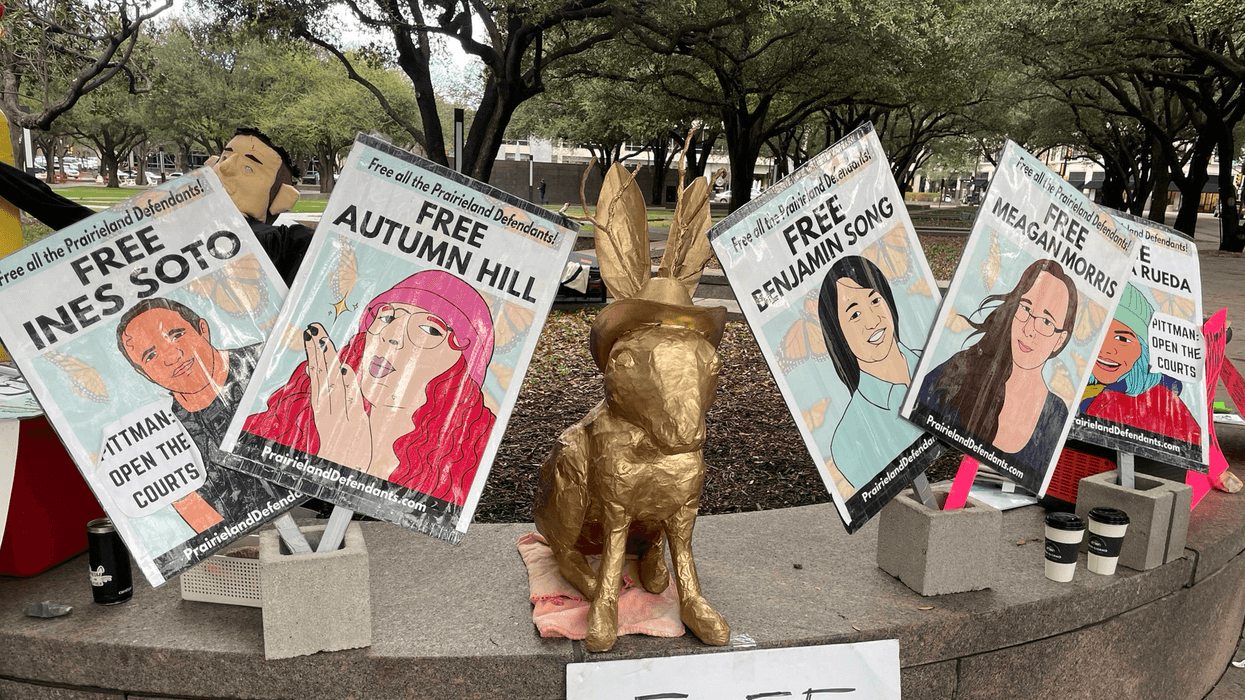
The extremely harsh sentences for Texas anti-ICE protesters did not set off any alarm bells among mainstream papers, and were underreported by national news outlets that should have covered their clearly national implications.
"Thirty-Year Sentence for Transporting Zines Is a Five-Alarm Fire for Free Speech,” an Intercept headline (6/26/26) shouted days after a federal court sentenced eight anti-Immigration and Customs Enforcement protesters to a combined 450 years in prison.
The case stemmed from a July 4, 2025, protest outside the ICE Prairieland detention center in Alvarado, Texas. People had gathered for a noise demonstration to show their solidarity with the detainees inside, and one protester discharged his rifle after a police officer pulled his weapon, resulting in a minor injury to the officer.
Charges were brought against a total of 22 people from the Dallas-Fort Worth area in November 2025, after President Donald Trump signed an executive order declaring “antifa” a “terrorist organization,” and after the related National Security Presidential Memo 7 was issued declaring a wide swath of First Amendment-protected political views as “terrorist.”
Eight of the defendants were convicted in March and sentenced on June 23; another eight were sentenced in early July, four of whom became prosecution witnesses and received shorter sentences. This was the first successful government prosecution testing the claims of EO-18709 and NSPM-7 that previously protected views and protest activity are “terrorism.”
National reporting on the sentencing missed the actual story almost entirely: that a group of people opposed to the government’s ethnic cleansing policies were given decades-long prison terms for their political views and the exercise of their First Amendment right to protest.
One of the defendants, Daniel Sanchez Estrada, was not even at the protest. He was, as The Intercept’s headline correctly reported, sentenced to 30 years because he moved a box of zines. “Five-alarm fire” seems an accurate assessment.
Yet the extremely harsh sentences for Sanchez Estrada and the others did not set off any alarm bells among corporate media, and were underreported by national news outlets that should have covered their clearly national implications. The New York Times (6/23/26) published an online piece that ran on page A14 in print—two days later. The Wall Street Journal (6/23/26) ran an article both online and in print, while The Washington Post (6/23/26) gave the story web-only treatment.
Meanwhile, national broadcast media largely sat this story out. CBS and ABC took a pass altogether. NBC (6/23/26) ran a version of The Associated Press’ reporting on its website, as did CNN (6/23/26), but no original reporting and nothing on their flagship evening news shows. PBS NewsHour (6/24/26) ran an analysis piece (I use that term lightly) the next day; and NPR’s Morning Edition (6/24/26) gave it two minutes.
By casually and inaccurately turning the protesters’ convictions into “terrorism” convictions, these outlets further reinforced the government’s narrative of violence and subversive threat.
The coverage of the Prairieland sentencing was similar, in both content and quantity, to the reporting on the case overall. The verdict in March garnered a single article from several national news outlets, but the trial itself was barely covered. An NPR Up First piece (2/17/26) reported on it when it started; The New York Times (2/24/26) ran a piece at the start of the second trial, after the mistrial; The Washington Post (3/5/26) reported on the trial once halfway through.
By comparison, The New York Times alone ran 153 pieces on Kyle Rittenhouse, the white supremacist who shot and killed two people during a Black Lives Matter protest in Kenosha, Wisconsin, during the month of his trial in November 2021, a Nexis search revealed. Given the enormous stakes in the Prairieland case—NPR (2/17/26) accurately said “it could have nationwide implications for how left-wing movements are prosecuted”—the relative lack of coverage itself may well have implications for how left-wing movements are prosecuted.
But corporate media’s disinterest in the case is just the beginning of the problems. (There’s so much to cover on this that we’re not gonna have time for the mistrial, but the National Lawyers Guild can catch you up on that.) This piece will focus on the coverage of the June 23 sentencing as representative of the overall national reporting. (It does not look at local coverage.) If anything, the draconian prison terms should have made that coverage more skeptical than the previous coverage, but it did not.
With the exception of PBS, every other national outlet covering the June sentencing framed the central and salient nature of the protest on July 4, 2025, as violence. The New York Times lead (6/23/26) said a jury had found the protesters “guilty of supporting terrorism while taking part in an armed assault.” The Wall Street Journal lead (6/23/26) said protesters were “accused of carrying out an attack on a Texas ICE facility.”
The Washington Post headline (6/23/26) characterized the demonstration as a “violent ICE protest.” The AP story (6/23/26) framed the event as “immigration center shooting and protest” (note the order), while NPR’s headline (6/24/26) described it simply as an “immigration center shooting.”
No one mentioned that Kyle Rittenhouse—who actually killed two people—was acquitted on self-defense grounds. Song’s conviction on attempted murder charges would be laughable if it weren’t so horrible.
What actually happened that night was that protesters set off fireworks as planned for their noise demonstration, and the evening was peaceful at first. Some protesters then engaged in property damage, including graffiti and slashed tires. When a police officer drew his gun and pointed it at the protesters, one of them, Benjamin Song, fired “suppressive shots,” aiming his rifle at the ground, in what he claims was self-defense. The bullet that struck the police officer “showed signs of impact with a hard surface,” as In These Times (3/26/26) reported, suggesting that it ricocheted off the ground. None of the national news stories on the sentencing included this information.
In the wake of the killings of Renee Good and Alex Pretti in Minneapolis, Song’s fear certainly seems plausible, but the judge in the case had barred the defense from arguing a self-defense claim. That fact was mentioned in only one outlet, NPR (6/24/26), and without any context. And no one mentioned that Kyle Rittenhouse—who actually killed two people—was acquitted on self-defense grounds. Song’s conviction on attempted murder charges would be laughable if it weren’t so horrible.
To describe these events as “an armed assault” is at best a wild exaggeration, and at worst a deliberate mischaracterization. Between the uncritical adoption of the government’s framing of the protest as violent and the omission of so much evidence that contradicts that claim, national reporting on the sentencing missed the actual story almost entirely: that a group of people opposed to the government’s ethnic cleansing policies were given decades-long prison terms for their political views and the exercise of their First Amendment right to protest.
PBS (6/24/26) stands out as the only outlet to have framed the story this way, leading with the headline, “Anti-ICE Protesters Sentenced to Decades in Prison in Latest Crackdown on Dissent.” It interviewed George University Law Center professor Paul Butler, who said, “The concern is, when people are labeled terrorists based on their political views, that chills free speech”—an understatement.
Neither NPR nor The Wall Street Journal managed to even mention the First Amendment, and The Washington Post’s only mention of it (6/23/26) was in a quote from a federal prosecutor who said the protesters’ actions were “a far cry from a peaceful protest or First Amendment expression.”
National news stories also failed to interrogate the central claim by the government that the protesters’ action amounted to terrorism, and none explained the charge of “material support for terrorism,” the central charge all but Sanchez Estrada were convicted on.
Several outlets simply conflated “terrorism” and “material support for terrorism,” though the two are legally and substantively distinct. New York Times (6/23/26): “Six of the defendants who were convicted of terrorism charges… which was the first time terrorism charges had been brought against purported members of antifa.” NPR (6/24/26): “The group faced terrorism charges.” AP (6/23/26): “All but one of the eight defendants sentenced Tuesday were convicted on terrorism charges.”
By casually and inaccurately turning the protesters’ convictions into “terrorism” convictions, these outlets further reinforced the government’s narrative of violence and subversive threat.
Has opposition to fascism really been defenestrated from the Overton Window?
The actual charge, material support, rests on that “support” being linked to an identified terrorist organization, and the novelty and grave danger of the Prairieland case was precisely in linking the defendants’ banal activities that allegedly prove their membership in “antifa”—wearing black, being part of a book club that reads anarchist books, having left-wing literature in their possession—to a made-up domestic terrorist organization called “antifa.”
Most of the national reports on the sentencing mention Trump’s executive order designating “antifa” a “domestic terrorist organization,” and a few point out in a half sentence that there is no provision under US law for such a thing as a domestic terrorist organization (New York Times, 6/23/26; PBS, 6/24/26; AP, 6/23/26). But none spell out the alarming precedent being set here by a court legitimizing a legal category that literally does not exist in US law.
(The Brennan Center has an excellent primer on the executive order and NSPM-7 that presciently points out “extending the foreign material support for terrorism regime [to domestic organizations] would allow the government to formally assign the label to domestic groups with unpopular beliefs and prosecute anyone who supports them.”)
All this brings us, of course, to “antifa.” All the news pieces found a way to counter the government’s fiction that antifa is an organization, variously describing it as “an umbrella term” (AP, 6/23/26), “a decentralized movement” (PBS, 6/24/26), an “ideology, not a centralized organization” (NPR, 6/24/26 ), “a loose network” (Wall Street Journal, 6/23/26), a “loosely knit movement” (Washington Post, 6/23/26), and a “movement [with] no central structure or formal membership” (New York Times, 6/23/26). A few reminded readers that “antifa” is short for anti-fascism.
But every single one of them also characterized it as “far left.” Has opposition to fascism really been defenestrated from the Overton Window? Or are corporate (and semi-corporate public) media contributing to the delegitimation of “antifa,” even as they recognize it is not exactly what Donald Trump declares it to be?
By leaving out the deliberate right-wing creation of “antifa,” while characterizing it as “far left,” media are contributing to the government narrative that “antifa” is a real and dangerous thing.
More fundamentally, “antifa” isn’t really any of those things the media say it is, either—a network, a movement, an ideology. It is a right-wing boogeyman constructed precisely for the purpose it is now being deployed to fulfill.
There are a handful of organizations in the US that explicitly identify as antifa, but the overwhelming majority of US leftists never used the term before the contemporary right, abetted by the media, put it on the map. At which point, most of us reacted with: “Antifa” isn’t a thing, but yes, I am proudly anti-fascist.
By leaving out the deliberate right-wing creation of “antifa,” while characterizing it as “far left,” media are contributing to the government narrative that “antifa” is a real and dangerous thing. This helps legitimize the legal fiction that is being used to criminalize dissent.
That a government with strong fascistic tendencies is going to smear its opponents as dangerous and violent is a given at this point. That a court will wholeheartedly follow them down the path of creating legal fictions in order to prosecute those opponents is an alarming development. But that a national press corps is so cowed by government cries of “terrorism!” that they fail to interrogate those legal fictions is a danger to the very freedoms they purport to embody.
How the state uses conspiracy charges to crush social movements.
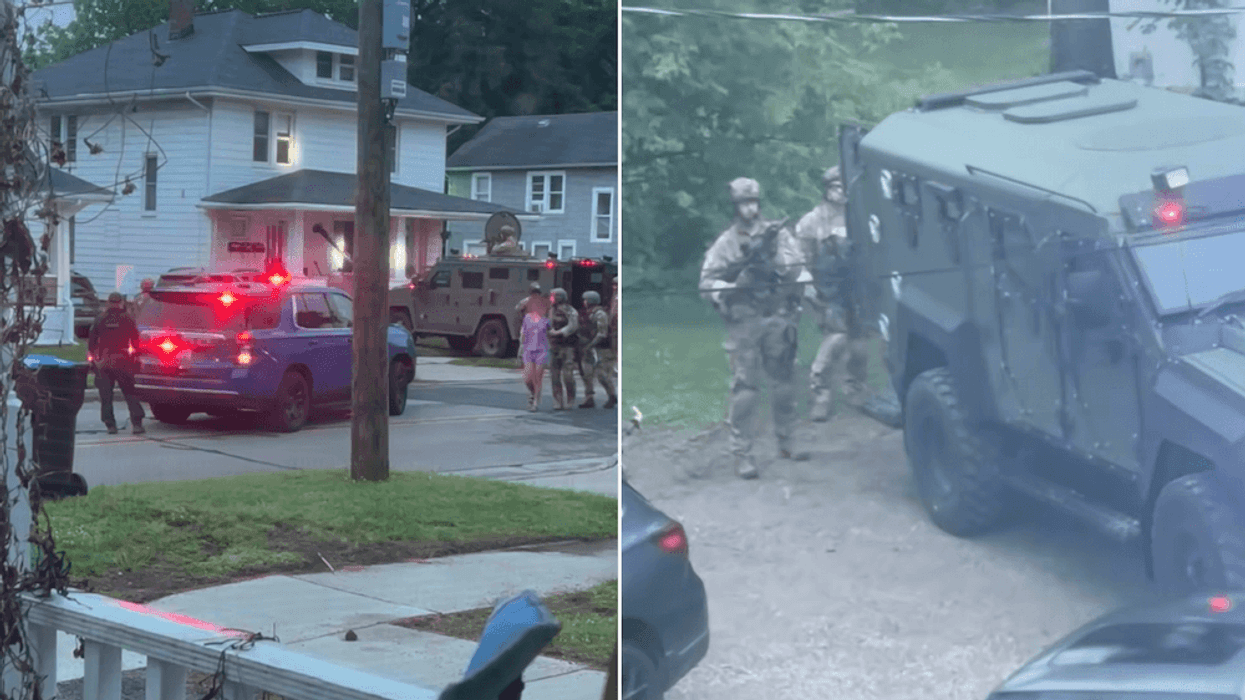
On the morning of June 10, 2026, the FBI, together with an ensemble of local and state police departments, including the University of Michigan Police Department, conducted a series of simultaneous raids and arrests in Michigan, Illinois, and Wisconsin in spectacular militarized fashion. The operation targeted eight individuals engaged in Palestine solidarity activism at the University of Michigan.
That afternoon, FBI director Kashyap Patel announced that the targeted individuals “engaged in a coordinated campaign of violent, criminal acts seeking to pressure University of Michigan leaders and other businesses in the Eastern District of Michigan to cut off all ties with Israel.” The alleged violent, criminal acts in question? Property damage. The coordinated campaign in question? Per their indictment, “using encrypted messages, social media, and overseas collaboration platforms […] [and] the internet and social media to broadcast their message.”
To be clear, the Michigan Eight are not being charged with property damage or vandalism. Instead, they are facing charges of conspiracy to transmit a threat, conspiracy to tamper with a witness, and destruction of property to prevent seizure. Less than a week after the raids against the Michigan Eight, 15 individuals were similarly indicted in Minnesota on various conspiracy charges for their participation in community activism and mutual aid in the context of Immigration and Custom Enforcement’s (ICE) Operation Metro Surge that saw 2,000 ICE agents deployed in Minnesota, leading to over 3,000 arrests, two protesters shot by ICE agents, and one individual dead in ICE custody. The conspiracy charges faced by the Michigan Eight and the Minnesota 15 carry a maximum sentence of 5-20 years and, when there are multiple counts of it, defendants face potentially decades in prison. A week after the Minnesota 15 indictments, anti-ICE protesters were sentenced to between 30 and 100 years in prison after being convicted of various conspiracy charges related to protest activity at the Prairieland Detention Center in Alvarado, Texas.
These are just three out of several other recent cases involving social movements and conspiracy charges. What links them is not the recurrence of some crime called “conspiracy,” but the conversion of ordinary political association into proof of unlawful intent. Conspiracy charges are among the most common charges brought against social movements precisely because they represent an extremely broad, far-reaching, and powerful tool of the state. You do not need to have taken any action, nor do you need to know the other alleged co-conspirators to be found guilty. Federal prosecutors simply have to establish that at least one alleged conspirator has taken an overt (legal or illegal) act toward the alleged plan. Needless to say, virtually anything can be claimed to be an overt act.
The only conspiracy related to the Michigan Eight or the Minnesota 15 is the one that has been constructed by the federal government.
Aside from formal charges of conspiracy, there is also the more diffuse concept of conspiracy that the prosecution in these cases use more generally to paint activists as dangerous, terroristic individuals engaged in a plot against the state. For example, during the detention hearing on June 12, 2026, for four of the Michigan Eight, one of the federal prosecutors, Margaret M. Smith, assistant United States attorney at the Department of Justice, made several references to the defendants being part of a revolution and a “revolution organization.” This language, as we shall see, has a long association with conspiracy charges. It does more than just describe the alleged beliefs of defendants. It represents the bridge by which belief, affiliation, and collective organization can be made to stand in for actual evidence of particular criminal acts.
But what does the nebulous concept of conspiracy mean and why does the government keep using it and who is it meant to target? The late Michael Parenti once noted that “conspiracy means to collude together in secrecy for what are potentially illegal or immoral ends and [the ruling elites] do this all the time and they talk about the necessity of it and they even give it a name, they call it national security.” Indeed, the only conspiracy related to the Michigan Eight or the Minnesota 15 is the one that has been constructed by the federal government. In fact, across more than a century of American history, the recurring pattern that has shaped the state’s response to dissent and protest has been the tendency to treat collective organization itself as a crime. The First Amendment may protect the freedom of speech and assembly as the very conditions of democratic politics, but conspiracy charges have long made these supposed rights conditional.
The state has a long history of using the concept and charge of conspiracy as a weapon against social movements that have sought to expand democratic freedoms. We must therefore place the particular case of the Michigan Eight and the Minnesota 15 in a longer history that involves the Haymarket Trial (1886-1887), the Espionage Act (1917), the Smith Act (1940), the Anti-Riot Act (1968), RICO (1970), and more contemporary post-9/11 developments such as the Patriot Act (2001). These historical moments represent the cumulative expansion in what the state can make conspiracy mean: from attributing responsibility for an unidentified act to an entire radical milieu, to treating speech as dangerous, group membership as suspicious, mundane logistical organization as evidence of criminal intent, and decentralized movements as racketeering enterprises. While, in case of the Michigan Eight, the targets are Palestine solidarity activists, and while in the case of the Minnesota 15, the targets are anti-ICE organizers, the tools that have been assembled and are still being expanded and perfected can and will be applied to other groups. What is at stake here is no less than ability to collectively organize to create a better and more just world and to resist oppression.
In 1941, the legal scholar Albert J. Harno wrote that, due to its “elasticity” and “vague boundaries,” the concept of conspiracy “presents serious potential dangers of abuse.” Only, there is nothing “potential” about its dangers. From some of its earliest applications right to the last two weeks, the charge of conspiracy has been the bane of organized labor and other broad social movements that the state has sought to repress. One facet of the seemingly endless elasticity of the concept of conspiracy relates to the category of unindicted conspirators. In the case of the Michigan Eight and the Minnesota 15, this term is constantly invoked in the indictments. Aside from the fact that unindicted conspirators cannot testify on behalf of the defense, prosecutors can introduce the out-of-court statements of unindicted conspirators in court as evidence against the defendants without these statements considered hearsay. Prosecutors can thus introduce texts, emails, phone calls, et cetera, involving unindicted conspirators as evidence against the defendants even if the defendants were not a direct party to these communications. Moreover, the shadow of not knowing whether one is or is not an unindicted conspirator introduces even more fear into social movements. This uncertainty is a feature of conspiracy law and one of its political effects, thus extending the coercive reach of an indictment beyond the courtroom.
Nineteenth-century labor cases show where this logic first acquired its legal form and political function. Labor Studies scholar Risa Lieberwitz notes that the charge of conspiracy has historically “provided a powerful weapon against groups advocating political and social change [and] the labor movement [in particular] was the target of many criminal conspiracy prosecutions during the 19th century, beginning with the Philadelphia Cordwainers’ Case of 1806, which was both the first criminal conspiracy trial in the United States, and the first recorded labor case.” If the Cordwainers’ Case demonstrated that workers coming together to demand higher wages could be a criminal conspiracy, the trial of the Haymarket Eight showed how conspiracy could make an entire political milieu culpable for an act that the state could not directly attribute to any one defendant.
On May 4, 1886, a bomb was thrown during a labor demonstration at Haymarket Square in Chicago. Till this day, no one can say for certain who threw that bomb. During the trial, prosecutors could not prove who threw it nor prove that the defendants had planned the bombing. They could not even, in some cases, prove that they had been present when the bomb was thrown. What they could prove was that the Haymarket Eight had given speeches, written articles, edited newspapers, belonged to radical organizations, and broadly advocated for a social revolution.
The concept of conspiracy was what allowed the prosecution to transform this into evidence of collective responsibility for the bombing. The prosecution did not need to identify the bomber; it only needed to argue that the Haymarket Eight had been part of a conspiracy to create the conditions in which such a bombing became likely. In other words, the defendants were guilty of belonging to and contributing to a radical workers’ milieu that the state had defined as dangerous. Haymarket helped established what would become a recurring pattern where membership in particular groups (whether well-defined or as vague as “antifa”) and speech (like posting messages on social media) and acts (like organizing a meeting or using the internet) can become evidence of a conspiracy.
Haymarket thus supplied the basic argument that the state would repeatedly adapt: When direct proof of individual action was absent, prosecutors could substitute much fuzzier ideas. World War I expanded this basic framework under the sign of national security. The federal government used the Espionage Act of 1917 against socialists, labor organizers, anti-war activists, and others who opposed conscription or otherwise criticized the war. During this time, the Department of Justice conducted a series of mass raids and arrests, collectively known as the Palmer Raids (1919–1920), in more than 30 cities and towns, targeting thousands of individuals, particularly Italian-American and Jewish-American socialists, the so-called “hyphenated Americans” that President Woodrow Wilson railed against, warning that “any man who carries a hyphen about with him carries a dagger that he is ready to plunge into the vitals of this Republic whenever he gets ready.”
In Schenck v. United States (1919), the Supreme Court unanimously held that the First Amendment did not protect Charles Schenck, who had distributed anti-draft and anti-war flyers to draft-age men, from prosecution under the Espionage Act precisely because, as Justice Oliver Wendell Holmes Jr. concluded, "The words used are used in such circumstances and are of such a nature as to create a clear and present danger that they will bring about the substantive evils that Congress has a right to prevent.” In other words, the Supreme Court ruled that otherwise lawful speech could be punished if it was thought likely to obstruct or encourage resistance to government aims.
In Brandenburg v. Ohio (1969), the Supreme Court did not expressly overrule Schenck v. United States, but it effectively superseded Schenck's clear-and-present-danger standard and, on the surface, introduced a more expansive interpretation of the First Amendment, holding that advocacy of illegal action cannot be punished unless it is “directed towards inciting or producing imminent lawless action and is likely to incite or produce such action.” Yet, the so-called Brandenburg test still reveals the subjective nature of, well, law in general, its interpretation, and its enforcement. In this case, the key subjective terms are “imminent” and “likely.” Whether an action is imminent and whether speech is likely to produce an action requires a level of guesswork that is wholly reminiscent of the trial of the Haymarket Eight.
Described as a “prison for ideas” by the National Committee to Win Amnesty for the Smith Act Victims in 1954, the Smith Act of 1940 would extend this logic within the context of the Cold War. Among other things, the Smith Act criminalized “knowingly or willingly advocate, abet, advise, or teach the duty, necessity, desirability, or propriety of overthrowing any government in the United States by force or violence.” In the late 1940s and 1950s, communists in particular were prosecuted under the law, not because they had launched an armed insurrection, or even taken material steps toward an armed insurrection, but because they belonged to organizations that taught Marxist theory and advocated for communist revolution.
Like their predecessors in 1886 who did not have to prove that the Haymarket Eight had thrown the bomb, prosecutors in these cases did not have to prove that communists had entered into an agreement to commit a crime (the most basic definition of conspiracy), but that the Communist Party itself was a criminal enterprise. The state did not need to demonstrate that any communists had agreed to carry out a specific unlawful act in the near future. Instead, their membership in the party and their ideological beliefs were sufficient proof of criminal liability. Charisse Burden-Stelly summarizes it well, writing that “membership in the CPUSA automatically meant conspiracy of insurrection.”
In the context of popular protests and anti-war mobilization, the Anti-Riot Act of 1968 made it a federal offense to cross state lines or use interstate facilities with the intent to incite, organize, or encourage a riot. If the Smith Act treated membership as evidence of insurrectionary conspiracy, the Anti-Riot Act adapted the same logic to the mass movements of the 1960s by treating travel, communication, planning, and assembly as evidence of an intention to produce disorder. The Chicago Seven would be the first to be prosecuted under the Anti-Riot Act and charged with conspiracy to incite a riot and crossing state lines with intent to incite a riot. Again, we see the danger in the elasticity of the key terms of the act that allowed the federal government to frame lawful activities taken to organize a protest, in this case at the Democratic National Convention in Chicago, as evidence of unlawful intent, namely, to incite a riot.
On February 18, 1970, seven defendants were acquitted on conspiracy charges, two were acquitted on all charges, and the remaining five were convicted of travelling across state lines with intent to incite a riot and sentenced to five years in prison. Over two years later, those convictions would be overturned by an appeals court panel that found numerous errors made by the judge. Yet, the damage to the defendants’ lives and to the broader public had been done. Even when defendants are acquitted or have their convictions overturned, conspiracy charges succeed in the ideological work for which they are perhaps best designed, leaving behind a public narrative in which dissent and protest are not cornerstones of democracy, but dangerous, hidden plots conducted by shadowy figures.
Even unsuccessful prosecutions impose a real material and mental cost on defendants and, more generally, they impose a heavy cost on the public at large, forcing all of us to consider whether participation in collective protest or forms of dissent may expose us to repression.
The Racketeer Influenced and Corrupt Organization (RICO) Act of 1970 would give an even more expansive tool for prosecutors to bind heterogeneous individuals and acts under the label of a single, criminal enterprise. RICO has increasingly been used by federal and state prosecutors to target labor unions and broad social movements. The statute’s breadth gives prosecutors considerable flexibility in defining a criminal enterprise and explaining how otherwise separate acts fit together.
In September 2023, Georgia prosecutors brought a sweeping state RICO indictment against dozens of activists associated with opposition to the Atlanta Public Safety Training Center, commonly known as Cop City. The indictment alleged that a broad protest movement constituted a criminal enterprise and cited a wide range of activities, including alleged acts of property destruction, distribution of literature, mutual aid, reimbursements, fundraising, communications among activists, and protests and demonstrations.
Prosecutors used the flimsiest of evidence to rope even more people into this “conspiracy” as “co-conspirators.” Signing a petition was enough to get a visit by the police and having mud on one’s shoes in a forest was taken as evidence of participation in alleged acts of property damage at a construction site. The significance of the Stop Cop City case lies less in the specific allegations, but in the indictment’s construction of a broad social movement as a unified, organized criminal enterprise. Social movements are almost by definition heterogenous and decentralized. They always comprise individuals with different goals, tactics, and levels of commitment.
The dismissal of the RICO charges against the defendants in December 2025 does not make this case any less troubling (the state could refile charges or repeal the dismissal). On the contrary, the dismissal sharpens the stakes of indictments like this. While the dismissal shows how weak the charges were in the first place, the state successfully punished the defendants. Even unsuccessful prosecutions impose a real material and mental cost on defendants and, more generally, they impose a heavy cost on the public at large, forcing all of us to consider whether participation in collective protest or forms of dissent may expose us to repression. From this perspective, it does not matter much that a court may eventually reject prosecutorial overreach when the threat of prosecution may shape the way we behave.
One lesson that we can learn from the historical continuity between each of these episodes is that movements for economic and racial justice, movements against wars and imperialism, and anti-fascism as a concept (through the targeting of “antifa”) have all been described, in different moments, as threats to public order. In each case, the state and its prosecutors have been able to portray individuals participating in these movements as public enemies. The language of conspiracy is especially useful in this process because it turns ordinary features of collective life into suspicion. Each of these historical cases has contributed to the ever-expanding use of conspiracy charges in state repression of social movements. Across these cases, the object of prosecution moves further and further away from identifiable unlawful acts to the social relations that make collective action possible. This past should inform our understanding of the recent cases and remind us not to take at face value the charges against the Michigan Eight and the Minnesota 15.
Like the cases from the past, the present charges are an attack on political speech and, more broadly, all those who seek to collectively work toward a more just and freer future. Isaac Sant, one of the Minnesota 15, has noted that what they are facing is “not a normal criminal trial; this is a political case, this is political repression against organizers.” The long history of conspiracy charges and state repression suggests that political repression cannot be defeated alone in the courtroom. This is because conspiracy cases do not just target the named defendants; the broader targets are concepts like trust, collective organization, and solidarity, that is to say the very bases of social movements.
Like previous generations of workers faced with political repression, we must seize the current crises as an opportunity to revitalize the labor movement from the ground up. That revitalization is not going to come from union leadership, but from you and other rank-and-file worker-organizers. As the veteran labor organizer Daniel Gross recently noted, in Unions of Our Own (2026), “A truly just society with reliable economic security, where we can live freely on a healthy planet, simply cannot happen without organized workers and liberatory unions.”
This moment threatens our very ability to collectively organize for a better world at the same time as it represents an opportunity for workers everywhere to double down on collective organization, whether it is to keep our fellow workers safe from abductions; to organize toward divestment from companies profiting from war and genocide; or to fight the daily struggles of autonomy, respect, and dignity on the shop floor. In all cases, every victory, big or small, is not a concession, but a privilege that workers have wrested from state and capital. The stakes of not meeting this moment could not be heavier.
Correction: The piece has been updated to reflect the fact that Brandenburg v. Ohio superseded, rather than overruled, Schenck v. United States.
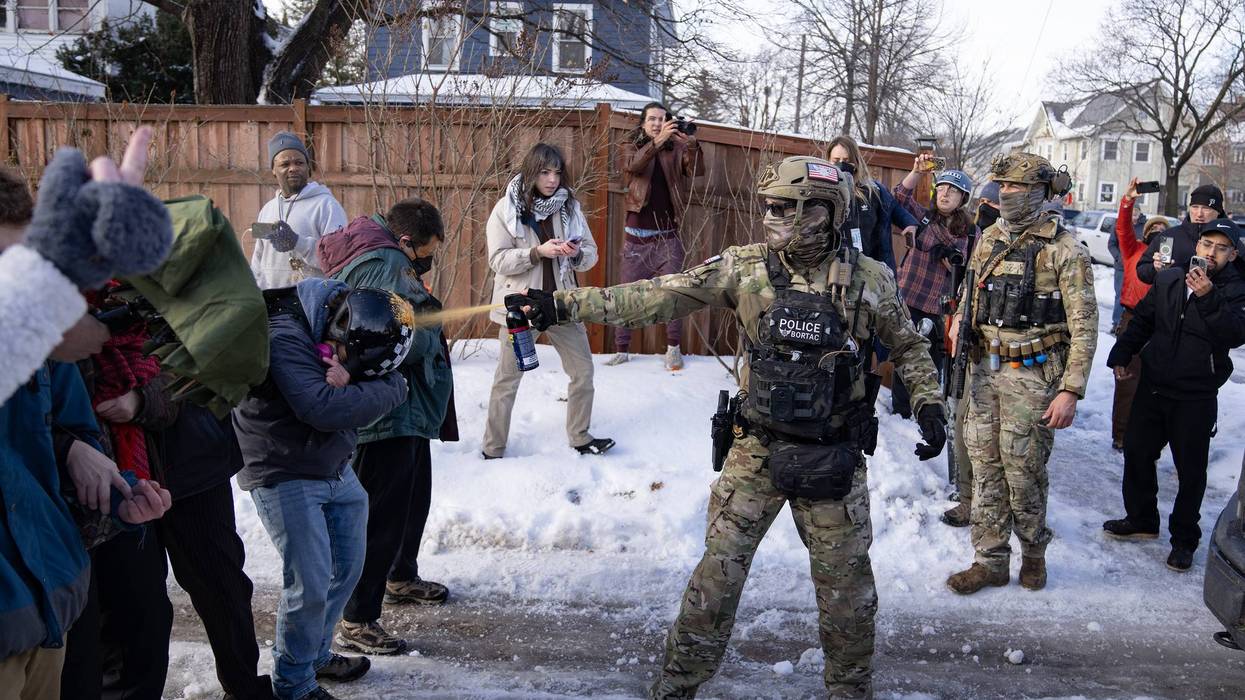
The unaccountable killings, the show trials, the informant bounties, the door knocks over emails, the leader’s praetorian guard, the captured press, the rewritten history, and now the reach for the ballots themselves: Every component is now built, tested, and humming.
Tuesday morning in Houston, Lorenzo Salgado Araujo did what he’d done nearly every morning for 35 years. He woke at 5:00 am, kissed his wife goodbye, loaded his van, and drove off to pick up his construction crew in Magnolia Park, the neighborhood that’s anchored Houston’s Mexican American community for a century.
He’d raised three sons in that city; they became a teacher and two engineers. He had no criminal record, and he was partway through the legal process of getting a work permit, biometrics and fingerprints already done.
By 7:00 am he was lying face down on Canal Street with a bullet in his abdomen, crying out for help in Spanish while a federal agent knelt over him talking on the phone. He died at Ben Taub Hospital, the same hospital where two of his sons were born. The Harris County medical examiner has ruled the manner of his death a “homicide.”
Immigration and Customs Enforcement (ICE) says he rammed their vehicle and “weaponized” his van to run down an officer, who fired in self-defense. His family says he almost certainly thought the unmarked cars tailing him were thieves after his work tools, because the men following him wore no insignia identifying them as law enforcement.
What we still have, and what the DDR and the Third Reich did not, is one more election in which the machine’s operators can be stripped of their power by the people they’re trying to frighten.
The League of United Latin American Citizens says photographs of the vehicles show little visible damage, which is a strange thing for a van that supposedly rammed a law enforcement vehicle hard enough to justify lethal force. David Bier of the libertarian Cato Institute reviewed newly surfaced footage and concluded it appears to show ICE initiating contact with Salgado Araujo’s vehicle, not the other way around; Norm Ornstein looked at the same evidence and called it “cold-blooded murder.”
The federal government has released no body camera footage, no dash camera video, and no photos of the damage it claims exists. The three eyewitnesses who were in the van, including Salgado Araujo’s own brother, are in ICE custody and can’t speak out. The Harris County District Attorney is trying to investigate, but her office says access to key evidence “remains under federal control.”
The president of Mexico announced this week that her government will pursue legal action against the United States over the killing. The historical inversion packed into that sentence is complete: Mexico is now appealing to international bodies to protect its citizens from American police violence.
Which brings us to the question people keep asking me on my radio show and on social media: “Are we in a police state yet?” And the question underneath it, the one that really matters: “How would we know?”
I lived in Germany for years, working with Salem International, some of that time in the little village of Höchheim hard up against the East German border, where the guard towers and the death strip were part of the landscape you saw on your way to buy bread.
I crossed through Checkpoint Charlie into East Berlin in 1986 and felt what a mature police state does to ordinary people: the lowered voices indoors, the glance over the shoulder before anybody said anything real. (If you’ve never experienced that world, watch the brilliant film The Lives of Others; it captures the East German surveillance state better than anything else on film.)
My spiritual mentor and employer in Germany, Gottfried Müller, had been an intelligence officer in Adolf Hitler’s army who renounced Nazism, was captured by the British in Iran, and spent most of the war in prison; he devoted the rest of his life to peace work.
And my dear old friend Armin Lehmann, who was the teenage Hitler Youth courier in the Führerbunker who delivered the news to Hitler that the war was lost (I still have a picture of him with Hitler, that’s on the cover of his book), spent his last decades in America as a peace activist.
Both men told me essentially the same story about how it began. It started getting scary, they noted, when the regime began to explicitly come after verbotener Gedanke, “forbidden thought.” For example, the radio stations, they said, used to encourage ordinary Germans to call in—to the shows and to the police—and “out” their neighbors who weren’t sufficiently loyal to the regime. Informing became one of the highest expressions of patriotism.
The Germans even have a word for the process by which their entire society was brought into line during 1933 and 1934: as Timothy Snyder notes, it’s Gleichschaltung, a coordination, a synchronization.
Germany didn’t become a police state in a day, and there was never an announcement.
There was just a series of Fridays, each one slightly worse than the last, until one day the question, “Are we in a police state?” had become dangerous to ask out loud.
So instead of waiting for an announcement that’s never coming, let’s do what Herr Müller would have done and run through the inventory necessary to create a fascist police state:
1. A police state is a nation where the police answer to the leader rather than to the law, and where nobody outside the leader’s circle is permitted to hold them accountable. It’s a nation where they can arrest, beat, torture, imprison, and even kill with both anonymity and impunity.
In January, ICE officer Jonathan Ross reportedly shot Renee Good, a 37-year-old mother of three, through the window of her car in Minneapolis, and Border Patrol agents killed Alex Pretti, an ICU nurse, on a public street days later. Within hours, then-Homeland Security Secretary Kristi Noem was calling both dead Americans “domestic terrorists,” a slander she refused six times under oath to retract.
Murder is a state crime, and in America state investigators have always worked police shootings alongside the feds. Not this time. The FBI agreed to a joint investigation with Minnesota’s Bureau of Criminal Apprehension the morning Good was killed, then reversed itself the same day after President Donald Trump declared Minnesota officials “crooked.”
Federal agents physically blocked state investigators holding a valid judicial warrant from the scene of the Pretti shooting. Federal prosecutors who wanted to pursue the Good case as a civil rights matter were pressured until they resigned. Today, Good’s car sits shrink-wrapped and unexamined in an FBI warehouse in Brooklyn Center, Minnesota, and the state has been forced to sue the federal government just to learn the names of the agents who killed two of its citizens.
Hennepin County Attorney Mary Moriarty called the categorical withholding of all evidence “unprecedented in American history.” Now the same machinery has closed around the killing of Lorenzo Salgado Araujo in Houston. It won’t be the last time.
2. A police state imprisons its dissidents, and it makes the sentences spectacular so everyone else gets the message.
On June 23, federal judges in Fort Worth sentenced eight members of a local book club who held a July 4, 2025 protest outside the Prairieland ICE detention center to a combined 450 years in prison, a figure the Justice Department bragged about in its own press release. Benjamin Song, who fired at an officer after the officer drew his weapon on the crowd, got 100 years.
Maricela Rueda, a doula and mother who was acquitted by the jury of every violent count against her, got 70 years in prison. Five others who were likewise acquitted of the attempted murder and firearms charges got 50 years apiece, because prosecutors persuaded the jury that wearing black and using the Signal messaging app constituted “material support for terrorism.”
And Daniel Sanchez Estrada, a Denton teacher and poet who wasn’t even at the protest, got 30 years for moving a box of anti-fascist political zines at his wife’s request, literature the prosecutors admitted was protected by the First Amendment.
For comparison, Proud Boy leader Enrique Tarrio was sentenced to 22 years for orchestrating the seditious conspiracy of January 6, and Trump pardoned him anyway. In this America, leading an armed attempt to overthrow the government earns you a pardon, while a book club that protests ICE earns its members what amounts to life without parole.
3. A police state criminalizes thought itself, as well as any expression of or action on that thought, no matter how “otherwise legal” it may be.
Last September, Trump signed NSPM-7, a national security directive that names “anti-Americanism, anti-capitalism, and anti-Christianity” as “indicators of domestic terrorism” and calls anti-fascism the “organizing rallying cry” of domestic terrorists. Consider how many of the roughly 75 million Americans who voted against Trump it could plausibly cover.
In December, then-AG Pam Bondi ordered every federal law enforcement agency to mine five years of data for anything “Antifa-related” by average Americans and hand it to the FBI, and directed the bureau to publicize its domestic terrorism call-in tip line and establish a cash reward system for informants.
The FBI has since retooled its roughly 200 Joint Terrorism Task Forces and their 4,000-plus personnel toward the American “left” and stood up a new Joint Mission Center that’s investigating the funding of anti-Trump protest movements and payment of bounties while actual crime fighting goes begging.
When Herr Müller and Armin told me about German radio hosts urging listeners to inform on their neighbors, I thought I was hearing history, but it turns out I was hearing a forecast, and the American version pays cash.
4. A police state knocks on your door in reaction to your opinions, should you dare to express them out loud or in print.
In January, a Rochester software professional named David Streever sent a three-paragraph email to then-ICE Director Todd Lyons after watching the videos of ICE killings in Minneapolis.
“You are a monstrous human being and will go down in history as America’s Reinhard Heydrich, the butcher,” he wrote. “You will torment yourself until your last day on Earth.”
The email contains no threat of any kind, just a prophecy about a man’s conscience, the kind of furious letter Americans have been writing to powerful officials since before there was a Constitution to protect the practice.
Five months later, two federal agents rang his doorbell while he was in Finland with his 7-year-old daughter and handed his wife a document headed “WARNING NOTICE” and “YOU MAY BE IN VIOLATION OF FEDERAL LAW.” When he flew home, an agent showed up at his New York City hotel, a hotel whose location his wife had never disclosed, meaning Homeland Security found him anyway.
He’s now suing with the help of FIRE, the Foundation for Individual Rights and Expression, which could, like the Southern Poverty Law Center and multiple DC law firms, cause the Trump regime to put FIRE in their crosshairs next.
That same week, federal agents confronted Paigelynne Gonyea while she was working the polls during New York’s primaries, over an Instagram post about the already-publicly-identified officer who killed Renee Good. Federal agents questioned this poll worker, at her polling place, during an election, about her opinion of a federal agent who killed an American citizen on live video for the world to see.
5. A police state builds a security force loyal to the leader and his oligarch cronies rather than the nation.
Pentagon documents reviewed by The Washington Post describe a new National Guard “quick reaction force” of roughly 23,500 troops across all 50 states, trained for domestic riot control, with the first units ordered ready by last January 1 and the rest by April, timed neatly to the midterms.
Trump has claimed “unfettered authority” to deploy troops into American cities, boasting, “I could send the Army, Navy, Air Force, Marines, I can send anybody I wanted,” while governors are cut out of the chain of command and Pete Hegseth has barred military personnel from even talking to Congress without approval.
Vladimir Putin built exactly this in 2016; he called it Rosgvardiya, and its job was never national defense but regime preservation. Hitler built his version too, and it started small, as a “protection detail,” which in German is Schutsstaffel. History remembers it as the SS.
6. A police state needs a compliant press, and you don’t have to nationalize the networks when you can simply arrange for a friendly morbidly rich oligarch to buy them.
Last month the Justice Department approved Paramount’s $111 billion acquisition of Warner Bros. Discovery, placing CNN, CBS News, HBO, and two major studios under David Ellison, Larry Ellison’s nepo-baby and a Trump ally who, The Wall Street Journal reported, privately assured administration officials he’d make “sweeping changes” at CNN if he got that network, too.
7. A police state rewrites the past, because people who remember accurate history make poor subjects. As George Orwell wrote of fascism, “Who controls the past controls the future: who controls the present controls the past.”
In March of last year Trump signed an executive order called “Restoring Truth and Sanity to American History,” and the sanitizing began: The National Park Service was ordered to strip signs and exhibits about slavery from national parks, including “The Scourged Back,” the famous photograph of the whip-scarred back of a man named Peter who escaped enslavement in Louisiana, and materials about John Brown’s raid at Harpers Ferry.
In Philadelphia, the administration went to court to replace the interpretive panels at the President’s House telling the story of the nine human beings George Washington enslaved there.
Trump himself complained that the Smithsonian was “OUT OF CONTROL” because its museums discussed “how bad Slavery was,” and this past weekend, on the Fourth of July no less, the White House released a report declaring that the National Museum of American History “cannot be trusted” to tell America’s story, faulting its director for, among other sins, wanting to move the museum away from an “America First mentality.”
That’s the same slogan under which 20,000 American Nazi sympathizers rallied at Madison Square Garden in 1939 beneath swastikas and a three-story portrait of George Washington, a chapter of our history this crowd would clearly prefer you never learn.
Herr Müller and Armin lived through the original version of this, too: Within months of taking power the Nazis had burned the books, purged the universities and museums of “un-German” scholarship, and rewritten the textbooks so that German children would grow up inside a glorious past that never existed. Control what people remember and you control what they’ll accept.
8. And finally, a police state controls the vote.
In January, FBI agents raided Fulton County’s election warehouse and seized more than 650 boxes of 2020 ballots and voter rolls on an affidavit that omitted the state findings debunking its own claims, with then-Director of National Intelligence Tulsi Gabbard on scene and Trump personally on the phone with the agents.
On Tuesday, the same day Lorenzo Salgado Araujo was killed, the Justice Department sent letters to the election chiefs of all 50 states threatening each of them individually with criminal prosecution if noncitizens are found on their rolls, giving them five days to respond, this after the department lost 11 straight court cases trying to seize those very rolls.
On Thursday, citing last week’s Supreme Court decision giving him essentially unlimited firing power, Trump removed from office all of the members of the Federal Election Assistance Commission, an independent, bipartisan agency that, along with the now-paralyzed Federal Election Commission, have the power to call out election fraud; illegal campaign tactics and spending; and vote-rigging when it’s committed by candidates, parties, or state or local officials. Both are now effectively shut down.
And when senators asked, under oath, whether ICE agents would be kept away from polling places this November, both Kristi Noem and her successor and former plumber Markwayne Mullin refused to rule it out, while the White House press secretary said she “can’t guarantee” it and Steve Bannon openly muses that ICE at the airports was a “test run” for ICE at the polls.
So, are we in a police state yet?
Armin and Herr Müller taught me that we’re asking the wrong question—or at least at the wrong moment—because nobody ever wakes up one morning and notices, “Gee, I guess I’m inside a police state…”
Instead, a police state gets assembled around you, one component at a time, while officials assure you that each component is perfectly normal and even necessary to “maintain order” or, more insidiously, to “preserve freedom.”
Milton Mayer, in his 1955 book They Thought They Were Free, described how good, decent Germans came to accept fascism. He was a Chicago reporter who, following World War II, went to Germany to interview 10 “average Germans” to try to learn how such a terrible thing could have happened and, hopefully, thus prevent it from ever happening here.
The stories he heard are so familiar to me, as I heard the same things over and over when living in Germany in the 1980s while talking with people who’d kept their heads down through the 1930s and early 1940s just to survive day-to-day:
“What happened here was the gradual habituation of the people,” a German college professor told Mayer, “little by little, to being governed by surprise; to receiving decisions deliberated in secret; to believing that the situation was so complicated that the government had to act on information which the people could not understand, or so dangerous that, even if the people could understand it, it could not be released because of national security....”
As Mayer’s professor friend noted, and Mayer recorded in his book:
This separation of government from people, this widening of the gap, took place so gradually and so insensibly, each step disguised (perhaps not even intentionally) as a temporary emergency measure or associated with true patriotic allegiance or with real social purposes. And all the crises and reforms (real reforms, too) so occupied the people that they did not see the slow motion underneath, of the whole process of government growing remoter and remoter...
To live in this process is absolutely not to be able to notice it—please try to believe me—unless one has a much greater degree of political awareness, acuity, than most of us had ever had occasion to develop… [O]ne no more saw it developing from day to day than a farmer in his field sees the corn growing. One day it is over his head.
In this conversation, Mayer’s friend suggests that he wasn’t making an excuse for not resisting the rise of the fascists but was simply pointing out what happens when you keep your head down and just assume that ultimately the good guys will win:
“You see,” Mayer’s friend continued, “One doesn’t see exactly where or how to move. Believe me, this is true. Each act, each occasion, is worse than the last, but only a little worse. You wait for the next and the next…"
"But of course this isn’t the way it happens. In between come all the hundreds of little steps, some of them imperceptible, each of them preparing you not to be shocked by the next. Step C is not so much worse than Step B, and, if you did not make a stand at Step B, why should you at Step C? And so on to Step D."
“And one day, too late, your principles, if you were ever sensible of them, all rush in upon you. The burden of self-deception has grown too heavy, and some minor incident, in my case my little boy, hardly more than a baby, saying ‘Jew swine,’ collapses it all at once, and you see that everything, everything, has changed and changed completely under your nose.”
In a police state, everything seems the same, Mayer’s friend told him. You still go to work, cash your paycheck, have friends over, go to the movies, enjoy a meal out. The regime even backs down from time to time, making things seem ever more normal. Little victories, you tell yourself.
Except, as the German professor told Mayer, they’re not. One day, he said, you inevitably realize that:
The world you live in—your nation, your people—is not the world you were in at all. The forms are all there, all untouched, all reassuring, the houses, the shops, the jobs, the mealtimes, the visits, the concerts, the cinema, the holidays.
But the spirit, which you never noticed because you made the lifelong mistake of identifying it with the forms, is changed. Now you live in a world of hate and fear, and the people who hate and fear do not even know it themselves; when everyone is transformed, no one is transformed. Now you live in a system which rules without responsibility even to God.
So, here we are. The unaccountable killings, the show trials, the informant bounties, the door knocks over emails, the leader’s praetorian guard, the captured press, the rewritten history, and now the reach for the ballots themselves: Every component is now built, tested, and humming.
But what we still have, and what the DDR and the Third Reich did not, is one more election in which the machine’s operators can be stripped of their power by the people they’re trying to frighten.
That’s precisely why they’re working so hard on the machinery of that election, and precisely why the single most subversive act available to a free American this year is to vote, and to help everyone you know do the same.
So call the Capitol switchboard at 202-224-3121 and tell your senators and representative to defend state authority over elections; demand independent investigations of the killings of Renee Good, Alex Pretti, and Lorenzo Salgado Araujo; and put a statutory ban on federal agents at the polls.
Check your registration right now at vote.org, because voter roll purges are already happening in red states.
Sign up to be a poll worker in your county; they want poll workers intimidated, and the answer to that is more of us, not fewer.
Program the Election Protection hotline into your phone, 866-OUR-VOTE, and share it.
Support the people fighting this in court, from FIRE to the Blue state attorneys general.
And if this piece helped you see the machinery used to construct a police state more clearly, please share it and support independent media like my Hartmann Report, because a free press that can’t be bought by billionaires is one component of democracy they haven’t figured out how to seize.
At least not yet.
NSPM-7 is the architecture of a system designed to make dissent unthinkable, but it won’t work.
Mari Rueda's favorite color is blue, as is, sometimes, her hair. She used to live with two cats, two rabbits, a dog, and her tween child. She was a casual gardener and an enthusiastic karaoke singer in training to be a doula. Des Sanchez Estrada is a tattoo artist, poet, and animal lover who sometimes fostered orphaned baby possums and liked experimenting with vegan cooking. Des and Mari are married. One year into the Trump administration's violent campaign of mass deportation and immigrant roundups, they are facing a combined century in federal prison: 70 years for Mari, 30 for Des. Their crimes? Mari went to a noise demonstration outside an Immigration and Customs Enforcement (ICE) detention center. Des moved a box of zines.
On July 4, 2025, Mari joined dozens of others at a noise demonstration outside the Prairieland ICE Detention Center in Alvarado, Texas. Noise demonstrations are a commonly used form of protest solidarity; I've been to a number of them outside metro Atlanta jails over the years. People gather outside carceral facilities and get loud, because the people inside have no other way of knowing that anyone outside is fighting for them. People bang pots and pans, play music, sometimes set off fireworks. The vibes are generally good, until police invariably show up.
Prairieland sits on the discordantly cheery-sounding Sunflower Lane, 40 miles southwest of Dallas. It's a private prison run for profit by LaSalle Corrections, designed to hold 707 people, although it usually cages more than a thousand. Like every ICE detention center, it has a documented record of inadequate medical care, suicide prevention failures, and deaths in custody.
When police showed up to interrupt the July 4 noise demo, things devolved into chaos quickly. One of the responding officers had a gun trained on an unarmed protester who was running away, and Benjamin Song, a former Marine and firearms trainer, acted in a split second: He fired a shot at the officer, who sustained an injury to his neck and was discharged from the hospital hours later. It's obviously a very good thing that this wasn't a fatal shot—but we didn't need to look much further into the future for what Song was fearful of to come to pass. In Minneapolis, federal agents shot and killed two protesters within a three-week period this January.
The people who show up outside detention centers, who defend forests and animals, who organize bail funds and drive people to demonstrations, are not doing it because they expect it to be free.
So: one person, acting on their own, fired one shot. The federal government then used it to imprison people in the vicinity, and some who weren't even there at all.
Song received a sentence of 100 years. Mari's 70-year sentence came down after she was convicted of rioting, material support for terrorism, conspiracy to use and carry an explosive, use and carry of an explosive, and conspiracy to conceal documents for allegedly asking Des to move the box of political literature. Five others who were present received 50 years each for rioting, material support for terrorism, conspiracy to use and carry an explosive, and use and carry of an explosive (which, to be clear, were consumer fireworks, the kind you can buy on the side of the road in most states). For comparison: the longest sentence handed to any January 6 participant before the pardons was 22 years, given to the former leader of the Proud Boys a paramilitary organization that stormed the United States Capitol to stop the certification of a presidential election.
I think it's important to name two things here: first, how exceptionally long these sentences are, even on a US-adjusted scale; and second, how this criminalization of protest is not unexpected, it’s just the next mutation of the sprawling policing and incarceration apparatus we've built over decades.
It's not even a unique strategy. In November 1919, in what became known as the Palmer Raids, the Department of Justice arrested more than 4,000 people across the country. Much like the Prairieland defendants, the vast majority were guilty of nothing more than being in the wrong place at the wrong time—guilty, in the eyes of the government, of possessing radical politics: being Russian, simply being present when others were arrested, attending meetings, holding the wrong beliefs. The government eventually deported 800 of them.
The legal tools on display today are the same ones, just tweaked a bit over the ensuing century. The felony murder doctrine has sent thousands of people to prison for life for deaths they didn't cause. (A notable example that garnered a lot of attention: Ryan Holle lent his car to a friend in Florida, went to sleep, and was convicted of first degree murder when his friend committed a robbery and killed someone). Conspiracy law has been used to prosecute the periphery of alleged drug networks, “gang” affiliations, and social movements for generations. Mandatory minimums have produced sentences that are wildly disproportionate to the underlying conduct for as long as they have existed. The terrorism enhancement applied to the Prairieland defendants—because they had fireworks—has been used to inflate sentences and justify mass surveillance against Muslim communities, environmental activists, and animal rights protesters for decades.
The brutality of these sentences is not particularly shocking to the communities that have been living with police violence and mass incarceration for generations. It is a confirmation of what they already knew—that this is a country willing to sentence an aspiring doula and mother of a 13-year-old to 70 years in a cage for fleeing a righteous protest, while pardoning everyone who stormed the Capitol.
The Prairieland prosecution was underwritten by National Security Presidential Memorandum-7 (NSPM-7), the presidential memo issued in September 2025. President Donald Trump also cited the Prairieland case in an update to his memo designating “antifa”—which literally just means anti-fascist—as a terrorist organization. His memo defines the common threads of left wing terrorism, among other things, as anti-capitalism and opposition to immigration enforcement. It’s being used across the country: in Minneapolis, 15 organizers were indicted in June under NSPM-7 for “overt acts” which included sharing flyers. In Atlanta, two Stop Cop City protesters were federally indicted two weeks ago for conduct from 2022—four years ago!—explicitly as part of the NSPM-7 initiative. In Michigan, pro-Palestine student protesters face federal charges for conduct from 2023. People who carry zines, use Signal, defend land and animals, wear black, or show up outside detention centers are now, under NSPM-7, potential domestic terrorists.
Prairieland was a detention center—our country’s modern answer to a concentration camp—before it was a crime scene.
I watched the Stop Cop City movement—and the state’s violent response to the community’s dissent—unfold in Atlanta. In November 2023, I sat in a courtroom as 57 people churned through arraignment proceedings on a sweeping racketeering case; defendants held neon green numbers and were split into groups of five because the courtroom wasn't big enough to hold them all at once. The rambling, 110-page indictment had charged protesters with criminal conspiracy for things like transferring less than $20 in reimbursement for harm reduction supplies, refusing police commands to exit a tree house, and signing an arrest form with the acronym "ACAB." These, the state alleged, were overt acts in furtherance of a terrorist enterprise. That RICO case eventually collapsed.
Many of the new NSPM-7 cases are not over, so they too may eventually collapse. The Prairieland defendants have pending motions for acquittal and new trial. The Brennan Center has found NSPM-7 to be wholly unmoored, legally. But "eventually" is measured in years of people's lives spent in federal cages.
What happened in Fort Worth last week is a message. The federal government is betting that sentences of 30, 50, 70, 100 years will make the cost of showing up too high. But the people who show up outside detention centers, who defend forests and animals, who organize bail funds and drive people to demonstrations, are not doing it because they expect it to be free. They are doing it because the alternative—a world in which Prairieland and everything it represents goes unchallenged—is unbearable. NSPM-7 is the architecture of a system designed to make dissent unthinkable, but it won’t work. What it will do is hurt people, and the question every organizer now has to answer is: How do we build a movement sturdy enough to absorb that hurt and keep going?
As Marlon Kautz, an Atlanta Solidarity Fund organizer and Stop Cop City RICO defendant, has said: "A plan to avoid repression is a plan to lose." The only meaningful response is to build protest movement infrastructure that can withstand it—through legal defense funds, rapid response networks, the refusal to throw anyone under the bus, the refusal to cooperate with the government, and the sustained work of dismantling the infrastructure that made these sentences possible.
You certainly don't end people’s willingness to protest by making those same people angrier. Prairieland was a detention center—our country’s modern answer to a concentration camp—before it was a crime scene. That's why people were there, and that’s why they'll be back.
"The Prairieland model is in motion: inflate anti-ICE protest into a terrorism narrative, then use the courts to punish people for being part of a movement," said one observer.
Civil liberties defenders sounded the alarm Tuesday over the draconian prison sentences imposed on a group of activists falsely accused by the Trump administration of being members of a non-existent "North Texas Antifa Cell"—including a 30-year term for a man convicted of moving a box containing leftist literature.
In what the US Department of Justice (DOJ) called "the first sentencing of defendants affiliated with Antifa following President Donald J. Trump’s executive order designating the group as a Domestic Terrorist Organization in September 2025," the defendants were sentenced in the US District Court for the Northern District of Texas in Fort Worth to between 30-100 years imprisonment for actions in connection with a July 4, 2025 protest at the Prairieland Detention Center in Alvarado, Texas, an ICE lockup run by prison profiteer LaSalle Corrections.
Despite DOJ documents showing that none of the defendants identified as Antifa—which does not exist as an organization, but is rather mostly an anti-fascist ideology and, to a lesser extent, a decentralized international movement—the targeted individuals were called "members of a North Texas Antifa Cell."
Prosecutors speciously called them "part of a larger militant enterprise made up of networks of individuals and small groups primarily ascribing to an ideology that explicitly calls for the overthrow of the United States government, law enforcement authorities, and the system of law."
The group Support the Prairieland Defendants said that relatives and supporters of the defendants "sat stunned as US District Judges Mark Pittman and Reed O’Connor delivered sentences ranging from 30-100 years in prison." They called the punishment "cruel, callous, and starkly disproportionate to the defendants’ actions."
On the night of the Prairieland protest, the group of convicted activists gathered outside what critics have called a concentration camp for what was meant to be a noise demonstration in solidarity with detainees. The group set off fireworks, and some participants vandalized property by spray-painting slogans, damaging a guard station, and damaging vehicles.
When law enforcement responded, a gunman fired from a wooded area and wounded Alvarado Police Lt. Thomas Gross in the neck. Prosecutors characterized the event as a coordinated attack, while defense attorneys argued that most participants intended only to protest and did not plan or expect violence.
Former US Marine Corps reservist Benjamin Song, who was convicted of shooting Gross, was sentenced to 100 years, officially for attempted murder of a law enforcement officer and lesser offenses including discharging a firearm during a violent crime, conspiracy to use and using an explosive, and rioting.
The "explosives" in question were fireworks brought to the Fourth of July protest to show solidarity with people detained by ICE.
Song said he acted in defense of his comrades.
"When I saw... Gross stop pursuing and point his gun at the back of a running, unarmed protester, like he testified, I was terrified," he said on Tuesday. "As a firearms instructor and a United States Marine Corps veteran, I understood what I was seeing. I knew what it meant for someone to lean forward into a gun, like he testified, to prepare for recoil."
Maricela Rueda was sentenced to 70 years, officially for rioting, providing material support to terrorists, conspiracy to use and using an explosive, and conspiracy to conceal documents. Critics said her "crime" was protesting ICE oppression and asking her husband to move a box.
Savanna Batten, Zachary Evetts, Autumn Hill, Bradford Morris, and Elizabeth Soto got 50 years each, officially for rioting, providing material support to terrorists, and conspiracy to use and using an explosive. Critics said their "crime" was attending a protest.
Seven others—Seth Sikes, Nathan Baumann, Joy Gibson, Susan Kent, Rebecca Morgan, Lynette Sharp, and John Thomas—have already pleaded guilty to one count each of providing material support to terrorists and are set to be sentenced on July 1. Ines Soto, who is married to Elizabeth Soto, was convicted of the same offenses as her spouse and was granted a continuance. She is also set to be sentenced on July 1.
Most disturbingly, say free speech defenders, is the 30-year prison sentence imposed on Daniel "Des" Rolando Sanchez Estrada for conspiracy to conceal documents.
Under the auspices of National Security Presidential Memorandum 7 (NSPM-7)—signed by Trump following last year's assassination of racist influencer Charlie Kirk in an effort to target leftists—Sanchez was accused of “corruptly concealing a document or record” after he moved a box containing leftist literature, including zines titled "Another Critique of Insurrectionalism," "It's Vacant, Take It!," and "War In the Streets: Tactical Lessons From the Global Civil War Vol. I."
Prosecutors alleged that Sanchez moved the box in a bid to avoid incriminating Rueda, who is his wife.
Prior to his sentencing, Sanchez—who is a green card holder—told the court that "I worked really hard every day in this country, and I believe in human rights and helping others in need. I donate money and art to help animals and other people."
"I’m a father, a husband, and a teacher," he added. "But I’m not a terrorist.”
Judge O'Connor was not moved, telling the court that the lengthy sentences are meant to "send a message to anyone who shares a similar ideology" with the defendants, according to one observer of Tuesday's proceedings.
"These sentences are a travesty and totally unjustified, but that's the point," Congresswoman Rashida Tlaib (D-Mich.) said on social media. "Americans hate the fascist Trump regime, so the only way they can try to cling to power is brute force. NSPM-7 is a grave threat to all of us, and more bullshit 'terrorism' charges like these are coming."
The Freedom of the Press Foundation said in response to Tuesday's sentencing, "The zines at issue may have discussed controversial political views, but they said nothing about the shooting or the Prairieland protest, and prosecutors did not allege that Sanchez’s wife... fired any shots or had anything to do with the shooting."
Seth Stern, Freedom of the Press Foundation's advocacy chief, said in a statement that "if prosecutors are correct that Sanchez moved zines because he feared they’d try to use them against his wife, that’s a commentary on prosecutors’ lawlessness, not Sanchez’s."
"Under the First Amendment, possessing literature cannot be criminal, so what legitimate evidence could he possibly have been concealing?" he continued. "Political zines like those Sanchez possessed are no different from the pro-Revolution pamphlets this country’s founders had in mind when they drafted the First Amendment’s press clause."
“Sanchez’s case is the latest example of the Trump administration grasping at any legal straws it can to criminalize disfavored ideologies and writings, from conflating dissent with terrorism to deporting immigrants who report on protests or criticize wars the US bankrolls," Stern said.
"Americans should not make the mistake of believing Sanchez’s sentence only threatens immigrants, leftists, or so-called Antifa members—they’re just the low-hanging fruit, not the endgame," he added.
The prison terms for the Prairieland defendants were more severe than the longest sentences for the average US murderer or rapist, as well as for the January 6, 2021 Capitol insurrectionists—all of whom were later pardoned by Trump.
Arjun Sethi, a professor at Georgetown Law and Vanderbilt Law School, said on social media that "if you care about free speech and protest one iota, you should be aghast at the sentences just handed down in the Prairieland case."
Democratic Socialists of America (DSA) Fort Worth secretary Moishe Dovgolevsky called the sentences "the face of the new Red Scare."
Ana Marie Thorne, chair of the Social Justice Committee at All People’s Church Unitarian Universalist in Fort Worth, said that “as a congregation, we decided that this case was a fundamental test of our right to dissent against authoritarian regimes."
“These defendants are not militant monsters out to kill,” she added. “They are everyday people who saw our country literally interning people in concentration camps and decided to show up at Prairieland Detention Center to let those incarcerated there know that they mattered. We leave here today knowing that the outcome of this trial is not the end. It is the beginning.”
Moira Meltzer-Cohen, an attorney representing defendants in the case, said following Tuesday's sentencing that "this entire prosecution has been calculated to test the state's ability to quell dissent."
"But the way forward is not silence, it is courageous solidarity with those who are being punished on the basis of their protected beliefs, associations, and activities," she added. "And as devastating as this has been for those affected, I do believe their rights will be vindicated in the post-conviction process."
"This entire prosecution has been calculated to test the state's ability to quell dissent."
Song warned the American people Tuesday that while "strangers" may be targeted today, "it will be you tomorrow."
"There is no group called Antifa. Everyone knows that, but this government is so blinded by hate... they want to bury me with an idea," he said. "This idea that they hate is the very idea of being against fascism."
"What kind of people are not against fascism?" he continued. "What kind of people are not against the hate and war and genocide and concentration camps that the Nazis brought upon the world?"
"The hate has migrated into the government," Song warned. "Now that hate is taking power over me. It is taking power over you, over your words and your ideas. When will you be called a domestic terrorist, too?"
In Minneapolis, US Attorney Daniel Rosen—who was appointed by Trump last year—last week invoked NSPM-7 in the prosecution of 15 organizers with the groups Direct Action Minnesota and Black Cat Workers Collective who Rosen claims are linked to Antifa and who are accused of impeding the Department of Homeland Security's deadly anti-immigrant crackdown.
"When they killed Renee Good and Alex Pretti, they went on TV, and they called them domestic terrorists, the same day, within the hour," Song said, referring to two US citizens shot dead by Trump administration immigration enforcers in Minneapolis. "When will that happen to you?"
"I don’t fear for myself," he added. "I fear for all of you."