SUBSCRIBE TO OUR FREE NEWSLETTER
Daily news & progressive opinion—funded by the people, not the corporations—delivered straight to your inbox.
5
#000000
#FFFFFF
To donate by check, phone, or other method, see our More Ways to Give page.
Daily news & progressive opinion—funded by the people, not the corporations—delivered straight to your inbox.
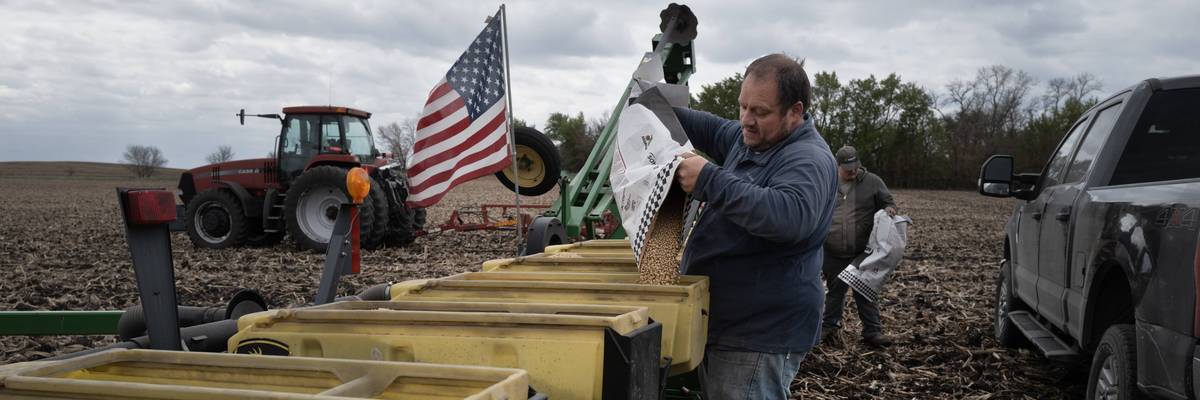
Alan Montag, a third-generation Iowa farmer, and his son Aden load soybean seed into a planter on May 6, 2026 near West Bend, Iowa.
"I think a lot of people expected that maybe the war would wrap up and the prices would go down some... then it just skyrocketed," said one farmer of the cost of diesel.
Farmers across the US are speaking up about their struggles as President Donald Trump's illegal war with Iran and trade war with Canada are taking a hammer to their finances.
In an interview with CBS News published Thursday, North Carolina farmer Matt Bell revealed that "I have never worried and stressed like I have the last year," thanks to the soaring costs of fuel, fertilizer, and farm equipment, all of which have gotten more expensive thanks to Trump's policies.
"The fertilizer, fuel, chemicals, seed, parts—you know, the whole nine yards," said Bell, "everything that we touch has gone up."
"We are fighting for survival."
Matt Bell, 52, has been farming for more than half his life in central North Carolina.
He grows soybeans, corn and wheat and raises beef cattle on more than 1,000 acres. But Bell, who voted for President Trump, says soaring prices for fuel,… pic.twitter.com/9ELYXkJywt
— CBS News (@CBSNews) September 18, 2026
Bell, who voted for Trump, said he feels "misled" and "strung along" when it comes to the president's rationale for attacking Iran without congressional authorization in February.
The North Carolina farmer said his costs for diesel fuel have doubled in the last year, driven in large part by Trump's war.
According to data released Friday by the American Automobile Association, the average price of diesel in the US now stands at a record-high $6.45 per gallon, a 74% increase of the average price of diesel one year ago.
"We are fighting for survival," Bell emphasized, "and we're running out of options."
Bell is far from the only farmer struggling.
Theresa Sisung, commodity and regulatory relations manager at the Michigan Farm Bureau, said in an interview with Up North Live that farmers in the state are about to "use a ton of fuel on their farms" due to the start of harvest season, making the record-high diesel prices particularly inconvenient.
"We have seen a slight increase in farm bankruptcies across the nation," said Sisung. "We are seeing those farms that are more stressed. We've had some negative margins for farms for a few years now, so there is certainly stress out in the countryside."
Michigan farmer Russell Ketchum told Up North Live that the high diesel prices have made what was already a challenging year and farming even more difficult.
"We started out the year with a lot of cold weather, a lot of freeze damage," Ketchum explained, "so we've been working on short crops all year and then the diesel fuel prices and the gas prices all on top of that, they made everything challenging to say the least."
North Dakota farmer Chris McDonald told the North Dakota Monitor in an interview published Wednesday that diesel prices have climbed so high that they "can erase your profit."
McDonald also tied the increase in diesel costs directly to Trump's war, which the president said would only last a matter of weeks but has since dragged on for more than six months.
"I think a lot of people expected that maybe the war would wrap up," said McDonald, "and the prices would go down some, and they never really did drop very much. Then it just skyrocketed.”
The Iran War isn't the only Trump policy that's hurting US agriculture and bringing pain to US farming families, as a Tuesday NPR report highlighted the impact that the president's trade war with Canada is having on farmers in Montana.
As noted by NPR, Canada is Montana's biggest trading partner, as it accounts for "$1 billion in cross-border sales." But the tariffs imposed by Trump, and the counter-tariffs imposed by Canada, have both harmed Montana farmers' sales and made the equipment they buy more expensive.
Steve Sheffels, a Montana wheat farmer, told NPR that he'd like to buy "a new drill" and some "grain bins that come out of Canada," but now fears that "I won't be able to afford them" thanks to the trade war.
Sheffels, whose wife is Canadian, also told NPR that he was not happy to see America's relationship with its largest trading partner deteriorate throughout Trump's second term.
"You don't treat your neighbors like this," he said.
Dear Common Dreams reader, It’s been nearly 30 years since I co-founded Common Dreams with my late wife, Lina Newhouser. We had the radical notion that journalism should serve the public good, not corporate profits. It was clear to us from the outset what it would take to build such a project. No paid advertisements. No corporate sponsors. No millionaire publisher telling us what to think or do. Many people said we wouldn't last a year, but we proved those doubters wrong. Together with a tremendous team of journalists and dedicated staff, we built an independent media outlet free from the constraints of profits and corporate control. Our mission has always been simple: To inform. To inspire. To ignite change for the common good. Building Common Dreams was not easy. Our survival was never guaranteed. When you take on the most powerful forces—Wall Street greed, fossil fuel industry destruction, Big Tech lobbyists, and uber-rich oligarchs who have spent billions upon billions rigging the economy and democracy in their favor—the only bulwark you have is supporters who believe in your work. But here’s the urgent message from me today. It's never been this bad out there. And it's never been this hard to keep us going. At the very moment Common Dreams is most needed, the threats we face are intensifying. We need your support now more than ever. We don't accept corporate advertising and never will. We don't have a paywall because we don't think people should be blocked from critical news based on their ability to pay. Everything we do is funded by the donations of readers like you. When everyone does the little they can afford, we are strong. But if that support retreats or dries up, so do we. Will you donate now to make sure Common Dreams not only survives but thrives? —Craig Brown, Co-founder |
Farmers across the US are speaking up about their struggles as President Donald Trump's illegal war with Iran and trade war with Canada are taking a hammer to their finances.
In an interview with CBS News published Thursday, North Carolina farmer Matt Bell revealed that "I have never worried and stressed like I have the last year," thanks to the soaring costs of fuel, fertilizer, and farm equipment, all of which have gotten more expensive thanks to Trump's policies.
"The fertilizer, fuel, chemicals, seed, parts—you know, the whole nine yards," said Bell, "everything that we touch has gone up."
"We are fighting for survival."
Matt Bell, 52, has been farming for more than half his life in central North Carolina.
He grows soybeans, corn and wheat and raises beef cattle on more than 1,000 acres. But Bell, who voted for President Trump, says soaring prices for fuel,… pic.twitter.com/9ELYXkJywt
— CBS News (@CBSNews) September 18, 2026
Bell, who voted for Trump, said he feels "misled" and "strung along" when it comes to the president's rationale for attacking Iran without congressional authorization in February.
The North Carolina farmer said his costs for diesel fuel have doubled in the last year, driven in large part by Trump's war.
According to data released Friday by the American Automobile Association, the average price of diesel in the US now stands at a record-high $6.45 per gallon, a 74% increase of the average price of diesel one year ago.
"We are fighting for survival," Bell emphasized, "and we're running out of options."
Bell is far from the only farmer struggling.
Theresa Sisung, commodity and regulatory relations manager at the Michigan Farm Bureau, said in an interview with Up North Live that farmers in the state are about to "use a ton of fuel on their farms" due to the start of harvest season, making the record-high diesel prices particularly inconvenient.
"We have seen a slight increase in farm bankruptcies across the nation," said Sisung. "We are seeing those farms that are more stressed. We've had some negative margins for farms for a few years now, so there is certainly stress out in the countryside."
Michigan farmer Russell Ketchum told Up North Live that the high diesel prices have made what was already a challenging year and farming even more difficult.
"We started out the year with a lot of cold weather, a lot of freeze damage," Ketchum explained, "so we've been working on short crops all year and then the diesel fuel prices and the gas prices all on top of that, they made everything challenging to say the least."
North Dakota farmer Chris McDonald told the North Dakota Monitor in an interview published Wednesday that diesel prices have climbed so high that they "can erase your profit."
McDonald also tied the increase in diesel costs directly to Trump's war, which the president said would only last a matter of weeks but has since dragged on for more than six months.
"I think a lot of people expected that maybe the war would wrap up," said McDonald, "and the prices would go down some, and they never really did drop very much. Then it just skyrocketed.”
The Iran War isn't the only Trump policy that's hurting US agriculture and bringing pain to US farming families, as a Tuesday NPR report highlighted the impact that the president's trade war with Canada is having on farmers in Montana.
As noted by NPR, Canada is Montana's biggest trading partner, as it accounts for "$1 billion in cross-border sales." But the tariffs imposed by Trump, and the counter-tariffs imposed by Canada, have both harmed Montana farmers' sales and made the equipment they buy more expensive.
Steve Sheffels, a Montana wheat farmer, told NPR that he'd like to buy "a new drill" and some "grain bins that come out of Canada," but now fears that "I won't be able to afford them" thanks to the trade war.
Sheffels, whose wife is Canadian, also told NPR that he was not happy to see America's relationship with its largest trading partner deteriorate throughout Trump's second term.
"You don't treat your neighbors like this," he said.
Farmers across the US are speaking up about their struggles as President Donald Trump's illegal war with Iran and trade war with Canada are taking a hammer to their finances.
In an interview with CBS News published Thursday, North Carolina farmer Matt Bell revealed that "I have never worried and stressed like I have the last year," thanks to the soaring costs of fuel, fertilizer, and farm equipment, all of which have gotten more expensive thanks to Trump's policies.
"The fertilizer, fuel, chemicals, seed, parts—you know, the whole nine yards," said Bell, "everything that we touch has gone up."
"We are fighting for survival."
Matt Bell, 52, has been farming for more than half his life in central North Carolina.
He grows soybeans, corn and wheat and raises beef cattle on more than 1,000 acres. But Bell, who voted for President Trump, says soaring prices for fuel,… pic.twitter.com/9ELYXkJywt
— CBS News (@CBSNews) September 18, 2026
Bell, who voted for Trump, said he feels "misled" and "strung along" when it comes to the president's rationale for attacking Iran without congressional authorization in February.
The North Carolina farmer said his costs for diesel fuel have doubled in the last year, driven in large part by Trump's war.
According to data released Friday by the American Automobile Association, the average price of diesel in the US now stands at a record-high $6.45 per gallon, a 74% increase of the average price of diesel one year ago.
"We are fighting for survival," Bell emphasized, "and we're running out of options."
Bell is far from the only farmer struggling.
Theresa Sisung, commodity and regulatory relations manager at the Michigan Farm Bureau, said in an interview with Up North Live that farmers in the state are about to "use a ton of fuel on their farms" due to the start of harvest season, making the record-high diesel prices particularly inconvenient.
"We have seen a slight increase in farm bankruptcies across the nation," said Sisung. "We are seeing those farms that are more stressed. We've had some negative margins for farms for a few years now, so there is certainly stress out in the countryside."
Michigan farmer Russell Ketchum told Up North Live that the high diesel prices have made what was already a challenging year and farming even more difficult.
"We started out the year with a lot of cold weather, a lot of freeze damage," Ketchum explained, "so we've been working on short crops all year and then the diesel fuel prices and the gas prices all on top of that, they made everything challenging to say the least."
North Dakota farmer Chris McDonald told the North Dakota Monitor in an interview published Wednesday that diesel prices have climbed so high that they "can erase your profit."
McDonald also tied the increase in diesel costs directly to Trump's war, which the president said would only last a matter of weeks but has since dragged on for more than six months.
"I think a lot of people expected that maybe the war would wrap up," said McDonald, "and the prices would go down some, and they never really did drop very much. Then it just skyrocketed.”
The Iran War isn't the only Trump policy that's hurting US agriculture and bringing pain to US farming families, as a Tuesday NPR report highlighted the impact that the president's trade war with Canada is having on farmers in Montana.
As noted by NPR, Canada is Montana's biggest trading partner, as it accounts for "$1 billion in cross-border sales." But the tariffs imposed by Trump, and the counter-tariffs imposed by Canada, have both harmed Montana farmers' sales and made the equipment they buy more expensive.
Steve Sheffels, a Montana wheat farmer, told NPR that he'd like to buy "a new drill" and some "grain bins that come out of Canada," but now fears that "I won't be able to afford them" thanks to the trade war.
Sheffels, whose wife is Canadian, also told NPR that he was not happy to see America's relationship with its largest trading partner deteriorate throughout Trump's second term.
"You don't treat your neighbors like this," he said.