

SUBSCRIBE TO OUR FREE NEWSLETTER
Daily news & progressive opinion—funded by the people, not the corporations—delivered straight to your inbox.
5
#000000
#FFFFFF
To donate by check, phone, or other method, see our More Ways to Give page.
Daily news & progressive opinion—funded by the people, not the corporations—delivered straight to your inbox.

At this challenging time, 80 years since the founding of the United Nations and the bombings of Hiroshima and Nagasaki in a world torn apart by war, there is hope for a just, environmentally sustainable, and peaceful world.
With two significant interconnected anniversaries occurring this week, Sunday marked the 44th anniversary of the United Nations International Day of Peace. This year‘s theme, “Act Now for a Peaceful World,“ is a call to action, identifying individual responsibility and collective power in “cultivating a culture of peace.“
Noting that this year finds a time of global turbulence, tumult, and uncertainty, it is easy to find oneself despairing. Surrendering to this challenge fuels despair. Hope is realized in identifying our individual response and working together to realize collective power. We must discard outmoded “us and them” thinking, realizing that we are one interconnected human family on this fragile planet that will either learn to live together or perish together.
Everyone has a role to play, and each of us must decide what that role is. It is not necessarily a large role or a small role, it is our role. We can no longer assume that “they will take care of it.” They, are us! We must speak up against violence, hate, discrimination, and inequality. We must practice respect and embrace the diversity of our world. The International Day of Peace builds on the Sustainable Development Goals of the United Nations. The theme aligns with the broader UN goals of sustainable development, recognizing that a peaceful world is intrinsically linked to social justice, equality, and environmental sustainability.
This week also marks the 11th anniversary of the “UN International Day for the Total Elimination of Nuclear Weapons” on September 26. With current global nuclear arsenals numbering 12,241 weapons, there is no humanitarian, social, or environmental justice and no sustainability as long as these weapons exist. Everything and everyone we care about is threatened. We must recognize the social and economic costs of the continued existence of these weapons. The United States is spending over $110 billion on all nuclear weapons programs in FY 2025 equating to over $209,000 every minute of every day on these weapons with plans for massive expansion of these expenditures in the years to come under the misguided myths of deterrence and “more is better.“
Ultimately there cannot be peace with the planet until there is peace on the planet.
Fortunately, there is hope in the effort to eliminate these weapons both here at home and around the world. The International Campaign to Abolish Nuclear Weapons was instrumental in the development and adoption of the International Treaty on the Prohibition of Nuclear Weapons, which makes nuclear weapons illegal to have, develop, transfer, use, or threaten to use under international treaty, just as all other weapons of mass destruction are.
At a time when our world is closer to nuclear war than at any time since the bombings of Hiroshima and Nagasaki, 89 seconds till “Doomsday” per the Bulletin of Atomic Scientists, there is a growing movement here in the United States to eliminate these weapons. It is called Back From the Brink. This movement that supports the international effort is bringing communities together to abolish nuclear weapons and making the connection between our future and sustainability goals. Currently there are 502 national organizations, 78 municipalities and counties, eight state legislative bodies, 487 municipal and state officials, and 51 members of Congress endorsing. The people‘s voice is rising and being heard and is the best way to affect federal policy. When the people speak, the leaders will follow. This movement can be endorsed by all, and everyone is encouraged to take the simple action of reaching out to your elected officials, both in the US House, Senate, and local officials to endorse this campaign.
So at this challenging time, 80 years since the founding of the United Nations and the bombings of Hiroshima and Nagasaki in a world torn apart by war, there is hope for a just, environmentally sustainable, and peaceful world. Ultimately there cannot be peace with the planet until there is peace on the planet. The choice is ours. It is in our hands on this week of the International Day of Peace.
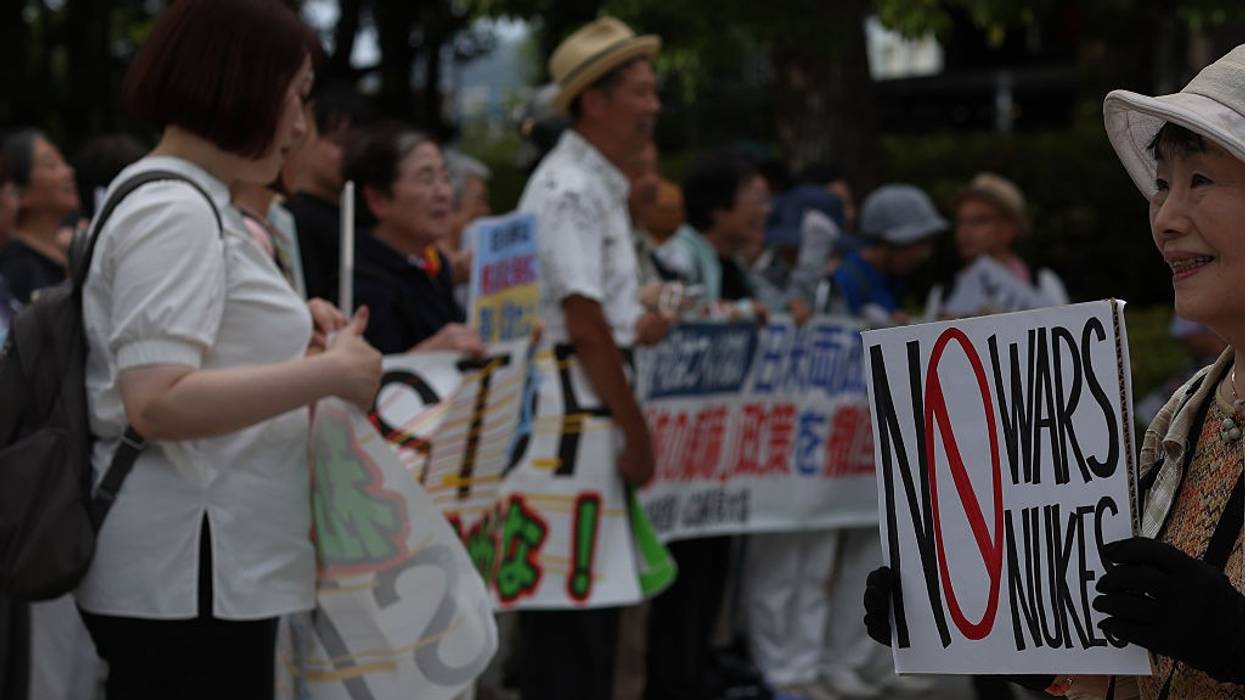
The hibakusha, or survivors, "deserve to see their work vindicated and to witness the end of these inhumane, indiscriminate weapons of total destruction in their lifetime," said ICAN's leader.
Survivors of the U.S. atomic bombing of Hiroshima and other nuclear abolitionists renewed calls for ridding the world of nukes on Wednesday, the 80th anniversary of the American attack on the Japanese city.
During the annual Peace Memorial Ceremony in Japan, Hiroshima Mayor Kazumi Matsui pointed to Israel's assault on the Gaza Strip and the Russian invasion of Ukraine, which have contributed to the narrative that nuclear weapons are necessary for national defense and elevated global fears of their use.
"These developments flagrantly disregard the lessons the international community should have learned from the tragedies of history," he said. Russia and the United States—which is arming Ukraine and Israel—have the largest nuclear arsenals. The other nuclear-armed nations are China, France, India, Israel, North Korea, Pakistan, and the United Kingdom.
"Despite the current turmoil at the nation-state level, we, the people, must never give up," Matsui added. "Instead, we must work even harder to build civil society consensus that nuclear weapons must be abolished for a genuinely peaceful world."
Silent prayers were held in the Japanese city of Hiroshima, marking 80 years since the atomic bombing of the city by the US on August 6, 1945.
[image or embed]
— Al Jazeera English (@aljazeera.com) August 6, 2025 at 6:35 AM
The mayor also urged the Japanese government to respect the wishes of hibakusha, or survivors, and join the United Nations Treaty on the Prohibition of Nuclear Weapons (TPNW), which was adopted in 2017 and took effect in 2021.
"The treaty not only bans nuclear weapons and all activities related to their production, deployment, and use, but also mandates that countries that joined the treaty provide support for people harmed by nuclear weapons in the past and for the cleanup of areas that were used for nuclear testing," survivor Terumi Tanaka noted Wednesday in a New York Times opinion piece.
Tanaka was 13 years old at the time of the bombing—an experience he recounted last year, while accepting the Nobel Peace Prize on behalf of a group he co-chairs: Nihon Hidankyo, also known as the Japan Confederation of A- and H-Bomb Sufferers.
"Our Nobel Peace Prize sends a message to younger people that they need to be aware that we are facing an emergency—and the need to see a larger movement of young activists working to address the nuclear threat," 93-year-old Tanaka wrote Wednesday. "Even here in Japan, not enough people see this as a pressing issue."
The International Campaign to Abolish Nuclear Weapons (ICAN)—which won the Nobel Peace Prize after playing a significant role in building support for the TPNW in 2017—also used the anniversary to advocate for abolishing nuclear weapons.
ICAN executive Melissa Parke, who joined the ceremony in Japan, said in a statement that "it is not possible to come to Hiroshima and attend these solemn commemorations without being moved as well as convinced of the urgent need for nuclear weapons to be eliminated."
"The hibakusha, who were awarded last year's Nobel Peace Prize for their tenacious campaigning for the elimination of nuclear weapons, deserve to see their work vindicated and to witness the end of these inhumane, indiscriminate weapons of total destruction in their lifetime," Parke argued. "That means the nine nuclear-armed countries, most of which were represented here today, must heed their call to join the U.N. Treaty on the Prohibition of Nuclear Weapons and get rid of their arsenals."
As we mark 80 years since the atomic bombings of Japan, CND Vice-President Caroline Lucas writes from Hiroshima and asks why are nuclear powers ditching disarmament for a new nuclear arms race? Read more: www.independent.co.uk/voices/hiros...
[image or embed]
— Campaign for Nuclear Disarmament (@cnduk.bsky.social) August 6, 2025 at 8:03 AM
In a Common Dreams opinion piece about the youth impacted by the 1945 bombings, ICAN treaty coordinator Tim Wright wrote: "The fact that children would suffer the greatest harm of all in the event of a nuclear attack against a city today should have profound implications for policymaking in nuclear-armed states and spur action for disarmament. Yet, all nine such states continue to act contrary to that objective. And the risk of a nuclear weapon being used again appears to be at an all-time high."
Common Dreams also published related opinions from Gerry Condon, a Vietnam-era veteran and former president of Veterans for Peace; Austin Headrick, public education and advocacy coordinator for Asia at American Friends Service Committee; and Ann Wright, a U.S. Army veteran who resigned from the U.S. State Department in opposition to the 2003 invasion of Iraq.
Speaking at the ongoing 2025 World Conference Against Atomic and Hydrogen Bombs, Wright noted that "there are a multitude of organizations in the United States and around the world that are working for the elimination of nuclear weapons."
"As we commemorate the lives lost and damaged by nuclear weapons 80 years ago," she said, "we commit ourselves to work harder for the elimination of these weapons, taking on our governments and the industries that make money from the construction and testing of these weapons of mass destruction."
ICAN in June released a report showing that the world's nine nuclear-armed nations spent more than $100 billion on their arsenals last year, up 11% from 2023. A few days later, the Stockholm International Peace Research Institute's annual yearbook warned that "a dangerous new nuclear arms race is emerging at a time when arms control regimes are severely weakened."
Those reports followed similar warnings from the experts behind the Doomsday Clock, who in January set the symbol of how close the world is to apocalypse at "89 seconds to midnight—the closest it has ever been to catastrophe."
Fueling fears of such a catastrophe, U.S. President Donald Trump said last Friday that he "ordered two Nuclear Submarines to be positioned in the appropriate regions" in response to "highly provocative statements" by former Russian President Dmitry Medvedev, who is now the deputy chairman of Russia's Security Council.
During Trump's first term, he withdrew the United States from the 1987 Intermediate-range Nuclear Forces Treaty with Russia—after which the Kremlin declared a self-imposed moratorium on the deployment of those missiles. The Russian Foreign Ministry announced Monday that it will no longer abide by its rules, citing recent moves by the U.S. and its allies.
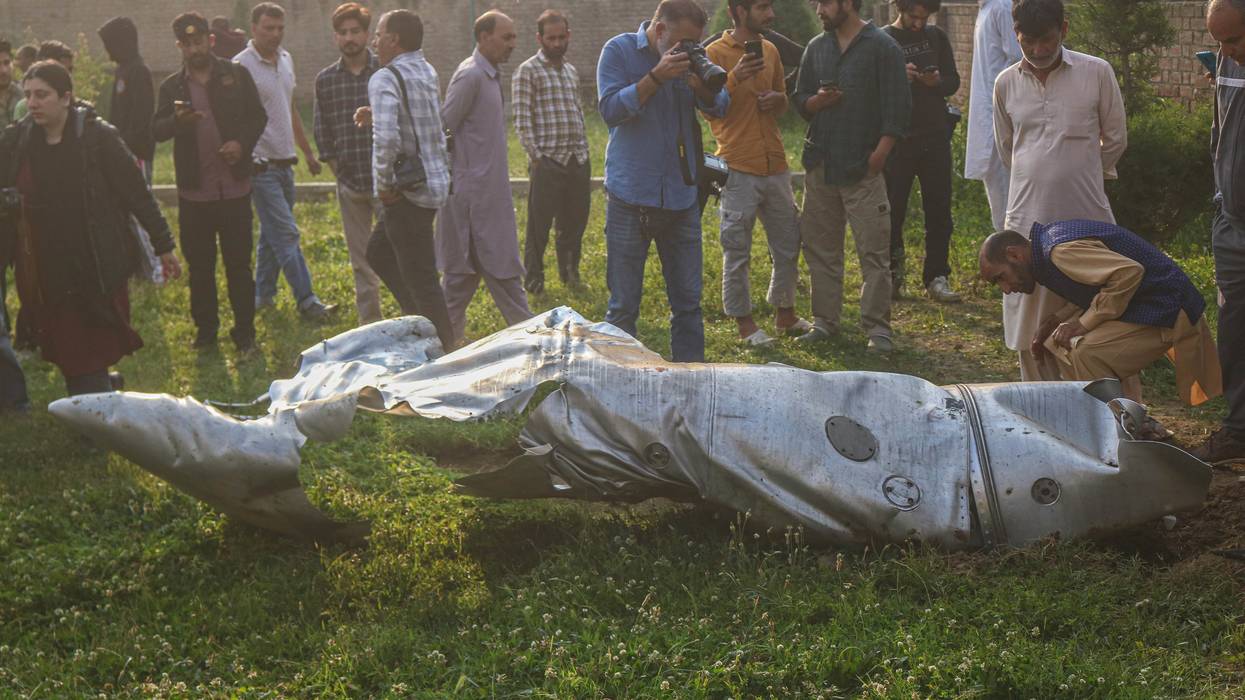
Nobel-winning nuclear abolition group called on "the international community to redouble efforts toward disarmament through the Treaty on the Prohibition of Nuclear Weapons."
Fear of potential war between India and Pakistan, both nuclear-armed nations, rose after India launched deadly strikes on Pakistan and Pakistani Kashmir early Wednesday local time—prompting the nuclear nonproliferation group the International Campaign to Abolish Nuclear Weapons to call for de-escalation between the two countries.
In retaliation on Wednesday, Pakistan shot down several Indian aircraft. The fighting is the latest in escalating tensions that have risen since last month's Kashmir massacre. India has blamed Pakistan for the April 22 attack in which armed militants killed tourists in Indian-administered Jammu and Kashmir, while the Pakistani government has called for a "neutral" probe.
Both countries control parts of Kashmir but claim it in full.
"A nuclear exchange between India and Pakistan would cause millions of immediate deaths in the region and have global consequences," said executive director of the International Campaign to Abolish Nuclear Weapons (ICAN) Melissa Parke in a Wednesday statement.
Parke pointed to a study published in 2022 in Nature Food, which found that even a more limited nuclear war between the two countries could have devastating consequences for global food supplies and could lead to the deaths of a sizable portion of the world's population. The authors of the study also estimated that more than 2 billion people could die from nuclear war between India and Pakistan due to famine.
"No country would be spared. No government can protect its people from the consequences," said Parke.
"This is exactly why nuclear weapons must be eliminated. ICAN calls on both governments to show restraint and de-escalate, and calls on the international community to redouble efforts toward disarmament through the Treaty on the Prohibition of Nuclear Weapons," Parke continued. "The only way to guarantee these weapons are never used is to ban and eliminate them."
The U.N. Treaty on the Prohibition of Nuclear Weapons is a global agreement that bans the possession, use, and testing of nuclear weapons. The treaty has 94 signatories and 73 state parties, though neither Pakistan nor India have signed or are a party to it.
ICAN won the 2017 Nobel Peace Prize in part due to its work on the treaty.

Works like Promemoria—Reminder (Sending Out an SOS) by EMA can get to the heart of the matter by tapping not just the intellect but the emotions, putting us in touch with a deeper sense of meaning too often ignored in our rush to deal with the crises of the moment.
The world is in danger, mind-numbingly so, from a combination of crises: disease, hunger, mass displacement, racial and economic inequality, war and the threat of more war, a rampaging climate crisis, and an accelerating nuclear arms race (and that’s just for starters)—all occurring in a climate of massive mis- and disinformation that makes it ever harder to build a consensus toward solutions to the multiple problems we face.
Words can’t fully express our current predicament. We need other tools and other ways of making sense of the situation we now find ourselves in.
This should be a time for action and activism on behalf of our species and our planet. While there’s certainly a fair amount of that already, the combined weight of the risks we face makes all too many of us turn inward toward family and friends, or outward to find scapegoats for our problems. And yes, there are still moments of joy, optimism, and constructive action. Unfortunately, they are increasingly hard to sustain amid relentless daily attacks on people’s lives, livelihoods, and basic dignity.
One of the best ways to find a place of balance and light amid all the chaos is by creating and appreciating art, which can get to the heart of the matter by tapping not just the intellect but the emotions, putting us in touch with a deeper sense of meaning too often ignored in our rush to deal with the crises of the moment.
It’s in this context that I read and viewed Promemoria—Reminder (Sending Out an SOS) by EMA (Enrico Muratore Aprosio), a Geneva-based human rights advocate, humanitarian, and artist. The words in the book, which addresses Covid-19, the climate, and the prospects of nuclear war through poetry, prose, and storytelling, are compelling. But the artworks that punctuate the text are truly stunning, using bright colors and complex designs that incorporate pictures of both historical and imaginary figures—its images ranging from Karl Marx to Marilyn Monroe, Ronald Reagan to the Mona Lisa (wearing a Covid-19 protective mask).
The book honors the spirit of altruism and courage, most notably in a section dedicated to Mbaye Diagne, a Senegalese peacekeeper who saved up to 1,000 lives amid the 1994 genocide in Rwanda, only to be killed in a mortar attack 12 days before he was set to return home.
Melissa Parke, director general of the Nobel Prize-winning International Coalition to Abolish Nuclear Weapons, captures the sense of the book well, suggesting that Aprosio’s “use of beautiful animals, striking colors, and magical happenings communicates both the urgency of the situation we face and reminds us of what we stand to lose if we don’t change course.”
Not only will the book have its own impact, but it will hopefully inspire others to produce projects that address our most urgent problems in new ways, moving people to take action grounded in our common humanity.
Appreciating what we still stand to lose couldn’t be more crucial in the world we now face. Savoring everything from the signal achievements of humanity (writ large) to the pleasures and accomplishments of our everyday lives matters deeply, both as a motivation to continue working for change in an ever-messier world and as fuel for sustaining us in a struggle of unknown duration.
Yes, EMA’s book is grimly grounded in reality, even as it (literally) paints a picture of a world that could be so much better. One of my favorite panels in the book is entitled “Every Day More Bullshit,” just because, well, it seems all too sadly appropriate to the moment we’re in.
There’s also a chapter called “Radioactive Beasts,” inspired by George Orwell’s dystopian novel Animal Farm. The animals Aprosio writes about are worried by the state of the world and concerned that humans aren’t taking the risks posed by current conflicts seriously enough.
In April 2023, some of Aprosio’s fictional beasts were projected onto buildings in New York City’s Times Square with support from the International Campaign to Abolish Nuclear Weapons (ICAN). Other portions of the book could be displayed across this embattled planet of ours in a similar fashion to good effect.
There’s more to EMA’s book than can be taken in at a sitting, or even many sittings, or certainly summarized in an essay like this. Still, get your hands on it if you can. It can serve as an inspirational reference work you can dip into at any time to reenergize yourself or contemplate what a different world might indeed look like. In that way, it reminds me of the effects of Afrofuturist art and literature, not because the forms necessarily resemble each other, but because both approaches underscore the desperate need for a bold vision of what a new world might look like—a vision of what anyone trying to change things might dream of.
Promemoria is anything but the only current art project that takes on nuclear weapons and related dangers. One of the most interesting current networks is Artists Against the Bomb, a global organization of creators who have produced an amazing array of antinuclear posters, among other works.
Another vital project in a world where nuclear weapons are proliferating and the U.S. is planning to invest up to $2 trillion dollars in the (yes, this is indeed the term!) “modernization” of its nuclear force in the coming decades is Bombshelltoe. It’s a policy and arts collective that defines itself as “a creative organization pushing for an active exploration of arts, culture, and history to promote nuclear nonproliferation, arms control, and disarmament for the next generation.” One of its prominent efforts is the Atomic Terrain Project, which highlights how nuclear weapons have “seeped into our waters and tapped into our soil” and “continue to harm all life, human and non-human alike.”
I was fortunate enough to see an exhibition that the project mounted at the 2024 New York Art Book Fair entitled “How to Make a Bomb”—a book with the same title was also released then—organized and presented by Gabriella Hirst, Warren Harper, Tammy Nguyen, and Lovely Umayam (the founder of Bombshelltoe). The exhibit was built around a flower, the Rosa Floribunda, or—yes!—“Atom Bomb,” which Hirst describes as “a garden rose that was cultivated and named in 1953 during the Cold War arms race to commemorate Britain’s newfound status as a nuclear power.” Hirst has taken the lead in cultivating (and you might say pacifying) that rose, while getting it planted in gardens throughout the United Kingdom and beyond as an antinuclear gesture of beauty.
At the book fair, attendees could learn how to plant and maintain just such a rose while engaging in conversations about the history and devastating impact of nuclear weapons or checking out basic documents and books about the nuclear age. Such an indirect (even flowery!) route into truly grim subject matter drew interest from people who might not normally pick up a book on, or read an article about, the dangers of nuclear weapons but were fascinated by the physical process of grafting a rose and then willing to stay for open-ended conversations about the growing nuclear dangers in our world.
When asked why the project chose to use a rose as an entry point into discussions of such ominous and grim subject matter, Lovely Umayam noted that “nuclear issues alone can feel abstract and alarmist” and eerily unapproachable. As Gabriella Hirst put it, the project “is about taking the sublime into your own hands and working through that in small ways… to reduce fear among non-experts.”
At the same book fair where I encountered the Rose Project, I had the pleasure of meeting Ben Rejali, an organizer of the art and political website Khabar Keslan. Recent essays there include an interview with Palestinian filmmaker Khaled Jarrar, but I was first drawn to the project’s printed works, including reproductions of stamps from Iran and South Asia going back to the 1950s. There were, of course, numerous stamps portraying the once-dreaded Shah of Iran. There was also one of the CIA’s logo with blood running down it, a reference to the agency’s role in the 1953 coup that installed the Shah as Iran’s autocratic ruler. Perhaps the most emotionally powerful product of Khabar Keslan, however, may have been a collection of poems entitled “Salute to Olives” by the late Omar al-Bargouthi, many of which were written while he was being held in Israeli prisons.
On a planet where nuclear dangers are only growing, both Promemoria and the Atomic Terrain project underscore the importance of finding new ways to communicate about this increasingly fragile and endangered planet of ours that inspire creativity and action rather than fear, paralysis, and denial. At a time when challenges to fundamental rights are hurtling toward us at warp speed, taking the time to experience artworks of any kind can seem like a distinct luxury, but don’t believe that for a second. Such art is a key to reclaiming our humanity and getting in touch with the creative, collaborative impulses that could help save our planet. A pause, artistic in nature, to reflect and recharge our psychic batteries can go a long way toward helping us to cope with this all too strange present moment and build for the future. Promemoria provides us with that precious opportunity.
Music, theater, painting, and other forms of artistic expression have, in fact, been part of every major movement for change in recent memory. The Federal Theatre Project of the 1930s, funded as part of the Works Progress Administration of President Franklin D. Roosevelt in the era of the Great Depression, hired unemployed performers and writers who produced more than 800 plays and dance events. In the process, they highlighted work by under-represented groups, including African Americans via the Negro Theatre Project and the African-American Dance Unit. It also funded foreign language plays in Spanish, Yiddish, and German until Congressman Martin Dies, Jr., head of the House Un-American Activities Committee, led a successful charge to defund the program because of its advocacy of racial equality and other progressive themes.
Theater, however, continued to play a central role in progressive movements of the 1960s and 1970s, from Teatro Campesino, born during the United Farm Workers Union’s organizing drives in California; to the Bread and Puppet Theater, a staple of anti-war efforts; and the San Francisco Mime Troupe, whose plays captured a whole range of progressive themes, often in hilarious fashion. And don’t forget the freedom songs that were at the core of the civil rights movement, sung by demonstrators at mass rallies and activists detained in local jails in the South.
The anti-nuclear movement of the 1980s was also sustained and amplified by works of art. Its best-known cultural product was undoubtedly the TV movie The Day After, a fictionalized treatment of the impacts of a nuclear war viewed by more than 100 million people when it aired on ABC in November 1983. But there was also a steady drumbeat of anti-nuclear cartoons, some of which were assembled in a widely distributed collection entitled Warheads. Joel Andreas’s 77-page graphic comic book, Addicted to War: Why America Can’t Kick Militarism, proved to be a primer on the roots of the American war system from the 19th-century vision of “manifest destiny” to (in an updated edition) the Global War on Terror, taking on war profiteers and the role of the media along the way.
More recently, groups like the Yes Men and Reverend Billy and the Stop Shopping Choir have lampooned corporations and their executives through street theater and by posing as participants in corporate gatherings (and so underscoring the absurdity of their activities and world views). The Yes Men describe their work as using “humor and trickery to highlight the corporate takeover of society, the neoliberal delusion that allows it, [and] the corporate Democrats’ responsibility for our current situation.” Reverend Billy and the Stop Shopping Choir ridicule materialism in all its forms from Starbucks displacing local coffee shops to the excesses of the Disney Store in New York’s Times Square.
Paul Miller, aka DJ Spooky, has similarly engaged in a wide range of politically focused art projects, ranging from a Peace Symphony performed in Hiroshima to The Book of Ice, which addresses climate change, to a wide array of films, articles, and concerts. Robin Bell Visuals has produced films and art installations, including projecting the words “Pay Bribes Here” on the side of the Trump International Hotel in Washington. And there have been scores of anti-war anthems produced in virtually every genre of modern music from folk to jazz to rock to hip hop to heavy metal.
My colleague Khody Akhavi makes short compelling videos on topics ranging from the dangerous rise of AI-driven weaponry to the impact of the funding of think tanks by weapons contractors, the Pentagon, and foreign governments. And the Center for Artistic Activism partners with advocacy groups on specific projects, schools them in artistic techniques, and helps them build art into their campaigns and public education efforts. Their slogan: “we make social and environmental change more effective—and more creative.”
Better yet, the artists and projects cited above are just a sampling of the many forms of political art that have attracted audiences and encouraged activism at the local, national, and global levels. Promemoria is a worthy addition to this tradition. Not only will the book have its own impact, but it will hopefully inspire others to produce projects that address our most urgent problems in new ways, moving people to take action grounded in our common humanity. Given the world we’re now in, it can’t happen soon enough.
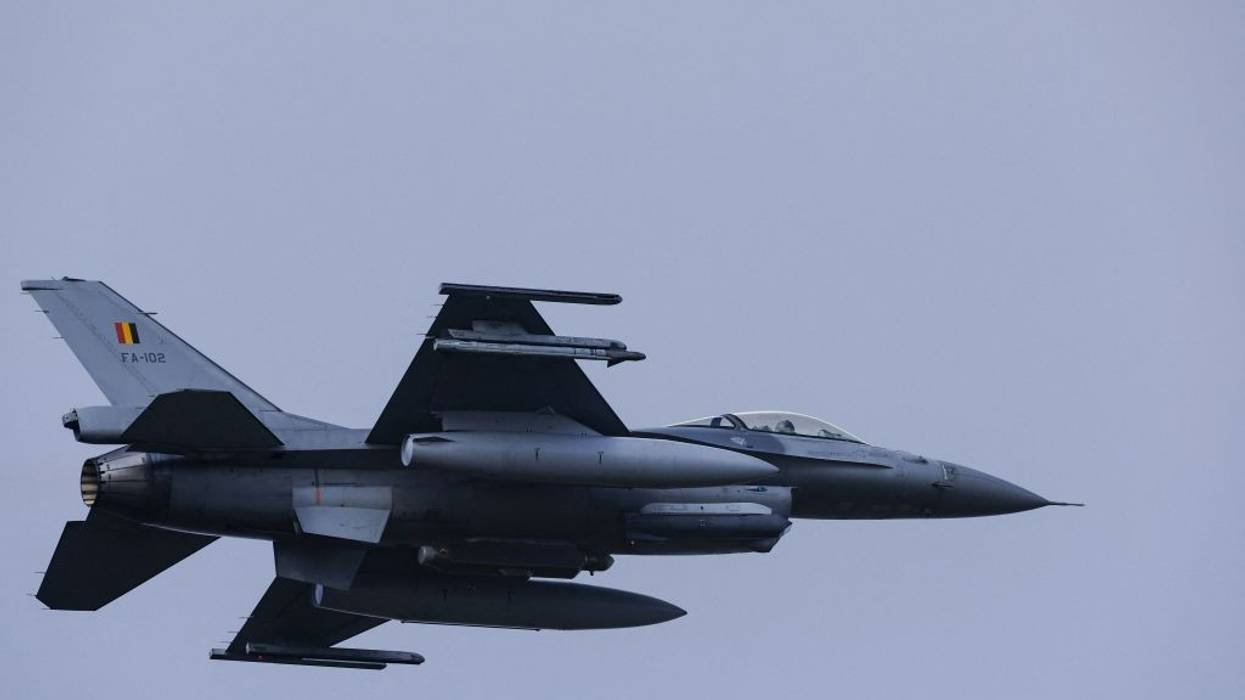
Disarmament advocate Beatrice Fihn stressed that the exercise is practice for "wiping out hundreds of thousands of civilians" with weapons that would also "flatten cities and poison survivors."
The NATO military block announced Friday that its annual nuclear exercise is set to begin next week—news that arrived just as Japanese atomic bomb survivors who advocate for disarmament received the Nobel Peace Prize.
"There is bad timing, there is dropping a brick... and then there is this. Nice work," the Geneva Nuclear Disarmament Initiative said in response to NATO Spokesperson Farah Dakhlallah on social media.
Dakhlallah shared a NATO statement explaining that "Steadfast Noon," the two-week military drills scheduled to start Monday, will include 2,000 soldiers from eight air bases and more than 60 "nuclear-capable jets, bombers, fighter escorts, refueling aircraft, and planes capable of reconnaissance and electronic warfare" flying over western Europe.
"Nuclear deterrence is the cornerstone of allied security," NATO Secretary General Mark Rutte said in the statement. "Steadfast Noon is an important test of the alliance's nuclear deterrent and sends a clear message to any adversary that NATO will protect and defend all allies."
Mary Wareham, deputy director of the crisis, conflict, and arms division at Human Rights Watch, also responded to the spokesperson on social media, asking, "Any comment from NATO on today's announcement that the Norwegian Nobel Committee has awarded the 2024 Nobel Peace Prize to the Japanese association of atomic bomb survivors organization Nihon Hidankyo?"
Since the United States dropped atomic bombs on the Japanese cities of Hiroshima and Nagasaki in 1945, survivors known as hibakusha have shared their experiences to promote peace. The Norwegian Nobel Committee on Friday honored the group Nihon Hidankyo, which "has provided thousands of witness accounts, issued resolutions and public appeals, and sent annual delegations to the United Nations and a variety of peace conferences to remind the world of the pressing need for nuclear disarmament."
The committee highlighted that "the nuclear powers are modernizing and upgrading their arsenals; new countries appear to be preparing to acquire nuclear weapons; and threats are being made to use nuclear weapons in ongoing warfare. At this moment in human history, it is worth reminding ourselves what nuclear weapons are: the most destructive weapons the world has ever seen."
The peace award and plans for NATO's exercise come as Russia's invasion of Ukraine, Israel's assault on the Gaza Strip, and provocations against Iran have heightened global fears of nuclear war. Russia and the United States have by far the largest arsenals, but China, France, India, Israel, North Korea, Pakistan, and the United Kingdom also have nuclear weapons.
Beatrice Fihn, director of Lex International and a senior fellow at the United Nations Institute for Disarmament Research, stressed on social media Friday that NATO exercise is practice for "wiping out hundreds of thousands of civilians" with weapons that would also "flatten cities and poison survivors."
Fihn previously directed the International Campaign to Abolish Nuclear Weapons (ICAN), which in 2017 won the Nobel Peace Prize for its work on the Treaty on the Prohibition of Nuclear Weapons. On Friday, she urged countries that haven't yet signed the treaty to "listen" to the Nobel committee and Nidon Hidankyo.
ICAN's current executive director, Melissa Parke, said in a Friday statement that the campaign "is honored to have been able to work alongside Nihon Hidankyo and the hibakusha to push for the total elimination of nuclear weapons."
"Their testimonies and tireless campaigning have been crucial to progress on nuclear disarmament in general and the adoption and entry into force of the U.N. Treaty on the Prohibition of Nuclear Weapons," she added. "We call on the nuclear-armed states and their allies which support the use of nuclear weapons, including of course Japan, to heed their call to abolish these inhumane weapons, to make sure what they have been through never happens again."
Gregory Kulacki, who has worked with disarmament advocates in Japan as East Asia project manager for the Union of Concerned Scientists' Global Security Program, similarly said Friday that "the testimony of the Hibakusha demonstrates the grave risks we still run by the very existence of nuclear weapons, which have only become more destructive. It's time for the world to not only acknowledge the risks of nuclear weapons but take action to enact a permanent international ban against them."

"There is no sound technical or strategic rationale for spending tens of billions of dollars building new nuclear weapons," an expert said.
More than 700 scientists on Monday called for an end to the United States' land-based nuclear weapons program that's set to be replaced, following a Pentagon decision to approve the program despite soaring costs.
In an open letter to President Joe Biden and Congress, the Union of Concerned Scientists (UCS) argued that the new intercontinental-range ballistic missile system, known as Sentinel, was "expensive, dangerous, and unnecessary."
The Department of Defense on Monday certified the continuation of the project, releasing the results of a review that was legally required when the cost estimate ballooned to "at least" $131 billion earlier this year, which drew the scrutiny of some Democrats in Congress, according to The Hill.
The Defense review found that Sentinel was "essential to national security," but the scientists disagreed with the assessment.
"There is no sound technical or strategic rationale for spending tens of billions of dollars building new nuclear weapons," Tara Drozdenko, director of UCS' global security program, said in a statement.
Nobel Prize-winning physicist Barry Barish, a signatory to the letter, was also harshly critical of the Pentagon's approach.
"It is unconscionable to continue to develop nuclear weapons, like the Sentinel program," he said.
700+ scientists & experts are calling on President Biden & Congress to cancel the Sentinel program and retire the US land-based missile force. Doing so would save Americans more than $100 billion and make the world safer.
Learn more: https://t.co/5dQCOUKnQ3 pic.twitter.com/UxtHV9TSod
— Union of Concerned Scientists (@UCSUSA) July 8, 2024
The soaring costs of Sentinel, which is overseen by the defense contractor Northrup Grumman, have been the subject of media attention. The program will cost an estimated $214 million per missile, far more than originally expected, Bloomberg reported on Friday.
However, the cost is hardly the only reason to cancel the program, UCS scientists argue. The silos that house the nuclear missiles, which are found in North Dakota, Montana, Wyoming, Colorado, and Nebraska, are vulnerable to attack—in fact, they are designed to draw enemy weapons away other U.S. targets, according to Scientific American. Such an attack would expose huge swaths of the American population to radioactive fallout.
Because they are a likely target, the siloed missiles are kept on "hair-trigger" alert so the U.S. president can launch them within minutes. This "increases the risk of nuclear war" that could start from false alarms, miscalculations, or misunderstandings, the UCS letter states.
The scientists further argue that there's no need for a land-based nuclear weapons system given the effectiveness of nuclear-armed submarines—one of the other parts of the nuclear triad, along with bomber jets. Such submarines are "hidden at sea" and "essentially invulnerable to attack," according to the letter. Moreover, the submarine missiles are just as accurate as land-based missiles, and already have "destructive capability than could ever be employed effectively," it states.
The submarine system is also being overhauled, as is the 'air' component of the nuclear triad. In total, the U.S. military plans to spend more than $1 trillion over 30 years on renewing the nuclear arsenal, according to the Arms Control Association.
The U.S. leads the way in a surge of global spending on nuclear arms, according to two studies published last month, one of which found that nearly $3,000 per second was spent in 2023.

The International Campaign to Abolish Nuclear Weapons said both NATO and Russia must "reverse course" and end their nuclear brinkmanship.
Nuclear disarmament campaigners on Monday implored NATO and Russia to step back from the brink after the head of the Western military alliance said its members are considering deploying additional atomic weapons to counter Moscow and Beijing.
"This is the dangerous escalation inherent to the deterrence doctrine," the International Campaign to Abolish Nuclear Weapons (ICAN) wrote on social media, referring to the notion that the threat of catastrophic nuclear retaliation prevents nations from using atomic weaponry.
The U.S., which spent more on its atomic weapons arsenal than every other nuclear-armed nation combined last year, currently has nukes deployed in five NATO countries—Italy, Germany, Turkey, Belgium, and the Netherlands. Russia, meanwhile, recently deployed nuclear weapons to Belarus, which said earlier this month that it would join Moscow's nuclear exercises.
ICAN said Monday that "it's time for both to reverse course."
"NATO countries hosting U.S. nuclear weapons should admit to their citizens they have weapons of mass destruction on their soil with no public say," ICAN added. "But neither Belarus nor NATO allies should flaunt being prepared to indiscriminately kill millions of people."
"The risk of nuclear weapons use, and public attention to this danger, is at an all-time high."
The group's warning came after NATO Secretary-General Jens Stoltenberg told The Telegraph on Sunday that members of the military alliance are in the process of deliberating over "how many nuclear warheads should be operational and which should be stored."
"NATO's aim is, of course, a world without nuclear weapons, but as long as nuclear weapons exist, we will remain a nuclear alliance, because a world where Russia, China, and North Korea have nuclear weapons, and NATO does not, is a more dangerous world," Stoltenberg continued.
The NATO chief's remarks drew a swift response from Moscow. Dmitry Peskov, a spokesperson for the Kremlin, condemned Stoltenberg's comments as "nothing else but an escalation" and claimed that whenever Russian President Vladimir Putin "comments on the issue of nuclear arms, he does so taking someone's questions or questions from reporters, including foreign ones."
A report published Monday by the Stockholm International Peace Research Institute (SIPRI) found that "nearly all" of the world's 2,100 deployed nuclear warheads that were "kept in a state of high operational alert" as of January 2024 belonged to the U.S. or Russia.
Separately, ICAN released an analysis Monday showing that the U.S., Russia, and China were the world's largest spenders on nuclear weapons last year. The U.S. and Russia control about 90% of the world's arsenal of atomic weapons. According to experts, a nuclear conflict between the two countries would likely kill tens of millions of people within hours and set off a devastating global famine.
"The risk of nuclear weapons use, and public attention to this danger, is at an all-time high," ICAN's new report warns. "Explicit and implicit threats to use nuclear weapons, including in the context of ongoing conflicts in Ukraine and Gaza, combined with the Oppenheimer blockbuster, Fallout TV show (and possible video game reboot), and bestselling book 'Nuclear War: A Scenario,' mean the world is talking about the bomb."

"A nuclear attack on Gaza would be catastrophic with unimaginable consequences," said the International Campaign to Abolish Nuclear Weapons, adding that casual talks of using such arms "shouldn't be normalized."
Anti-war voices on Monday fiercely condemned U.S. Sen. Lindsey Graham's suggestion that Israel would be within its rights to drop nuclear weapons on the Gaza Strip, seven months into an assault that has killed at least 35,091 Palestinians and injured another 78,827.
"Why did we drop two bombs—nuclear bombs—on Hiroshima and Nagasaki? To end a war that we couldn't afford to lose. You don't understand apparently what Israel is facing," Graham (R-S.C.) told NBC News' Kristen Welker on "Meet the Press" Sunday.
"So when we were faced with destruction as a nation after Pearl Harbor, fighting the Germans and the Japanese, we decided to end the war by bombing Hiroshima and Nagasaki with nuclear weapons. That was the right decision," Graham said of World War II. "Give Israel the bombs they need to end the war they can't afford to lose and work with them to minimize casualties."
As the pair discussed U.S. President Joe Biden's effort to use arms shipments to try to push Israel to more precisely target Hamas, Graham added: "Why is it okay for America to drop two nuclear bombs on Hiroshima and Nagasaki to end their existential threat war? Why was it okay for us to do that? I thought it was okay. To Israel, do whatever you have to do to survive as a Jewish state."
Responding on social media Monday, Greek economist Yanis Varoufakis declared that "madness is taking over the West."
CodePink pointed to the pro-Palestine protests at U.S. colleges and universities and said that "it is despicable that a sitting senator can go on live TV to support nuclear bombing Gaza, but students protesting a genocide are made out to be a threat."
The International Campaign to Abolish Nuclear Weapons (ICAN) on Monday called out Graham's comments as "utterly unacceptable."
ICAN warned that "any use of nuclear weapons wouldn't 'end' a war; it would solely lead to mass murder, immense sufferings for hundreds of thousands of people that would last for decades and beyond generations, and cause devastating harm to the environment."
"A nuclear attack on Gaza would be catastrophic with unimaginable consequences, including for Israelis given how radioactive fallout is no respecter of borders," the group emphasized. "Statements like that by Lindsey Graham justifying these weapons plus suggesting they're used shouldn't be normalized."
"Nuclear weapons are illegal under international law, civilians and civilian infrastructure must never be targeted in warfare. This is a fundamental principle of international humanitarian law," ICAN added, also pointing to the United Nations Treaty on the Prohibition of Nuclear Weapons (TPNW)—the passage of which led to the group receiving the 2017 Nobel Peace Prize.
ICAN also highlighted that Graham has previously referenced Hiroshima and Nagasaki while discussing U.S. arms for Israel, including at a Senate hearing, which Japanese Foreign Minister Kamikawa Yōko was asked about last week.
"I believe those remarks about Hiroshima and Nagasaki were not appropriate. Japan is aware that the atomic bombings of Hiroshima and Nagasaki took so many precious lives and caused an extremely regrettable humanitarian situation in which people suffered indescribable hardships due to illness and disabilities," the foreign minister said.
"As the government has been saying for a long time, we believe the use of nuclear weapons does not match the spirit of humanitarianism, which is the ideological foundation of international law, because of their tremendous destructive and lethal power," she added.
Israel and the United States are two of the nine nations known to have nuclear weapons; the others are China, India, France, North Korea, Pakistan, Russia—which is currently waging war on Ukraine—and the United Kingdom. None of them support the TPNW.

"What is needed now is de-escalation," said ICAN. "Russia can still stop the exercises and should be called on to do so immediately by all states."
Disarmament advocates on Monday denounced the Russian Defense Ministry's plans to hold tactical nuclear weapons drills "in the near future," an announcement that came over two years into Russia's war on Ukraine.
"Russia announcing nuclear weapons exercises near Ukraine is dangerous and irresponsible. It must be widely condemned," the International Campaign to Abolish Nuclear Weapons (ICAN) declared on social media. "This kind of brinkmanship, typical of 'nuclear deterrence' thinking, can spiral out of control and result in catastrophe."
'"Saber-rattling' like this is part of how all nuclear-armed states show they are serious about using nuclear weapons. But it's reckless: It increases the risk of nuclear weapons use, whether intentionally or by accident, at a time when it is at its highest since the Cold War," ICAN continued. "And let's not forget these 'exercises' train military personnel to mass murder civilians in seconds."
While strategic nuclear weapons are intended to wipe out cities, nonstrategic or tactical arms have shorter ranges and lower yields, and are designed for battlefield use. However, as ICAN highlighted, "'tactical' nuclear weapons could have up to 20 times the destructive power of the bomb the U.S. dropped on Hiroshima."'
"What is needed now is de-escalation. Russia can still stop the exercises and should be called on to do so immediately by all states," the group said, urging all "responsible states opposed to nuclear drills and nuclear blackmail" to join the United Nations Treaty on the Prohibition of Nuclear Weapons (TPNW), passage of which
earned ICAN the 2017 Nobel Peace Prize.
Since invading Ukraine in February 2022, Russian President Vladimir Putin and other officials have
ramped up fears of nuclear war. Russia has the largest arsenal of the nine nuclear-armed nations, followed closely by the United States—which has armed Ukrainians throughout the ongoing war. The other countries known to have nukes are China, France, India, Israel, North Korea, Pakistan, and the United Kingdom. None of them support the TPNW.
As
Reuters reported on Monday:
Some Western and Ukrainian officials have said Russia is bluffing over nuclear weapons to scare the West, though the Kremlin has repeatedly indicated that it would consider breaking the nuclear taboo if Russia's existence was threatened.
"We do not see anything new here," said Andriy Yusov, a spokesperson for Ukrainian military intelligence. "Nuclear blackmail is a constant practice of Putin's regime."
The Russian Defense Ministry said Monday that its exercises would involve troops of the Southern Military District—which, as The New York Times noted, is "an area that covers Russian-occupied Ukraine and part of Russia's border region with Ukraine."
The ministry explained on social media that its plans "to practice the preparation and use of nonstrategic nuclear weapons" come "in response to provocative statements and threats of individual Western officials against the Russian Federation."
Dmitry Peskov, a Kremlin spokesperson, echoed that reasoning for the drills, citing statements from British, French, and U.S. officials, according to TASS. He also told reporters that "deploying NATO soldiers to confront the Russian military in the latest escalation of tensions is an unprecedented move. And, of course, it requires special attention and special measures."
NATO in January launched the Steadfast Defender 2024 drills—its largest exercises since the Cold War, involving more than 90,000 troops, over 1,000 combat vehicles, and dozens of ships and aircraft. The drills in Poland are due to end this month.
Hans Kristensen, director of the Nuclear Information Project at the Federation of American Scientists, said that while "Putin has previously used nuclear rhetoric against [the] West during his war in Ukraine," this is the first time he knows of that the Russian leader has ordered tactical nuke drills in this district "with explicit reference to West," and it is "obviously intended as a signal."
"For NATO this is an opportunity to double down on condemnation of nuclear threats, reaffirm that nuclear war can't be won and should never be fought, and study how Russia operates its tac nuke forces in exercise," the expert added. "Just don't take the bait and respond with NATO nuke operations!"
Pavel Podvig, the Geneva-based director of the Russian Nuclear Forces Project, agreed that "this is, of course, a signal." He urged Western leaders to "avoid... getting sucked into this" and rally the world around the message that "nuclear threats are inadmissible."
Responding to Podvig's remarks on social media, former ICAN executive director Beatrice Fihn pointed out that over 70 nations condemned threats to use nuclear weapons at the first TPNW meeting.
"I wish more NATO states would work with the TPNW states that have close connections to Russia to strengthen and support this kind of work," she said.
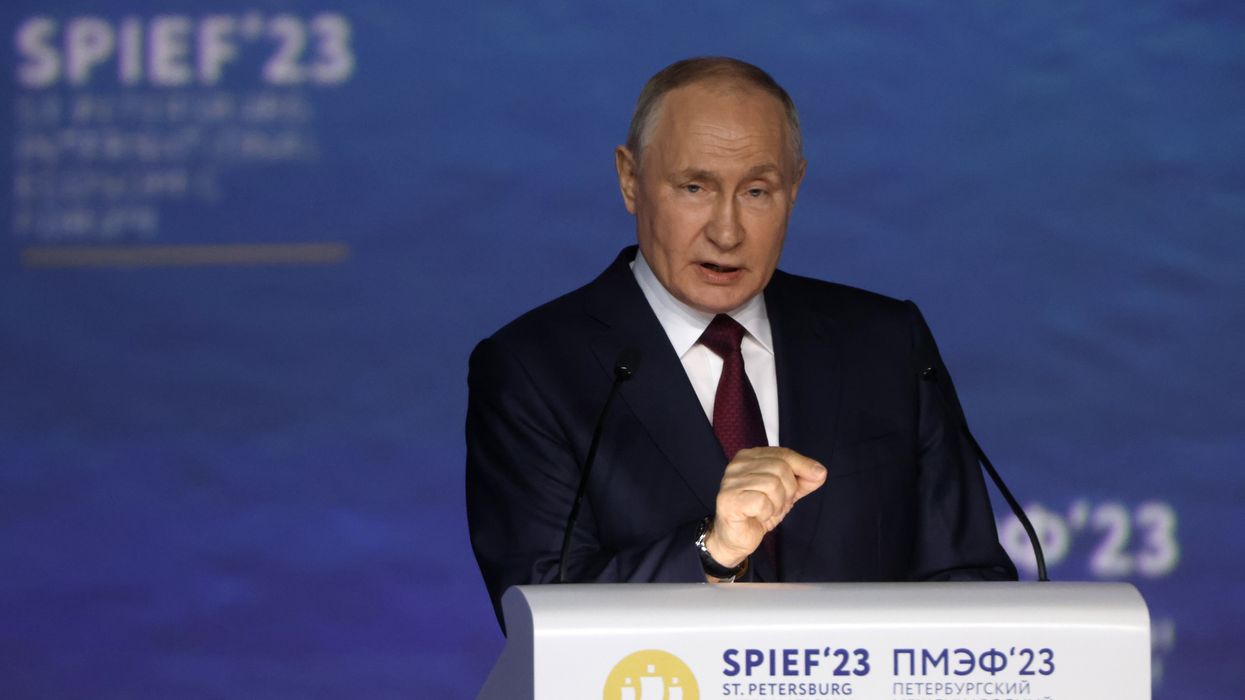
"No matter what the political climate, Russia must work with the United States to control the risk that nuclear weapons will be used—and to eliminate them," says Global Zero. "Anything less means disaster for everyone."
Nearly 16 months into Russia's invasion of Ukraine, Russian President Vladimir Putin said Friday that Moscow has begun deploying "tactical" nuclear weapons in Belarus, confirming recent remarks from Belarusian President Alexander Lukashenko.
In what the Nobel Peace Prize-winning International Campaign to Abolish Nuclear Weapons (ICAN) called an "extremely dangerous escalation" that "risks catastrophic humanitarian consequences," Putin had announced the plan in late March.
"We have missiles and bombs that we have received from Russia, both that are three times more powerful than the ones used on Hiroshima and Nagasaki," Lukashenko told a Russian state television channel earlier this week, referencing the 1945 U.S. bombing of the Japanese cities. "Up to a million people would die immediately if, God forbid, this weapon were used."
Putin, who has said that Moscow will retain control over the Russian nukes in Belarus, addressed the deployment on Friday while speaking at the St. Petersburg International Economic Forum, according to the Russian state news agency TASS.
"As you know, we held talks with our union state, with President Lukashenko on deploying part of these tactical weapons to Belarusian territory," Putin said. "It has happened—the first nuclear warheads have been delivered to Belarusian territory. This is the first batch. We will complete this work by the end of this year."
In response to a question about the deployment, the Russian leader reportedly said that "this is a deterrence measure."
According to the BBC: "When asked by the forum's moderator about the possibility of using those weapons, he replied: 'Why should we threaten the whole world? I have already said that the use of extreme measures is possible in case there is a danger to Russian statehood.'"
Writing Friday for Responsible Statecraft, Greg Lane, a former senior executive in the U.S. Central Intelligence Agency's Directorate of Operations, argued that "Russia's goals here appear more political than military."
"First, and as it relates to the war in the Ukraine, he wants to again highlight his own unpredictability, specifically his willingness to escalate the conflict if certain red lines are crossed," Lane wrote. "Highlighting the possibility of a nuclear exchange over the war in the Ukraine also serves a second political goal for Moscow, which is to find and exploit wedge issues that can be used to influence European public opinion."
"Perhaps most importantly for the Kremlin, however, is that the re-stationing of nuclear weapons in Belarus marks real and measurable progress in Putin's effort to reconstitute a 'Greater Russia,'" Lane added. "With the debacle of his so-called 'special military operation' and the now extreme improbability that the Ukrainians would ever voluntarily join such a union, the Russian president needs to be able to identify some success in making Russia great again."
TASS reported that Russia's embassy in Washington D.C. said that Russian Ambassador to the United States Anatoly Antonov met with U.S. Ambassador to Russia Lynne Tracy on Friday and "topical issues of the bilateral agenda were discussed."
Asked about Putin's statements on Friday, U.S. Secretary of State Antony Blinken told reporters that "we'll continue to monitor the situation very closely and very carefully. We have no reason to adjust our own nuclear posture. We don't see any indications that Russia is preparing to use a nuclear weapon."
Noting U.S. President Joe Biden's comments earlier this week about the American commitment to defending the North Atlantic Treaty Organization (NATO), Blinken stressed, "That is our north star and we're very focused on that."
"As for Belarus itself, this is just another example of Lukashenko making irresponsible, provocative choices to cede control of Belarus' sovereignty against the will of the Belarusian people," the top U.S. diplomat said.
Blinken's remarks aligned with NATO Secretary General Jens Stoltenberg's Thursday response to Lukashenko announcing the arrival of Russian nukes.
According to The Associated Press, Stoltenberg told journalists in Brussels that "we are, of course, closely monitoring what Russia is doing. So far, we haven't seen any changes in the nuclear posture that requires any changes in our posture."
"Russia's nuclear rhetoric and messaging is reckless and dangerous... Russia must know that a nuclear war cannot be won and must never be fought," he added, noting that "Russia has invested heavily in new modern nuclear capabilities and also deployed more nuclear capabilities, including close to NATO borders, for instance, in the high north."
The AP pointed out that "Biden and his NATO counterparts are gathering for a summit on July 11-12 in the Lithuanian capital, Vilnius, about 35 kilometers (22 miles) from the Belarus border."
Of the world's nine nuclear-armed nations, Russia has the largest stockpile, followed by the United States; the other seven countries have far fewer. None of them support the Treaty on the Prohibition of Nuclear Weapons.
"No matter what the political climate, Russia must work with the United States to control the risk that nuclear weapons will be used—and to eliminate them," Global Zero, a campaign to abolish nukes, tweeted Thursday. "Anything less means disaster for everyone."