SUBSCRIBE TO OUR FREE NEWSLETTER
Daily news & progressive opinion—funded by the people, not the corporations—delivered straight to your inbox.
5
#000000
#FFFFFF
To donate by check, phone, or other method, see our More Ways to Give page.
Daily news & progressive opinion—funded by the people, not the corporations—delivered straight to your inbox.
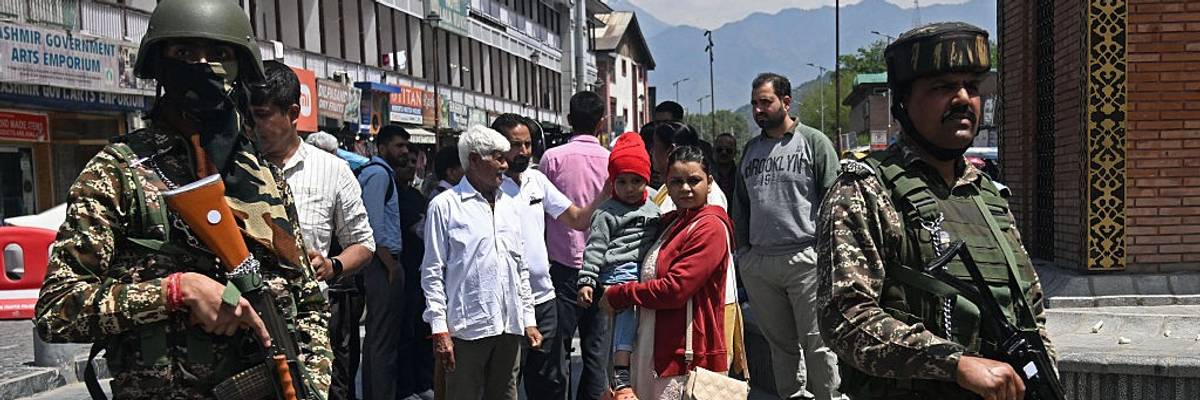
Indian occupation forces stand guard as tourists look on in Srinagar on April 24, 2025.
"Any issues between Pakistan and India, we believe can be and should be resolved peacefully through meaningful mutual engagement," said a spokesperson for U.N. Secretary-General António Guterres.
United Nations Secretary-General António Guterres on Thursday led calls for India and Pakistan to "exercise maximum restraint" as the nuclear-armed neighbors took tit-for-tat measures against each other in the wake of Tuesday's massacre of 26 people in Indian-occupied Kashmir.
Pakistan warned India that it was committing an "act of war" by suspending the landmark Indus Waters Treaty, which allows both countries to share the vital river system's flow. Pakistan announced the suspension of trade and closed its airspace to Indian flights. Both countries closed border ports of entry, canceled visas, and took other measures against each other.
India said it was downgrading relations with Pakistan, whom it blamed for supporting "cross-border terrorism" after gunmen killed 25 Indians and one Nepali and wounded at least 17 others at a popular vacation spot in Pahalgam, Kashmir on Tuesday.
"May sanity prevail between both nations."
A front group of the Pakistan-based militant group Lashkar-e-Taiba claimed responsibility for the attack, which killed mostly tourists.
Pakistani Defense Minister Khawaja Asif countered that his country's government believes "very strongly" that the attack "was a false flag operation."
Speaking Thursday, Stephane Dujarric, Guterres' spokesperson,
said that "we very much appeal to both the governments of Pakistan and India to exercise maximum restraint, and to ensure that the situation and the developments we've seen do not deteriorate any further."
"Any issues between Pakistan and India, we believe can be and should be resolved peacefully through meaningful mutual engagement," he added.
Progressives from both sides of the border echoed calls for restraint.
"We, the people of Kashmir, have already suffered so much over the years—and now, more than ever, we want peace to prevail in our homeland," Kashmiri social activist Jasib Shabir Bhat said on social media Wednesday. "We stand united for peace, for humanity, and for a better future for all."
Pakistani authori and activist Ehtesham Hassan wrote that "as a Pakistani who visited India and received immense love, I am devastated by the news from Pahalgam."
"I wish peace for the common people of India and Pakistan regardless of religion," Hassan added. "May sanity prevail between both nations."
Dear Common Dreams reader, It’s been nearly 30 years since I co-founded Common Dreams with my late wife, Lina Newhouser. We had the radical notion that journalism should serve the public good, not corporate profits. It was clear to us from the outset what it would take to build such a project. No paid advertisements. No corporate sponsors. No millionaire publisher telling us what to think or do. Many people said we wouldn't last a year, but we proved those doubters wrong. Together with a tremendous team of journalists and dedicated staff, we built an independent media outlet free from the constraints of profits and corporate control. Our mission has always been simple: To inform. To inspire. To ignite change for the common good. Building Common Dreams was not easy. Our survival was never guaranteed. When you take on the most powerful forces—Wall Street greed, fossil fuel industry destruction, Big Tech lobbyists, and uber-rich oligarchs who have spent billions upon billions rigging the economy and democracy in their favor—the only bulwark you have is supporters who believe in your work. But here’s the urgent message from me today. It's never been this bad out there. And it's never been this hard to keep us going. At the very moment Common Dreams is most needed, the threats we face are intensifying. We need your support now more than ever. We don't accept corporate advertising and never will. We don't have a paywall because we don't think people should be blocked from critical news based on their ability to pay. Everything we do is funded by the donations of readers like you. When everyone does the little they can afford, we are strong. But if that support retreats or dries up, so do we. Will you donate now to make sure Common Dreams not only survives but thrives? —Craig Brown, Co-founder |
United Nations Secretary-General António Guterres on Thursday led calls for India and Pakistan to "exercise maximum restraint" as the nuclear-armed neighbors took tit-for-tat measures against each other in the wake of Tuesday's massacre of 26 people in Indian-occupied Kashmir.
Pakistan warned India that it was committing an "act of war" by suspending the landmark Indus Waters Treaty, which allows both countries to share the vital river system's flow. Pakistan announced the suspension of trade and closed its airspace to Indian flights. Both countries closed border ports of entry, canceled visas, and took other measures against each other.
India said it was downgrading relations with Pakistan, whom it blamed for supporting "cross-border terrorism" after gunmen killed 25 Indians and one Nepali and wounded at least 17 others at a popular vacation spot in Pahalgam, Kashmir on Tuesday.
"May sanity prevail between both nations."
A front group of the Pakistan-based militant group Lashkar-e-Taiba claimed responsibility for the attack, which killed mostly tourists.
Pakistani Defense Minister Khawaja Asif countered that his country's government believes "very strongly" that the attack "was a false flag operation."
Speaking Thursday, Stephane Dujarric, Guterres' spokesperson,
said that "we very much appeal to both the governments of Pakistan and India to exercise maximum restraint, and to ensure that the situation and the developments we've seen do not deteriorate any further."
"Any issues between Pakistan and India, we believe can be and should be resolved peacefully through meaningful mutual engagement," he added.
Progressives from both sides of the border echoed calls for restraint.
"We, the people of Kashmir, have already suffered so much over the years—and now, more than ever, we want peace to prevail in our homeland," Kashmiri social activist Jasib Shabir Bhat said on social media Wednesday. "We stand united for peace, for humanity, and for a better future for all."
Pakistani authori and activist Ehtesham Hassan wrote that "as a Pakistani who visited India and received immense love, I am devastated by the news from Pahalgam."
"I wish peace for the common people of India and Pakistan regardless of religion," Hassan added. "May sanity prevail between both nations."
United Nations Secretary-General António Guterres on Thursday led calls for India and Pakistan to "exercise maximum restraint" as the nuclear-armed neighbors took tit-for-tat measures against each other in the wake of Tuesday's massacre of 26 people in Indian-occupied Kashmir.
Pakistan warned India that it was committing an "act of war" by suspending the landmark Indus Waters Treaty, which allows both countries to share the vital river system's flow. Pakistan announced the suspension of trade and closed its airspace to Indian flights. Both countries closed border ports of entry, canceled visas, and took other measures against each other.
India said it was downgrading relations with Pakistan, whom it blamed for supporting "cross-border terrorism" after gunmen killed 25 Indians and one Nepali and wounded at least 17 others at a popular vacation spot in Pahalgam, Kashmir on Tuesday.
"May sanity prevail between both nations."
A front group of the Pakistan-based militant group Lashkar-e-Taiba claimed responsibility for the attack, which killed mostly tourists.
Pakistani Defense Minister Khawaja Asif countered that his country's government believes "very strongly" that the attack "was a false flag operation."
Speaking Thursday, Stephane Dujarric, Guterres' spokesperson,
said that "we very much appeal to both the governments of Pakistan and India to exercise maximum restraint, and to ensure that the situation and the developments we've seen do not deteriorate any further."
"Any issues between Pakistan and India, we believe can be and should be resolved peacefully through meaningful mutual engagement," he added.
Progressives from both sides of the border echoed calls for restraint.
"We, the people of Kashmir, have already suffered so much over the years—and now, more than ever, we want peace to prevail in our homeland," Kashmiri social activist Jasib Shabir Bhat said on social media Wednesday. "We stand united for peace, for humanity, and for a better future for all."
Pakistani authori and activist Ehtesham Hassan wrote that "as a Pakistani who visited India and received immense love, I am devastated by the news from Pahalgam."
"I wish peace for the common people of India and Pakistan regardless of religion," Hassan added. "May sanity prevail between both nations."