SUBSCRIBE TO OUR FREE NEWSLETTER
Daily news & progressive opinion—funded by the people, not the corporations—delivered straight to your inbox.
5
#000000
#FFFFFF
To donate by check, phone, or other method, see our More Ways to Give page.
Daily news & progressive opinion—funded by the people, not the corporations—delivered straight to your inbox.
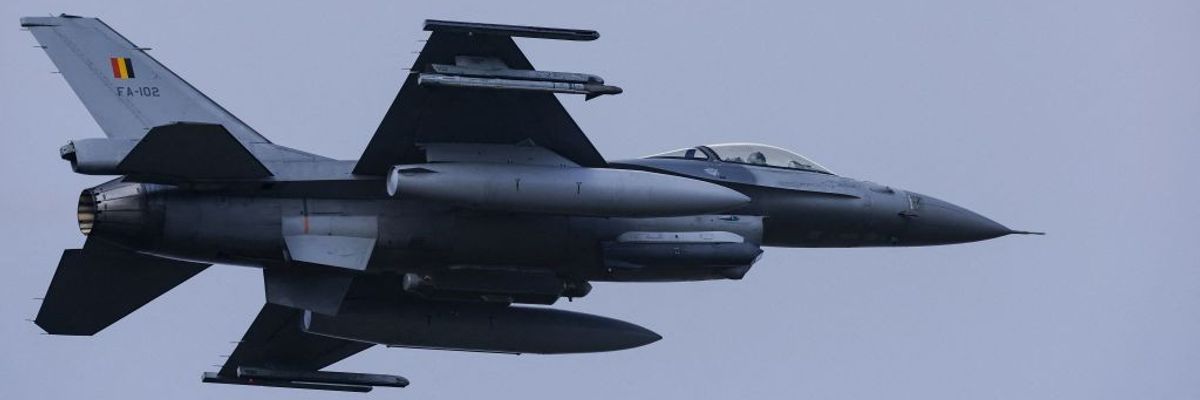
A Belgian F-16 jet fighter takes part in a NATO nuclear drill at the Kleine-Brogel air base in Belgium on October 18, 2022.
Disarmament advocate Beatrice Fihn stressed that the exercise is practice for "wiping out hundreds of thousands of civilians" with weapons that would also "flatten cities and poison survivors."
The NATO military block announced Friday that its annual nuclear exercise is set to begin next week—news that arrived just as Japanese atomic bomb survivors who advocate for disarmament received the Nobel Peace Prize.
"There is bad timing, there is dropping a brick... and then there is this. Nice work," the Geneva Nuclear Disarmament Initiative said in response to NATO Spokesperson Farah Dakhlallah on social media.
Dakhlallah shared a NATO statement explaining that "Steadfast Noon," the two-week military drills scheduled to start Monday, will include 2,000 soldiers from eight air bases and more than 60 "nuclear-capable jets, bombers, fighter escorts, refueling aircraft, and planes capable of reconnaissance and electronic warfare" flying over western Europe.
"Nuclear deterrence is the cornerstone of allied security," NATO Secretary General Mark Rutte said in the statement. "Steadfast Noon is an important test of the alliance's nuclear deterrent and sends a clear message to any adversary that NATO will protect and defend all allies."
Mary Wareham, deputy director of the crisis, conflict, and arms division at Human Rights Watch, also responded to the spokesperson on social media, asking, "Any comment from NATO on today's announcement that the Norwegian Nobel Committee has awarded the 2024 Nobel Peace Prize to the Japanese association of atomic bomb survivors organization Nihon Hidankyo?"
Since the United States dropped atomic bombs on the Japanese cities of Hiroshima and Nagasaki in 1945, survivors known as hibakusha have shared their experiences to promote peace. The Norwegian Nobel Committee on Friday honored the group Nihon Hidankyo, which "has provided thousands of witness accounts, issued resolutions and public appeals, and sent annual delegations to the United Nations and a variety of peace conferences to remind the world of the pressing need for nuclear disarmament."
The committee highlighted that "the nuclear powers are modernizing and upgrading their arsenals; new countries appear to be preparing to acquire nuclear weapons; and threats are being made to use nuclear weapons in ongoing warfare. At this moment in human history, it is worth reminding ourselves what nuclear weapons are: the most destructive weapons the world has ever seen."
The peace award and plans for NATO's exercise come as Russia's invasion of Ukraine, Israel's assault on the Gaza Strip, and provocations against Iran have heightened global fears of nuclear war. Russia and the United States have by far the largest arsenals, but China, France, India, Israel, North Korea, Pakistan, and the United Kingdom also have nuclear weapons.
Beatrice Fihn, director of Lex International and a senior fellow at the United Nations Institute for Disarmament Research, stressed on social media Friday that NATO exercise is practice for "wiping out hundreds of thousands of civilians" with weapons that would also "flatten cities and poison survivors."
Fihn previously directed the International Campaign to Abolish Nuclear Weapons (ICAN), which in 2017 won the Nobel Peace Prize for its work on the Treaty on the Prohibition of Nuclear Weapons. On Friday, she urged countries that haven't yet signed the treaty to "listen" to the Nobel committee and Nidon Hidankyo.
ICAN's current executive director, Melissa Parke, said in a Friday statement that the campaign "is honored to have been able to work alongside Nihon Hidankyo and the hibakusha to push for the total elimination of nuclear weapons."
"Their testimonies and tireless campaigning have been crucial to progress on nuclear disarmament in general and the adoption and entry into force of the U.N. Treaty on the Prohibition of Nuclear Weapons," she added. "We call on the nuclear-armed states and their allies which support the use of nuclear weapons, including of course Japan, to heed their call to abolish these inhumane weapons, to make sure what they have been through never happens again."
Gregory Kulacki, who has worked with disarmament advocates in Japan as East Asia project manager for the Union of Concerned Scientists' Global Security Program, similarly said Friday that "the testimony of the Hibakusha demonstrates the grave risks we still run by the very existence of nuclear weapons, which have only become more destructive. It's time for the world to not only acknowledge the risks of nuclear weapons but take action to enact a permanent international ban against them."
Dear Common Dreams reader, It’s been nearly 30 years since I co-founded Common Dreams with my late wife, Lina Newhouser. We had the radical notion that journalism should serve the public good, not corporate profits. It was clear to us from the outset what it would take to build such a project. No paid advertisements. No corporate sponsors. No millionaire publisher telling us what to think or do. Many people said we wouldn't last a year, but we proved those doubters wrong. Together with a tremendous team of journalists and dedicated staff, we built an independent media outlet free from the constraints of profits and corporate control. Our mission has always been simple: To inform. To inspire. To ignite change for the common good. Building Common Dreams was not easy. Our survival was never guaranteed. When you take on the most powerful forces—Wall Street greed, fossil fuel industry destruction, Big Tech lobbyists, and uber-rich oligarchs who have spent billions upon billions rigging the economy and democracy in their favor—the only bulwark you have is supporters who believe in your work. But here’s the urgent message from me today. It's never been this bad out there. And it's never been this hard to keep us going. At the very moment Common Dreams is most needed, the threats we face are intensifying. We need your support now more than ever. We don't accept corporate advertising and never will. We don't have a paywall because we don't think people should be blocked from critical news based on their ability to pay. Everything we do is funded by the donations of readers like you. When everyone does the little they can afford, we are strong. But if that support retreats or dries up, so do we. Will you donate now to make sure Common Dreams not only survives but thrives? —Craig Brown, Co-founder |
The NATO military block announced Friday that its annual nuclear exercise is set to begin next week—news that arrived just as Japanese atomic bomb survivors who advocate for disarmament received the Nobel Peace Prize.
"There is bad timing, there is dropping a brick... and then there is this. Nice work," the Geneva Nuclear Disarmament Initiative said in response to NATO Spokesperson Farah Dakhlallah on social media.
Dakhlallah shared a NATO statement explaining that "Steadfast Noon," the two-week military drills scheduled to start Monday, will include 2,000 soldiers from eight air bases and more than 60 "nuclear-capable jets, bombers, fighter escorts, refueling aircraft, and planes capable of reconnaissance and electronic warfare" flying over western Europe.
"Nuclear deterrence is the cornerstone of allied security," NATO Secretary General Mark Rutte said in the statement. "Steadfast Noon is an important test of the alliance's nuclear deterrent and sends a clear message to any adversary that NATO will protect and defend all allies."
Mary Wareham, deputy director of the crisis, conflict, and arms division at Human Rights Watch, also responded to the spokesperson on social media, asking, "Any comment from NATO on today's announcement that the Norwegian Nobel Committee has awarded the 2024 Nobel Peace Prize to the Japanese association of atomic bomb survivors organization Nihon Hidankyo?"
Since the United States dropped atomic bombs on the Japanese cities of Hiroshima and Nagasaki in 1945, survivors known as hibakusha have shared their experiences to promote peace. The Norwegian Nobel Committee on Friday honored the group Nihon Hidankyo, which "has provided thousands of witness accounts, issued resolutions and public appeals, and sent annual delegations to the United Nations and a variety of peace conferences to remind the world of the pressing need for nuclear disarmament."
The committee highlighted that "the nuclear powers are modernizing and upgrading their arsenals; new countries appear to be preparing to acquire nuclear weapons; and threats are being made to use nuclear weapons in ongoing warfare. At this moment in human history, it is worth reminding ourselves what nuclear weapons are: the most destructive weapons the world has ever seen."
The peace award and plans for NATO's exercise come as Russia's invasion of Ukraine, Israel's assault on the Gaza Strip, and provocations against Iran have heightened global fears of nuclear war. Russia and the United States have by far the largest arsenals, but China, France, India, Israel, North Korea, Pakistan, and the United Kingdom also have nuclear weapons.
Beatrice Fihn, director of Lex International and a senior fellow at the United Nations Institute for Disarmament Research, stressed on social media Friday that NATO exercise is practice for "wiping out hundreds of thousands of civilians" with weapons that would also "flatten cities and poison survivors."
Fihn previously directed the International Campaign to Abolish Nuclear Weapons (ICAN), which in 2017 won the Nobel Peace Prize for its work on the Treaty on the Prohibition of Nuclear Weapons. On Friday, she urged countries that haven't yet signed the treaty to "listen" to the Nobel committee and Nidon Hidankyo.
ICAN's current executive director, Melissa Parke, said in a Friday statement that the campaign "is honored to have been able to work alongside Nihon Hidankyo and the hibakusha to push for the total elimination of nuclear weapons."
"Their testimonies and tireless campaigning have been crucial to progress on nuclear disarmament in general and the adoption and entry into force of the U.N. Treaty on the Prohibition of Nuclear Weapons," she added. "We call on the nuclear-armed states and their allies which support the use of nuclear weapons, including of course Japan, to heed their call to abolish these inhumane weapons, to make sure what they have been through never happens again."
Gregory Kulacki, who has worked with disarmament advocates in Japan as East Asia project manager for the Union of Concerned Scientists' Global Security Program, similarly said Friday that "the testimony of the Hibakusha demonstrates the grave risks we still run by the very existence of nuclear weapons, which have only become more destructive. It's time for the world to not only acknowledge the risks of nuclear weapons but take action to enact a permanent international ban against them."
The NATO military block announced Friday that its annual nuclear exercise is set to begin next week—news that arrived just as Japanese atomic bomb survivors who advocate for disarmament received the Nobel Peace Prize.
"There is bad timing, there is dropping a brick... and then there is this. Nice work," the Geneva Nuclear Disarmament Initiative said in response to NATO Spokesperson Farah Dakhlallah on social media.
Dakhlallah shared a NATO statement explaining that "Steadfast Noon," the two-week military drills scheduled to start Monday, will include 2,000 soldiers from eight air bases and more than 60 "nuclear-capable jets, bombers, fighter escorts, refueling aircraft, and planes capable of reconnaissance and electronic warfare" flying over western Europe.
"Nuclear deterrence is the cornerstone of allied security," NATO Secretary General Mark Rutte said in the statement. "Steadfast Noon is an important test of the alliance's nuclear deterrent and sends a clear message to any adversary that NATO will protect and defend all allies."
Mary Wareham, deputy director of the crisis, conflict, and arms division at Human Rights Watch, also responded to the spokesperson on social media, asking, "Any comment from NATO on today's announcement that the Norwegian Nobel Committee has awarded the 2024 Nobel Peace Prize to the Japanese association of atomic bomb survivors organization Nihon Hidankyo?"
Since the United States dropped atomic bombs on the Japanese cities of Hiroshima and Nagasaki in 1945, survivors known as hibakusha have shared their experiences to promote peace. The Norwegian Nobel Committee on Friday honored the group Nihon Hidankyo, which "has provided thousands of witness accounts, issued resolutions and public appeals, and sent annual delegations to the United Nations and a variety of peace conferences to remind the world of the pressing need for nuclear disarmament."
The committee highlighted that "the nuclear powers are modernizing and upgrading their arsenals; new countries appear to be preparing to acquire nuclear weapons; and threats are being made to use nuclear weapons in ongoing warfare. At this moment in human history, it is worth reminding ourselves what nuclear weapons are: the most destructive weapons the world has ever seen."
The peace award and plans for NATO's exercise come as Russia's invasion of Ukraine, Israel's assault on the Gaza Strip, and provocations against Iran have heightened global fears of nuclear war. Russia and the United States have by far the largest arsenals, but China, France, India, Israel, North Korea, Pakistan, and the United Kingdom also have nuclear weapons.
Beatrice Fihn, director of Lex International and a senior fellow at the United Nations Institute for Disarmament Research, stressed on social media Friday that NATO exercise is practice for "wiping out hundreds of thousands of civilians" with weapons that would also "flatten cities and poison survivors."
Fihn previously directed the International Campaign to Abolish Nuclear Weapons (ICAN), which in 2017 won the Nobel Peace Prize for its work on the Treaty on the Prohibition of Nuclear Weapons. On Friday, she urged countries that haven't yet signed the treaty to "listen" to the Nobel committee and Nidon Hidankyo.
ICAN's current executive director, Melissa Parke, said in a Friday statement that the campaign "is honored to have been able to work alongside Nihon Hidankyo and the hibakusha to push for the total elimination of nuclear weapons."
"Their testimonies and tireless campaigning have been crucial to progress on nuclear disarmament in general and the adoption and entry into force of the U.N. Treaty on the Prohibition of Nuclear Weapons," she added. "We call on the nuclear-armed states and their allies which support the use of nuclear weapons, including of course Japan, to heed their call to abolish these inhumane weapons, to make sure what they have been through never happens again."
Gregory Kulacki, who has worked with disarmament advocates in Japan as East Asia project manager for the Union of Concerned Scientists' Global Security Program, similarly said Friday that "the testimony of the Hibakusha demonstrates the grave risks we still run by the very existence of nuclear weapons, which have only become more destructive. It's time for the world to not only acknowledge the risks of nuclear weapons but take action to enact a permanent international ban against them."