

SUBSCRIBE TO OUR FREE NEWSLETTER
Daily news & progressive opinion—funded by the people, not the corporations—delivered straight to your inbox.
5
#000000
#FFFFFF
To donate by check, phone, or other method, see our More Ways to Give page.



About the time Zionist settlers were beginning their occupation of Palestine in the early 1920s, an Indian right-wing figure, V.D. Savarkar, fashioned the ideology of Hindutva (Hindu-ness). Today, right-wing Hindu nationalists employ Hindutva and physical violence to further its vision of India as a nation for Hindus and Hindus only. Similarly, Zionism views historic Palestine as a land for Jews and Jews only. These parallel visions, along with the two governments’ increasingly authoritarian tendencies and ready use of violence, have drawn them into a dark alliance the consequences of which are unpredictable.
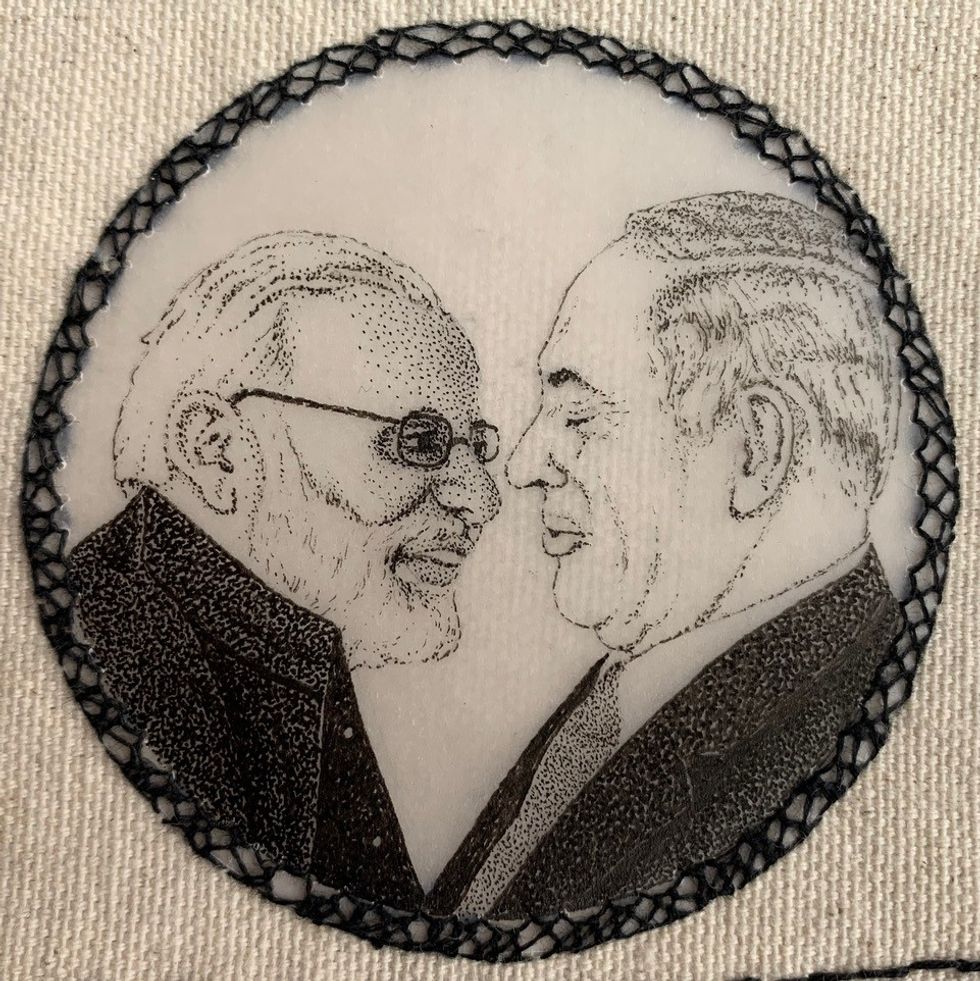
The Modi-Bibi bromance.
(Image: Priti Gulati Cox)
The Republic of India and the State of Israel were born nine months apart in 1947 and 1948, each an offspring of partition. The British-ruled Indian subcontinent was then split into Muslim-majority Pakistan and Hindu-majority India, while Israel was carved out of a portion of the British Mandate Palestine.
Throughout the Cold War, India would be a leader of what came to be known as the nonaligned movement—formerly colonized nations that sought to develop independently of both American and Soviet influence. In the 1980s, it also became the first non-Arab nation to recognize the state of Palestine. A similar recognition of Israel didn’t come until 1992, around the time India was shifting away from its nonaligned social-democratic stance toward its current adherence to neoliberalism.
In recent decades, India and Israel have established strong trading relationships, especially in the military sphere. In fact, given the massive militarization of its borders with China and Pakistan and its suppression of occupied Kashmir and its people, India has become the top importer of weapons and surveillance equipment from Israel. In 2014, the Hindu-supremacist Bharatiya Janata Party (BJP) won power and its leader, Narendra Modi, became prime minister. In the process, India and Israel grew ever closer.
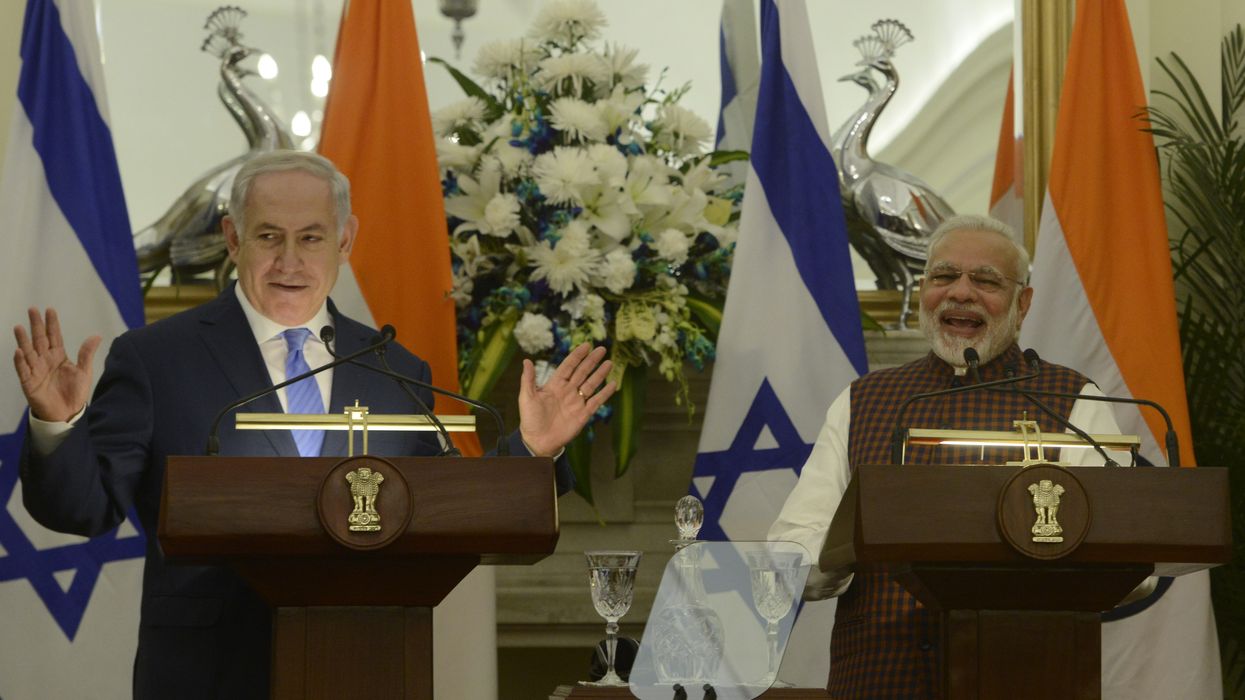
Modi and Israeli Prime Minister Benjamin Netanyahu have established a mutual-admiration society, dubbed by the media of both countries the “Modi-Bibi bromance.”
By 2016, as The Washington Post reported, “after Indian commandos carried out a raid inside Pakistan-controlled Kashmir in response to an attack by militants on an Indian army post, Modi trumpeted the action, saying: ‘Earlier, we used to hear of Israel having done something like this. But the country has seen that the Indian army is no less than anyone else.’”
Today, the Israeli weapons-robotics firm Elbit Systems has even established a drone factory in India and now has a $300 million contract to supply drones to the Indian army occupying Kashmir. Meanwhile, Modi and Israeli Prime Minister Benjamin Netanyahu have established a mutual-admiration society, dubbed by the media of both countries the “Modi-Bibi bromance.” And New Delhi has all but abandoned the Palestinians.
When, on October 27, the U.N. General Assembly passed a resolution calling for an “immediate, durable, and sustained humanitarian truce leading to a cessation of hostilities” in Gaza, only the U.S., Israel, and a handful of small nations voted “no.” India abstained. (Apparently, the Modi-Bibi bromance wasn’t quite enough to sustain a “no” vote.) Modi, however, immediately responded to the measure’s passage by declaring his “solidarity” with Israel.
Economic, political, and diplomatic relations between New Delhi, Tel Aviv, and Washington (all nuclear powers, by the way) had been strengthening even before the current conflict. Last year, for instance, India, Israel, the United Arab Emirates, and the United States formed the “I2U2 Group” to attract corporate investment for their mutual benefit. Projects now underway include “food parks across India” with “climate-smart technologies” and a “unique space-based tool for policymakers, institutions, and entrepreneurs” (whatever in—or out of—the world “food parks” and “space-based tools” might be).
Then, in September, the G20 summit of the group of 20 major nations, meeting in New Delhi, approved an India-Middle East-Europe Economic Corridor which, according to Voice of America, would “establish a rail and shipping network linking the UAE, Saudi Arabia, and Jordan to the Israeli port of Haifa on the Mediterranean Sea.” And guess who now operates that very port? A company led by Gautam Adani, India’s richest person and (naturally!) a Modi buddy. Foreign Policy notes, “It is also palatable for the Middle East to have India as a major energy market to diversify its exports and offset Chinese influence over critical commodities such as oil and gas.”
But not surprisingly, the war in Gaza has thrown plans for such a new Indian-oriented economic corridor through the Middle East into limbo.
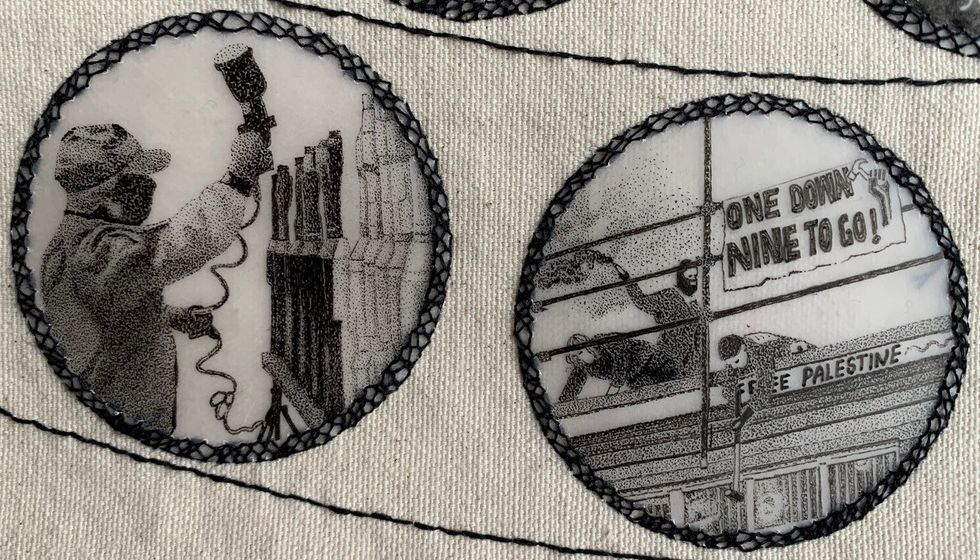
Qassam fighters making Yassin grenades (L) and Palestine Action targeting Elbit Systems sites (R).
(Image: Priti Gulati Cox)
Militarily, the conflicts in occupied Palestine and occupied Kashmir are both lopsided mismatches. In each, a powerful nation-state is assaulting resource-poor populations, though the scale of slaughter, displacement, immiseration, and death wrought by the Indian regime doesn’t faintly approach what’s currently being done by Israel in the Gaza Strip—at least not yet. While the cases have similarities, magnitude isn’t one of them.
In Gaza, you have the Israeli Defense Forces (IDF), a massive high-tech killing machine financed in large part by the world’s richest nation, facing off against Palestinian resistance groups, including the Qassam Brigade, whose most effective weapons are homemade Yassin antitank grenades and whose defenses largely consist of a network of fortified tunnels. Instead of engaging in face-to-face subterranean combat with the Qassam fighters—something that could turn out badly indeed for the IDF—the Israelis have been carrying out an industrial-scale bombardment of densely populated areas. As of late November, the result was approximately 15,000 civilians killed (including more than 6,000 children) and the displacement of 1.6 million people, or two-thirds of Gaza’s population.
Figuratively speaking, millions of desperate Palestinians have their backs to the wall, or in this case, fence, with nowhere to run.
In India, the Hindu nationalists’ onslaught against non-Hindu minorities has not been carried out by the Indian Army itself, but by a paramilitary organization, the Rashtriya Swayamsevak Sangh (RSS), in partnership with the BJP. That unofficial army, founded almost a century ago and modeled on Italian fascist Benito Mussolini’s “blackshirts” and Adolph Hitler’s Nazi stormtroopers, has a membership of 5 to 6 million and holds daily meetings in more than 36,000 different locales across India. Its shock troops rarely even carry firearms; their weapons are low-tech, crude, and exceptionally cruel, and their targets are unarmed, unsuspecting civilians. They kill or maim using batons, machetes, strangulation, sulfuric acid to the face, and rape, among other horrors.
Such attacks by Hindu-nationalist gangs, different as they are from the military assault on Gaza, do have parallels in the occupied West Bank. There, Israeli settlers, some carrying government-supplied small arms, maraud through parts of that area (where they live illegally), beating, torturing, and killing Palestinians, including ethnic Bedouin families. They have expelled people from their homes, stolen their money and possessions, including livestock, and destroyed houses and schools. It is now olive harvest season and Jewish settlers have attacked Palestinians in their olive groves, sometimes forcing them off their ancestors’ land, perhaps permanently. More than 200 Palestinians have been killed this way since October.

A Palestinian boy holding the body of his little brother killed in an Israeli bombardment, at Al-Nasser hospital, southern Gaza Strip, November 21.
(Image: Priti Gulati Cox)
One of the worst atrocities perpetrated against Muslims since India’s partition occurred in 2002 in the western state of Gujarat. (Not coincidentally, that state’s chief minister at the time was Narendra Modi.) Following the alleged torching of a train compartment in which 58 Hindu nationalist “volunteers” were traveling, Hindu mobs inflicted state-sponsored terrorism on the Muslim community across Gujarat. More than 2,000 Muslims were killed. Speaking in the aftermath of that horror, then-prime minister A.B. Vajpayee offered a perfunctory admission of regret for the carnage, only to ask rhetorically, “Lekin aag lagayi kisne?” (“But who lit the fire?”) The implication was that since some from their community were accused of committing the initial crime, all Gujarat Muslims were responsible and that, however regrettably, justified their slaughter.
Similar allegations of collective guilt and justifications for collective punishment have a long history in Israel, as in the current conflict. In October, Israeli President Isaac Herzog claimed that “there is an entire nation out there that is responsible.” That comment earned Herzog a place in a greatest-hits video of Israeli leaders attempting to defend atrocities inflicted on Gaza’s 2.3 million inhabitants. Similarly, a former Israeli ambassador to the U.N. told Sky News, “I am very puzzled by the constant concern which the world… is showing for the Palestinian people, and is actually showing for these horrible inhuman animals.”
Some of the language surrounding it can be similar. Allegations that, in their October 7 attack on Israel, Hamas fighters beheaded children and tore fetuses from women’s wombs—none of which have been substantiated—eerily echo the sexualized violence committed by Hindu mobs in Gujarat in 2002 (rape, mutilation, the killing of women and their babies, and other horrors). A report of attackers using a sword to cut a fetus out of a Muslim woman and burning the bodies of both fetus and mother has been told and retold countless times over the past two decades.
And within mere hours of the October 7 attack in Israel, BJP politicians and Hindu nationalists in India were spreading propaganda on social media, including accusations that Palestinians were “worse than animals” and were cutting fetuses from wombs, beheading children, and taking girls as “sex slaves.” This started in India before IDF spokespeople began spreading similar claims.

Clockwork Joe.
(Image: Priti Gulati Cox)
Drawing a comparison to the ethnic cleansing of 1948, the Israeli agriculture minister, a member of the security cabinet, recently explained his government’s goal to a reporter for the Israeli newspaper Ha’aretz this way: “We are now rolling out the Gaza Nakba.” (Nakba was a reference to Israel’s forcible expulsion of 800,000 Palestinians from large portions of their territory in 1948.) When the incredulous reporter tossed the minister a lifeline, asking if he really meant what he’d said, he doubled down: “Gaza Nakba 2023. That’s how it’ll end.”
As of now, it certainly looks that way. The IDF bombed apartment blocks, shelters, schools, and hospitals in northern Gaza to force the migration of the population there toward supposedly “safe” south Gaza. They then began bombing southbound car caravans and even ambulances in which refugees were fleeing. Large groups of other Gazans were forced to make the long journey south on foot through narrow IDF-designated corridors. As The Guardian reported in mid-November,
Those walking south under the tense gaze of Israeli troops, through a hellscape of tangled rubble that had been buildings two months ago, along roads shattered by weapons and churned to mud by tanks, had little hope of rest when they reached the south. Shelters are crammed, food and water supplies are so low the U.N. has warned that Palestinians face the ‘immediate possibility’ of starvation, infectious diseases are spreading, and the war there is expected to intensify in coming days.
Israel soon began bombing parts of South Gaza, too, clearly trying to drive the refugees further south, possibly even through the Raffah gate into Egypt. But Egypt has refused to participate in such an ethnic-cleansing campaign. So, figuratively speaking, millions of desperate Palestinians have their backs to the wall, or in this case, fence, with nowhere to run.
As economic and geopolitical ties among Israel, India, and the U.S. have only continued to strengthen, Joe Biden has chummed it up with both Netanyahu and Modi, averting his eyes from their antidemocratic and all-too-violent national visions. He has backed the assault on Gaza all the way and as late as November 18 was still arguing in The Washington Post against a cease-fire. At the same time, he called for increasing the flow of humanitarian assistance to Gaza to remedy critical staggering shortages of food, water, housing, and fuel. In other words, the Biden administration is treating the catastrophe there like a natural disaster, acting as if there’s something terrible happening, something beyond his (or anyone’s) power to prevent, so all that can be done is to aid the survivors.
In truth, administrations in Washington have been treating Israel’s occupation and immiseration of the West Bank and Gaza like a natural disaster for more than half a century now. Liz Theoharis, co-chair of the Poor People’s Campaign, recently pointed out an incident that suggests just how disingenuous that claim is. In November, Israeli Defense Minister Yoav Gallant came under withering criticism for permitting a few small, wholly inadequate truckloads of humanitarian aid to enter Gaza from Egypt. As Theoharis noted, Gallant defended his decision to allow the aid this way: “The Americans insisted, and we are not in a place where we can refuse them. We rely on them for planes and military equipment. What are we supposed to do? Tell them no?” This puts the lie to the idea that Washington has no influence over the progress or outcome of this war. It does have influence over Israel—more than $3 billion worth in the form of military aid provided by Washington every year, not to speak of the $14 billion the Biden administration still wants to reward Israel with.
As we write this, we don’t know what will happen to the people of Gaza once the temporary cease-fire for prisoner exchanges expires. But rest assured that the governments of India and Israel will continue to feed off each other as they develop new strategies, tactics, and propaganda for their respective campaigns of occupation and oppression, campaigns the U.S. government, through both action and inaction, is endorsing. Consider them now three nations under god(s) of hell.
