SUBSCRIBE TO OUR FREE NEWSLETTER
Daily news & progressive opinion—funded by the people, not the corporations—delivered straight to your inbox.
5
#000000
#FFFFFF
To donate by check, phone, or other method, see our More Ways to Give page.


Daily news & progressive opinion—funded by the people, not the corporations—delivered straight to your inbox.
Back from the first global conference on money in politics in Mexico City, I'm bursting with stories that might carry messages of possibility that Americans need right now. Sure worked for me.
In Spain, with one-fifth of its population jobless, the Indignados movement--that paralleled our Occupy-- erupted with protests in 2011. But instead of fading from sight, by early 2014 the Indignados had set the stage for the birth of a new political party: Podemos, "We Can."
In only a few months, Podemos surprised everyone by winning 8 percent of the Spanish vote for the European Parliament, giving it five of 54 Spanish seats. One year later, in coalition with other grassroots movements, Podemos won mayor's races in Barcelona, Madrid and other cities. Today it is Spain's third largest political party. "Unprecedented" declared the pundits.
The Party's aim has been to "capture a desire for transparency and participation in politics" stirred by the Indignados movement, Miguel Ongil, 35, Podemos' point person on finance and transparency explained to me. During the Mexico City conference, I scribbled furiously as he laid out three ways his new party stands against corruption and for social equity.
"Crowdfunding." Miguel described the Spanish system of public campaign financing in which parties typically take out bank loans to pay their bills that are largely refunded later by the government based on the parties' showing at the polls. "But when the parties don't get the expected results, they cannot pay back their debts," Miguel explained later, so the banks then "get more credits to pay for credits..." In effect, these Spanish banks become "shareholders of political parties," another conference attendee quipped to Miguel.
But not Podemos. It wants no "bank donors" to whom it might feel an obligation, Miguel told conference attendees. His new party relies instead on "microcredit" from citizen supporters who are later repaid with public funds. This is our "innovation," he wrote to me later: "how to make your way around without state funding or bank credits, and our answer is simple: collaborative finances, crowdfunding and fresh ideas."
"Radical transparency." The party publishes all its accounts online in real time, Miguel told his audience which represented several dozen nations. Plus, "we are the only party with three external control mechanisms: the Court of Accounts, a second formal external audit, and citizens' control."
"Citizens' control": What does that mean? I asked.
Podemos' "accounts include so much detail, including the actual tickets, that an external audit wouldn't really be required," Miguel wrote later. "Anyone can do it, and they do. One of our publications of accounts had 138,000 views. Newspapers have been trying to nail us. We have so much citizen supervision it becomes a control mechanism in itself."
Radical equity. Miguel didn't use this term but for me it fits: Podemos requires that none of its elected representatives--from the local to the European level--earn more than three times the minimum wage. Any income above this level goes to the Party, where we "spend 50 percent in the Party and 50 percent goes to a fund to which anyone can apply for social projects. The sympathizers of Podemos decide in a 100 percent-participatory mechanism which projects are to be funded."
Clearly, commitment to participation runs deep in Podemos, and that includes some direct guidance from citizens. Podemos uses, for example, web tools to enable people collectively to develop its key documents, with party "synthesizers" weaving together the final versions.
At their height about a thousand Podemos "circles" connected citizens and their party in regular, horizontally-organized, local meetings. Miguel notes that in growing as a party, Podemos is working to find a new balance between in-person and virtual participation, "including electronic mechanisms of direct democracy." For example, citizens have the "possibility to propose 'legislative citizen initiatives,' which require the support of a minimum number of votes or circles. These give circles some weight."
Aligning action with its philosophy, another Podemos touch boils down to postage stamps. The head of the party is long-term activist Pablo Iglesias whose campaign letters were hand delivered to mailboxes, with this explanation:
This letter did not reach you by post, because mailing a letter like this all over the country costs over 2 million Euros. Ask the parties who sent you an election letter by post where they got the money to do so and in exchange for what. "We don't ask for favours from bankers or corrupt [politicians]... If you are reading this it is because someone who lives near you wants to change things for real.
Podemos policy positions range from strengthening the public health system to halting evictions over mortgage defaults to promoting clean energy. But, "underlining the entire platform is a proposed change in political culture, bringing transparency and participative democracy to all institutions," notes what's called a "Dummies Guide" to Podemos--making it as much about how we do politics as about any specific issue.
Since it's the takeover of our democratic process by big money that makes most Americans angry, Podemos is a story from which Americans could take heart. Saying good-bye to Miguel, I sensed his determination and clarity of purpose. I felt fortified to do everything I can to pick up where Occupy left off and to help build a passionate US democracy movement.
Now I hear Miguel whispering in my ear: The Indignados "created a new social majority that no party was able to represent." And now Podemos is determined "to turn that new social majority into a new political majority." Even three years ago, he could not have foreseen how far Podemos has already come. Hmm. Maybe it's not possible to know what's possible.
Imagine that the Occupy Movement stood for election in New York and won, or that anti-gentrification activists took over the city hall in San Francisco. That's what just happened in Spain, where citizens' groups with roots in the anti-austerity indignados movement performed so well in recent municipal elections that they now lead governments in the country's three largest cities -- Madrid, Barcelona, and Valencia -- along with several others.
The epicenter of this political earthquake is Barcelona, where the new mayor is Ada Colau, former spokesperson as the Mortgage Victims Platform, or PAH. She stood as the candidate for a newly formed citizens' platform called Barcelona in Common (Barcelona en Comu), whose immediate priorities for the city include stopping foreclosures.
The capital, Madrid, had been governed by the right-wing People's Party (PP) for 24 years, but the new government is led by another citizens' platform called Ahora Madrid, which came a close second in the elections and succeeded in securing enough votes from other parties to form the city government. The new mayor is Manuela Carmena, a 71-year old former judge who cut her political teeth opposing the Franco dictatorship in the 1970s.
Radical citizens' coalitions or "popular unity" candidates now also now lead city administrations in Zaragoza, A Coruna, Pamplona, Cadiz, and Santiago de Compostela. All of these involve candidates from Podemos, an anti-austerity party founded in 2014. But the impetus mainly comes from the social movements that took over public squares across Spain in May 2011.
Symbolizing change
Spain's new mayors took office on June 13 -- and they've already ruffled more than a few feathers.
Some of their first acts have been symbolic, including the new mayor of Cadiz's much-publicized replacement of a picture of the former king with that of a 19th century anarchist republican. The new council of Madrid has given up its boxes at the city's bullfighting ring and royal theater, as part of a manifesto pledge to cut expenses.
In Barcelona, Colau's first interventions have also symbolized a clear break with the neoliberal, tourism-at-all-costs "global city" model of previous administrations. She made international headlines by promising to withdraw a EUR4 million subsidy given to the race circuit that hosts the Spanish Grand Prix, suggesting that the money could instead restore school meal subsidies for poor families. Barcelona in Common has also promised to review the lease of the Port Vell Marina, which has recently been converted to accommodate the luxury yachts of the world's super-rich in the heart of the city.
In Madrid, meanwhile, scenes of panic were reported at the Club de Campo Villa de Madrid, a high-society country club built on city-owned property, when Manuela Carmena promised to re-designate the area as a public park.
The right to housing
Behind the symbolism, though, the first priority of many of Spain's new mayors is to end home foreclosures. In her first day on the job, Colau intervened to stop an eviction in the poorest district of Barcelona, while promising to look for "a more stable solution." The mayor of Cadiz and four of his councilors were dragged away by police while attempting to prevent a foreclosure.
There have been close to half-a-million home evictions in Spain -- a country of around 18 million households -- since the economic crisis hit in 2007. The victims were caught up in a housing bubble, fueled by sub-prime lending and a construction boom.
With the onset of the crisis, the construction industry ground to a halt, leaving over 3 million empty properties and many more half-finished, which precipitated the collapse of many of the banks that had financed Spain's building boom. At the same time, with successive governments pursuing harsh austerity measures, the labor market fell off a cliff, with unemployment peaking at close to 27 percent in 2013. Many of those who lost their jobs lost their homes soon after. But under Spanish law, they must still pay back the lender even after foreclosure.
The rise of the PAH, with Colau as its spokesperson, came in response to these foreclosures on an industrial scale. The group adopted militant tactics: physically blocking evictions, occupying bank branches, surrounding the homes and workplaces of politicians, and squatting in empty housing developments. Since its inception, the PAH has successfully blocked over 1,000 evictions and negotiated debt cancellations for many households.
The PAH also pursued legislative initiatives and legal challenges to Spain's housing law, with limited success. With prominent allies in city halls now, that could change.
One option to address evictions is to establish a public office that would negotiate agreements between banks and defaulters -- a model that's been successfully tried in the Spanish Basque country. It may also be possible for the city council to be given first refusal on the purchase of evicted properties, which it could then rent out to the evictees or other tenants. Zaragoza in Common has proposed a hybrid of these schemes, setting up an anti-foreclosure office and asking banks to make empty housing available for social housing at affordable rents -- a proposal that's received a positive response from some major banks. Ahora Madrid is considering similar proposals.
In advance of such measures, one thing that's already changed is the attitude of property speculators. The day after the election, a private investment firm that less than a year ago spent EUR90 million on a site for a proposed Four Seasons hotel in Barcelona announced that it was abandoning its plans.
Then, on May 30th, a high-level conference of bankers, private equity firms, and investment funds in Madrid was reported to have become an impromptu debrief for firms concerned about the future of their Spanish investments. The new mayors of Barcelona and Madrid have backed the PAH in pledging to fight off vulture funds that have bought up large portfolios of rented properties from the city council and bailed out banks, hiking up rents and evicting tenants.
Emergency plans
The priority given to stopping foreclosures is just one element of the "emergency plan" that Barcelona in Common announced that it would implement in its first months in office.
Other flagship measures include a review of contracts for sub-contractors working for the municipality (whose terms of work are often highly precarious), stopping the privatization of daycare, handing out fines to banks that leave multiple properties empty, refusing to grant new hotel licenses, and subsidizing energy and transport costs for the unemployed and those earning under the minimum wage. Colau has already appointed a new city police chief with a mandate to reform the "bad practices" of the city police force, and promised to review the contracts of multinational service providers. Similar provisions are planned in other cities where "popular unity" candidates lead the government.
The new council will also employ fewer political appointees at lower salaries than their predecessors. Colau herself will take home EUR2,200 per month -- compared with the EUR8,800 paid to her predecessor Xavier Trias -- in accordance with Barcelona in Common's crowdsourced code of ethics, called "governing by obeying." In Madrid, Manuela Carmena has promised to halve the nearly EUR100,000 annual salary of her predecessor.
Passing these measures through councils that require cross-party support won't be easy, with the fragmentation of Spain's two-party system and resurgent nationalism in some parts of the country meaning that city halls across Spain are now ruled by minority administrations. Nowhere will that be more difficult than in the Catalan capital, where Barcelona in Common holds just 11 seats in the 41-member city council. It's dependent upon the support of most of the councilors from two center-left parties and a smaller, left nationalist bloc.
The experience of building an electoral coalition out of social movements lends itself to a more nuanced conception of power than just the forging of political pacts, however. In her first press conference after the election, Ada Colau affirmed that she would talk to all left and center-left parties, but stressed that she would continue to attend neighborhood assemblies from the civil society groups that helped propel her to power.
The clear message is that Barcelona in Common will look to active social movements and associations as a means to win legitimacy for its proposals, which would then put pressure on other parties to allow it to pass legislation. That's a marked shift from the usual model of horse-trading between parties behind closed doors.
A political springboard
Taking control of Spain's largest cities is just the start of a journey that leads to general elections in November.
Along the way, Barcelona will go to the polls again in September, when regional elections will be held in Catalonia. The regional government, a nationalist coalition led by CiU (Convergencia i Unio, or Convergence and Union), can currently block attempts by Barcelona in Common to expand public health and education facilities in poorer neighborhoods since it plays the lead role in providing these services.
CiU is a coalition of two parties, who have governed Catalonia in a pact for most of the period since 1980. But that coalition is in disarray. The coalition held for as long as it was winning elections and leading polls, but on June 17 the two parties split.
That leaves an opening for the left in Catalonia. A region-wide coalition of the groups that joined Barcelona in Common is currently under discussion. If the talks are successful, they could produce a popular unity list with a viable shot at becoming the largest bloc in the regional parliament.
Success in regional elections would open the way to a bigger prize. A strong showing for the left in Catalonia -- Spain's second most populous region and a former stronghold of the Socialist Party -- is vital if the left is to triumph nationally. The prospect of a popular unity platform for Spain's general elections is now being openly discussed. The leadership of the United Left, wiped out when standing against popular unity coalitions but increasing its representation when incorporated within them, is virtually pleading for a pact. Equo, the country's Green party, is similarly open to a common list.
These calls are increasingly find an echo within Podemos, too. Pablo Echenique, one of the party's first members of the European Parliament and its regional leader in Aragon, and 22 prominent activists have also called on Podemos to embrace pluralism and open the party to electoral pacts in the general election. Pablo Iglesias, the party leader, has opened the door for joint candidacies with other parties, but only in three of Spain's 17 regions (including Catalonia).
Calls for unity are obviously far easier to make than to achieve, but they could be heard if they help to create a bloc that could outflank the center-left Socialist Party in the general election. That would be enough to fundamentally reshape the politics of Spain, claims Iglesias. Even if the conservative People's Party remained the largest single party, Podemos could negotiate from a position of strength. As Iglesias puts it, the Socialists would be forced into a choice of either "undertaking a 180-degree turn and rejecting austerity policies, so that we could reach an understanding with them... or commit political suicide by submitting to the PP."
It's a tantalizing prospect for the fall, but for now Spain is entering the summer still reveling in its democratic spring.
Everyone has something sweeping to say about last week's European elections. And, indeed, from a glance, it's easy to make pronouncements about the state of politics on the continent. Most emphasize mass abstention, the rise of far-right eurosceptic parties that oppose the EU, the crisis of social democracy, even some gains by the radical left.

A careful look at the data, however, invites more caution. The most important questions to be raised are whether these elections univocally show an increasing disaffection of citizens towards the project of the European Union and whether the European political establishment is facing a deep and general crisis.
My answer on both counts is no: the electoral results show a growing discontent caused by the five year-long poisonous combination of austerity and crisis, but this is not sufficient to speak of a deep political instability and even less of a legitimacy crisis. Moreover, except for the rise of eurosceptic parties, it is difficult to identify a strong common trend. The results seem to largely be the outcome of diverse political dynamics in each country.
To understand the elections, we should do something rare among the chattering classes: start with the data. For example, the rate of electoral participation and its trend in the last decades contrast claims that mass abstention is proof of the EU's increasing loss of political legitimacy. Despite predictions of a collapse due to the increasing disaffection of European citizens towards the European Union and its institutions, voter participation has been significantly higher than expected (43%).
In fact, the last elections have been the first ones since 1979 in which the trend of declining voter participation has reached a halt. This has been due in particular to the rate of voter participation in some of the largest countries. Massive abstention at these elections can hardly be proof of a growing loss of EU legitimacy -- not only because voting rates are steady, but also because this halt to the trend of declining voter participation cannot be explained only through the strong presence and affirmation of eurosceptic electoral lists.
While it is true that among some countries with the largest eurosceptic forces there is an increase in electoral participation -- for example, in France (+2.9%), UK (+1.5%), Greece (+5.6%), and Lithuania (+23.9%) -- this is not the case for Italy (-7.7%), Denmark (-3.1%), or Hungary (-7.4%). In the case of Germany, the increase could even be connected to a growth of a consensus in favor of the European Union and satisfied with the domestic economic situation. Moreover, from 2007 to 2014, the fall in the level of support for the euro has been relatively modest: from 69% to 66%.
It would, therefore, be more prudent to speak of a plurality of factors that have impacted voters' behavior in various countries. We can identify at least three of them: the rise of eurosceptic forces, mostly on the far-right; the presence of radical left organizations that have managed to express a strong opposition to austerity policies, a factor that has been decisive in countries such as Spain and Greece; and finally, an increase in trust towards governing parties that have taken a critical stance towards an excessively rigid interpretation of the fiscal compact and have advocated for a new season of taxes cuts and public spending.
These three factors hold different sway depending on the situation in each country.
A similar variety of situations characterizes the electoral results. Take the EU's five biggest countries: the severe defeat of the Tories in UK and of the Socialist Party in France, both soundly beaten by the two rising right-wing eurosceptic parties, UKIP and Front National (FN), has drawn much of the public attention. But this has obscured the fact that in Germany and Italy, the two countries led by a Grand Coalition government, the electoral results seem, on the contrary, to indicate a renewed trust for the governing parties.
Despite significant growth in voter participation, Angela Merkel's Christian Democratic Union (CDU) managed to maintain a stable position, winning 30% of vote. But the party that took advantage of the larger electoral participation, winning 2.5 million votes more than in 2009, is the Social Democratic Party (SPD), which got 27.3%.
In Italy, the Democratic Party (PD) was the protagonist of an astonishing recovery. Only a few months ago it was shaken by a deep leadership crisis, which then led to the rise of Matteo Renzi first as leader of the party and then as new prime minister. And just a year ago Italian voters seemed to be losing any trust in governing and traditional parties and in the political system as a whole, and the rise of the Five Star Movement, the new anti-establishment, populist and post-ideological formation guided by former comedian Beppe Grillo seemed irresistible.
On the contrary, on Sunday both Berlusconi and the Five Stars Movement were soundly beaten: the PD gained three million more votes than in 2009 and 2.5 million more votes than in the national election of 2013, reaching an impressive 41%.
Finally, in Spain the governing conservative People's Party (PP) got only 26% of votes (against 42.1% in 2009) and the Socialist Party (PSOE) got only 23% (against 38.8% in 2009). Contrary to UK and France, however, the opposition to the austerity policies implemented by the EU and the Spanish government has favored not right-wing eurosceptic parties, but rather left-wing coalitions: United Left (IU), which won 9.9% of votes (compared to 3.7% of 2009) and Podemos.
The latter is one of the biggest and most encouraging surprises of these elections: Podemos is a new embryonic political organization, based on grassroots participation and inspired by the indignados movement, that managed to win an astonishing 7.96%.
If we look at the aggregate results, the claim that these elections show the European social democracy's further loss of support seems to be ungrounded. Of course, one may contend that the social-democratic label does not apply anymore to parties such as the Italian Democrats, and one might question what we mean by "European social democracy" today. And granted, in France and Greece the center-left has collapsed.
However, on a European level the real loser of the elections are center-right parties: the European People's Party (EPP) fell from 35.8% to 28.4% of the seats, while the Socialists and Democrats (S&D) had their share hold steady: 25.4% (it was 25.6% in 2009).
If there is a common trend in these elections, it is the rise of forces that are strongly critical of the European Union. "Eurosceptic", however, is a wide and ambiguous umbrella category covering political forces as diverse as the Five Star Movement in Italy (21.1%) and the neo-Nazi Golden Dawn in Greece (9.4%). Nationalist, xenophobic and Islamophobic far-right parties litter the European landscape. Beyond just Golden Dawn, there's Jobbik in Hungary (14.7%), the Swedish Democrats (9.7%), the Party for Freedom in the Netherlands (13.2%), Freedom Party in Austria (19.5%), Vlaams Belang in Belgium (4.2%), Northern League in Italy (6.1%), Finns Party in Finland (12.9%).
This definition, however, does not so easily apply to other right-wing and reactionary formations such as UKIP in the United Kingdom (27%), the newly formed Alternative for Germany (7%), the libertarian Party of Free Citizens in the Czech Republic (5.2%), or the populist People's Party in Denmark (26.6%).
In the last period, Marine Le Pen has carried on a significant restyling of the Front National. Without entirely breaking with the fascist inheritance of her party, she has consistently pursued its partial institutional normalization and focused the electoral campaign on a combination of Islamophobic and anti-immigrant policies, economic protectionism, and opposition to austerity and to the loss of French national sovereignty.
This blend managed to convince a large part of working class and young voters, but as a matter of fact only one in five FN voters declared that they opposed the EU. Being the major winner of these elections, in the days after the vote Marine Le Pen launched the idea of regrouping the eurosceptics of the European Parliament under the FN leadership. However, UKIP, Finns Party, the Danish People's Party, and Alternative for Germany have declined the invitation, judging a regroupment with the FN out of question, while the FN itself refuses any official association with the neo-Nazi Jobbik and Golden Dawn parties.
Finally, on the Left, the GUE/NGL (European United Left/Nordic Green Left) won 5.6% of the seats, 1% more than in 2009. The most promising and positive results are certainly those of Greece, where Syriza won the ballot with 26.6%, creating the conditions for a call for anticipated national elections in the fall, and in Spain, with the rise of IU and Podemos. Another interesting novelty is the affirmation of the Swedish feminist and anti-racist organization (Feminist Initiative) created in 2005, which won 5.3% of the votes.
Less reassuring are the outcomes in France and Germany. The French Front de Gauche (FG) paid for the choices and behavior of the Communist Party (PCF). At the local elections of some months ago, the PCF decided to privilege its alliance with the Socialist Party over its involvement in the FG, causing a major crisis within the left-wing coalition. The ambiguous association of the PCF with the Socialists hurt the FG, in an election characterized by a vote of protest addressed mainly against the inept Socialist administration of Francois Hollande.
While the FN stormed among working-class voters, the FG did not manage to attract disappointed socialist voters, getting only 6.3% of the vote. In Germany, Die Linke did not manage to grow in comparison with the 2009 elections, winning basically the same score: 7.4%. Finally, the anticapitalist left in France, Greece, and Portugal got disappointing results: Nouveau Parti anticapitaliste and Antarsya are under one percent and the Portuguese Bloco de Esquerda got only 4.6%, dropping a full 6% compared to their 2009 total.
What does this data all mean?
While it is certainly true that this vote expressed a clear discontent about the deterioration of conditions of life caused by the combination of crisis and austerity policies across Europe, the political translation of this discontent varies according to the different national situations. As I suggested earlier, we can identify three different political translations of this discontent: rising support to far-right or populist anti-Euro parties; rise of left-wing opposition to austerity policies; and renewed trust in governing or establishment political parties that have expressed the intention of interpreting the fiscal compact in a looser and more flexible way.
It would be a mistake to think that the main outcome of these elections is simply a vertical crisis of governing and pro-Euro parties, and it would be an even greater mistake to think that the most important match in the next months will be the one played between the formations of the radical left, on the one hand, and those of the far-right, on the other. While this scenario may partially apply to some countries, such as France, it does not apply so easily to the European situation in general.
Germany and Italy's electoral results should be taken seriously. The Italian Democratic Party, which has now thirty-one seats in the European Parliament (only three less than the German CDU), will most likely play a major role in the coming months, due to the collapse of the French Socialist Party. Moreover, starting from July, Italy will have the Presidency of the Council of the European Union for six months.
The success of the Democratic Party is due to a combination of various factors, some of which are peculiar to the Italian political landscape. One of the factors, however, is particularly relevant for the European scenario: Matteo Renzi, the new leader of the party and prime minister, has taken a critical stance towards a rigid application of the fiscal compact. As Perry Anderson noticed in a recent article on "The Italian Disaster":
[H]is opening package of social measures combines legislation making it so easy for newworkers to be fired that even the Economist has raised its eyebrows, with a handout of EUR1,000 tax cuts to the least well-paid, unabashedly presented as a plum for the polls.
Italian voters proved to be sensitive to the idea of bending EU rules, partially redistributing income, while at the same time not questioning the EU neoliberal paradigm, including a further de-regularization of the labor market.
Could this become the European Commission's response to the threat of a legitimacy and anti-European crisis? And is there a space for an increase of public spending and a policy of partial expansive reforms? This is likely to become the open question of the coming months.
In the meantime, on Monday, one day after the election, the President of the European Central Bank (ECB), Mario Draghi, declared that the electoral results are worrying and that the moment has arrived to give concrete answers to the European citizens. He will likely release further press statements in the coming days, and on June 5 the ECB might announce not only the cutting of interest rates, but also a bond-buying program, with no conditionality attached, to supposedly avoid deflation, overcome credit constraints, and support economic growth.
Finally, the second likely scenario will be a further drift of democracy into technocratic soft despotism. The European Parliament has already quite limited decisional powers relative to the European Commission and the European Council. The current presence of 143 eurosceptic representatives and 42 members of the GUE in the Parliament will likely push the governing parties to a further displacement of decisional power to the Commission and the ECB, particularly in a situation as complex as that of the next months, which include the negotiations on the TTIP (Trade Transatlantic Investment Partnership) between US and EU.
A significant event in the coming months will be the summit of the European heads of states on youth employment, which will take place on July 11 in Turin, Italy. This may become an important occasion for a discussion among governments on a new course of European policies: a greater flexibility in the application of the fiscal compact and in public spending combined with a further erosion of social and labor rights.
A network of Italian and German political and social organizations is already organizing a day of protest against the summit. This might be the first opportunity for the Left to forcefully oppose this new course.
Finally, Podemos's surprising electoral success in Spain should be taken as an important lesson for the European Left. We will have to confront a complex situation combining rise of nationalist and populist parties, a possible reformulation of European economic policies capable of institutional stabilization, and a further drift to new forms of technocratic authoritarianism.
The combination of social conflict and radical democracy should not only be a key goal of the Left, but also the "way of life" for all radical formations. As Perry Anderson wrote, "Europe is ill." And we're the only ones who can cure the disease.
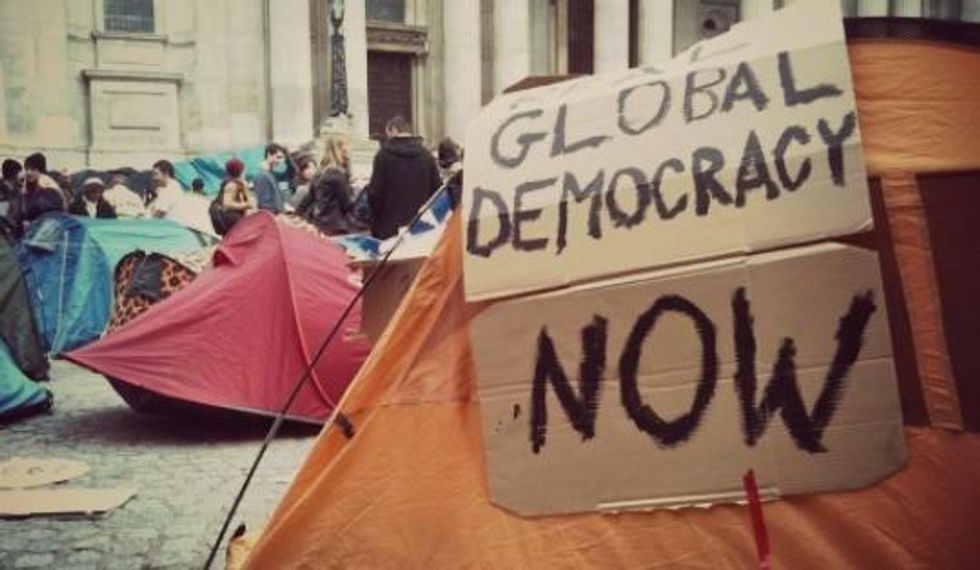
Credited as a precursor and the partial model for what became the Occupy Movement in the U.S., the indignados in Spain have continued their organizing despite the end of mass encampments in the nation's city centers.
Simmering below the surface, as The Guardian's Paul Hamilos reports from Madrid, the seeds planted amid the economic calamities of recent years are now growing into a new kind of political party that believes it is now ready to harness the energy and ideas of that movement in order to build a new kind of political and economic future for Spain.
"We have a slogan: 'Democracy, full stop.'" -Simona Levi, 'Partido X' member
So far ignored by most beyond Spain's borders, Hamilos paints a picture of the newly emergent 'Partido X' (or Party X) as an antidote to the resilient, yet destructive, politics of corruption and top-down economic policies that are hampering progress across Europe.
As Simona Levi, the equivalent of a spokesperson for the new political party, told Hamilos, "In Spain there is a political class that, at best, doesn't understand the needs of civil society, and at worst is completely corrupt and bankrupt. They have to go."
Following their official party announcement earlier this month, Joaquin Pagola, a member of the party explained to The Irish Times why a new political party and a new approach is necessary.
"We're in a situation whereby our democracy is full of holes, the system itself has failings," Pagola said. "Decisions are being taken that go against the wishes of the majority of Spaniards and as far as the economy is concerned, this is an emergency."
As The Guardian reports:
Partido X is positioning itself as a force for [...] change. Like many young parties, it is light on policy proposals in some areas, but says it has its sights set on tackling corruption with a "Nuremberg-style trial for bankers" and a dedicated anti-fraud unit, and to bring in more participatory democracy, with regular referendums.
The party promises to provide financial aid for Spain's small businesses, increase the minimum wage and introduce a maximum wage so no boss can earn more than 10 times his or her staff. These, and various other measures, may earn a shake of the head from the financial sector, but could appeal to those who have been left on the margins.
Unlike the traditional parties in Spain, Partido X understands the power of the internet, and its members have been using social media to spread their message and gather funds as well as ideas.
The party refuses to be pigeonholed as "right" or "left" but as Hamilos reports, its major policy plank is based on anti-corruption and the party broadly defines itself as "progressive," rejecting the serial malpractice performed by two-party system that currently dominates in Spain.
As Levi explained to the Irish Times: "We have a slogan: 'Democracy, full stop' which is a group of rules with which we can really control what a politician does, starting with a transparency law, which we don't have in Spain, and ending with [regular] referenda, which are almost non-existent in Spain."
And as, the Irish Times explains, the party's entrance into the arena of partisan politics is not designed as a departure from the street protest roots of their members, but an extention of it. As the Irish Times explains,
the most obvious reference point for Spain's new party is the indignados movement, which sprang up in 2011 and was a precursor to the likes of Occupy Wall Street. It was a spontaneous response to the country's rigid bi-party political system and poor handling of the economic crisis.
"The indignados was a historic moment, something akin to the French Revolution," Ms Levi told reporters [...]. "We're children of the indignados."
"Up until now no political party had managed to express the anger of the indignados," said Juan Carlos Monedero, a political scientist at Madrid's Complutense University.
"[Partido X] is a party made up of young, professional people who are closely involved in social networks and who somehow express this disenchantment - albeit from one particular angle."
And Hamilos adds:
Many have drawn comparisons with the Five Star movement led by the comedian Beppe Grillo, which stormed the Italian elections last year. Levi, who was born in Italy, agrees there are some similarities, and that the two groups have been in contact, but says Partido X is keen to avoid being led by a populist, charismatic leaderand sees itself as a "party of, and for, the citizens of this country". [...]
The sociologist Alejandro Navas, from the University of Navarra, has studied the indignados and understands the appeal in a country where youth unemployment has forced many educated Spaniards to leave. "We tell young people the world is theirs, but then the adult world doesn't allow that to happen. There is a shortage of jobs, and the ones that are out there often have low salaries and short-term contracts."
There is a contradiction inherent in Spain, said Navas: "Young people reject politicians, but they also expect a lot from the state. There is a lot of pessimism and resignation, which it will be hard to break." He is equivocal about whether Partido X can break that mood, and whether its activist base can come to terms with mainstream politics. But, he said, "change will only come from the ground up, from small parties and organisations."
In 2012, Democracy Now! host Amy Goodman interviewed Stephane Grueso, an activist and filmmaker who was making a documentary film about the indignados. In their exchange, Grueso explains why the indignados never "went away" but how they put down roots in their communities for ongoing and future political change. Watch:
________________________________________
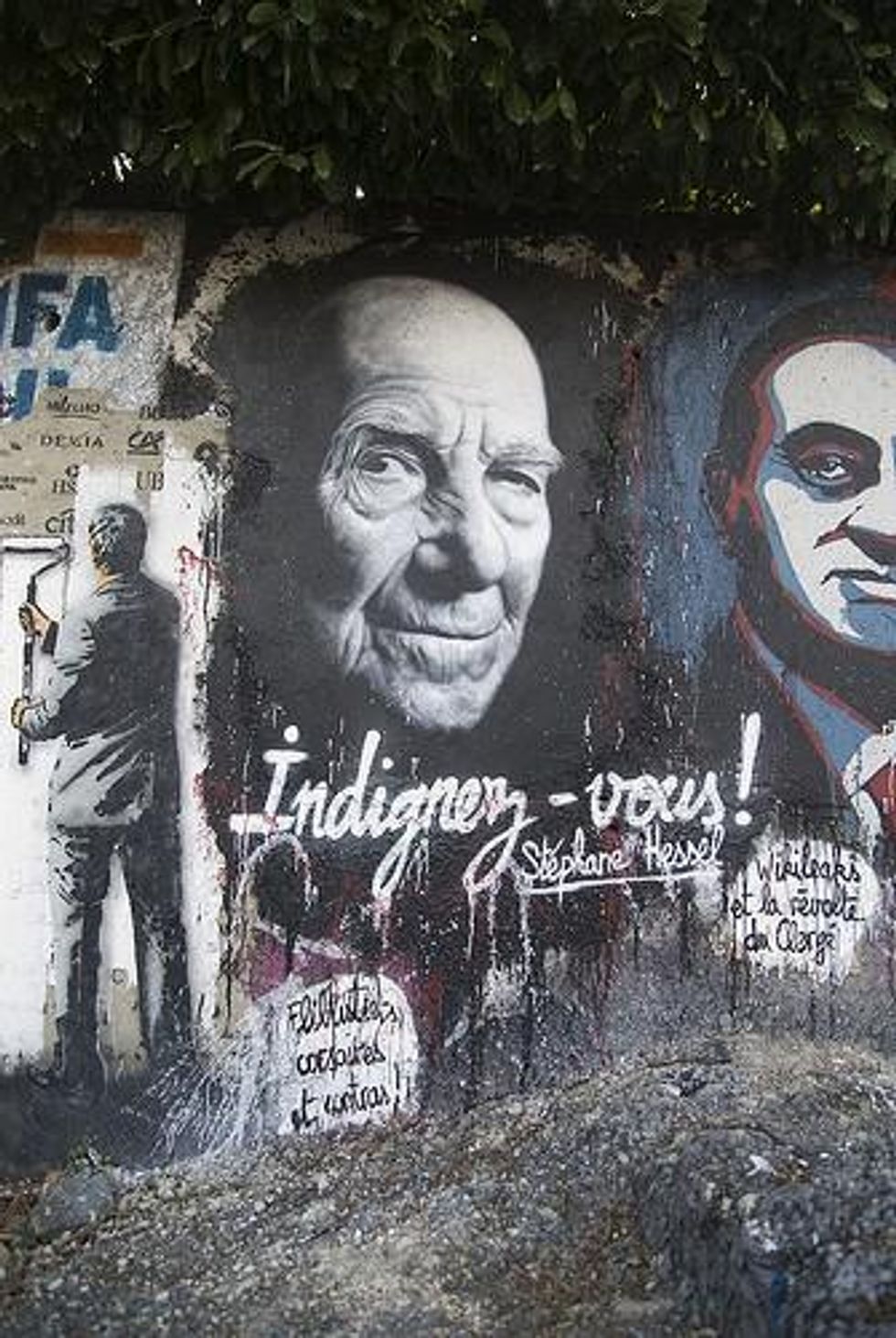
"To you who will create the twenty-first century, we say, from the bottom of our hearts, to create is to resist. To resist is to create." --Stephane Hessel, Indignez-Vous! (Time for Outrage)
Stephane Hessel, inspiration for the Spanish indignados movement, later paralleled with Occupy Wall Street, died in Paris on Tuesday night. He was 95.
Hessel, Democracy Now! explained
occupied many positions in his life: immigrant, French Resistance fighter, concentration camp survivor, diplomat, advocate and author. He joined the French Resistance during World War II, was caught by the Gestapo and sent to the Buchenwald concentration camp. He escaped during transfer to Bergen-Belsen and later helped draft the United Nations Universal Declaration of Human Rights, then became an honorary "Ambassador of France," appointed to special government missions. He has since been a fierce advocate of the Palestinians.
But Hessel, Kim Willsher writes in an obituary in the Guardian, achieved
his worldwide celebrity at the age of 93, when a political pamphlet he wrote became a bestselling publishing sensation and inspired global protest and the Occupy Wall Street movement.
Millions of copies of his pamphlet Time for Outrage have been sold worldwide.
Introducing Hessel at a talk in September 2011 at Columbia University, The Nation's Katrina vanden Heuvel called his "a voice of humanity and conscience in a time when such values are so dangerously imperiled."

When I first asked an editor, Indigene Editions of Montpellier, to publish a little pamphlet, a little appeal, I thought it would hark back to the French Resistance, and that the movement of the French Resistance brought up some basic values, which they considered fundamental and they wanted General de Gaulle to apply when the war would be over. These values are still eminently the basic values. I found them carried forward by an American president for whom I have the greatest admiration and respect, Franklin Roosevelt. He was the one who allowed the Charter of the United Nations to come up. And I'm still working, 66 years later, to try to make those values felt by the younger generation. That is why in this small book--not very expensive, easily distributed all around--we try to say, these are the values on which, if they are violated, you must protest. You must find the time for outrage when these values are not respected.
Lauding the efforts of Occupy Wall Street, Hessel later added:
I think we have had the possibility of living in democracies. What does it mean? It means places where the privileged are not the one to make the decisions, but that the underprivileged are going to rise to a status where they are normal human beings and human citizens with their freedoms and their rights. When that is no longer the case, whatever the circumstance--in France, with President Sarkozy, definitely; in Spain, perhaps, after many attempts--then it is proper for the young generation to listen to the very old ones who tell them, "We have been resisters at a time where there was fascism or Stalinism. You must find the things that you will not accept, that will outrage you. And these things, you must be able to fight against nonviolently, peacefully, but determinedly." That is why I am so happy about what happens these days in Wall Street, because they're indeed very peaceful. They are not throwing any bombs or any stones, but they're there determined to see that their values are to be respected.
Agnes Poirier writes of Hessel's death:
Europe has lost a great European - and France a much-loved child, poet and, above all, a combatant for justice and freedom.
* * *
Note: The Nation was the first to publish Indignez-Vous! in the U.S.. Read it here.
____________________________
Is the 15-M movement going invisible? Or is it rather gaining strength in the 'underground'? The mainstream media keep claiming that the indignados have lost support since last year, that its only success is its ability to bring people together on special dates. Spanish newspaper El Pais concluded in May 2012 that, one year after the birth of the movement, popular support and sympathy for the indignados had decreased around 13% among the Spanish population, despite the massive mobilizations that took place from the 12th until the 15th of May, commemorating the anniversary of the movement. ABC opened its edition of May 15 stating that "the indignados movement shows less strength on their anniversary." But the media misses the point. In reality, rather than losing strength, the movement has become stronger, more organized, better coordinated, and supported by the commitment of hundreds of people.
The decentralization of the movement
When May 2011 came to an end, the recently born 15-M movement had to find out how to survive beyond the camp at Puerta del Sol (acampadasol). Thus arose the idea of decentralizing the movement towards the neighborhoods: the 'toma los barrios', or take the neighborhoods, initiative supported and encouraged the creation of assemblies in every neighborhood of Madrid. In this way, the movement went local: since the creation of the neighborhood assemblies on May 28, 2011, around 120 assemblies have been set up, and they coordinate through the Asamblea Popular de Madrid, the popular assembly of Madrid, also known as Asamblea Interbarrios (the inter-neighborhood assembly). As there were many thematic working groups in the original Sol camp, working groups with similar interests were created in most of the neighborhood assemblies, which since then collaborate and coordinate with the general groups from acampadasol.
The objectives of such decentralization aimed, in the first place, to promote direct and participatory democracy in the local sphere, based on an understanding of politics as the art of collectively creating an alternative pattern of social relations, thereby bringing people out of isolation and into a community. A second objective aimed to retake the public sphere, as defined by Habermas, as a place in which political participation is enacted through the medium of talk, the space in which citizens deliberate about their common affairs, hence, an arena of discursive interaction. This interaction is structured through assemblies, which constitute the greatest expression of horizontal organization and democracy from below. The combination of both objectives shows the movement's efforts in fighting for a 'real democracy now' (Democracia Real Ya), which goes in the direction of Daniel Barber's concept of 'strong democracy', a "normative alternative where citizens are engaged at the local and national levels in a variety of political activities and regard discourse, debate and deliberation as essential conditions for reaching common ground."
The emergence of new social initiatives
The neighborhood assemblies usually meet once a week and they constitute public spaces for debate, where neighbors exchange ideas and visions about general topics (the economy, unemployment, housing, the financial system, education, social security), but also about local problems that particularly affect their neighborhood. A large number of activities have been organised within these assemblies, one of the most interesting of which is the creation of so-called 'time banks', or bancos de tiempo. Time banking is a pattern of non-monetary reciprocal service, which seeks to address requirements outside of the market sphere. As an alternative to the monetary system, the unit of currency used is one hour of any person's labor. In this way, time banks seek to provide incentives and rewards for work usually done on a volunteer basis. The assembly of the La Concepcion neighborhood, in the northeast of Madrid, has one of the biggest and better organised bancos de tiempo, which is coordinated through the internet. The neighbors can create an online profile where they share information about the services they can provide, and they can get in touch with people who offer services they are interested in. They conclude the transaction between one another, and a mediation commission is planned in case any problem come up.
Other initiatives that originated within the assemblies include the creation of organic vegetable gardens in empty neighborhood spaces, aiming to reduce food dependency, and the constitution of co-operatives of agro-ecological consumption, which seek to shorten the commercialization circuits and establish closer relationships to producers. The latter is a very clear materialization of the movement's critique of the conventional models of production and consumption of the capitalist system, claiming that they are neither sustainable, fair, healthy, nor tasty. In this way, the assemblies are encouraging the emergence of alternative lifestyles and consumption habits.
One of the most successful actions of the 15-M movement that the neighborhoods have helped to coordinate is the 'stop forced evictions' campaign (stop desahucios). Around 200 evictions have been stopped since last year. Since the beginning, a working group on housing rights was constituted inside of the indignados movement, which formed the housing office (oficina de vivienda). When the neighborhood assemblies were created, they served as a means to channel the desahucios initiative. Only last year, 58.241 evictions were processed in the country, a rise of 22 percent compared to 2010. The Platform of Those Affected by a Mortgage (PAH: Plataforma de Afectados por la Hipoteca), an association that was created in 2009 to try to find a solution to the drama of forced evictions, tightly connected to the 15-M movement, was able to provide its people-gathering strength and visibility to the stop evictions. The neighborhoods were a key actor in this process: they started collecting information of the evictions planned in their area, and organized the mobilization of activists on eviction dates. Through the celebration of mutual assemblies and the sharing of information through social networks, housing has become one of the main targets for the neighborhood assemblies to work on and mobilize around.
The truth is that the 15-M movement has marked a turning point in Spain's social climate: it has opened up a whole new sphere of public debate. It has shown that it is possible to think differently, to feel differently, and to act differently. It has proved that it is possible to set up alternatives to the current system, and it has gathered together a large number of people who are now showing that there is more beyond the movement than only sporadic massive mobilizations.
Under the slogan 'No human being is illegal', the Neighborhood Brigades for Human Rights Monitoring (Brigadas Vecinales de Observacion de los Derechos Humanos) have been formed within some popular assemblies in Madrid, mostly in those neighborhoods with big immigrant collectives, with the goal of rendering visible the police raids on the immigrant population, as well as denouncing the xenophobic and racist bias that they usually display. The neighborhood assemblies, with their Human Rights Monitoring Brigades, have also been the cradle of protest against immigration detention centres (CIEs: Centro de Internamiento de Extranjeros), advocating for their closure and the improvement of detainee's human rights guarantees.
The indignados have revitalized the neighborhood movement: new forms of cooperation coexist with the old neighborhood associations, and they are coordinating and sharing a large number of initiatives and joint actions. The neighborhood associations, which appeared in Madrid in the late sixties, had gradually moderated their demands and plunged into a light sleep. The 15-M movement has reawakened local politics and boosted community-based mobilization: we are witnessing how old and new forms of neighborhood organization are coexisting, coordinating and mutually learning from one another.
A new social climate
The media has emphasized lately that the 15-M movement still has a powerful people-gathering effect, but that, apart from the massive mobilizations, it is losing its influence in day-to-day life. But the 15-M movement has in fact created a new social climate. As the popular assembly of Algete expressed on its Twitter account, "we were sleeping, we woke up, and now we have chronic insomnia" (dormiamos, despertamos, y ahora tenemos insomnio cronico). Philosopher Amador Fernandez-Savater goes beyond that and claims that the 15-M movement has opened a "new state of mind". The truth is that the 15-M movement has marked a turning point in Spain's social climate: it has opened up a whole new sphere of public debate. It has shown that it is possible to think differently, to feel differently, and to act differently. It has proved that it is possible to set up alternatives to the current system, and it has gathered together a large number of people who are now showing that there is more beyond the movement than only sporadic massive mobilizations.
In more than one hundred neighborhoods of Madrid, every single week, popular assemblies are held, working groups are created, and new initiatives are taking shape. Once a week, the Popular Assembly of Madrid (Asamblea Popular de Madrid, or Comision Interbarrios), the inter-neighborhood coordination instance, meets to analyze, discuss and adopt proposals coming from the different neighborhood assemblies. A silent interconnection of minds takes place on a weekly basis all over the city, in the squares and on the internet. Yet the media keeps insisting that the movement is losing strength. We are witnessing the appearance of a parallel, alternative, underground economy. Yet those in power remain blind to it. As political scientist Carlos Taibo expresses it, "we constantly see how the media declares that the 15-M movement is dead. And I have realized that it is better not to reply back: the less they know about the reality of the movement, the more surprised they will be by what emerges from the invisible."
"The 15-M movement was an explosion in the streets, but it has spread seeds of work all over the neighborhoods," says Lola Diaz, from Agora Sol. One year after its birth, we can conclude that the 15-M movement is more vibrant than ever before. It has raised a world awareness on the importance of being united for change. As activist and researcher Esther Vivas remarks, "with individual single actions we are not going to change the world, the change of paradigm will come only from collective action; if we don't fight, if we are not proactive, if we don't take the streets, we have lost before starting."
The 15-M movement has gone beyond protest: it has succeeded in altering the collective imagination and the political atmosphere at its very roots. It has generated a process of re-politicization of society. The agenda of actions has expanded and been radicalized: now we do not only occupy the squares, but we are taking back the public spaces in our own neighborhoods. We stop evictions. We crowd-fund our initiatives. We bring legal actions against bankers. We build our own parallel networks of social support. Does this show a weakened movement, running out of strength? Or does it rather show a dynamic movement, working in the underground on a silent revolution? The 15-M movement, armed with a 'slow impatience', as philosopher Daniel Bensaid pointed out, is putting its efforts in rebuilding the correlation of forces between the 1 percent in power and the vast majority of society, the other 99 percent. And stay sharp: this is only just the beginning.
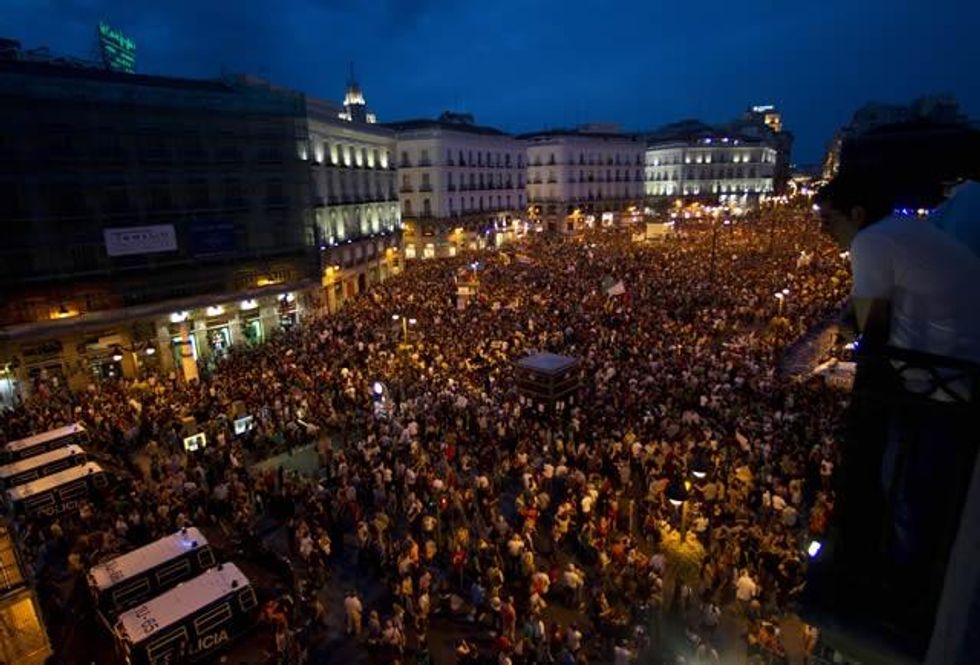
Tens of thousands of Spaniards fed up with the economic misery caused by austerity measures and waving banners against bankers marched this weekend to mark the first anniversary of the grassroots "Indignados" movement that has sparked similar protests around the world.
Police arrested 18 people in Madrid's Puerta del Sol overnight for resisting an order to leave. Protesters rallied anew in the square during the day calling for the release of the 18, chanting: "We're not all here!"
On Saturday, tens of thousands of Spaniards took to the streets in 80 cities across the country, waving banners and chanting against the bankers and politicians they blame for Spain's worst crisis in decades.
* * *
The Independent/UK reports:
Spaniards angered by increasingly grim economic prospects and unemployment hitting one out of every four citizens turned out in droves in the nation's largest cities.
Austerity cuts targeting "health and education, but rescuing banks are wrong. They need to find other places to cut".The protest marked the one-year anniversary of a spontaneous movement that inspired similar anti-authority demonstrations across the world.
The Interior Ministry said 72,000 people marched against the government's tough austerity measures in Madrid, Barcelona and six other cities, but protesters claimed the turnout was much higher.
The epicenter of the protest was Madrid, where at least 30,000 people flooded into the central Puerta del Sol plaza last night, vowing to stay put for three days.
Authorities warned they would not allow anyone to camp out overnight as protesters did last year, but the demonstrators stayed put after a midnight deadline to leave and more than 2,000 riot police on duty made no immediate effort to force them out.
"I'm here to defend the rights that we're losing and for the young people who have it so tough," said 57-year-old teacher Roberto Alonso. "They're better educated than ever. But they don't have work. They don't have anything. They're behind and they'll stay that way."
At least 22,000 people demonstrated in Barcelona, Spain's second largest city. Marches were also held in Bilbao, Malaga and Seville, and sympathizers from other countries held protests across Europe.
The protests began May 15 last year and drew hundreds of thousands of people calling themselves the Indignant Movement. The demonstrations spread across Spain and Europe as anti-austerity sentiment grew.
"We've had this crisis for four years, but it feels like it's just starting," the fine arts major said.
Mr Colilla, who lives with his parents, said he saw no prospect of getting a menial job after graduation and thinks he may never be able to buy a flat.
"Right now I'm thinking my best option will be to go to Germany where I can wash dishes, make a little money and learn German," he said. "The prospects of getting a job in Spain are practically nonexistent."
He said the government austerity cuts targeting "health and education, but rescuing banks are wrong. They need to find other places to cut".
A year ago, the "indignados" pitched tents and occupied town and city squares across Spain for weeks. Demonstrators clashed with police who eventually moved in to evict them.
* * *

# # #
Spain's "indignados" will be hitting the streets this weekend in the tens of thousands to mark their one-year anniversary with renewed calls for economic justice.
"We need to take back all the wealth and redistribute it fairly," Aitor, a member of Real Democracy Now (Democracia Real Ya), which started the 15-M movement, told El Pais.
Jon Aguirre, a 27-year-old architect, told Agence France-Presse, "When families can no longer help, we will see what happens: what happened in Greece is not far off."
Spain's "indignados" will be hitting the streets this weekend in the tens of thousands to mark their one-year anniversary with renewed calls for economic justice.
"We need to take back all the wealth and redistribute it fairly," Aitor, a member of Real Democracy Now (Democracia Real Ya), which started the 15-M movement, told El Pais.
Jon Aguirre, a 27-year-old architect, told Agence France-Presse, "When families can no longer help, we will see what happens: what happened in Greece is not far off."
In the face of the government cracking down on protest, Spaniards will be met with thousands of riot police this weekend who will arrest anyone attempting to make encampments. In addition, the government has already limited the amount of time protests will be allowed in Madrid.
Ter Garcia writes in Waging Nonviolence: "We don't want May 12 to be a celebration of our anniversary, or a one-day demonstration," one often hears activists in the Spanish 15M movement saying lately. "We want it to be a new milestone."
The indignados' protest, starting tomorrow, will culminate on the 15th, the movement's birth in Madrid's Puerta del Sol.
The weekend will also see global protests to call for justice for the 99%. On the May 12 2012 website, which lists scheduled actions across the globe, a call for action reads: "In 2011 we showed another world was possible. Our struggle continues in 2012; together we will rally against corruption, human-rights violations, censorship, police brutality and corporate greed. May 12th, 2012 -- everywhere. Join us."
* * *
* * *
El Pais: Demonstrators take to streets to mark 15-M anniversary
More than 80 cities across Spain will hold protests against politicians and bankers, who the 15-M movement blames for the global economic crisis. In Valencia, demonstrators are expected to set off fireworks. Mayor Rita Barbera has said that police will cordon off the main square in front of City Hall to prevent the demonstrators from taking it over, as they did last summer.
"What this lady doesn't realize is that there are thousands of squares, and not all of them can be cordoned off," said Matilde, a 15-M activist.
Among the activities planned will be debates and discussions about the direction the movement will take and new strategies to pressure the government of Prime Minister Mariano Rajoy to stop his proposed budget cuts in health and education, say the 15-M organizers.
"We need to take back all the wealth and redistribute it fairly," said Aitor, a member of the Democracy Now platform, from which the 15-M movement was created.
In Europe, the most important demonstrations are expected to take place in Frankfurt, London and Lisbon, while across the Atlantic, the Occupy Wall Street movement has organized a massive demonstration in New York.
* * *
* * *
Ter Garcia: Spain's 15M movement gears up for May 12 and beyond
"We don't want May 12 to be a celebration of our anniversary, or a one-day demonstration," one often hears activists in the Spanish 15M movement saying lately. "We want it to be a new milestone." For months now, many of them have been taking part in local and international meetings to prepare. Through online conference calls using the open-source platform Mumble, organizers from Occupy, 15M and movements all around the world chose May 12 as a day for a global mobilization, leading up to another on May 15.
After its birth with occupations in public squares across Spain last May, 15M has been a model for movements around the world, many of which have reached a critical mass and brought to the fore issues of austerity, wealth inequality and political corruption. Yet, in Spain and elsewhere, governments continue to respond with more budget cuts and increased police repression. Activists hope that this latest round of mobilizations will help turn the tide.
* * *
The Guardian: Spain's indignado protesters face anniversary crackdown
Police will be out in force in Madrid's Puerta del Sol as well in other squares across the country as Mariano Rajoy's government vows to prevent the indignados rebuilding the camps that appeared suddenly last May.
Madrid alone will have up to 2,000 anti-riot police watching the protesters and arresting those who try to pitch camp.
The indignados have announced 96 continuous hours of protests in the Puerta del Sol from Saturday until Tuesday, but the civil governor has set a limit of 10 hours or less a day for demonstrations.
That may mean riot police will be called in the clear the Puerta del Sol every evening - with force potentially being used against the avowedly non-violent movement.
"Camps are illegal and so they will not be allowed to happen," the interior minister, Jorge Fernandez Diaz, warned.
Madrid's civil governor, Cristina Cifuentes, has complained that she is unable to communicate directly with a movement that remains largely amorphous and leaderless. "Those who want to meet in the Puerta del Sol have the right to do so ... but they cannot get in the way of other citizens or break the law," she said.
Protests will also be seen in Barcelona, Seville, Valencia and other major cities -- with authorities banning some of the events proposed by the indignados.
The fresh protests come after a year of further austerity and misery in the Spanish economy - with a return to recession and unemployment among the young rising above 50%. But they also come after Spaniards turned to the political right, in the form of Rajoy's People's party, at elections last November.
A fierce austerity programme includes cuts to health and education, while reduced public spending is deepening a crisis that saw Spain's fourth biggest bank, Bankia, nationalised on Wednesday.
* * *
Spain announced yesterday proposed changes to the country's penal code that many see as an attempt to clamp down on protests, silence dissent and dismantle democracy.

The changes, Spanish interior minister Jorge Fernandez Diaz said, were needed to toughen up punishment against street vandalism that "disturb public peace" and would include criminalizing intent to organize violent demonstrations through "any means including the Internet."
Fernandez Diaz said the measures were needed so as not to have a repeat of recent events in Barcelona, where Spanish police fired rubber bullets into crowds of protesters.
The Twittersphere exploded after the announcement with users tweeting the hashtags #holadictadura (hello dictatorship) and #soycriminal (I'm a criminal).
* * *
The Telegraph: Spain accused of 'draconian' plans to clamp down on protests
[The new laws have] raised fears that the new measures could be used to stem the wave of protests that began last summer with the birth of what has been dubbed the "indignado movement", when tens ouf thousands of peaceful protesters camped out in squares across Spain.
Protest groups were quick to draw comparisons to the fascist dictatorship of Gen Grancisco Franco. [...]
[Diaz] also said that the measures would extend authorities powers to deal with passive resistance as contempt of court.
The measures will make it "an offence to breach authority using mass active or passive resistance against security forces and to include as a crime of assault any threatening or intimidating behaviour," he said in Congress.
Spain is about to experience huge austerity cuts that may prove explosive. On Friday Mariano Rajoy, the prime minister, is set to announce what even he describes as a "very, very austere budget" to reduce the deficit. According to El Pais, the EU is demanding cuts larger than those of Greece, Ireland or Portugal: "There is no comparable adjustment in [our] economic history," says the paper.
As a result of this and recent changes to labor laws, only four months after the new conservative government took power, Spain's two largest unions have called for a general strike on the day before the budget announcement.
On top of EUR15bn cuts already announced in December, it is estimated Rajoy will cut about another EUR40bn. Many are expecting drastic cuts to health and education, not least the financial markets, who are waiting to see whether Rajoy will deliver what they require. This is on top of existing cuts to social spending, wage freezes for public employees, and privatizations, in a context where 40 home evictions a day are taking place across the country.
Response to this austerity has already been fierce. Hundreds of thousands protested across the country in February against labor law changes described by the unions as "the most regressive in the history of the [Spanish] democracy". Thursday's general strike will be much larger, seeing hundreds of planes grounded, public transport on a skeleton service, manufacturing at a virtual standstill, and even fresh bread from the bakeries in scant supply.
Polls suggest 30% of employed adults say they will participate, but this figure hides the true size of what the indignados movement is calling the "invisible" strike. With the highest unemployment rate in the developed world - 23% are out of work and 49.9% of those under 30 - there is a vast, invisible precariat of students, temp workers, the unpaid, immigrants and older people, looking for ways to meaningfully participate in and expand the political possibilities of the general strike.
This is the natural constituency of the indignados, who launched the global Occupy movement last summer with their city encampments and an emphasis on openness and direct democracy.
Many have been instrumental in continuing struggles around the Spanish state against what have already been drastic cuts. For instance, the "iaiaflautas" are retirees and grandparents who occupy bank lobbies against bailouts, buses against price hikes, and health departments against cutbacks. Their name is a play on the "perroflautas", Spanish slang for crusty, to show how impossible it is to stereotype those taking part in protests as typical activists.
Meanwhile in Valencia, one of the worst-hit regions, students and schoolchildren took part in recent protests against government cuts that had left their schools without adequate heating, many sitting in blankets in classrooms during the cold. The protests were brutally repressed. The sight of schoolkids being arrested by police galvanised a whole wave of solidarity protests around the country from outraged citizens.
These are only the most visible actions. All over the country small groups of determined everyday acts of resistance are taking place, like the villages where people blockade the highway weekly because their emergency clinic is closing down.
In this context, the general strike will be a kind of creative laboratory for the indignados who will be exploring new ways to exert social pressure. They hold the traditional unions at arm's length but join the dance, calling for participation in what they describe as "a strike for the 99 per cent". Many of the actions on the day will start with activists massing in defence of the homes of those about to be evicted for mortgage default; local indignado assemblies will hold popular lunches in the public squares to draw new people into the discussion.
Few are expecting the unions to win immediate concessions, for there are larger forces at work. The EU will be sending officials in April to make sure Rajoy doesn't back pedal in the wake of the strike. Meanwhile the indignados are building for renewed mobilizations in May, taking part in global day of action for the Occupy movement, and for the struggles beyond. For, as Madrilonia, an indignado blog puts it, "a defensive strike is not enough": ultimately this is a struggle for a new social contract for the 99%.