SUBSCRIBE TO OUR FREE NEWSLETTER
Daily news & progressive opinion—funded by the people, not the corporations—delivered straight to your inbox.
5
#000000
#FFFFFF
To donate by check, phone, or other method, see our More Ways to Give page.
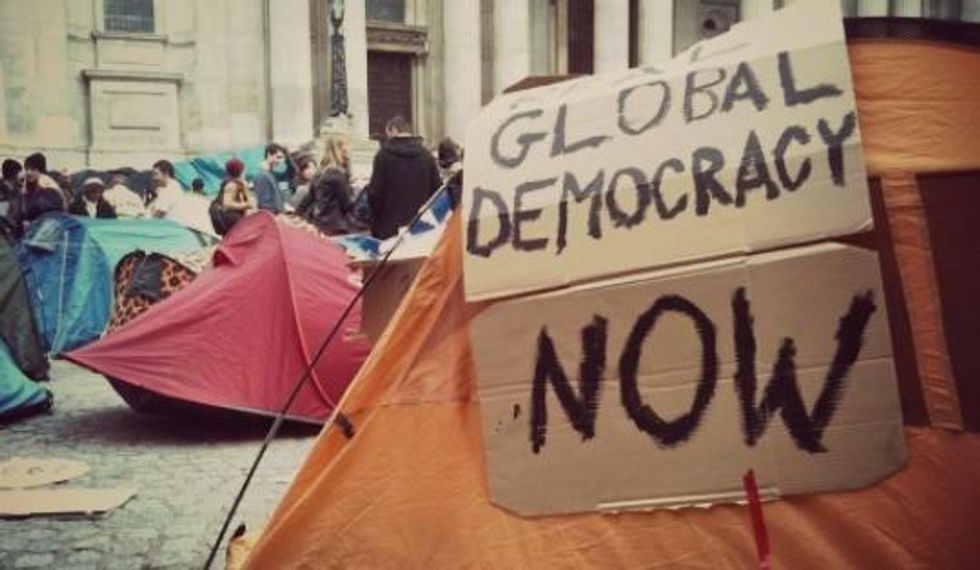
Credited as a precursor and the partial model for what became the Occupy Movement in the U.S., the indignados in Spain have continued their organizing despite the end of mass encampments in the nation's city centers.
Simmering below the surface, as The Guardian's Paul Hamilos reports from Madrid, the seeds planted amid the economic calamities of recent years are now growing into a new kind of political party that believes it is now ready to harness the energy and ideas of that movement in order to build a new kind of political and economic future for Spain.
"We have a slogan: 'Democracy, full stop.'" -Simona Levi, 'Partido X' member
So far ignored by most beyond Spain's borders, Hamilos paints a picture of the newly emergent 'Partido X' (or Party X) as an antidote to the resilient, yet destructive, politics of corruption and top-down economic policies that are hampering progress across Europe.
As Simona Levi, the equivalent of a spokesperson for the new political party, told Hamilos, "In Spain there is a political class that, at best, doesn't understand the needs of civil society, and at worst is completely corrupt and bankrupt. They have to go."
Following their official party announcement earlier this month, Joaquin Pagola, a member of the party explained to The Irish Times why a new political party and a new approach is necessary.
"We're in a situation whereby our democracy is full of holes, the system itself has failings," Pagola said. "Decisions are being taken that go against the wishes of the majority of Spaniards and as far as the economy is concerned, this is an emergency."
As The Guardian reports:
Partido X is positioning itself as a force for [...] change. Like many young parties, it is light on policy proposals in some areas, but says it has its sights set on tackling corruption with a "Nuremberg-style trial for bankers" and a dedicated anti-fraud unit, and to bring in more participatory democracy, with regular referendums.
The party promises to provide financial aid for Spain's small businesses, increase the minimum wage and introduce a maximum wage so no boss can earn more than 10 times his or her staff. These, and various other measures, may earn a shake of the head from the financial sector, but could appeal to those who have been left on the margins.
Unlike the traditional parties in Spain, Partido X understands the power of the internet, and its members have been using social media to spread their message and gather funds as well as ideas.
The party refuses to be pigeonholed as "right" or "left" but as Hamilos reports, its major policy plank is based on anti-corruption and the party broadly defines itself as "progressive," rejecting the serial malpractice performed by two-party system that currently dominates in Spain.
As Levi explained to the Irish Times: "We have a slogan: 'Democracy, full stop' which is a group of rules with which we can really control what a politician does, starting with a transparency law, which we don't have in Spain, and ending with [regular] referenda, which are almost non-existent in Spain."
And as, the Irish Times explains, the party's entrance into the arena of partisan politics is not designed as a departure from the street protest roots of their members, but an extention of it. As the Irish Times explains,
the most obvious reference point for Spain's new party is the indignados movement, which sprang up in 2011 and was a precursor to the likes of Occupy Wall Street. It was a spontaneous response to the country's rigid bi-party political system and poor handling of the economic crisis.
"The indignados was a historic moment, something akin to the French Revolution," Ms Levi told reporters [...]. "We're children of the indignados."
"Up until now no political party had managed to express the anger of the indignados," said Juan Carlos Monedero, a political scientist at Madrid's Complutense University.
"[Partido X] is a party made up of young, professional people who are closely involved in social networks and who somehow express this disenchantment - albeit from one particular angle."
And Hamilos adds:
Many have drawn comparisons with the Five Star movement led by the comedian Beppe Grillo, which stormed the Italian elections last year. Levi, who was born in Italy, agrees there are some similarities, and that the two groups have been in contact, but says Partido X is keen to avoid being led by a populist, charismatic leaderand sees itself as a "party of, and for, the citizens of this country". [...]
The sociologist Alejandro Navas, from the University of Navarra, has studied the indignados and understands the appeal in a country where youth unemployment has forced many educated Spaniards to leave. "We tell young people the world is theirs, but then the adult world doesn't allow that to happen. There is a shortage of jobs, and the ones that are out there often have low salaries and short-term contracts."
There is a contradiction inherent in Spain, said Navas: "Young people reject politicians, but they also expect a lot from the state. There is a lot of pessimism and resignation, which it will be hard to break." He is equivocal about whether Partido X can break that mood, and whether its activist base can come to terms with mainstream politics. But, he said, "change will only come from the ground up, from small parties and organisations."
In 2012, Democracy Now! host Amy Goodman interviewed Stephane Grueso, an activist and filmmaker who was making a documentary film about the indignados. In their exchange, Grueso explains why the indignados never "went away" but how they put down roots in their communities for ongoing and future political change. Watch:
________________________________________
Credited as a precursor and the partial model for what became the Occupy Movement in the U.S., the indignados in Spain have continued their organizing despite the end of mass encampments in the nation's city centers.
Simmering below the surface, as The Guardian's Paul Hamilos reports from Madrid, the seeds planted amid the economic calamities of recent years are now growing into a new kind of political party that believes it is now ready to harness the energy and ideas of that movement in order to build a new kind of political and economic future for Spain.
"We have a slogan: 'Democracy, full stop.'" -Simona Levi, 'Partido X' member
So far ignored by most beyond Spain's borders, Hamilos paints a picture of the newly emergent 'Partido X' (or Party X) as an antidote to the resilient, yet destructive, politics of corruption and top-down economic policies that are hampering progress across Europe.
As Simona Levi, the equivalent of a spokesperson for the new political party, told Hamilos, "In Spain there is a political class that, at best, doesn't understand the needs of civil society, and at worst is completely corrupt and bankrupt. They have to go."
Following their official party announcement earlier this month, Joaquin Pagola, a member of the party explained to The Irish Times why a new political party and a new approach is necessary.
"We're in a situation whereby our democracy is full of holes, the system itself has failings," Pagola said. "Decisions are being taken that go against the wishes of the majority of Spaniards and as far as the economy is concerned, this is an emergency."
As The Guardian reports:
Partido X is positioning itself as a force for [...] change. Like many young parties, it is light on policy proposals in some areas, but says it has its sights set on tackling corruption with a "Nuremberg-style trial for bankers" and a dedicated anti-fraud unit, and to bring in more participatory democracy, with regular referendums.
The party promises to provide financial aid for Spain's small businesses, increase the minimum wage and introduce a maximum wage so no boss can earn more than 10 times his or her staff. These, and various other measures, may earn a shake of the head from the financial sector, but could appeal to those who have been left on the margins.
Unlike the traditional parties in Spain, Partido X understands the power of the internet, and its members have been using social media to spread their message and gather funds as well as ideas.
The party refuses to be pigeonholed as "right" or "left" but as Hamilos reports, its major policy plank is based on anti-corruption and the party broadly defines itself as "progressive," rejecting the serial malpractice performed by two-party system that currently dominates in Spain.
As Levi explained to the Irish Times: "We have a slogan: 'Democracy, full stop' which is a group of rules with which we can really control what a politician does, starting with a transparency law, which we don't have in Spain, and ending with [regular] referenda, which are almost non-existent in Spain."
And as, the Irish Times explains, the party's entrance into the arena of partisan politics is not designed as a departure from the street protest roots of their members, but an extention of it. As the Irish Times explains,
the most obvious reference point for Spain's new party is the indignados movement, which sprang up in 2011 and was a precursor to the likes of Occupy Wall Street. It was a spontaneous response to the country's rigid bi-party political system and poor handling of the economic crisis.
"The indignados was a historic moment, something akin to the French Revolution," Ms Levi told reporters [...]. "We're children of the indignados."
"Up until now no political party had managed to express the anger of the indignados," said Juan Carlos Monedero, a political scientist at Madrid's Complutense University.
"[Partido X] is a party made up of young, professional people who are closely involved in social networks and who somehow express this disenchantment - albeit from one particular angle."
And Hamilos adds:
Many have drawn comparisons with the Five Star movement led by the comedian Beppe Grillo, which stormed the Italian elections last year. Levi, who was born in Italy, agrees there are some similarities, and that the two groups have been in contact, but says Partido X is keen to avoid being led by a populist, charismatic leaderand sees itself as a "party of, and for, the citizens of this country". [...]
The sociologist Alejandro Navas, from the University of Navarra, has studied the indignados and understands the appeal in a country where youth unemployment has forced many educated Spaniards to leave. "We tell young people the world is theirs, but then the adult world doesn't allow that to happen. There is a shortage of jobs, and the ones that are out there often have low salaries and short-term contracts."
There is a contradiction inherent in Spain, said Navas: "Young people reject politicians, but they also expect a lot from the state. There is a lot of pessimism and resignation, which it will be hard to break." He is equivocal about whether Partido X can break that mood, and whether its activist base can come to terms with mainstream politics. But, he said, "change will only come from the ground up, from small parties and organisations."
In 2012, Democracy Now! host Amy Goodman interviewed Stephane Grueso, an activist and filmmaker who was making a documentary film about the indignados. In their exchange, Grueso explains why the indignados never "went away" but how they put down roots in their communities for ongoing and future political change. Watch:
________________________________________
Credited as a precursor and the partial model for what became the Occupy Movement in the U.S., the indignados in Spain have continued their organizing despite the end of mass encampments in the nation's city centers.
Simmering below the surface, as The Guardian's Paul Hamilos reports from Madrid, the seeds planted amid the economic calamities of recent years are now growing into a new kind of political party that believes it is now ready to harness the energy and ideas of that movement in order to build a new kind of political and economic future for Spain.
"We have a slogan: 'Democracy, full stop.'" -Simona Levi, 'Partido X' member
So far ignored by most beyond Spain's borders, Hamilos paints a picture of the newly emergent 'Partido X' (or Party X) as an antidote to the resilient, yet destructive, politics of corruption and top-down economic policies that are hampering progress across Europe.
As Simona Levi, the equivalent of a spokesperson for the new political party, told Hamilos, "In Spain there is a political class that, at best, doesn't understand the needs of civil society, and at worst is completely corrupt and bankrupt. They have to go."
Following their official party announcement earlier this month, Joaquin Pagola, a member of the party explained to The Irish Times why a new political party and a new approach is necessary.
"We're in a situation whereby our democracy is full of holes, the system itself has failings," Pagola said. "Decisions are being taken that go against the wishes of the majority of Spaniards and as far as the economy is concerned, this is an emergency."
As The Guardian reports:
Partido X is positioning itself as a force for [...] change. Like many young parties, it is light on policy proposals in some areas, but says it has its sights set on tackling corruption with a "Nuremberg-style trial for bankers" and a dedicated anti-fraud unit, and to bring in more participatory democracy, with regular referendums.
The party promises to provide financial aid for Spain's small businesses, increase the minimum wage and introduce a maximum wage so no boss can earn more than 10 times his or her staff. These, and various other measures, may earn a shake of the head from the financial sector, but could appeal to those who have been left on the margins.
Unlike the traditional parties in Spain, Partido X understands the power of the internet, and its members have been using social media to spread their message and gather funds as well as ideas.
The party refuses to be pigeonholed as "right" or "left" but as Hamilos reports, its major policy plank is based on anti-corruption and the party broadly defines itself as "progressive," rejecting the serial malpractice performed by two-party system that currently dominates in Spain.
As Levi explained to the Irish Times: "We have a slogan: 'Democracy, full stop' which is a group of rules with which we can really control what a politician does, starting with a transparency law, which we don't have in Spain, and ending with [regular] referenda, which are almost non-existent in Spain."
And as, the Irish Times explains, the party's entrance into the arena of partisan politics is not designed as a departure from the street protest roots of their members, but an extention of it. As the Irish Times explains,
the most obvious reference point for Spain's new party is the indignados movement, which sprang up in 2011 and was a precursor to the likes of Occupy Wall Street. It was a spontaneous response to the country's rigid bi-party political system and poor handling of the economic crisis.
"The indignados was a historic moment, something akin to the French Revolution," Ms Levi told reporters [...]. "We're children of the indignados."
"Up until now no political party had managed to express the anger of the indignados," said Juan Carlos Monedero, a political scientist at Madrid's Complutense University.
"[Partido X] is a party made up of young, professional people who are closely involved in social networks and who somehow express this disenchantment - albeit from one particular angle."
And Hamilos adds:
Many have drawn comparisons with the Five Star movement led by the comedian Beppe Grillo, which stormed the Italian elections last year. Levi, who was born in Italy, agrees there are some similarities, and that the two groups have been in contact, but says Partido X is keen to avoid being led by a populist, charismatic leaderand sees itself as a "party of, and for, the citizens of this country". [...]
The sociologist Alejandro Navas, from the University of Navarra, has studied the indignados and understands the appeal in a country where youth unemployment has forced many educated Spaniards to leave. "We tell young people the world is theirs, but then the adult world doesn't allow that to happen. There is a shortage of jobs, and the ones that are out there often have low salaries and short-term contracts."
There is a contradiction inherent in Spain, said Navas: "Young people reject politicians, but they also expect a lot from the state. There is a lot of pessimism and resignation, which it will be hard to break." He is equivocal about whether Partido X can break that mood, and whether its activist base can come to terms with mainstream politics. But, he said, "change will only come from the ground up, from small parties and organisations."
In 2012, Democracy Now! host Amy Goodman interviewed Stephane Grueso, an activist and filmmaker who was making a documentary film about the indignados. In their exchange, Grueso explains why the indignados never "went away" but how they put down roots in their communities for ongoing and future political change. Watch:
________________________________________