SUBSCRIBE TO OUR FREE NEWSLETTER
Daily news & progressive opinion—funded by the people, not the corporations—delivered straight to your inbox.
5
#000000
#FFFFFF
To donate by check, phone, or other method, see our More Ways to Give page.


Daily news & progressive opinion—funded by the people, not the corporations—delivered straight to your inbox.
"These extreme weather events that used to be once in a lifetime are now an almost annual occurrence," said Janez Lenarčič.
With the Portuguese government declaring a "state of calamity" over wildfires that have killed at least seven people, and the daily lives of hundreds of thousands of people in Central and Eastern Europe upended by deadly flooding, the European Union's top crisis official said the bloc must face the reality made evident by the disasters: "This is fast becoming the norm for our shared future."
A year after Europe was found to be the world's fastest-warming continent in an analysis by the World Meteorological Organization (WMO) and the E.U.'s Copernicus Climate Change Service (C3S), crisis management commissioner Janez Lenarčič told the European Parliament on Wednesday that "the global reality of the climate breakdown has moved into the everyday lives of Europeans."
"Make no mistake. This tragedy is not an anomaly," said Lenarčič. "We face a Europe that is simultaneously flooding and burning. These extreme weather events that used to be once in a lifetime are now an almost annual occurrence."
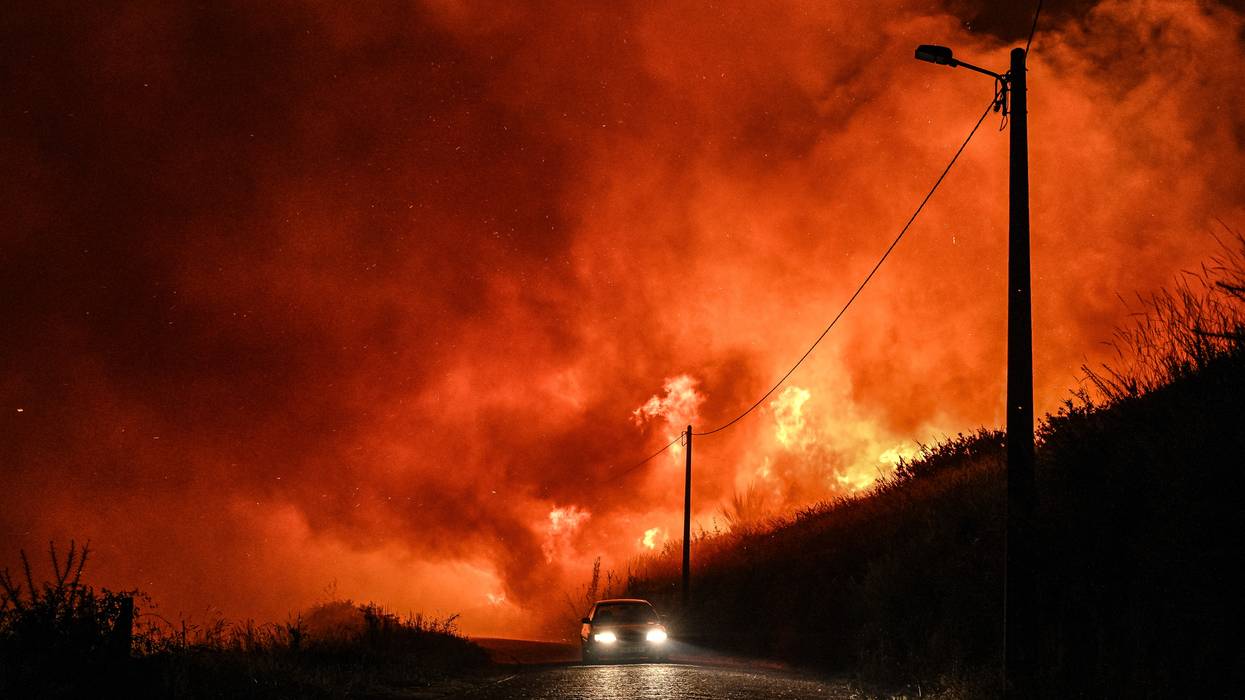
As countries including Poland, Romania, Austria, and the Czech Republic were reeling from flooding caused by Storm Boris in recent days, more than 478 square miles in Portugal's northern region were torched by fast-moving wildfires that started over the weekend.
Dozens of homes have been destroyed by more than 100 separate wildfires as officials deployed 5,000 firefighters to try to control the blazes on Wednesday. Spain, France, and Italy—which is now also preparing for heavy rainfall like the torrential downpour that inundated Central and Eastern Europe—contributed waterbombing aircraft.
Lenarčič focused his address largely on the need to ramp up disaster preparedness, noting that the rise in costs for repairing infrastructure destroyed by storms and fires has ballooned in recent decades.
"The average cost of disasters in the 1980s was 8 billion euros per year," said Lenarčič. "Meanwhile in 2022 alone, the damages surpassed 50 billion euros per year... The cost of inaction is far greater than the cost of action."
Lenarčič called on the European Commission to work closely with E.U. member states to implement the bloc's Floods Directive and a robust water resilience strategy to tackle catastrophic flooding and water shortages.
"Such challenges cannot be tackled solely through the limited portfolio of civil protection," the commissioner said.
The Left in the European Parliament, a coalition of progressive parties, echoed Lenarčič's call to strengthen civil protection, but also emphasized the need to tackle "climate change and its impacts."
Progressives in Parliament have pushed member states to meet the goals set by the European Green Deal, a set of climate policies aimed at ensuring net-zero fossil fuel emissions by 2050 and slashing emissions by at least 55% by 2030.
"Our success will depend on how determined we are to combat climate change together in order to reduce emissions," said Terry Reintke, a German lawmaker who is co-president of the Greens/European Free Alliance (EFA) group in the European Parliament.
With right-wing parties making significant gains in the bloc's parliamentary elections in June, analysts have said passing ambitious climate policies and targets will be more difficult.
Following the implementation of parts of the Green Deal, emissions are down by nearly a third from 1990 across the bloc, and member states are building wind and solar infrastructure. But right-wing leaders have pushed to block a ban on new gas- and diesel-powered cars that was set to take effect in 2035.
Far-right Italian Prime Minister Giorgia Meloni said in June that the proposed ban "was an ideological folly, which absolutely must be corrected."
On Wednesday, Italy's civil protection service issued 50 yellow alerts for the Emilia-Romagna and Marche regions, warning that the areas would face the risk of landslides and flooding as they are expected to see the equivalent of two months of rainfall in the next three days.
The heavy rains have moved across Central Europe from parts of the Czech Republic, Austria, Romania, and other countries, with at least 21 people killed by flooding.
"The E.U. must do everything in its power to help those affected by the devastating floods in many different E.U. countries," said the Greens/EFA. "These floods show that more than ever our fight against climate change is a common social and economic challenge we must tackle together."
The Czech Republic has more permissive gun laws than many other European countries.
This is a developing story… Please check back for possible updates...
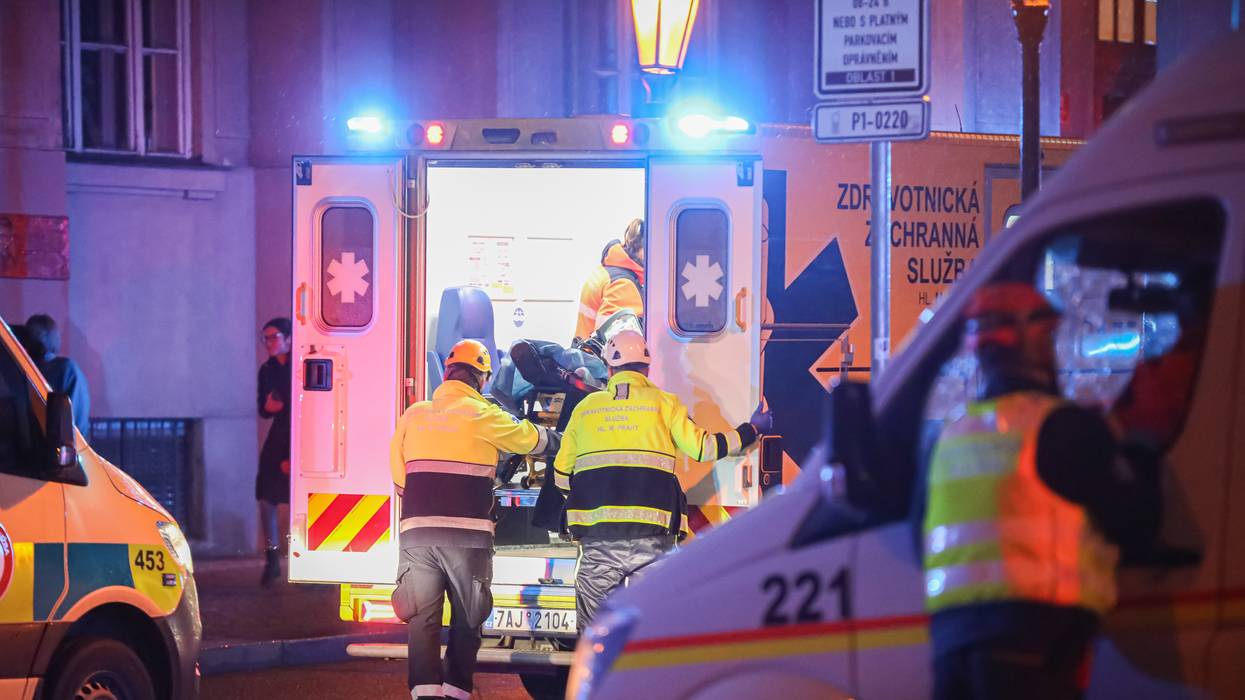
Residents and officials in the Czech Republic were stunned Thursday as news spread of a mass shooting at Charles University in Prague—a relatively rare occurrence in the Eastern European country—that reportedly killed at least 14 people and injured at least 24.
Authorities warned that the death toll was likely to rise.
The suspect, identified by Czech police—who use crime suspects' first names and last initials—as David K., was reportedly a 24-year-old world history student at the university. The New York Times reported that he fatally shot himself in addition to the victims.
On social media, several users posted a photo of students clinging to a ledge on one of the school buildings as they tried to evade the shooter.
A police officer with Interpol Prague also reported that the suspect shot and killed his father in a town outside Prague before proceeding to the university.
The authorities were investigating late Thursday whether several violent messages posted in recent days by someone using the name David Kozak on the platform Telegram were connected to the shooting. One of the messages suggested that two mass shootings that took place in Russia earlier this month and in 2021 had inspired Thursday's shooting.
The Czech Republic restricts gun ownership by requiring stringent testing of people who try to buy firearms, but the government has less strict gun laws than most other European countries.
The country recognizes the "right to acquire, keep, and bear firearms" and the constitution was amended in 2021 to legally guarantee "the right to defend one's own life or the life of another person with a weapon."
Police said the gunman legally owned several firearms, as did the 63-year-old man who shot and killed eight people in a restaurant in an eastern town in 2015.
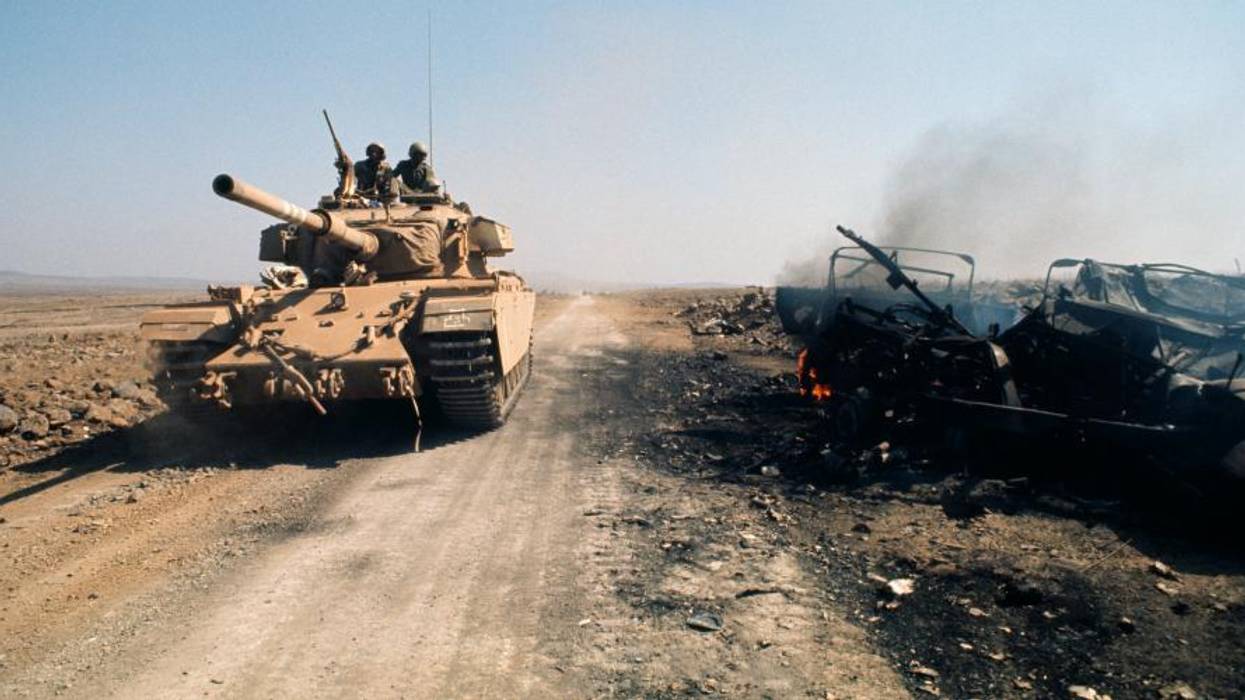
European countries and members of the United Nations Security Council are speaking out against U.S. President Donald Trump's recent recognition of Israeli sovereignty over the Syrian Golan Heights, which Israel has illegally occupied for more than five decades.
"If anybody feels any temptation to follow this poor example, we would urge them to refrain from this aggressive revision of international law."
--Vladimir Safronkov, Russian diplomat
The European Union (EU) issued a statement on Wednesday reaffirming its position that the occupation is illegal.
That came as members of the Security Council denounced Trump's decision at a meeting convened at the request of Syria, which called the president's move a "flagrant violation" of U.N. resolutions.
Trump initially announced his decision to support Israeli sovereignty over the territory on Twitter last week--immediately provoking international condemnation. He finalized the new stance by signing an official proclamation on Monday, as Israeli Prime Minister Benjamin Netanyahu visited the White House.
"This unilateral action does nothing to assist in finding a long-term peaceful solution to the conflict in the Middle East," South Africa's U.N. Ambassador Jerry Matjila said at the Security Council meeting on Wednesday, as Al Jazeera reported.
Vladimir Safronkov, the deputy ambassador from Russia--Syria's closest ally--added, "If anybody feels any temptation to follow this poor example, we would urge them to refrain from this aggressive revision of international law."
Representatives from Syria and Israel also joined the meeting. Israeli Ambassador Danny Danon--according to official meeting notes--declared, "Israeli sovereignty over the Golan Heights is forever."
Israel seized the Golan Heights from Syria in 1967, during the Six-Day War, and officially annexed it 1981. That same year, the Security Council unanimously adopted resolution 497, which states that the "acquisition of territory by force is inadmissible, in accordance with the Charter of the United Nations, the principles of international law, and relevant Security Council resolutions."
Resolution 497 specifically calls the Israeli occupation of the territory "null and void and without international legal effect."
In the E.U.'s statement on Wednesday, High Representative for Foreign Affairs and Security Policy Federica Mogherini cited the resolution, and confirmed that "the European Union does not recognize Israeli sovereignty over the occupied Golan Heights."
The Israeli newspaper Haaretz highlighted the significance of Mogherini's statement, given that it required a consensus among all 28 members of EU.
As the newspaper noted, "it reflects the official stance of countries such as Hungary, Poland, Czech Republic, Romania, Austria, Lithuania and Romania," nations that Netanyahu has "courted in recent years in order to break up the unanimity within the EU when it comes to Israel."
While a world leaders and human rights advocates continue to raise alarm about Israel's occupation of Golan Heights and other territories, Netanyahu--who will face a tough election on April 9--has celebrated the Trump administration's new position.
According to the New York Times, shortly before Netanyahu arrived at Ben-Gurion Airport in Israel on Tuesday--after cutting short his trip to the United States--the prime minister told reporters that the decision by Trump was enough for him.
"Everyone says you can't hold an occupied territory, but this proves you can," Netanyahu said. "If occupied in a defensive war, then it's ours."
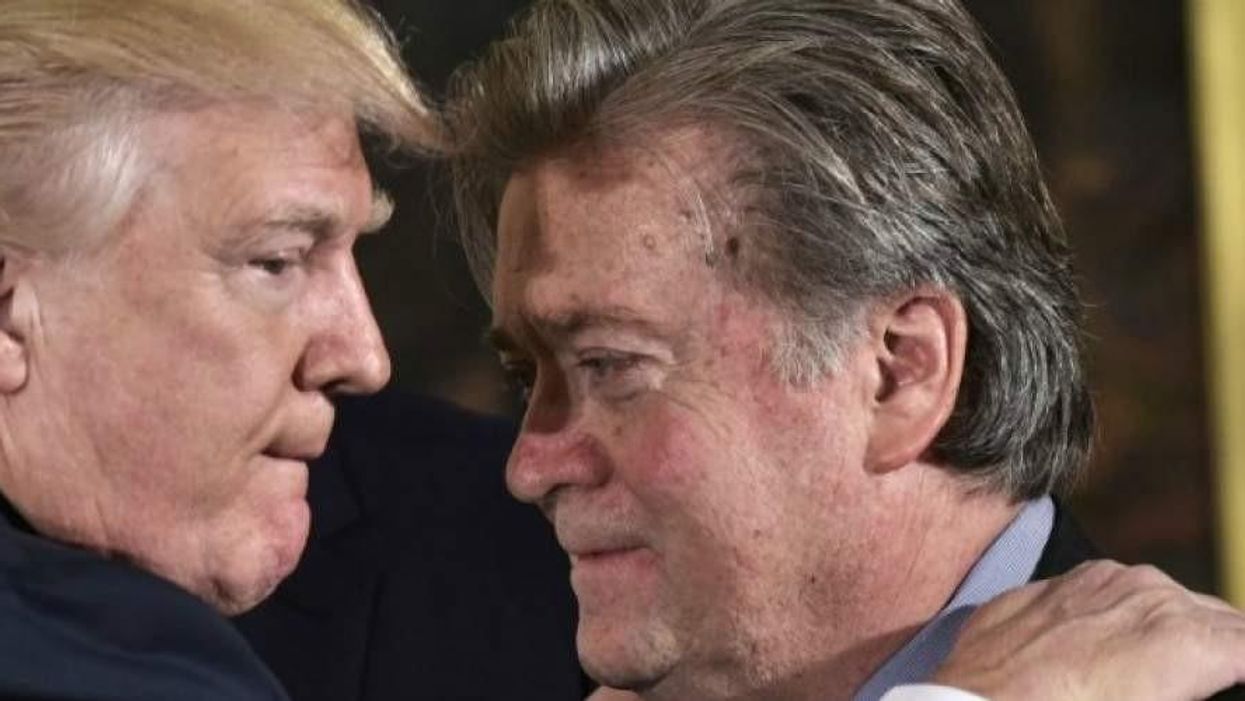
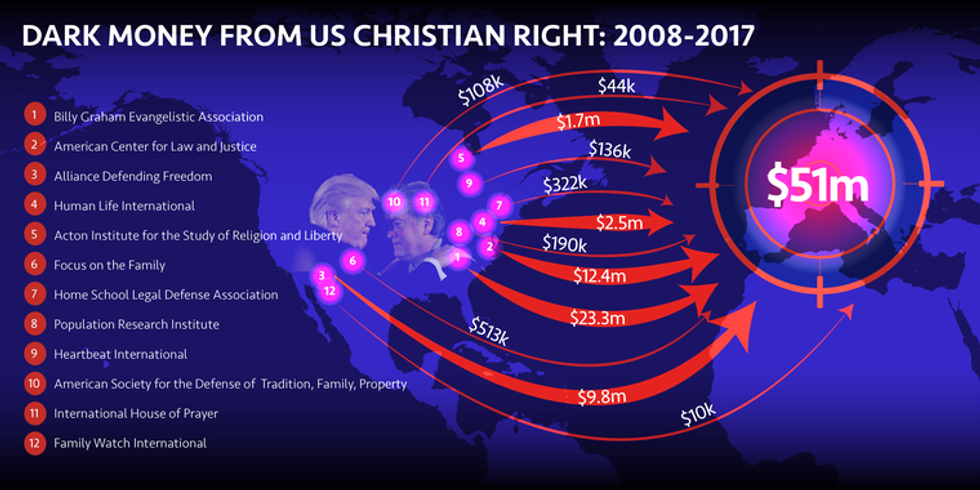
According to a new analysis released by openDemocracy, Christian-right fundamentalists linked to the Trump administration and Steve Bannon are among a dozen American groups that have poured at least $50 million of dark money into Europe over the last decade.
Between them, these groups have backed armies of ultra-conservative lawyers and political activists, as well as so-called family values campaigns against LGBTQ rights, sex education and abortion--and a number appear to have increasing links with Europe's far right.
They are spending money on a scale "not previously imagined," according to lawmakers and human rights advocates, who have called openDemocracy's findings "shocking."
Among the biggest spenders is a group whose chief counsel is also Donald Trump's personal lawyer, Jay Sekulow. Another organization has collaborated with a controversial Rome-based institute backed by Steve Bannon.
None of these American groups discloses who its donors are--though at least two have links to famous conservative billionaires, such as the Koch brothers (who helped bankroll the Tea Party movement) and the family of Trump's education secretary, Betsy DeVos.
'Nobody should be in any doubt as to the insidious nature of these fundamentalist groups'
The increasing ties between some of these Christian conservative groups and the European far right will be on display this weekend at a summit of the World Congress of Families (WCF): a network of American, Russian and other ultra-conservative activists.
Right-wing politicians and their supporters from across Europe are expected to attend the event in Verona, Italy--including the Italian deputy prime minister, Matteo Salvini, who has described the WCF as a showcase for "the Europe that we like."
A cross-party group of more than 40 members of the European Parliament (MEPs) has called on the EU's transparency tsar Frans Timmermans to look into the influence of "U.S. Christian fundamentalists... with the greatest urgency" ahead of May's European Parliament elections.
In a letter reacting to openDemocracy's findings, and copied to the presidents of the European Council, European Commission and European Parliament, the MEPs have demanded action to protect European democracy "against nefarious outside influences."
Scottish National Party MEP Alyn Smith, who sits on the European Parliament's foreign affairs committee and signed the letter, said on Wednesday: "This investigation by openDemocracy is extremely timely and shines a light on a major challenge facing democracy in Europe."
OpenDemocracy's findings "are highly alarming, and nobody should be in any doubt as to the insidious nature of these fundamentalist groups," he continued. "No group of any kind should be able to use dark money to distort debate and to subvert democracy in Europe, least of all groups such as these whose causes are deeply regressive."
'The Europe we like'
OpenDemocracy has examined a decade of U.S. Christian organizations' financial accounts and found that several of them appear to have significantly increased their spending in Europe over the past five years.
These findings come as far-right parties aim for big wins in the upcoming European Parliament elections in May, and show how large amounts of foreign money have supported the spread of their "traditional values" messages.
OpenDemocracy has reviewed hundreds of pages of financial filings for a dozen religious conservative groups that are registered as tax-exempt non-profit organizations, and thus are required to disclose some information about their foreign spending.
Some of these groups have been previously accused of supporting campaigns to criminalize homosexuality in Africa, "draconian" anti-abortion laws in Latin America and controversial projects to encourage gay people in the United States to "leave homosexuality."
But the extent of their European activity has--until now--received little scrutiny. The new investigation reveals that some of these groups have:
Five of the conservative groups have previously been listed as partners of the World Congress of Families (WCF) network, which is meeting in Verona this week.
It's not just European politicians who are concerned about them: These groups are controversial in America too. The WCF itself has been described as an "anti-LGBT hate group" by the Southern Poverty Law Center (SPLC), which monitors extremist movements and tracks this network's increasing connections with the far right.
The SPLC explains that "viewing homosexuality as unbiblical or simply opposing same-sex marriage" is not enough to be categorized as a "hate group." Groups on this list go further--claiming that homosexuality is dangerous, linked to pedophilia, and should be criminalized, disseminating "disparaging 'facts' about LGBT people that are simply untrue."
This is, says SPLC, "no different to how white supremacists and nativist extremists propagate lies about black people and immigrants to make these communities seem like a danger to society."
Joseph Grabowski, a WCF spokesperson, told openDemocracy: "We dispute entirely the premise [of the 'hate group' designation]... It's an unfortunate slight for the countless Americans and the people around the world who hold the same views as we do on marriage, the nature of family and the right to life, that are part of the fabric of Christianity and also other traditional points of view," he said.
The WCF is a project of the International Organization for the Family and the Illinois-based Howard Center for Family, Religion and Society, whose directors include an ultra-conservative Spanish activist linked to the leader of the far-right Vox party.
Other directors include a close associate of a Russian oligarch who sponsored a 2014 "secret meeting" in Vienna with key French and Austrian far-right leaders--and an Italian politician facing corruption charges in his country.
Over the last decade, the WCF has hosted at least seven major meetings in Europe, attended by hundreds of religious right activists and a growing list of far-right politicians. Its 2017 meeting in Budapest was opened by Hungarian prime minister Viktor Orban.
Among the conveners of this week's event in Verona is an Italian anti-abortion group linked to the neo-fascist Forza Nuova party, whose leader is also expected to attend the WCF.
Trump, the far-right and the Christian 'legal army'
Two of the Trump-linked groups examined by openDemocracy are Christian-right legal powerhouses: Alliance Defending Freedom (ADF) and the American Center for Law and Justice. Together, they have spent more than $20 million in Europe since 2008.
They don't disclose their funders, but journalists have previously traced at least $1 million in grants to ADF from a foundation controlled by the billionaire family of Betsy DeVos, Trump's education secretary, and Erik Prince, founder of the Blackwater mercenary firm.
ADF was co-founded by Alan Sears, a Christian-right leader who co-authored a book against "the homosexual agenda." It is increasingly active internationally, including in Latin America. It supported a 2016 law in Belize making gay sex punishable with 10 years in jail.
This group tripled its annual spending in Europe between 2012 and 2016, to more than $2.6 million a year. It now has offices in Belgium, France, Austria, Switzerland and the UK, and spends hundreds of thousands of euros lobbying EU officials, according to separate transparency data.
Among its European projects, the group supported the defense of a notorious German activist who compared abortion to the Holocaust and accused specific doctors of murder.
This year, ADF International also co-hosted an event with the French group La Manif Pour Tous, which has been previously been linked to the far-right party Front National.
Ahead of the last European Parliament elections in 2014, La Manif Pour Tous launched a "Europe for Family" campaign that got 230 French candidates to sign a pledge opposing marriage equality, trans rights and sex education.
Speaking to openDemocracy, a spokesperson for ADF International said they are "exclusively privately funded by people from all over the world, who care about human rights" and that their activities include "advocating for freedom of speech in Europe."
Asked for more detail about whom the group gives its money to, they said: "Since our advocacy involves court cases in countries where people are harassed, stigmatized, and even killed because of their religious convictions, it is our general policy not to disclose any recipients of funding in order to protect their personal safety and livelihoods."
The second of the two Trump-linked groups, the American Center for Law and Justice (ACLJ), also operates through the courts. It was founded in 1990 by American televangelist Pat Robertson to oppose the American Civil Liberties Union.
The group's current chief counsel is Jay Sekulow, a conservative talk-show host who has been described as "the top lawyer" on Donald Trump's legal team in the Mueller inquiry.
This group has had an office in Strasbourg, France--home of the European Court of Human Rights--for more than 20 years, from where it has intervened in numerous cases on issues including same-sex marriage, abortion rights and artificial insemination.
The director of its Strasbourg outfit has also represented the Holy See at the Council of Europe, while its Moscow center has praised Putin's laws banning "gay propaganda."
Trump, Franklin Graham and U.S.-sanctioned Kremlin officials
The Billy Graham Evangelistic Association is another major spender. It is led by the famous evangelical preacher's son, Franklin Graham, who said Satan is the architect of same-sex marriage and described Islam as an "evil and very wicked religion."
Franklin Graham, who has supported Trump as someone who "defends the faith," was in Russia earlier this month meeting with Kremlin officials under U.S. sanctions, on a trip that he said was personally signed off on by Vice President Michael Pence.
In 2018, his group organized festivals in England and Scotland amid protests from Muslim and LGBT rights groups. It also supports "rapid response chaplains" that target crises and have been accused of "chasing ambulances" and "exploiting tragedy."
Its filings disclose more than $23 million spent in Europe through two different U.S. entities between 2008 and 2014--making it the largest spender in this region, of the American groups analyzed by openDemocracy.
However, 2014 is the latest year for which openDemocracy was able to find public documents for this group, which has offices in the UK, Germany, France and Spain, so the true extent of its influence in the region is not yet known.
Training Europeans, on the 'front lines of the Culture War'
A number of groups spending smaller amounts of money appear to have increased their activities in Europe in recent years.
The Acton Institute for the Study of Religion and Liberty, which combines a conservative Christian worldview with free-market economics, has received hundreds of thousands of dollars from the Koch family foundations.
This group spent more than $1.7 million in Europe since 2008, with its spending in the region rising in recent years (from around $166,000 in 2008 to almost $240,000 in 2017).
In Italy, it has collaborated with the Dignitatis Humanae Institute--of which Steve Bannon is a trustee--that has locally controversial plans to use a monastery outside Rome as a "gladiator school for culture warriors."
Also on the list is the U.S. branch of the Tradition, Family and Property (TFP), an ultra-conservative transnational Catholic movement that says it's "on the front lines of the Culture War, peacefully defending the values of tradition, family and private ownership."
This group said it spent about $100,000 in Europe since 2010. Its filings don't detail where this money went, but the TFP has been linked to a controversial think tank in Poland that has helped develop policies for far-right Law and Justice (PiS) politicians.
A 'wake-up call' to prevent 'foreign interference'
Under U.S. law, the groups analyzed by openDemocracy are required to publicly disclose some information about their foreign spending, but not the names of their overseas recipients, details of what activities they fund--or the identities of their own funders.
The $50 million figure drawn from openDemocracy's analysis is also a likely underestimation of the resources that U.S. conservatives have channeled into Europe in recent years.
Data for 2018 is not yet available; meanwhile, there are some important loopholes. Religious organizations registered as churches, for example, don't need to file the same disclosures.
A number of other U.S. Christian conservative groups appear to be spending money in Europe, but do not disclose this on their U.S. filings--including the Howard Center for Family, Religion and Society, which has coordinated the WCF network.
Reacting to openDemocracy's findings, German Green MEP Terry Reintke, who sits on equality-related committees at the European Parliament, said: "This extreme extent of financial support flooding the EU is shocking--especially with the European elections ahead of us."
Every day European societies face concerted attacks by outside forces seeking to impose reproductive coercion... This is utterly at odds with the European values of democracy and human rights."
The SNP MEP Alyn Smith has said he and his fellow parliamentarians who signed Wednesday's letter have called for the mobilization of "EU institutions and member states in preventing malign actors such as those identified in the investigation from interfering in the European Parliament elections in May--and beyond."
Caroline Hickson, regional director of the International Planned Parenthood Federation's European Network, said: "The scale of this meddling by U.S. extremists is shocking, but sadly no surprise to us. Every day European societies face concerted attacks by outside forces seeking to impose reproductive coercion... This is utterly at odds with the European values of democracy and human rights."
"This is dark money coming into Europe to threaten human rights, and we're not doing anything about it," warned Neil Datta, secretary of the European Parliamentary Forum on Population and Development, describing the amounts of money involved as "staggering."
"It took the Christian right 30 years to get to where they are now in the White House," he said. "We knew a similar effort was happening in Europe, but this should be a wake-up call that this is happening even faster and on a grander scale than many experts could have ever imagined."
Additional reporting by Peter Geoghegan.
This article was produced by openDemocracy in partnership with the Independent Media Institute.
Geopolitics, like thermodynamics, has its laws of conservation. If a wall comes down in one place, you can bet that it will go up somewhere else.
It wasn't long after the Berlin Wall fell that different kinds of walls went up in Eastern Europe. New borders separated the Czech Republic from Slovakia, and then, after much bloodshed, the new successor states of former Yugoslavia.
By the end of the 1990s, barriers were being established in small towns in the Czech Republic, in Slovakia, and in Romania to separate Roma and non-Roma populations. Germans on both sides of the former Berlin Wall were declaring that they were one people. But in other countries in the region, the majority population was insisting, rule of law notwithstanding, that the citizenry was not one people and a wall was necessary to emphasize the distinction.
These discriminatory walls anticipated the next round of walls in the region: to keep out immigrants. Hungary built a wall on its border with Serbia in 2015, and then a second one in 2017 just to be sure. Germany was letting in more than a million desperate people. Hungary and most of the rest of Eastern Europe, after making the earlier case that they belonged in the European Union, were shutting the door after themselves.
It's not just Eastern Europe. The Brexit vote was basically an effort to build a big wall across the English Channel to separate the United Kingdom from Europe. Keeping out immigrants was a major motivating factor.
Walls are practically everywhere, alas. You can find a very sad set of walls separating Israel from the Occupied Territories. Spain has walled off its cities of Ceuta and Melilla from the rest of Morocco (yes, there are two Spanish towns in North Africa). There's a wall between Saudi Arabia and Iraq. According to Elisabeth Vallet, a geography professor at the University of Quebec-Montreal, there were 15 border walls around the world in 1989. That has jumped to 77 today.
As with so many of his fixations, Donald Trump's call for a wall is hardly original. And this wall, too, is a response to the collapse of walls elsewhere. Economic globalization was responsible, from the 1980s on, for gradually tearing down all manner of barriers: to trade, to finance, and to the movement of manufacturers. Trump and his economic populists have done as much as they can to put back some of those barriers, for instance by withdrawing from the Trans Pacific Partnership and by slapping tariffs on products from allies and adversaries.
But Trump's wall along the Mexico border is first and foremost about keeping people out. Economic globalization removed some barriers to the movement of people, but primarily those with highly sought-after skills. As for the truly desperate who were trying to climb over walls and breach borders, they were often motivated more by war and the violence of non-state actors.
These two types of "open borders" -- one for money, the other for bodies -- have often been confused in the public imagination. Or politicians have deliberately conflated the two, as Trump supporters did in the case of the infamous Hillary Clinton quote about "open borders." She quite obviously meant economic globalization, not immigration, which was troubling in its own right, but for different reasons.
Trump is not a big fan of openness, in any of its manifestations. He loves the idea of exclusivity: private jets, elite parties, membership-only clubs like Mar-a-Lago. He prefers not to reveal his tax returns. He'd like to keep all of his financials well hidden. In Trump's mind, walls define the parameters of privilege. Whenever he can wall off the press, his "low-intelligence" critics, the populations of "shit-hole" countries, he does so in a New York minute. He devises travel bans. He instructs his press secretary to dispense with the traditional daily press briefings. He stays within his Fox News enclosure. Even when he prances before the public in mass events, he wants to make sure that everyone in the crowd is on his side.
The Trump brand has always been about exclusivity, though of a rather tawdry variety: the appearance of prestige instead of the reality. As the writer Fran Lebowitz once remarked, Trump is "a poor person's idea of a rich person." It could also be said that he's a non-political person's idea of a president. He projects the appearance of a president -- handshakes with other leaders, photo ops in the Oval Office -- without any of the substance. All of his talk of "fake news" is just an indirect admission of his own doubts about his own authenticity as a president.
America, in other words, has not really adjusted to a multipolar world, its more modest place within it, or the resulting anxieties that torment the souls of Americans.
No surprise, then, that Trump is offering the appearance of security rather than the reality of security. A wall is largely a symbol. It means nothing when the United States refuses to address the true causes of insecurity, both at home and abroad. Nicholas Kristof did a nice column in The New York Times, drawn in part from my IPS colleagues' National Priorities Project data, about all the sensible ways to spend $5.7 billion: on America's children, on gun buybacks and drug treatment programs, on job training for prisoners, and on helping people overseas. That's what a real president would support, not a "fake president."
But let's dig a little deeper. The wall addresses a core psychological insecurity. Trump supporters -- and many others -- feel as if their own privileges are evaporating. Those privileges are connected to race and gender (the angry white men who now swell the ranks of the Republican Party). But they are also connected to class (the blue-collar workers that once formed the backbone of the Democratic Party).
And don't forget the oft-overlooked privilege of being American. U.S. citizens are feeling increasingly anxious as they watch the United States fail to achieve its objectives in one war after another -- even as China expands its influence and Russia regains its great power status. Americans watch conflict, extremism, disease, and the other horsemen of the Apocalypse engulf other countries, and they feel as if America can no longer ride in on its white horse to save the day (the last time was perhaps World War II). Worse, they can hear the drumbeat of those hooves approaching the very shores of this country.
Trump and his supporters want that wall to prevent all these privileges--individual, communal, national --from leaking out. It's the architectural equivalent of a gun. It's for defense, a way for people to "stand their ground." But it's also compensation for powerlessness and lack of control. As with guns, the sense of safety and security is almost entirely illusory.
Liberals, unfortunately, don't offer much of an alternative. They use more inclusive language when it comes to individual and communal privilege -- though liberals are also guilty of constructing walls when they live in the ghettoes of the wealthy, send their children to private schools, or expunge any discordant viewpoints from their social media networks. These walls are largely invisible -- just like the financial red lines that helped to create America's urban wastelands -- but they are no less powerful.
In terms of national privilege, liberals also believe in American supremacy, though they speak more in terms of restoring American leadership. America, in other words, has not really adjusted to a multipolar world, its more modest place within it, or the resulting anxieties that torment the souls of Americans.
The U.S. military, after all its failures around the world, no longer preserves American privilege. The U.S. dollar, weakened by U.S. debt and the strengthening of other national currencies, may soon lose its special glow. A wall is a fallback position, and a rather pathetic one at that. The United States desperately needs a leader -- actually, a cadre of leaders -- who can reconceive America's relationship with the world, who can redefine U.S. privilege, who can see the importance of a shift from global power over to global power with. It would be a true privilege to elect such visionaries to leadership positions.
The world is waiting.
I'm standing atop Rush Hill on Alaska's remote St. Paul Island. While only 665 feet high, it provides a 360-degree view of this tundra-covered, 13-mile-long, seven-mile-wide part of the Pribilof Islands. While the hood of my rain jacket flaps in the cold wind, I gaze in wonder at the silvery waters of the Bering Sea. The ever-present wind whips the surface into a chaos of whitecaps, scudding mist, and foam.
The ancient cinder cone I'm perched on reminds me that St. Paul, was, oh so long ago, one of the last places woolly mammoths could be found in North America. I'm here doing research for my book The End of Ice. And that, in turn, brings me back to the new reality in these far northern waters: as cold as they still are, human-caused climate disruption is warming them enough to threaten a possible collapse of the food web that sustains this island's Unangan, its Aleut inhabitants, also known as "the people of the seal." Given how deeply their culture is tied to a subsistence lifestyle coupled with the new reality that the numbers of fur seals, seabirds, and other marine life they hunt or fish are dwindling, how could this crisis not be affecting them?
While on St. Paul, I spoke with many tribal elders who told me stories about fewer fish and sea birds, harsher storms and warming temperatures, but what struck me most deeply were their accounts of plummeting fur seal populations. Seal mothers, they said, had to swim so much farther to find food for their pups that the babies were starving to death before they could make it back.
And the plight of those dramatically declining fur seals could well become the plight of the Unangan themselves, which in the decades to come, as climate turbulence increases, could very well become the plight of all of us.
Just before flying to St. Paul, I met with Bruce Wright in Anchorage, Alaska. He's a senior scientist with the Aleutian Pribilof Islands Association, has worked for the National Marine Fisheries Service, and was a section chief for the National Oceanic and Atmospheric Administration for 11 years. "We're not going to stop this train wreck," he assures me grimly. "We are not even trying to slow down the production of CO2 [carbon dioxide], and there is already enough CO2 in the atmosphere."
While describing the warming, ever more acidic waters around Alaska and the harm being caused to the marine food web, he recalled a moment approximately 250 million years ago when the oceans underwent similar changes and the planet experienced mass extinction events "driven by ocean acidity. The Permian mass extinction where 90% of the species were wiped out, that is what we are looking at now."
I wrap up the interview with a heavy heart, place my laptop in my satchel, put on my jacket, and shake his hand. Knowing I'm about to fly to St. Paul, Wright has one final thing to tell me as he walks me out: "The Pribilofs were the last place mammoths survived because there weren't any people out there to hunt them. We've never experienced this, where we are headed. Maybe the islands will become a refuge for a population of humans."
The Loss Upon Us
For at least two decades, I've found my solace in the mountains. I lived in Alaska from 1996 to 2006 and more than a year of my life has been spent climbing on the glaciers of Denali and other peaks in the Alaska Range. Yet that was a bittersweet time for me as the dramatic impacts of climate change were quickly becoming apparent, including quickly receding glaciers and warmer winter temperatures.
After years of war and then climate-change reporting, I regularly withdrew to the mountains to catch my breath. As I filled my lungs with alpine air, my heart would settle down and I could feel myself root back into the Earth.
Later, my book research would take me back onto Denali's fast-shrinking glaciers and also to Glacier National Park in Montana. There I met Dr. Dan Fagre, a U.S. Geological Survey research ecologist and director of the Climate Change in Mountain Ecosystems Project. "This is an explosion," he assured me, "a nuclear explosion of geologic change. This... exceeds the ability for normal adaptation. We've shoved it into overdrive and taken our hands off the wheel." Despite its name, the park he studies is essentially guaranteed not to have any active glaciers by 2030, only 11 years from now.
My research also took me to the University of Miami, Coral Gables, where I met the chair of the Department of Geological Science, Harold Wanless, an expert in sea-level rise.
I asked him what he would say to people who think we still have time to mitigate the impacts of runaway climate change. "We can't undo this," he replied. "How are you going to cool down the ocean? We're already there."
As if to underscore the point, Wanless told me that, in the past, carbon dioxide had varied from roughly 180 to 280 parts per million (ppm) in the atmosphereas the Earth shifted from glacial to interglacial periods. Linked to this 100-ppm fluctuation was about a 100-foot change in sea level. "Every 100-ppm CO2 increase in the atmosphere gives us 100 feet of sea level rise," he told me. "This happened when we went in and out of the Ice Age."
As I knew, since the industrial revolution began, atmospheric CO2 has already increased from 280 to 410 ppm. "That's 130 ppm in just the last 200 years," I pointed out to him. "That's 130 feet of sea level rise that's already baked into Earth's climate system."
He looked at me and nodded grimly. I couldn't help thinking of that as a nod goodbye to coastal cities from Miami to Shanghai.
In July 2017, I traveled to Camp 41 in the heart of the Brazilian Amazon rainforest, part of a project founded four decades ago by Thomas Lovejoy, known to many as the "godfather of biodiversity." While visiting him, I also met Vitek Jirinec, an ornithologist from the Czech Republic who had held 11 different wildlife positions from Alaska to Jamaica. In the process, he became all too well acquainted with the signs of biological collapse among the birds he was studying. He'd watched as some Amazon populations like that of the black-tailed leaftosser declined by 95%; he'd observed how mosquitoes in Hawaii were killing off native bird populations; he'd explored how saltwater intrusion into Alaska's permafrost was changing bird habitats there.
His tone turned somber as we discussed his research and a note of anger slowly crept into his voice. "The problem of animal and plant populations left marooned within various fragments [of their habitat] under circumstances that are untenable for the long term has begun showing up all over the land surface of the planet. The familiar questions recur: How many mountain gorillas inhabit the forested slopes of the Virunga volcanoes, along the shared borders of the Democratic Republic of the Congo, Uganda, and Rwanda? How many tigers live in the Sariska Tiger Reserve of northwestern India? How many are left? How long can they survive?"
As he continued, the anger in his voice became palpable, especially when he began discussing how "island biogeography" had come to the mainland and what was happening to animal populations marooned by human development on fragments of land in places like the Amazon. "How many grizzly bears occupy the North Cascades ecosystem, a discrete patch of mountain forest along the northern border of the state of Washington? Not enough. How many European brown bears are there in Italy's Abruzzo National Park? Not enough. How many Florida panthers in Big Cypress Swamp? Not enough. How many Asiatic lions in the Forest of Gir? Not enough... The world is broken in pieces now."
"A Terrifying 12 Years"
In October 2018, 15 months after Jirinec's words brought me to tears in the Amazon, the world's leading climate scientists authored a report for the U.N. Intergovernmental Panel on Climate Change (IPCC) warning us that we have just a dozen years left to limit the catastrophic impacts of climate change. The gist of it is this: we've already warmed the planet one degree Celsius. If we fail to limit that warming process to 1.5 degrees, even a half-degree more than that will significantly worsen extreme heat, flooding, widespread droughts, and sea level increases, among other grim phenomena. The report has become a key talking point of political progressives in the U.S., who, like journalist and activist Naomi Klein, are now speaking of "a terrifying 12 years" left in which to cut fossil fuel emissions.
There is, however, a problem with even this approach. It assumes that the scientific conclusions in the IPCC report are completely sound. It's well known, however, that there's been a political element built into the IPCC's scientific process, based on the urge to get as many countries as possible on board the Paris climate agreement and other attempts to rein in climate change. To do that, such reports tend to use the lowest common denominator in their projections, which makes their science overly conservative (that is, overly optimistic).
In addition, new data suggest that the possibility of political will coalescing across the planet to shift the global economy completely off fossil fuels in the reasonably near future is essentially a fantasy. And that's even if we could remove enough of the hundreds of billions of tons of CO2 already in our overburdened atmosphere to make a difference (not to speak of the heat similarly already lodged in the oceans).
"It's extraordinarily challenging to get to the 1.5 degree Celsius target and we are nowhere near on track to doing that," Drew Shindell, a Duke University climate scientist and a co-author of the IPCC report, told the Guardian just weeks before it was released. "While it's technically possible, it's extremely improbable, absent a real sea change in the way we evaluate risk. We are nowhere near that."
In fact, even best-case scenarios show us heading for at least a three-degree warming and, realistically speaking, we are undoubtedly on track for far worse than that by 2100, if not much sooner. Perhaps that's why Shindell was so pessimistic.
For example, a study published in Nature magazine, also released in October, showed that over the last quarter-century, the oceans have absorbed 60% more heat annually than estimated in the 2014 IPCC report. The study underscored that the globe's oceans have, in fact, already absorbed 93% of all the heat humans have added to the atmosphere, that the climate system's sensitivity to greenhouse gases is far higher than thought and that planetary warming is far more advanced than had previously been grasped.
To give you an idea of how much heat the oceans have absorbed: if that heat had instead gone into the atmosphere, the global temperature would be 97 degrees Fahrenheit hotter than it is today. For those who think that there are still 12 years left to change things, the question posed by Wanless seems painfully apt: How do we remove all the heat that's already been absorbed by the oceans?
Two weeks after that Nature article came out, a study in Scientific Reports warned that the extinction of animal and plant species thanks to climate change could lead to a "domino effect" that might, in the end, annihilate life on the planet. It suggested that organisms will die out at increasingly rapid rates because they depend on other species that are also on their way out. It's a process the study calls "co-extinction." According to its authors, a five to six degree Celsius rise in average global temperatures might be enough to annihilate most of Earth's living creatures.
To put this in perspective: just a two degree rise will leave dozens of the world's coastal mega-cities flooded, thanks primarily to melting ice sheets in Greenland and Antarctica, as well as the thermal expansion of the oceans as they warm. There will be 32 times as many heat waves in India and nearly half a billion more people will suffer water scarcity. At three degrees, southern Europe will be in permanent drought and the area burned annually by wildfires in the U.S. will sextuple. These impacts, it's worth noting, may already be baked into the system, even if every country that signed the Paris climate accord were to fully honor its commitments, which most of them are not currently doing.
At four degrees, global grain yields could drop by half, most likely resulting in annual worldwide food crises (along with far more war, general conflict, and migration than at present).
The International Energy Agency has already shown that maintaining our current fossil-fueled economic system would virtually guarantee a six-degree rise in the Earth's temperature before 2050. To add insult to injury, a 2017 analysis from oil giants BP and Shell indicated that they expected the planet to be five degrees warmer by mid-century.
In late 2013, I wrote a piece for TomDispatch titled "Are We Falling Off the Climate Precipice?" Even then, it was already clear enough that we were indeed heading off that cliff. More than five years later, a sober reading of the latest climate change science indicates that we are now genuinely in free fall.
The question is no longer whether or not we are going to fail, but how are we going to comport ourselves in the era of failure?
Listening While Saying Goodbye
It's been estimated that between 150 and 200 plant, insect, bird, and mammal species are already going extinct every day. In other words, during the two and a half years I worked on my book 136,800 species may have gone extinct.
We have a finite amount of time left to coexist with significant parts of the biosphere, including glaciers, coral, and thousands of species of plants, animals, and insects. We're going to have to learn how to say goodbye to them, part of which should involve doing everything we humanly can to save whatever is left, even knowing that the odds are stacked against us.
For me, my goodbyes will involve spending as much time as I can on the glaciers in Washington State's Olympic National Park and North Cascades National Park near where I live, or far more modestly taking in the trees around my home on a daily basis. It's unclear, after all, how much longer such forest areas are likely to remain fully intact. I often visit a small natural altar I've created amid a circle of cedar trees growing around a decomposing mother tree. In this magical spot, I grieve and express my gratitude for the life that is still here. I also go to listen.
Where do you go to listen? And what are you hearing?
For me, these days, it all begins and ends with doing my best to listen to the Earth, with trying my hardest to understand how best to serve, how to devote myself to doing everything possible for the planet, no matter the increasingly bleak prognosis for this time in human history.
Perhaps if we listen deeply enough and regularly enough, we ourselves will become the song this planet needs to hear.
Should the United States build a permanent military base in Poland? Dangle a couple billion dollars in front of Donald Trump -- who seems to see himself as America's premier arms merchant, when he's not using the presidency to make money for himself and his family -- and you can see his eyes light up. "Fort Trump," we will call it, suggested Poland's president Andrzej Duda, who knows how to manipulate an insatiable ego.
Trump responded positively: "Poland would be paying billions of dollars for a base, and we are looking at that."
But even some of the more hawkish military analysts, such as Ben Hodges, commander of US Army Europe from 2014 to 2017, have argued that this is "unnecessarily provocative."
But even some of the more hawkish military analysts, such as Ben Hodges, commander of US Army Europe from 2014 to 2017, have argued that this is "unnecessarily provocative." The idea was roundly rejected by the US and Germany when it was suggested in 2016.
If the power of the weapons industry were to prevail, however, it wouldn't be the first time. In fact, that's a big part of the story of how we got in this New Cold War in the first place. From The New York Times' reporting:
"At night, Bruce L. Jackson is president of the U.S. Committee to Expand NATO, giving intimate dinners for Senators and foreign officials. By day, he is director of strategic planning for Lockheed Martin Corporation, the world's biggest weapons maker."
That was 1997. Two years later, Poland, Hungary, and the Czech Republic would join NATO, hauling in billions of dollars of arms sales. Ten more countries would join over the next nine years, bringing NATO's military to Russia's doorstep.
The United States and Germany promised Russia in 1990, as the Soviet Union was collapsing, that they would not expand NATO even "an inch" to the East. Although many Americans have forgotten World War II, the Russians have not; they lost 27 million people to Nazi invaders. Needless to say, they are not fond of the violent neo-Nazis that the US government has supported in Ukraine, or the idea that Ukraine could end up with the next NATO military base, on their border.
Americans are understandably upset about any foreign interference in our elections. As are Hondurans, Chileans, Haitians, Nicaraguans, Italians, Iranians, or citizens of scores of other countries where the United States has intervened much more heavily -- sometimes with military coups to reverse results -- in elections.
These are the most important structural causes of the New Cold War, not Russia's annexation of Crimea -- which violated international law -- or Russian interference in the 2016 US presidential election. Americans are understandably upset about any foreign interference in our elections. As are Hondurans, Chileans, Haitians, Nicaraguans, Italians, Iranians, or citizens of scores of other countries where the United States has intervened much more heavily -- sometimes with military coups to reverse results -- in elections. This includes Russia itself, where Americans organized and spent heavily to reelect their ally, Boris Yeltsin, in 1996.
Election expert Nate Silver noted this week that Russian troll farms, memes and Tweets were much too small and without evidence of effectiveness to have made a difference in the 2016 election. But in any case, the New Cold War with Russia has deeper structural causes that will not be resolved through sanctions, threats, and certainly not by expanding NATO's military encirclement of Russia. Ironically, despite Trump's personal friendliness with Putin -- and whatever private financial gains he has sought there -- he has been more aggressive toward Russia through stepped-up sanctions, sending lethal weapons to Ukraine, proposing to abandon the Intermediate-Range Nuclear Forces Treaty, and continuing to expand NATO.
This is no way to manage relations between the two countries that have the vast majority of the world's nuclear weapons. Of course, even talking about a new military base in Poland shows how far US foreign policy toward Russia has descended into stupidity and recklessness. It will take much more public awareness and political mobilization to reverse course.
Nation-states: what a quaint notion.
As a means of organizing territory, they seem to be a brief transition period between large empires and an even larger, borderless world. Sure, nation-states might live on in the form of anthems and flags and independence days, but the idea of fixed borders just don't make sense in a world of cell phones, the Internet, and global assembly lines. Borders just seem like a twentieth-century contrivance that slows everything down, like those paper forms you still have to fill out at the doctor's office.
But just when you think you've progressed to the next level, along comes a reminder that the past is nipping at your heels, eager to bring you down.
This Sunday, Donald Trump temporarily closed the border crossing at San Ysidro in San Diego, across from Tijuana, Mexico. In response to a surge in migrants and asylum-seekers from Central America, the president has threatened to close the entire border permanently and even shut down the U.S. government if Congress doesn't fund his border wall.
Also this Sunday, the European Union approved British Prime Minister Theresa May's Brexit proposal. If the British parliament gives its okay, Britain will begin its formal withdrawal from the transnational pact at the end of March. Parliamentary approval, however, is far from certain, which leaves the border between the EU and its second most economically powerful member still very much up in the air.
Finally, in the Azov Sea this Sunday, Russian border patrol boats opened fire on three Ukrainian vessels and then took them into custody. Russia is currently holding 24 Ukrainian sailors. Both Russia and Ukraine border the Sea of Azov, as does the disputed territory of Crimea. It's only the latest in a long series of clashes over the border between the two most populous successor states of the Soviet Union.
The border disputes this Sunday were by no means the only ones. Tensions continue over who controls what islands and reefs in the South China Sea. Israel and Palestine continue to clash around the Gaza border and over the West Bank. Syria remains an internally divided country, as is Libya and, frankly, Iraq as well.
Borders are back in fashion. Whether they're trying to keep out immigrants, confront neighbors, or just reassert sovereignty in an increasingly intrusive world, the latest batch of nationalist and authoritarian leaders are challenging the notion that history is heading in an ever more frictionless direction.
Actually, these leaders are all about friction, especially at the borders, because that's precisely where worldviews rub up against each other and create dangerous sparks.
The Break
The decision by a narrow majority of Britons, in a 2016 referendum, to leave the EU was impulsive, uninformed, and splenetic. It was, ultimately, a crime of passion. And now, unless someone issues a last-minute reprieve, the authorities are going to execute the judgment.
I can't resist another metaphor. There is no good Brexit, just as there is no good broken kneecap. They are both ruptures that require careful surgery and a long period of rehabilitation. In this case, there's not just one fracture. Other border issues have included Gibraltar (resolved at the last minute), Northern Ireland (still unclear), and Scotland (it might vote for independence in order to negotiate its own EU membership).
The "soft" Brexit deal to which May and the EU have agreed would keep the UK in the trade area, for a transition period, but also force it to comply with many of the EU regulations that prompted the "leave" campaign to begin with. That's why a number of May's cabinet ministers, including Foreign Minister Boris Johnson, resigned in mid-November. They wanted a "hard" Brexit that represents a clean break with the EU regulatory system - a deal that the EU was not likely to approve.
If the British parliament rejects May's proposal, however, the prime minister might be forced to negotiate a divorce without any deal at all, the hardest of hard Brexits. At the moment, the parliament seems to be gearing up to do just that, though May will use the threat of impending chaos to force the wary to line up behind her.
There are other possibilities, such as an even softer "Norway-plus" arrangement. Also, the European Court of Justice is now considering whether an interpretation of Article 50 of the Lisbon Treaty - which covers withdrawal from the EU - could permit Britain to revoke its Brexit declaration unilaterally. If that's the case, then, the British could go ahead with a second referendum to see if the people, now apprised of the consequences of their actions, are willing to change their minds. It's a rewind button that those who commit crimes of passion and break their kneecaps are not given. Back in March, the people building a new anti-Brexit campaign, with the help of donors like George Soros, gave the prospects of a second referendum at 50/50. With the May government increasingly rickety, the EU standing firm, and virtually everyone predicting economic decline under any Brexit scenario, those odds have gone up.
Still, as Andrew Rawnsley points out in The Guardian, preaching to the Remainers may not be enough to secure a win the second time around.
It is one thing to hold Boris Johnson and his gang to account for the mendacities they peddled in 2016. It is another thing to say that the millions of voters who bought into the bogus Brexit prospectus were idiots and suckers. It is never a smart idea to tell voters that they have been fools. Even, perhaps especially, when they have been. The anti-Brexit campaign has to show respect for Leave voters and for the reasons that they voted Leave. They may be willing to change their minds but they won't hear the arguments for doing so unless they are convinced that they have been listened to as well.
Sound familiar? The Democrats will face the same choice in two years when it comes time to address the buyer's remorse of the American people for shelling out good money for a lemon president.
The Wall
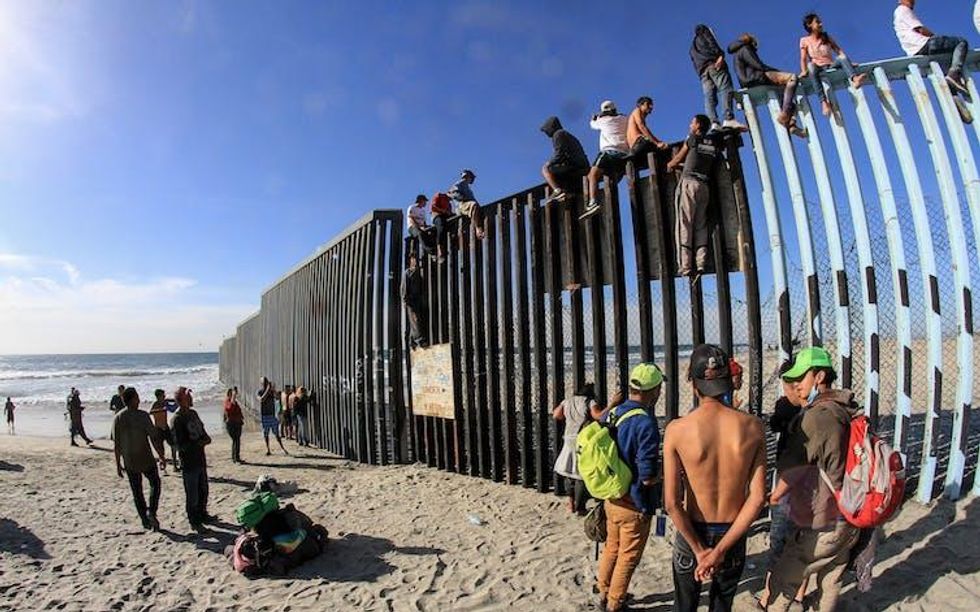
It's no surprise that Donald Trump has declared his first war against a group of civilians, many of them women and children. In a Cabinet memo on November 20, the president authorized U.S. soldiers to use lethal force against asylum-seekers at the Mexican border. Pentagon chief Jim Mattis has tried to indicate that calmer heads will prevail at the border. But impatient protesters threw some rocks on Sunday at the San Ysidro border crossing, and Customs and Border Protection officers sprayed the crowd with tear gas. It was bad enough for the protesters. The visuals also reinforced the message that the Trump administration will do whatever it takes to break national and international law that requires processing the claims of asylum-seekers fairly and expeditiously.
Tear gas is only the latest indignity visited upon the people waiting in Mexico for safe passage out of the horror that had become their lives. In an episode from mid-September, This American Life recounted all the different ways that the Trump administration has made life even more difficult for asylum-seekers.
Over the last six months, Customs and Border Protection officers have been stopping asylum seekers from even walking up to federal facilities at the border. This has been filmed by crews from CBS, NBC, Fox, and many others. They stop people in the middle of bridges that cross from Mexico into the United States at El Paso and Brownsville, and turn them away before they can even get to the official ports of entry on the other side to apply for asylum.
These were people freely exercising their right - not folks jumping over walls or swimming across rivers. Before the latest caravan arrived, a thousand people were basically waiting in line in Mexico for the few opportunities to make their case for asylum. By November 10, the administration closed down that option as well with its asylum ban, which a federal judge blocked 10 days later (which set up the testy exchange between the president and Chief Justice Roberts about "Obama" judges).
Asylum-seekers: can you think of a more ragtag "enemy" to target? Trump has tried to beef up his purported adversary by claiming that gang members and Middle Eastern terrorists have infiltrated their ranks. No one except perhaps the lunatic Ann Coulter, who has urged an invasion of Mexico, believes that particular claim. But a few thousand civilians with no more than rocks for weapons, are just the straw man he needs. The president doesn't want to go up against an opponent that has any chance of winning. Ronald Reagan, when dealing with the legacy of the Vietnam War syndrome, went to war against the tiny island nation of Grenada. Trump, dealing with the Iraq War syndrome, has chosen an even weaker target.
But what motivates the president's attack on immigrants and the caravan more specifically is the opportunity to weaponize America's borders. Right-wing populists in Europe used the immigration issue for the same purpose. Viktor Orban built his own wall to keep the desperate out of Hungary. More importantly, Orban and Poland's Jaroslaw Kaczynski and the Czech Republic's Milos Zeman discovered that nothing defines a nation's sovereignty better than a full-scale effort to keep people out of the country. Moreover, in so doing, they can challenge a key principle of European integration, the free movement of people, in a way to reinforce their Euroskeptical agenda.
Trump doesn't have to deal with Brussels. But he is sandwiched between a liberal in Canada and a socialist in Mexico. He has insulted the former and twisted the arm of the latter to line up behind a new (sort of) regional trade deal. They are stand-ins for what Trump considers an invasive species: globalists. Trump has challenged international institutions, imposed tariffs on allies and adversaries alike, and ridiculed global principles like human rights. And like many so-called conservatives, he has benefited enormously from the system he lambastes (the immigrants he's hired, the global assembly line that has produced his namesake goods).
But again, Trump prefers wars that have favorable odds. He wants to win. Globalization's ardent supporters, like politicians and financiers, are powerful people. They cross borders with ease. Much easier to pick on the poorest and most disadvantaged people in the world.
The War
The conflict between Ukraine and Russia has largely disappeared from the headlines. The Crimean Peninsula remains in Russian hands, the status of eastern Ukraine is still up in the air, and Russia continues to manipulate matters behind the scenes to weaken Ukraine as a whole and battle Western influence in the region. People are still dying every day in the conflict. The separatist ranks in the Donbass have been thinned by assassination and exile. And corruption in eastern Ukraine is rampant. But Europe has too many other crises to manage in-house and not a lot of spare resources to focus on Ukraine.
It's hard not to see the latest naval clash in the Azov Sea as a convenient provocation by Kiev. Ukrainian President Petro Poroshenko has been trying to persuade his parliament to grant him state-of-emergency powers. They balked and balked. But on Monday, after Russia seized the Ukrainian vessels, Poroshenko got what he wanted, for the next month at least. Plus, the most recent crisis strengthens the case for an extension of sanctions against Moscow.
Ukraine says that the boats sought permission to enter the sea when the Russian crafts suddenly attacked. It also complains that Russia has been trying to turn the Azov Sea into a Russian lake. Moscow controls the narrow access of the Kerch strait, particularly after it built a low bridge connecting Crimea to the Russian mainland - which has slowed Ukraine's access to its Azov ports. A 2003 agreement gives both countries access to this body of water, but Russia no longer seems to adhere to it.
It all sounds like a plot line out of Occupied, the TV series about the Russian occupation of Norway. In that series, the Russians and Free Norway rebels both escalate situations in order to improve their strategic positions. It's often hard to know who has provoked whom.
Russian President Vladimir Putin, however, has a very clear agenda. He needs to keep his public opinion ratings high (they've been dropping). He'd like to widen the split between Washington and Brussels and perhaps was thinking that Trump would overlook a naval spat much as he has apparently let Saudi Crown Prince Mohammed bin Salman off the hook for planning the assassination of journalist Jamal Khashoggi. And he'd like to strengthen the wall that divides the EU from all areas to the east.
In a recent interview with Putin, a Russian journalist complains about the EU. "They are working on Belarus, Kazakhstan and now they are very active in Armenia. We can see how they drip poison into their ears. We should do something about it. Our allies are leaving us." Putin responds with a verbal threat that has all too much resonance in light of Russian conduct.
"The poisoners dripping poison into someone's ears will sooner or later swallow it and get poisoned," Putin says.
After this latest clash in the Sea of Azov, Russian allies and adversaries will think twice about sidling up to the bear. Putin would like to reinforce the border between Russia and the West in order to maintain greater influence over Russia's "near abroad." For that same reason, however, the Russian president prefers that the borders closer to home are more fluid, which enables him to meddle more easily in the affairs of his neighbors.
Against Fluidity
It might seem ironic that countries are getting so hung up over borders just when so many people around the world are challenging borders in their everyday lives. Gender fluidity asserts a spectrum of options rather than a rigid binary. Greater racial diversity pushes everyone to think beyond black and white. Workplaces have been revolutionized by telecommuting and automation and the sharing economy. Race, class, and gender are no longer such clearly delineated categories.
Trump is against many things: immigrants, Europeans, strong women, cosmopolitans, policy wonks, whiny democrats, anyone who crosses him. But in his references to an imagined past when America was great and prosperous and commanded global respect - claims that require just the kind of asterisks that Trump hates - the president is also channeling the anxiety of many people for a time of certainties: when men were men and never changed their minds about it, when men married women and never had second thoughts, when a job was a lifetime appointment, and when nation-states were like billiard balls that clashed or kissed but never interpenetrated one another.
Trump's message is so appealing to the older generation, evangelicals, and traditional conservatives that they're willing to overlook the fluidities in the president's own life (divorce, adultery, political perambulations). Trump's supporters cling to his false certainties because they're preferable to true uncertainties.
Such delusions can last only so long.
After all, countries will rise and fall. Regional pacts may crumble. Rates of migration will fluctuate according to national and international policy, the vicissitudes of war and peace, and the hazards of climate change.
But however much the Trumps and Putins and Euroskeptics of the world beef up the borders, fluidity is here to stay.
The "migrant caravan" is making its way towards the US border - and is facing countless obstacles and much opposition along the way. Most recently, protests erupted when a large group of the migrants reached the Mexican border town of Tijuana. Unsurprisingly, Donald Trump was quick to join the clamour, accusing them of causing "crime and big problems in Mexico":
The men, women and children in the caravan are travelling as a large group because in the past individuals and small groups who have fled central America to escape political violence or to find a better livelihood have been kidnapped by traffickers and drug gangs. Travelling en masse offers them a degree of protection.
US president Donald Trump has long lambasted the migrants. He first characterised them as "invaders", who sheltered among their ranks "unknown Middle Easterners". Later, Trump admitted that this thinly veiled attempt to portray the migrants as terrorists was not based on any "proof" but nevertheless went on to calm the public by declaring that the US military would be waiting for the caravan at the Mexican border. Initially announcing that he would send as many as 5,200 troops, he later upped this number to a possible 15,000 soldiers.
US secretary of state, Michael Pompeo, joined the bandwagon, warning the American people that the migrants are "putting women and children in front of this caravan to use as shields as they make their way through."
As if to add credibility to this claim, the Department of Homeland Security (DHS) then released a factsheet stating that among the marchers are hundreds of individuals who "have criminal histories", and adding that, in Central America, they have put "women and children to the front to act as human shields as the caravan pushes against [the Guatemalan] military forces".
Interestingly, the president, secretary of state, and DHS did not pluck these allegations out of thin air. They are simply repeating claims made in a 2014 report published by the US right-wing Tea Party organisation.
The report described the movement of migrants as an "offensive whereby the southern borders of America are being swarmed", adding: "This offensive is an invasion, not led by troops, but by divisions of mothers, children and young adults marching north from Central America and Mexico". It went on:
Civilian women and children are directly marched into the target nation so that permanent settlement locations may be secured for more advancing insurgents. In effect, the civilians become political human shields for the insurgents coming in behind them, which are part of a much larger (and more dangerous) offensive.
The use of military vocabulary - "invasion", "divisions", "insurgency", "offensive" and "human shields" - to describe such migrants is, of course, calculated. It aims to prepare the ground for the way they will be treated once they reach the US border.
Consider the expression "human shields". According to international law, human shields are civilians or prisoners of war whose bodies are deployed to illegally protect a legitimate military target. Whether they do so voluntarily or are forced to do so, the law states that they cannot "render an area immune from attack."
Consequently, voluntary shields who die during an attack are responsible for their own deaths because they put themselves in harm's way. Similarly, when involuntary shields die, those deploying them rather than those killing them are to blame. In armed conflicts, when civilians are used as shields by state militaries, they lose or risk losing the protections bestowed on them by international law.
By using such language, Pompeo and the DHS potentially achieve two things. First, they cast the migrant caravan as an enemy that is willing to deploy human shields - a legitimate target for military action rather than a group of innocent and vulnerable individuals. Second, they suggest that if these migrant "human shields" die, it is those who use them as shields - rather than the US authorities - who must be held responsible.
Pompeo and the DHS are not alone in their attempts to frame migrants as legitimate military targets. Hungary and the Czech Republic have also categorised migrant children as "human shields", claiming that their parents are using them to facilitate their efforts to enter Europe.
Significantly, the use of "human shields" is also something that is projected almost exclusively on to non-white migrants, another attempt to portray them as "barbaric" people who fail to understand and respect the civilised norms of international law.
Much like the rebels in Syria, Houthis in Yemen, and Palestinian protestors in Gaza, migrants are now widely depicted as deliberately violating the distinction between combatant and non-combatant, purportedly shielding themselves behind "women and children" in order to gain an advantage against state militaries. Consequently, such migrants are depicted as perpetrators of a war crime - even though they are not waging an armed struggle and, in many cases, are simply trying to escape one.
And so by attempting to make a better life for themselves, migrants are transformed into military targets, people who can be legitimately injured or killed. As the migrant caravan works its way north, and is further demonised for doing so, the world should reflect on this and how one of the pillars of international law - the category of civilian - is being eroded.
The victory of Jair Bolsonaro in Brazil's presidential election last week has won Israel a passionate new friend on the international stage. The world's fifth-most populous nation will now be "coloured in blue and white", an Israeli official said, referring to the colours of Israel's flag.
The Israeli prime minister Benjamin Netanyahu immediately called to congratulate Bolsonaro, a former army officer with a pronounced nostalgia for his country's 20-year military dictatorship. Critics describe him as a neo-fascist.
According to Israeli media reports, it is "highly probable" that Netanyahu will attend Bolsonaro's inauguration on January 1.
The Brazilian president-elect has already promised that his country will be the third to relocate its embassy to Jerusalem, after the United States and Guatemala. That will further undermine Palestinian hopes for an eventual state with East Jerusalem as its capital.
Bolsonaro has told Israel that it can count on Brazil's vote at the United Nations, and has threatened to close the Palestinian embassy in Brasilia.
One might imagine that Netanyahu is simply being pragmatic in cosying up to Bolsonaro, given Brazil's importance. But that would be to ignore an unmistakable trend: Israel has relished the recent emergence of far-right leaders across the Americas and Europe, often to the horror of local Jewish communities.
Bolsonaro has divided Brazil's 100,000 Jews. Some have been impressed by the frequent appearance of Israeli flags at his rallies and his anti-Palestinian stance. But others point out that he regularly expresses hostility to minorities.
They suspect that Bolsonaro covets Israel's military expertise and the votes of tens of millions of fundamentalist Christians in Brazil, who see Israel as central to their apocalyptic, and in many cases antisemitic, beliefs. Not that this worries Netanyahu.
He has been engaged in a similar bromance with Viktor Orban, the ultra-nationalist prime minister of Hungary, who barely veils his Jew-baiting and has eulogised Miklos Horthy, a Hungarian leader who collaborated with the Nazis.
Netanyahu has also courted Poland's far-right prime minister Mateusz Morawiecki, even as the latter has fuelled Holocaust revisionism with legislation to outlaw criticism of Poland for its involvement in the Nazi death camps. Millions of Jews were exterminated in such camps.
Israel is cultivating alliances with other ultra-nationalists - in and out of power - in the Czech Republic, Italy, Switzerland, Germany and Austria.
The conclusion drawn by Jewish communities abroad is that their wellbeing - even their safety - is now a much lower priority than bolstering Israel's diplomatic influence.
That was illustrated starkly last week in the immediate aftermath of a massacre at a Pittsburgh synagogue on October 27. Robert Bowers gunned down 11 worshippers in the worst antisemitic attack in US history.
Jewish communities have linked the awakening of the white-nationalist movement to which Bowers belonged to the Trump administration's hostile rhetoric towards immigrants and ethnic minorities.
In Pittsburgh, huge crowds protested as Trump paid a condolence visit to the Tree of Life synagogue, holding banners aloft with slogans such as: "President Hate, leave our state."
Equally hard to ignore is that Israeli leaders, while they regularly denounce US and European left-wingers as antisemites for criticising Israel over its abuse of Palestinians, have remained studiously silent on Trump's inflammatory statements.
Chemi Shalev, a commentator for the Israeli newspaper Haaretz, noted the disturbing impression created by Ron Dermer, Israel's ambassador to the US, escorting Trump through Pittsburgh. Dermer looked like a "bodyguard", shielding the president from local Jewish protesters, Shalev observed.
Meanwhile, tone-deaf diaspora affairs minister Naftali Bennett, leader of largest Israeli settler party, the Jewish Home, milked the local community's pain over the Pittsburgh massacre to Israel's advantage. At an official commemoration service, he compared Bowers' bullets to rockets fired by Palestinians, describing both as examples of antisemitism.
In an online post before the attack, Bowers singled out the synagogue for its prominent role helping refugees gain asylum in the US.
Trump has rapidly turned immigration into a "national security" priority. Last week, he sent thousands of US troops to the border with Mexico to stop what he termed an "invasion" by refugees from Central America.
Drawing on the histories of their own families having fled persecution, liberal Jews such as those at the Pittsburgh synagogue believe it is a moral imperative to assist refugees escaping oppression and conflict.
That message is strenuously rejected not only by Trump, but by the Israeli government.
In a move Trump hopes to replicate on the Mexico border, Israel has built a 250km wall along the border with Egypt to block the path of asylum-seekers from war-torn Africa.
Netanyahu's government has also circumvented international law and Israeli court rulings to jail and then deport existing refugees back to Africa, despite evidence that they will be placed in grave danger.
Bennett has termed the refugees "a plague of illegal infiltrators", while the culture minister Miri Regev has labelled them a "cancer". Polls suggest that more than half of Israeli Jews agree.
Separately, Israel's nation-state law, passed in the summer, gives constitutional weight to the notion that Israel belongs exclusively to Jews, stripping the fifth of the population who are Palestinian citizens of the most basic rights.
More generally, Israel views Palestinians through a single prism: as a demographic threat to the Jewishness of the Greater Israel project that Netanyahu has been advancing.
In short, Israel's leaders are not simply placating a new wave of white-nationalist and neo-fascist leaders. They have a deep-rooted ideological sympathy with them.
For the first time, overseas Jewish communities are being faced with a troubling dilemma. Do they really wish to subscribe to a Jewish nationalism in Israel that so strongly echoes the ugly rhetoric and policies threatening them at home?