
SUBSCRIBE TO OUR FREE NEWSLETTER
Daily news & progressive opinion—funded by the people, not the corporations—delivered straight to your inbox.
5
#000000
#FFFFFF
To donate by check, phone, or other method, see our More Ways to Give page.


Daily news & progressive opinion—funded by the people, not the corporations—delivered straight to your inbox.
While the chamber's GOP leader brushed off concerns, others predict that "Johnson's days as speaker could be numbered."
Just over a week away from a partial government shutdown, 13 far-right Republicans in the U.S. House of Representatives on Wednesday protested Speaker Mike Johnson's bipartisan spending deal by joining Democrats to tank an unrelated procedural vote.
Congressional Democrats, Capitol Hill journalists, and other observers highlighted the development as further proof of "Republicans in disarray" as the January 19 deadline looms. Some government agencies are funded until then; others have until February 2.
"The House is essentially frozen again. The GOP leadership cannot bring up any bills that are not already noticed on the suspension calendar. And conservatives just killed leadership's ability to bring up any bills under a rule," Punchbowl News' Jake Sherman explained, calling the House "ungovernable" and the vote "an unmitigated disaster" for Republicans.
"House Republicans are intent on having 2024 in Congress look a lot like it did in 2023: full of dysfunction and chaos."
Decrying "another week of House GOP chaos and confusion," U.S. Rep. Jim McGovern (D-Mass.) similarly declared that "the incompetence of Republican leadership is a total unmitigated disaster for this country."
Other House Democrats also piled on and stressed that a government shutdown is just nine days away.
"So far, it seems House Republicans are intent on having 2024 in Congress look a lot like it did in 2023: full of dysfunction and chaos," asserted Rep. Raja Krishnamoorthi (D-Ill.).
"Deja vu! House Republicans have lost control of the House floor, again. House Republicans have repeatedly shown that they cannot govern," said Rep. Ted Lieu (D-Calif.).
Congressional Progressive Caucus Chair Pramila Jayapal (D-Wash.) agreed, saying that "Republicans simply can't govern," and separately pointing out that "they're leading the least productive Congress since the Great Depression—it's an embarrassment."
Last October, far-right House Republicans ousted then-Speaker Kevin McCarthy (R-Calif.)—who ultimately resigned from Congress at the end of last year, reducing his party's majority—and eventually replaced him with Johnson (R-La.), after Reps. Tom Emmer (D-Minn.), Steve Scalise (R-La.), and Jim Jordan (R-Ohio) all abandoned their speakership bids.
While Johnson's election was seen as a sign of the far-right's hold on the Republican Party, he and Senate Majority Leader Chuck Schumer (D-N.Y.) still reached a spending agreement on Sunday that largely aligns with the deal McCarthy and President Joe Biden negotiated last year while passing the Fiscal Responsibility Act to prevent a U.S. default.
Johnson and Schumer agreed to $886 billion for defense and nearly $773 billion for nonmilitary spending for fiscal year 2024. The Senate leader and House Minority Leader Hakeem Jeffries (D-N.Y.) also said Sunday that they made clear to Johnson that "Democrats will not support including poison pill policy changes in any of the 12 appropriations bills."
NBC News noted that before the vote on Wednesday, Johnson "did not rule out another short-term funding bill to avert a shutdown later this month, a shift from December when he vowed there would be no more stopgap bills in 2024."
Explaining the far-right revolt, House Freedom Caucus Chair Bob Good (R-Va.) reportedly told journalists, "We're making a statement that the deal, as has been announced—that doesn't secure the border and doesn't cut out spending and is going to be passed apparently under suspension of the rules with predominantly Democrat votes—is unacceptable."
According to Politico:
As the vote failed, Johnson left the floor and huddled in his office with Republicans on the Rules Committee, including Rep. Chip Roy (R-Texas), who has flirted with trying to oust the speaker after the topline spending agreement.
"We'll see," Roy said as he was leaving Johnson's office about the potential that additional bills go down. "Right now, the point here is that we're not remotely satisfied."
Appearing on Fox News after the revolt on Wednesday, Johnson stressed that he, too, is a "conservative hardliner" and acknowledged the frustrations of Roy and others, while also dismissing concerns that he may be ousted like McCarthy was just a few months ago.
Johnson said that "I don't think I'm in any jeopardy of being 'vacated,'" but others were quick to frame the vote as a signal that a motion to vacate may be coming soon.
"The GOP can't manage to pass rules (largely unheard of before this Congress), they're about to chase off another speaker, and they're showing revenge porn in committee again... The 118th Congress," said Rep. Summer Lee (D-Pa.).
Democratic strategist Sawyer Hackett declared: "Here we go again. A dozen or so Republicans are blocking passage of a rules vote to protest Speaker Johnson agreeing to a spending deal similar to McCarthy. Johnson's days as speaker could be numbered."
"We cannot allow indiscriminate and harmful cuts to happen because House Republicans are incapable of doing their jobs," said Rep. Brendan Boyle.
The Congressional Budget Office said Thursday that nonmilitary federal spending could face tens of billions of dollars in automatic cuts if lawmakers fail to agree on full-year government funding bills for 2024.
Under the Fiscal Responsibility Act (FRA)—bipartisan legislation passed last year to avert a debt ceiling catastrophe—automatic spending cuts are required if lawmakers don't pass annual appropriations bills by April 30. Congress is currently working under a two-tiered continuing resolution that funds government agencies through January 19 and February 2.
With negotiations at an impasse as Republicans demand lower spending levels than were agreed upon in the FRA as well as draconian anti-immigrant policies, House Speaker Mike Johnson (R-La.) has suggested that he could pursue a full-year continuing resolution that would mean major cuts to key federal programs.
According to the CBO, nondefense spending would be cut to $736 billion, down from the current level of $777 billion. Military spending would take a much smaller hit, falling from $860 billion to $850 billion.
Rep. Brendan Boyle (D-Pa.), the top Democrat on the House Budget Committee, said Thursday that the CBO's analysis "confirms what we already knew: Speaker Johnson's attempt to trigger devastating across-the-board cuts is not an actual government funding plan, but another dangerous threat that would put American families on the chopping block."
"House Republicans have governed through brinkmanship for more than a year now—first with a default threat, then a series of shutdown threats, and now this sequestration threat," said Boyle. "Their reckless attempts to achieve steep budget cuts failed time and time again last year, and they will fail again this year."
"Passing full-year government funding bills is the most basic task of Congress," Boyle added. "We cannot allow indiscriminate and harmful cuts to happen because House Republicans are incapable of doing their jobs."
The FRA caps discretionary federal spending at $1.59 trillion for fiscal year 2024, leaving $886 billion for the U.S. military and $704 billion for nonmilitary spending, which covers healthcare, housing, transportation, and more.
But as part of an FRA "side deal," lawmakers agreed to an additional $69 billion in nonmilitary spending. Now, however, House Republicans are trying to ditch "some if not all of the $69 billion in extra nondefense spending," Roll Call reported last month.
As the Senate Budget Committee stressed in a memo released late Thursday, the CBO's analysis examines only the letter of the FRA, excluding the $69 billion side deal.
"If negotiators limit themselves to only the portion of the agreement that is in law, as many House Republicans are demanding, nondefense programs will be cut 9% from current levels and defense programs will be leaving a 3% increase on the table," the memo noted. "CBO's report should serve as a wake-up call that Congress must reject these harmful cuts."
"Democrats should walk away from any deal that makes further cuts to the spending levels agreed upon in the bipartisan compromise," said one advocate.
As a U.S. government shutdown yet again looms, a progressive coalition on Thursday warned Democrats against allowing federal spending cuts beyond what was agreed to in the debt ceiling deal that President Joe Biden negotiated with Republicans last year.
"Congressional Republicans aren't hiding the ball. They want to eviscerate funding for programs working families rely on and they are willing to shut down the government to do it," said Groundwork Collaborative executive director Lindsay Owens, a member of the ProsperUS coalition, in a statement.
"There is absolutely no reason for Democrats to participate in their efforts to starve programs that provide food, housing, and childcare for families," Owens argued. "Democrats should walk away from any deal that makes further cuts to the spending levels agreed upon in the bipartisan compromise."
To avoid an economically catastrophic U.S. default last spring, Biden and then-House Speaker Kevin McCarthy (R-Calif.) struck a deal on the so-called Fiscal Responsibility Act, which included two years of spending caps for nondefense discretionary spending.
Since then, government shutdowns were narrowly avoided with temporary measures in September and November. Between those moves, House Republicans also ousted McCarthy—who then resigned from Congress at the end of last year—and eventually replaced him with Rep. Mike Johnson (R-La.), whose rise to power was widely seen as a signal of the far-right's hold on the party.
Neither chamber of Congress will be in session until next week, but Johnson and Senate Majority Leader Chuck Schumer (D-N.Y.) have told reporters that budget talks are underway to potentially reach an agreement before the two government shutdown deadlines—which are midnight on January 19 and February 2, with various agencies set to be affected by one date or the other.
A shutdown could be prevented with an omnibus bill or a continuing resolution. Although Johnson claimed in November that "I'm done with short-term CRs," Forbes noted Tuesday that "full budgets appear unlikely given the tight timeline and limited progress so far. The House and Senate have both passed some appropriations bills, but they are a long way from being reconciled. Specifically, the House has passed seven appropriation bills and the Senate three."
While leading a Republican trip to the border city of Eagle Pass, Texas on Wednesday to demand hardline immigration policies, Johnson said that "we have been working in earnest and in good faith with the Senate and the White House virtually every day through the holidays trying to come to an agreement. Negotiations are still ongoing."
"And let me tell you what our top two priorities are right now," he said. "In summary, we want to get the border closed and secured first, and we want to make sure that we reduce nondefense discretionary spending."
Johnson supports the GOP's Secure the Border Act (H.R. 2)—which Republicans have tied to the budget battle and Biden's supplemental funding request for Ukraine, Israel, and Taiwan—but the speaker "stopped short of embracing his right flank's demand to shut down the government without action," Politico pointed out Wednesday.
However, far-right Republicans, including House Freedom Caucus members, have a clear message. Fox News' Bill Melugin reported from Eagle Pass that GOP Reps. Andy Biggs (Ariz.), Eli Crane (Ariz.), Matt Gaetz (Fla.), Bob Good (Va.), and Matt Rosendale (Mont.) said: "Shut the border down, or we'll shut the government down. We control the money."
The House Freedom Caucus is also a barrier to getting an agreement more broadly. According to NBC News:
A source familiar with the talks, who wasn't authorized to share details, said that they're "moving along" and that it "appears we'll reach agreement soon" on a dollar amount that includes less spending in fiscal year 2024 than was in the budget deal, "without any cuts to defense" spending.
Republicans are targeting cuts to a side pot of $69 billion in domestic nonmilitary funding that was part of the budget deal, alongside a spending "cap" of $1.59 trillion.
"One obstacle to a deal is the House Freedom Caucus, a group of ultraconservative lawmakers who want to wipe away the entire side agreement," the outlet explained. "A Freedom Caucus spokesperson said they still oppose any deal that would add to the $1.59 trillion level and pointed to the group's statement Friday blasting the use of 'disingenuous gimmicks' to secure separate funding for programs."
"Extremists in Congress need to stop using our lives as bargaining chips," said AFSCME's president. "It's time for them to follow through on the promises they have already made to keep the government open."
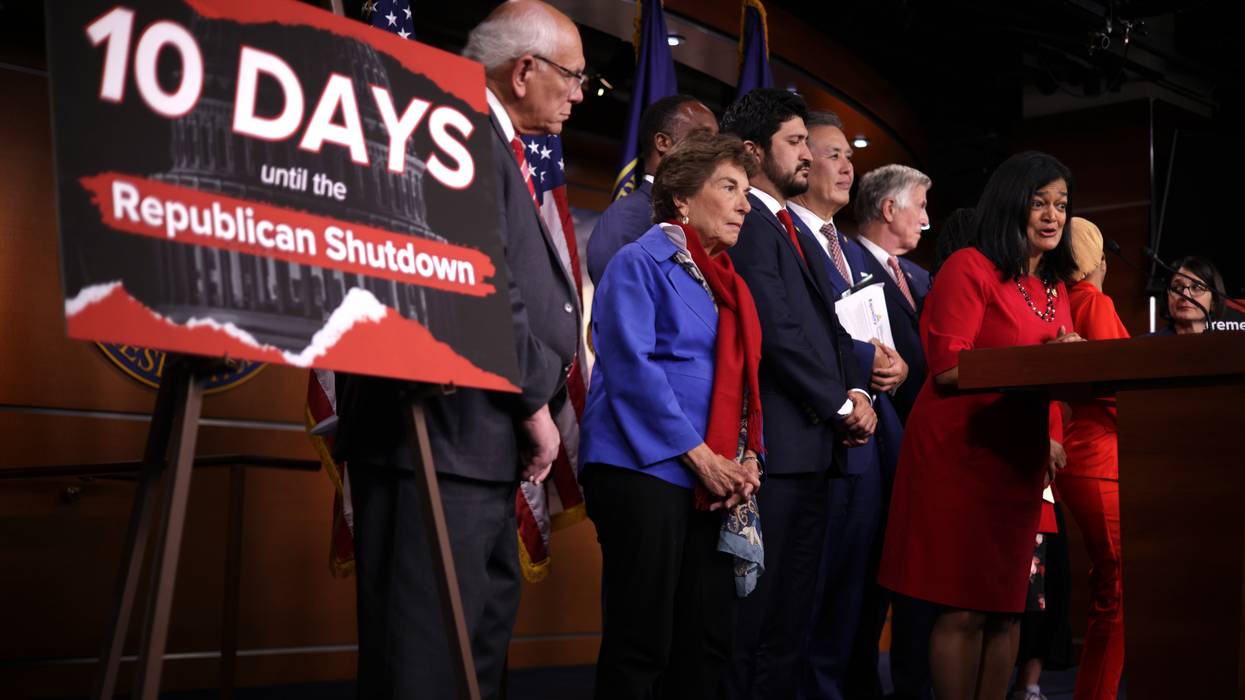
Just 10 days away from a potential U.S. government shutdown, calls for bipartisan action to prevent it are mounting, as is outrage over Republicans in the House of Representatives who seem content with causing chaos.
"What we want is simple: No cuts. No layoffs. No shutdown," Congressional Progressive Caucus (CPC) Chair Pramila Jayapal (D-Wash.) said at an afternoon press conference. She described the "Republican shutdown" as "a ticking time bomb," and called out the GOP—particularly House Speaker Kevin McCarthy (R-Calif.)—for lighting the fuse.
"And who loses from these absurd, delusional political games? Working- and middle-class families will suffer," Jayapal stressed. In addition to some CPC members, she was flanked by signs calling out McCarthy and warning that MAGA Republicans are trying to pull teachers out of classrooms, kick kids out of preschool, and slash funding for food aid.
Far-right House Republicans this week have refused to support a McCarthy-backed continuing resolution (CR) that would prevent a government shutdown for a month. The measure contains provisions also opposed by congressional Democrats and President Joe Biden—including spending cuts that conflict with the Fiscal Responsibility Act, the debt limit deal Biden struck with McCarthy earlier this year.
In a Wednesday letter to McCarthy arguing that "the time has come to end partisan posturing and put forward a viable path to funding our government," 92 members of the CPC noted that the GOP has pushed for betraying the debt ceiling deal.
"We stand ready to support a bipartisan funding vehicle free of poison pill policy riders that is consistent with the agreement you struck with President Biden and which was ratified by bipartisan majorities in both the House and Senate," they wrote. "If you choose not to pass a bipartisan government funding bill consistent with the Fiscal Responsibility Act, you are deliberately choosing to shut down the government."
"We can look to the Senate for an example, where senators achieved bipartisan consensus on funding and policy for all 12 of its appropriations bills," the CPC members continued. "In contrast, your House majority has been unable to pass the vast majority of its own hyper-partisan appropriations bills, despite the inclusion of extreme policy riders and draconian spending cuts designed to accommodate the far-right faction of your conference."
The CPC was far from alone in calling out the GOP on Wednesday. The Biden White House said in a lengthy statement that "extreme House Republicans are consumed by chaos and marching our country toward a government shutdown that would damage our communities, economy, and national security."
The White House highlighted impacts of the looming shutdown, from endangering disaster response and delaying infrastructure projects to undermining medical research, food safety, and environmental and public health protections.
"These consequences are real and avoidable—but only if House Republicans stop playing political games with people's lives and catering to the ideological demands of their most extreme, far-right members," the White House added. "It's time for House Republicans to abide by the bipartisan budget agreement that a majority of them voted for, keep the government open, and address other urgent needs for the American people."
Lee Saunders, president of the American Federation of State, County, and Municipal Employees (AFSCME)—the nation's largest trade union of public employees—also called out "anti-worker politicians in Congress" for "going back on their word."
"They are demanding drastic cuts to the essential programs millions of families need to survive—food, housing, education, and more," he said. "And to get their way, they are using the threat of a government shutdown, which would jeopardize the livelihood of frontline federal employees as well as their families, while pausing lifesaving programs for millions of people nationwide."
"All this to appease their corporate megadonors, who care about little else besides receiving massive tax cuts," Saunders emphasized. "Extremists in Congress need to stop using our lives as bargaining chips. It's time for them to follow through on the promises they have already made to keep the government open."
The current GOP-caused chaos on Capitol Hill was arguably predicable. As Chris Lehmann
wrote Tuesday for The Nation:
Today's shutdown battle involves little in the way of clear policy objectives beyond McCarthy's rapid capitulation to far-right House demands to launch Biden impeachment inquiries and the perennial demand for more draconian measures to police the U.S. southern border. "In many ways, the shutdown is the goal," says Princeton University historian Julian Zelizer... "Meaning, to create chaos and dysfunction has become an animating goal for the GOP, which makes negotiation much harder to achieve even within the party."
[...]
Across the past quarter-century of Republican-engineered shutdowns, the clearest lesson is that the triumph of procedural nihilism only ensures that things will get worse. Since this budget bloodsport launched in 1995, Zelizer says, "we have seen a continual ratcheting up of what the GOP is willing to do: shutdowns, debt ceiling threats, and the rest are all part of the new normal. McCarthy... accepts this and agreed to rules that made these forces stronger than ever."
Given those conditions, "small groups of centrist Democrats are holding secret talks with several of McCarthy's close GOP allies about a last-ditch deal to fund the government," Politico reported Wednesday, citing over a half-dozen people familiar with the discussions.
"Generally, the bipartisan group is focusing on two major ideas: a procedural maneuver to force a vote on a compromise spending plan—or somehow crafting a bill so popular that McCarthy can pass it and survive any challenge from the right," according to the outlet. "That bill would likely be a bipartisan short-term patch with some disaster money, Ukraine aid, and small-scale border policies."
In the meantime, Punchbowl News' John Bresnahan reported after House Republicans' Wednesday afternoon meeting that "the current thinking in House GOP leadership" is that the chamber should focus on a defense bill Thursday and Friday, then pass a new CR Saturday.
Then, the Senate could take up the CR, amend it, and send it back to House, which "will take several days" and "sets up shutdown drama for [the] following weekend," he explained, stressing that "this is all very fluid."
On the Senate side, Majority Leader Chuck Schumer (D-N.Y.) said Wednesday that "House Republicans rejected their own extremist bill, and by rejecting it, that's a dead giveaway they're not serious about avoiding a shutdown."
"Speaker McCarthy says he wants to avoid a shutdown, he says nobody wins in a shutdown," Schumer added. "Well, then he should reach across the aisle to find an agreement that actually has the votes to pass both chambers. That's the only way—the only way—this crisis gets resolved."
This post has been updated with comment from Senate Majority Leader Chuck Schumer (D-N.Y.) and the Groundwork Collaborative.
"The proposed continuing resolution backed by Speaker McCarthy is trying to force a path to deep cuts that were rejected in the debt ceiling deal he agreed to with President Biden earlier this year," said one expert.
Two weeks out from a U.S. government shutdown, some House Republicans on Sunday evening reached a potential deal—one which Democrats on Capitol Hill and other critics across the country warn is a dangerous proposal that is "doomed to fail."
The GOP's continuing resolution (CR) would avert a government shutdown on October 1, but the 30-day stopgap funding bill also lacks military assistance for Ukraine and requested U.S. disaster relief, would impose an 8% cut for nondefense spending, and includes immigration riders opposed by congressional Democrats and President Joe Biden.
House Speaker Kevin McCarthy (R-Calif.) "was well aware" that the CR wouldn't pass the Democrat-controlled upper chamber "but was hoping House passage would be a show of strength that would force a response from the Senate and potentially shift responsibility for a shutdown across the Rotunda," noted The New York Times.
However, Politico reported Monday, "as details of the deal hashed out by leaders of the Main Street Caucus and House Freedom Caucus trickled out, a bevy of conservative hardliners piped up with various versions of 'Hell No'." At least a dozen far-right House members have voiced their opposition, with some suggesting they won't support any CR.
Congressional Progressive Caucus Chair Pramila Jayapal (D-Wash.) wrote on social media Monday that "we cannot allow Kevin McCarthy and his radical posse to throw yet another tantrum at the expense of poor and working Americans. Period."
The 87-member ProsperUS coalition said in a statement Monday that "these last-ditch efforts to slash critical investments in workers and families are deeply unpopular and doomed to fail. Extreme House GOP members should accept reality: The majority of Congress is with the American people in rejecting hostage-taking and painful and irresponsible cuts."
The coalition also noted that the proposed CR betrays the Fiscal Responsibility Act, the bipartisan debt ceiling deal Biden and McCarthy negotiated earlier this year, as House Republicans nearly forced an economically catastrophic U.S. default.
"The House majority should set aside this latest failed proposal and allow the full House to vote on government funding bills at or above the floor set in the bipartisan debt limit deal," ProsperUS argued. "Anything less would be a clear step backward for our economy and hurt the most vulnerable communities we represent."
In a series of posts on X, formerly Twitter, Center on Budget and Policy Priorities president Sharon Parrott similarly stressed that "the proposed continuing resolution backed by Speaker McCarthy is trying to force a path to deep cuts that were rejected in the debt ceiling deal he agreed to with President Biden earlier this year."
The GOP proposal would slash funding for federal programs—including on childcare, education, environmental protection, food assistance, medical research, and transportation—for 30 days, but that could be dragged out much longer. As Parrott explained, "The nondefense cuts will create some near-term challenges, but more importantly, once a CR is in place, it is likely to be extended until final appropriations bills are complete—which is sure to take more than a month."
"Congress needs to pass a CR that allows the government to continue operations until funding bills are done, addresses near-term needs that cannot wait for final appropriations bills, and doesn't try to renegotiate the debt ceiling agreement," she asserted. "The public deserves a government that stays open to deliver services people count on and policymakers who negotiate agreements in good faith and govern by a theory other than brinkmanship."
In an apparent reference to Sen. Ron Johnson (R-Wis.) blocking a "minibus" packaging three spending bills, Parrott also said that "last week's hiccup notwithstanding, the Senate has demonstrated that reasonable funding bills crafted under the basic framework of the debt ceiling agreement can garner broad bipartisan support."
Senate Appropriations Committee Chair Patty Murray (D-Wash.) on Monday moved to suspend a rule invoked by Johnson—which will require 67 votes later this week.
"This is an effort to move forward on the minibus, and keep the appropriations process on track here in the Senate," said Senate Majority Leader Chuck Schumer (D-N.Y.) on Monday. "It's unfortunate that one member—who does not represent the views of most senators—prevented us from moving forward last week."
"But I believe a majority of senators want to keep moving forward. Our Republican colleagues have asked for regular order and we have worked with them to let that happen," he added, thanking not only Murray but also Susan Collins (R-Maine), the top Republican on the Senate Appropriations Committee, who last week called out Johnson.
Schumer also took aim at Republicans in the lower chamber for "what they called a deal for a CR but in reality reads like a hard-right screed," declaring that the proposal "can be boiled down to two words: slapdash, reckless. Slapdash because it is not a serious proposal for avoiding a shutdown, and reckless because if passed it would cause immense harm to so many priorities that help the American people."
"To his credit, the speaker knows a shutdown would be a terrible outcome. When I spoke with him in late July, we had a very encouraging conversation about the need for bipartisanship to avoid a shutdown. We both recognized that a bipartisan CR would be the way forward," Schumer added. "Two months later, a bipartisan CR is still the only answer for avoiding a government shutdown. I urge Speaker McCarthy, as well as reasonable House Republicans, to resist the 30 or so extremists within their ranks who seem dead-set on provoking a crisis."
"We cannot allow a handful of extremists in the House to force a government shutdown over cruel and unnecessary cuts to essential programs that workers and families rely on."
A coalition of nearly 90 progressive groups and labor organizations condemned U.S. House Republicans on Friday for threatening a destructive government shutdown as they push for steep and unpopular cuts to education, healthcare, food aid, and environmental protection programs.
"We urge Congress to quickly pass appropriations bills—at least at the spending levels agreed upon in the bipartisan Fiscal Responsibility Act of 2023—and to refuse to entertain legislation that guts critical programs so many Americans rely on," the ProsperUS coalition wrote in a letter to Republican and Democratic congressional leaders.
The Fiscal Responsibility Act was the product of weeks of negotiations between the Biden White House and House Republicans, who threatened to force the U.S. government to default on its debt and send the economy into a tailspin if the administration and congressional Democrats didn't agree to massive spending cuts.
The two sides ultimately reached a deal that included two years of caps on nonmilitary federal spending—which are effectively cuts, as spending won't keep up with inflation—as well as new work requirements for older food aid recipients.
But Republicans quickly reneged on the deal by putting forth appropriations bills that would set federal spending well below the agreed-upon levels—heightening the risk of a government shutdown come September 30, the end of the current fiscal year.
The Center for American Progress—a member of the ProsperUS coalition—estimated in an analysis released last week that the House GOP's 12 appropriations bills would "provide $58 billion less for ongoing nondefense programs than the levels agreed to in the debt limit deal," leaving the programs with their lowest funding levels since at least 1962. The House has only passed one of the dozen appropriations bills.
"There is absolutely no reason for deal-breaking and hostage-taking to be rewarded and encouraged by caving to the demands of a small, reckless group of radical members in the House."
In its letter on Friday, ProsperUS warned that House Republicans' proposals "would hurt workers, families, and communities, particularly low-income people of color, by slashing investments in K-12 education, healthcare, lead poisoning prevention, safe drinking water, cancer research, and more."
"They would also empower the wealthiest Americans and biggest corporations by slashing the resources that the Internal Revenue Service needs to go after wealthy tax cheats and recoup billions of dollars in unpaid taxes," the letter continues. "These cuts fly in the face of what the vast majority of people across the country want."
The coalition cites new survey data from Navigator Research showing that U.S. voters overwhelmingly oppose cuts to clean water programs, education, the Social Security Administration, and other areas that Republicans have targeted in recent weeks.
"We urge the House to abandon the dangerous, partisan path it has chosen so far and instead follow the example set by the Senate and pass appropriations bills that, at minimum, adhere to the contours of the recent bipartisan budget deal, invest appropriately in critical national priorities, and can earn bipartisan support," the coalition wrote. "Simply put, there is absolutely no reason for deal-breaking and hostage-taking to be rewarded and encouraged by caving to the demands of a small, reckless group of radical members in the House."
The letter comes a day after House GOP leaders were forced to postpone a procedural vote on the chamber's military appropriations bill. As Reuters reported, the move "may be a sign that Republicans, who hold a narrow 222-212 majority, are not confident they have the votes to pass the measure, as party hardliners push back against Speaker Kevin McCarthy."
A day earlier, McCarthy (R-Calif.) was accused of caving to the most far-right members of his caucus by announcing an impeachment inquiry into President Joe Biden.
McCarthy is also facing pressure from members of the far-right House Freedom Caucus to pursue even larger cuts to federal spending than what's already been proposed, further increasing the likelihood of a shutdown that would risk damage to critical nutrition assistance programs and other services.
"We're gonna have a shutdown," Rep. Ralph Norman (R-S.C.), a Freedom Caucus member, said earlier this week. "It's just a matter of how long."
Bilal Baydoun, director of policy and research at the Groundwork Collaborative—which is part of the ProsperUS coalition—said Friday that "the choice by House Republicans to deprive the American public of food aid, clean water funding, or lifesaving cancer research is not about red ink or 'funding levels.'"
"It's a moral verdict that the majority of communities and vulnerable Americans do not deserve public support," said Baydoun. "We cannot allow a handful of extremists in the House to force a government shutdown over cruel and unnecessary cuts to essential programs that workers and families rely on."
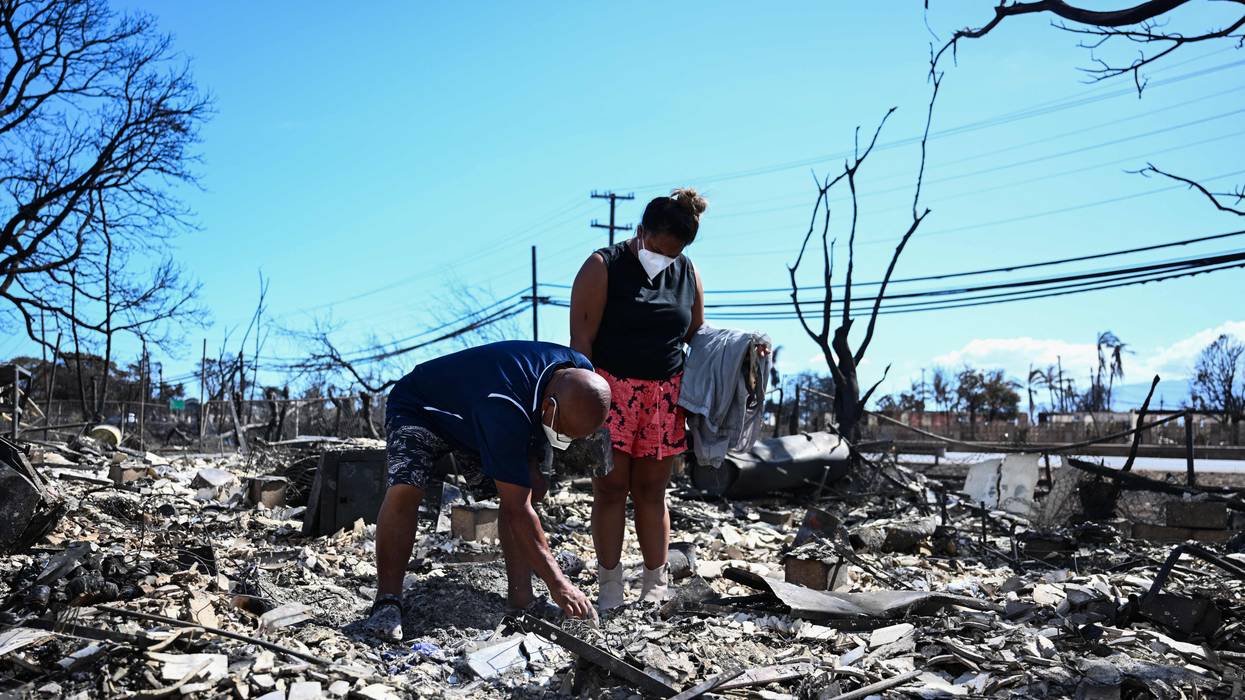
After Hawaii saw the worst disaster in its history and people perished in a massive climate change-driven wildfire, the 4th Circuit felt they had no other choice but to dismiss lawsuits designed to protect our environment.
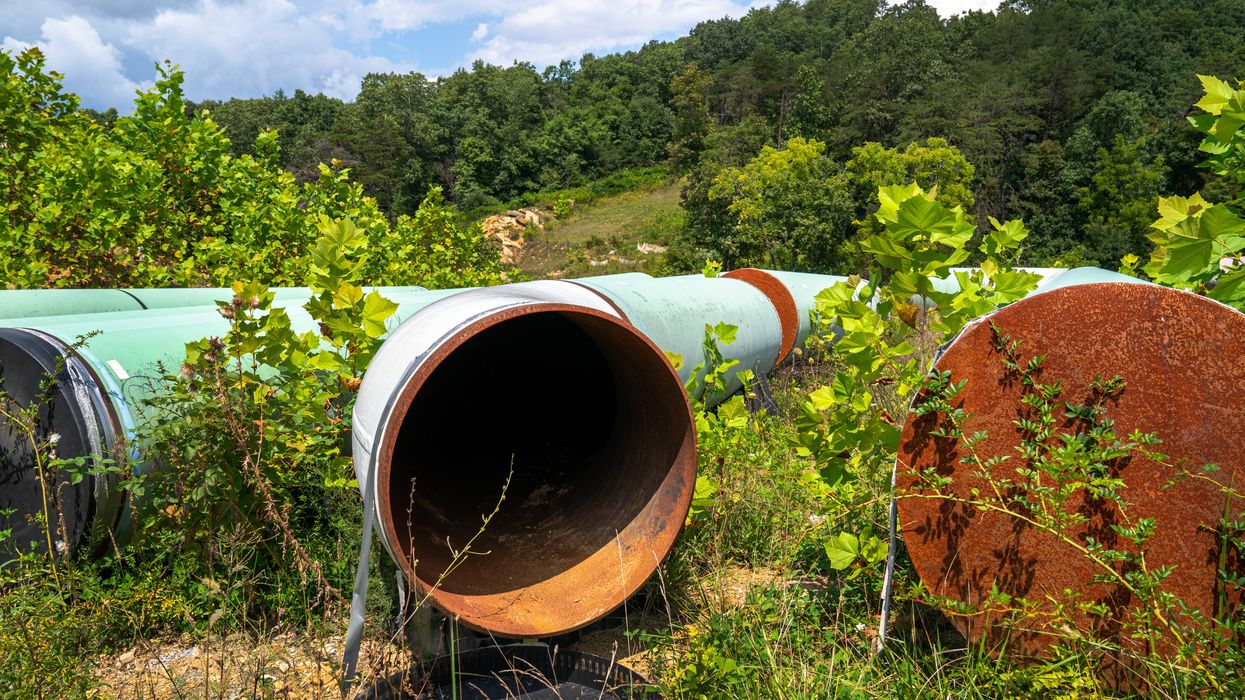
In late 2014, hundreds of landowners were thrust into a nearly decadelong fight against a conglomerate of megacorporations who wanted to build two fracked gas pipelines from the fracking fields of northern West Virginia across Virginia and ultimately end in North Carolina. The Atlantic Coast Pipeline (ACP) was being proposed by Dominion and Duke Energy, two of the nation’s largest fossil fuel energy companies. This unnecessary pipeline was proposed to cross central West Virginia into the Shenandoah Valley of Virginia. It would then split in central Virginia, with one of its tentacles heading toward Norfolk, Virginia, and the other ending near Lumbee, North Carolina.
A second fracked gas pipeline called the Mountain Valley Pipeline (MVP) was proposed by EQT, Next Era Energy, and an assortment of lesser fossil fuel companies, and would cross some of the steepest and environmentally fragile areas in the Appalachian Mountains in West Virginia and southwest Virginia. In 2019, the builders of the MVP proposed the MVP Southgate project, an extension that would cross some of the most environmental injustice communities in Virginia and North Carolina.
Both of these projects were met with fierce opposition by those living along their nearly 1,000 miles of collective proposed pathways, as well as allies and organizations across the nation. The resistance from this coalition proved to be too much for the larger, 600+ mile ACP project and in July 2020 the developers canceled the project. Suddenly the fossil fuel companies realized that their power over the people was being threatened like never before. It was only about just a few months earlier that they had seen the cancellation of the Constitution Pipeline in New York and the Keystone XL pipeline across the central part of the U.S. In 2021 they also saw the cancellation of the Penn East pipeline in Pennsylvania and New Jersey as well as the Pacific Connector Pipeline and Jordan Cove LNG project in Oregon. They also witnessed mass resistance to the Dakota Access Pipeline at Standing Rock. Panic must have set in for the corporations that make up the American Petroleum Institute.
The MVP is a climate time bomb. It is literally a public safety hazard and an enormously corrupt and democracy-ending project.
Imagine that. People, just regular people, were challenging the industry’s grip on the U.S. government—and winning. This was a direct assault to their year-in-and-year-out massive profits. The people were fighting for their property rights, for their water, for Indigenous rights, and for the environment. In West Virginia and Virginia, a rag-tag group of citizens formed the POWHR (Protect OUR Water Heritage & Rights) Coalition to fight the MVP. At first, that coalition was largely ignored by most everyone. But we just did not give up. Eventually, people across the nation started to listen and join with our coalition to fight the MVP. This growing coalition and its allies proved to be too powerful for the developers of the MVP, so they pulled out their pocketbooks and started donating massive amounts of money to some key U.S. senators, namely Democrats Chuck “NextEra” Schumer of New York and Joe “Dirty Deal” Manchin of West Virginia.
In late 2022, these two powerful senators reached a deal with President Joe Biden to include a legislative mandate to rescue the MVP as part of Manchin’s support of the not-such-a-great climate bill called the Inflation Reduction Act. The people said not so fast. We rallied against this so-called “Dirty Deal” and killed it multiple times in late 2022. Then came the debt ceiling crisis in early 2023. Manchin and fellow Republican senator from West Virginia, Shelly “For Sale” Moore Capito, convinced the debt ceiling negotiators to include Section 324 in the Fiscal Responsibility Act (FRA). Section 324 would strip citizens’ rights to object to permits and deem the pipeline to be “in the national interest.” It was opposed by many senators and House progressives but the corruption in government proved too much for them to overcome.
You might think that the people had lost. They had more to say. On June 8, under smoke-filled skies, dozens of MVP-affected citizens and their allies from across the nation rallied at the White House. Their message: We demand that the administration declare a climate emergency and cancel the MVP and other recently approved fossil fuel projects like the Willow project in Alaska and the expansions of LNG projects in Texas and Louisiana’s Gulf Coast. The opponents of the MVP also continued their challenges to the pipeline, which already has a track record of hundreds of violations. Our coalition also continued to challenge not only the constitutionality of Section 324 of the FRA, but also the eminent domain provisions of the Natural Gas Act.
Unfortunately on Friday, the 4th Circuit Court of Appeals concluded they had only one recourse and dismissed the MVP opponents’ challenges to the already pending permit challenges. But they did not do it quietly. On Friday, I shared this press statement referencing Judge Roger L. Gregory’s concern about Section 324 of the FRA:
Today is a very sad day, the very day after Hawaii saw the worst disaster in its history, where dozens, if not hundreds of people perished in a massive climate change-driven wildfire, that the 4th Circuit Court felt they had no other choice but to dismiss lawsuits designed to protect our environment. Judge Gregory was correct when he stated,
…Section 324 is a blueprint for construction of a natural gas pipeline by legislative fiat. If that provision is likewise constitutionally sanctioned, the Congress will have found a way to adjudicate by legislating for particular cases and for particular litigants, no different than the governmental excesses our Framers sought to avoid. For that reason, I fear Congress has employed this Court’s constitutionally directed deference to legislative prerogatives to undermine the Constitution and in the process, it has made the Court an accessory to its deeds. If that is so, I wonder if Section 324 is a harbinger of erosion not just to the environment, but to our republic.
I share Judge Gregory’s real concern for our environment and our democracy.
Where does this leave us? The MVP is a climate time bomb. It is literally a public safety hazard and an enormously corrupt and democracy-ending project. If it is allowed to be built under these circumstances the entire nation will suffer from the precedent-setting way it was legislated to competition by “legislative fiat.” Exempting any single project of any kind from long-held environmental rules is a slippery slope down the road toward oligarchy. That is why partisan politics must be set aside and the courts and Congress must put a halt to such practices. They must act quickly because our survival depends upon it. Just ask the people on Maui.
"It is clear to us that the top levers of power in this country do not serve the good of the people of Appalachia, who they have continued to sacrifice for the whims of a corrupt, reckless fossil fuel corporation," said one activist.
Local and national climate campaigns on Friday expressed disappointment over an appellate court's dismissal of challenges to a partially built fracked gas pipeline in West Virginia and Virginia but pledged to continue their efforts to kill the project.
Citing a section of the debt ceiling law that President Joe Biden negotiated with congressional Republicans this spring, a three-judge panel from the U.S. Court of Appeals for the 4th Circuit dismissed cases in which green groups challenged the U.S. Fish and Wildlife Service's Endangered Species Act approvals for the Mountain Valley Pipeline (MVP) as well as the U.S. Forest Service and Bureau of Land Management's authorizations for the Jefferson National Forest.
"It is clear to us that the top levers of power in this country do not serve the good of the people of Appalachia, who they have continued to sacrifice for the whims of a corrupt, reckless fossil fuel corporation," said Russell Chisholm, managing director of the Protect Our Water, Heritage, Rights (POWHR) Coalition. "As wildfires and heatwaves terrorize our global kin, as President Biden spreads misinformation about his climate commitments, we resolve to protect our communities because we can't count on so-called 'leaders' to do so."
Jason Crazy Bear Keck, co-founder of 7 Directions of Service, was similarly undeterred, saying that "we are extremely disappointed but never surprised by the system created for profit. Such tools of oppression operate exactly as they were intended to. This terrible news does not hinder or harm our conviction, rather it proves the necessity to keep on resisting."
"The temper tantrums from corporate agents and bought-off political implants only remind the people of how terribly off-track governance has become as it relates to the protection of society and its natural environment," the campaigner added. "We continue to condemn irresponsibility, condemn systematic oppression, and condemn an all-out federal attack on our futures. We stand on what's right, what's just, and what's sustainable for our generations not yet arrived."
"We will not stop exposing the dangers and damages from this project and insisting that it be canceled."
The pipeline developer and Biden administration sought to have the cases dismissed after passing the Fiscal Responsibility Act (FRA). Section 324 of the June law fast-tracks MVP and states that only the U.S. Court of Appeals for the District has jurisdiction over "any claim alleging the invalidity of this section or that an action is beyond the scope of authority conferred by this section."
In an opinion authored by Judge James Andrew Wynn and joined by the other two panel members, the 4th Circuit—which previously paused MVP construction only to have the U.S. Supreme Court reverse those decisions—ruled Friday that green groups' "sole contention in response to the motions to dismiss was that Section 324 was unconstitutional, a claim that can only be heard by the D.C. Circuit. Therefore, the motions to dismiss must be granted for lack of jurisdiction."
Judge Stephanie D. Thacker wrote in a concurring opinion that "while I join the conclusion that Congress has acted within its legislative authority in enacting" the part of Section 324 that gives the D.C. Circuit jurisdiction, "I write separately because Congress' use of its authority in this manner threatens to disturb the balance of power between co-equal branches of government."
Judge Roger L. Gregory also raised separation of power concerns in a concurring opinion, writing that "Section 324 is a blueprint for the construction of a natural gas pipeline by legislative fiat. If that provision is likewise constitutionally sanctioned, then Congress will have found the way to adjudicate by legislating for particular cases and for particular litigants, no different than the governmental excesses our Framers sought to avoid."
"For that reason, I fear Congress has employed this court's constitutionally directed deference to legislative prerogatives to undermine the Constitution and, in the process, it has made the court an accessory to its deeds," he added. "If that is so, I wonder if Section 324 is a harbinger of erosion not just to the environment, but to our republic. That, only our Supreme Court can decide."
Maury Johnson—West Virginia co-chair of the POWHR Coalition, a Preserve Monroe board member, and a landowner affected by MVP—said Friday that "I share Judge Gregory's real concern for our environment and our democracy."
Other campaigners explicitly condemned Congress for giving the pipeline developer "a free pass to edge out vulnerable species and steamroll communities in its path," in the words of Sierra Club executive director Ben Jealous.
Preserve Giles County coordinator Donna Pitt declared that "the ill-advised enactment of Section 324 of the Fiscal Responsibility Act lays bare the danger we are in if we continue to allow ourselves to be governed by the self-serving needs of fossil fuel corporations."
"The builders and political backers of the MVP could not get this destructive project across the finish line by following the rules that are supposed to apply to all projects," said Wild Virginia conservation director David Sligh. "The reason is simple. The pipeline cannot be built across these valuable and sensitive landscapes in a way that upholds our historic laws, including the Endangered Species Act."
"The Fish and Wildlife Service failed in its duties three times, so Congress and the president have attempted to give the MVP a get-out-of-jail-free card on its responsibility to protect our rare and precious species," Sligh added. "We will not stop exposing the dangers and damages from this project and insisting that it be canceled."
Earlier Friday, a pair of activists locked themselves to construction equipment at an MVP worksite on Poor Mountain in Roanoke County, Virginia—an action that was denounced by the pipeline developer and drew police to the scene.
According to Appalachians Against Pipelines, one supporter of the action said: "Any reputable scientist could tell you that this pipeline is inconsistent with a future where humans continue to live. It's that simple. The MVP is a doomsday device. It is only being built so the rich can get richer. Our 'leaders' have clearly taken a side, so it's up to us to stop this thing."
"Why is the Biden administration trying to rob itself of a clear opportunity to protect American workers and the economy from being roiled by MAGA saboteurs?" asked the head of the Revolving Door Project.
A government watchdog on Thursday called out the Biden administration for attempting to kill a lawsuit filed in May by a union representing about 75,000 workers across U.S. agencies that challenges the federal debt ceiling law.
"Why is the Biden administration trying to rob itself of a clear opportunity to protect American workers and the economy from being roiled by MAGA saboteurs?" asked Jeff Hauser, executive director of the Revolving Door Project.
A federal judge canceled plans to hear arguments for the National Association of Government Employees (NAGE) case when President Joe Biden and congressional Republicans who were holding the economy hostage announced a negotiated deal to suspend the nation's borrowing limit until 2025—signed into law in early June as the Fiscal Responsibility Act (FRA).
Biden then ordered his aides to create a working group intended to prevent similar crises in the future. As the White House said last month, "Now that the latest debt ceiling crisis is behind us, it is necessary to explore all legal and policy options to prevent Congress from ever again holding hostage the full faith and credit of the United States."
Now, as Government Executive reported earlier this week, even though "federal employees are still facing the prospect of delayed paychecks when the debt ceiling is reinstated in 2025," the U.S. Department of Justice "asked Judge Richard Stearns of the U.S. District Court for the District of Massachusetts to dismiss the case, suggesting the FRA has made the case moot and NAGE members lack standing because their claims are 'wholly speculative.'"
"After calling for just such a case to be brought, the Biden administration now fights it, demonstrating a truly remarkable willingness to shoot itself in the foot."
Hauser said that "the Justice Department's notion that the federal employees' claims of injury are 'wholly speculative, as they depend on a future chain of events that may never occur,' is absurd: The crisis is scheduled to recur precisely on January 1, 2025, as it has recurred repeatedly this century."
"In the meantime, uncertainty continues to trouble hundreds of thousands of federal workers, who have no guarantee of how their jobs, salaries, and pensions will be affected," he noted. "Indeed, the stance that [Attorney General] Merrick Garland's Justice Department is advancing creates an unfortunately sound case against workers considering taking a job in what has become an unstable federal government."
During the drawn-out fight earlier this year, as Republicans in Congress signaled their willingness to force the first-ever U.S. default despite warnings of a resulting economic catastrophe, Biden even suggested that while he wasn't planning to invoke the 14th Amendment—which states that the validity of the nation's public debt "shall not be questioned"—to end the current crisis, he would be open to challenging the debt ceiling law in the future.
"Rather than use the existing case as a means to that end, however, the administration is seeking to have it dismissed. The Justice Department declined to weigh in further on the merits of the case, reducing its argument only to the union's lack of standing," Government Executive explained, noting that a hearing on the motion to dismiss the case is set for August 29.
Hauser said that "after calling for just such a case to be brought, the Biden administration now fights it, demonstrating a truly remarkable willingness to shoot itself in the foot."
"The administration has every authority to take a different tack in this lawsuit and make space for the constitutionality of the debt limit to be worked out in the famously slow-moving U.S. legal system before the clock runs out on preventing the next crisis," he stressed.
The NAGE complaint names as defendants Biden and Treasury Secretary Janet Yellen in their official capacities.
Biden is seeking reelection next year and is expected to face the Republican nominee; former President Donald Trump is currently leading a crowded field of GOP candidates in spite of his legal issues, including the recent indictment related to his efforts to overturn his 2020 loss, which led to the January 6, 2021 attack on the U.S. Capitol.
Even if Biden wins in 2024 and Democrats keep control of the Senate and regain a majority in the House of Representatives, they may lack the votes needed to extend the suspension or raise the debt ceiling in early 2025. Democratic lawmakers notably declined to take action on the borrowing limit after the last midterm elections, despite warnings that Republicans would use their House takeover this year to hold the economy hostage to extract concessions.
One climate advocate applauded the court for giving communities "a measure of reprieve" by stopping construction of the pipeline in Jefferson National Forest.
A three-judge panel from the U.S. Court of Appeals for the Fourth Circuit on Monday temporarily blocked the construction of a section of the Mountain Valley Pipeline that runs through Jefferson National Forest, pending a conservation group's petition to review the federal government's authorization of the fossil fuel infrastructure development.
"Time and time again, Mountain Valley has tried to force its dangerous pipeline through the Jefferson National Forest, devastating communities in its wake and racking up violations," Ben Tettlebaum, director and senior staff attorney at The Wilderness Society, said in a statement. "We're grateful that the court has given those communities a measure of reprieve by hitting the brakes on construction across our public lands, sparing them from further irreversible damage while this important case proceeds."
Work on unfinished portions of the 303-mile Mountain Valley Pipeline (MVP) was fast-tracked last month via the debt ceiling agreement that President Joe Biden, shunning his options for unilateral action, forged with House Republicans who took the global economy hostage.
Construction of the $6.6 billion fracked gas project—pushed hard by the GOP and Sen. Joe Manchin (D-W.Va.), a coal profiteer and Congress' top recipient of Big Oil money—has been halted by courts for years due to concerns about the harms it would unleash on people and ecosystems in Virginia, West Virginia, and beyond.
But Section 324 of the so-called Fiscal Responsibility Act of 2023 required federal authorities to approve all of MVP's outstanding permits, prohibited judicial review of those permits, and said only the D.C. Circuit Court of Appeals has jurisdiction to hear challenges to the provision's constitutionality.
Citing Section 324, MVP's developers and multiple government agencies filed motions last month to dismiss lawsuits against the pipeline. On behalf of The Wilderness Society, the Southern Environmental Law Center (SELC) filed a brief opposing those motions on June 26, arguing that Section 324 is unconstitutional because it violates the separation of powers.
In response to the stay issued by the Fourth Circuit on Monday, Mountain Valley Pipeline LLC said: "This is not the court to hear that claim. Congress, in plain terms, gave the D.C. Circuit 'exclusive jurisdiction' to hear such claims... Congress' message was crystal clear: If you want to challenge Section 324, you must do so in the D.C. Circuit."
In a similar vein, Manchin asserted that the Fourth Circuit lacks jurisdiction over MVP permits, rendering its new order unlawful.
But as The Wilderness Society and SELC explained last month, their two cases against the pipeline challenge "defective approvals by the United States Forest Service and the Bureau of Land Management allowing the MVP to cross the Jefferson National Forest in Virginia and West Virginia." Because both lawsuits predate the passage of Section 324 and allege violations of several environmental laws as well as the Administrative Procedure Act, the groups argued, the Fourth Circuit does have jurisdiction.
"Mountain Valley could not build their pipeline in compliance with the law, so they appealed to Congress to interfere with the courts, skirting both our legal system and Constitution," Chase Huntley, vice president of Strategy and Policy at The Wilderness Society, said two weeks ago. "The MVP rider buried in the Fiscal Responsibility Act attempts to ram through the pipeline, forcing it onto communities who have spoken out against its devastating impacts for nearly a decade."
"Because bedrock environmental laws stood in the pipeline's path, Mountain Valley convinced Congress to reach beyond its powers and decide in Mountain Valley's favor, circumventing the courts," said Huntley. "We're fighting to make sure our challenge to the Forest Service and Bureau of Land Management's approvals for the pipeline to cross the Jefferson National Forest has its rightful day in court."
The Wilderness Society and SELC weren't the only organizations to take action last month. Lawyers from the Sierra Club, Appalachian Mountain Advocates, and the Center for Biological Diversity filed a companion response opposing identical motions to dismiss another MVP case. That brief was submitted on behalf of 10 environmental groups—Wild Virginia, Appalachian Voices, Indian Creek Watershed Association, Preserve Bent Mountain, Preserve Giles County, West Virginia Highlands Conservancy, West Virginia Rivers Coalition, Chesapeake Climate Action Network, Sierra Club, and the Center for Biological Diversity.
In a Tuesday morning statement, Equitrans Midstream—which holds the largest interest among MVP stakeholders and plans to manage the pipeline once operational—said it was "disappointed" with the Fourth Circuit's stay and claimed the judges exceeded their authority.
"We are evaluating all legal options, which include filing an emergency appeal to the U.S. Supreme Court," the company said. "Unless this decision is promptly reversed, it would jeopardize Mountain Valley's ability to complete construction by year-end 2023."
MVP is one of several new fossil fuel projects being built or considered in the U.S. despite mounting evidence of the worsening climate crisis—and in direct conflict with the international scientific consensus, which has long warned that increasing the extraction and combustion of coal, oil, and gas will exacerbate deadly planetary heating.
As extreme weather disasters continue to wreak havoc across the U.S. and the world, Biden is facing growing pressure to declare a national climate emergency, which advocates say would unlock additional powers his administration could use to rein in the fossil fuel industry and ramp up clean energy production. Congressional Republicans, meanwhile, are currently trying to preempt the president from making such a move.